 Скачать презентацию Globalisation and Trans-National Student Mobility Test Case for
9dcaf4987870bc82d1b802f1ef365188.ppt
- Количество слайдов: 19



Globalisation and Trans-National Student Mobility: Test Case for Multiculturalism in Australian Education Anthony Welch University of Sydney
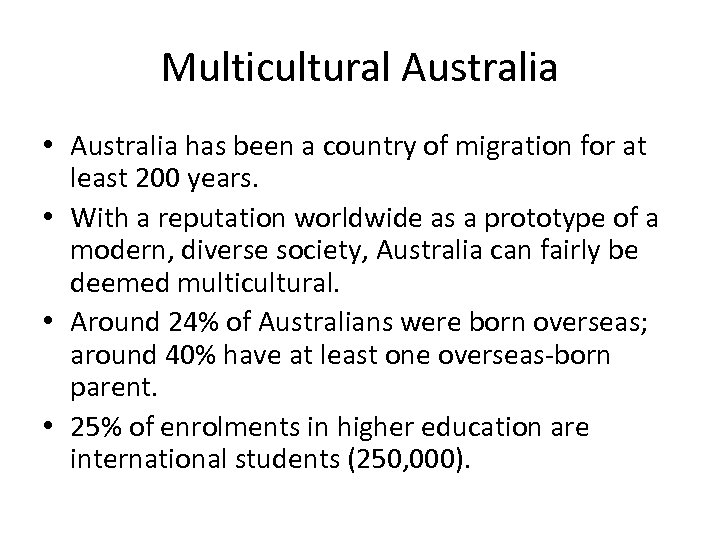
Multicultural Australia • Australia has been a country of migration for at least 200 years. • With a reputation worldwide as a prototype of a modern, diverse society, Australia can fairly be deemed multicultural. • Around 24% of Australians were born overseas; around 40% have at least one overseas-born parent. • 25% of enrolments in higher education are international students (250, 000).
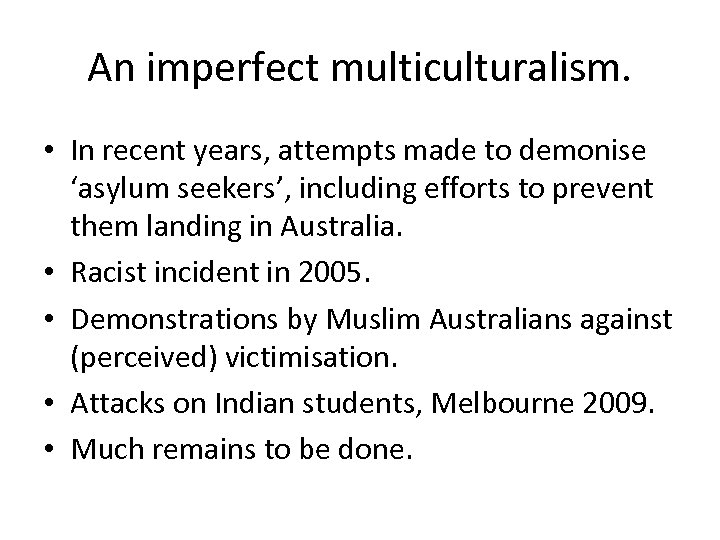
An imperfect multiculturalism. • In recent years, attempts made to demonise ‘asylum seekers’, including efforts to prevent them landing in Australia. • Racist incident in 2005. • Demonstrations by Muslim Australians against (perceived) victimisation. • Attacks on Indian students, Melbourne 2009. • Much remains to be done.
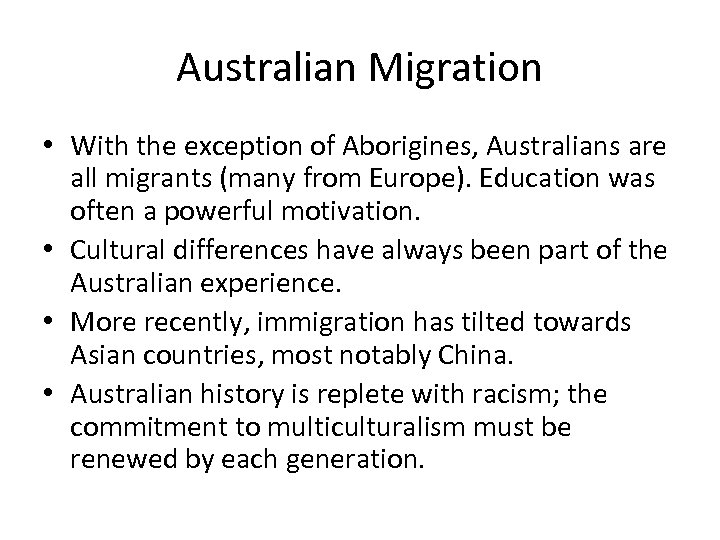
Australian Migration • With the exception of Aborigines, Australians are all migrants (many from Europe). Education was often a powerful motivation. • Cultural differences have always been part of the Australian experience. • More recently, immigration has tilted towards Asian countries, most notably China. • Australian history is replete with racism; the commitment to multiculturalism must be renewed by each generation.
History of Migration • Of a total population of 22 m, Australia welcomed its 6 millionth migrant in 2002 (a Filipina IT specialist). • At the same time, internment camps were being established offshore and in the desert, to house asylum seekers. • A longstanding tension existed between place and dominant cultural heritage.
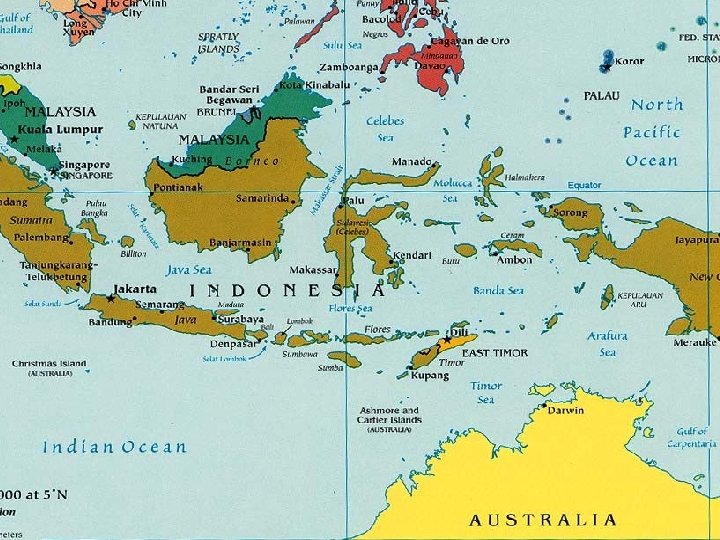
Australia’s Neighbours
Culture, Language, Identity • Currently, around 200 migrant communities exist in Australia. • This provides a rich and fertile storehouse of cultural and linguistic experience. In both Melbourne and Sydney, around 25% of families speak another language at home. • Yet, like other Anglo countries (UK, US, Canada, NZ), Australia’s record of second-language learning is poor. Of the few who study a language to Yr. 12, the large majority are from that linguistic background.
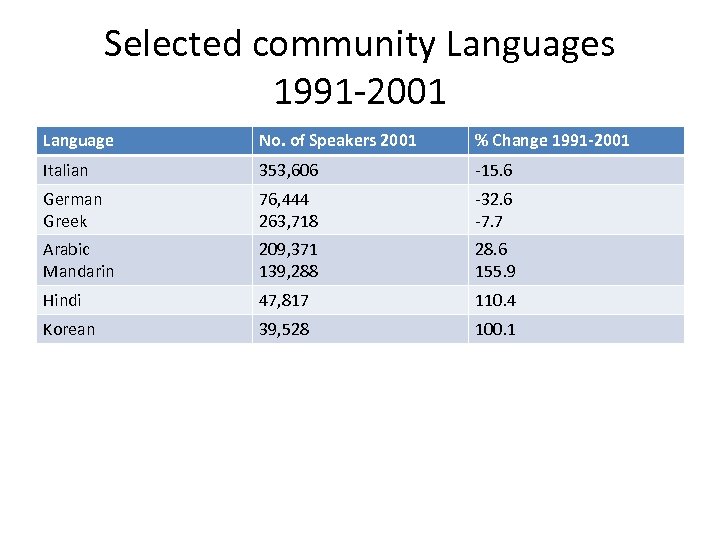
Selected community Languages 1991 -2001 Language No. of Speakers 2001 % Change 1991 -2001 Italian 353, 606 -15. 6 German Greek 76, 444 263, 718 -32. 6 -7. 7 Arabic Mandarin 209, 371 139, 288 28. 6 155. 9 Hindi 47, 817 110. 4 Korean 39, 528 100. 1
Migration (2) • 19 th. Century Racist incidents against Chinese -> White Australia Policy (1947: Non-white 0. 25%) • German schools closed during WWI • Jewish refugees limited in late 1930 s • Assimilationist era: ‘Assimilation would be complete when nobody noticed the newcomer’ (Jupp, 2002). • 1970 ->Non-discriminatory migration. Now 40% Asian. • % of Skilled Migrants increased from 40% of total to 60% (1990 -2008). Family Reunion from 44% to 30%.
Implications for Education • 19 th C. no accommodation: race and religion triumphed over difference. • Assimilationist assumptions dominant in education until 1970 s. • Each state began to develop Multicultural policies and programmes in 1970 s. • Textbooks, curricula etc now should reflect contemporary multicultural Austr. , but some feel their cultures still poorly represented.
Two Case Studies 1. Muslims in Australia • Muslims have been in Australia for at least 150 years. • Now 320, 000, of whom 38% born in Australia. • Very unevenly distributed: 50% in one state, over 80% in two most populous states. • Arabic speakers growing rapidly. • Muslims now 1. 6% of population, and growing. • Incidents of harassment, Islamophobia (although less than in e. g. Germany). • Unemployment rates for young Islamic men in suburbs of Muslim density around twice that of young males in Sydney; Year 12 completion rates are less than two-thirds of the average for the country
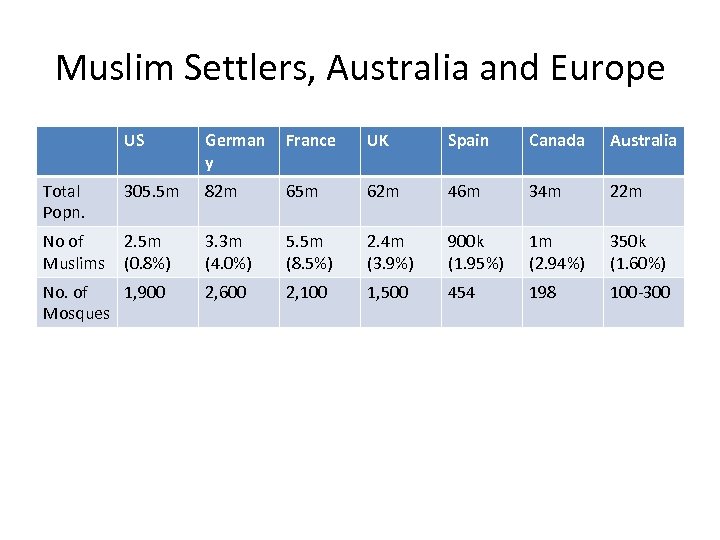
Muslim Settlers, Australia and Europe US German y France UK Spain Canada Australia Total Popn. 305. 5 m 82 m 65 m 62 m 46 m 34 m 22 m No of Muslims 2. 5 m (0. 8%) 3. 3 m (4. 0%) 5. 5 m (8. 5%) 2. 4 m (3. 9%) 900 k (1. 95%) 1 m (2. 94%) 350 k (1. 60%) 2, 600 2, 100 1, 500 454 198 100 -300 No. of 1, 900 Mosques
Islamic Schooling (1) • Muslim settlers experienced difficulties in providing appropriate edn. for their children in 19 th C. • Community schools now teach c. 50, 000 children Arabic, but retention rates poor. • Islamic schools now in each state, total population perhaps 15, 000+. Mostly established in 1980 s and 1990 s. • Many now highly qualified, often more so than the general population. Turkish community less so. • Some Muslims still ‘experience inter-generational unemployment and poverty. ’ Unemployment rate more than double overall population; much higher than Middle East born Christians (esp. if English was poor). • Among some young males, this fosters alienation and breakdown of community.
Islamic Schooling (2) • Muslim schools vary in size, some one or two hundred, at least one 1, 750 strong. • Varying degrees of success: some highly successful, others struggle. At least one is among the top 20 in the state. • As with other religions, all Muslim Schools get major support from the state (60 -80%). Fees generally low – perhaps $2, 000 per child, p. a. • Curric. and teachers are much like other schools, but with several hours a week devoted to studying Islam, and prayers.
Highly-skilled Chinese • High-skilled migration now over half of Australian total. Of mainland Chinese, 80%+ are within highest skill categories. • Non-discriminatory migration (since c. 1970) has led to increased migration from Asia, esp. China. • Charges of brain drain to Australia from Asia not simple, as many Chinese maintain rel’ship. with China. • Chinese Knowledge Diaspora more significant. • Chinese students becoming highly successful in Australian schools e. g. Selective high schools.
Limits of Multicultural Schooling • While Australia’s multiculturalism is a success, this is no cause for complacency. • Multiculturalism has long been seen as a value, not merely a fact. Diversity enriching, something from which all should benefit. • Schools a key site for promoting such values, esp. culturally diverse learning environments. This includes languages NSW 47 languages by 230 community groups in 2004. • But discrimination persists, incl. among some teachers, and students. School success varies.
Indian Students. A Test Case? • Internationalisation of Australian ed. system has enriched research, teaching, cultural diversity. • Numbers have risen sharply in recent years, partly due to lax regulation (whereby migration not education was the goal): ‘. . some providers and their agents (became) interested in ‘selling’ a migration outcome. . ’ • Total international enrolments rose from 228, 000 in 2002 to 491, 000 in 2009 (about half in higher ed). • Some agents over promised; some institutions underdelivered, particularly in the private vocational college sector (hair dressing, cooking). Gov’t. review 2010. .
Attacks on Students • A worrying series of attacks on Indian students, some racist and some opportunistic, particularly in one state (Victoria) in 2009, was unexpected, unprecedented and unexplained. • The attacks made front page headlines in Australia and India, temporarily damaging bilateral relations. • Tardy and inadequate responses by police and politicians deepened dissatisfaction among students and families.
What is to be Done? • Clearly, more efforts need to be made to enhance student security. • More efforts to promote the study of other languages and cultures by Australians may help. • More efforts to enhance understanding of and acceptance of cultural differences, and their contribution to Australian society. • Multiculturalism in education can not deliver tolerance on its own, but has an important role to play. • Commitment to Multiculturalism must be continually renewed, and not allowed to become ritualistic or taken for granted.
Скачать презентацию Globalisation and Trans-National Student Mobility Test Case for
9dcaf4987870bc82d1b802f1ef365188.ppt