 Скачать презентацию Global warming manifestations in waters surrounding Svalbard archipelago
English_exam.pptx
- Количество слайдов: 12



Global warming manifestations in waters surrounding Svalbard archipelago in the 20 th and 21 st centuries Anna V. VESMAN AARI, NIERSC English colloquium Saint-Petersburg, May 2015
Ph. D thesis: Ph. D topic: Global warming manifestations in waters surrounding Svalbard archipelago in the 20 th and 21 st centuries Main Goal: Description of long-term variability of regime of “Whaler’s Bay” polynya Study area: Fram Strait and waters surrounding Svalbard Archipelago, main focus area – “Whaler’s Bay” polynya Data: In-situ data (AARI) + different databases, archives; remote sensing data; reanalysis data Supervisors: Dr. Boris V. Ivanov (AARI) Dr. Vladimir A. Volkov (NIERSC) Prof. Stein Sandven (NERSC)
Work structure: Main Goal: Description of the long-term variability of the regime of “Whaler’s Bay” polynya Stages of the work: 1. Literature review (What has been done? ) 2. Creating an archive of oceanographic data for research area (digitizing old data, collecting required data in different databases, creating an archive) 3. Analysis and description of oceanographic characteristics in research area (using created archive) 4. Analysis and description of variability of polynya size in 20 th and 21 st centuries (using remote sensing data) 5. Calculation of turbulent heat fluxes (using remote sensing data and reanalysis data): - Learning methods - Calculation and analysis
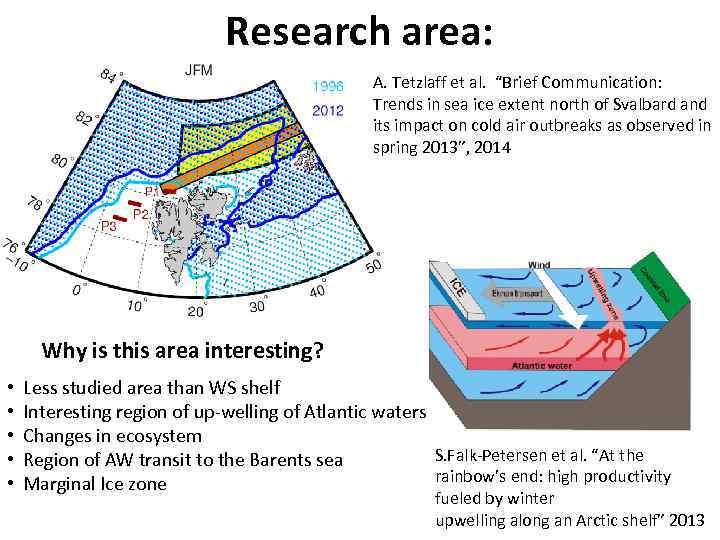
Research area: A. Tetzlaff et al. “Brief Communication: Trends in sea ice extent north of Svalbard and its impact on cold air outbreaks as observed in spring 2013”, 2014 Why is this area interesting? • • • Less studied area than WS shelf Interesting region of up-welling of Atlantic waters Changes in ecosystem S. Falk-Petersen et al. “At the Region of AW transit to the Barents sea rainbow’s end: high productivity Marginal Ice zone fueled by winter upwelling along an Arctic shelf” 2013
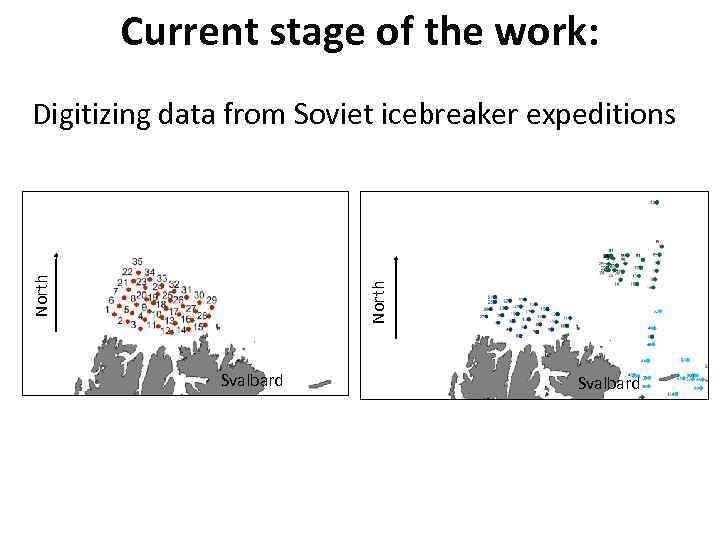
Current stage of the work: North Digitizing data from Soviet icebreaker expeditions Svalbard
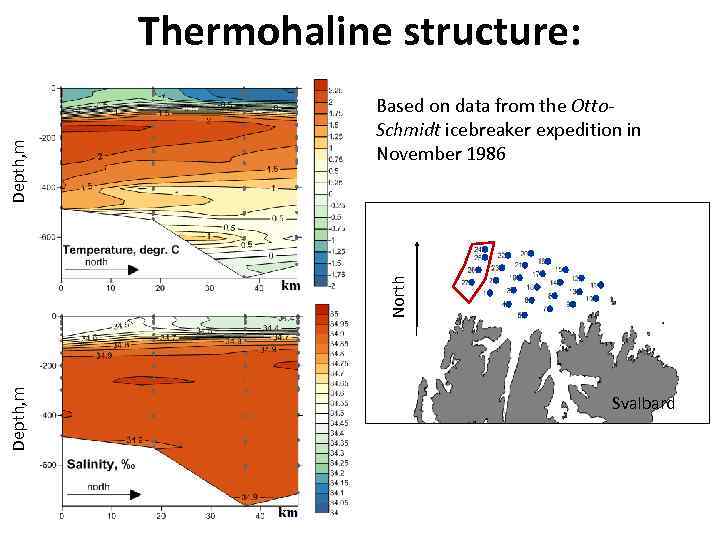
Based on data from the Otto. Schmidt icebreaker expedition in November 1986 Depth, m North Depth, m Thermohaline structure: Svalbard
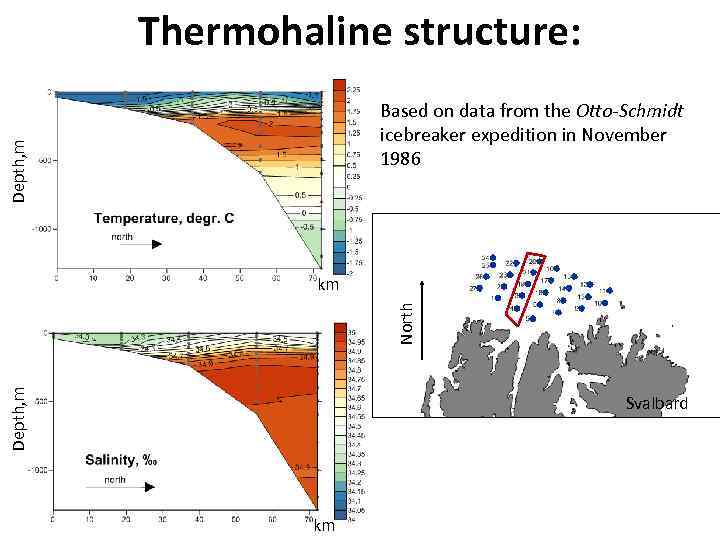
Thermohaline structure: Depth, m Based on data from the Otto-Schmidt icebreaker expedition in November 1986 Depth, m North km Svalbard km
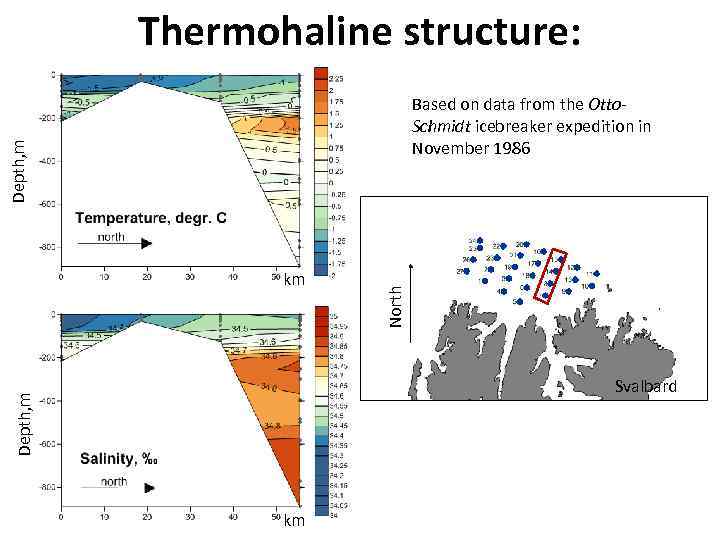
Thermohaline structure: km North Depth, m Based on data from the Otto. Schmidt icebreaker expedition in November 1986 Depth, m Svalbard km
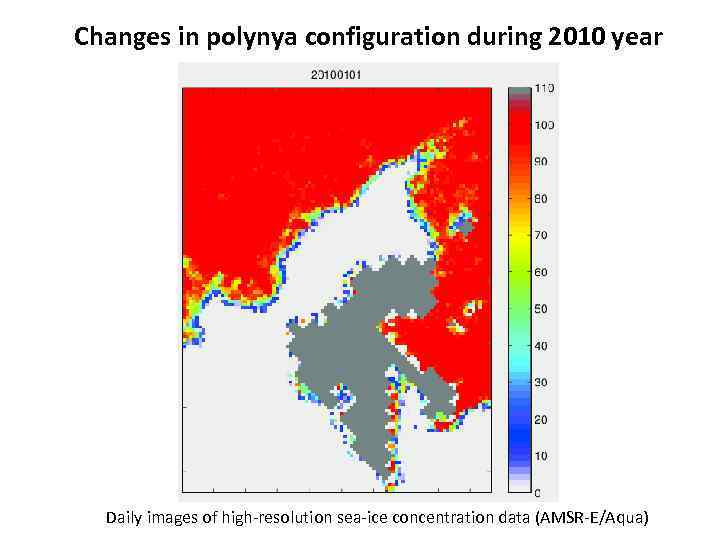
Changes in polynya configuration during 2010 year Daily images of high-resolution sea-ice concentration data (AMSR-E/Aqua)
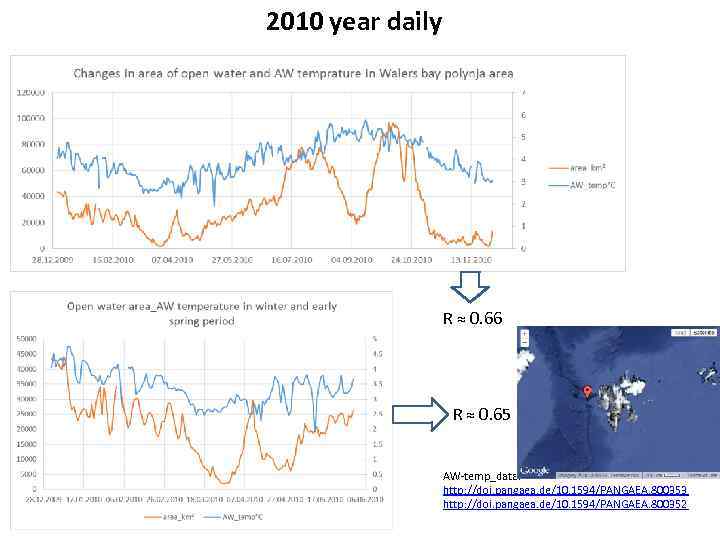
2010 year daily R ≈ 0. 66 R ≈ 0. 65 AW-temp_data: http: //doi. pangaea. de/10. 1594/PANGAEA. 800353 http: //doi. pangaea. de/10. 1594/PANGAEA. 800352
Conclusions: Tasks for future research: ü To learn algorithms and methods of working with remote sensing data ü To complete archive ü To analyze thermohaline water structure in the Whaler’s Bay polynya ü To learn methods and programs of computation of turbulent heat fluxes in polar regions
Thank you! Anna V. VESMAN AARI, NIERSC anna. vesman@gmail. com
Скачать презентацию Global warming manifestations in waters surrounding Svalbard archipelago
English_exam.pptx