 Скачать презентацию Global Trends Long Term Conditions London 7 June
f3fb2962435aa373ae05e4bf1599ff02.ppt
- Количество слайдов: 31



Global Trends Long Term Conditions London. 7 June 2007 King´s Fund and Health Services Management Centre of the University of Birmingham Dr. Rafael Bengoa • ESADE Business School • Kroniker Observatory. Bilbao. Spain
The Burden ! Frank´s Cat.
Very different systems=Similar Problems Adults' experiences in five countries l 8, 672 people > 18 across 5 countries l Shortfalls in delivering safe, effective, patient- centered, timely, efficient & equitable care - l Widespread failure to give patients plans to manage chronic conditions at home & gaps in receipt of preventive tests l Widespread failure in involving patients in treatment decisions v Australia v UK v Canada v USA v New Zealand Schoen et al, Health Affairs 2004, web exclusive: 487 -503
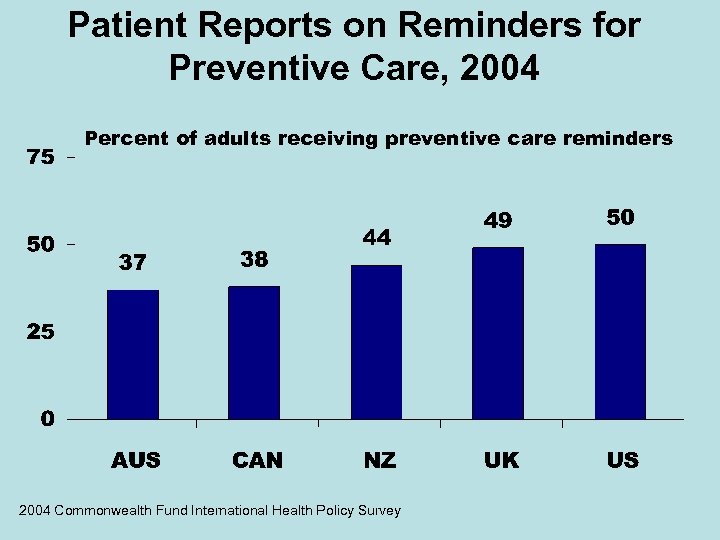
Patient Reports on Reminders for Preventive Care, 2004 Percent of adults receiving preventive care reminders 2004 Commonwealth Fund International Health Policy Survey
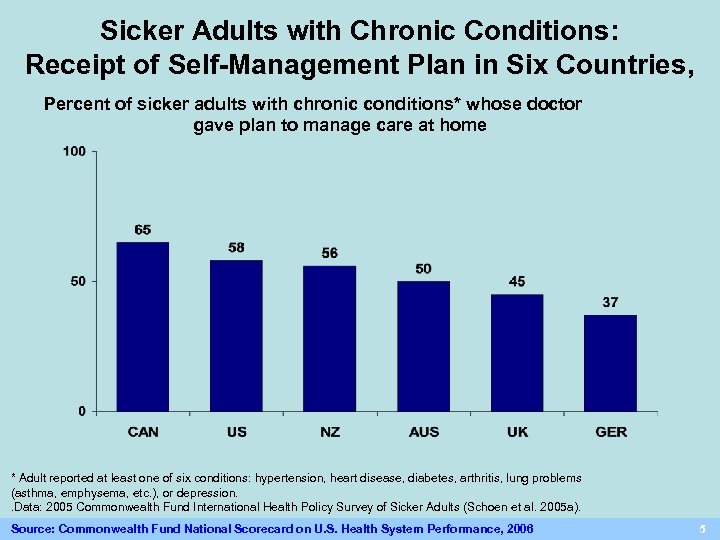
Sicker Adults with Chronic Conditions: Receipt of Self-Management Plan in Six Countries, Percent of sicker adults with chronic conditions* whose doctor gave plan to manage care at home * Adult reported at least one of six conditions: hypertension, heart disease, diabetes, arthritis, lung problems (asthma, emphysema, etc. ), or depression. . Data: 2005 Commonwealth Fund International Health Policy Survey of Sicker Adults (Schoen et al. 2005 a). Source: Commonwealth Fund National Scorecard on U. S. Health System Performance, 2006 5
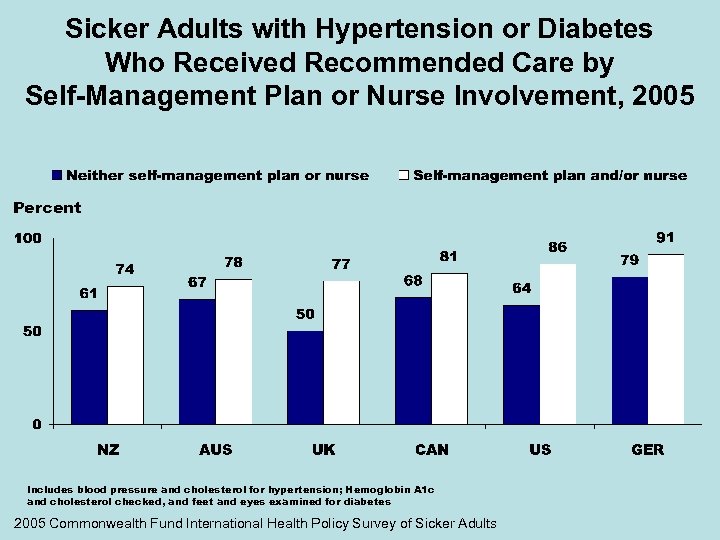
Sicker Adults with Hypertension or Diabetes Who Received Recommended Care by Self-Management Plan or Nurse Involvement, 2005 Percent Includes blood pressure and cholesterol for hypertension; Hemoglobin A 1 c and cholesterol checked, and feet and eyes examined for diabetes 2005 Commonwealth Fund International Health Policy Survey of Sicker Adults
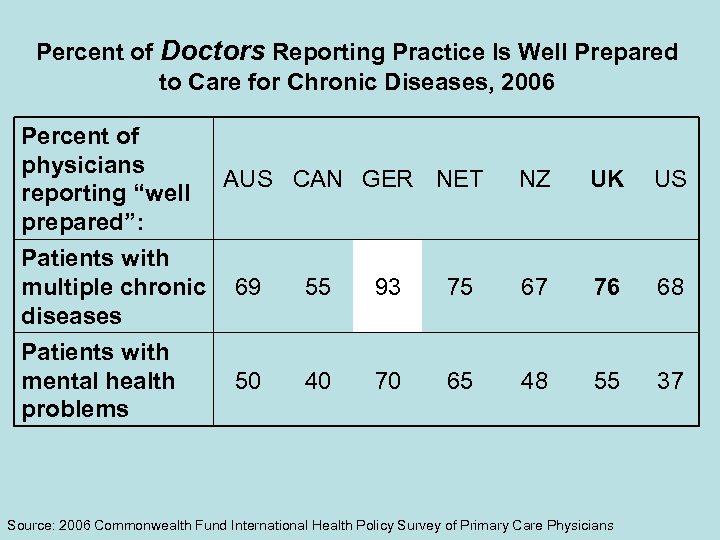
Percent of Doctors Reporting Practice Is Well Prepared to Care for Chronic Diseases, 2006 Percent of physicians AUS CAN GER NET reporting “well prepared”: Patients with multiple chronic 69 55 93 75 diseases Patients with mental health 50 40 70 65 problems NZ UK US 67 76 68 48 55 37 Source: 2006 Commonwealth Fund International Health Policy Survey of Primary Care Physicians
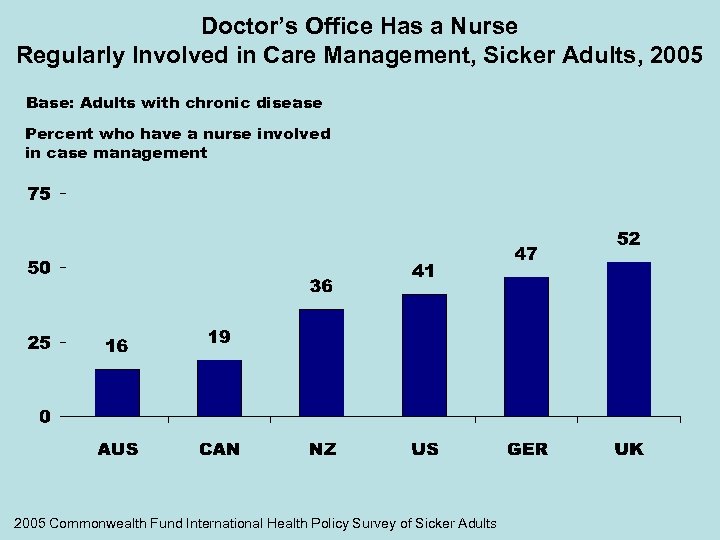
Doctor’s Office Has a Nurse Regularly Involved in Care Management, Sicker Adults, 2005 Base: Adults with chronic disease Percent who have a nurse involved in case management 2005 Commonwealth Fund International Health Policy Survey of Sicker Adults 2005 Commonwealth Fund International Health Policy Survey
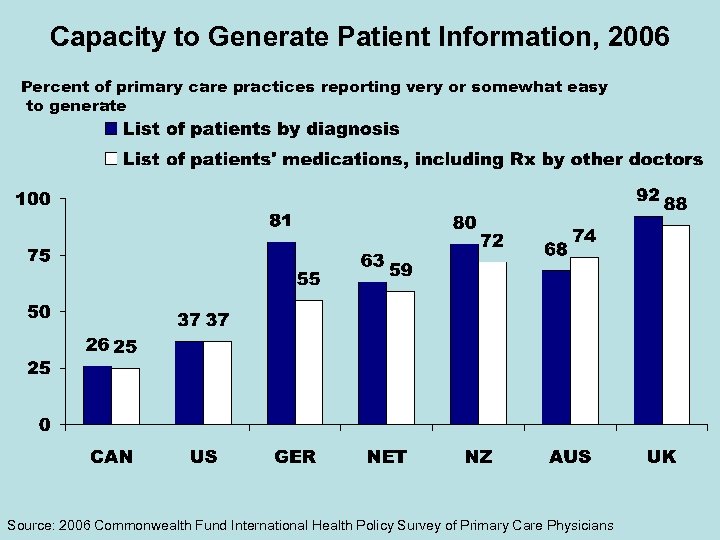
Capacity to Generate Patient Information, 2006 Percent of primary care practices reporting very or somewhat easy to generate Source: 2006 Commonwealth Fund International Health Policy Survey of Primary Care Physicians
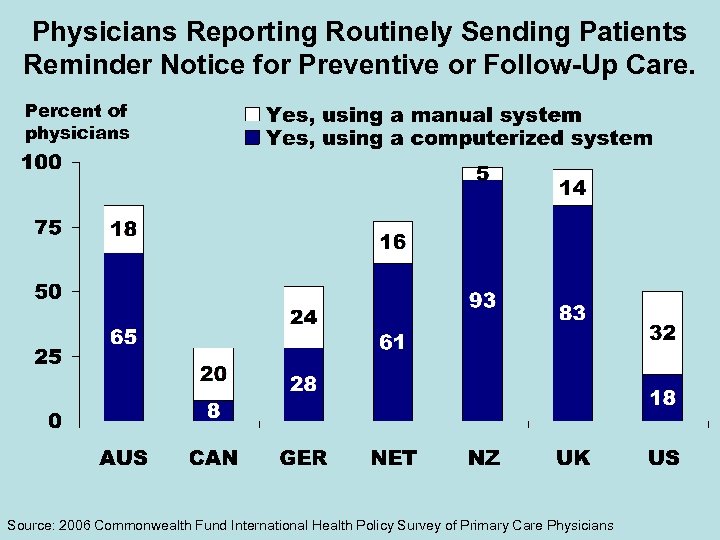
Physicians Reporting Routinely Sending Patients Reminder Notice for Preventive or Follow-Up Care. Percent of physicians Source: 2006 Commonwealth Fund International Health Policy Survey of Primary Care Physicians
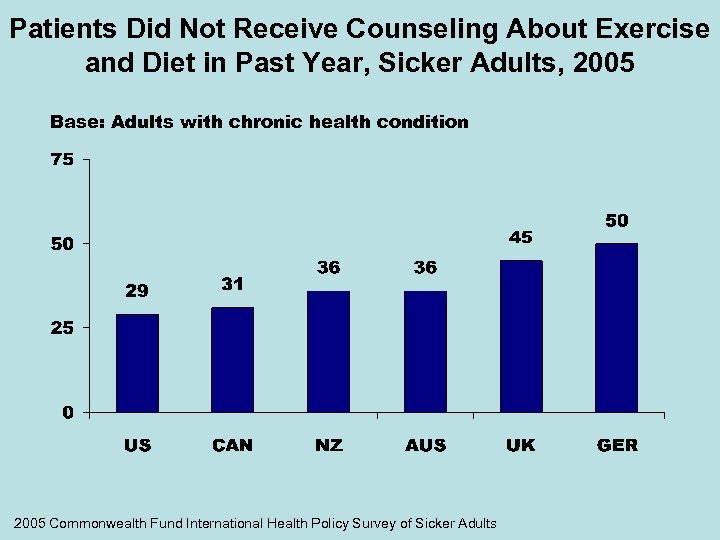
Patients Did Not Receive Counseling About Exercise and Diet in Past Year, Sicker Adults, 2005 Base: Adults with chronic health condition 2005 Commonwealth Fund International Health Policy Survey of Sicker Adults 2005 Commonwealth Fund International Health Policy Survey
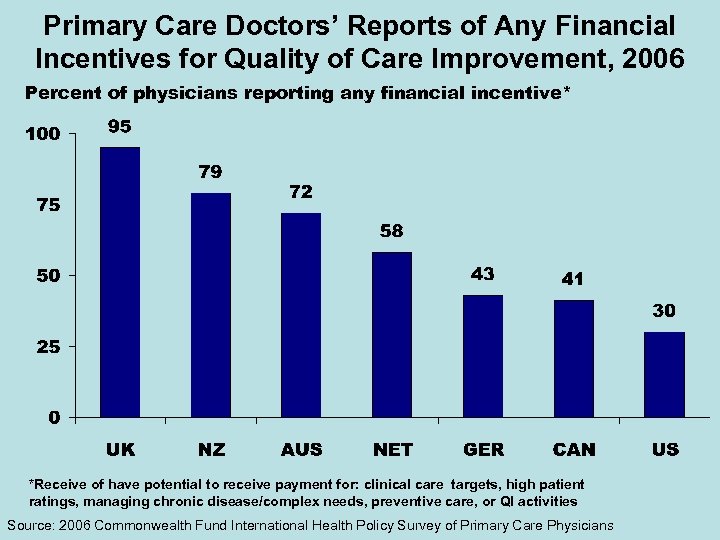
Primary Care Doctors’ Reports of Any Financial Incentives for Quality of Care Improvement, 2006 Percent of physicians reporting any financial incentive* *Receive of have potential to receive payment for: clinical care targets, high patient ratings, managing chronic disease/complex needs, preventive care, or QI activities Source: 2006 Commonwealth Fund International Health Policy Survey of Primary Care Physicians
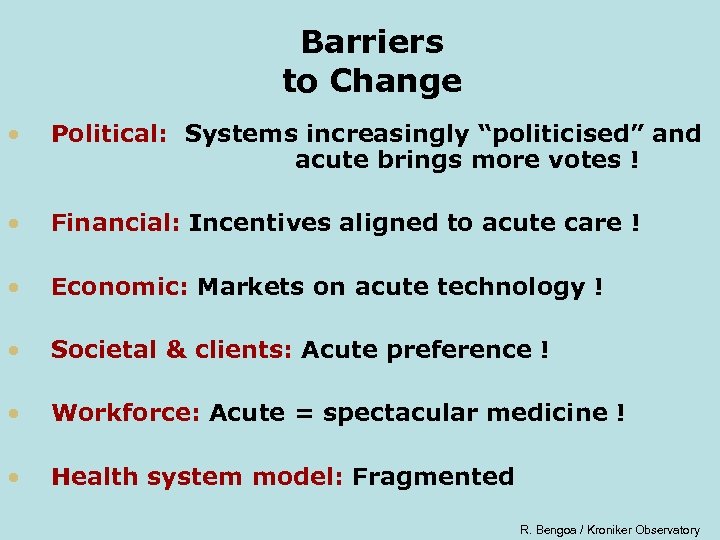
Barriers to Change • Political: Systems increasingly “politicised” and acute brings more votes ! • Financial: Incentives aligned to acute care ! • Economic: Markets on acute technology ! • Societal & clients: Acute preference ! • Workforce: Acute = spectacular medicine ! • Health system model: Fragmented R. Bengoa / Kroniker Observatory
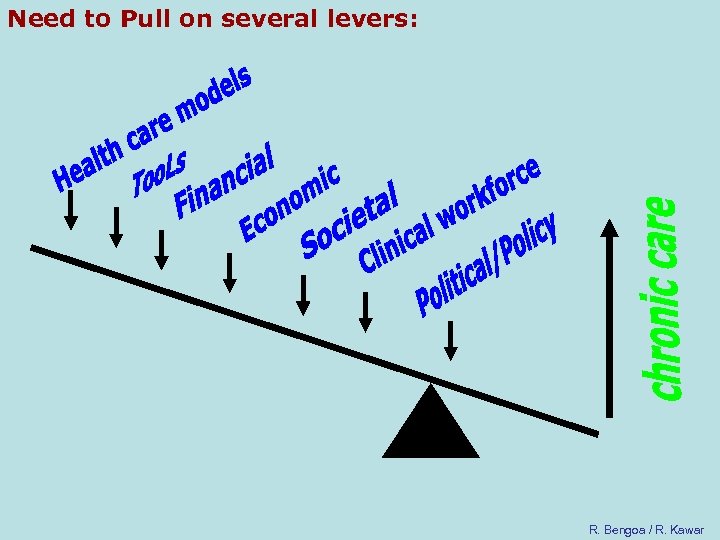
Need to Pull on several levers: R. Bengoa / R. Kawar
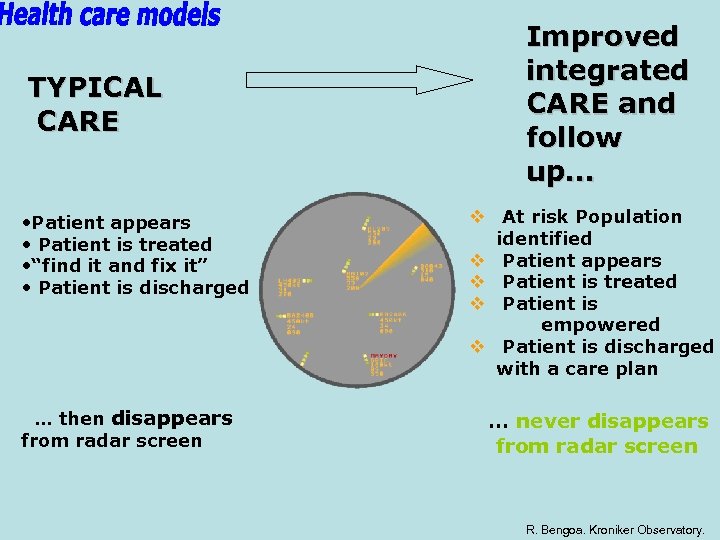
TYPICAL CARE • Patient appears • Patient is treated • “find it and fix it” • Patient is discharged … then disappears from radar screen Improved integrated CARE and follow up… v At risk Population identified v Patient appears v Patient is treated v Patient is empowered v Patient is discharged with a care plan … never disappears from radar screen R. Bengoa. Kroniker Observatory.
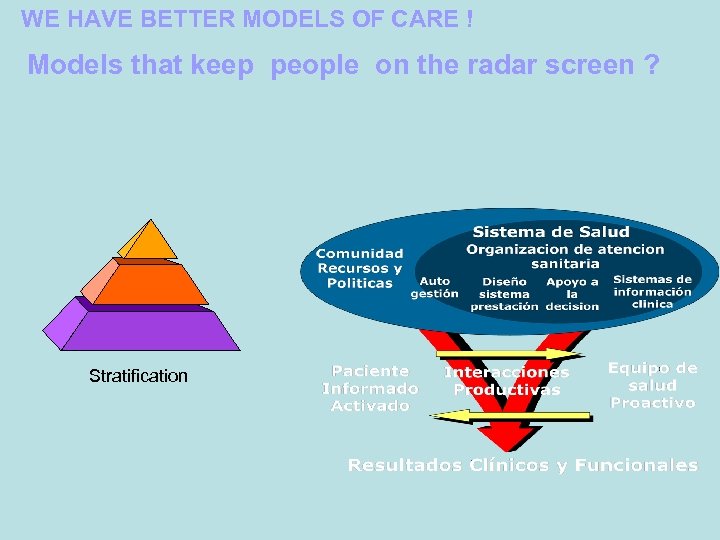
WE HAVE BETTER MODELS OF CARE ! Models that keep people on the radar screen ? Stratification
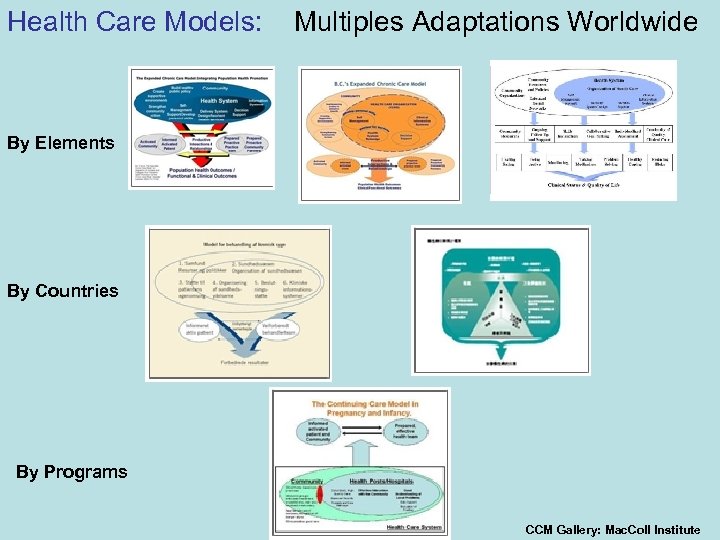
Health Care Models: Multiples Adaptations Worldwide By Elements By Countries By Programs CCM Gallery: Mac. Coll Institute
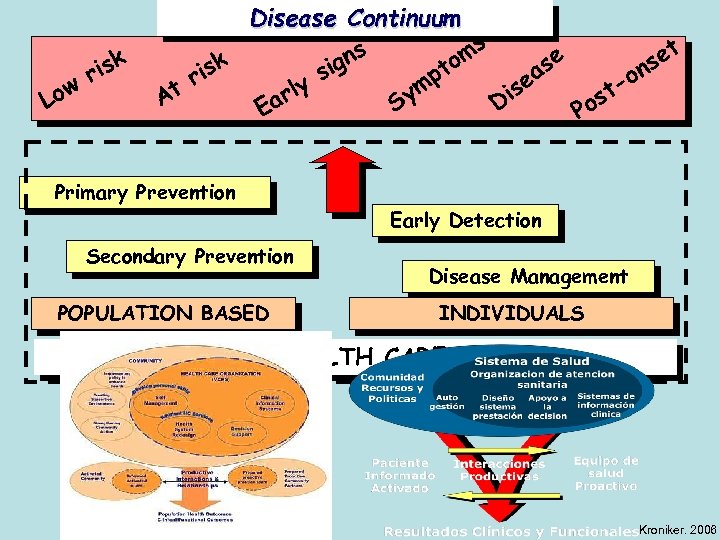
w Lo isk r Disease Continuum t s ms e o k se gn as si pt on ris e is rly ym st At D S Ea Po Primary Prevention Early Detection Secondary Prevention POPULATION BASED Disease Management INDIVIDUALS HEALTH CARE Kroniker. 2006
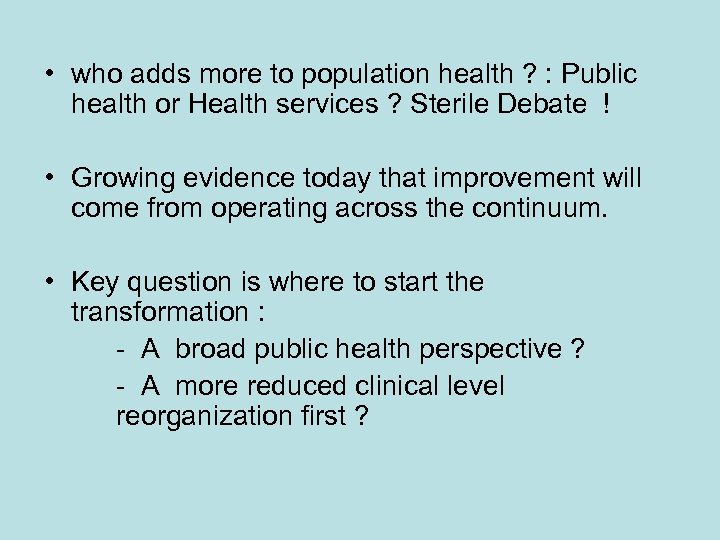
• who adds more to population health ? : Public health or Health services ? Sterile Debate ! • Growing evidence today that improvement will come from operating across the continuum. • Key question is where to start the transformation : - A broad public health perspective ? - A more reduced clinical level reorganization first ?
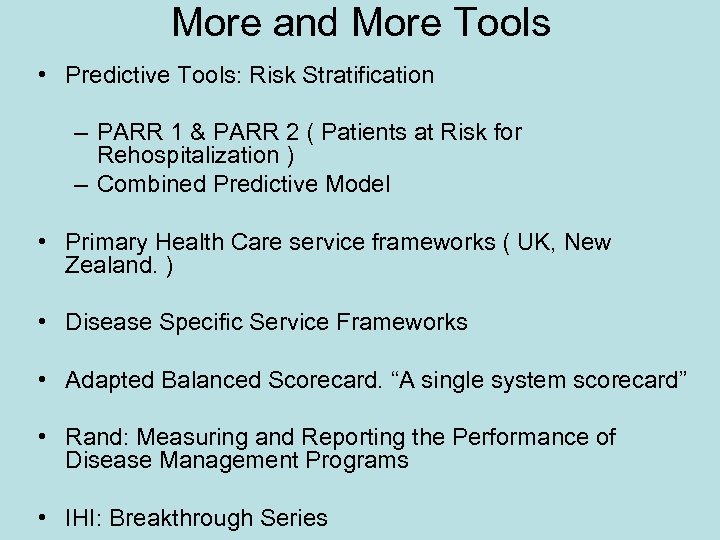
More and More Tools • Predictive Tools: Risk Stratification – PARR 1 & PARR 2 ( Patients at Risk for Rehospitalization ) – Combined Predictive Model • Primary Health Care service frameworks ( UK, New Zealand. ) • Disease Specific Service Frameworks • Adapted Balanced Scorecard. “A single system scorecard” • Rand: Measuring and Reporting the Performance of Disease Management Programs • IHI: Breakthrough Series
Formal Policy. • Denmark National Board of Health: “CHRONIC CONDITIONS - PATIENT, HEALTHCARE AND COMMUNITY” 2006 • UK - The NHS Improvement Plan (2004) - Our Health, Our Care, Our Say(2006) - Expert patient • Australia The National Chronic Disease Strategy (NCDS) 2006 • New Zealand Care Plus. Danish National Board of Health
Health Policy Studies on Chronic Conditions…. Growing Awareness: “System Problem Needing “Systems” Solution” • USA : IOM Redesign Imperatives: – – – Reengineered care process Effective use of information technologies Knowledge and skills management Development of effective teams Coordination of care over patient conditions, services, sites of care. • France: Inspection Generale des Affaires Sociales. 2006 “Lessons from other countries on Disease Management”. (Bras, Duhamel, Grass) • Germany : The Lauterbach Report • Canada, Spain, Australia …. .
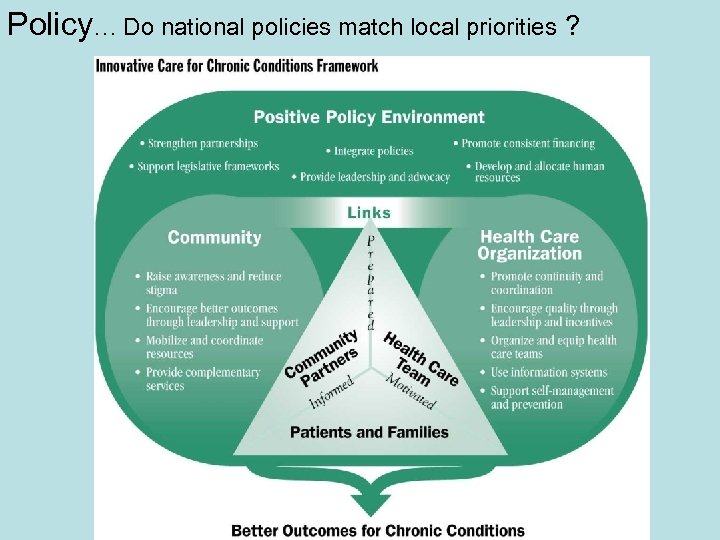
Policy… Do national policies match local priorities ?
GETTING TO THE POLICY LEVEL ! Policy Interest seems to Grow when… • When the use of models exposes fragmentation within our systems. • Use of the models helps to identify incoherent policies. • When perceived as a form to abandon cottage industry set up ( solo or single handed GP) • When seen as a way to shift to non physician caregivers • Some countries (Spain ) which have not moved into purchaser-provider split now organizing local single systems where those functions are integrated. • When evidence on Organizational models/solutions are presented • When Results of models elsewhere are presented! R. Bengoa.
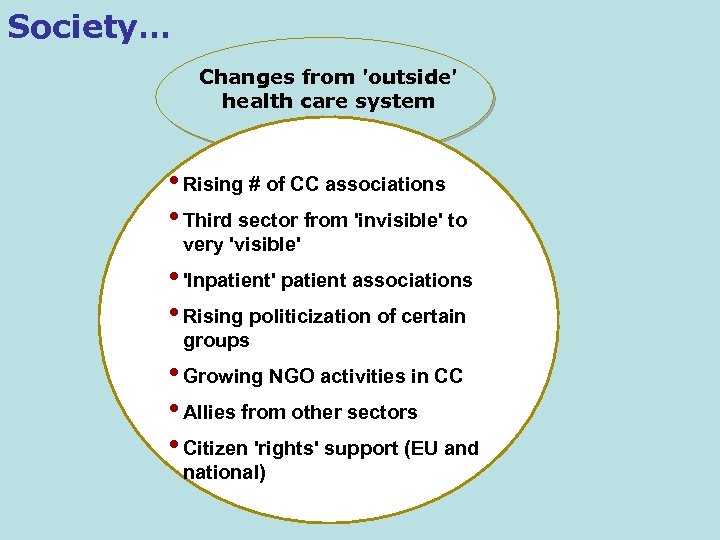
Society… Changes from 'outside' health care system • Rising # of CC associations • Third sector from 'invisible' to very 'visible' • 'Inpatient' patient associations • Rising politicization of certain groups • Growing NGO activities in CC • Allies from other sectors • Citizen 'rights' support (EU and national)
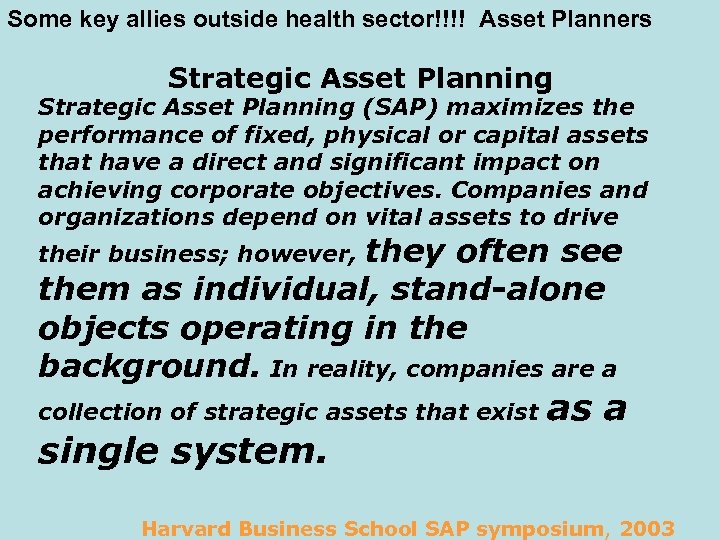
Some key allies outside health sector!!!! Asset Planners Strategic Asset Planning (SAP) maximizes the performance of fixed, physical or capital assets that have a direct and significant impact on achieving corporate objectives. Companies and organizations depend on vital assets to drive they often see them as individual, stand-alone objects operating in the background. In reality, companies are a their business; however, collection of strategic assets that exist single system. as a Harvard Business School SAP symposium, 2003
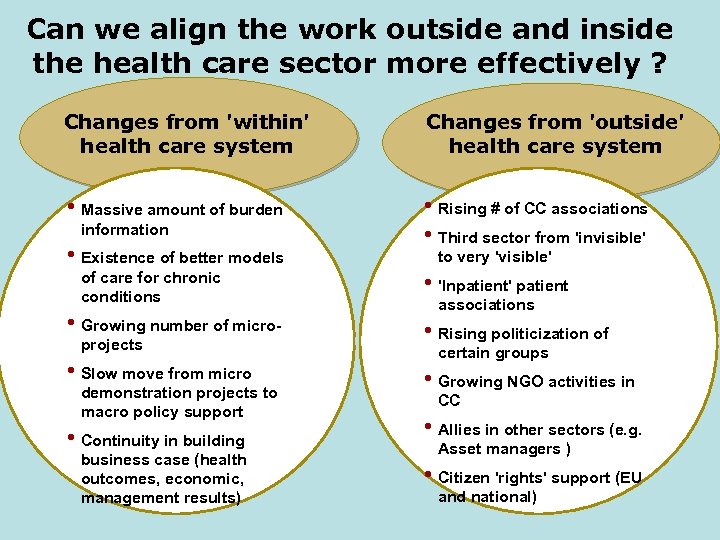
Can we align the work outside and inside the health care sector more effectively ? Changes from 'within' health care system Changes from 'outside' health care system • Massive amount of burden • Rising # of CC associations • Third sector from 'invisible' information • Existence of better models of care for chronic conditions • Growing number of microprojects • Slow move from micro demonstration projects to macro policy support • Continuity in building business case (health outcomes, economic, management results) to very 'visible' • 'Inpatient' patient associations • Rising politicization of certain groups • Growing NGO activities in CC • Allies in other sectors (e. g. Asset managers ) • Citizen 'rights' support (EU and national)
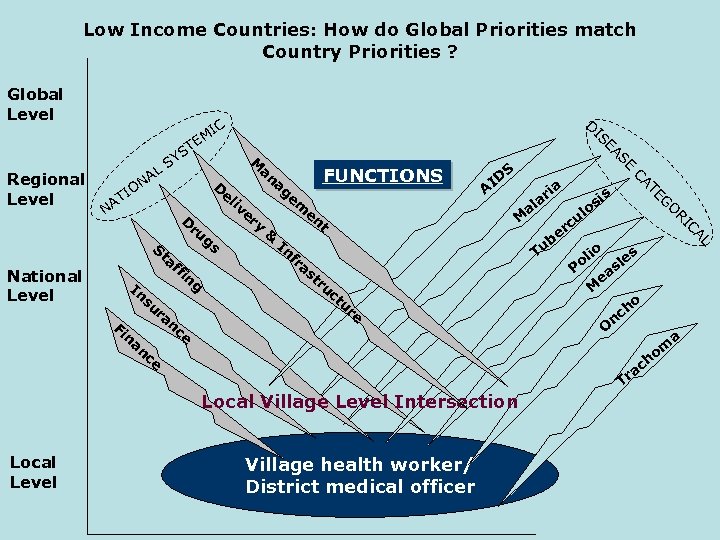
Low Income Countries: How do Global Priorities match Country Priorities ? Global Level el National Level af In su Fi n ra n gs fi ng ce an & M a l e b Tu In fr as tr uc tu re s si o u rc io l Po s ea e sl M o O h nc a ce om h c ra Local Village Level Intersection Local Level L St en t ia CA ru er y r la RI D em S D AI O N iv FUNCTIONS G TE D an ag CA ON M SE EA IS T YS S AL I AT D Regional Level C MI E Village health worker/ District medical officer T
Chronic Care models : Low Income Countries ? • 75% of deaths due to Chronic Conditions are in LICs. • Need to build organised horizontal systems in order to cope with massive shower of vertical programmes from the north • Chronic disease models required as frameworks for planners so they don´t copy our fragmented “systems” • Solo practitioners is the norm so need models which integrate. • Lack of human resources : will need to shift to non – physician caregivers • Will need to rely on self - management to handles their chronic disease epidemics R. Bengoa. Kroniker. 2007
• WE HAVE HEAVY EPIDEMIC BURDEN ! • WE HAVE CONCERNED PATIENTS • WE HAVE BETTER MODELS OF CARE ! • THOSE MODELS FAVOUR INCREASED PATIENT ENGAGEMENT • WE HAVE ENCOURAGING RESULTS. . • WE ARE TRACKING THEM ACROSS COUNTRIES
Observatory on the Quality and Management of Chronic Conditions www. kroniker. com E-mail: kroniker@kroniker. com
Скачать презентацию Global Trends Long Term Conditions London 7 June
f3fb2962435aa373ae05e4bf1599ff02.ppt