 Скачать презентацию Global Tobacco Will Legislation Kill the Industry July
f887161fe149bdf5a913b138766f9b0b.ppt
- Количество слайдов: 82



Global Tobacco: Will Legislation Kill the Industry? July 2009
Tobacco - Legislation © Euromonitor International > Introduction Legislation: What Restrictions Are There? Litigation: What Have Been the Impacts? Regional Legislation: Analysis by Region Manufacturer Strategies Legislation Outlook: Where Next? 2
Introduction Tobacco - Legislation © Euromonitor International > Probably the Worst Operating Environment in the World · A survey of the world's major tobacco markets shows an increasingly restricted smoking environment. · A phrase used by the French Ministry of Health whose stated aim is to "de-normalise the consumption of tobacco" epitomises the objectives of the legislative measures to which the industry is subject. · The de-normalisation is effected through public smoking bans, particularly bans on smoking in social environments. The aim is to prevent non- smokers being subjected to 'second-hand' smoke. · However, legislation also targets the way in which the product is marketed – by cutting off advertising in all media, such that it becomes difficult to find any positive attribute, image, media, location or sponsorship which is not proscribed or limited in some way. · Legislation also targets the product by using compulsory health warnings to separate tobacco products from other consumer goods and makes it more difficult for cigarette packs to be fashion items. The warnings are increasingly designed not merely to appraise the smoker of the health effects but to frighten him or her into giving up. The next stage in warnings is to use graphics to shock the smoker and these are already present in a number of countries. · There is also legislation concerning the minimum tar yield of cigarettes in many countries, though this is viewed as a Trojan Horse by some since creating a minimum may be taken to imply that a lower level of tar is safer than a higher level of tar, which is the concept behind billions of dollars worth of anti-tobacco litigation. · However, the key point regarding tobacco control legislation, particularly in developing countries is the extent to which it is observed by the population, which depends on the smoking culture and how far the government is prepared to go to enforce the legislation. This report analyses the impact of tobacco control legislation on the industry: public smoking bans, advertising restrictions, health warnings, minimum age requirements and tar limits. The future legislative environment as tobacco control tightens its grip, the impact on the market and what the industry can do to mitigate the damage are also considered. Note: All tables and regional analysis based on the 80 largest tobacco markets analysed by Euromonitor International. 3
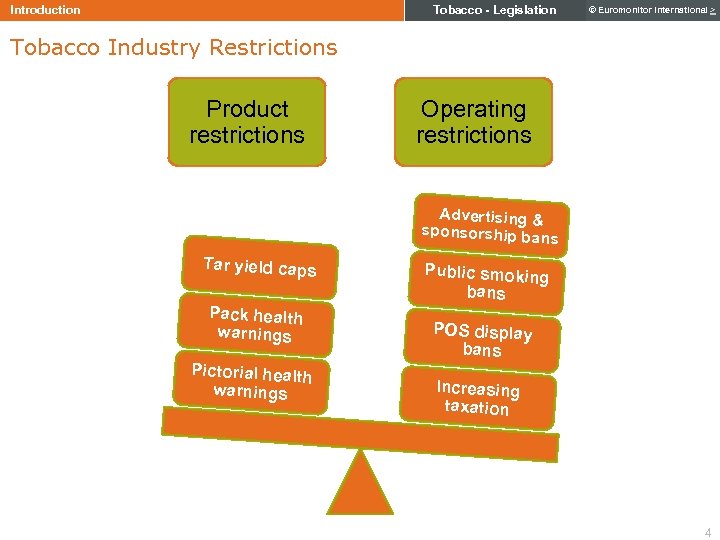
Tobacco - Legislation Introduction © Euromonitor International > Tobacco Industry Restrictions Product restrictions Operating restrictions Advertising & sponsorship ba ns Tar yield caps Pack health warnings Pictorial health warnings Public smoking bans POS display bans Increasing taxation 4

Tobacco - Legislation Introduction © Euromonitor International > The WHO Framework Convention on Tobacco Control (FCTC), adopted by the World Health Assembly in May 2003, is a legally binding international treaty which aims to reduce the health and economic impacts of tobacco. Some 168 nations, representing over 92% of the world's population and including China and the major European markets, have signed and ratified the FCTC. How? The standard tobacco control measures required include a total ban on tobacco advertising, sponsorship and promotion; strong health warnings on tobacco packaging that cover at least 30% (and ideally 50%) of the surface area; protection from second-hand smoke in workplaces, public places and on public transport; . The FCTC also aims to tackle illicit trade and encourage alternative crops to tobacco. fctc Who? fctc The Framework Convention for Tobacco Control Effect? The effect has been virtually universal pack warnings and public smoking bans. Bans have been imposed in 79 out of 80 of the major markets analysed by Euromonitor International, though varying considerably in scope and implementation. The FCTC has helped to severely restrict advertising of tobacco products in the majority of the world's countries, which, combined with the bans and the warnings, has made the cigarette the world's most denigrated and reviled of all globally popular FMCGs – 5
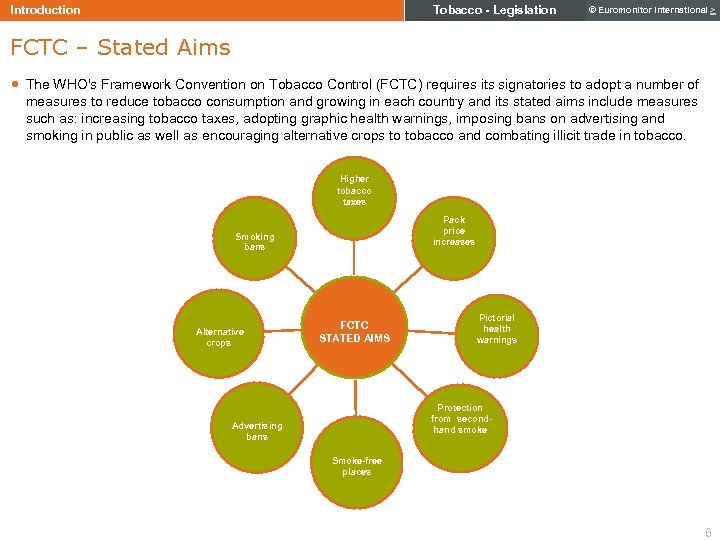
Tobacco - Legislation Introduction © Euromonitor International > FCTC – Stated Aims · The WHO's Framework Convention on Tobacco Control (FCTC) requires its signatories to adopt a number of measures to reduce tobacco consumption and growing in each country and its stated aims include measures such as: increasing tobacco taxes, adopting graphic health warnings, imposing bans on advertising and smoking in public as well as encouraging alternative crops to tobacco and combating illicit trade in tobacco. Higher tobacco taxes Pack price increases Smoking bans Alternative crops FCTC STATED AIMS Pictorial health warnings Protection from secondhand smoke Advertising bans Smoke-free places 6
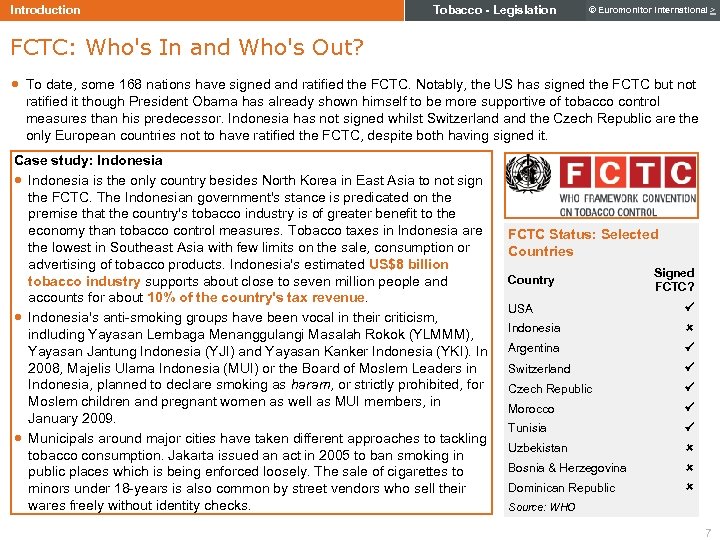
Introduction Tobacco - Legislation © Euromonitor International > FCTC: Who's In and Who's Out? · To date, some 168 nations have signed and ratified the FCTC. Notably, the US has signed the FCTC but not ratified it though President Obama has already shown himself to be more supportive of tobacco control measures than his predecessor. Indonesia has not signed whilst Switzerland the Czech Republic are the only European countries not to have ratified the FCTC, despite both having signed it. Case study: Indonesia · Indonesia is the only country besides North Korea in East Asia to not sign the FCTC. The Indonesian government's stance is predicated on the premise that the country's tobacco industry is of greater benefit to the economy than tobacco control measures. Tobacco taxes in Indonesia are the lowest in Southeast Asia with few limits on the sale, consumption or advertising of tobacco products. Indonesia's estimated US$8 billion tobacco industry supports about close to seven million people and accounts for about 10% of the country's tax revenue. · Indonesia's anti-smoking groups have been vocal in their criticism, indluding Yayasan Lembaga Menanggulangi Masalah Rokok (YLMMM), Yayasan Jantung Indonesia (YJI) and Yayasan Kanker Indonesia (YKI). In 2008, Majelis Ulama Indonesia (MUI) or the Board of Moslem Leaders in Indonesia, planned to declare smoking as haram, or strictly prohibited, for Moslem children and pregnant women as well as MUI members, in January 2009. · Municipals around major cities have taken different approaches to tackling tobacco consumption. Jakarta issued an act in 2005 to ban smoking in public places which is being enforced loosely. The sale of cigarettes to minors under 18 -years is also common by street vendors who sell their wares freely without identity checks. FCTC Status: Selected Countries Country Signed FCTC? USA Indonesia Argentina Switzerland Czech Republic Morocco Tunisia Uzbekistan Bosnia & Herzegovina Dominican Republic Source: WHO 7
Introduction Tobacco - Legislation © Euromonitor International > National Anti-smoking Lobbies · The strength of anti-smoking groups is a key factor in legislation. Strong, wellorganised groups orchestrating high-profile campaigns can create an atmosphere of acceptance for anti-smoking legislation. The mobilisation of public anti-tobacco sentiment can be a strong influence on Governments, especially in democracies. · There are hundreds of anti-smoking organisations in the world. Many are charities with links to Cancer and other health charities. Action for Smoking and Health ASH in the UK receives funding from the British Heart Foundation and Cancer research UK. · There a number of anti-smoking organisations in the US which have a strong voice in the media on smoking and health matters such as National Center for Tobacco Free Kids, Foundation for a Smokefree America and the American Cancer Society. Some organisations major on offering help to smokers wishing to stop, e. g. Stumppi in Finland Stivoro in the Netherlands. · The most significant organisation is the World Health Organisation, partly through its instrument FCTC which countries and powerful regional organisations such as the EU can use as a platform and launch pad for national and regional legislation. Anti-smoking organisations are stronger in developed than developing countries. The development of Government-sanctioned anti-smoking campaigns in China is of particular importance to the future of global cigarette volumes. In April 2007, the biggest scale anti-tobacco project 'Stepping into No-Smoking China' was launched jointly by the China Disease Control Centre and China Medical and Health Ministry across 20 provinces, in an attempt to reduce smoking in public places in both urban and rural China. The projects have a concrete aim of reducing the population of second-hand smokers from 53% to 30%, according to the ministry. The question is whether the Governments in countries like China have the will to make such campaigns effective within a resolute smoking culture and in view of the importance of the tobacco industry to government revenues and employment? 8
Tobacco - Legislation © Euromonitor International > Introduction Legislation: What Restrictions Are There? Litigation: What Have Been the Impacts? Regional Legislation: Analysis by Region Manufacturer Strategies Legislation Outlook: Where Next? 9
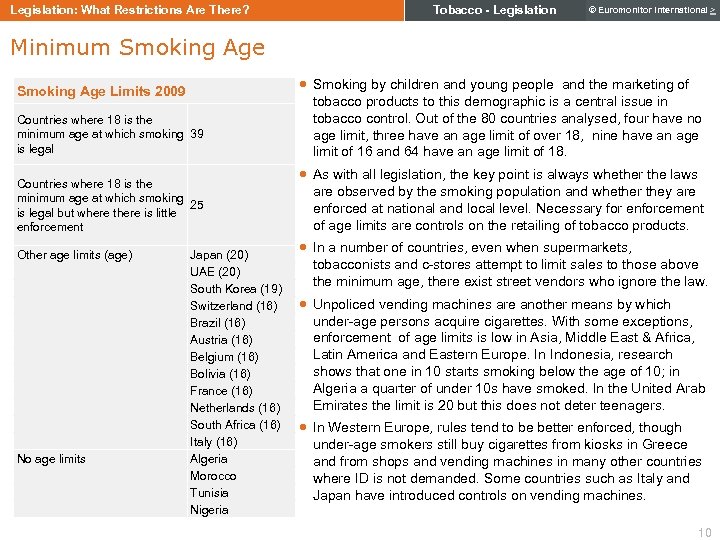
Legislation: What Restrictions Are There? Tobacco - Legislation © Euromonitor International > Minimum Smoking Age · Smoking by children and young people and the marketing of Smoking Age Limits 2009 Countries where 18 is the minimum age at which smoking 39 is legal Countries where 18 is the minimum age at which smoking 25 is legal but where there is little enforcement Other age limits (age) No age limits Japan (20) UAE (20) South Korea (19) Switzerland (16) Brazil (16) Austria (16) Belgium (16) Bolivia (16) France (16) Netherlands (16) South Africa (16) Italy (16) Algeria Morocco Tunisia Nigeria tobacco products to this demographic is a central issue in tobacco control. Out of the 80 countries analysed, four have no age limit, three have an age limit of over 18, nine have an age limit of 16 and 64 have an age limit of 18. · As with all legislation, the key point is always whether the laws are observed by the smoking population and whether they are enforced at national and local level. Necessary for enforcement of age limits are controls on the retailing of tobacco products. · In a number of countries, even when supermarkets, tobacconists and c-stores attempt to limit sales to those above the minimum age, there exist street vendors who ignore the law. · Unpoliced vending machines are another means by which under-age persons acquire cigarettes. With some exceptions, enforcement of age limits is low in Asia, Middle East & Africa, Latin America and Eastern Europe. In Indonesia, research shows that one in 10 starts smoking below the age of 10; in Algeria a quarter of under 10 s have smoked. In the United Arab Emirates the limit is 20 but this does not deter teenagers. · In Western Europe, rules tend to be better enforced, though under-age smokers still buy cigarettes from kiosks in Greece and from shops and vending machines in many other countries where ID is not demanded. Some countries such as Italy and Japan have introduced controls on vending machines. 10
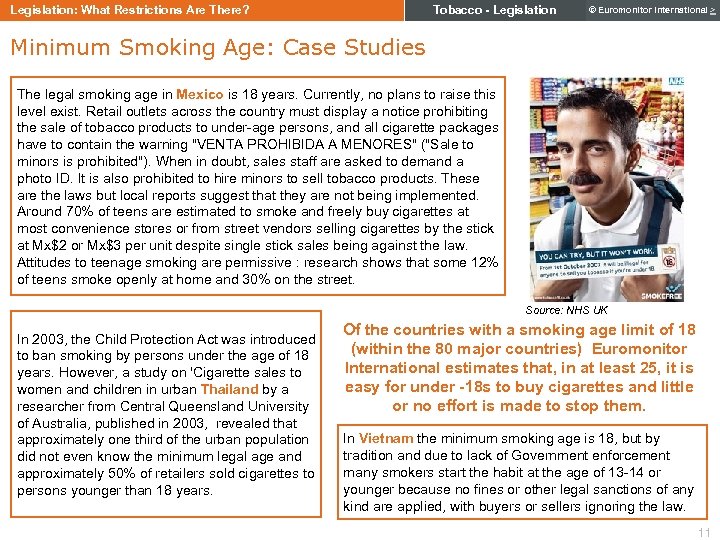
Tobacco - Legislation: What Restrictions Are There? © Euromonitor International > Minimum Smoking Age: Case Studies The legal smoking age in Mexico is 18 years. Currently, no plans to raise this level exist. Retail outlets across the country must display a notice prohibiting the sale of tobacco products to under-age persons, and all cigarette packages have to contain the warning "VENTA PROHIBIDA A MENORES" ("Sale to minors is prohibited"). When in doubt, sales staff are asked to demand a photo ID. It is also prohibited to hire minors to sell tobacco products. These are the laws but local reports suggest that they are not being implemented. Around 70% of teens are estimated to smoke and freely buy cigarettes at most convenience stores or from street vendors selling cigarettes by the stick at Mx$2 or Mx$3 per unit despite single stick sales being against the law. Attitudes to teenage smoking are permissive : research shows that some 12% of teens smoke openly at home and 30% on the street. Source: NHS UK In 2003, the Child Protection Act was introduced to ban smoking by persons under the age of 18 years. However, a study on 'Cigarette sales to women and children in urban Thailand by a researcher from Central Queensland University of Australia, published in 2003, revealed that approximately one third of the urban population did not even know the minimum legal age and approximately 50% of retailers sold cigarettes to persons younger than 18 years. Of the countries with a smoking age limit of 18 (within the 80 major countries) Euromonitor International estimates that, in at least 25, it is easy for under -18 s to buy cigarettes and little or no effort is made to stop them. In Vietnam the minimum smoking age is 18, but by tradition and due to lack of Government enforcement many smokers start the habit at the age of 13 -14 or younger because no fines or other legal sanctions of any kind are applied, with buyers or sellers ignoring the law. 11
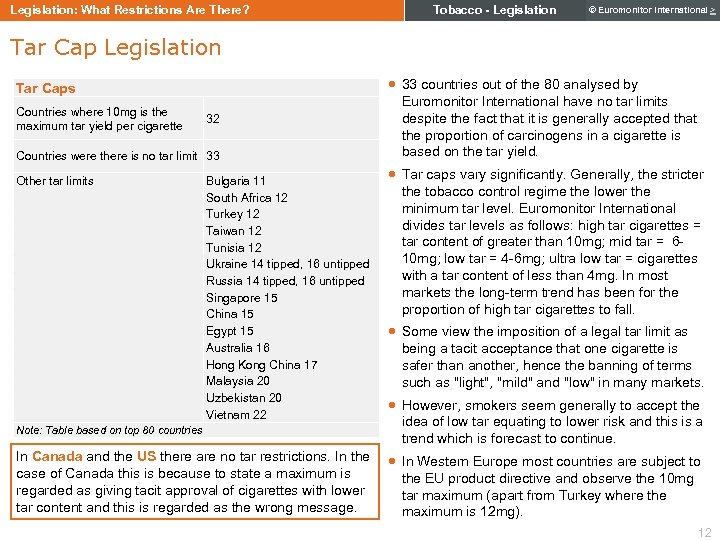
Legislation: What Restrictions Are There? Tobacco - Legislation © Euromonitor International > Tar Cap Legislation · 33 countries out of the 80 analysed by Tar Caps Countries where 10 mg is the maximum tar yield per cigarette 32 Countries were there is no tar limit 33 Other tar limits Note: Table based on top 80 countries Bulgaria 11 South Africa 12 Turkey 12 Taiwan 12 Tunisia 12 Ukraine 14 tipped, 16 untipped Russia 14 tipped, 16 untipped Singapore 15 China 15 Egypt 15 Australia 16 Hong Kong China 17 Malaysia 20 Uzbekistan 20 Vietnam 22 Euromonitor International have no tar limits despite the fact that it is generally accepted that the proportion of carcinogens in a cigarette is based on the tar yield. · Tar caps vary significantly. Generally, the stricter the tobacco control regime the lower the minimum tar level. Euromonitor International divides tar levels as follows: high tar cigarettes = tar content of greater than 10 mg; mid tar = 610 mg; low tar = 4 -6 mg; ultra low tar = cigarettes with a tar content of less than 4 mg. In most markets the long-term trend has been for the proportion of high tar cigarettes to fall. · Some view the imposition of a legal tar limit as being a tacit acceptance that one cigarette is safer than another, hence the banning of terms such as "light", "mild" and "low" in many markets. · However, smokers seem generally to accept the idea of low tar equating to lower risk and this is a trend which is forecast to continue. In Canada and the US there are no tar restrictions. In the · In Western Europe most countries are subject to case of Canada this is because to state a maximum is the EU product directive and observe the 10 mg regarded as giving tacit approval of cigarettes with lower tar maximum (apart from Turkey where the tar content and this is regarded as the wrong message. maximum is 12 mg). 12
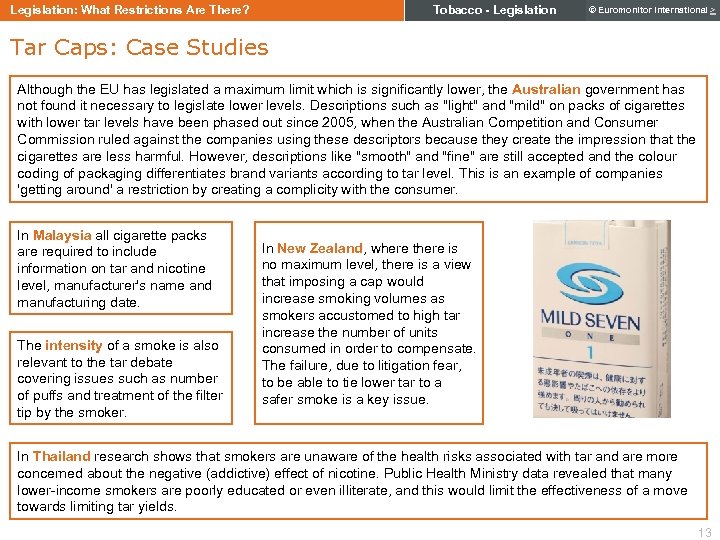
Tobacco - Legislation: What Restrictions Are There? © Euromonitor International > Tar Caps: Case Studies Although the EU has legislated a maximum limit which is significantly lower, the Australian government has not found it necessary to legislate lower levels. Descriptions such as "light" and "mild" on packs of cigarettes with lower tar levels have been phased out since 2005, when the Australian Competition and Consumer Commission ruled against the companies using these descriptors because they create the impression that the cigarettes are less harmful. However, descriptions like "smooth" and "fine" are still accepted and the colour coding of packaging differentiates brand variants according to tar level. This is an example of companies 'getting around' a restriction by creating a complicity with the consumer. In Malaysia all cigarette packs are required to include information on tar and nicotine level, manufacturer's name and manufacturing date. The intensity of a smoke is also relevant to the tar debate covering issues such as number of puffs and treatment of the filter tip by the smoker. In New Zealand, where there is no maximum level, there is a view that imposing a cap would increase smoking volumes as smokers accustomed to high tar increase the number of units consumed in order to compensate. The failure, due to litigation fear, to be able to tie lower tar to a safer smoke is a key issue. In Thailand research shows that smokers are unaware of the health risks associated with tar and are more concerned about the negative (addictive) effect of nicotine. Public Health Ministry data revealed that many lower-income smokers are poorly educated or even illiterate, and this would limit the effectiveness of a move towards limiting tar yields. 13
Tobacco - Legislation: What Restrictions Are There? © Euromonitor International > Health Warning Legislation · Health warnings are present on tobacco products in all 80 Health Warnings (Text) Countries where health warning present on packs 80 of which: Countries with health 27 EU countries warning 30% front, 40% rear Other countries with health EU candidates warning 30% front, 40% rear Macedonia, Croatia No size stipulation Bosnia Herzegovina, Costa Rica No pack health warning legislation Colombia (but manufacturers self regulate) Cigarettes mainly sold in singles so pack warning not Cameroon, Nigeria effective Note: Table based on top 80 countries analysed, in the vast majority of cases due to legislation. The main variation is in size of warnings in terms of percentage coverage and whether the warnings are on both sides of the pack. In the EU in all countries (plus official candidate countries Croatia and Macedonia) the warning must occupy at least 30% of the area on the pack front and 40% of the area on the rear. · The EU is also considering the idea of enlarging pack warnings and ordering mandatory pictorial warnings on both sides of packs. It is also considering replacing maximum tar, nicotine and carbon monoxide (TNCO) yield data with information on other substances in tobacco products or help lines. · It has been suggested that smokers quickly become accustomed to health warnings, and either ignore them or cover them up. However, some research indicates that pack health warnings may be more effective for juveniles, especially if backed by other measures such as high-profile anti-smoking campaigns. Where cigarettes are sold in single sticks consumers do not see the pack warning. Similarly, in rural areas of developing countries where illiteracy is high, only graphic warnings are likely to have the desired deterrent effect. 14
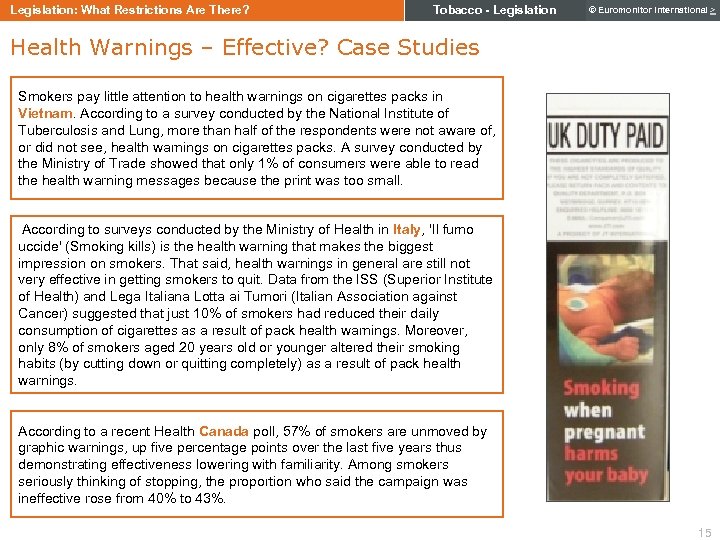
Legislation: What Restrictions Are There? Tobacco - Legislation © Euromonitor International > Health Warnings – Effective? Case Studies Smokers pay little attention to health warnings on cigarettes packs in Vietnam. According to a survey conducted by the National Institute of Tuberculosis and Lung, more than half of the respondents were not aware of, or did not see, health warnings on cigarettes packs. A survey conducted by the Ministry of Trade showed that only 1% of consumers were able to read the health warning messages because the print was too small. According to surveys conducted by the Ministry of Health in Italy, 'Il fumo uccide' (Smoking kills) is the health warning that makes the biggest impression on smokers. That said, health warnings in general are still not very effective in getting smokers to quit. Data from the ISS (Superior Institute of Health) and Lega Italiana Lotta ai Tumori (Italian Association against Cancer) suggested that just 10% of smokers had reduced their daily consumption of cigarettes as a result of pack health warnings. Moreover, only 8% of smokers aged 20 years old or younger altered their smoking habits (by cutting down or quitting completely) as a result of pack health warnings. According to a recent Health Canada poll, 57% of smokers are unmoved by graphic warnings, up five percentage points over the last five years thus demonstrating effectiveness lowering with familiarity. Among smokers seriously thinking of stopping, the proportion who said the campaign was ineffective rose from 40% to 43%. 15
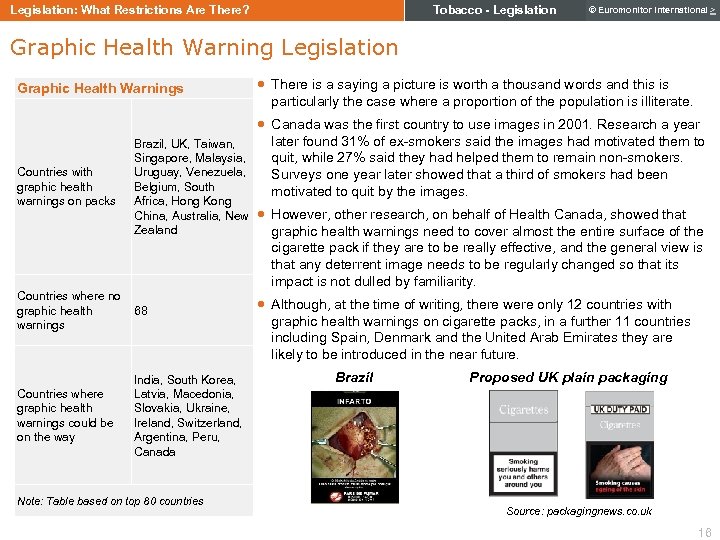
Tobacco - Legislation: What Restrictions Are There? © Euromonitor International > Graphic Health Warning Legislation Graphic Health Warnings · There is a saying a picture is worth a thousand words and this is particularly the case where a proportion of the population is illiterate. · Canada was the first country to use images in 2001. Research a year Countries with graphic health warnings on packs Brazil, UK, Taiwan, Singapore, Malaysia, Uruguay, Venezuela, Belgium, South Africa, Hong Kong China, Australia, New Zealand Countries where no graphic health 68 warnings Countries where graphic health warnings could be on the way India, South Korea, Latvia, Macedonia, Slovakia, Ukraine, Ireland, Switzerland, Argentina, Peru, Canada Note: Table based on top 80 countries later found 31% of ex-smokers said the images had motivated them to quit, while 27% said they had helped them to remain non-smokers. Surveys one year later showed that a third of smokers had been motivated to quit by the images. · However, other research, on behalf of Health Canada, showed that graphic health warnings need to cover almost the entire surface of the cigarette pack if they are to be really effective, and the general view is that any deterrent image needs to be regularly changed so that its impact is not dulled by familiarity. · Although, at the time of writing, there were only 12 countries with graphic health warnings on cigarette packs, in a further 11 countries including Spain, Denmark and the United Arab Emirates they are likely to be introduced in the near future. Brazil Proposed UK plain packaging Source: packagingnews. co. uk 16
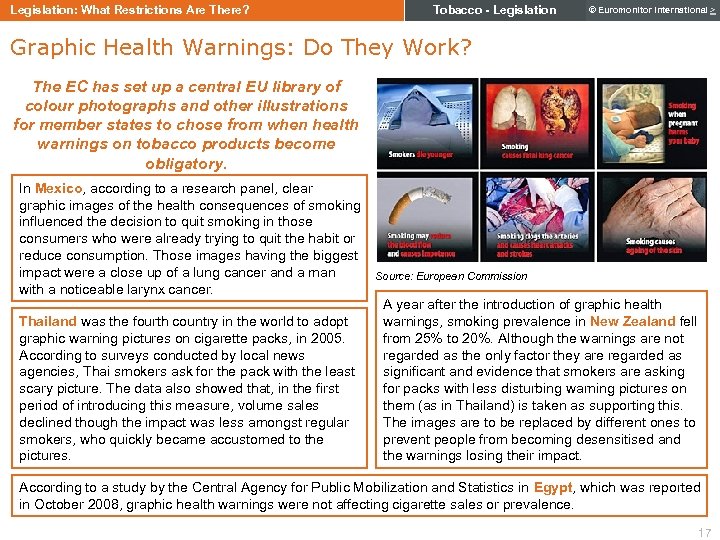
Legislation: What Restrictions Are There? Tobacco - Legislation © Euromonitor International > Graphic Health Warnings: Do They Work? The EC has set up a central EU library of colour photographs and other illustrations for member states to chose from when health warnings on tobacco products become obligatory. In Mexico, according to a research panel, clear graphic images of the health consequences of smoking influenced the decision to quit smoking in those consumers who were already trying to quit the habit or reduce consumption. Those images having the biggest impact were a close up of a lung cancer and a man with a noticeable larynx cancer. Thailand was the fourth country in the world to adopt graphic warning pictures on cigarette packs, in 2005. According to surveys conducted by local news agencies, Thai smokers ask for the pack with the least scary picture. The data also showed that, in the first period of introducing this measure, volume sales declined though the impact was less amongst regular smokers, who quickly became accustomed to the pictures. Source: European Commission A year after the introduction of graphic health warnings, smoking prevalence in New Zealand fell from 25% to 20%. Although the warnings are not regarded as the only factor they are regarded as significant and evidence that smokers are asking for packs with less disturbing warning pictures on them (as in Thailand) is taken as supporting this. The images are to be replaced by different ones to prevent people from becoming desensitised and the warnings losing their impact. According to a study by the Central Agency for Public Mobilization and Statistics in Egypt, which was reported in October 2008, graphic health warnings were not affecting cigarette sales or prevalence. 17
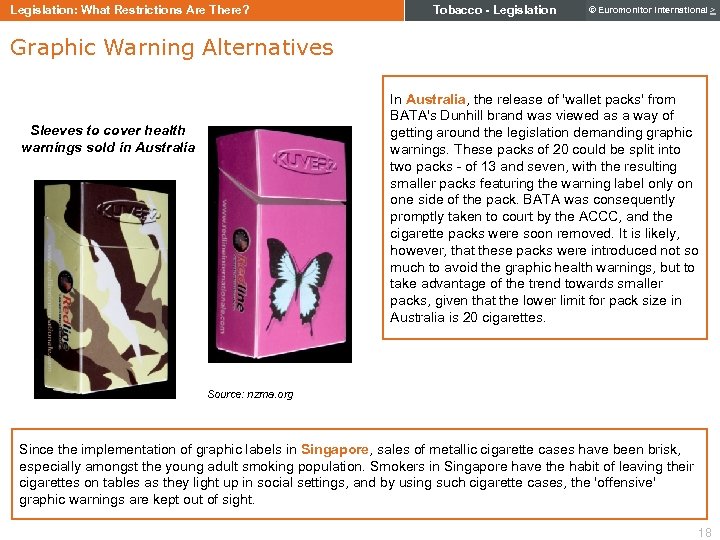
Legislation: What Restrictions Are There? Tobacco - Legislation © Euromonitor International > Graphic Warning Alternatives In Australia, the release of 'wallet packs' from BATA's Dunhill brand was viewed as a way of getting around the legislation demanding graphic warnings. These packs of 20 could be split into two packs - of 13 and seven, with the resulting smaller packs featuring the warning label only on one side of the pack. BATA was consequently promptly taken to court by the ACCC, and the cigarette packs were soon removed. It is likely, however, that these packs were introduced not so much to avoid the graphic health warnings, but to take advantage of the trend towards smaller packs, given that the lower limit for pack size in Australia is 20 cigarettes. Sleeves to cover health warnings sold in Australia Source: nzma. org Since the implementation of graphic labels in Singapore, sales of metallic cigarette cases have been brisk, especially amongst the young adult smoking population. Smokers in Singapore have the habit of leaving their cigarettes on tables as they light up in social settings, and by using such cigarette cases, the 'offensive' graphic warnings are kept out of sight. 18
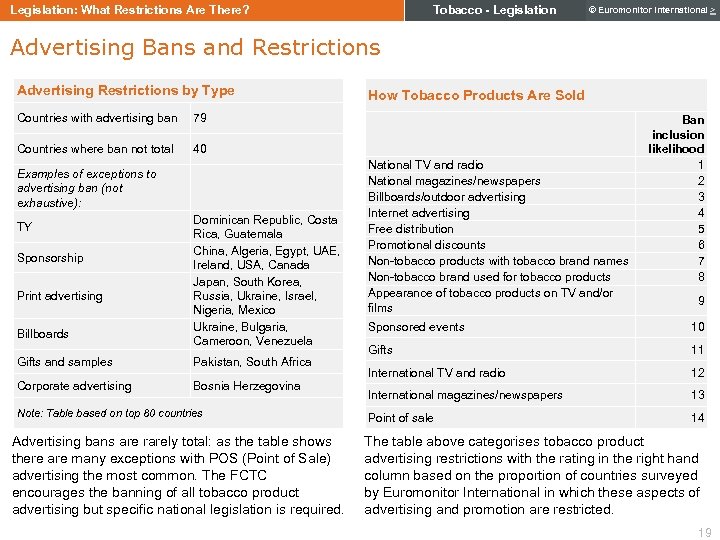
Tobacco - Legislation: What Restrictions Are There? © Euromonitor International > Advertising Bans and Restrictions Advertising Restrictions by Type Countries with advertising ban 79 Countries where ban not total How Tobacco Products Are Sold 40 Examples of exceptions to advertising ban (not exhaustive): TY Sponsorship Print advertising Billboards Dominican Republic, Costa Rica, Guatemala China, Algeria, Egypt, UAE, Ireland, USA, Canada Japan, South Korea, Russia, Ukraine, Israel, Nigeria, Mexico Ukraine, Bulgaria, Cameroon, Venezuela Gifts and samples Pakistan, South Africa Corporate advertising Bosnia Herzegovina Note: Table based on top 80 countries Advertising bans are rarely total: as the table shows there are many exceptions with POS (Point of Sale) advertising the most common. The FCTC encourages the banning of all tobacco product advertising but specific national legislation is required. National TV and radio National magazines/newspapers Billboards/outdoor advertising Internet advertising Free distribution Promotional discounts Non-tobacco products with tobacco brand names Non-tobacco brand used for tobacco products Appearance of tobacco products on TV and/or films Ban inclusion likelihood 1 2 3 4 5 6 7 8 9 Sponsored events 10 Gifts 11 International TV and radio 12 International magazines/newspapers 13 Point of sale 14 The table above categorises tobacco product advertising restrictions with the rating in the right hand column based on the proportion of countries surveyed by Euromonitor International in which these aspects of advertising and promotion are restricted. 19
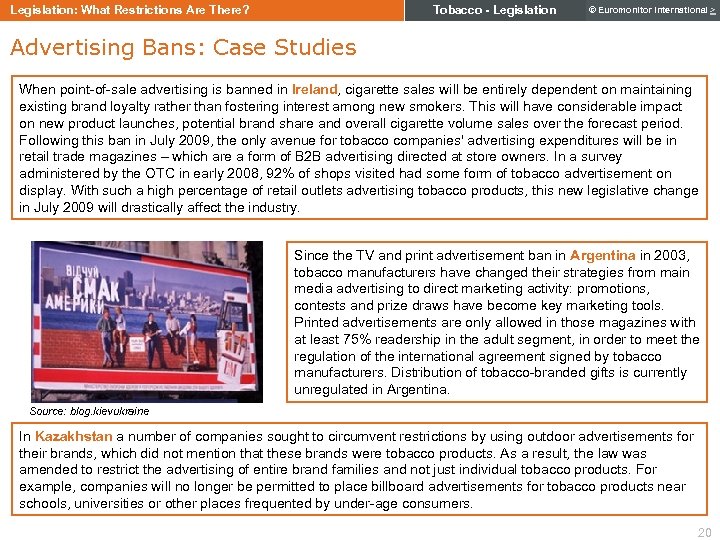
Tobacco - Legislation: What Restrictions Are There? © Euromonitor International > Advertising Bans: Case Studies When point-of-sale advertising is banned in Ireland, cigarette sales will be entirely dependent on maintaining existing brand loyalty rather than fostering interest among new smokers. This will have considerable impact on new product launches, potential brand share and overall cigarette volume sales over the forecast period. Following this ban in July 2009, the only avenue for tobacco companies' advertising expenditures will be in retail trade magazines – which are a form of B 2 B advertising directed at store owners. In a survey administered by the OTC in early 2008, 92% of shops visited had some form of tobacco advertisement on display. With such a high percentage of retail outlets advertising tobacco products, this new legislative change in July 2009 will drastically affect the industry. Since the TV and print advertisement ban in Argentina in 2003, tobacco manufacturers have changed their strategies from main media advertising to direct marketing activity: promotions, contests and prize draws have become key marketing tools. Printed advertisements are only allowed in those magazines with at least 75% readership in the adult segment, in order to meet the regulation of the international agreement signed by tobacco manufacturers. Distribution of tobacco-branded gifts is currently unregulated in Argentina. Source: blog. kievukraine In Kazakhstan a number of companies sought to circumvent restrictions by using outdoor advertisements for their brands, which did not mention that these brands were tobacco products. As a result, the law was amended to restrict the advertising of entire brand families and not just individual tobacco products. For example, companies will no longer be permitted to place billboard advertisements for tobacco products near schools, universities or other places frequented by under-age consumers. 20
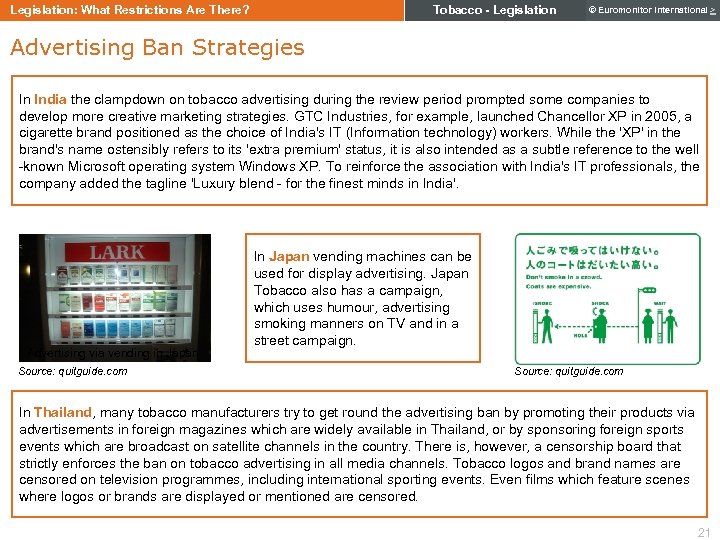
Tobacco - Legislation: What Restrictions Are There? © Euromonitor International > Advertising Ban Strategies In India the clampdown on tobacco advertising during the review period prompted some companies to develop more creative marketing strategies. GTC Industries, for example, launched Chancellor XP in 2005, a cigarette brand positioned as the choice of India's IT (Information technology) workers. While the 'XP' in the brand's name ostensibly refers to its 'extra premium' status, it is also intended as a subtle reference to the well -known Microsoft operating system Windows XP. To reinforce the association with India's IT professionals, the company added the tagline 'Luxury blend - for the finest minds in India'. Advertising via vending in Japan Source: quitguide. com In Japan vending machines can be used for display advertising. Japan Tobacco also has a campaign, which uses humour, advertising smoking manners on TV and in a street campaign. Source: quitguide. com In Thailand, many tobacco manufacturers try to get round the advertising ban by promoting their products via advertisements in foreign magazines which are widely available in Thailand, or by sponsoring foreign sports events which are broadcast on satellite channels in the country. There is, however, a censorship board that strictly enforces the ban on tobacco advertising in all media channels. Tobacco logos and brand names are censored on television programmes, including international sporting events. Even films which feature scenes where logos or brands are displayed or mentioned are censored. 21
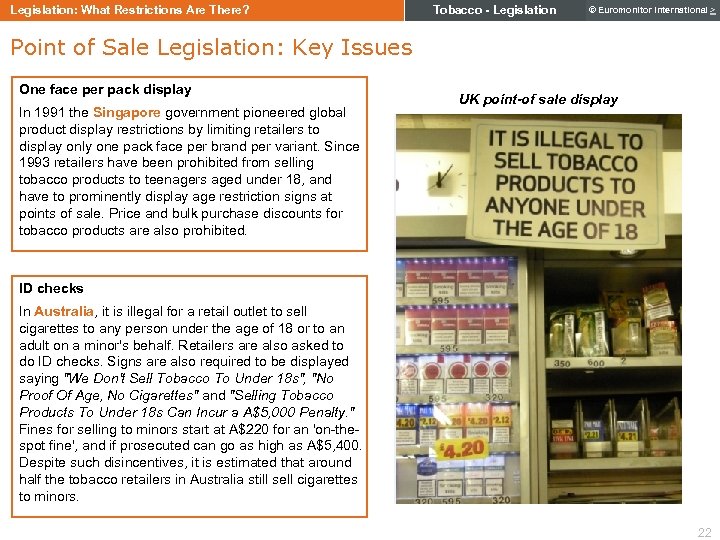
Legislation: What Restrictions Are There? Tobacco - Legislation © Euromonitor International > Point of Sale Legislation: Key Issues One face per pack display In 1991 the Singapore government pioneered global product display restrictions by limiting retailers to display only one pack face per brand per variant. Since 1993 retailers have been prohibited from selling tobacco products to teenagers aged under 18, and have to prominently display age restriction signs at points of sale. Price and bulk purchase discounts for tobacco products are also prohibited. UK point-of sale display ID checks In Australia, it is illegal for a retail outlet to sell cigarettes to any person under the age of 18 or to an adult on a minor's behalf. Retailers are also asked to do ID checks. Signs are also required to be displayed saying "We Don't Sell Tobacco To Under 18 s", "No Proof Of Age, No Cigarettes" and "Selling Tobacco Products To Under 18 s Can Incur a A$5, 000 Penalty. " Fines for selling to minors start at A$220 for an 'on-thespot fine', and if prosecuted can go as high as A$5, 400. Despite such disincentives, it is estimated that around half the tobacco retailers in Australia still sell cigarettes to minors. 22
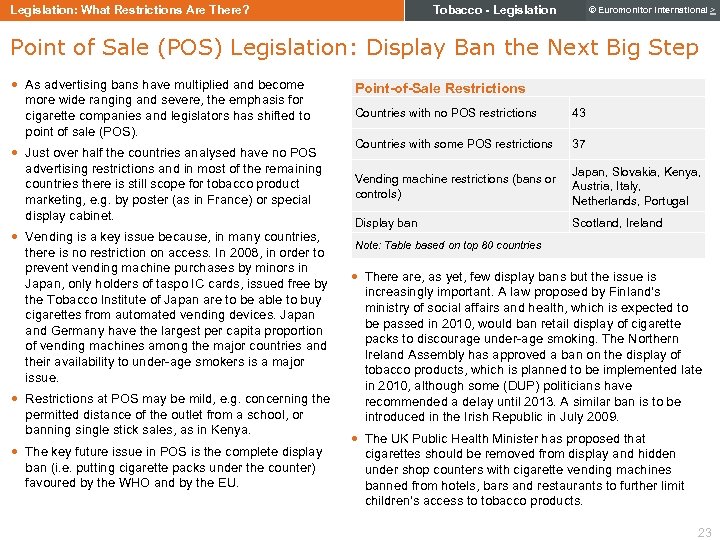
Tobacco - Legislation: What Restrictions Are There? © Euromonitor International > Point of Sale (POS) Legislation: Display Ban the Next Big Step · As advertising bans have multiplied and become more wide ranging and severe, the emphasis for cigarette companies and legislators has shifted to point of sale (POS). · Just over half the countries analysed have no POS advertising restrictions and in most of the remaining countries there is still scope for tobacco product marketing, e. g. by poster (as in France) or special display cabinet. · Vending is a key issue because, in many countries, there is no restriction on access. In 2008, in order to prevent vending machine purchases by minors in Japan, only holders of taspo IC cards, issued free by the Tobacco Institute of Japan are to be able to buy cigarettes from automated vending devices. Japan and Germany have the largest per capita proportion of vending machines among the major countries and their availability to under-age smokers is a major issue. · Restrictions at POS may be mild, e. g. concerning the permitted distance of the outlet from a school, or banning single stick sales, as in Kenya. · The key future issue in POS is the complete display ban (i. e. putting cigarette packs under the counter) favoured by the WHO and by the EU. Point-of-Sale Restrictions Countries with no POS restrictions 43 Countries with some POS restrictions 37 Vending machine restrictions (bans or controls) Japan, Slovakia, Kenya, Austria, Italy, Netherlands, Portugal Display ban Scotland, Ireland Note: Table based on top 80 countries · There are, as yet, few display bans but the issue is increasingly important. A law proposed by Finland's ministry of social affairs and health, which is expected to be passed in 2010, would ban retail display of cigarette packs to discourage under-age smoking. The Northern Ireland Assembly has approved a ban on the display of tobacco products, which is planned to be implemented late in 2010, although some (DUP) politicians have recommended a delay until 2013. A similar ban is to be introduced in the Irish Republic in July 2009. · The UK Public Health Minister has proposed that cigarettes should be removed from display and hidden under shop counters with cigarette vending machines banned from hotels, bars and restaurants to further limit children's access to tobacco products. 23
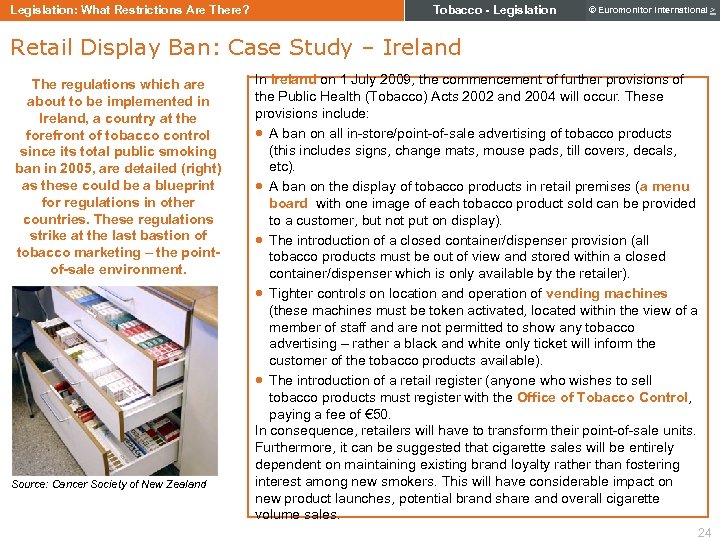
Legislation: What Restrictions Are There? Tobacco - Legislation © Euromonitor International > Retail Display Ban: Case Study – Ireland The regulations which are about to be implemented in Ireland, a country at the forefront of tobacco control since its total public smoking ban in 2005, are detailed (right) as these could be a blueprint for regulations in other countries. These regulations strike at the last bastion of tobacco marketing – the pointof-sale environment. Source: Cancer Society of New Zealand In Ireland on 1 July 2009, the commencement of further provisions of the Public Health (Tobacco) Acts 2002 and 2004 will occur. These provisions include: · A ban on all in-store/point-of-sale advertising of tobacco products (this includes signs, change mats, mouse pads, till covers, decals, etc). · A ban on the display of tobacco products in retail premises (a menu board with one image of each tobacco product sold can be provided to a customer, but not put on display). · The introduction of a closed container/dispenser provision (all tobacco products must be out of view and stored within a closed container/dispenser which is only available by the retailer). · Tighter controls on location and operation of vending machines (these machines must be token activated, located within the view of a member of staff and are not permitted to show any tobacco advertising – rather a black and white only ticket will inform the customer of the tobacco products available). · The introduction of a retail register (anyone who wishes to sell tobacco products must register with the Office of Tobacco Control, paying a fee of € 50. In consequence, retailers will have to transform their point-of-sale units. Furthermore, it can be suggested that cigarette sales will be entirely dependent on maintaining existing brand loyalty rather than fostering interest among new smokers. This will have considerable impact on new product launches, potential brand share and overall cigarette volume sales. 24
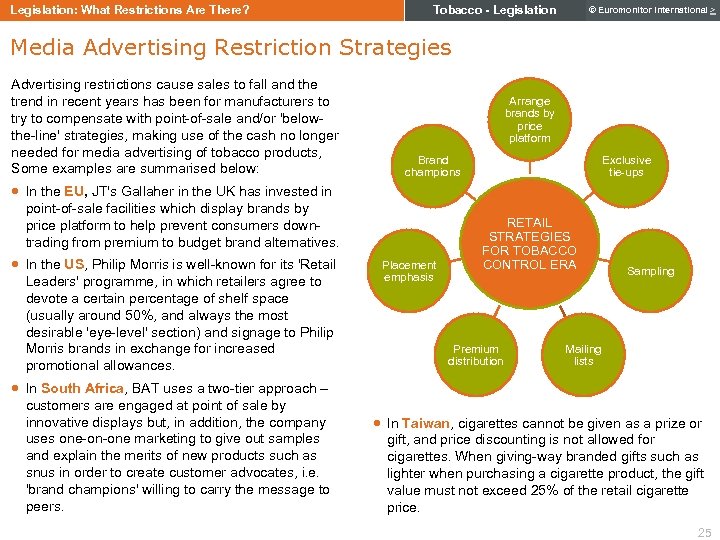
Legislation: What Restrictions Are There? Tobacco - Legislation © Euromonitor International > Media Advertising Restriction Strategies Advertising restrictions cause sales to fall and the trend in recent years has been for manufacturers to try to compensate with point-of-sale and/or 'belowthe-line' strategies, making use of the cash no longer needed for media advertising of tobacco products, Some examples are summarised below: Arrange brands by price platform Brand champions Exclusive tie-ups · In the EU, JT's Gallaher in the UK has invested in point-of-sale facilities which display brands by price platform to help prevent consumers downtrading from premium to budget brand alternatives. · In the US, Philip Morris is well-known for its 'Retail Leaders' programme, in which retailers agree to devote a certain percentage of shelf space (usually around 50%, and always the most desirable 'eye-level' section) and signage to Philip Morris brands in exchange for increased promotional allowances. Placement emphasis RETAIL STRATEGIES FOR TOBACCO CONTROL ERA Premium distribution Sampling Mailing lists · In South Africa, BAT uses a two-tier approach – customers are engaged at point of sale by innovative displays but, in addition, the company uses one-on-one marketing to give out samples and explain the merits of new products such as snus in order to create customer advocates, i. e. 'brand champions' willing to carry the message to peers. · In Taiwan, cigarettes cannot be given as a prize or gift, and price discounting is not allowed for cigarettes. When giving-way branded gifts such as lighter when purchasing a cigarette product, the gift value must not exceed 25% of the retail cigarette price. 25
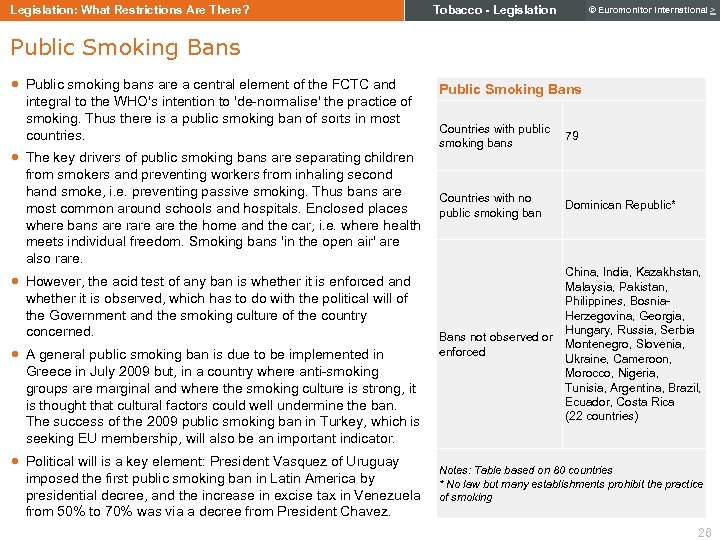
Legislation: What Restrictions Are There? Tobacco - Legislation © Euromonitor International > Public Smoking Bans · Public smoking bans are a central element of the FCTC and integral to the WHO's intention to 'de-normalise' the practice of smoking. Thus there is a public smoking ban of sorts in most countries. · The key drivers of public smoking bans are separating children Public Smoking Bans Countries with public smoking bans from smokers and preventing workers from inhaling second hand smoke, i. e. preventing passive smoking. Thus bans are Countries with no most common around schools and hospitals. Enclosed places public smoking ban where bans are rare the home and the car, i. e. where health meets individual freedom. Smoking bans 'in the open air' are also rare. · However, the acid test of any ban is whether it is enforced and whether it is observed, which has to do with the political will of the Government and the smoking culture of the country concerned. · A general public smoking ban is due to be implemented in Greece in July 2009 but, in a country where anti-smoking groups are marginal and where the smoking culture is strong, it is thought that cultural factors could well undermine the ban. The success of the 2009 public smoking ban in Turkey, which is seeking EU membership, will also be an important indicator. · Political will is a key element: President Vasquez of Uruguay imposed the first public smoking ban in Latin America by presidential decree, and the increase in excise tax in Venezuela from 50% to 70% was via a decree from President Chavez. 79 Dominican Republic* China, India, Kazakhstan, Malaysia, Pakistan, Philippines, Bosnia. Herzegovina, Georgia, Hungary, Russia, Serbia Bans not observed or Montenegro, Slovenia, enforced Ukraine, Cameroon, Morocco, Nigeria, Tunisia, Argentina, Brazil, Ecuador, Costa Rica (22 countries) Notes: Table based on 80 countries * No law but many establishments prohibit the practice of smoking 26
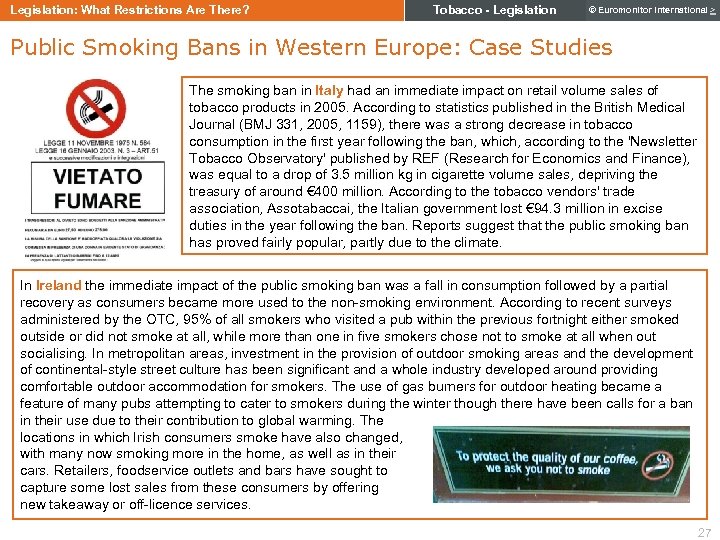
Legislation: What Restrictions Are There? Tobacco - Legislation © Euromonitor International > Public Smoking Bans in Western Europe: Case Studies The smoking ban in Italy had an immediate impact on retail volume sales of tobacco products in 2005. According to statistics published in the British Medical Journal (BMJ 331, 2005, 1159), there was a strong decrease in tobacco consumption in the first year following the ban, which, according to the 'Newsletter Tobacco Observatory' published by REF (Research for Economics and Finance), was equal to a drop of 3. 5 million kg in cigarette volume sales, depriving the treasury of around € 400 million. According to the tobacco vendors' trade association, Assotabaccai, the Italian government lost € 94. 3 million in excise duties in the year following the ban. Reports suggest that the public smoking ban has proved fairly popular, partly due to the climate. In Ireland the immediate impact of the public smoking ban was a fall in consumption followed by a partial recovery as consumers became more used to the non-smoking environment. According to recent surveys administered by the OTC, 95% of all smokers who visited a pub within the previous fortnight either smoked outside or did not smoke at all, while more than one in five smokers chose not to smoke at all when out socialising. In metropolitan areas, investment in the provision of outdoor smoking areas and the development of continental-style street culture has been significant and a whole industry developed around providing comfortable outdoor accommodation for smokers. The use of gas burners for outdoor heating became a feature of many pubs attempting to cater to smokers during the winter though there have been calls for a ban in their use due to their contribution to global warming. The locations in which Irish consumers smoke have also changed, with many now smoking more in the home, as well as in their cars. Retailers, foodservice outlets and bars have sought to capture some lost sales from these consumers by offering new takeaway or off-licence services. 27
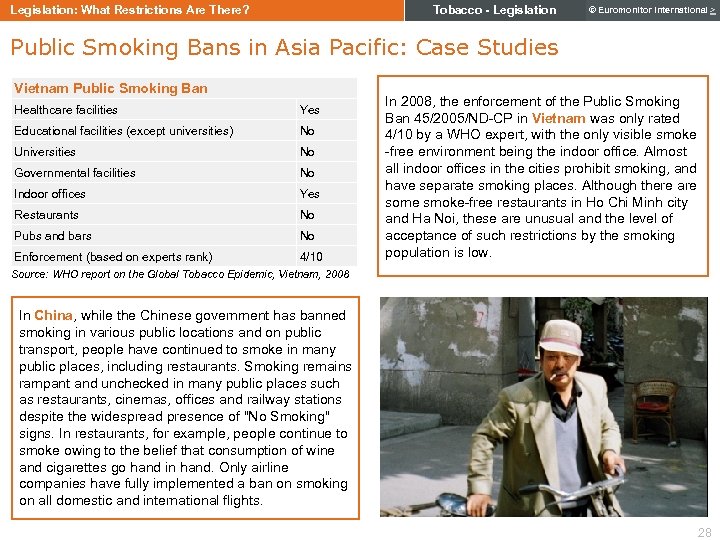
Tobacco - Legislation: What Restrictions Are There? © Euromonitor International > Public Smoking Bans in Asia Pacific: Case Studies Vietnam Public Smoking Ban Healthcare facilities Yes Educational facilities (except universities) No Universities No Governmental facilities No Indoor offices Yes Restaurants No Pubs and bars No Enforcement (based on experts rank) 4/10 In 2008, the enforcement of the Public Smoking Ban 45/2005/ND-CP in Vietnam was only rated 4/10 by a WHO expert, with the only visible smoke -free environment being the indoor office. Almost all indoor offices in the cities prohibit smoking, and have separate smoking places. Although there are some smoke-free restaurants in Ho Chi Minh city and Ha Noi, these are unusual and the level of acceptance of such restrictions by the smoking population is low. Source: WHO report on the Global Tobacco Epidemic, Vietnam, 2008 In China, while the Chinese government has banned smoking in various public locations and on public transport, people have continued to smoke in many public places, including restaurants. Smoking remains rampant and unchecked in many public places such as restaurants, cinemas, offices and railway stations despite the widespread presence of "No Smoking" signs. In restaurants, for example, people continue to smoke owing to the belief that consumption of wine and cigarettes go hand in hand. Only airline companies have fully implemented a ban on smoking on all domestic and international flights. 28
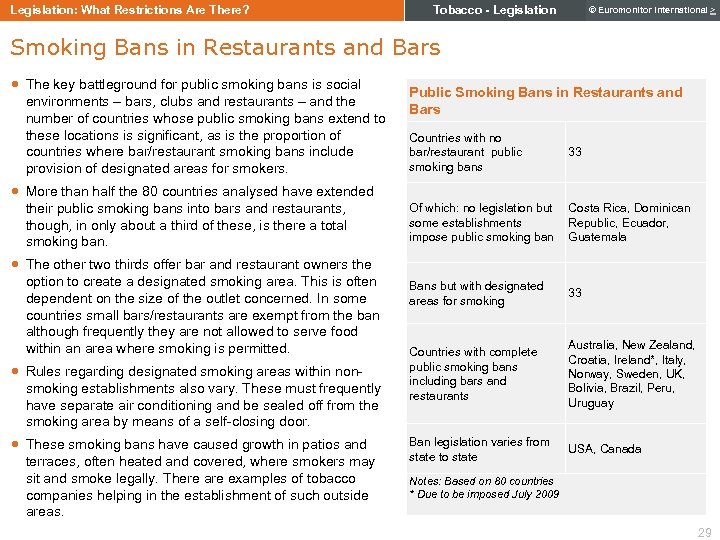
Legislation: What Restrictions Are There? Tobacco - Legislation © Euromonitor International > Smoking Bans in Restaurants and Bars · The key battleground for public smoking bans is social environments – bars, clubs and restaurants – and the number of countries whose public smoking bans extend to these locations is significant, as is the proportion of countries where bar/restaurant smoking bans include provision of designated areas for smokers. Public Smoking Bans in Restaurants and Bars Countries with no bar/restaurant public smoking bans 33 Of which: no legislation but some establishments impose public smoking ban Costa Rica, Dominican Republic, Ecuador, Guatemala Bans but with designated areas for smoking 33 Countries with complete public smoking bans including bars and restaurants Australia, New Zealand, Croatia, Ireland*, Italy, Norway, Sweden, UK, Bolivia, Brazil, Peru, Uruguay Ban legislation varies from state to state USA, Canada · More than half the 80 countries analysed have extended their public smoking bans into bars and restaurants, though, in only about a third of these, is there a total smoking ban. · The other two thirds offer bar and restaurant owners the option to create a designated smoking area. This is often dependent on the size of the outlet concerned. In some countries small bars/restaurants are exempt from the ban although frequently they are not allowed to serve food within an area where smoking is permitted. · Rules regarding designated smoking areas within nonsmoking establishments also vary. These must frequently have separate air conditioning and be sealed off from the smoking area by means of a self-closing door. · These smoking bans have caused growth in patios and terraces, often heated and covered, where smokers may sit and smoke legally. There are examples of tobacco companies helping in the establishment of such outside areas. Notes: Based on 80 countries * Due to be imposed July 2009 29
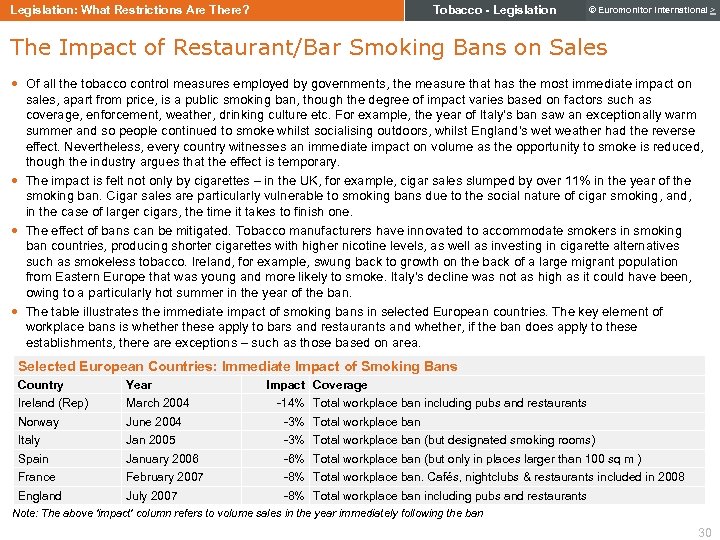
Tobacco - Legislation: What Restrictions Are There? © Euromonitor International > The Impact of Restaurant/Bar Smoking Bans on Sales · Of all the tobacco control measures employed by governments, the measure that has the most immediate impact on sales, apart from price, is a public smoking ban, though the degree of impact varies based on factors such as coverage, enforcement, weather, drinking culture etc. For example, the year of Italy's ban saw an exceptionally warm summer and so people continued to smoke whilst socialising outdoors, whilst England's wet weather had the reverse effect. Nevertheless, every country witnesses an immediate impact on volume as the opportunity to smoke is reduced, though the industry argues that the effect is temporary. · The impact is felt not only by cigarettes – in the UK, for example, cigar sales slumped by over 11% in the year of the smoking ban. Cigar sales are particularly vulnerable to smoking bans due to the social nature of cigar smoking, and, in the case of larger cigars, the time it takes to finish one. · The effect of bans can be mitigated. Tobacco manufacturers have innovated to accommodate smokers in smoking ban countries, producing shorter cigarettes with higher nicotine levels, as well as investing in cigarette alternatives such as smokeless tobacco. Ireland, for example, swung back to growth on the back of a large migrant population from Eastern Europe that was young and more likely to smoke. Italy's decline was not as high as it could have been, owing to a particularly hot summer in the year of the ban. · The table illustrates the immediate impact of smoking bans in selected European countries. The key element of workplace bans is whether these apply to bars and restaurants and whether, if the ban does apply to these establishments, there are exceptions – such as those based on area. Selected European Countries: Immediate Impact of Smoking Bans Country Year Impact Coverage Ireland (Rep) March 2004 Norway June 2004 -3% Total workplace ban Italy Jan 2005 -3% Total workplace ban (but designated smoking rooms) Spain January 2006 -6% Total workplace ban (but only in places larger than 100 sq m ) France February 2007 -8% Total workplace ban. Cafés, nightclubs & restaurants included in 2008 England July 2007 -8% Total workplace ban including pubs and restaurants -14% Total workplace ban including pubs and restaurants Note: The above 'impact' column refers to volume sales in the year immediately following the ban 30
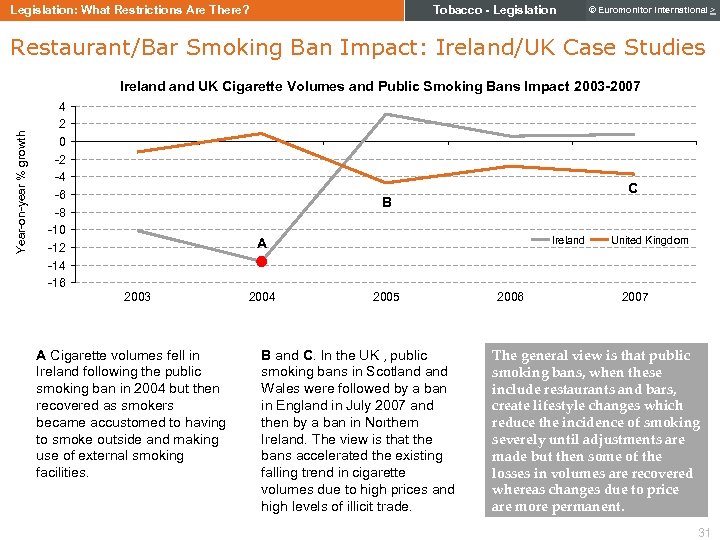
Tobacco - Legislation: What Restrictions Are There? © Euromonitor International > Restaurant/Bar Smoking Ban Impact: Ireland/UK Case Studies Year-on-year % growth Ireland UK Cigarette Volumes and Public Smoking Bans Impact 2003 -2007 4 2 0 -2 -4 -6 -8 -10 -12 -14 -16 C B Ireland A 2003 A Cigarette volumes fell in Ireland following the public smoking ban in 2004 but then recovered as smokers became accustomed to having to smoke outside and making use of external smoking facilities. 2004 2005 B and C. In the UK , public smoking bans in Scotland Wales were followed by a ban in England in July 2007 and then by a ban in Northern Ireland. The view is that the bans accelerated the existing falling trend in cigarette volumes due to high prices and high levels of illicit trade. 2006 United Kingdom 2007 The general view is that public smoking bans, when these include restaurants and bars, create lifestyle changes which reduce the incidence of smoking severely until adjustments are made but then some of the losses in volumes are recovered whereas changes due to price are more permanent. 31
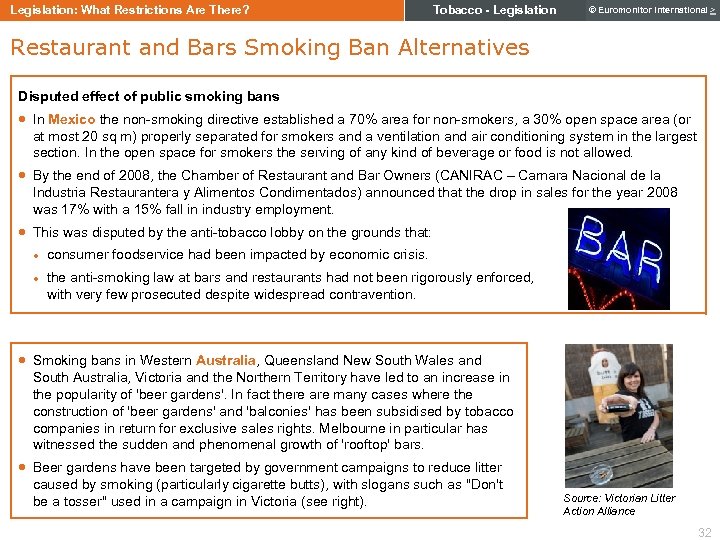
Legislation: What Restrictions Are There? Tobacco - Legislation © Euromonitor International > Restaurant and Bars Smoking Ban Alternatives Disputed effect of public smoking bans · In Mexico the non-smoking directive established a 70% area for non-smokers, a 30% open space area (or at most 20 sq m) properly separated for smokers and a ventilation and air conditioning system in the largest section. In the open space for smokers the serving of any kind of beverage or food is not allowed. · By the end of 2008, the Chamber of Restaurant and Bar Owners (CANIRAC – Camara Nacional de la Industria Restaurantera y Alimentos Condimentados) announced that the drop in sales for the year 2008 was 17% with a 15% fall in industry employment. · This was disputed by the anti-tobacco lobby on the grounds that: · consumer foodservice had been impacted by economic crisis. · the anti-smoking law at bars and restaurants had not been rigorously enforced, with very few prosecuted despite widespread contravention. · Smoking bans in Western Australia, Queensland New South Wales and South Australia, Victoria and the Northern Territory have led to an increase in the popularity of 'beer gardens'. In fact there are many cases where the construction of 'beer gardens' and 'balconies' has been subsidised by tobacco companies in return for exclusive sales rights. Melbourne in particular has witnessed the sudden and phenomenal growth of 'rooftop' bars. · Beer gardens have been targeted by government campaigns to reduce litter caused by smoking (particularly cigarette butts), with slogans such as "Don't be a tosser" used in a campaign in Victoria (see right). Source: Victorian Litter Action Alliance 32
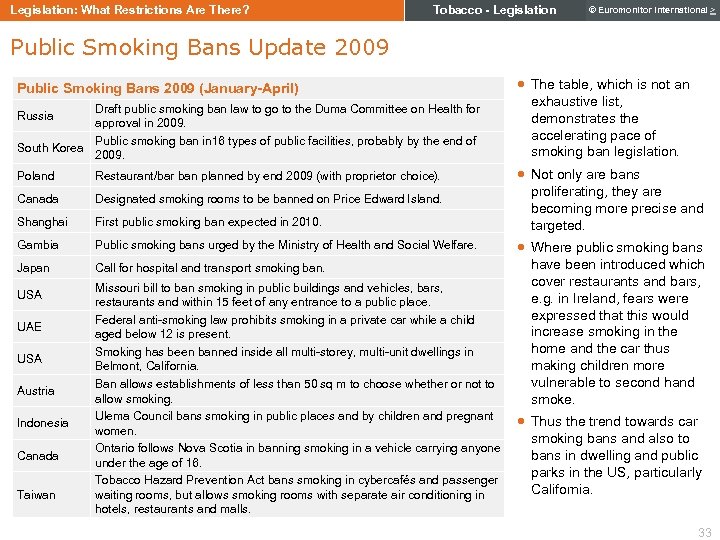
Legislation: What Restrictions Are There? Tobacco - Legislation © Euromonitor International > Public Smoking Bans Update 2009 Public Smoking Bans 2009 (January-April) Draft public smoking ban law to go to the Duma Committee on Health for approval in 2009. Public smoking ban in 16 types of public facilities, probably by the end of South Korea 2009. Russia Poland Restaurant/bar ban planned by end 2009 (with proprietor choice). Canada Designated smoking rooms to be banned on Price Edward Island. Shanghai First public smoking ban expected in 2010. Gambia Public smoking bans urged by the Ministry of Health and Social Welfare. Japan Call for hospital and transport smoking ban. USA UAE USA Austria Indonesia Canada Taiwan Missouri bill to ban smoking in public buildings and vehicles, bars, restaurants and within 15 feet of any entrance to a public place. Federal anti-smoking law prohibits smoking in a private car while a child aged below 12 is present. Smoking has been banned inside all multi-storey, multi-unit dwellings in Belmont, California. Ban allows establishments of less than 50 sq m to choose whether or not to allow smoking. Ulema Council bans smoking in public places and by children and pregnant women. Ontario follows Nova Scotia in banning smoking in a vehicle carrying anyone under the age of 16. Tobacco Hazard Prevention Act bans smoking in cybercafés and passenger waiting rooms, but allows smoking rooms with separate air conditioning in hotels, restaurants and malls. · The table, which is not an exhaustive list, demonstrates the accelerating pace of smoking ban legislation. · Not only are bans proliferating, they are becoming more precise and targeted. · Where public smoking bans have been introduced which cover restaurants and bars, e. g. in Ireland, fears were expressed that this would increase smoking in the home and the car thus making children more vulnerable to second hand smoke. · Thus the trend towards car smoking bans and also to bans in dwelling and public parks in the US, particularly California. 33
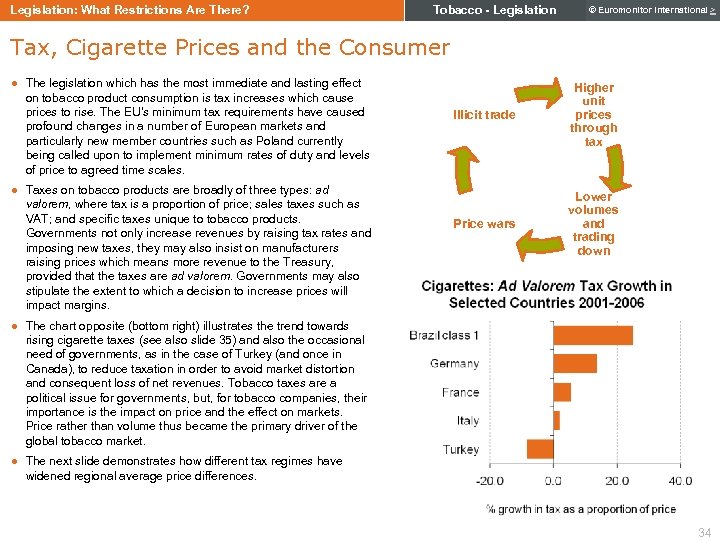
Legislation: What Restrictions Are There? Tobacco - Legislation © Euromonitor International > Tax, Cigarette Prices and the Consumer · The legislation which has the most immediate and lasting effect on tobacco product consumption is tax increases which cause prices to rise. The EU's minimum tax requirements have caused profound changes in a number of European markets and particularly new member countries such as Poland currently being called upon to implement minimum rates of duty and levels of price to agreed time scales. Illicit trade Higher unit prices through tax Price wars Lower volumes and trading down · Taxes on tobacco products are broadly of three types: ad valorem, where tax is a proportion of price; sales taxes such as VAT; and specific taxes unique to tobacco products. Governments not only increase revenues by raising tax rates and imposing new taxes, they may also insist on manufacturers raising prices which means more revenue to the Treasury, provided that the taxes are ad valorem. Governments may also stipulate the extent to which a decision to increase prices will impact margins. · The chart opposite (bottom right) illustrates the trend towards rising cigarette taxes (see also slide 35) and also the occasional need of governments, as in the case of Turkey (and once in Canada), to reduce taxation in order to avoid market distortion and consequent loss of net revenues. Tobacco taxes are a political issue for governments, but, for tobacco companies, their importance is the impact on price and the effect on markets. Price rather than volume thus became the primary driver of the global tobacco market. · The next slide demonstrates how different tax regimes have widened regional average price differences. 34
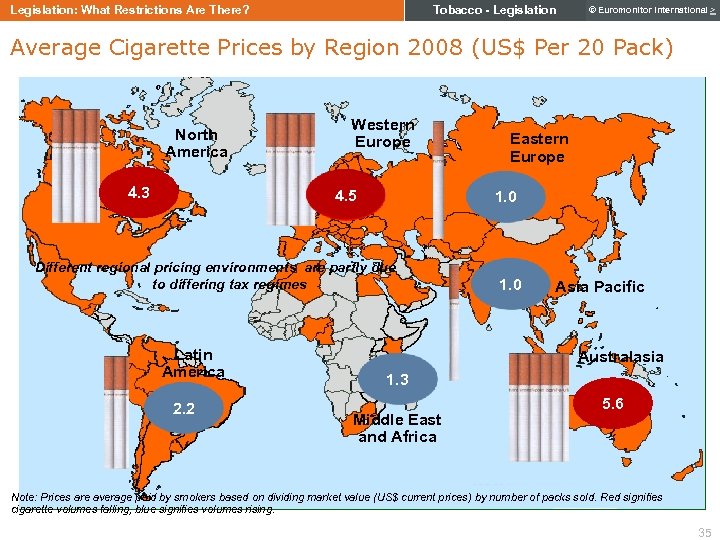
Tobacco - Legislation: What Restrictions Are There? © Euromonitor International > Average Cigarette Prices by Region 2008 (US$ Per 20 Pack) North America 4. 3 Western Europe 4. 5 1. 0 Different regional pricing environments are partly due to differing tax regimes Latin America 2. 2 Eastern Europe 1. 0 Asia Pacific Australasia 1. 3 Middle East and Africa 5. 6 Note: Prices are average paid by smokers based on dividing market value (US$ current prices) by number of packs sold. Red signifies cigarette volumes falling, blue signifies volumes rising. 35
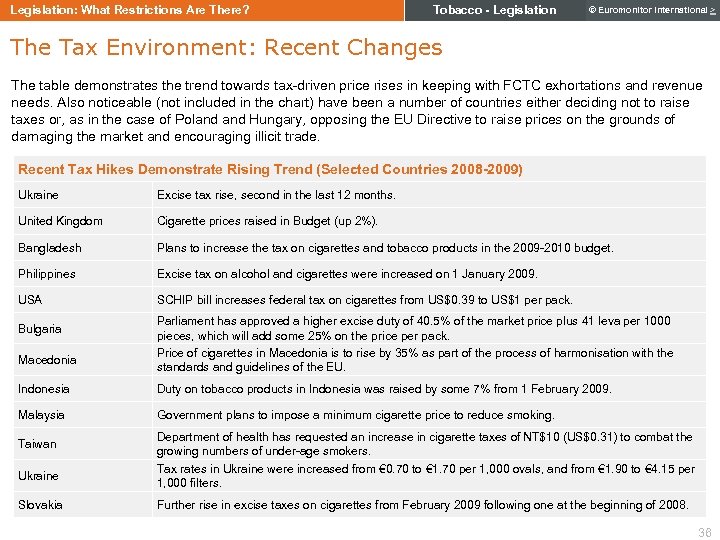
Legislation: What Restrictions Are There? Tobacco - Legislation © Euromonitor International > The Tax Environment: Recent Changes The table demonstrates the trend towards tax-driven price rises in keeping with FCTC exhortations and revenue needs. Also noticeable (not included in the chart) have been a number of countries either deciding not to raise taxes or, as in the case of Poland Hungary, opposing the EU Directive to raise prices on the grounds of damaging the market and encouraging illicit trade. Recent Tax Hikes Demonstrate Rising Trend (Selected Countries 2008 -2009) Ukraine Excise tax rise, second in the last 12 months. United Kingdom Cigarette prices raised in Budget (up 2%). Bangladesh Plans to increase the tax on cigarettes and tobacco products in the 2009 -2010 budget. Philippines Excise tax on alcohol and cigarettes were increased on 1 January 2009. USA SCHIP bill increases federal tax on cigarettes from US$0. 39 to US$1 per pack. Bulgaria Macedonia Parliament has approved a higher excise duty of 40. 5% of the market price plus 41 leva per 1000 pieces, which will add some 25% on the price per pack. Price of cigarettes in Macedonia is to rise by 35% as part of the process of harmonisation with the standards and guidelines of the EU. Indonesia Duty on tobacco products in Indonesia was raised by some 7% from 1 February 2009. Malaysia Government plans to impose a minimum cigarette price to reduce smoking. Taiwan Ukraine Slovakia Department of health has requested an increase in cigarette taxes of NT$10 (US$0. 31) to combat the growing numbers of under-age smokers. Tax rates in Ukraine were increased from € 0. 70 to € 1. 70 per 1, 000 ovals, and from € 1. 90 to € 4. 15 per 1, 000 filters. Further rise in excise taxes on cigarettes from February 2009 following one at the beginning of 2008. 36
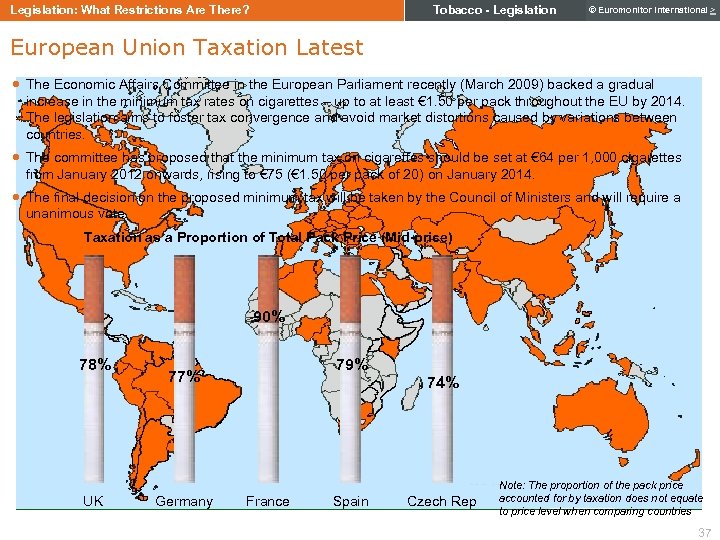
Tobacco - Legislation: What Restrictions Are There? © Euromonitor International > European Union Taxation Latest · The Economic Affairs Committee in the European Parliament recently (March 2009) backed a gradual increase in the minimum tax rates on cigarettes – up to at least € 1. 50 per pack throughout the EU by 2014. The legislation aims to foster tax convergence and avoid market distortions caused by variations between countries. · The committee has proposed that the minimum tax on cigarettes should be set at € 64 per 1, 000 cigarettes from January 2012 onwards, rising to € 75 (€ 1. 50 per pack of 20) on January 2014. · The final decision on the proposed minimum tax will be taken by the Council of Ministers and will require a unanimous vote. Taxation as a Proportion of Total Pack Price (Mid-price) 90% 78% UK 79% 77% Germany 74% France Spain Czech Rep Note: The proportion of the pack price accounted for by taxation does not equate to price level when comparing countries 37
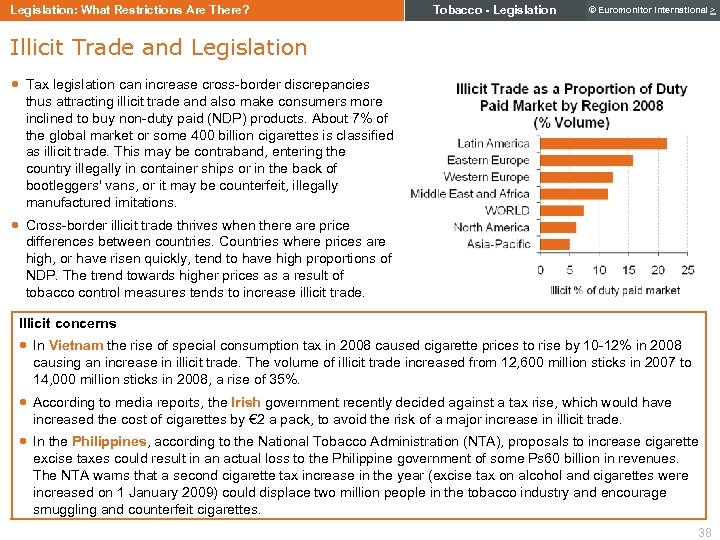
Legislation: What Restrictions Are There? Tobacco - Legislation © Euromonitor International > Illicit Trade and Legislation · Tax legislation can increase cross-border discrepancies thus attracting illicit trade and also make consumers more inclined to buy non-duty paid (NDP) products. About 7% of the global market or some 400 billion cigarettes is classified as illicit trade. This may be contraband, entering the country illegally in container ships or in the back of bootleggers' vans, or it may be counterfeit, illegally manufactured imitations. · Cross-border illicit trade thrives when there are price differences between countries. Countries where prices are high, or have risen quickly, tend to have high proportions of NDP. The trend towards higher prices as a result of tobacco control measures tends to increase illicit trade. Illicit concerns · In Vietnam the rise of special consumption tax in 2008 caused cigarette prices to rise by 10 -12% in 2008 causing an increase in illicit trade. The volume of illicit trade increased from 12, 600 million sticks in 2007 to 14, 000 million sticks in 2008, a rise of 35%. · According to media reports, the Irish government recently decided against a tax rise, which would have increased the cost of cigarettes by € 2 a pack, to avoid the risk of a major increase in illicit trade. · In the Philippines, according to the National Tobacco Administration (NTA), proposals to increase cigarette excise taxes could result in an actual loss to the Philippine government of some Ps 60 billion in revenues. The NTA warns that a second cigarette tax increase in the year (excise tax on alcohol and cigarettes were increased on 1 January 2009) could displace two million people in the tobacco industry and encourage smuggling and counterfeit cigarettes. 38
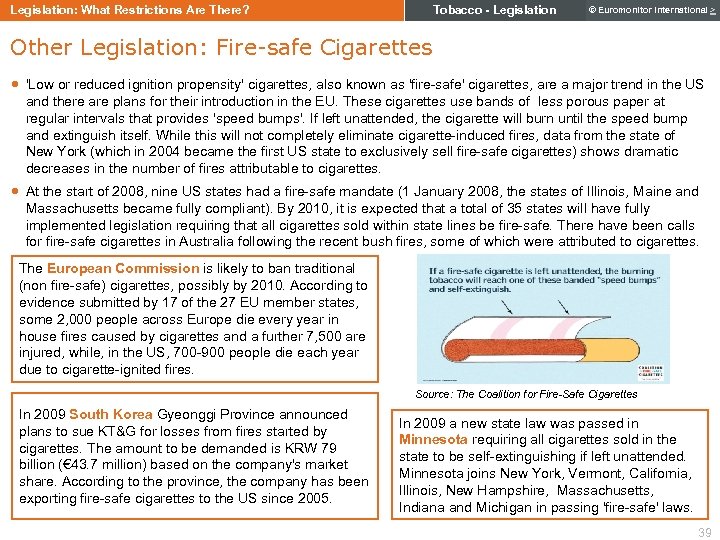
Tobacco - Legislation: What Restrictions Are There? © Euromonitor International > Other Legislation: Fire-safe Cigarettes · 'Low or reduced ignition propensity' cigarettes, also known as 'fire-safe' cigarettes, are a major trend in the US and there are plans for their introduction in the EU. These cigarettes use bands of less porous paper at regular intervals that provides 'speed bumps'. If left unattended, the cigarette will burn until the speed bump and extinguish itself. While this will not completely eliminate cigarette-induced fires, data from the state of New York (which in 2004 became the first US state to exclusively sell fire-safe cigarettes) shows dramatic decreases in the number of fires attributable to cigarettes. · At the start of 2008, nine US states had a fire-safe mandate (1 January 2008, the states of Illinois, Maine and Massachusetts became fully compliant). By 2010, it is expected that a total of 35 states will have fully implemented legislation requiring that all cigarettes sold within state lines be fire-safe. There have been calls for fire-safe cigarettes in Australia following the recent bush fires, some of which were attributed to cigarettes. The European Commission is likely to ban traditional (non fire-safe) cigarettes, possibly by 2010. According to evidence submitted by 17 of the 27 EU member states, some 2, 000 people across Europe die every year in house fires caused by cigarettes and a further 7, 500 are injured, while, in the US, 700 -900 people die each year due to cigarette-ignited fires. Source: The Coalition for Fire-Safe Cigarettes In 2009 South Korea Gyeonggi Province announced plans to sue KT&G for losses from fires started by cigarettes. The amount to be demanded is KRW 79 billion (€ 43. 7 million) based on the company's market share. According to the province, the company has been exporting fire-safe cigarettes to the US since 2005. In 2009 a new state law was passed in Minnesota requiring all cigarettes sold in the state to be self-extinguishing if left unattended. Minnesota joins New York, Vermont, California, Illinois, New Hampshire, Massachusetts, Indiana and Michigan in passing 'fire-safe' laws. 39
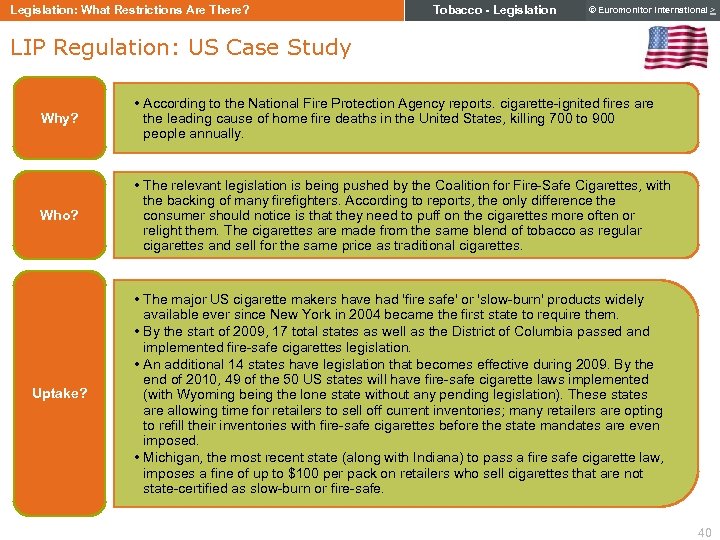
Legislation: What Restrictions Are There? Tobacco - Legislation © Euromonitor International > LIP Regulation: US Case Study Why? • According to the National Fire Protection Agency reports. cigarette-ignited fires are the leading cause of home fire deaths in the United States, killing 700 to 900 people annually. Who? • The relevant legislation is being pushed by the Coalition for Fire-Safe Cigarettes, with the backing of many firefighters. According to reports, the only difference the consumer should notice is that they need to puff on the cigarettes more often or relight them. The cigarettes are made from the same blend of tobacco as regular cigarettes and sell for the same price as traditional cigarettes. Uptake? • The major US cigarette makers have had 'fire safe' or 'slow-burn' products widely available ever since New York in 2004 became the first state to require them. • By the start of 2009, 17 total states as well as the District of Columbia passed and implemented fire-safe cigarettes legislation. • An additional 14 states have legislation that becomes effective during 2009. By the end of 2010, 49 of the 50 US states will have fire-safe cigarette laws implemented (with Wyoming being the lone state without any pending legislation). These states are allowing time for retailers to sell off current inventories; many retailers are opting to refill their inventories with fire-safe cigarettes before the state mandates are even imposed. • Michigan, the most recent state (along with Indiana) to pass a fire safe cigarette law, imposes a fine of up to $100 per pack on retailers who sell cigarettes that are not state-certified as slow-burn or fire-safe. 40
Legislation: What Restrictions Are There? Tobacco - Legislation © Euromonitor International > LIP Service: US Reaction What is company reaction? • Not surprisingly, manufacturers do not oppose the trend towards fire-safe cigarettes although Philip Morris stated in 2007 that it would prefer a uniform, national standard. • In October 2007, RJ Reynolds went a step further, announcing that by 2009 all of its cigarettes sold in the US will be fire-safe, even if state laws do not have formal mandates. What is consumer reaction? • The only opposition to fire-safe cigarettes comes from those smokers who find having to re-light them after a brief period of inattention to be a nuisance. • Some smokers also claim a change in flavour, though there have been no significant trends recorded of increased cross-state buying (where this is possible) to avoid the fire-safe packs. • Groups such as the Citizens Against Fire Safe Cigarettes have worked to repeal firesafe cigarettes legislation, but this had minimal impact. In addition, the introduction of fire-safe cigarettes – and the limited opposition to relevant legislation – is unlikely to have any visible impact on declining cigarettes volume sales over the forecast period. Other impact? • Fire safe cigarette laws do not apply to RYO cigarettes but, to date, there have been no reports of a positive impact on RYO sales in those states where fire safe cigarettes have been made compulsory. 41
Tobacco - Legislation © Euromonitor International > Introduction Legislation: What Restrictions Are There? Litigation: What Have Been the Impacts? Regional Legislation: Analysis by Region Manufacturer Strategies Legislation Outlook: Where Next? 42
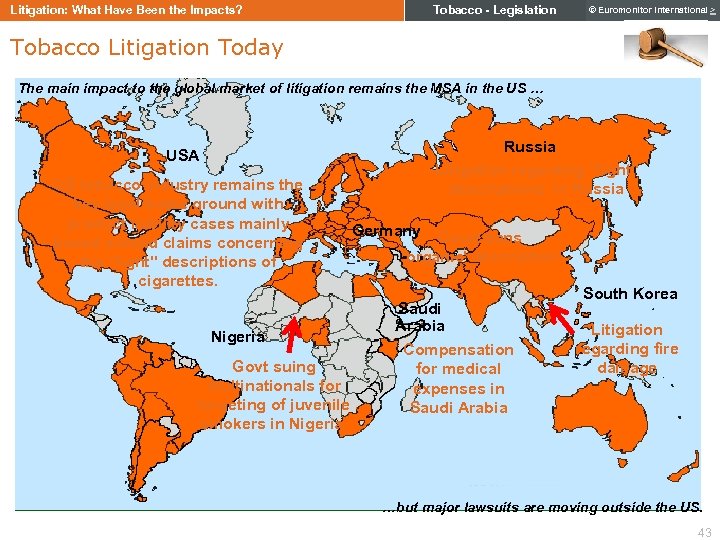
Tobacco - Legislation Litigation: What Have Been the Impacts? © Euromonitor International > Tobacco Litigation Today The main impact to the global market of litigation remains the MSA in the US … Russia Litigation regarding "light" descriptions in Russia USA US tobacco industry remains the key legal battle ground with product liability cases mainly based around claims concerning the "light" descriptions of cigarettes. Nigeria Govt suing multinationals for targeting of juvenile smokers in Nigeria. Germany Court bans 'organic' description Saudi Arabia Compensation for medical expenses in Saudi Arabia South Korea Litigation regarding fire damage …but major lawsuits are moving outside the US. 43
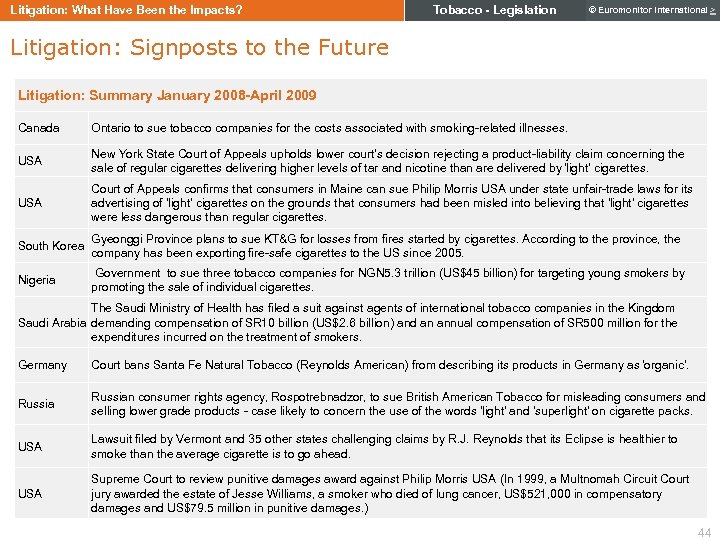
Litigation: What Have Been the Impacts? Tobacco - Legislation © Euromonitor International > Litigation: Signposts to the Future Litigation: Summary January 2008 -April 2009 Canada Ontario to sue tobacco companies for the costs associated with smoking-related illnesses. USA New York State Court of Appeals upholds lower court's decision rejecting a product-liability claim concerning the sale of regular cigarettes delivering higher levels of tar and nicotine than are delivered by 'light' cigarettes. USA Court of Appeals confirms that consumers in Maine can sue Philip Morris USA under state unfair-trade laws for its advertising of 'light' cigarettes on the grounds that consumers had been misled into believing that 'light' cigarettes were less dangerous than regular cigarettes. South Korea Gyeonggi Province plans to sue KT&G for losses from fires started by cigarettes. According to the province, the company has been exporting fire-safe cigarettes to the US since 2005. Nigeria Government to sue three tobacco companies for NGN 5. 3 trillion (US$45 billion) for targeting young smokers by promoting the sale of individual cigarettes. The Saudi Ministry of Health has filed a suit against agents of international tobacco companies in the Kingdom Saudi Arabia demanding compensation of SR 10 billion (US$2. 6 billion) and an annual compensation of SR 500 million for the expenditures incurred on the treatment of smokers. Germany Court bans Santa Fe Natural Tobacco (Reynolds American) from describing its products in Germany as 'organic'. Russian consumer rights agency, Rospotrebnadzor, to sue British American Tobacco for misleading consumers and selling lower grade products - case likely to concern the use of the words 'light' and 'superlight' on cigarette packs. USA Lawsuit filed by Vermont and 35 other states challenging claims by R. J. Reynolds that its Eclipse is healthier to smoke than the average cigarette is to go ahead. USA Supreme Court to review punitive damages award against Philip Morris USA (In 1999, a Multnomah Circuit Court jury awarded the estate of Jesse Williams, a smoker who died of lung cancer, US$521, 000 in compensatory damages and US$79. 5 million in punitive damages. ) 44
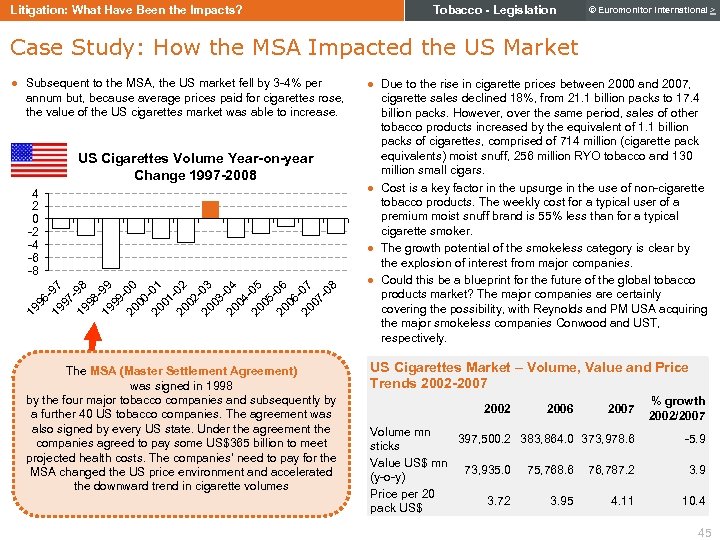
Litigation: What Have Been the Impacts? Tobacco - Legislation © Euromonitor International > Case Study: How the MSA Impacted the US Market · Subsequent to the MSA, the US market fell by 3 -4% per annum but, because average prices paid for cigarettes rose, the value of the US cigarettes market was able to increase. US Cigarettes Volume Year-on-year Change 1997 -2008 19 96 19 97 97 19 98 98 19 99 99 20 00 00 20 01 01 20 02 02 20 03 03 20 04 04 20 05 05 20 06 06 20 07 07 -0 8 4 2 0 -2 -4 -6 -8 The MSA (Master Settlement Agreement) was signed in 1998 by the four major tobacco companies and subsequently by a further 40 US tobacco companies. The agreement was also signed by every US state. Under the agreement the companies agreed to pay some US$365 billion to meet projected health costs. The companies' need to pay for the MSA changed the US price environment and accelerated the downward trend in cigarette volumes · Due to the rise in cigarette prices between 2000 and 2007, cigarette sales declined 18%, from 21. 1 billion packs to 17. 4 billion packs. However, over the same period, sales of other tobacco products increased by the equivalent of 1. 1 billion packs of cigarettes, comprised of 714 million (cigarette pack equivalents) moist snuff, 256 million RYO tobacco and 130 million small cigars. · Cost is a key factor in the upsurge in the use of non-cigarette tobacco products. The weekly cost for a typical user of a premium moist snuff brand is 55% less than for a typical cigarette smoker. · The growth potential of the smokeless category is clear by the explosion of interest from major companies. · Could this be a blueprint for the future of the global tobacco products market? The major companies are certainly covering the possibility, with Reynolds and PM USA acquiring the major smokeless companies Conwood and UST, respectively. US Cigarettes Market – Volume, Value and Price Trends 2002 -2007 2002 2006 2007 Volume mn 397, 500. 2 383, 864. 0 373, 978. 6 sticks Value US$ mn 73, 935. 0 75, 768. 6 76, 787. 2 (y-o-y) Price per 20 3. 72 3. 95 4. 11 pack US$ % growth 2002/2007 -5. 9 3. 9 10. 4 45
Tobacco - Legislation © Euromonitor International > Introduction Legislation: What Restrictions Are There? Litigation: What Have Been the Impacts? Regional Legislation: Analysis by Region Manufacturer Strategies Legislation Outlook: Where Next? 46
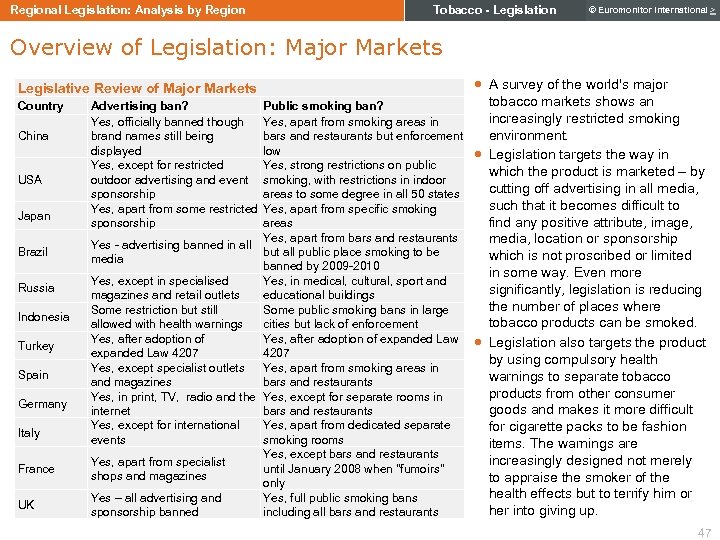
Regional Legislation: Analysis by Region Tobacco - Legislation © Euromonitor International > Overview of Legislation: Major Markets Legislative Review of Major Markets Country China USA Japan Brazil Russia Indonesia Turkey Spain Germany Italy France UK Advertising ban? Public smoking ban? Yes, officially banned though Yes, apart from smoking areas in brand names still being bars and restaurants but enforcement displayed low Yes, except for restricted Yes, strong restrictions on public outdoor advertising and event smoking, with restrictions in indoor sponsorship areas to some degree in all 50 states Yes, apart from some restricted Yes, apart from specific smoking sponsorship areas Yes, apart from bars and restaurants Yes - advertising banned in all but all public place smoking to be media banned by 2009 -2010 Yes, except in specialised Yes, in medical, cultural, sport and magazines and retail outlets educational buildings Some restriction but still Some public smoking bans in large allowed with health warnings cities but lack of enforcement Yes, after adoption of expanded Law 4207 Yes, except specialist outlets Yes, apart from smoking areas in and magazines bars and restaurants Yes, in print, TV, radio and the Yes, except for separate rooms in internet bars and restaurants Yes, except for international Yes, apart from dedicated separate events smoking rooms Yes, except bars and restaurants Yes, apart from specialist until January 2008 when "fumoirs" shops and magazines only Yes – all advertising and Yes, full public smoking bans sponsorship banned including all bars and restaurants · A survey of the world's major tobacco markets shows an increasingly restricted smoking environment. · Legislation targets the way in which the product is marketed – by cutting off advertising in all media, such that it becomes difficult to find any positive attribute, image, media, location or sponsorship which is not proscribed or limited in some way. Even more significantly, legislation is reducing the number of places where tobacco products can be smoked. · Legislation also targets the product by using compulsory health warnings to separate tobacco products from other consumer goods and makes it more difficult for cigarette packs to be fashion items. The warnings are increasingly designed not merely to appraise the smoker of the health effects but to terrify him or her into giving up. 47
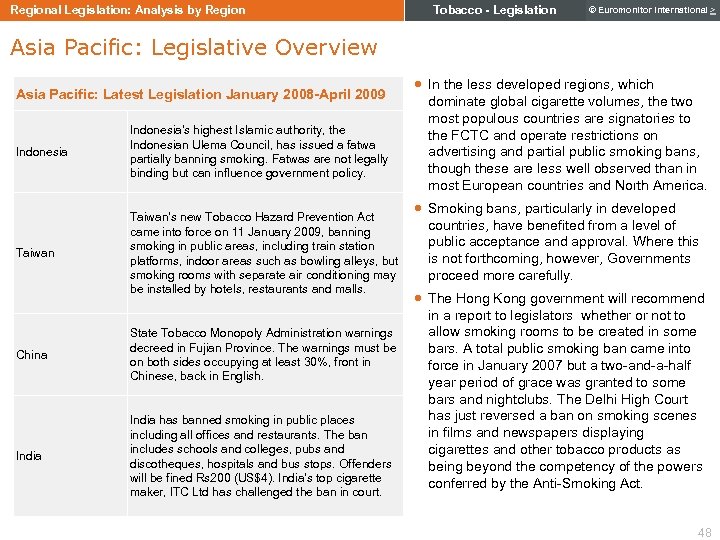
Regional Legislation: Analysis by Region Tobacco - Legislation © Euromonitor International > Asia Pacific: Legislative Overview Asia Pacific: Latest Legislation January 2008 -April 2009 Indonesia's highest Islamic authority, the Indonesian Ulema Council, has issued a fatwa partially banning smoking. Fatwas are not legally binding but can influence government policy. Taiwan's new Tobacco Hazard Prevention Act came into force on 11 January 2009, banning smoking in public areas, including train station platforms, indoor areas such as bowling alleys, but smoking rooms with separate air conditioning may be installed by hotels, restaurants and malls. China State Tobacco Monopoly Administration warnings decreed in Fujian Province. The warnings must be on both sides occupying at least 30%, front in Chinese, back in English. India has banned smoking in public places including all offices and restaurants. The ban includes schools and colleges, pubs and discotheques, hospitals and bus stops. Offenders will be fined Rs 200 (US$4). India's top cigarette maker, ITC Ltd has challenged the ban in court. · In the less developed regions, which dominate global cigarette volumes, the two most populous countries are signatories to the FCTC and operate restrictions on advertising and partial public smoking bans, though these are less well observed than in most European countries and North America. · Smoking bans, particularly in developed countries, have benefited from a level of public acceptance and approval. Where this is not forthcoming, however, Governments proceed more carefully. · The Hong Kong government will recommend in a report to legislators whether or not to allow smoking rooms to be created in some bars. A total public smoking ban came into force in January 2007 but a two-and-a-half year period of grace was granted to some bars and nightclubs. The Delhi High Court has just reversed a ban on smoking scenes in films and newspapers displaying cigarettes and other tobacco products as being beyond the competency of the powers conferred by the Anti-Smoking Act. 48
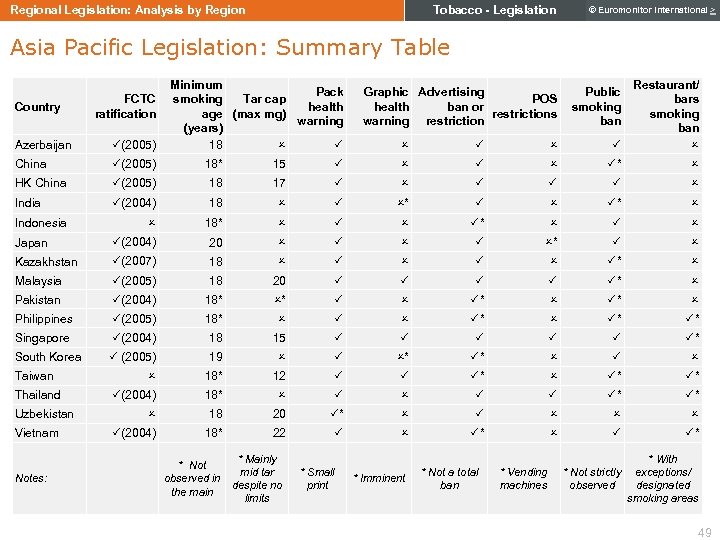
Tobacco - Legislation Regional Legislation: Analysis by Region © Euromonitor International > Asia Pacific Legislation: Summary Table Restaurant/ bars smoking ban * 17 18 * 18* * Japan (2004) 20 * Kazakhstan (2007) 18 * Malaysia (2005) 18 20 * Pakistan (2004) 18* * * Philippines (2005) 18* * Singapore (2004) 18 15 * South Korea (2005) 19 * * 18* 12 * * * (2004) 18* * * 18 20 * (2004) 18* 22 * * Not strictly observed * With exceptions/ designated smoking areas Country FCTC ratification Minimum Pack smoking Tar cap health age (max mg) warning (years) 18 Azerbaijan (2005) China (2005) 18* 15 HK China (2005) 18 India (2004) Indonesia Taiwan Thailand Uzbekistan Vietnam Notes: * Not observed in the main * Mainly mid tar despite no limits * Small print Graphic Advertising POS health ban or restrictions warning restriction * Imminent * Not a total ban * Vending machines Public smoking ban 49
Regional Legislation: Analysis by Region Tobacco - Legislation © Euromonitor International > Asia Pacific Legislation: Analysis by Country (Part 1) · In Azerbaijan production and sale of cigarettes must be licensed but underage sales from street vendors, often of single sticks continues. Similarly, there is an advertising ban but polythene bags with tobacco company logos are sold. · In China there are clearly efforts being made to impose and implement tobacco control legislation in accordance with the FCTC but there remains a gap between intention and achievement. Starting in April 2007, the biggest scale anti-tobacco project 'Stepping into No-Smoking China' was launched jointly by the China Disease Control Centre and China Medical and Health Ministry across 20 provinces, in an attempt to reduce smoking in public places in both urban and rural China. The projects have a concrete aim of reducing the population of second-hand smokers from 53% to 30%, according to the ministry. · In Hong Kong, however, bans are being extended into previously exempt areas such as bars and restaurants and graphic warnings are compulsory. Graphic warnings are expected to be introduced in India along with other new guidelines to enforce previously ignored public smoking bans. · Indonesia is the only country besides North Korea not to sign the World Health Organisation's Framework Convention on Tobacco Control (FCTC) in 2003. The Indonesian government's non-interventionism is because policy thinking is inclining to the view that the tobacco industry is of greater benefit to the economy than tobacco control measures. · In Malaysia manufacturers are required to print all six of a set of warning graphics including pictures of neck, mouth and lung cancers as well as gangrene and miscarriages. By 1 June 2009, all cigarette packs must include the health warnings. · Culture and infrastructure are key elements of tobacco control. In Pakistan, although there is no tar limit most people smoke mid-tar but generally restrictions are not enforced. On the other hand, Singapore is one of the strongest tobacco control regimes because rules are enforced; in January 2008, four retailers had their tobacco retail licences suspended for six months after the employees were found to have repeatedly sold tobacco products to under-age customers. 50
Regional Legislation: Analysis by Region Tobacco - Legislation © Euromonitor International > Asia Pacific Legislation: Analysis by Country (Part 2) · The Philippines, despite being an early signatory, does not tend to impose the regulations. Here, the legal smoking age is 18 but cigarettes continue to be available to minors through sari-sari stores and street vendors. Similarly, in Kazakhstan, public smoking bans have low acceptance: in many educational institutions and offices, for example, people simply smoke in the toilets. · In South Korea the anti-smoking TV advertising campaign that highlights the risk of second-hand smoking and the rights of non-smokers through a "Say no" song greatly contributed to establishing social resistance to smoking in public places, and permitted smoking areas will disappear if the proposals of the Health Ministry are approved in the national assembly. · In Taiwan graphics including pictures of a cancerous lung covered over 35% of the pack on both sides were introduced from December 2008. In response, some brands offered cigarette cases as gifts at the store checkout in order to cover those pictures. · In February 2008, Thailand banned smoking in all bars and nightclubs. Even popular open-air eateries and markets must have dedicated smoking sections. This recent regulation is an extension of 2006 regulations that turned most public places into smoke-free zones, but did not cover night entertainment venues. · Thailand was the fourth country in the world to adopt graphic warning pictures on cigarette packs, in 2005. The first series comprises six pictures showing the problems to which smoking can contribute. These include premature wrinkles, dental problems and the impact of second-hand smoke on children, bronchitis, lung cancer and death. According to surveys smokers always ask for the pack with the least scary picture. In 2008, the government announced graphics extended to smoking tobacco and cigars packaging. · In Vietnam cigarettes are designated "discouraging-consumed products", which means that no new investment is allowed in the tobacco market. However, smoking is accepted and there are no anti-smoking groups in the country and few governmental campaigns to encourage people to stop smoking. 51
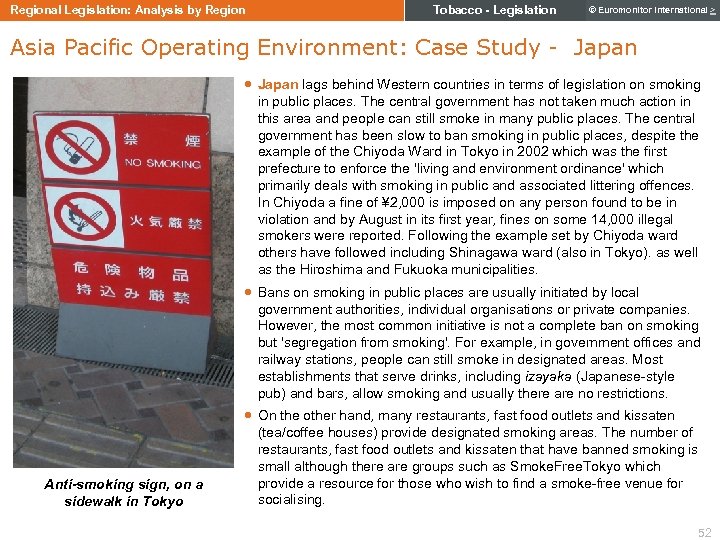
Regional Legislation: Analysis by Region Tobacco - Legislation © Euromonitor International > Asia Pacific Operating Environment: Case Study - Japan · Japan lags behind Western countries in terms of legislation on smoking in public places. The central government has not taken much action in this area and people can still smoke in many public places. The central government has been slow to ban smoking in public places, despite the example of the Chiyoda Ward in Tokyo in 2002 which was the first prefecture to enforce the 'living and environment ordinance' which primarily deals with smoking in public and associated littering offences. In Chiyoda a fine of ¥ 2, 000 is imposed on any person found to be in violation and by August in its first year, fines on some 14, 000 illegal smokers were reported. Following the example set by Chiyoda ward others have followed including Shinagawa ward (also in Tokyo). as well as the Hiroshima and Fukuoka municipalities. · Bans on smoking in public places are usually initiated by local government authorities, individual organisations or private companies. However, the most common initiative is not a complete ban on smoking but 'segregation from smoking'. For example, in government offices and railway stations, people can still smoke in designated areas. Most establishments that serve drinks, including izayaka (Japanese-style pub) and bars, allow smoking and usually there are no restrictions. · On the other hand, many restaurants, fast food outlets and kissaten Anti-smoking sign, on a sidewalk in Tokyo (tea/coffee houses) provide designated smoking areas. The number of restaurants, fast food outlets and kissaten that have banned smoking is small although there are groups such as Smoke. Free. Tokyo which provide a resource for those who wish to find a smoke-free venue for socialising. 52
Tobacco - Legislation Regional Legislation: Analysis by Region © Euromonitor International > Australasia: Legislative Overview · Australia has the most rigorous anti-smoking environment in Asia Pacific, with health warning graphics which include gangrenous feet and diseased lungs. However, there are exceptions to public smoking bans. In retail display space, restrictions have been imposed with cigars hit hardest as, when space is prioritised, manufacturers choose to display cigarettes. · As indicated in the table, car smoking bans, display bans at point of sale, and, inevitably, calls for fire-safe/low -ignition cigarettes following the disastrous Victoria fires in which cigarettes were implicated, became a key issue recently. · Graphic warning on packs are regarded as having an impact, since reports suggest that smokers are asking for packs with less disturbing warning pictures on them. Australia: Latest Legislation January 2008 -April 2009 Legislation Location Background Graphic warnings New Zealand A year after the introduction of graphic health warnings, smoking prevalence in New Zealand fell from 25% to 20% of the adult population POS display ban New South Wales Display of packs at point of sale ban plus vending machine restrictions to prevent under age purchasers. Car smoking ban Queensland bans smoking in cars carrying passengers under the age of 16, with A$150 on-the-spot fines for the adult. Car smoking ban South Australia 86 fines during the first year following the imposition of a state law banning smoking in vehicles carrying children. Car smoking ban New South Wales Queensland bans smoking in cars carrying young people under the age of 16. Canberra Self-extinguishing cigarettes could be mandatory in Australia from 2009. Following a meeting of emergency services ministers in Canberra, LIP (low-ignition) cigarettes were fast-tracked in response to the bush fires. Fire-safe cigarettes 53
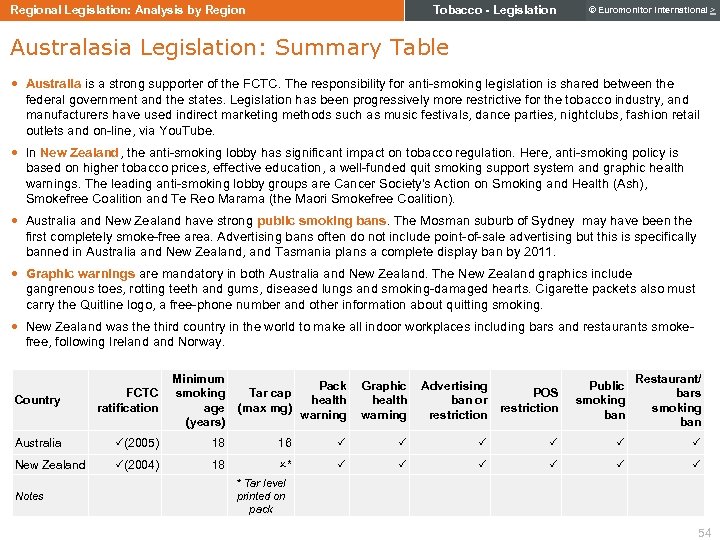
Tobacco - Legislation Regional Legislation: Analysis by Region © Euromonitor International > Australasia Legislation: Summary Table · Australia is a strong supporter of the FCTC. The responsibility for anti-smoking legislation is shared between the federal government and the states. Legislation has been progressively more restrictive for the tobacco industry, and manufacturers have used indirect marketing methods such as music festivals, dance parties, nightclubs, fashion retail outlets and on-line, via You. Tube. · In New Zealand, the anti-smoking lobby has significant impact on tobacco regulation. Here, anti-smoking policy is based on higher tobacco prices, effective education, a well-funded quit smoking support system and graphic health warnings. The leading anti-smoking lobby groups are Cancer Society's Action on Smoking and Health (Ash), Smokefree Coalition and Te Reo Marama (the Maori Smokefree Coalition). · Australia and New Zealand have strong public smoking bans. The Mosman suburb of Sydney may have been the first completely smoke-free area. Advertising bans often do not include point-of-sale advertising but this is specifically banned in Australia and New Zealand, and Tasmania plans a complete display ban by 2011. · Graphic warnings are mandatory in both Australia and New Zealand. The New Zealand graphics include gangrenous toes, rotting teeth and gums, diseased lungs and smoking-damaged hearts. Cigarette packets also must carry the Quitline logo, a free-phone number and other information about quitting smoking. · New Zealand was the third country in the world to make all indoor workplaces including bars and restaurants smokefree, following Ireland Norway. Country FCTC ratification Minimum smoking age (years) Australia (2005) 18 16 New Zealand (2004) 18 * Notes Pack Tar cap health (max mg) warning Graphic health warning Advertising ban or restriction POS restriction Public smoking ban Restaurant/ bars smoking ban * Tar level printed on pack 54
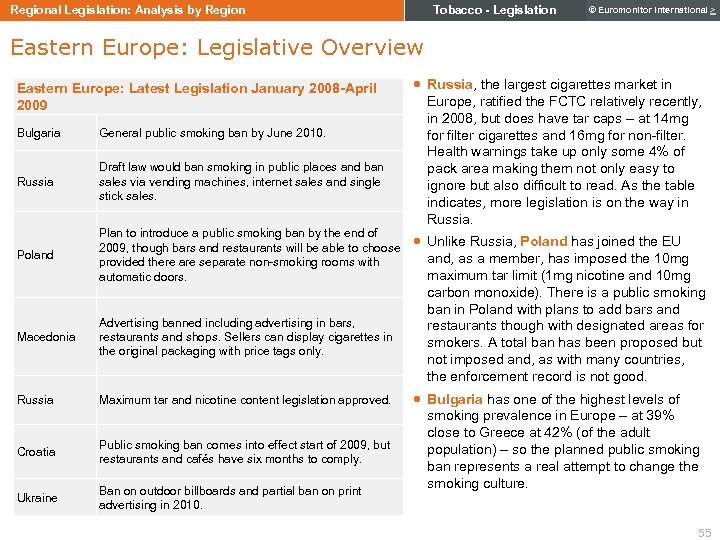
Tobacco - Legislation Regional Legislation: Analysis by Region © Euromonitor International > Eastern Europe: Legislative Overview Eastern Europe: Latest Legislation January 2008 -April 2009 Bulgaria General public smoking ban by June 2010. Russia Draft law would ban smoking in public places and ban sales via vending machines, internet sales and single stick sales. Poland Plan to introduce a public smoking ban by the end of 2009, though bars and restaurants will be able to choose provided there are separate non-smoking rooms with automatic doors. Macedonia Advertising banned including advertising in bars, restaurants and shops. Sellers can display cigarettes in the original packaging with price tags only. Russia Maximum tar and nicotine content legislation approved. Croatia Public smoking ban comes into effect start of 2009, but restaurants and cafés have six months to comply. Ukraine Ban on outdoor billboards and partial ban on print advertising in 2010. · Russia, the largest cigarettes market in Europe, ratified the FCTC relatively recently, in 2008, but does have tar caps – at 14 mg for filter cigarettes and 16 mg for non-filter. Health warnings take up only some 4% of pack area making them not only easy to ignore but also difficult to read. As the table indicates, more legislation is on the way in Russia. · Unlike Russia, Poland has joined the EU and, as a member, has imposed the 10 mg maximum tar limit (1 mg nicotine and 10 mg carbon monoxide). There is a public smoking ban in Poland with plans to add bars and restaurants though with designated areas for smokers. A total ban has been proposed but not imposed and, as with many countries, the enforcement record is not good. · Bulgaria has one of the highest levels of smoking prevalence in Europe – at 39% close to Greece at 42% (of the adult population) – so the planned public smoking ban represents a real attempt to change the smoking culture. 55
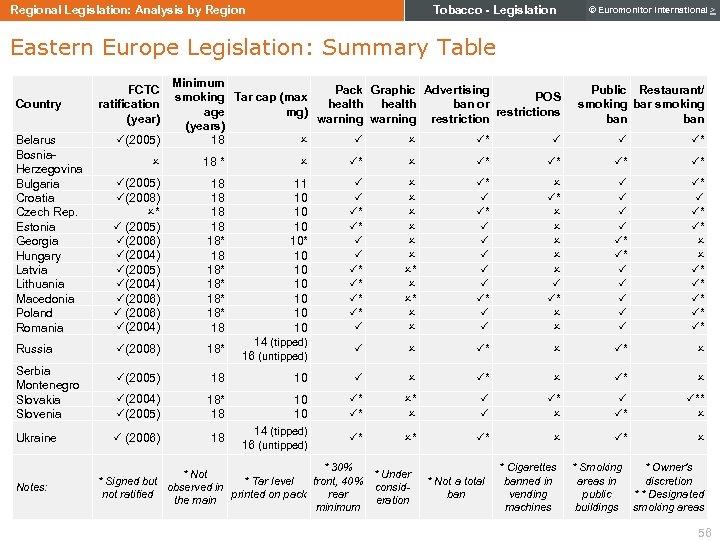
Tobacco - Legislation Regional Legislation: Analysis by Region © Euromonitor International > Eastern Europe Legislation: Summary Table Country Minimum Pack Graphic Advertising smoking Tar cap (max POS health ban or age mg) restrictions warning restriction (years) (2005) * 18 FCTC ratification (year) Belarus Bosnia. Herzegovina Bulgaria Croatia Czech Rep. Estonia Georgia Hungary Latvia Lithuania Macedonia Poland Romania 18 * * * (2005) (2008) * (2005) (2006) (2004) (2005) (2004) (2006) (2004) 18 18 18* 18* 18* 18 11 10 10* 10 10 10 * * * * * Russia (2008) 18* 14 (tipped) 16 (untipped) (2005) 18 10 (2004) (2005) 18* 18 (2006) 18 Serbia Montenegro Slovakia Slovenia Ukraine Notes: Public Restaurant/ smoking bar smoking ban * * * * * * * * * 10 10 * * * ** 14 (tipped) 16 (untipped) * * * * * 30% * Not * Under * Signed but * Tar level front, 40% observed in considnot ratified printed on pack rear the main eration minimum * Not a total ban * Cigarettes banned in vending machines * Smoking areas in public buildings * Owner's discretion * * Designated smoking areas 56
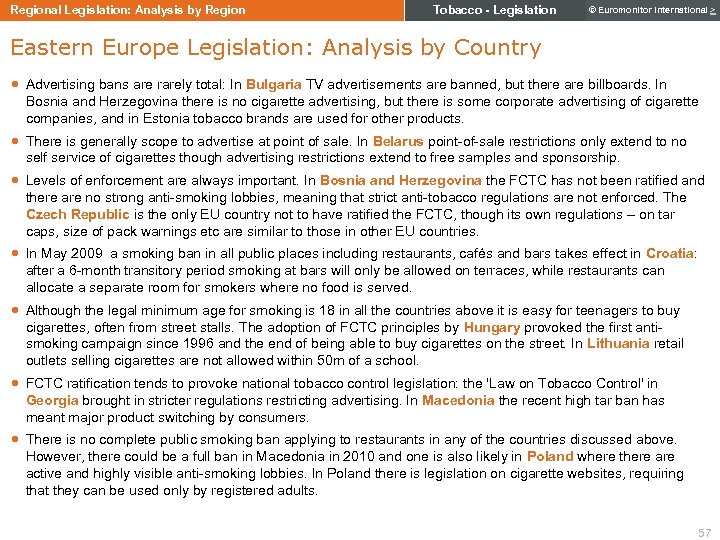
Regional Legislation: Analysis by Region Tobacco - Legislation © Euromonitor International > Eastern Europe Legislation: Analysis by Country · Advertising bans are rarely total: In Bulgaria TV advertisements are banned, but there are billboards. In Bosnia and Herzegovina there is no cigarette advertising, but there is some corporate advertising of cigarette companies, and in Estonia tobacco brands are used for other products. · There is generally scope to advertise at point of sale. In Belarus point-of-sale restrictions only extend to no self service of cigarettes though advertising restrictions extend to free samples and sponsorship. · Levels of enforcement are always important. In Bosnia and Herzegovina the FCTC has not been ratified and there are no strong anti-smoking lobbies, meaning that strict anti-tobacco regulations are not enforced. The Czech Republic is the only EU country not to have ratified the FCTC, though its own regulations – on tar caps, size of pack warnings etc are similar to those in other EU countries. · In May 2009 a smoking ban in all public places including restaurants, cafés and bars takes effect in Croatia: after a 6 -month transitory period smoking at bars will only be allowed on terraces, while restaurants can allocate a separate room for smokers where no food is served. · Although the legal minimum age for smoking is 18 in all the countries above it is easy for teenagers to buy cigarettes, often from street stalls. The adoption of FCTC principles by Hungary provoked the first antismoking campaign since 1996 and the end of being able to buy cigarettes on the street. In Lithuania retail outlets selling cigarettes are not allowed within 50 m of a school. · FCTC ratification tends to provoke national tobacco control legislation: the 'Law on Tobacco Control' in Georgia brought in stricter regulations restricting advertising. In Macedonia the recent high tar ban has meant major product switching by consumers. · There is no complete public smoking ban applying to restaurants in any of the countries discussed above. However, there could be a full ban in Macedonia in 2010 and one is also likely in Poland where there active and highly visible anti-smoking lobbies. In Poland there is legislation on cigarette websites, requiring that they can be used only by registered adults. 57
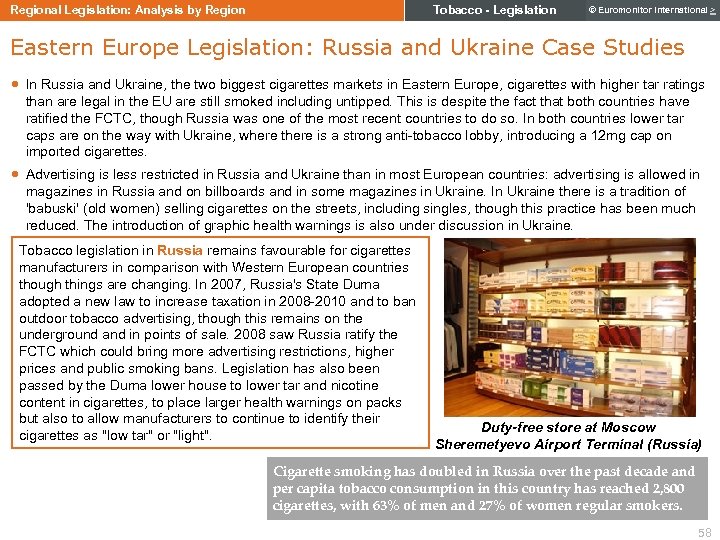
Tobacco - Legislation Regional Legislation: Analysis by Region © Euromonitor International > Eastern Europe Legislation: Russia and Ukraine Case Studies · In Russia and Ukraine, the two biggest cigarettes markets in Eastern Europe, cigarettes with higher tar ratings than are legal in the EU are still smoked including untipped. This is despite the fact that both countries have ratified the FCTC, though Russia was one of the most recent countries to do so. In both countries lower tar caps are on the way with Ukraine, where there is a strong anti-tobacco lobby, introducing a 12 mg cap on imported cigarettes. · Advertising is less restricted in Russia and Ukraine than in most European countries: advertising is allowed in magazines in Russia and on billboards and in some magazines in Ukraine. In Ukraine there is a tradition of 'babuski' (old women) selling cigarettes on the streets, including singles, though this practice has been much reduced. The introduction of graphic health warnings is also under discussion in Ukraine. Tobacco legislation in Russia remains favourable for cigarettes manufacturers in comparison with Western European countries though things are changing. In 2007, Russia's State Duma adopted a new law to increase taxation in 2008 -2010 and to ban outdoor tobacco advertising, though this remains on the underground and in points of sale. 2008 saw Russia ratify the FCTC which could bring more advertising restrictions, higher prices and public smoking bans. Legislation has also been passed by the Duma lower house to lower tar and nicotine content in cigarettes, to place larger health warnings on packs but also to allow manufacturers to continue to identify their cigarettes as "low tar" or "light". Duty-free store at Moscow Sheremetyevo Airport Terminal (Russia) Cigarette smoking has doubled in Russia over the past decade and per capita tobacco consumption in this country has reached 2, 800 cigarettes, with 63% of men and 27% of women regular smokers. 58
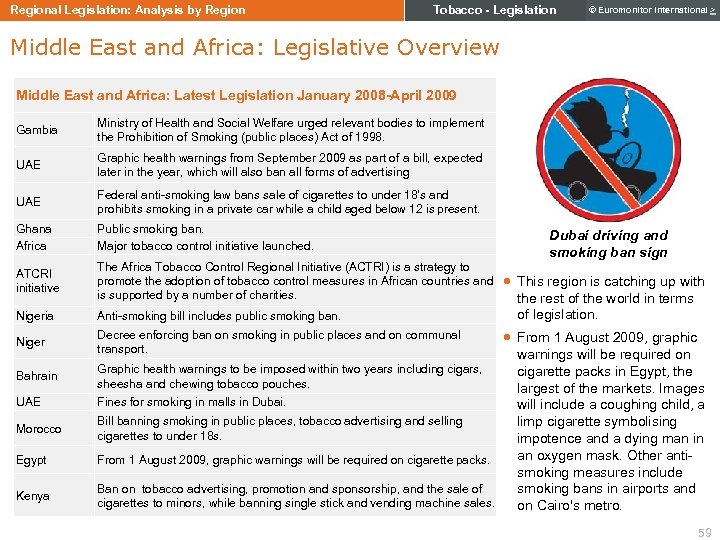
Regional Legislation: Analysis by Region Tobacco - Legislation © Euromonitor International > Middle East and Africa: Legislative Overview Middle East and Africa: Latest Legislation January 2008 -April 2009 Gambia Ministry of Health and Social Welfare urged relevant bodies to implement the Prohibition of Smoking (public places) Act of 1998. UAE Graphic health warnings from September 2009 as part of a bill, expected later in the year, which will also ban all forms of advertising UAE Federal anti-smoking law bans sale of cigarettes to under 18's and prohibits smoking in a private car while a child aged below 12 is present. Ghana Africa Public smoking ban. Major tobacco control initiative launched. ATCRI initiative The Africa Tobacco Control Regional Initiative (ACTRI) is a strategy to promote the adoption of tobacco control measures in African countries and is supported by a number of charities. Nigeria Anti-smoking bill includes public smoking ban. Niger Decree enforcing ban on smoking in public places and on communal transport. Bahrain Graphic health warnings to be imposed within two years including cigars, sheesha and chewing tobacco pouches. UAE Fines for smoking in malls in Dubai. Morocco Bill banning smoking in public places, tobacco advertising and selling cigarettes to under 18 s. Egypt From 1 August 2009, graphic warnings will be required on cigarette packs. Kenya Ban on tobacco advertising, promotion and sponsorship, and the sale of cigarettes to minors, while banning single stick and vending machine sales. Dubai driving and smoking ban sign · This region is catching up with the rest of the world in terms of legislation. · From 1 August 2009, graphic warnings will be required on cigarette packs in Egypt, the largest of the markets. Images will include a coughing child, a limp cigarette symbolising impotence and a dying man in an oxygen mask. Other antismoking measures include smoking bans in airports and on Cairo's metro. 59
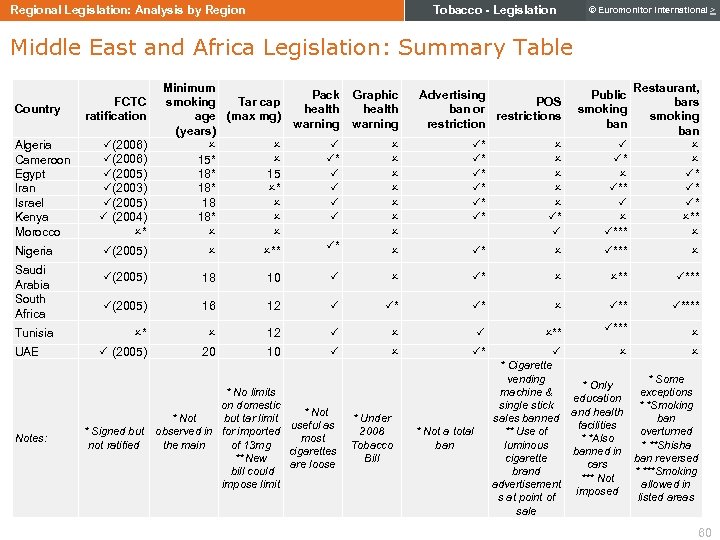
Tobacco - Legislation Regional Legislation: Analysis by Region © Euromonitor International > Middle East and Africa Legislation: Summary Table Country FCTC ratification Minimum smoking Tar cap age (max mg) (years) 15* 18* 15 * 18* Pack health warning Graphic health warning * * * * * * ** *** Restaurant, bars smoking ban * ** Advertising POS ban or restrictions restriction Public smoking ban Algeria Cameroon Egypt Iran Israel Kenya Morocco (2006) (2005) (2003) (2005) (2004) * Nigeria (2005) ** * * *** (2005) 18 10 * ** *** (2005) 16 12 * * ** **** * 12 *** (2005) 20 10 * Saudi Arabia South Africa Tunisia UAE Notes: * Signed but not ratified * No limits on domestic * Not but tar limit useful as observed in for imported most the main of 13 mg cigarettes ** New are loose bill could impose limit * Under 2008 Tobacco Bill * Not a total ban * Cigarette vending * Only machine & education single stick and health sales banned facilities ** Use of * *Also luminous banned in cigarette cars brand *** Not advertisement imposed s at point of sale * Some exceptions * *Smoking ban overturned * **Shisha ban reversed * ***Smoking allowed in listed areas 60
Regional Legislation: Analysis by Region Tobacco - Legislation © Euromonitor International > Middle East and Africa Legislation: Analysis by Country · In developing countries in particular there is a dichotomy between perceived health risks and revenue needs, the economy and employment. This is why in some countries, which have ratified the FCTC, tobacco control legislation is slow to be implemented and enforced. In Algeria and Egypt public smoking bans are not observed while, in Kenya, a smoking ban was overturned in October 2008 although it is likely to be restored. · The minimum age at which smoking is permitted is generally 18, but in many developing countries, younger teenagers can easily buy cigarettes. In Kenya 13% of under 15 s smoke, according to research. · Tar caps are far less frequent in developing countries and even, as is the case in Egypt, there is a cap, it is circumvented by use of sheesha which has a far higher tar delivery. However, in Iran and Israel, more stringent efforts have been made to impose tobacco control. In Iran smoking has been banned in coffee shops and all enclosed public areas and also when driving. In Israel, the sale or use of water pipes by under 18 s has been banned – research shows 30% of Israeli youth smoke water pipes. · Single stick sales are a key issue in developing countries and have been banned in Kenya. In Cameroon, however, a high proportion of sales are single stick, which means that health warnings on packs become ineffective. · Morocco and Tunisia are the only North African markets in the list above not to have ratified the FCTC, though both countries are signatories and in neither country is there a minimum smoking age law. · In the countries which have ratified the FCTC there is more evidence of moving towards stricter tobacco control. In Nigeria there is clear evidence of strengthening anti-tobacco feeling in the National Tobacco Control Bill 2009 which could change the market by imposing tar caps and minimum age. The public smoking ban in Abuja in May 2008, which included restaurants, bars and some open areas, also demonstrates this. · There is also Government focus on reducing smoking in Saudi Arabia with its campaigns. A public smoking ban includes shopping malls, but a law passed to shut down shisha establishments was reversed. · More evidence of the tightening environment resides in The Tobacco Products Control Amendment Act in South Africa, which could raise the smoking age limit and impose pack warning graphics. · The UAE has raised the smoking age to 20, while Dubai became the first UAE city to impose a public smoking ban. Graphic warnings were approved for Dubai in 2008. 61
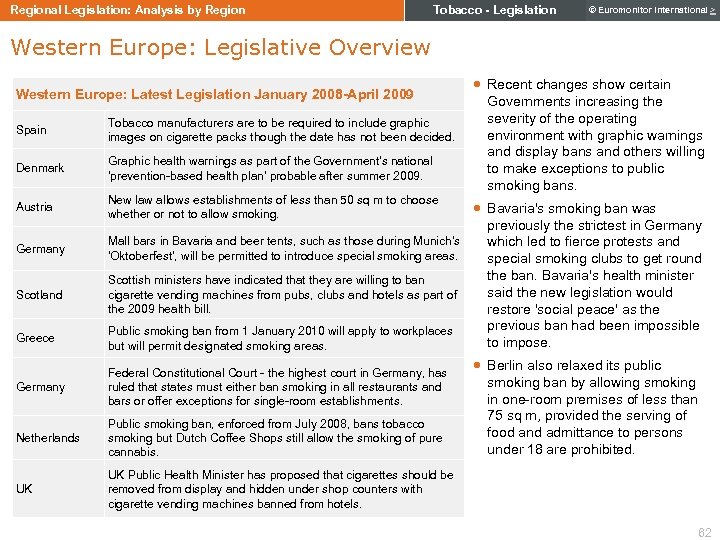
Regional Legislation: Analysis by Region Tobacco - Legislation © Euromonitor International > Western Europe: Legislative Overview Western Europe: Latest Legislation January 2008 -April 2009 Spain Tobacco manufacturers are to be required to include graphic images on cigarette packs though the date has not been decided. Denmark Graphic health warnings as part of the Government's national 'prevention-based health plan' probable after summer 2009. Austria New law allows establishments of less than 50 sq m to choose whether or not to allow smoking. Germany Mall bars in Bavaria and beer tents, such as those during Munich's 'Oktoberfest', will be permitted to introduce special smoking areas. Scotland Scottish ministers have indicated that they are willing to ban cigarette vending machines from pubs, clubs and hotels as part of the 2009 health bill. Greece Public smoking ban from 1 January 2010 will apply to workplaces but will permit designated smoking areas. Germany Federal Constitutional Court - the highest court in Germany, has ruled that states must either ban smoking in all restaurants and bars or offer exceptions for single-room establishments. Netherlands Public smoking ban, enforced from July 2008, bans tobacco smoking but Dutch Coffee Shops still allow the smoking of pure cannabis. UK · Recent changes show certain Governments increasing the severity of the operating environment with graphic warnings and display bans and others willing to make exceptions to public smoking bans. · Bavaria's smoking ban was previously the strictest in Germany which led to fierce protests and special smoking clubs to get round the ban. Bavaria's health minister said the new legislation would restore 'social peace' as the previous ban had been impossible to impose. UK Public Health Minister has proposed that cigarettes should be removed from display and hidden under shop counters with cigarette vending machines banned from hotels. · Berlin also relaxed its public smoking ban by allowing smoking in one-room premises of less than 75 sq m, provided the serving of food and admittance to persons under 18 are prohibited. 62
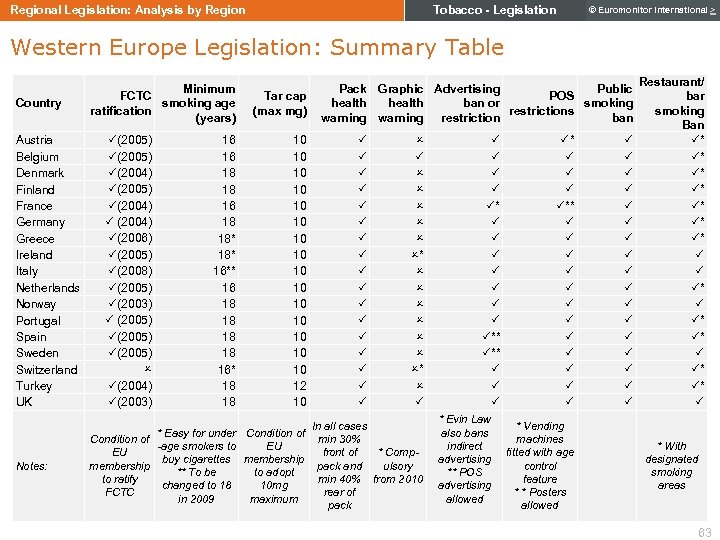
Tobacco - Legislation Regional Legislation: Analysis by Region © Euromonitor International > Western Europe Legislation: Summary Table Country Austria Belgium Denmark Finland France Germany Greece Ireland Italy Netherlands Norway Portugal Spain Sweden Switzerland Turkey UK Notes: Minimum FCTC smoking age ratification (years) Tar cap (max mg) 16 16 18 18* 18* 16** 16 18 18 16* 18 18 10 10 10 10 12 10 (2005) (2004) (2006) (2005) (2008) (2005) (2003) (2005) (2004) (2003) Pack Graphic Advertising Public POS health ban or smoking restrictions warning restriction ban * * In all cases * Easy for under Condition of min 30% -age smokers to EU * Comp. EU front of buy cigarettes membership ulsory membership pack and ** To be to adopt to ratify min 40% from 2010 changed to 18 10 mg FCTC rear of in 2009 maximum pack * ** ** * Evin Law also bans indirect advertising ** POS advertising allowed * ** * Vending machines fitted with age control feature * * Posters allowed Restaurant/ bar smoking Ban * * * * * With designated smoking areas 63
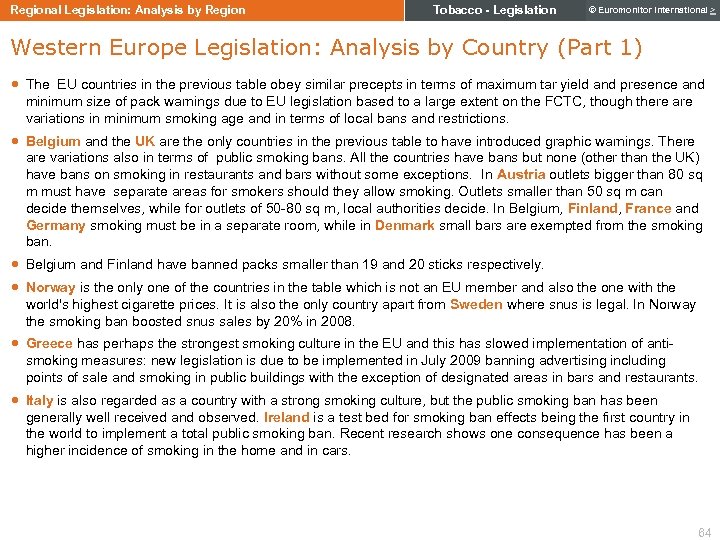
Regional Legislation: Analysis by Region Tobacco - Legislation © Euromonitor International > Western Europe Legislation: Analysis by Country (Part 1) · The EU countries in the previous table obey similar precepts in terms of maximum tar yield and presence and minimum size of pack warnings due to EU legislation based to a large extent on the FCTC, though there are variations in minimum smoking age and in terms of local bans and restrictions. · Belgium and the UK are the only countries in the previous table to have introduced graphic warnings. There are variations also in terms of public smoking bans. All the countries have bans but none (other than the UK) have bans on smoking in restaurants and bars without some exceptions. In Austria outlets bigger than 80 sq m must have separate areas for smokers should they allow smoking. Outlets smaller than 50 sq m can decide themselves, while for outlets of 50 -80 sq m, local authorities decide. In Belgium, Finland, France and Germany smoking must be in a separate room, while in Denmark small bars are exempted from the smoking ban. · Belgium and Finland have banned packs smaller than 19 and 20 sticks respectively. · Norway is the only one of the countries in the table which is not an EU member and also the one with the world's highest cigarette prices. It is also the only country apart from Sweden where snus is legal. In Norway the smoking ban boosted snus sales by 20% in 2008. · Greece has perhaps the strongest smoking culture in the EU and this has slowed implementation of antismoking measures: new legislation is due to be implemented in July 2009 banning advertising including points of sale and smoking in public buildings with the exception of designated areas in bars and restaurants. · Italy is also regarded as a country with a strong smoking culture, but the public smoking ban has been generally well received and observed. Ireland is a test bed for smoking ban effects being the first country in the world to implement a total public smoking ban. Recent research shows one consequence has been a higher incidence of smoking in the home and in cars. 64
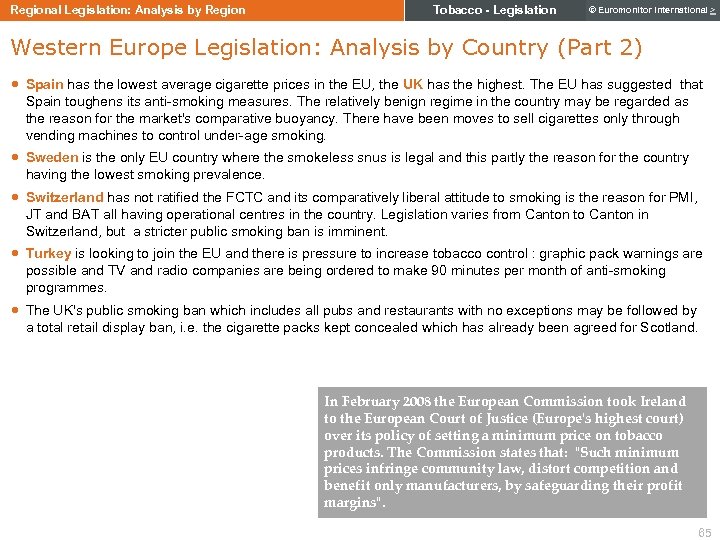
Regional Legislation: Analysis by Region Tobacco - Legislation © Euromonitor International > Western Europe Legislation: Analysis by Country (Part 2) · Spain has the lowest average cigarette prices in the EU, the UK has the highest. The EU has suggested that Spain toughens its anti-smoking measures. The relatively benign regime in the country may be regarded as the reason for the market's comparative buoyancy. There have been moves to sell cigarettes only through vending machines to control under-age smoking. · Sweden is the only EU country where the smokeless snus is legal and this partly the reason for the country having the lowest smoking prevalence. · Switzerland has not ratified the FCTC and its comparatively liberal attitude to smoking is the reason for PMI, JT and BAT all having operational centres in the country. Legislation varies from Canton to Canton in Switzerland, but a stricter public smoking ban is imminent. · Turkey is looking to join the EU and there is pressure to increase tobacco control : graphic pack warnings are possible and TV and radio companies are being ordered to make 90 minutes per month of anti-smoking programmes. · The UK's public smoking ban which includes all pubs and restaurants with no exceptions may be followed by a total retail display ban, i. e. the cigarette packs kept concealed which has already been agreed for Scotland. In February 2008 the European Commission took Ireland to the European Court of Justice (Europe's highest court) over its policy of setting a minimum price on tobacco products. The Commission states that: "Such minimum prices infringe community law, distort competition and benefit only manufacturers, by safeguarding their profit margins". 65
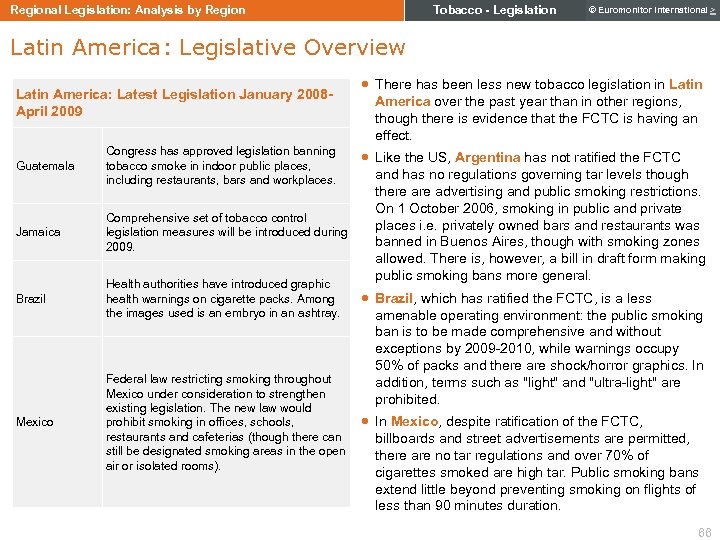
Tobacco - Legislation Regional Legislation: Analysis by Region © Euromonitor International > Latin America: Legislative Overview Latin America: Latest Legislation January 2008 April 2009 · There has been less new tobacco legislation in Latin America over the past year than in other regions, though there is evidence that the FCTC is having an effect. Guatemala Congress has approved legislation banning tobacco smoke in indoor public places, including restaurants, bars and workplaces. Jamaica Comprehensive set of tobacco control legislation measures will be introduced during 2009. Brazil Health authorities have introduced graphic health warnings on cigarette packs. Among the images used is an embryo in an ashtray. · Brazil, which has ratified the FCTC, is a less Federal law restricting smoking throughout Mexico under consideration to strengthen existing legislation. The new law would prohibit smoking in offices, schools, restaurants and cafeterias (though there can still be designated smoking areas in the open air or isolated rooms). · In Mexico, despite ratification of the FCTC, Mexico · Like the US, Argentina has not ratified the FCTC and has no regulations governing tar levels though there advertising and public smoking restrictions. On 1 October 2006, smoking in public and private places i. e. privately owned bars and restaurants was banned in Buenos Aires, though with smoking zones allowed. There is, however, a bill in draft form making public smoking bans more general. amenable operating environment: the public smoking ban is to be made comprehensive and without exceptions by 2009 -2010, while warnings occupy 50% of packs and there are shock/horror graphics. In addition, terms such as "light" and "ultra-light" are prohibited. billboards and street advertisements are permitted, there are no tar regulations and over 70% of cigarettes smoked are high tar. Public smoking bans extend little beyond preventing smoking on flights of less than 90 minutes duration. 66
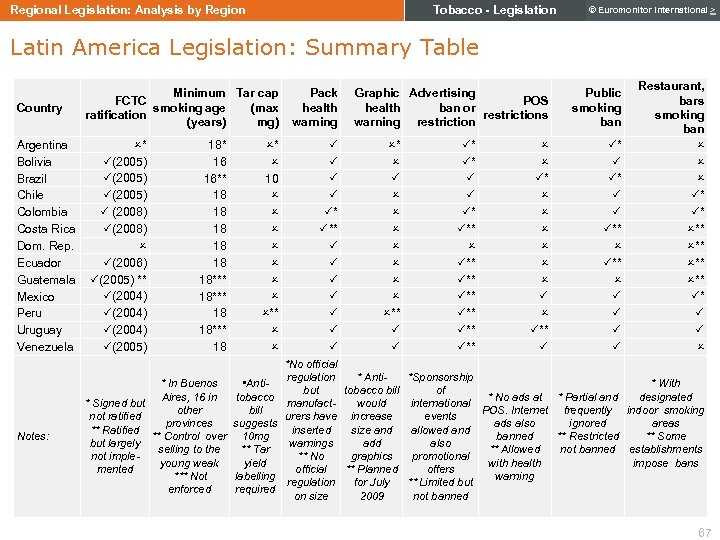
Tobacco - Legislation Regional Legislation: Analysis by Region © Euromonitor International > Latin America Legislation: Summary Table Country Argentina Bolivia Brazil Chile Colombia Costa Rica Dom. Rep. Ecuador Guatemala Mexico Peru Uruguay Venezuela Notes: Minimum Tar cap FCTC smoking age (max ratification (years) mg) * (2005) (2008) (2006) (2005) ** (2004) (2005) 18* 16 16** 18 18 18*** 18 * In Buenos Aires, 16 in * Signed but other not ratified provinces ** Ratified ** Control over but largely selling to the not impleyoung weak mented *** Not enforced * 10 ** • Antitobacco bill suggests 10 mg ** Tar yield labelling required Pack health warning * ** Graphic Advertising POS health ban or restrictions warning restriction * ** ** ** ** * ** Public smoking ban * * ** Restaurant, bars smoking ban * * ** ** * *No official * Anti*Sponsorship regulation * With tobacco bill of but * No ads at * Partial and designated manufactwould international POS. Internet frequently indoor smoking urers have increase events ads also ignored areas inserted size and allowed and banned ** Restricted ** Some warnings add also ** Allowed not banned establishments ** No graphics promotional with health impose bans official ** Planned offers warning for July ** Limited but regulation on size 2009 not banned 67
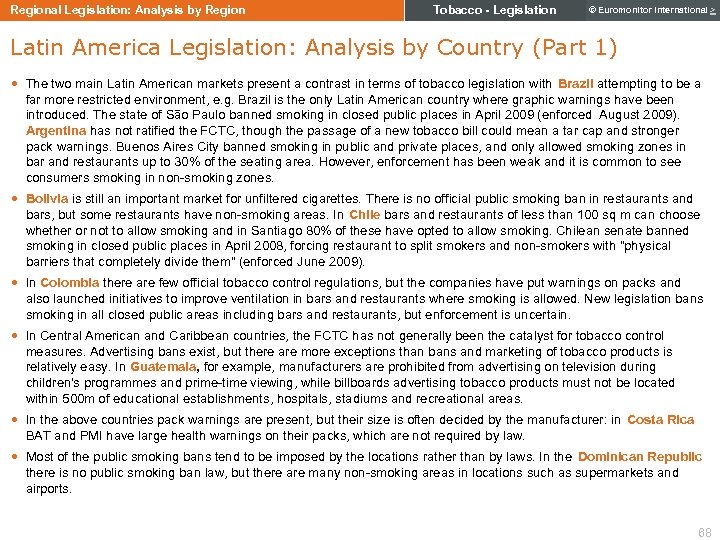
Regional Legislation: Analysis by Region Tobacco - Legislation © Euromonitor International > Latin America Legislation: Analysis by Country (Part 1) · The two main Latin American markets present a contrast in terms of tobacco legislation with Brazil attempting to be a far more restricted environment, e. g. Brazil is the only Latin American country where graphic warnings have been introduced. The state of São Paulo banned smoking in closed public places in April 2009 (enforced August 2009). Argentina has not ratified the FCTC, though the passage of a new tobacco bill could mean a tar cap and stronger pack warnings. Buenos Aires City banned smoking in public and private places, and only allowed smoking zones in bar and restaurants up to 30% of the seating area. However, enforcement has been weak and it is common to see consumers smoking in non-smoking zones. · Bolivia is still an important market for unfiltered cigarettes. There is no official public smoking ban in restaurants and bars, but some restaurants have non-smoking areas. In Chile bars and restaurants of less than 100 sq m can choose whether or not to allow smoking and in Santiago 80% of these have opted to allow smoking. Chilean senate banned smoking in closed public places in April 2008, forcing restaurant to split smokers and non-smokers with "physical barriers that completely divide them" (enforced June 2009). · In Colombia there are few official tobacco control regulations, but the companies have put warnings on packs and also launched initiatives to improve ventilation in bars and restaurants where smoking is allowed. New legislation bans smoking in all closed public areas including bars and restaurants, but enforcement is uncertain. · In Central American and Caribbean countries, the FCTC has not generally been the catalyst for tobacco control measures. Advertising bans exist, but there are more exceptions than bans and marketing of tobacco products is relatively easy. In Guatemala, for example, manufacturers are prohibited from advertising on television during children's programmes and prime-time viewing, while billboards advertising tobacco products must not be located within 500 m of educational establishments, hospitals, stadiums and recreational areas. · In the above countries pack warnings are present, but their size is often decided by the manufacturer: in Costa Rica BAT and PMI have large health warnings on their packs, which are not required by law. · Most of the public smoking bans tend to be imposed by the locations rather than by laws. In the Dominican Republic there is no public smoking ban law, but there are many non-smoking areas in locations such as supermarkets and airports. 68
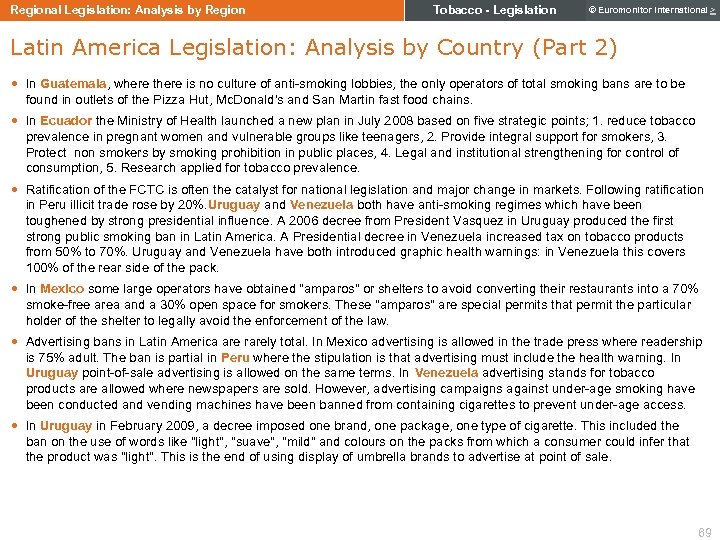
Regional Legislation: Analysis by Region Tobacco - Legislation © Euromonitor International > Latin America Legislation: Analysis by Country (Part 2) · In Guatemala, where there is no culture of anti-smoking lobbies, the only operators of total smoking bans are to be found in outlets of the Pizza Hut, Mc. Donald's and San Martin fast food chains. · In Ecuador the Ministry of Health launched a new plan in July 2008 based on five strategic points; 1. reduce tobacco prevalence in pregnant women and vulnerable groups like teenagers, 2. Provide integral support for smokers, 3. Protect non smokers by smoking prohibition in public places, 4. Legal and institutional strengthening for control of consumption, 5. Research applied for tobacco prevalence. · Ratification of the FCTC is often the catalyst for national legislation and major change in markets. Following ratification in Peru illicit trade rose by 20%. Uruguay and Venezuela both have anti-smoking regimes which have been toughened by strong presidential influence. A 2006 decree from President Vasquez in Uruguay produced the first strong public smoking ban in Latin America. A Presidential decree in Venezuela increased tax on tobacco products from 50% to 70%. Uruguay and Venezuela have both introduced graphic health warnings: in Venezuela this covers 100% of the rear side of the pack. · In Mexico some large operators have obtained "amparos" or shelters to avoid converting their restaurants into a 70% smoke-free area and a 30% open space for smokers. These "amparos" are special permits that permit the particular holder of the shelter to legally avoid the enforcement of the law. · Advertising bans in Latin America are rarely total. In Mexico advertising is allowed in the trade press where readership is 75% adult. The ban is partial in Peru where the stipulation is that advertising must include the health warning. In Uruguay point-of-sale advertising is allowed on the same terms. In Venezuela advertising stands for tobacco products are allowed where newspapers are sold. However, advertising campaigns against under-age smoking have been conducted and vending machines have been banned from containing cigarettes to prevent under-age access. · In Uruguay in February 2009, a decree imposed one brand, one package, one type of cigarette. This included the ban on the use of words like "light", "suave", "mild" and colours on the packs from which a consumer could infer that the product was "light". This is the end of using display of umbrella brands to advertise at point of sale. 69
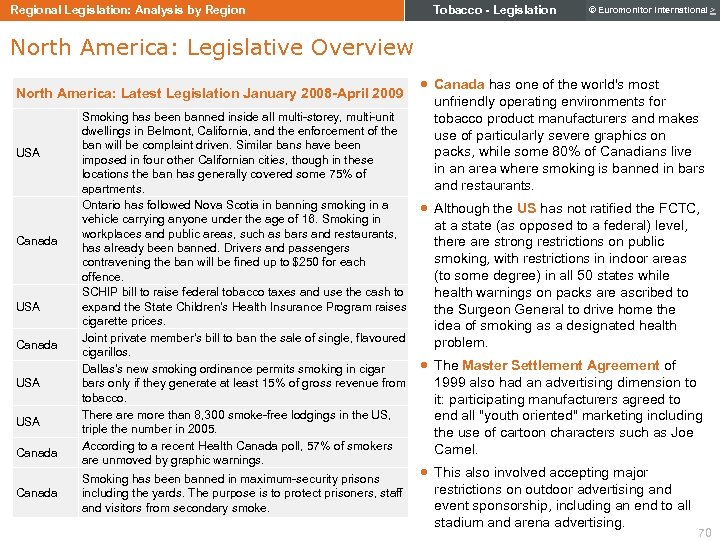
Regional Legislation: Analysis by Region Tobacco - Legislation © Euromonitor International > North America: Legislative Overview North America: Latest Legislation January 2008 -April 2009 USA Canada Smoking has been banned inside all multi-storey, multi-unit dwellings in Belmont, California, and the enforcement of the ban will be complaint driven. Similar bans have been imposed in four other Californian cities, though in these locations the ban has generally covered some 75% of apartments. Ontario has followed Nova Scotia in banning smoking in a vehicle carrying anyone under the age of 16. Smoking in workplaces and public areas, such as bars and restaurants, has already been banned. Drivers and passengers contravening the ban will be fined up to $250 for each offence. SCHIP bill to raise federal tobacco taxes and use the cash to expand the State Children's Health Insurance Program raises cigarette prices. Joint private member's bill to ban the sale of single, flavoured cigarillos. Dallas's new smoking ordinance permits smoking in cigar bars only if they generate at least 15% of gross revenue from tobacco. There are more than 8, 300 smoke-free lodgings in the US, triple the number in 2005. According to a recent Health Canada poll, 57% of smokers are unmoved by graphic warnings. Smoking has been banned in maximum-security prisons including the yards. The purpose is to protect prisoners, staff and visitors from secondary smoke. · Canada has one of the world's most unfriendly operating environments for tobacco product manufacturers and makes use of particularly severe graphics on packs, while some 80% of Canadians live in an area where smoking is banned in bars and restaurants. · Although the US has not ratified the FCTC, at a state (as opposed to a federal) level, there are strong restrictions on public smoking, with restrictions in indoor areas (to some degree) in all 50 states while health warnings on packs are ascribed to the Surgeon General to drive home the idea of smoking as a designated health problem. · The Master Settlement Agreement of 1999 also had an advertising dimension to it: participating manufacturers agreed to end all "youth oriented" marketing including the use of cartoon characters such as Joe Camel. · This also involved accepting major restrictions on outdoor advertising and event sponsorship, including an end to all stadium and arena advertising. 70
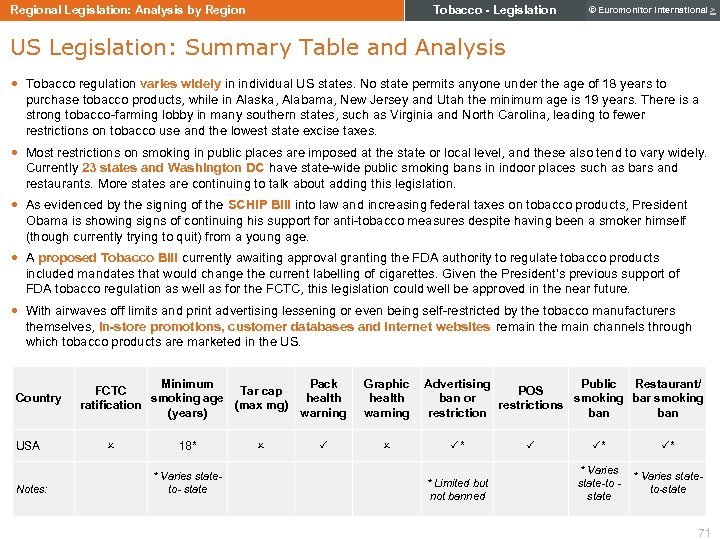
Tobacco - Legislation Regional Legislation: Analysis by Region © Euromonitor International > US Legislation: Summary Table and Analysis · Tobacco regulation varies widely in individual US states. No state permits anyone under the age of 18 years to purchase tobacco products, while in Alaska, Alabama, New Jersey and Utah the minimum age is 19 years. There is a strong tobacco-farming lobby in many southern states, such as Virginia and North Carolina, leading to fewer restrictions on tobacco use and the lowest state excise taxes. · Most restrictions on smoking in public places are imposed at the state or local level, and these also tend to vary widely. Currently 23 states and Washington DC have state-wide public smoking bans in indoor places such as bars and restaurants. More states are continuing to talk about adding this legislation. · As evidenced by the signing of the SCHIP Bill into law and increasing federal taxes on tobacco products, President Obama is showing signs of continuing his support for anti-tobacco measures despite having been a smoker himself (though currently trying to quit) from a young age. · A proposed Tobacco Bill currently awaiting approval granting the FDA authority to regulate tobacco products included mandates that would change the current labelling of cigarettes. Given the President's previous support of FDA tobacco regulation as well as for the FCTC, this legislation could well be approved in the near future. · With airwaves off limits and print advertising lessening or even being self-restricted by the tobacco manufacturers themselves, in-store promotions, customer databases and internet websites remain the main channels through which tobacco products are marketed in the US. Country USA Notes: Minimum FCTC Tar cap smoking age ratification (max mg) (years) 18* * Varies stateto- state Pack health warning Graphic health warning Advertising Public Restaurant/ POS ban or smoking bar smoking restrictions restriction ban * * Limited but not banned * * * Varies state-to state * Varies stateto-state 71
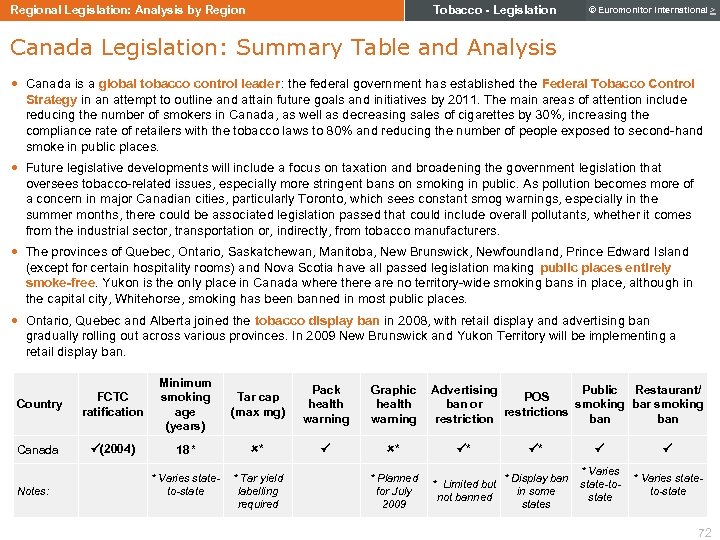
Tobacco - Legislation Regional Legislation: Analysis by Region © Euromonitor International > Canada Legislation: Summary Table and Analysis · Canada is a global tobacco control leader: the federal government has established the Federal Tobacco Control Strategy in an attempt to outline and attain future goals and initiatives by 2011. The main areas of attention include reducing the number of smokers in Canada, as well as decreasing sales of cigarettes by 30%, increasing the compliance rate of retailers with the tobacco laws to 80% and reducing the number of people exposed to second-hand smoke in public places. · Future legislative developments will include a focus on taxation and broadening the government legislation that oversees tobacco-related issues, especially more stringent bans on smoking in public. As pollution becomes more of a concern in major Canadian cities, particularly Toronto, which sees constant smog warnings, especially in the summer months, there could be associated legislation passed that could include overall pollutants, whether it comes from the industrial sector, transportation or, indirectly, from tobacco manufacturers. · The provinces of Quebec, Ontario, Saskatchewan, Manitoba, New Brunswick, Newfoundland, Prince Edward Island (except for certain hospitality rooms) and Nova Scotia have all passed legislation making public places entirely smoke-free. Yukon is the only place in Canada where there are no territory-wide smoking bans in place, although in the capital city, Whitehorse, smoking has been banned in most public places. · Ontario, Quebec and Alberta joined the tobacco display ban in 2008, with retail display and advertising ban gradually rolling out across various provinces. In 2009 New Brunswick and Yukon Territory will be implementing a retail display ban. Country FCTC ratification Minimum smoking age (years) Tar cap (max mg) Pack health warning Graphic health warning Canada (2004) 18* * * * Varies stateto-state * Tar yield labelling required Notes: * Planned for July 2009 Advertising Public Restaurant/ POS ban or smoking bar smoking restrictions restriction ban * * * Display ban * Limited but in some not banned states * Varies state-tostate * Varies stateto-state 72
Tobacco - Legislation © Euromonitor International > Introduction Legislation: What Restrictions Are There? Litigation: What Have Been the Impacts? Regional Legislation: Analysis by Region Manufacturer Strategies Legislation Outlook: Where Next? 73
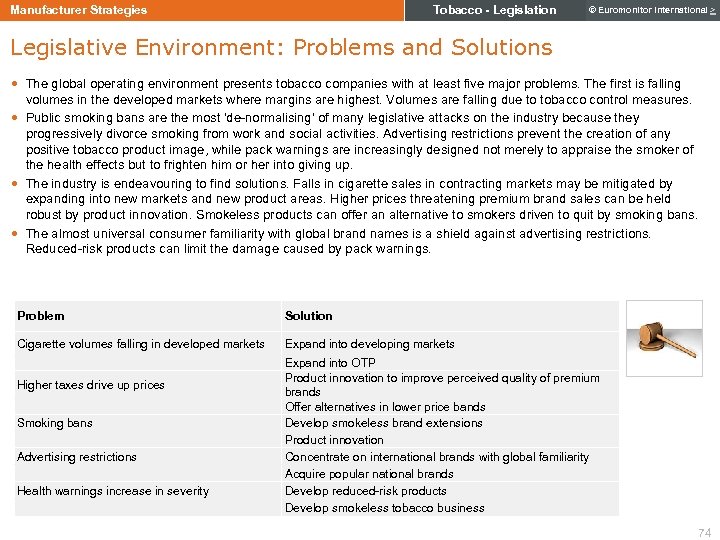
Tobacco - Legislation Manufacturer Strategies © Euromonitor International > Legislative Environment: Problems and Solutions · The global operating environment presents tobacco companies with at least five major problems. The first is falling volumes in the developed markets where margins are highest. Volumes are falling due to tobacco control measures. · Public smoking bans are the most 'de-normalising' of many legislative attacks on the industry because they progressively divorce smoking from work and social activities. Advertising restrictions prevent the creation of any positive tobacco product image, while pack warnings are increasingly designed not merely to appraise the smoker of the health effects but to frighten him or her into giving up. · The industry is endeavouring to find solutions. Falls in cigarette sales in contracting markets may be mitigated by expanding into new markets and new product areas. Higher prices threatening premium brand sales can be held robust by product innovation. Smokeless products can offer an alternative to smokers driven to quit by smoking bans. · The almost universal consumer familiarity with global brand names is a shield against advertising restrictions. Reduced-risk products can limit the damage caused by pack warnings. Problem Solution Cigarette volumes falling in developed markets Expand into developing markets Higher taxes drive up prices Smoking bans Advertising restrictions Health warnings increase in severity Expand into OTP Product innovation to improve perceived quality of premium brands Offer alternatives in lower price bands Develop smokeless brand extensions Product innovation Concentrate on international brands with global familiarity Acquire popular national brands Develop reduced-risk products Develop smokeless tobacco business 74
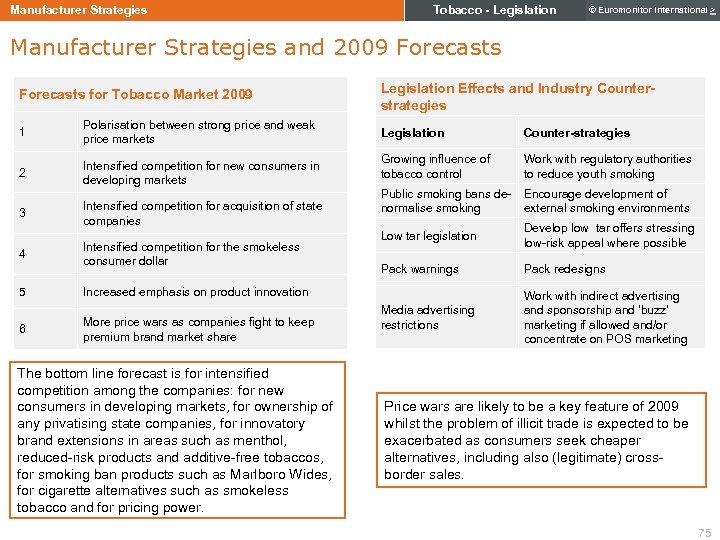
Manufacturer Strategies Tobacco - Legislation © Euromonitor International > Manufacturer Strategies and 2009 Forecasts for Tobacco Market 2009 1 Polarisation between strong price and weak price markets 2 Intensified competition for new consumers in developing markets 3 Intensified competition for acquisition of state companies 4 Intensified competition for the smokeless consumer dollar 5 6 Legislation Counter-strategies Growing influence of tobacco control Work with regulatory authorities to reduce youth smoking Public smoking bans denormalise smoking Encourage development of external smoking environments Low tar legislation Develop low tar offers stressing low-risk appeal where possible Pack warnings Pack redesigns Media advertising restrictions Work with indirect advertising and sponsorship and 'buzz' marketing if allowed and/or concentrate on POS marketing Increased emphasis on product innovation More price wars as companies fight to keep premium brand market share Legislation Effects and Industry Counterstrategies The bottom line forecast is for intensified competition among the companies: for new consumers in developing markets, for ownership of any privatising state companies, for innovatory brand extensions in areas such as menthol, reduced-risk products and additive-free tobaccos, for smoking ban products such as Marlboro Wides, for cigarette alternatives such as smokeless tobacco and for pricing power. Price wars are likely to be a key feature of 2009 whilst the problem of illicit trade is expected to be exacerbated as consumers seek cheaper alternatives, including also (legitimate) crossborder sales. 75
Tobacco - Legislation © Euromonitor International > Introduction Legislation: What Restrictions Are There? Litigation: What Have Been the Impacts? Regional Legislation: Analysis by Region Manufacturer Strategies Legislation Outlook: Where Next? 76
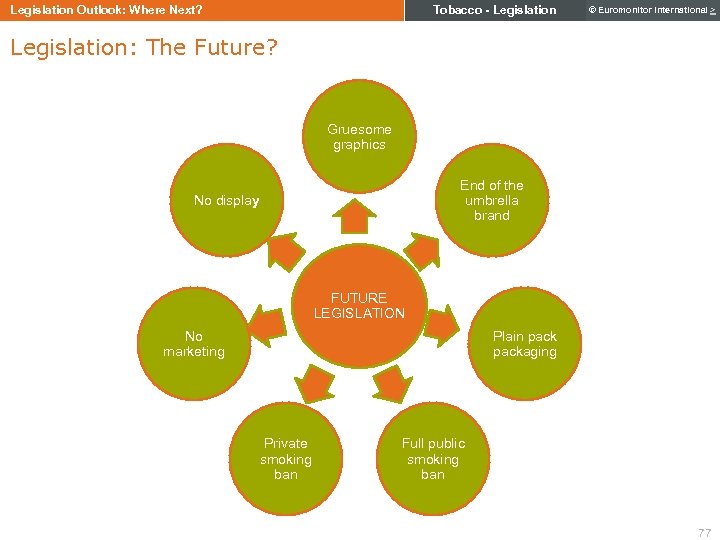
Tobacco - Legislation Outlook: Where Next? © Euromonitor International > Legislation: The Future? Gruesome graphics End of the umbrella brand No display FUTURE LEGISLATION No marketing Plain packaging Private smoking ban Full public smoking ban 77
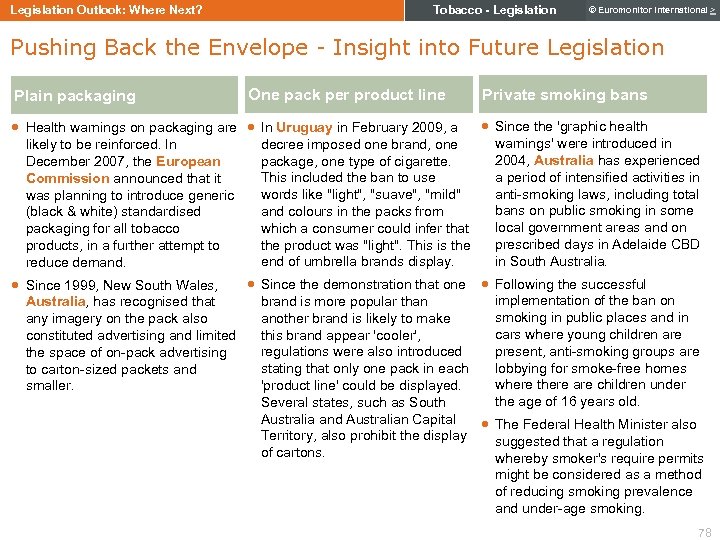
Legislation Outlook: Where Next? Tobacco - Legislation © Euromonitor International > Pushing Back the Envelope - Insight into Future Legislation Plain packaging One pack per product line · Health warnings on packaging are · In Uruguay in February 2009, a likely to be reinforced. In December 2007, the European Commission announced that it was planning to introduce generic (black & white) standardised packaging for all tobacco products, in a further attempt to reduce demand. · Since 1999, New South Wales, Australia, has recognised that any imagery on the pack also constituted advertising and limited the space of on-pack advertising to carton-sized packets and smaller. decree imposed one brand, one package, one type of cigarette. This included the ban to use words like "light", "suave", "mild" and colours in the packs from which a consumer could infer that the product was "light". This is the end of umbrella brands display. Private smoking bans · Since the 'graphic health warnings' were introduced in 2004, Australia has experienced a period of intensified activities in anti-smoking laws, including total bans on public smoking in some local government areas and on prescribed days in Adelaide CBD in South Australia. · Since the demonstration that one · Following the successful implementation of the ban on brand is more popular than smoking in public places and in another brand is likely to make cars where young children are this brand appear 'cooler', present, anti-smoking groups are regulations were also introduced lobbying for smoke-free homes stating that only one pack in each where there are children under 'product line' could be displayed. the age of 16 years old. Several states, such as South Australia and Australian Capital · The Federal Health Minister also Territory, also prohibit the display suggested that a regulation of cartons. whereby smoker's require permits might be considered as a method of reducing smoking prevalence and under-age smoking. 78
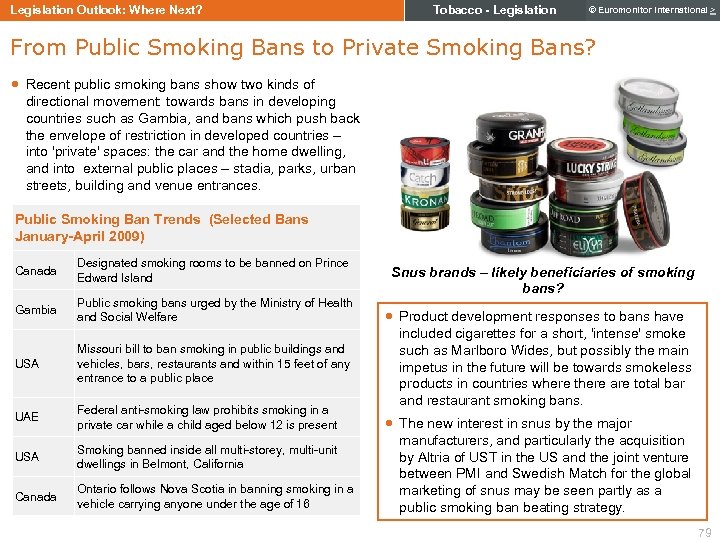
Legislation Outlook: Where Next? Tobacco - Legislation © Euromonitor International > From Public Smoking Bans to Private Smoking Bans? · Recent public smoking bans show two kinds of directional movement: towards bans in developing countries such as Gambia, and bans which push back the envelope of restriction in developed countries – into 'private' spaces: the car and the home dwelling, and into external public places – stadia, parks, urban streets, building and venue entrances. Public Smoking Ban Trends (Selected Bans January-April 2009) Canada Designated smoking rooms to be banned on Prince Edward Island Gambia Public smoking bans urged by the Ministry of Health and Social Welfare USA Missouri bill to ban smoking in public buildings and vehicles, bars, restaurants and within 15 feet of any entrance to a public place UAE Federal anti-smoking law prohibits smoking in a private car while a child aged below 12 is present USA Smoking banned inside all multi-storey, multi-unit dwellings in Belmont, California Canada Ontario follows Nova Scotia in banning smoking in a vehicle carrying anyone under the age of 16 Snus brands – likely beneficiaries of smoking bans? · Product development responses to bans have included cigarettes for a short, 'intense' smoke such as Marlboro Wides, but possibly the main impetus in the future will be towards smokeless products in countries where there are total bar and restaurant smoking bans. · The new interest in snus by the major manufacturers, and particularly the acquisition by Altria of UST in the US and the joint venture between PMI and Swedish Match for the global marketing of snus may be seen partly as a public smoking ban beating strategy. 79
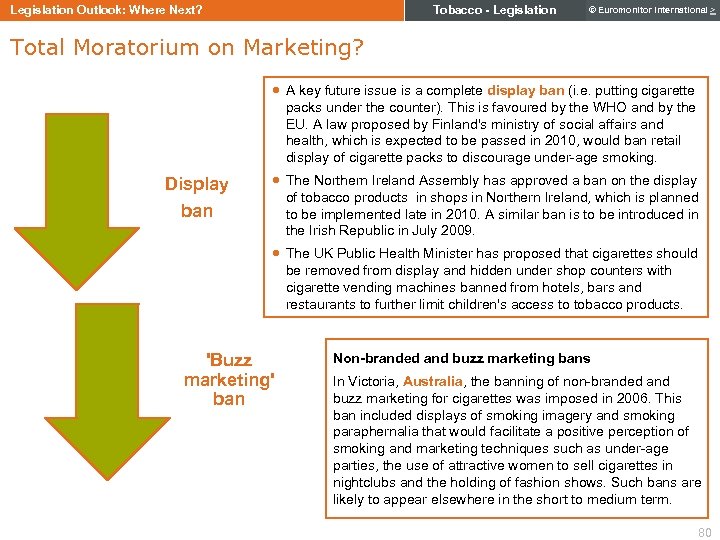
Tobacco - Legislation Outlook: Where Next? © Euromonitor International > Total Moratorium on Marketing? · A key future issue is a complete display ban (i. e. putting cigarette packs under the counter). This is favoured by the WHO and by the EU. A law proposed by Finland's ministry of social affairs and health, which is expected to be passed in 2010, would ban retail display of cigarette packs to discourage under-age smoking. Display · The Northern Ireland Assembly has approved a ban on the display of tobacco products in shops in Northern Ireland, which is planned to be implemented late in 2010. A similar ban is to be introduced in the Irish Republic in July 2009. ban · The UK Public Health Minister has proposed that cigarettes should be removed from display and hidden under shop counters with cigarette vending machines banned from hotels, bars and restaurants to further limit children's access to tobacco products. 'Buzz marketing' ban Non-branded and buzz marketing bans In Victoria, Australia, the banning of non-branded and buzz marketing for cigarettes was imposed in 2006. This ban included displays of smoking imagery and smoking paraphernalia that would facilitate a positive perception of smoking and marketing techniques such as under-age parties, the use of attractive women to sell cigarettes in nightclubs and the holding of fashion shows. Such bans are likely to appear elsewhere in the short to medium term. 80
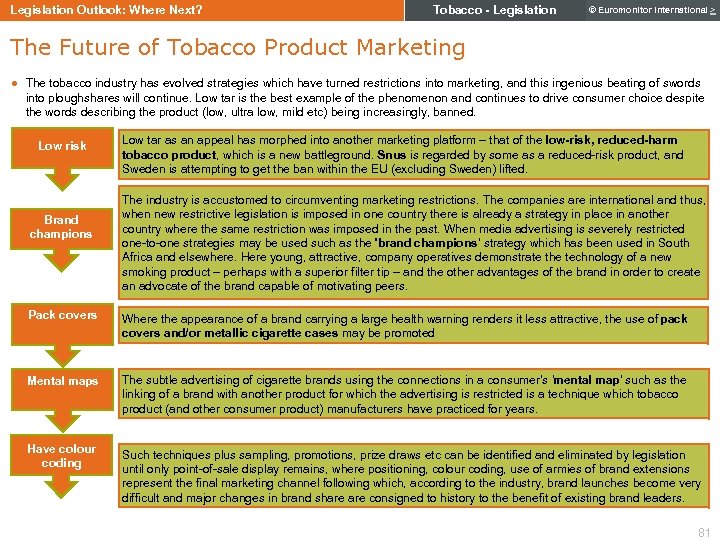
Legislation Outlook: Where Next? Tobacco - Legislation © Euromonitor International > The Future of Tobacco Product Marketing · The tobacco industry has evolved strategies which have turned restrictions into marketing, and this ingenious beating of swords into ploughshares will continue. Low tar is the best example of the phenomenon and continues to drive consumer choice despite the words describing the product (low, ultra low, mild etc) being increasingly, banned. Low risk Brand champions Low tar as an appeal has morphed into another marketing platform – that of the low-risk, reduced-harm tobacco product, which is a new battleground. Snus is regarded by some as a reduced-risk product, and Sweden is attempting to get the ban within the EU (excluding Sweden) lifted. The industry is accustomed to circumventing marketing restrictions. The companies are international and thus, when new restrictive legislation is imposed in one country there is already a strategy in place in another country where the same restriction was imposed in the past. When media advertising is severely restricted one-to-one strategies may be used such as the 'brand champions' strategy which has been used in South Africa and elsewhere. Here young, attractive, company operatives demonstrate the technology of a new smoking product – perhaps with a superior filter tip – and the other advantages of the brand in order to create an advocate of the brand capable of motivating peers. Pack covers Where the appearance of a brand carrying a large health warning renders it less attractive, the use of pack covers and/or metallic cigarette cases may be promoted Mental maps The subtle advertising of cigarette brands using the connections in a consumer's 'mental map' such as the linking of a brand with another product for which the advertising is restricted is a technique which tobacco product (and other consumer product) manufacturers have practiced for years. Have colour coding Such techniques plus sampling, promotions, prize draws etc can be identified and eliminated by legislation until only point-of-sale display remains, where positioning, colour coding, use of armies of brand extensions represent the final marketing channel following which, according to the industry, brand launches become very difficult and major changes in brand share consigned to history to the benefit of existing brand leaders. 81
Tobacco - Legislation © Euromonitor International > Experience more. . . This research from Euromonitor International is part of a global strategic intelligence system which offers a complete picture of the commercial environment. Also available from Euromonitor International: Global Briefings Global Company Profiles Country Market Insight Reports The state of the market globally and regionally, emerging trends and pressing industry issues: timely, relevant insight published every month. The competitive positioning and strategic direction of the leading companies including uniquely sector-specific sales and share data. The key drivers influencing the industry in each country; comprehensive coverage of supply-side and demand trends and how they shape the future outlook. Interactive Statistical Database Strategy Briefings Learn More Market sizes, market shares, distribution channels and forecasts; the complete market analysed at levels of category detail beyond any other source. Executive debate on the global trends changing the consumer markets of the future. To find out more about Euromonitor International's complete range of business intelligence on industries, countries and consumers please visit www. euromonitor. com or contact your local Euromonitor International office: London + 44 (0)20 7251 8024 Chicago +1 312 922 1115 Singapore +65 6429 0590 Shanghai +86 21 63726288 Vilnius +370 5 243 1577 Dubai +971 4 609 1340 82
Скачать презентацию Global Tobacco Will Legislation Kill the Industry July
f887161fe149bdf5a913b138766f9b0b.ppt