 Скачать презентацию Global TB control Progress and challenges Reaching all
024997d1e8a36ca4d50f8cd31b3c7b8b.ppt
- Количество слайдов: 18



Global TB control Progress and challenges Reaching all TB patients Quality TB care for all DOTS Expansion Working Group Paris 15 October 2008
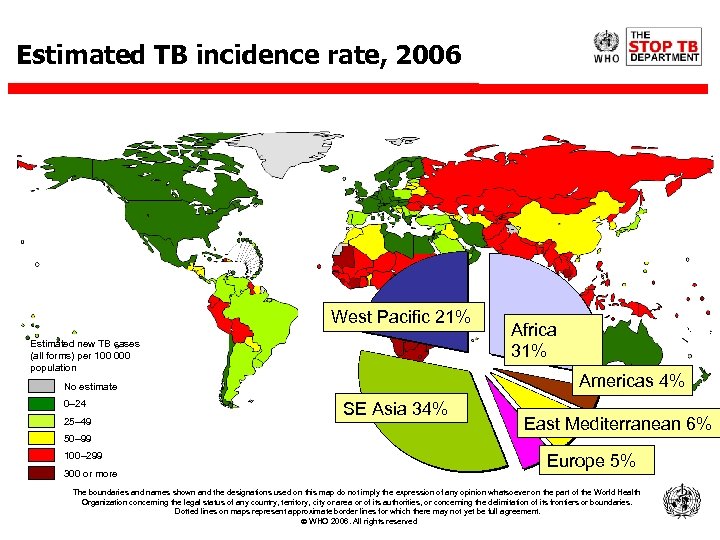
Estimated TB incidence rate, 2006 West Pacific 21% Estimated new TB cases (all forms) per 100 000 population Americas 4% No estimate 0– 24 25– 49 50– 99 100– 299 300 or more Africa 31% SE Asia 34% East Mediterranean 6% Europe 5% The boundaries and names shown and the designations used on this map do not imply the expression of any opinion whatsoever on the part of the World Health Organization concerning the legal status of any country, territory, city or area or of its authorities, or concerning the delimitation of its frontiers or boundaries. Dotted lines on maps represent approximate border lines for which there may not yet be full agreement. WHO 2006. All rights reserved
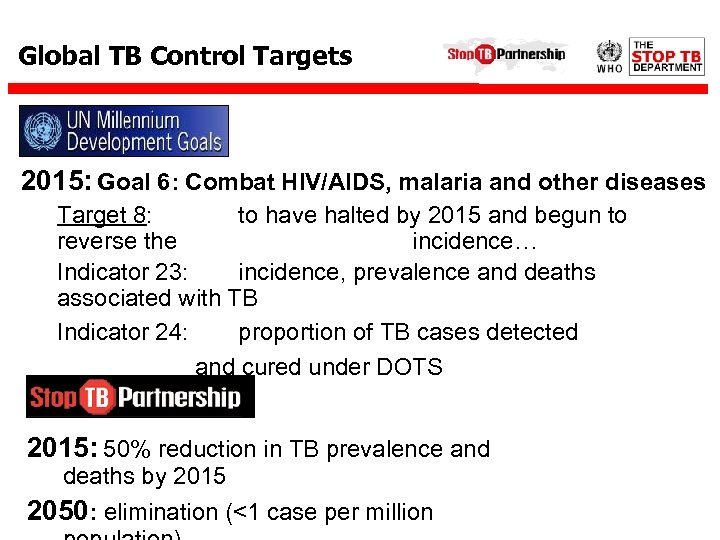
Global TB Control Targets 2015: Goal 6: Combat HIV/AIDS, malaria and other diseases Target 8: to have halted by 2015 and begun to reverse the incidence… Indicator 23: incidence, prevalence and deaths associated with TB Indicator 24: proportion of TB cases detected and cured under DOTS 2015: 50% reduction in TB prevalence and deaths by 2015 2050: elimination (<1 case per million
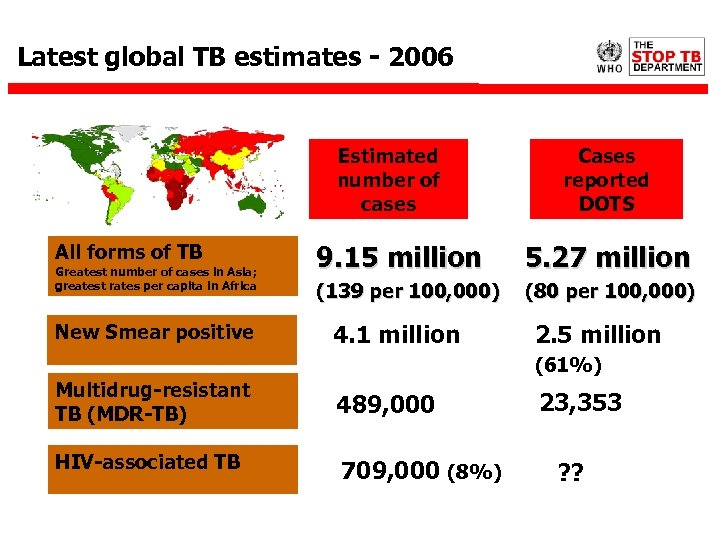
Latest global TB estimates - 2006 Estimated number of cases All forms of TB Greatest number of cases in Asia; greatest rates per capita in Africa New Smear positive Cases reported DOTS 9. 15 million 5. 27 million (139 per 100, 000) (80 per 100, 000) 4. 1 million 2. 5 million (61%) Multidrug-resistant TB (MDR-TB) 489, 000 HIV-associated TB 709, 000 (8%) 23, 353 ? ?
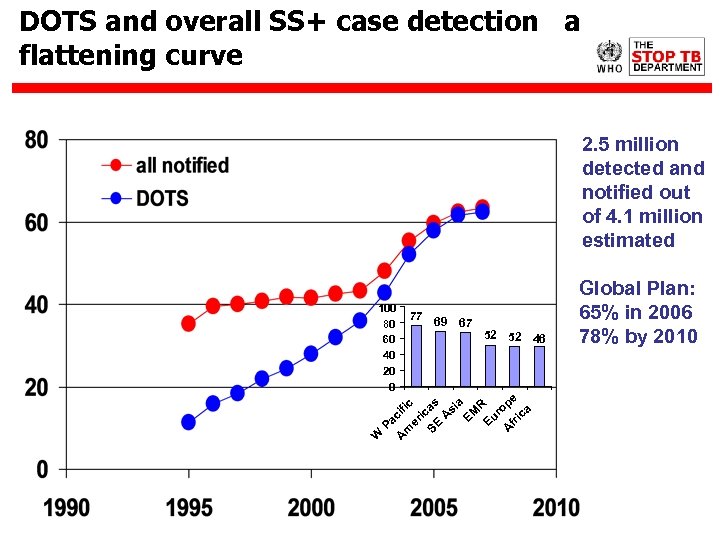
DOTS and overall SS+ case detection a flattening curve 2. 5 million detected and notified out of 4. 1 million estimated 77 69 67 52 52 46 W Pa A cifi m er c ic SE as A si a EM R Eu r A ope fr ic a 100 80 60 40 20 0 Global Plan: 65% in 2006 78% by 2010
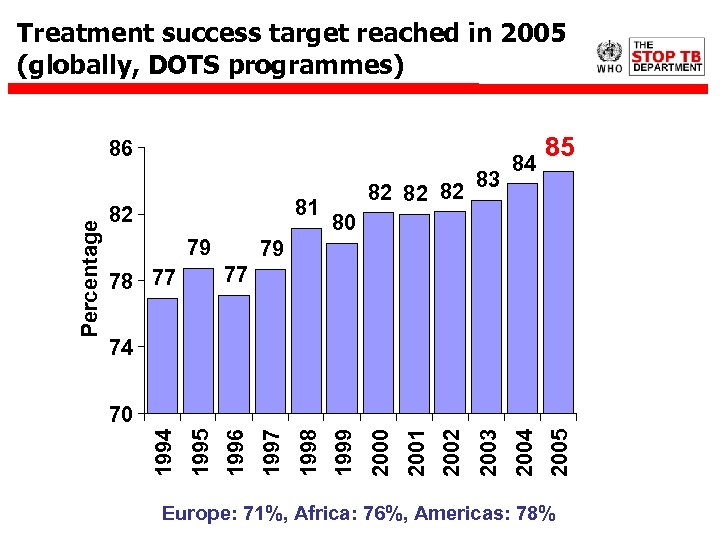
Treatment success target reached in 2005 (globally, DOTS programmes) 81 82 79 83 85 80 2. 34 million 79 244, 662 74 82 82 82 84 77 78 77 2005 2004 2003 2002 2001 2000 1999 1998 1997 1996 1995 70 1994 Percentage 86 Europe: 71%, Africa: 76%, Americas: 78%
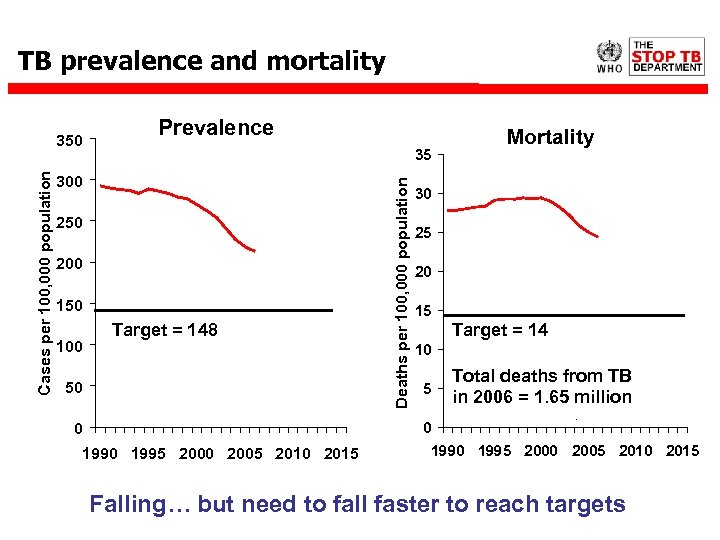
TB prevalence and mortality Prevalence 35 300 250 200 150 100 Target = 148 50 Deaths per 100, 000 population Cases per 100, 000 population 350 Mortality 30 25 20 15 Target = 14 10 5 Total deaths from TB in 2006 = 1. 65 million 0 0 1995 2000 2005 2010 2015 1990 1995 2000 2005 2010 2015 Falling… but need to fall faster to reach targets
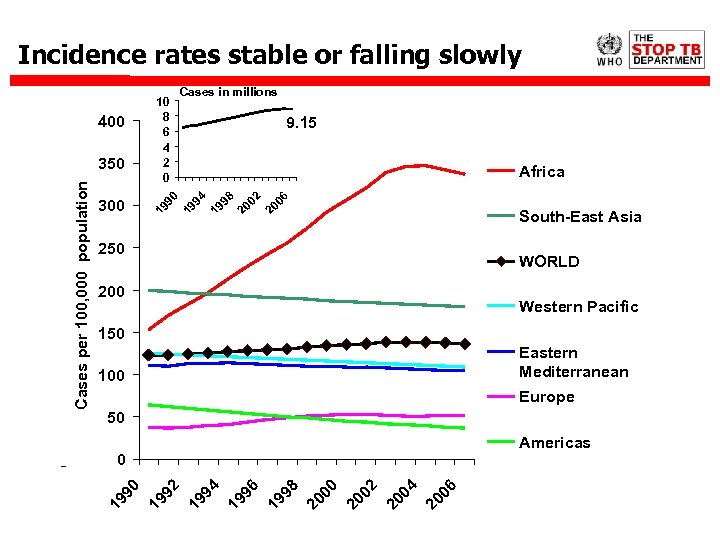
Incidence rates stable or falling slowly 9. 15 06 20 02 20 98 19 94 Africa 19 90 300 South-East Asia 250 WORLD 200 Western Pacific 150 Eastern Mediterranean 100 Europe 50 Americas 06 20 04 20 02 20 00 20 98 19 96 19 94 19 92 19 90 0 19 Cases per 100, 000 population 350 19 400 Cases in millions 10 8 6 4 2 0
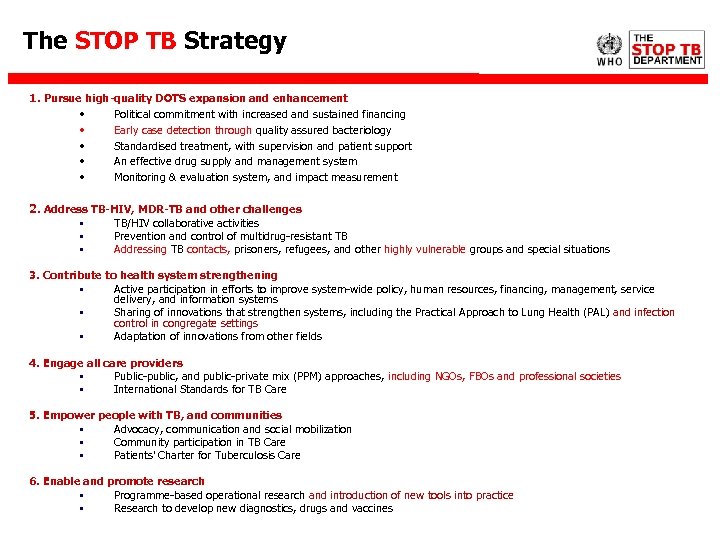
The STOP TB Strategy 1. Pursue high-quality DOTS expansion and enhancement • Political commitment with increased and sustained financing • Early case detection through quality assured bacteriology • Standardised treatment, with supervision and patient support • An effective drug supply and management system • Monitoring & evaluation system, and impact measurement 2. Address TB-HIV, MDR-TB and other challenges § TB/HIV collaborative activities § Prevention and control of multidrug-resistant TB § Addressing TB contacts, prisoners, refugees, and other highly vulnerable groups and special situations 3. Contribute to health system strengthening § Active participation in efforts to improve system-wide policy, human resources, financing, management, service delivery, and information systems § Sharing of innovations that strengthen systems, including the Practical Approach to Lung Health (PAL) and infection control in congregate settings § Adaptation of innovations from other fields 4. Engage all care providers § Public-public, and public-private mix (PPM) approaches, including NGOs, FBOs and professional societies § International Standards for TB Care 5. Empower people with TB, and communities § Advocacy, communication and social mobilization § Community participation in TB Care § Patients' Charter for Tuberculosis Care 6. Enable and promote research § Programme-based operational research and introduction of new tools into practice § Research to develop new diagnostics, drugs and vaccines
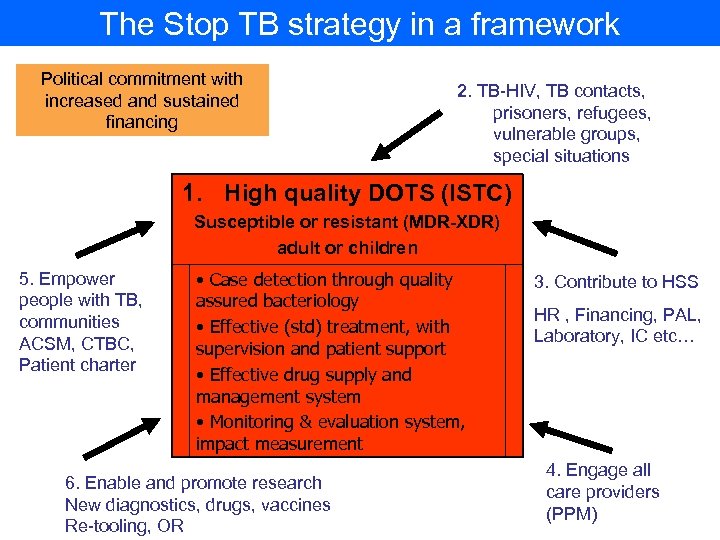
The Stop TB strategy in a framework Political commitment with increased and sustained financing 2. TB-HIV, TB contacts, prisoners, refugees, vulnerable groups, special situations 1. High quality DOTS (ISTC) Susceptible or resistant (MDR-XDR) adult or children 5. Empower people with TB, communities ACSM, CTBC, Patient charter • Case detection through quality assured bacteriology • Effective (std) treatment, with supervision and patient support • Effective drug supply and management system • Monitoring & evaluation system, impact measurement 6. Enable and promote research New diagnostics, drugs, vaccines Re-tooling, OR 3. Contribute to HSS HR , Financing, PAL, Laboratory, IC etc… 4. Engage all care providers (PPM)
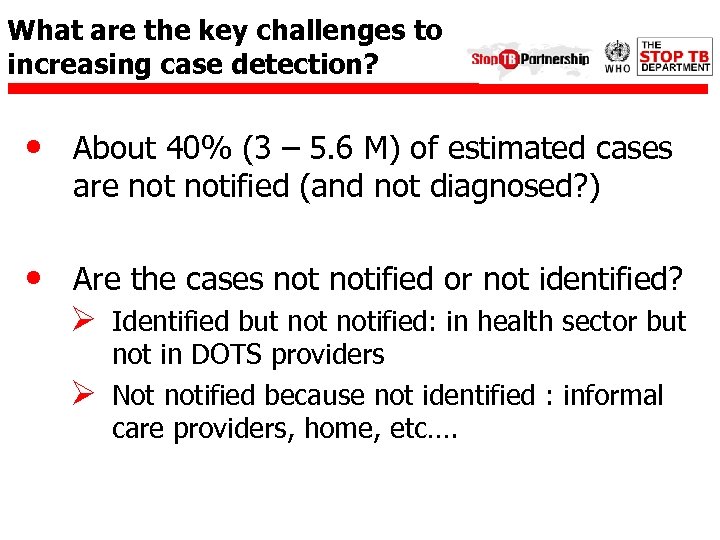
What are the key challenges to increasing case detection? • About 40% (3 – 5. 6 M) of estimated cases are notified (and not diagnosed? ) • Are the cases notified or not identified? Ø Identified but notified: in health sector but Ø not in DOTS providers Not notified because not identified : informal care providers, home, etc….
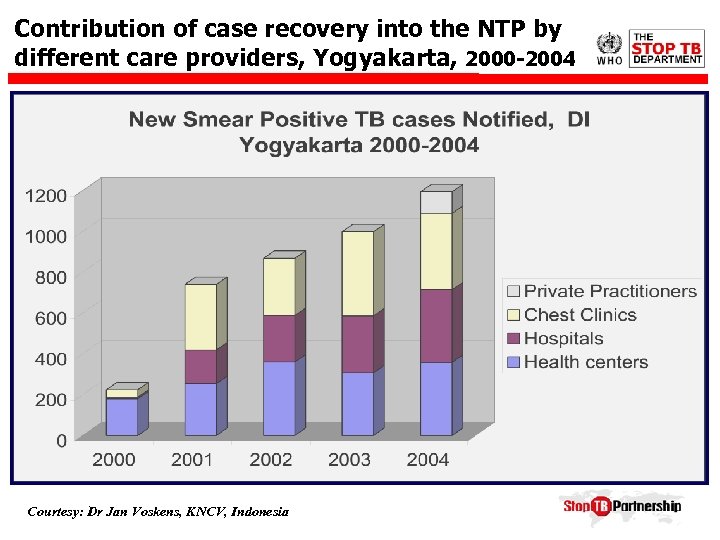
Contribution of case recovery into the NTP by different care providers, Yogyakarta, 2000 -2004 Courtesy: Dr Jan Voskens, KNCV, Indonesia
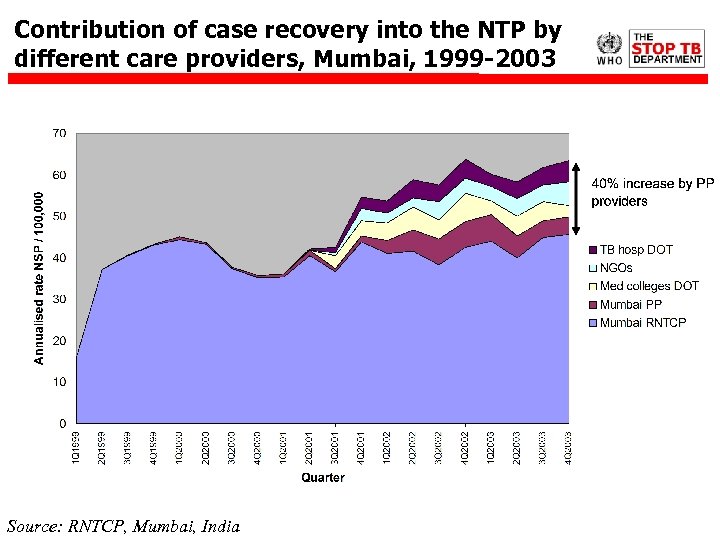
Contribution of case recovery into the NTP by different care providers, Mumbai, 1999 -2003 Source: RNTCP, Mumbai, India
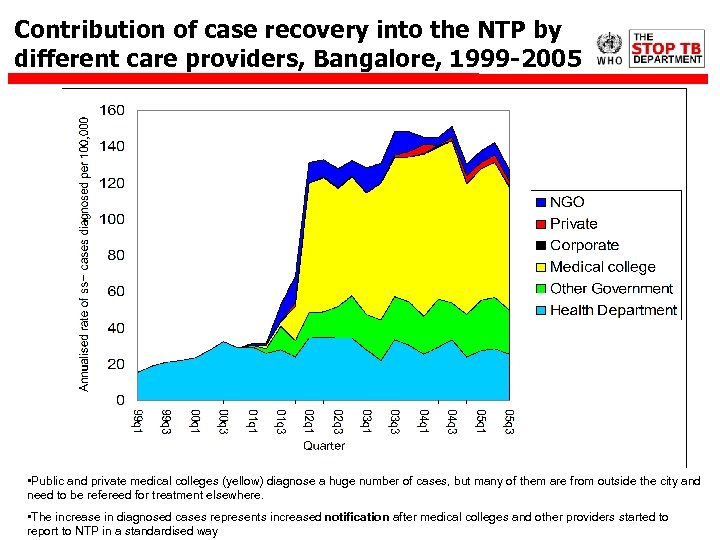
Contribution of case recovery into the NTP by different care providers, Bangalore, 1999 -2005 • Public and private medical colleges (yellow) diagnose a huge number of cases, but many of them are from outside the city and need to be refereed for treatment elsewhere. • The increase in diagnosed cases represents increased notification after medical colleges and other providers started to report to NTP in a standardised way
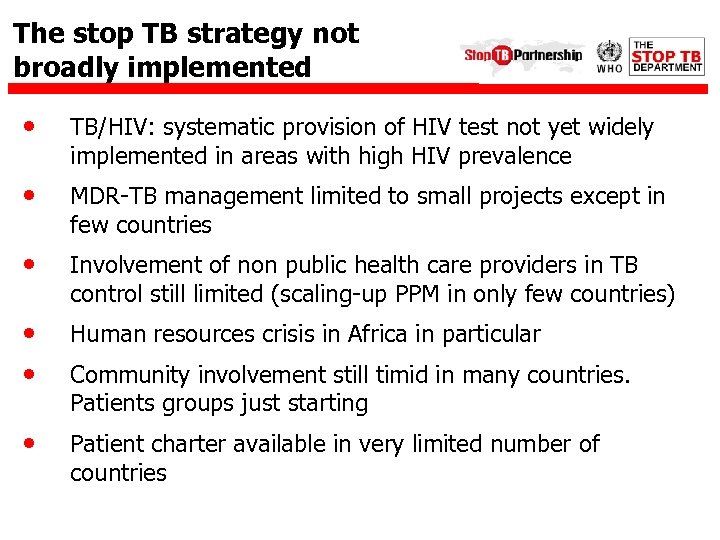
The stop TB strategy not broadly implemented • TB/HIV: systematic provision of HIV test not yet widely implemented in areas with high HIV prevalence • MDR-TB management limited to small projects except in few countries • Involvement of non public health care providers in TB control still limited (scaling-up PPM in only few countries) • • Human resources crisis in Africa in particular • Patient charter available in very limited number of countries Community involvement still timid in many countries. Patients groups just starting
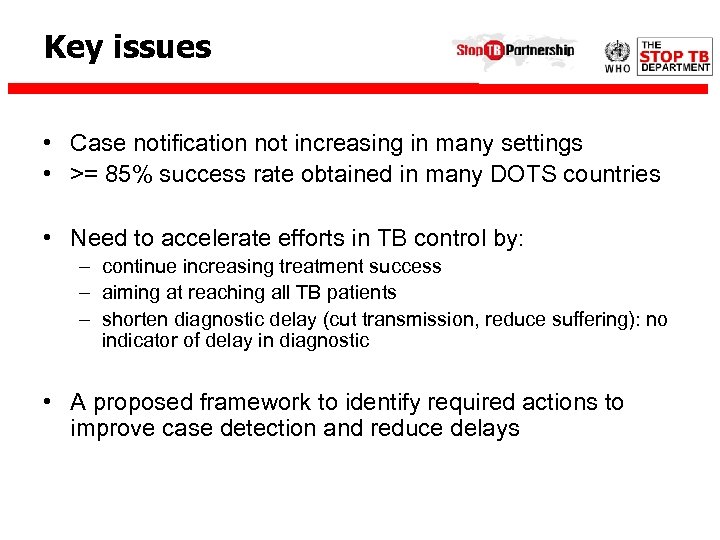
Key issues • Case notification not increasing in many settings • >= 85% success rate obtained in many DOTS countries • Need to accelerate efforts in TB control by: – continue increasing treatment success – aiming at reaching all TB patients – shorten diagnostic delay (cut transmission, reduce suffering): no indicator of delay in diagnostic • A proposed framework to identify required actions to improve case detection and reduce delays
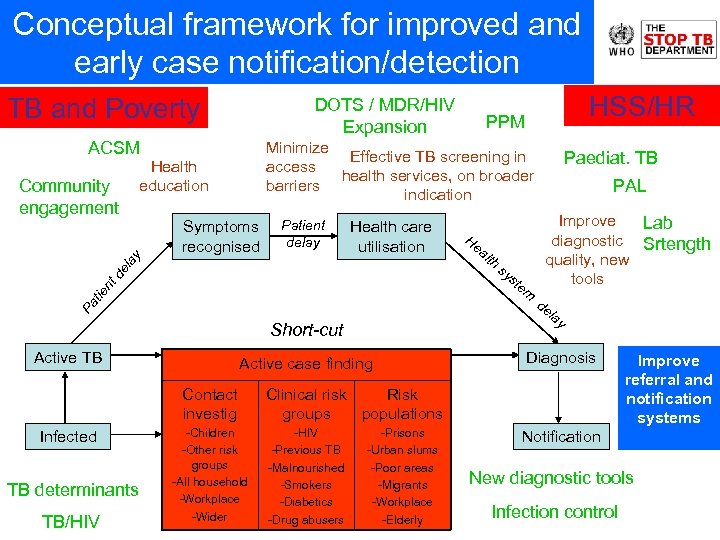
Conceptual framework for improved and early case notification/detection TB and Poverty DOTS / MDR/HIV Expansion ACSM Minimize Effective TB screening in access health services, on broader barriers indication Health education Symptoms recognised Patient delay Health care utilisation de l ay Community engagement tie nt Pa Active case finding Contact investig TB determinants TB/HIV th sy -Children -Other risk groups -All household -Workplace -Wider em Paediat. TB PAL Improve Lab diagnostic Srtength quality, new tools de la y Short-cut Infected He al st Active TB HSS/HR PPM Diagnosis Clinical risk Risk groups populations -HIV -Previous TB -Malnourished -Smokers -Diabetics -Drug abusers -Prisons -Urban slums -Poor areas -Migrants -Workplace -Elderly Improve referral and notification systems Notification New diagnostic tools Infection control
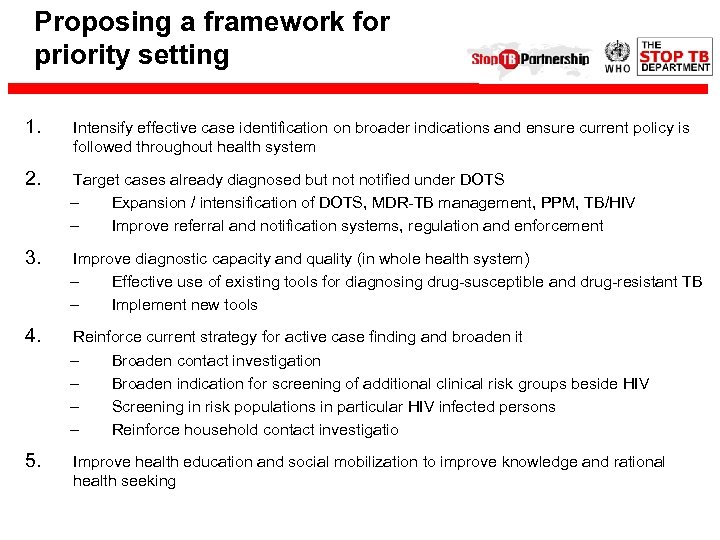
Proposing a framework for priority setting 1. Intensify effective case identification on broader indications and ensure current policy is followed throughout health system 2. Target cases already diagnosed but notified under DOTS – Expansion / intensification of DOTS, MDR-TB management, PPM, TB/HIV – Improve referral and notification systems, regulation and enforcement 3. Improve diagnostic capacity and quality (in whole health system) – Effective use of existing tools for diagnosing drug-susceptible and drug-resistant TB – Implement new tools 4. Reinforce current strategy for active case finding and broaden it – Broaden contact investigation – Broaden indication for screening of additional clinical risk groups beside HIV – Screening in risk populations in particular HIV infected persons – Reinforce household contact investigatio 5. Improve health education and social mobilization to improve knowledge and rational health seeking
Скачать презентацию Global TB control Progress and challenges Reaching all
024997d1e8a36ca4d50f8cd31b3c7b8b.ppt