 Скачать презентацию Global System For Mobile Communication GSM 1
8f1c9f19c403bd03004e30a0db8c4bb8.ppt
- Количество слайдов: 44



Global System For Mobile Communication (GSM) 1
History § § § § Europe cell tech fragmented in early 80’s 1982 GSM Study Group started 1991 1 st Commercial System 1993 1 Million Users, 22 Countries Today 10 % of World Population Today 709 Million users, 179 Countries Today 71 % of entire digital wireless 2
Goals n n n Full international roaming. Provision for national variations in charging and rates. Efficient interoperation with ISDN systems. Signal quality better than or equal to that of existing mobile systems Accommodation of non voice services Accommodation of portable terminals 3
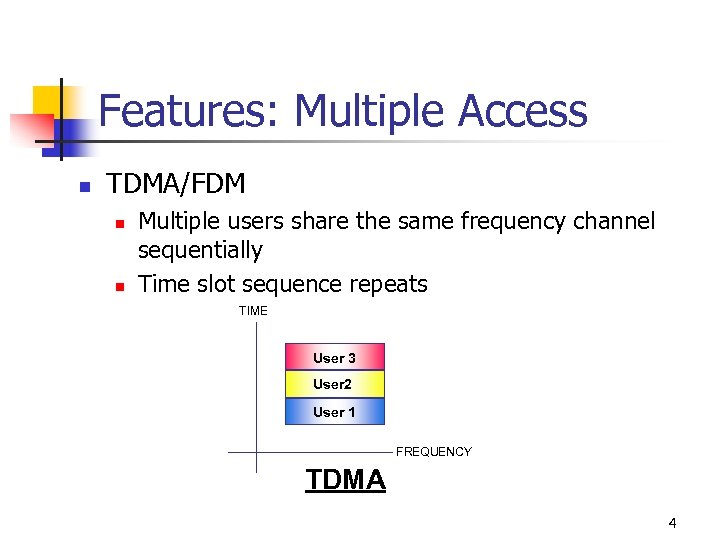
Features: Multiple Access n TDMA/FDM n n Multiple users share the same frequency channel sequentially Time slot sequence repeats TIME User 3 User 2 User 1 FREQUENCY TDMA 4
Cellular System n n n SIR: 11 d. B Reuse Factor: 3 Sectoring: 3 sectors/cell 5
Features: Service n n Telephone Data n n n support packet switched protocol data rate from 300 bps to 9. 6 kbps Other n SMS (Short Message Service) n limit 160 7 bit ASCII characters 6
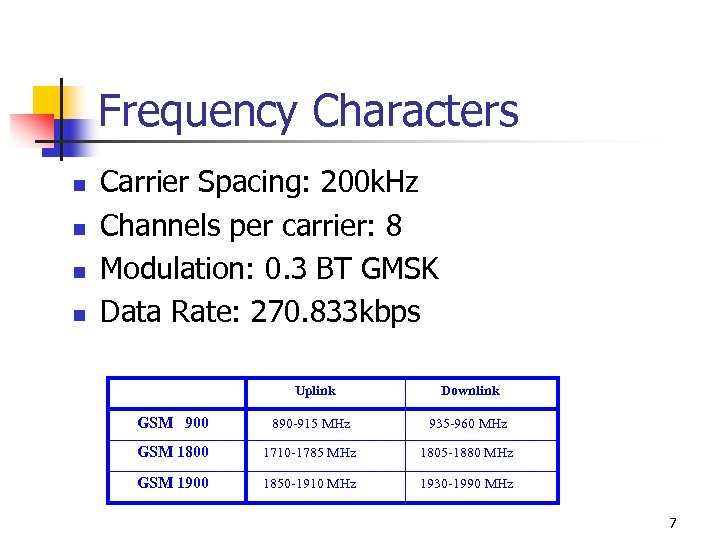
Frequency Characters n n Carrier Spacing: 200 k. Hz Channels per carrier: 8 Modulation: 0. 3 BT GMSK Data Rate: 270. 833 kbps Uplink Downlink GSM 900 890 -915 MHz 935 -960 MHz GSM 1800 1710 -1785 MHz 1805 -1880 MHz GSM 1900 1850 -1910 MHz 1930 -1990 MHz 7
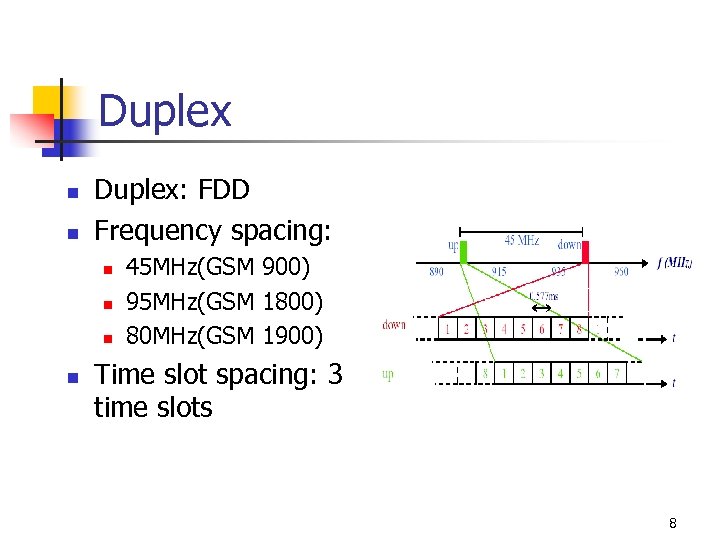
Duplex n n Duplex: FDD Frequency spacing: n n 45 MHz(GSM 900) 95 MHz(GSM 1800) 80 MHz(GSM 1900) Time slot spacing: 3 time slots 8
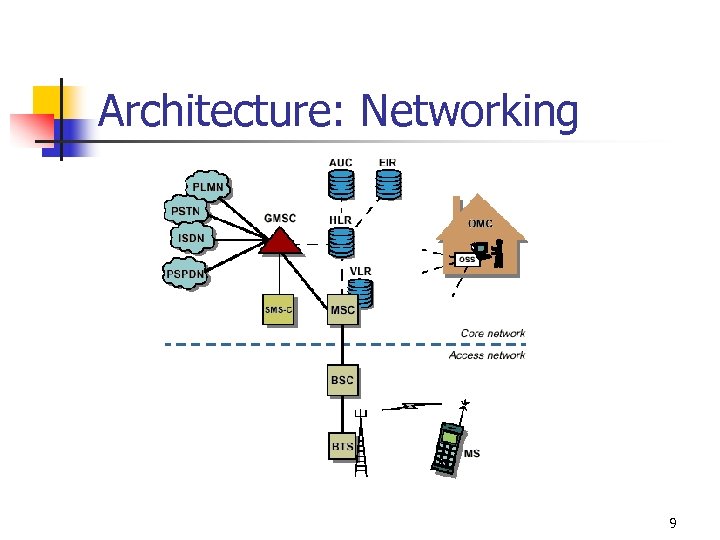
Architecture: Networking 9
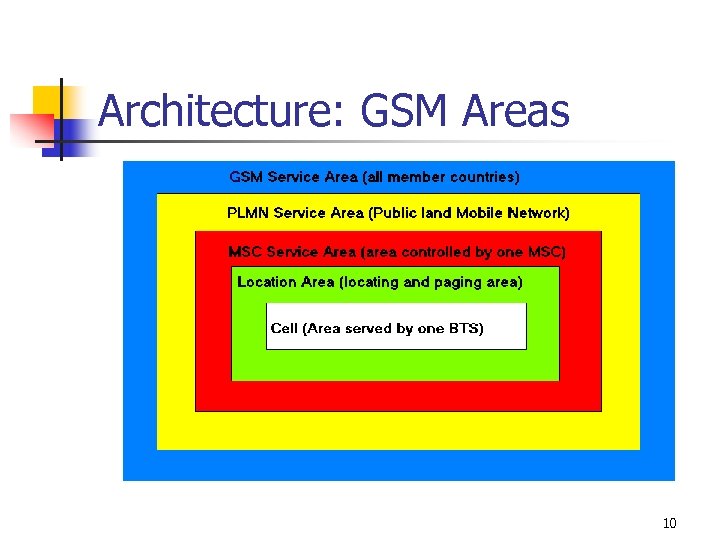
Architecture: GSM Areas 10
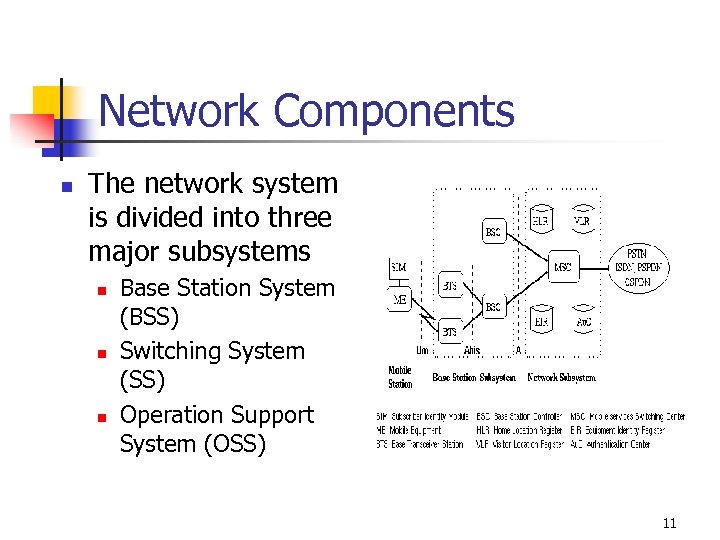
Network Components n The network system is divided into three major subsystems n n n Base Station System (BSS) Switching System (SS) Operation Support System (OSS) 11
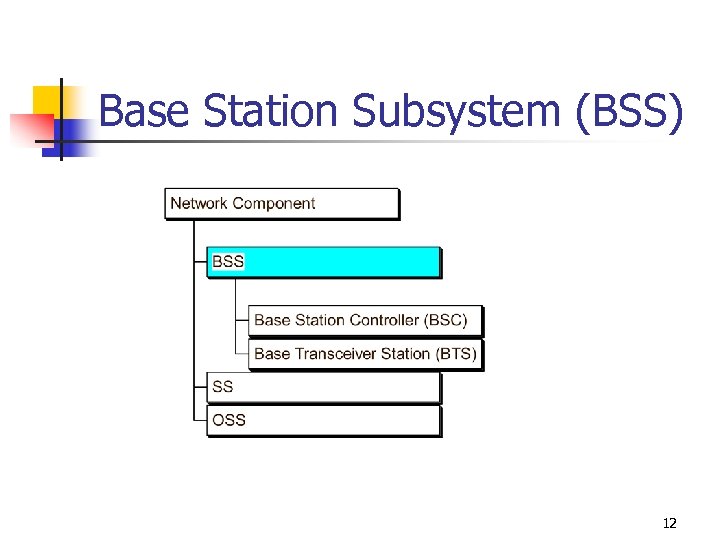
Base Station Subsystem (BSS) 12
Base Station Controller (BSC) n n Number of BSC varies Manages the allocation of radio resources for one or more BTSs, responsible for connection to MS on demand of MSC Controls handover between BTS and another BTS The link between the mobile station (MS) and the Mobile Switching Centre (MSC) 13
Base Transceiver Station (BTS) n n n Handles the radio transceivers (transmitters and receivers) that define a cell Handles the radio-link protocols (air interface) with the Mobile Station (MS) SPP (Signal Processing Part) which includes the coding, encryption, modulation of the signal 14
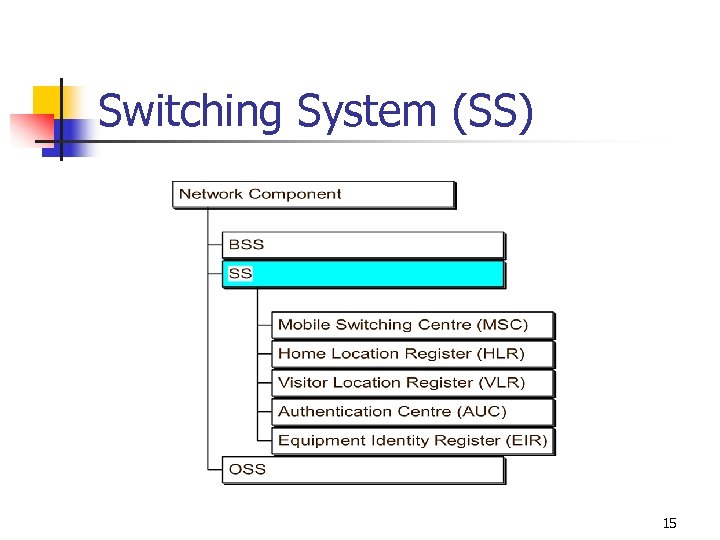
Switching System (SS) 15
Mobile Switching Centre (MSC) n n Handles the switching of calls between external networks and the BSCs Controls handovers between BSC within the MSC area Decide which function that is going to be used (call, SMS etc) Coordinates VLR, HLR, OSS (OMC) 16
Home Location Register (HLR) n n n Database that keeps information about all subscribers within it’s area Name, identification number, type of service, subscriber status, temporary roaming number for handovers n Temporary information n Permanent information Responsible for changing VLR-info if the subscriber changes VLR area 17
Visitor Location Register (VLR) n n Database that keeps information about all subscribers that temporary are within it’s area (MSC service area) Position updating if the MS moves to a different LA To connect up a call, the system now has no need to contact HLR, since VLR has all the necessary information Differs from HLR by the TMSI (Temporary Mobile Subscriber Identity) because of avoiding to send the IMSI (International Mobile Identification Number) via radio signals 18
Authentication Centre (AUC) n n Stores information regarding safety Encryption keys n n n ki (subscriber authentication key) rand MSC computes SRES (Signal response) from ki and rand n n SRES = generated Identification parameter out of a randomly selected variable and the ki SRES now stored in HLR for use in case of call 19
Equipment Identity Register (EIR) n n EIR is an option available for any operator in GSM Contains information about stolen cellular, defect cellular that may not be used in the network etc n Serial number, IMEI (international Mobile Equipment Identity) n IMEI contains info about manufacturer, country of manufacturing and certificate 20
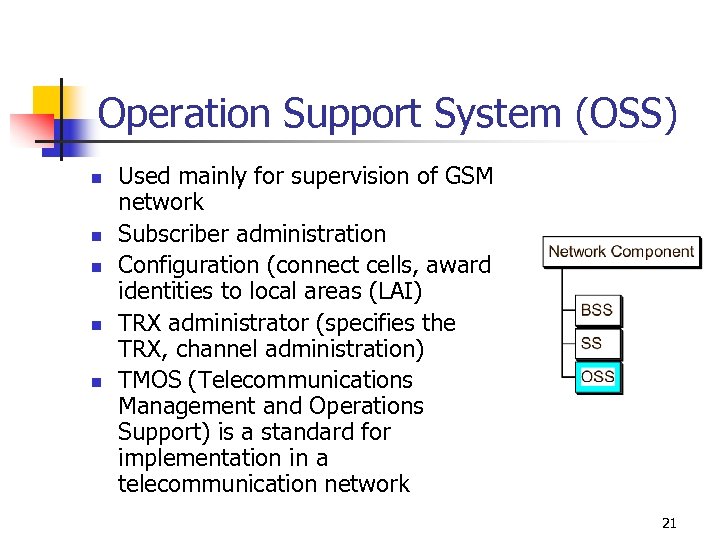
Operation Support System (OSS) n n n Used mainly for supervision of GSM network Subscriber administration Configuration (connect cells, award identities to local areas (LAI) TRX administrator (specifies the TRX, channel administration) TMOS (Telecommunications Management and Operations Support) is a standard for implementation in a telecommunication network 21
Operation Support System (OSS) (continued) n Errors from the network manually handled by an operator e. g. n n n Defect circuit boards in a BTS Messages from a cellular that are registered in EIR that tries to call Checking the functionality of the systems components Statistics (current traffic between BTS-BSC etc) Keeps info about definitions of all cells Graphical tools for presenting images of the network 22
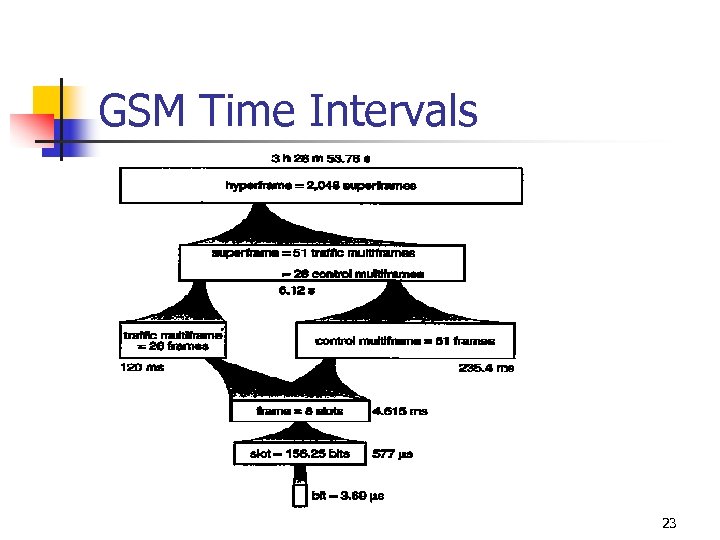
GSM Time Intervals 23
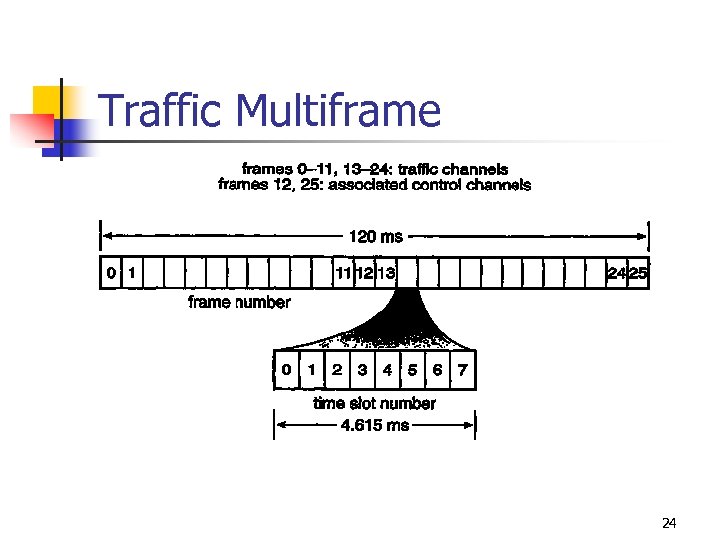
Traffic Multiframe 24
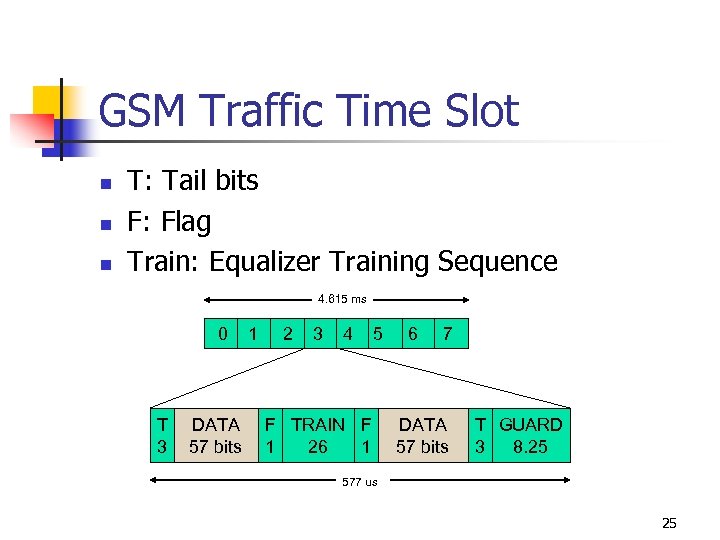
GSM Traffic Time Slot n n n T: Tail bits F: Flag Train: Equalizer Training Sequence 4. 615 ms 0 T 3 DATA 57 bits 1 2 3 4 5 F TRAIN F 1 26 1 6 7 DATA 57 bits T GUARD 3 8. 25 577 us 25
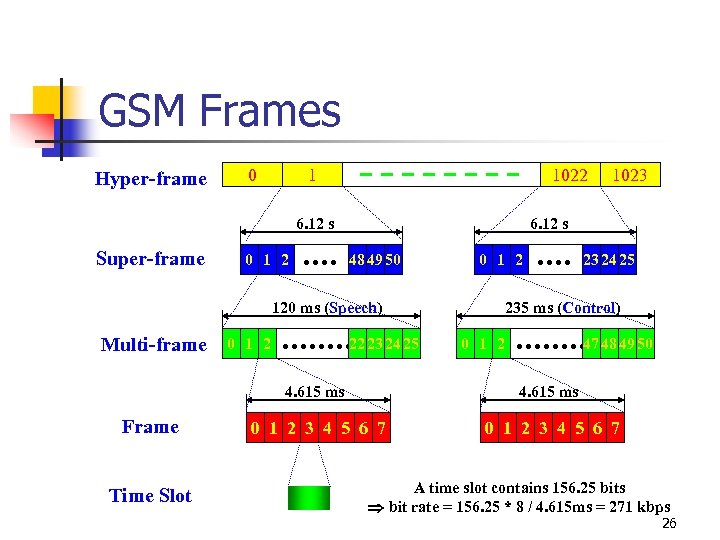
GSM Frames Hyper-frame 0 1 1022 6. 12 s Super-frame 0 1 2 6. 12 s 48 49 50 0 1 2 120 ms (Speech) Multi-frame 0 1 2 1023 22 23 24 25 235 ms (Control) 0 1 2 47 48 49 50 4. 615 ms Frame Time Slot 4. 615 ms 0 1 2 3 4 5 6 7 A time slot contains 156. 25 bits bit rate = 156. 25 * 8 / 4. 615 ms = 271 kbps 26
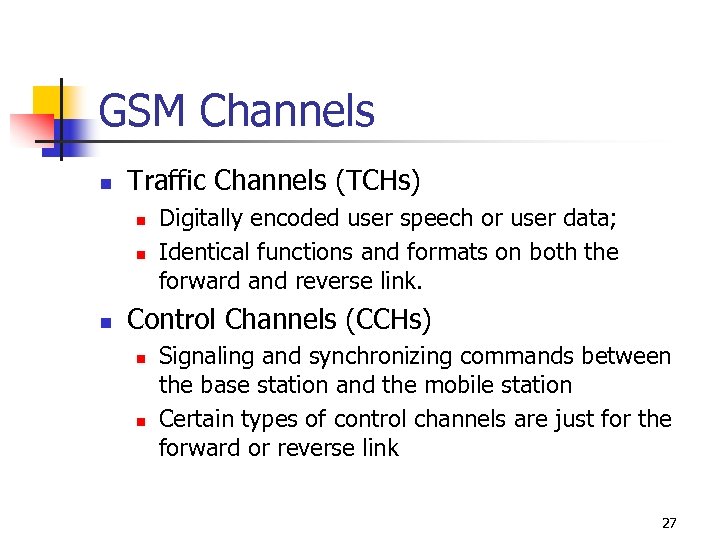
GSM Channels n Traffic Channels (TCHs) n n n Digitally encoded user speech or user data; Identical functions and formats on both the forward and reverse link. Control Channels (CCHs) n n Signaling and synchronizing commands between the base station and the mobile station Certain types of control channels are just for the forward or reverse link 27
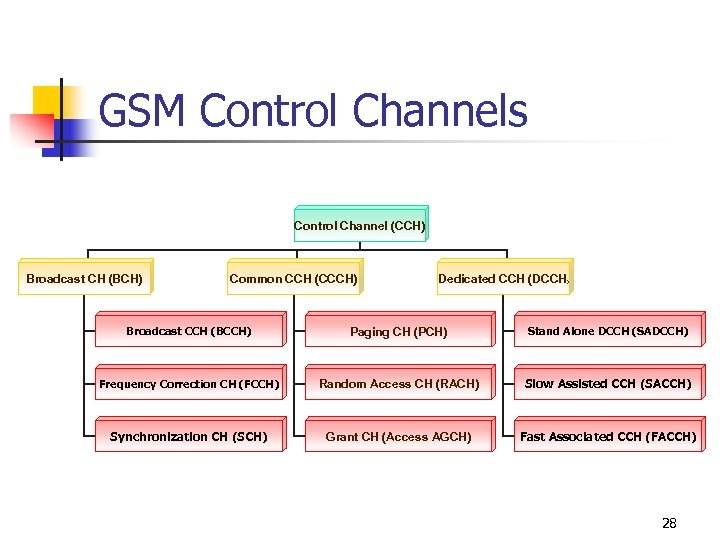
GSM Control Channels Control Channel (CCH) Broadcast CH (BCH) Common CCH (CCCH) Dedicated CCH (DCCH ) Broadcast CCH (BCCH) Paging CH (PCH) Stand Alone DCCH (SADCCH) Frequency Correction CH (FCCH) Random Access CH (RACH) Slow Assisted CCH (SACCH) Synchronization CH (SCH) Grant CH (Access AGCH) Fast Associated CCH (FACCH) 28
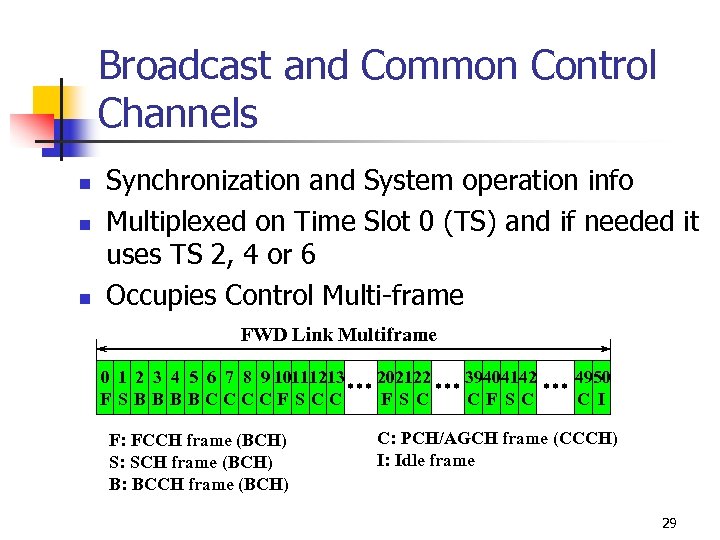
Broadcast and Common Control Channels n n n Synchronization and System operation info Multiplexed on Time Slot 0 (TS) and if needed it uses TS 2, 4 or 6 Occupies Control Multi-frame FWD Link Multiframe 0 1 2 3 4 5 6 7 8 9 10111213 F SBBBBCCCCF S CC F: FCCH frame (BCH) S: SCH frame (BCH) B: BCCH frame (BCH) 202122 F SC 39404142 CF SC 4950 C I C: PCH/AGCH frame (CCCH) I: Idle frame 29
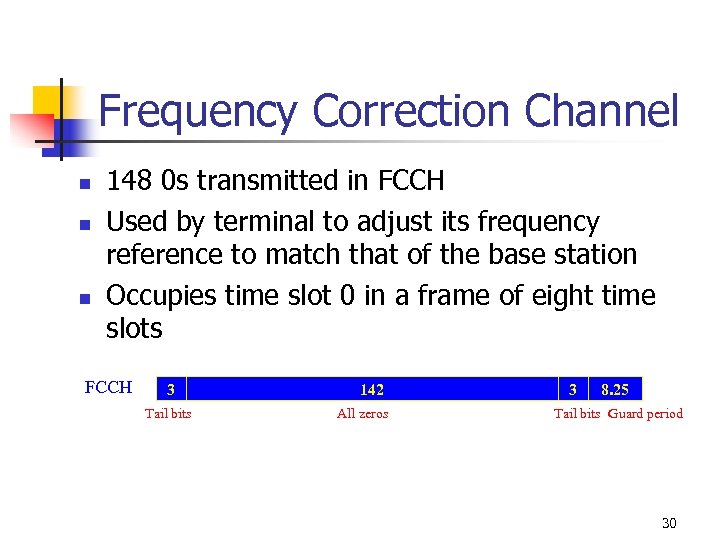
Frequency Correction Channel n n n 148 0 s transmitted in FCCH Used by terminal to adjust its frequency reference to match that of the base station Occupies time slot 0 in a frame of eight time slots FCCH 3 Tail bits 142 All zeros 3 8. 25 Tail bits Guard period 30
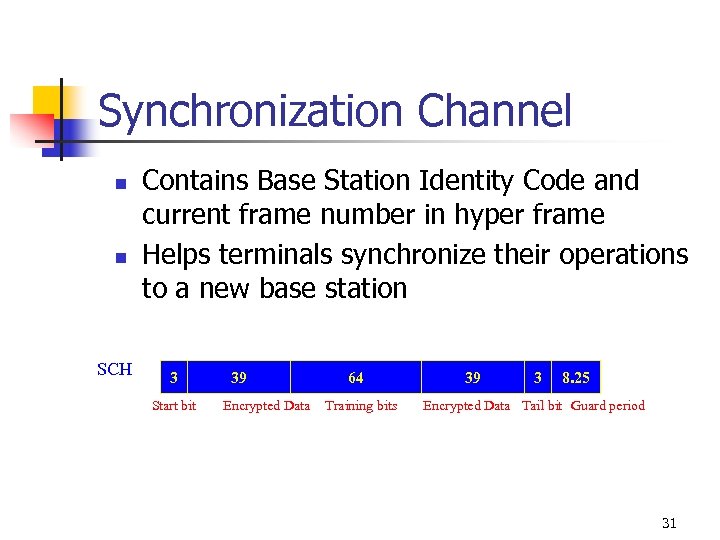
Synchronization Channel n n SCH Contains Base Station Identity Code and current frame number in hyper frame Helps terminals synchronize their operations to a new base station 3 Start bit 39 Encrypted Data 64 Training bits 39 3 8. 25 Encrypted Data Tail bit Guard period 31
Paging and Access Grant n n Used to notify terminals of arriving calls and to direct a terminal to a stand alone dedicated control channel Every mobile is assigned to a particular paging group 32
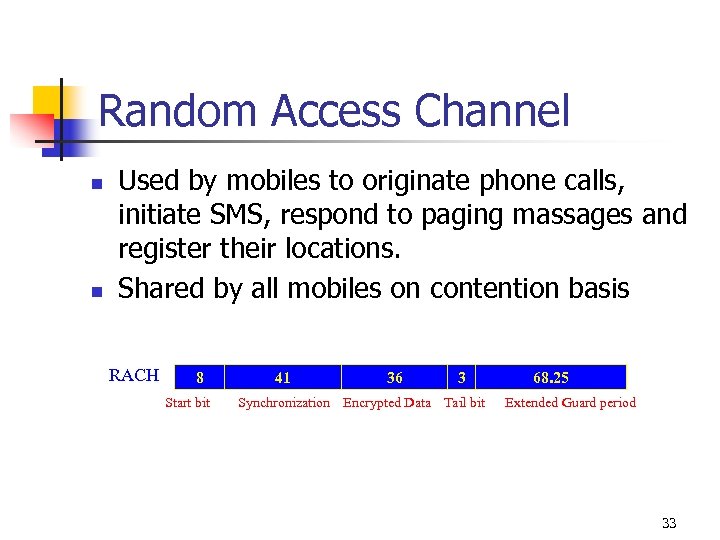
Random Access Channel n n Used by mobiles to originate phone calls, initiate SMS, respond to paging massages and register their locations. Shared by all mobiles on contention basis RACH 8 Start bit 41 36 3 Synchronization Encrypted Data Tail bit 68. 25 Extended Guard period 33
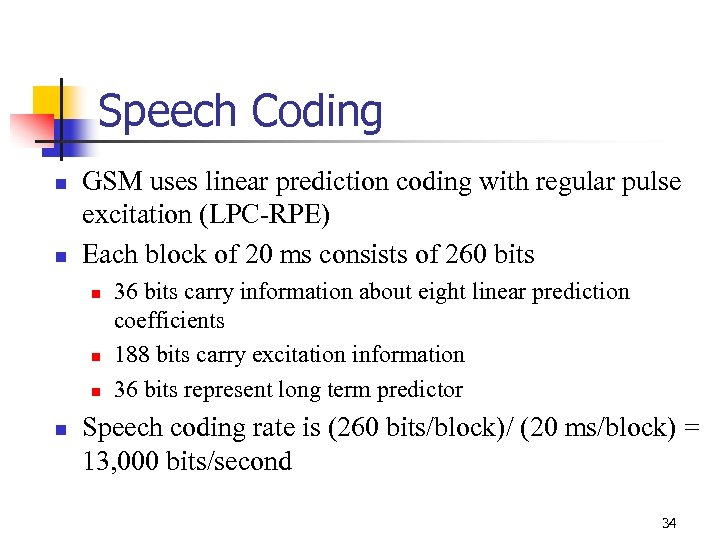
Speech Coding n n GSM uses linear prediction coding with regular pulse excitation (LPC-RPE) Each block of 20 ms consists of 260 bits n n 36 bits carry information about eight linear prediction coefficients 188 bits carry excitation information 36 bits represent long term predictor Speech coding rate is (260 bits/block)/ (20 ms/block) = 13, 000 bits/second 34
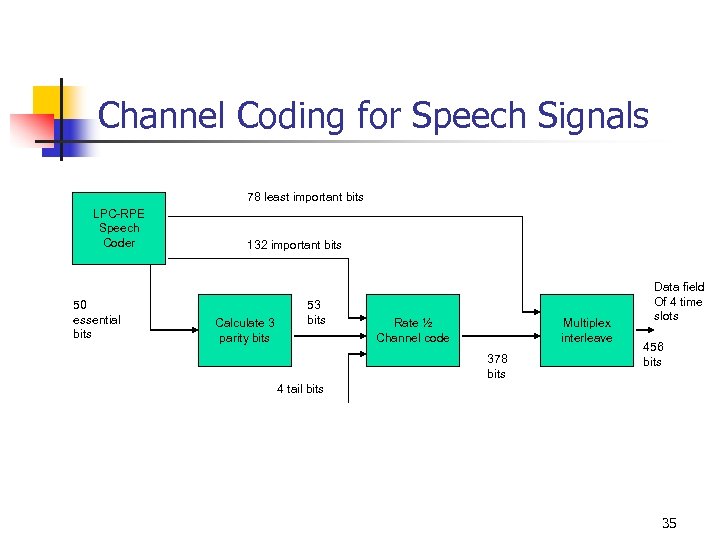
Channel Coding for Speech Signals 78 least important bits LPC-RPE Speech Coder 50 essential bits 132 important bits Calculate 3 parity bits 53 bits Rate ½ Channel code Multiplex interleave 378 bits Data field Of 4 time slots 456 bits 4 tail bits 35
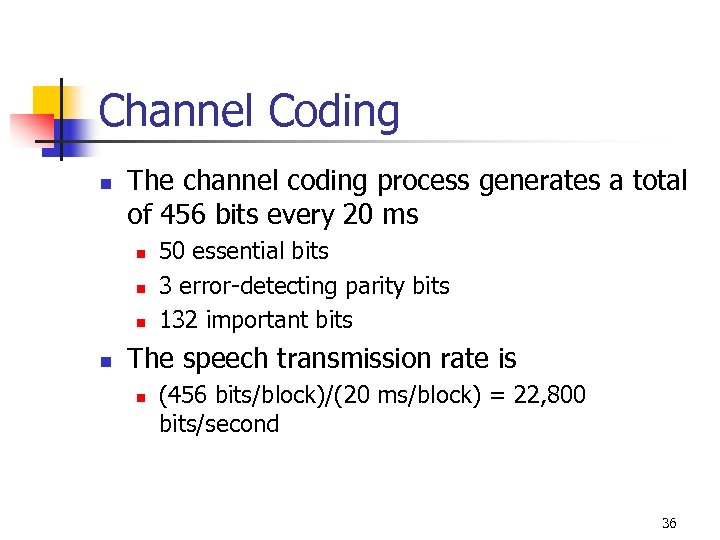
Channel Coding n The channel coding process generates a total of 456 bits every 20 ms n n 50 essential bits 3 error-detecting parity bits 132 important bits The speech transmission rate is n (456 bits/block)/(20 ms/block) = 22, 800 bits/second 36
Interleaving n n Interleaving takes error clusters and spreads them out over large intervals. 2 speech blocks, or 40 ms of speech (2 x 456=912 coded speech bits), distributed over 8 frames. 37
Multipath Equalization n n n Time varying effect of radio channels Adaptive equalizer is an important component of every GSM receiver Extracts desired signal from multiple versions of the signal Uses 26 -bit training sequence and inverse filter GSM specifies 8 different training sequences assigned to nearby cells which use the same carrier Enables terminals and base stations to confirm the received signal comes from the correct transmitter GSM can handle delay spreads up to 16 us ~ 4 -bit period 38
Power Control n n GSM specifies 5 classes of terminals by maximum transmitter power (20 W, 8 W, 5 W, 2 W, 0. 8 W) Power can adjust by steps of 2 d. B to any of 16 power levels that range over 30 d. B A full-rate transmitter is active for 1 time slot per frame Advantages: Minimizes co-channel interference n Conserves power Power control should be handled carefully because terminals increasing their power can cause co-channel cells’ terminals to increase their power levels, which results in unstable condition. n n 39
GSM Innovations n n Mobile assisted handoffs (MAHO) Location-based mobility management Network interfaces in addition to air interface Made the subscriber mobile with the Subscriber Identity Module (SIM) Card 40
GSM Mobility management n Location management n In GSM a compromise between the two is achieved by requiring the mobile to register only when it changes a collection of cells called a location area. The mobile is then paged only in the cells in the location area it last registered from. This is a tradeoff between high number of registrations to high number of paging attempts. 41
GSM Mobility management n n Handoff – In GSM handoff is done using the assistance of the mobile. This is called as MAHO (mobile assisted handoff). Handoff process proceeds like this : n n The mobile detects that the bit error rate for the base station signal has increased beyond a threshold value The mobile then measures the signal strength of the surrounding cells and sends measurement reports to MSC then decides the target cell for handoff. The handoff is hard - ‘break before make’ handoff 42
GSM Mobility Management n Roaming n n Terminal Mobility – If same radio frequency is employed or if mobile has multiple modes, then terminal mobility is possible Subscriber Mobility – By swapping the SIM card to the appropriate GSM terminal, subscriber is freed from the terminal 43
Frequency Hopping n Objective n n Procedure n n To avoid severe multipath problems Change the carrier frequency of a given user Characters n n Hopping frame by frame Maximum 217. 6 hops / second 44
Скачать презентацию Global System For Mobile Communication GSM 1
8f1c9f19c403bd03004e30a0db8c4bb8.ppt