 Скачать презентацию Global Reactive Gases Martin Schultz IEK-8 Forschungszentrum Jülich
a5aaa5a4dbfdd3582e13d2286a208396.ppt
- Количество слайдов: 56



Global Reactive Gases Martin Schultz IEK-8, Forschungszentrum Jülich Gmb. H

• • • MACC G-RG (13 partners) combines heritage from GEMS (12 partners) and PROMOTE (5 partners) PROMOTE heritage: • • level 2 satellite data products (GOME, GOME-2, Sciamachy, OMI) decentralized data assimilation for stratospheric (and total column) ozone (SACADA, BASCOE, TM 3 DAM) GEMS heritage: • • quasi-operational monitoring of tropospheric and stratospheric composition with IFS-MOZART and coupling achieved for IFS-TM 5 and IFS-MOCAGE reanalysis 2003 -2008 support of scientific field campaigns a lot of validation activities Introduction Slide 2

MACC G-RG comprises 4 work packages: • WP 1: Satellite based monitoring of stratospheric ozone and tropospheric trace gas columns • WP 2: Consolidation and improvement of integrated global stratospheric ozone service • WP 3: Consolidation and improvement of integrated service for global tropospheric reactive gases • WP 4: Development of fully integrated chemistry transport in the ECMWF IFS Introduction Slide 3

WP 1 objective: Continue existing decentralized services from PROMOTE that deliver value-added satellite data products related to stratospheric ozone and tropospheric trace gas columns (ozone, NO 2, HCHO, CO, SO 2) to end users WP 1 Status Slide 4

• Task G-RG_1. 1: Near-real time provision of ozone and NO 2 data from OMI, SCIAMACHY, GOME and GOME-2 • Task G-RG_1. 2: Stratospheric ozone record and NRT service using SACADA 4 D-Var • Task G-RG_1. 3: Stratospheric ozone record and NRT service using BASCOE 4 D-Var • Task G-RG_1. 4: Total ozone record, monitoring and forecast service Assimilation and forecasts of global stratospheric ozone • Task G-RG_1. 5: Validation of WP G-RG 1 trace gas services WP 1 Status Slide 5
• Main results of first reporting period • • • Routine provision of satellite based data for European instruments: GOME-2, OMI and SCIAMACHY Quasi-operational application of independent assimilation systems: BASCOE, SACADA, TM 3 DAM for stratospheric ozone chemistry Initial validation of stratospheric (assimilation) services WP 1 Status Slide 6

Task GRG 1. 1 Provision of satellite based data (level-2) • Most level-2 data on stratospheric ozone, Br. O, tropospheric and total NO 2, CH 2 O and SO 2 is now available in NRT via MACC and/or dedicated access points • Improvements of the trace gas retrieval w. r. t. speed, temperature data, new (standard) absorption spectra • Reprocessing for GOME(1995 -2003) and SCIA(20022010) WP 1 Status Slide 7
Tasks GRG 1. 2 --1. 4 Stratospheric ozone services • SACADA assimilation of SCIA nadir ozone observations since March 2010. • BASCOE assimilation of MLS AURA data since December 2009. • Multi-instrumental 30 year reanalysis based on TOMS, GOME, SBUV, SCIA, OMI and GOME-2 data. • SCIA ozone forecasts are now corrected for instrumental calibration issues, which is especially important for UV products. WP 1 Status Slide 8

TM 3 DAM Assimilated total ozone record for the period 1978 – 2008 based on satellite observations of TOMS, SBUV, GOME, SCIAMACHY, GOME-2 and OMI R. J. van der A, M. A. F. Allaart, and H. J. Eskes (2010): Multi sensor reanalysis of total ozone, Atmos. Chem. Phys. Discuss. , 10, 11401 -11448. WP 1 Status Slide 9
Task GRG 1. 5 BASCOE, SACADA and TM 3 DAM: Intercomparison and comparison to independent data (focus on 2003 episode) • • • BASCOE and SACADA more similar than TM 3 DAM. Results agree well in regions with good daily data coverage. Best correlation with independent data for the middle and high northern latitudes. Worst during ozone hole conditions. Most systematic deviations occur in data void regions. CTMs are capable to reproduce the Antarctic ozone hole. Though, timing and intensity differs from observations. WP 1 Status Slide 10
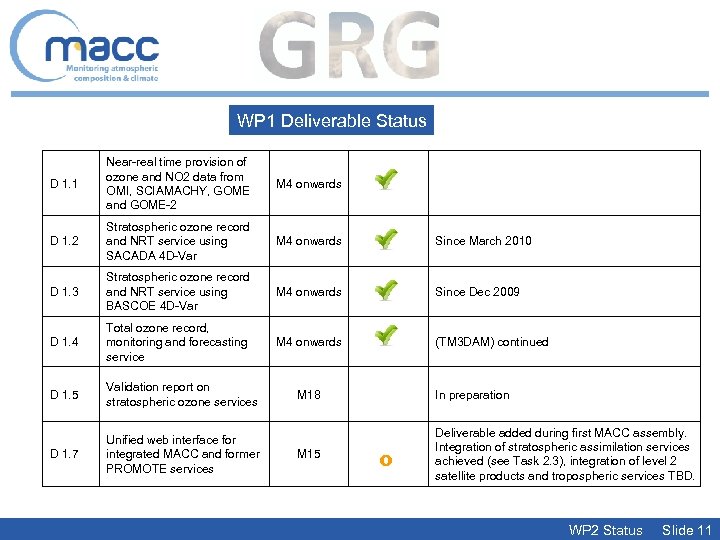
WP 1 Deliverable Status D 1. 1 Near-real time provision of ozone and NO 2 data from OMI, SCIAMACHY, GOME and GOME-2 M 4 onwards D 1. 2 Stratospheric ozone record and NRT service using SACADA 4 D-Var M 4 onwards Since March 2010 D 1. 3 Stratospheric ozone record and NRT service using BASCOE 4 D-Var M 4 onwards Since Dec 2009 D 1. 4 Total ozone record, monitoring and forecasting service M 4 onwards (TM 3 DAM) continued D 1. 5 Validation report on stratospheric ozone services D 1. 7 Unified web interface for integrated MACC and former PROMOTE services M 18 M 15 o In preparation Deliverable added during first MACC assembly. Integration of stratospheric assimilation services achieved (see Task 2. 3), integration of level 2 satellite products and tropospheric services TBD. WP 2 Status Slide 11
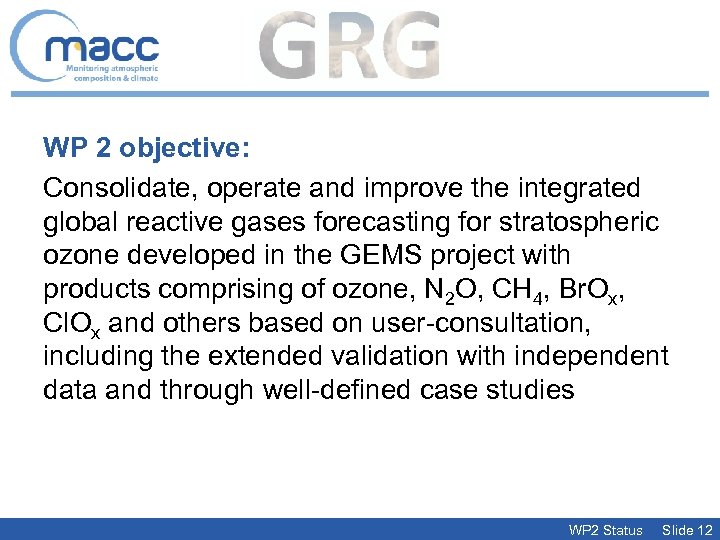
WP 2 objective: Consolidate, operate and improve the integrated global reactive gases forecasting for stratospheric ozone developed in the GEMS project with products comprising of ozone, N 2 O, CH 4, Br. Ox, Cl. Ox and others based on user-consultation, including the extended validation with independent data and through well-defined case studies WP 2 Status Slide 12
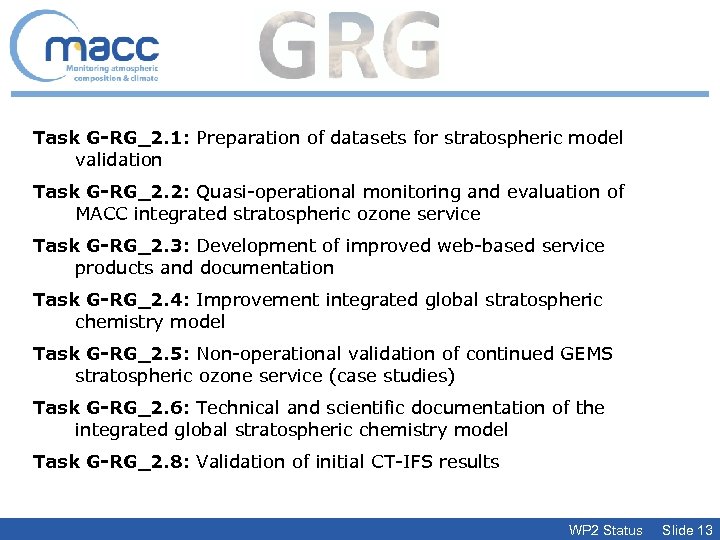
Task G-RG_2. 1: Preparation of datasets for stratospheric model validation Task G-RG_2. 2: Quasi-operational monitoring and evaluation of MACC integrated stratospheric ozone service Task G-RG_2. 3: Development of improved web-based service products and documentation Task G-RG_2. 4: Improvement integrated global stratospheric chemistry model Task G-RG_2. 5: Non-operational validation of continued GEMS stratospheric ozone service (case studies) Task G-RG_2. 6: Technical and scientific documentation of the integrated global stratospheric chemistry model Task G-RG_2. 8: Validation of initial CT-IFS results WP 2 Status Slide 13
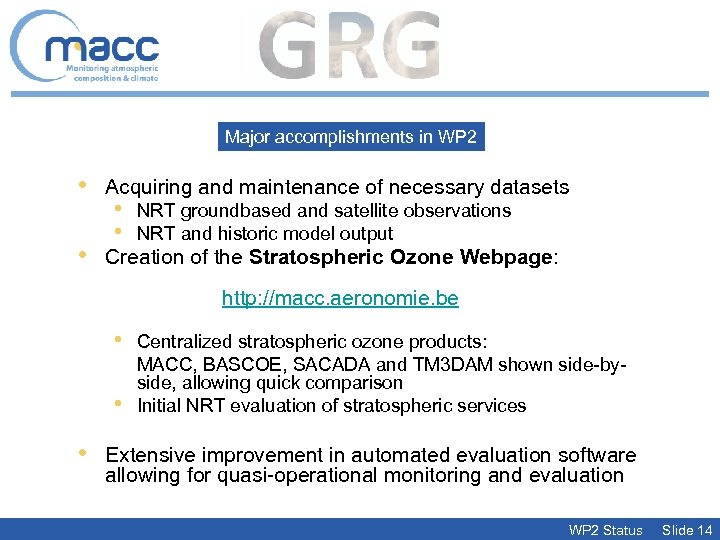
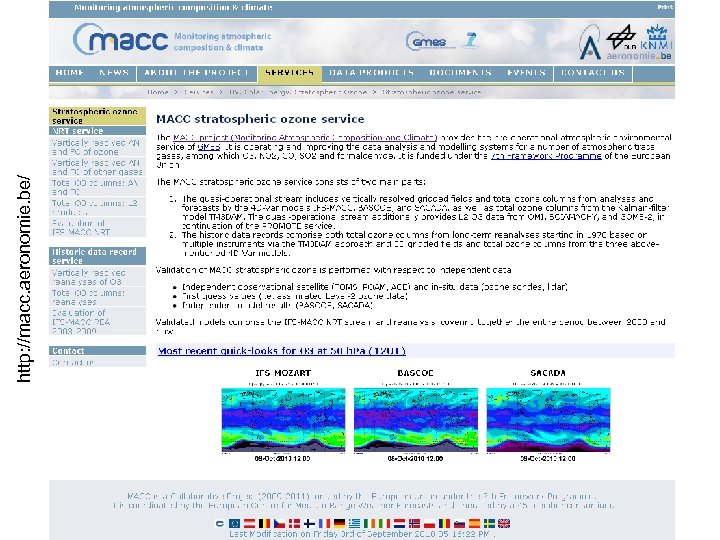
Major accomplishments in WP 2 • • Acquiring and maintenance of necessary datasets • • NRT groundbased and satellite observations NRT and historic model output Creation of the Stratospheric Ozone Webpage: http: //macc. aeronomie. be • • • Centralized stratospheric ozone products: MACC, BASCOE, SACADA and TM 3 DAM shown side-byside, allowing quick comparison Initial NRT evaluation of stratospheric services Extensive improvement in automated evaluation software allowing for quasi-operational monitoring and evaluation WP 2 Status Slide 14
http: //macc. aeronomie. be/
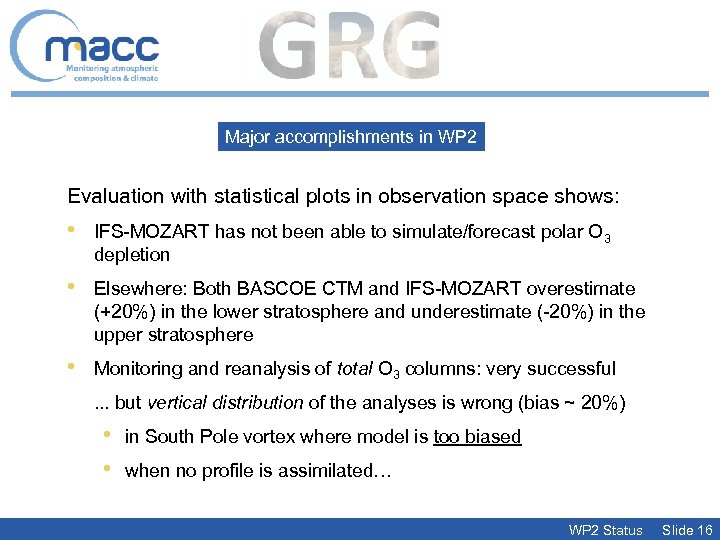
Major accomplishments in WP 2 Evaluation with statistical plots in observation space shows: • IFS-MOZART has not been able to simulate/forecast polar O 3 depletion • Elsewhere: Both BASCOE CTM and IFS-MOZART overestimate (+20%) in the lower stratosphere and underestimate (-20%) in the upper stratosphere • Monitoring and reanalysis of total O 3 columns: very successful . . . but vertical distribution of the analyses is wrong (bias ~ 20%) • • in South Pole vortex where model is too biased when no profile is assimilated… WP 2 Status Slide 16
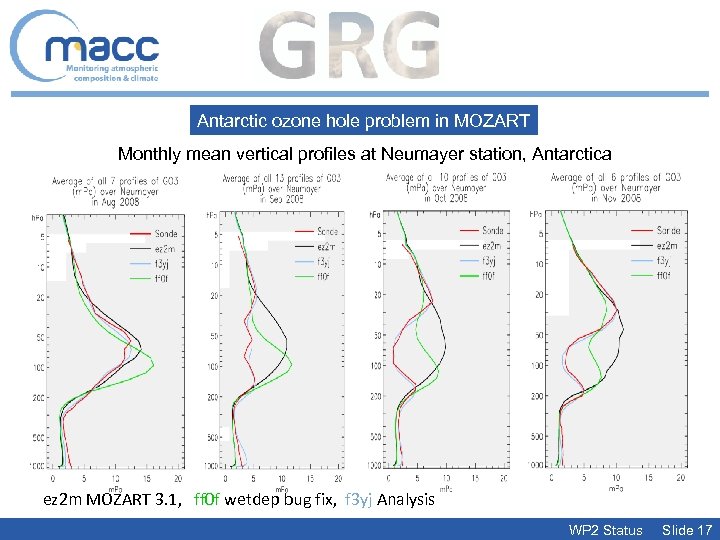
Antarctic ozone hole problem in MOZART Monthly mean vertical profiles at Neumayer station, Antarctica ez 2 m MOZART 3. 1, ff 0 f wetdep bug fix, f 3 yj Analysis WP 2 Status Slide 17
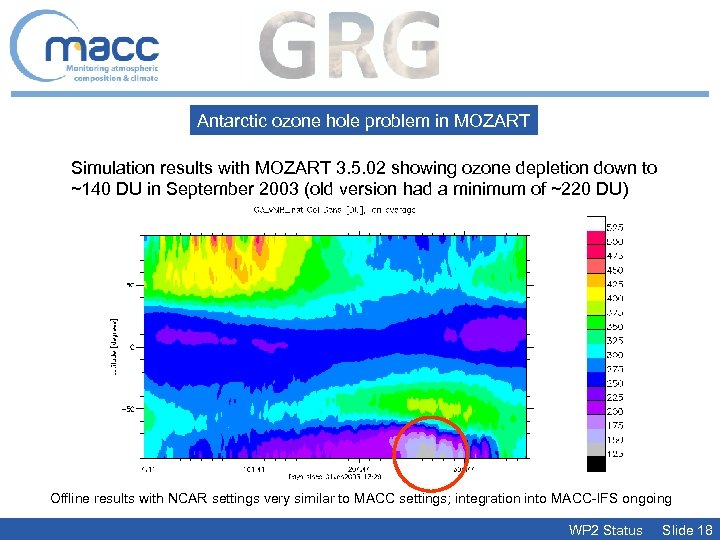
Antarctic ozone hole problem in MOZART Simulation results with MOZART 3. 5. 02 showing ozone depletion down to ~140 DU in September 2003 (old version had a minimum of ~220 DU) Offline results with NCAR settings very similar to MACC settings; integration into MACC-IFS ongoing WP 2 Status Slide 18
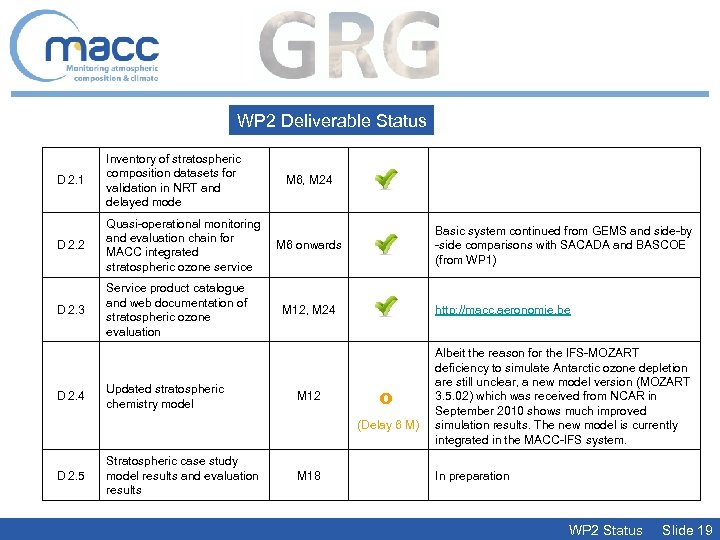
WP 2 Deliverable Status D 2. 1 Inventory of stratospheric composition datasets for validation in NRT and delayed mode D 2. 2 Quasi-operational monitoring and evaluation chain for MACC integrated stratospheric ozone service D 2. 3 Service product catalogue and web documentation of stratospheric ozone evaluation M 6, M 24 Basic system continued from GEMS and side-by -side comparisons with SACADA and BASCOE (from WP 1) M 6 onwards M 12, M 24 http: //macc. aeronomie. be D 2. 4 Updated stratospheric chemistry model M 12 o (Delay 6 M) D 2. 5 Stratospheric case study model results and evaluation results M 18 Albeit the reason for the IFS-MOZART deficiency to simulate Antarctic ozone depletion are still unclear, a new model version (MOZART 3. 5. 02) which was received from NCAR in September 2010 shows much improved simulation results. The new model is currently integrated in the MACC-IFS system. In preparation WP 2 Status Slide 19
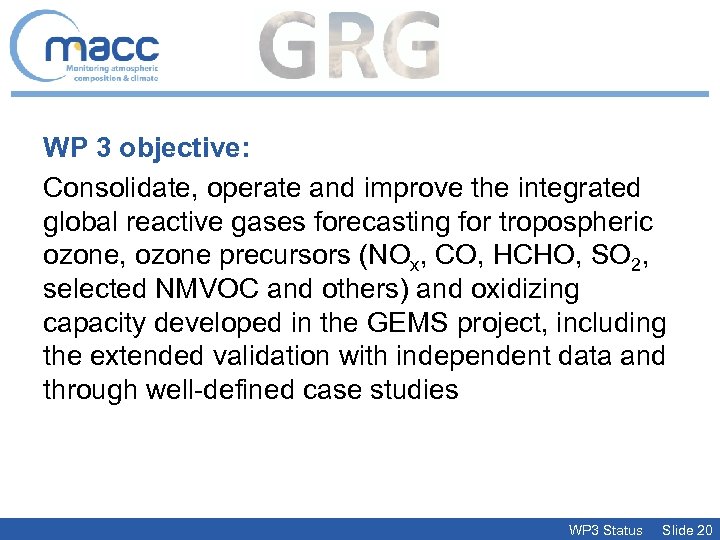
WP 3 objective: Consolidate, operate and improve the integrated global reactive gases forecasting for tropospheric ozone, ozone precursors (NOx, CO, HCHO, SO 2, selected NMVOC and others) and oxidizing capacity developed in the GEMS project, including the extended validation with independent data and through well-defined case studies WP 3 Status Slide 20
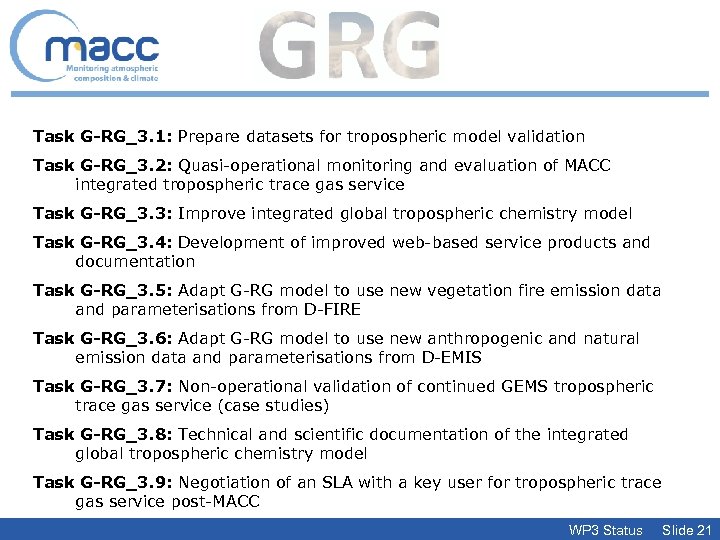
Task G-RG_3. 1: Prepare datasets for tropospheric model validation Task G-RG_3. 2: Quasi-operational monitoring and evaluation of MACC integrated tropospheric trace gas service Task G-RG_3. 3: Improve integrated global tropospheric chemistry model Task G-RG_3. 4: Development of improved web-based service products and documentation Task G-RG_3. 5: Adapt G-RG model to use new vegetation fire emission data and parameterisations from D-FIRE Task G-RG_3. 6: Adapt G-RG model to use new anthropogenic and natural emission data and parameterisations from D-EMIS Task G-RG_3. 7: Non-operational validation of continued GEMS tropospheric trace gas service (case studies) Task G-RG_3. 8: Technical and scientific documentation of the integrated global tropospheric chemistry model Task G-RG_3. 9: Negotiation of an SLA with a key user for tropospheric trace gas service post-MACC WP 3 Status Slide 21
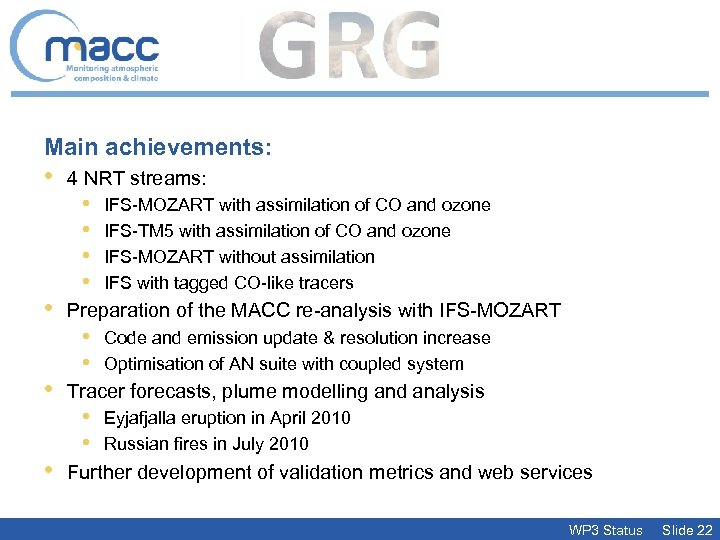
Main achievements: • • 4 NRT streams: • • IFS-MOZART with assimilation of CO and ozone IFS-TM 5 with assimilation of CO and ozone IFS-MOZART without assimilation IFS with tagged CO-like tracers Preparation of the MACC re-analysis with IFS-MOZART • • Code and emission update & resolution increase Optimisation of AN suite with coupled system Tracer forecasts, plume modelling and analysis • • Eyjafjalla eruption in April 2010 Russian fires in July 2010 Further development of validation metrics and web services WP 3 Status Slide 22
1 -2 slides with NRT stream results (could also be tied in with Russian fires…)
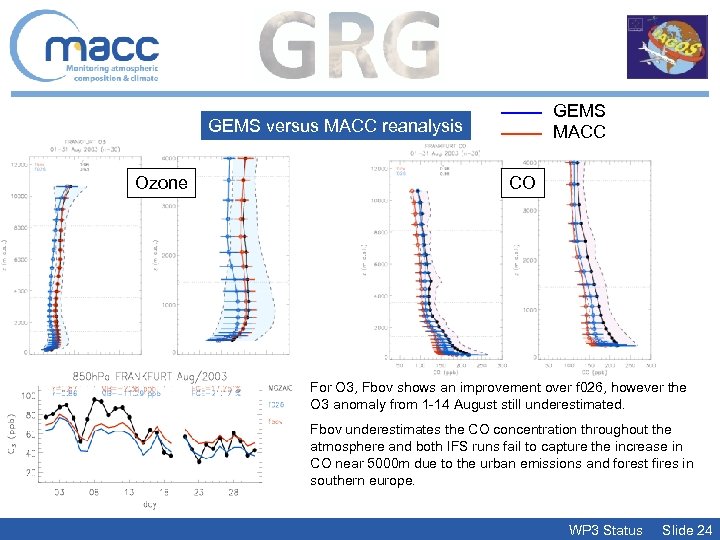
GEMS MACC GEMS versus MACC reanalysis Ozone CO For O 3, Fbov shows an improvement over f 026, however the O 3 anomaly from 1 -14 August still underestimated. Fbov underestimates the CO concentration throughout the atmosphere and both IFS runs fail to capture the increase in CO near 5000 m due to the urban emissions and forest fires in southern europe. WP 3 Status Slide 24
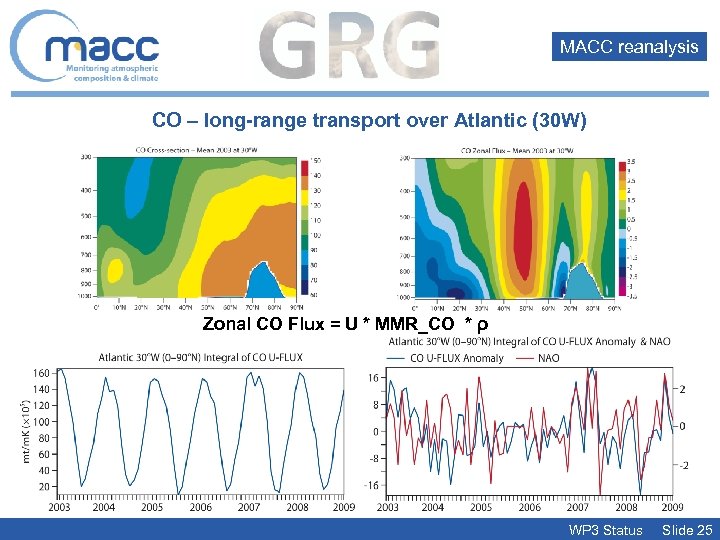
MACC reanalysis CO – long-range transport over Atlantic (30 W) Zonal CO Flux = U * MMR_CO * ρ WP 3 Status Slide 25
Eyjafjalla eruption: plume modelling • • • GEMS&MACC developments allowed for quick implementation of tracer forecast within 24 h after eruption using different injection height assumptions Good agreement in shape with forecast from VAAC - Metoffice and others Large uncertainty in emission source strength and injection height Ongoing experiments with data assimilation of SO 2 Ongoing inter-comparison of plume forecast within ENSEMBLE framework (Dispersion models) WP 3 Status Slide 26
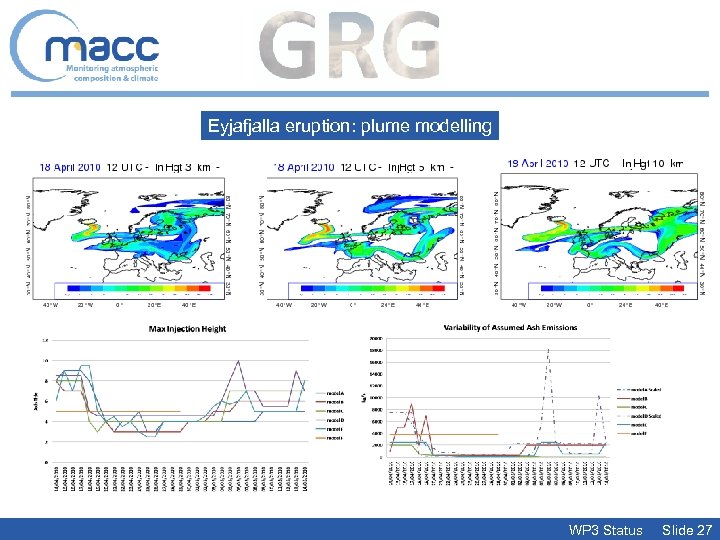
Eyjafjalla eruption: plume modelling WP 3 Status Slide 27
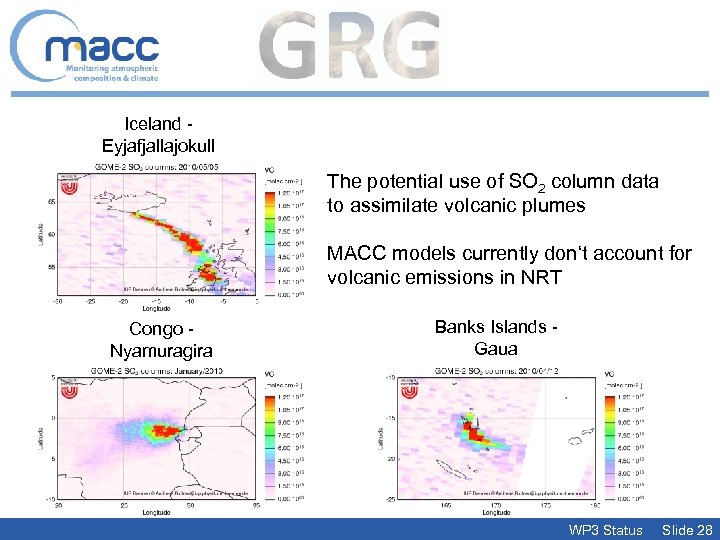
Iceland - Eyjafjallajokull The potential use of SO 2 column data to assimilate volcanic plumes MACC models currently don‘t account for volcanic emissions in NRT Congo - Nyamuragira Banks Islands - Gaua WP 3 Status Slide 28
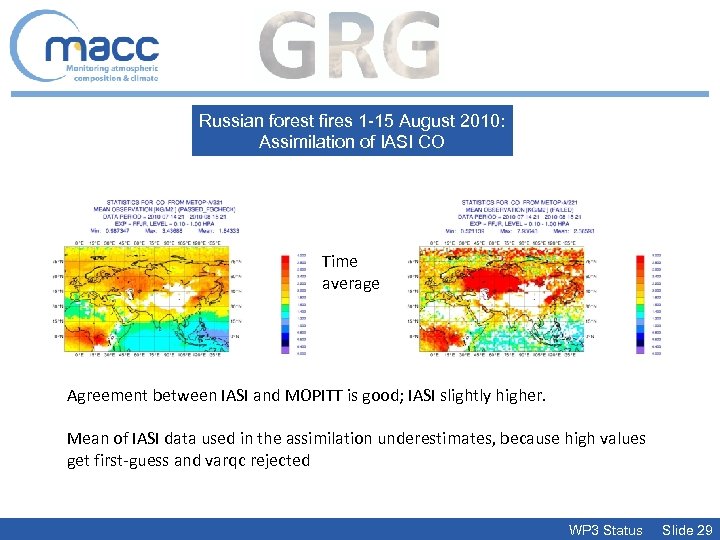
Russian forest fires 1 -15 August 2010: Assimilation of IASI CO Time average Agreement between IASI and MOPITT is good; IASI slightly higher. Mean of IASI data used in the assimilation underestimates, because high values get first-guess and varqc rejected WP 3 Status Slide 29
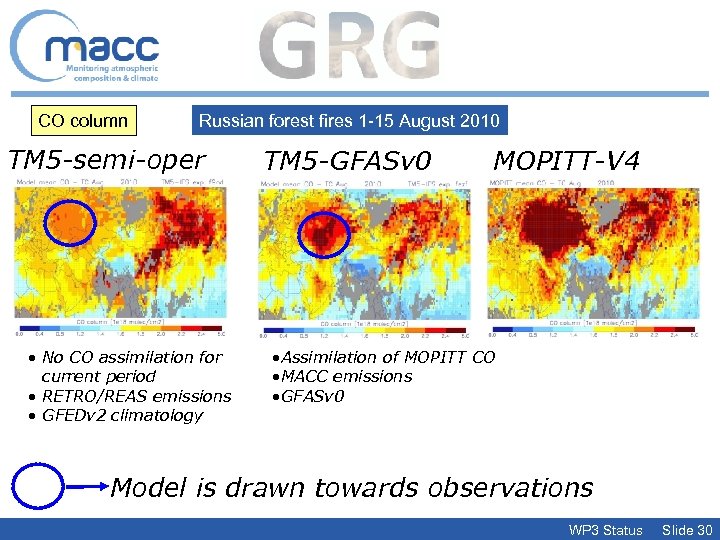
CO column Russian forest fires 1 -15 August 2010 TM 5 -semi-oper • No CO assimilation for current period • RETRO/REAS emissions • GFEDv 2 climatology TM 5 -GFASv 0 MOPITT-V 4 • Assimilation of MOPITT CO • MACC emissions • GFASv 0 Model is drawn towards observations WP 3 Status Slide 30
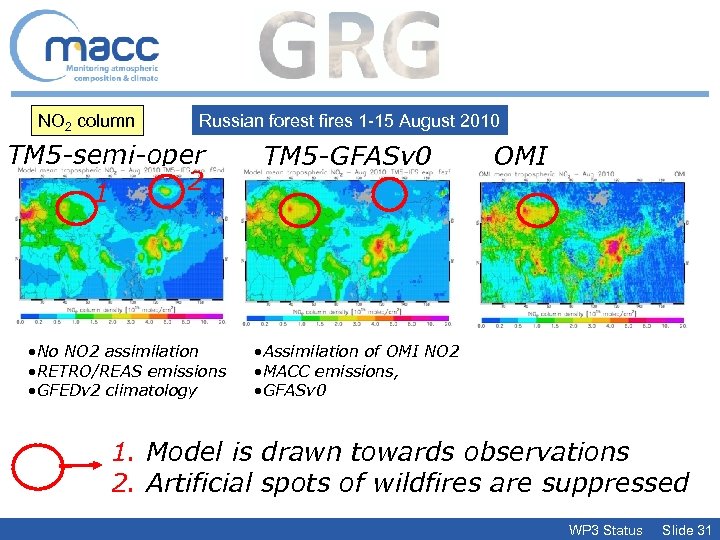
NO 2 column Russian forest fires 1 -15 August 2010 TM 5 -semi-oper 2 1 • No NO 2 assimilation • RETRO/REAS emissions • GFEDv 2 climatology TM 5 -GFASv 0 OMI • Assimilation of OMI NO 2 • MACC emissions, • GFASv 0 1. Model is drawn towards observations 2. Artificial spots of wildfires are suppressed WP 3 Status Slide 31
WP 3 Status Slide 32

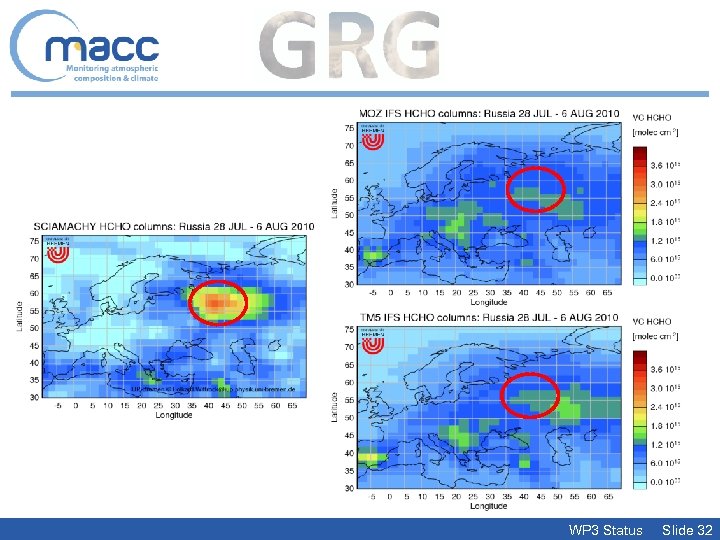
IFS-TM 5 model Assim uses IASI CO columns GFAS doesn‘t capture burning events or emission magnitude leading to „observed“ CO enhancement.
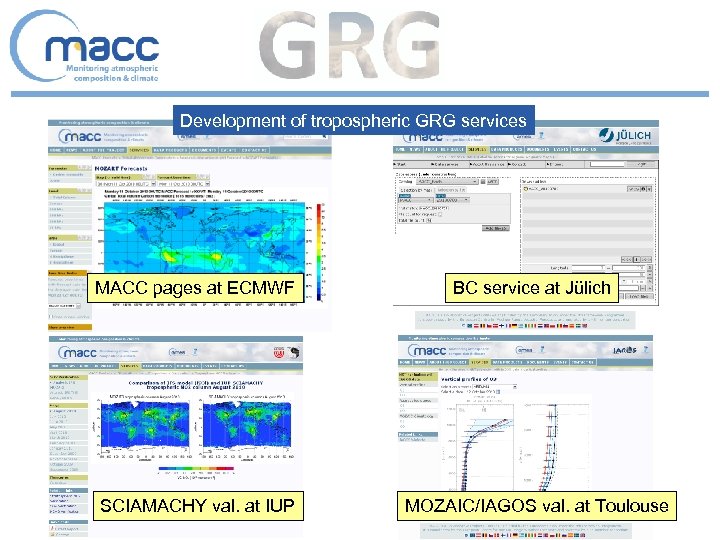
Development of tropospheric GRG services MACC pages at ECMWF BC service at Jülich SCIAMACHY val. at IUP MOZAIC/IAGOS val. at Toulouse

Use of global boundary conditions for regional AQ modeling GEMS-RAQ model: MM 5/CAMx Climatic Boundaries vs. MOZART-GRG f 026 boundaries Comparison with MOZAIC WP 3 Status Slide 35
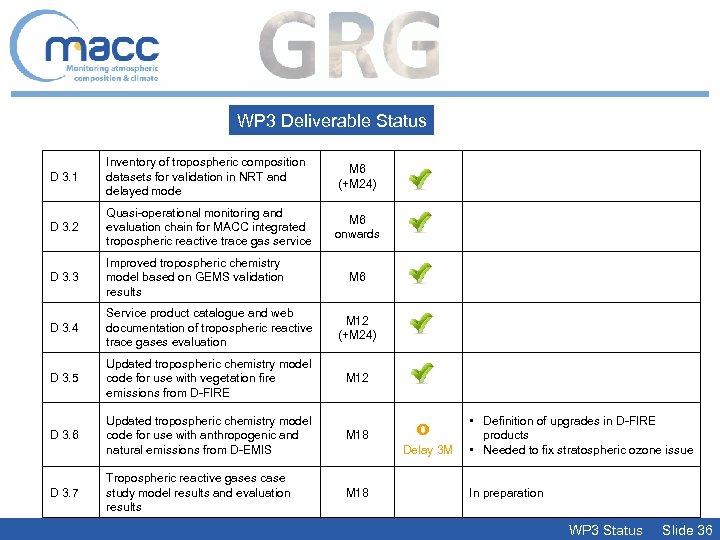
WP 3 Deliverable Status D 3. 1 Inventory of tropospheric composition datasets for validation in NRT and delayed mode M 6 (+M 24) D 3. 2 Quasi-operational monitoring and evaluation chain for MACC integrated tropospheric reactive trace gas service M 6 onwards D 3. 3 Improved tropospheric chemistry model based on GEMS validation results D 3. 4 Service product catalogue and web documentation of tropospheric reactive trace gases evaluation M 12 (+M 24) D 3. 5 Updated tropospheric chemistry model code for use with vegetation fire emissions from D-FIRE M 12 D 3. 6 Updated tropospheric chemistry model code for use with anthropogenic and natural emissions from D-EMIS M 18 Tropospheric reactive gases case study model results and evaluation results M 18 D 3. 7 M 6 o Delay 3 M • Definition of upgrades in D-FIRE products • Needed to fix stratospheric ozone issue In preparation WP 3 Status Slide 36
WP 4 objective: Begin the development of a fully coupled chemistry transport model based on the ECMWF integrated forecasting system in order to eliminate inconsistencies arising from the coupled set-up in GEMS WP 4 Status Slide 37
Task G-RG_4. 1: Design study for the integrated CT-IFS Task G-RG_4. 2: Analysis of IFS transport parameterisations for use with reactive gases Task G-RG_4. 3: Implementation of simplified linear chemistry schemes for CO and its adjoint code Task G-RG_4. 4: Preparation and implementation of chemistry modules Task G-RG_4. 5: Preparation and implementation of emission modules Task G-RG_4. 6: Preparation and implementation of deposition modules Task G-RG_4. 7: Testing and optimizing of the integrated CT-IFS WP 4 Status Slide 38
C-IFS Development Status • • Expanded IFS-code to run with 100+ tracers • Implementation of TM 5 chemistry package for troposphere (provided by KNMI) • • • Cariolle-scheme for stratospheric ozone Scripts to run C-IFS and to archive results (not in mars yet) Global mass, source and sink diagnostic Global tracer mass fixer (same relative change in MMR at all grid points to ensure conservation) Integration of wet-deposition and lightning modules Successful completion of first one-year run with good results WP 4 Status Slide 39

222 Rn simulation with C-IFS TM 5 C-IFS Area-averaged 222 Rn profiles at 12 UTC… … and at 24 UTC. 900 h. Pa WP 4 Status Slide 40

Surface ozone simulation with C-IFS Obs TM 5 C-IFS Differences to be expected, because of different wet deposition/dry deposition schemes WP 4 Status Slide 41
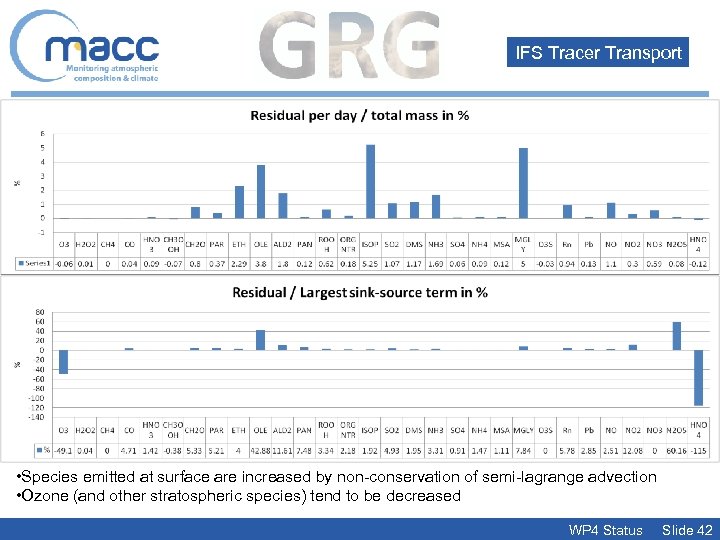
IFS Tracer Transport • Species emitted at surface are increased by non-conservation of semi-lagrange advection • Ozone (and other stratospheric species) tend to be decreased WP 4 Status Slide 42
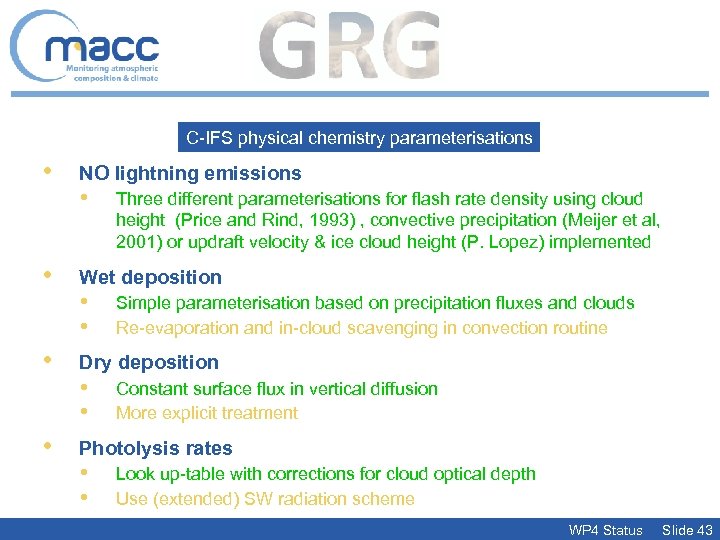
C-IFS physical chemistry parameterisations • • NO lightning emissions • Three different parameterisations for flash rate density using cloud height (Price and Rind, 1993) , convective precipitation (Meijer et al, 2001) or updraft velocity & ice cloud height (P. Lopez) implemented Wet deposition • • Simple parameterisation based on precipitation fluxes and clouds Re-evaporation and in-cloud scavenging in convection routine Dry deposition • • Constant surface flux in vertical diffusion More explicit treatment Photolysis rates • • Look up-table with corrections for cloud optical depth Use (extended) SW radiation scheme WP 4 Status Slide 43
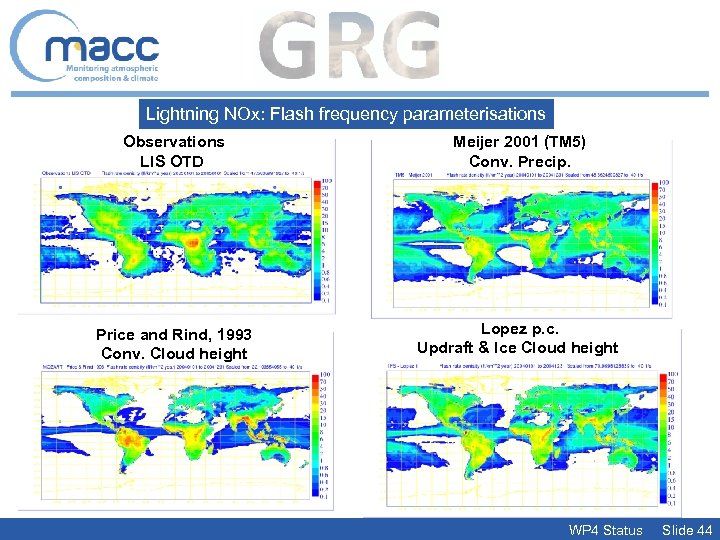
Lightning NOx: Flash frequency parameterisations Observations LIS OTD Meijer 2001 (TM 5) Conv. Precip. Price and Rind, 1993 Conv. Cloud height Lopez p. c. Updraft & Ice Cloud height WP 4 Status Slide 44

Lightning NOx: Flash frequency parameterisations Observations LIS OTD Grewe et al. , 2001 Updraft & Conv. Cloud height Lopez p. c. Updraft & Ice Cloud height ECHAM 5 -MOZ WP 4 Status Slide 45

C-IFS development plans for P 2 • • • Implement MOZART and MOCAGE chemistry modules Consolidate input/output data handling for C-IFS Continue work on mass diagnostics and simple mass fixers • • Family advection to reduce gradients Test different interpolation options Improve wet-deposition scheme and lightning Implement and test linear CO scheme Prepare C-IFS for data assimilation WP 4 Status Slide 46
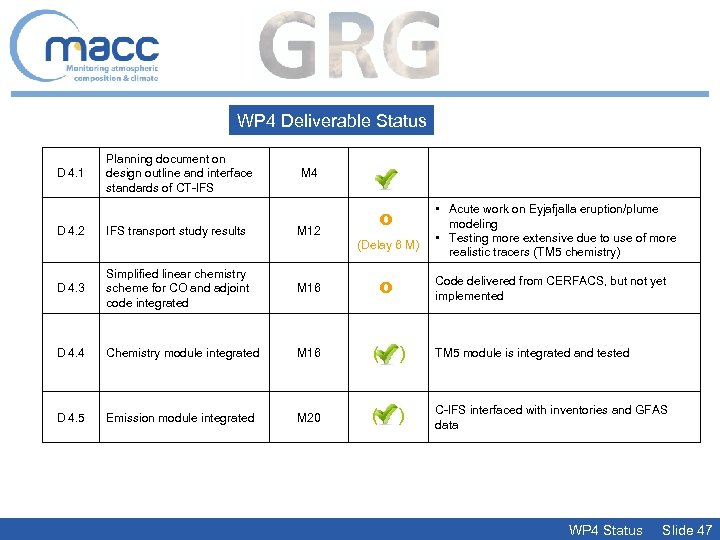
WP 4 Deliverable Status D 4. 1 D 4. 2 Planning document on design outline and interface standards of CT-IFS transport study results M 4 M 12 o (Delay 6 M) • Acute work on Eyjafjalla eruption/plume modeling • Testing more extensive due to use of more realistic tracers (TM 5 chemistry) D 4. 3 Simplified linear chemistry scheme for CO and adjoint code integrated M 16 o D 4. 4 Chemistry module integrated M 16 ( ) TM 5 module is integrated and tested D 4. 5 Emission module integrated M 20 ( ) C-IFS interfaced with inventories and GFAS data Code delivered from CERFACS, but not yet implemented WP 4 Status Slide 47
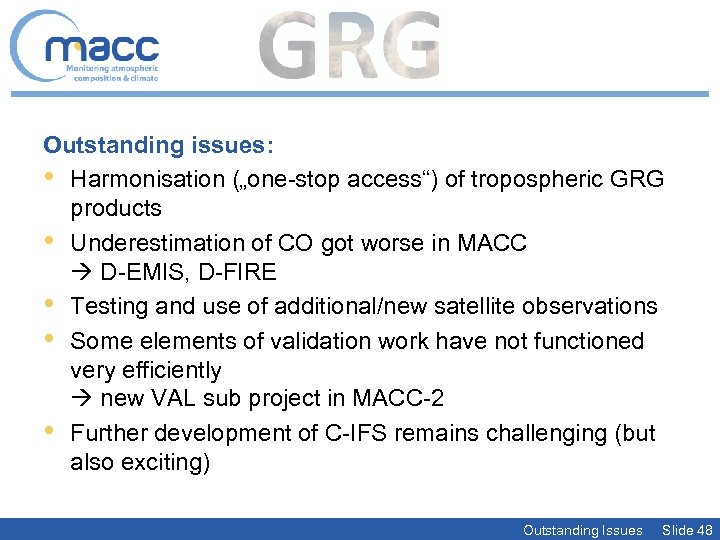
Outstanding issues: • Harmonisation („one-stop access“) of tropospheric GRG products • Underestimation of CO got worse in MACC D-EMIS, D-FIRE • Testing and use of additional/new satellite observations • Some elements of validation work have not functioned very efficiently new VAL sub project in MACC-2 • Further development of C-IFS remains challenging (but also exciting) Outstanding Issues Slide 48
Additional slides
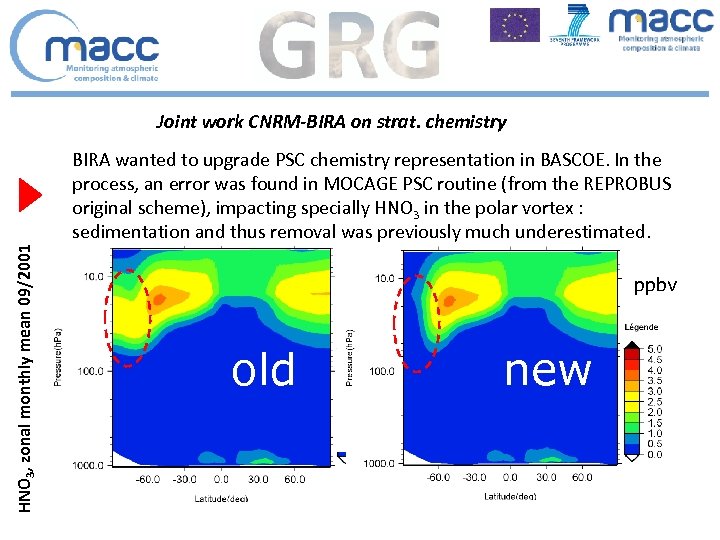
HNO 3, zonal monthly mean 09/2001 Joint work CNRM-BIRA on strat. chemistry BIRA wanted to upgrade PSC chemistry representation in BASCOE. In the process, an error was found in MOCAGE PSC routine (from the REPROBUS original scheme), impacting specially HNO 3 in the polar vortex : sedimentation and thus removal was previously much underestimated. old new ppbv
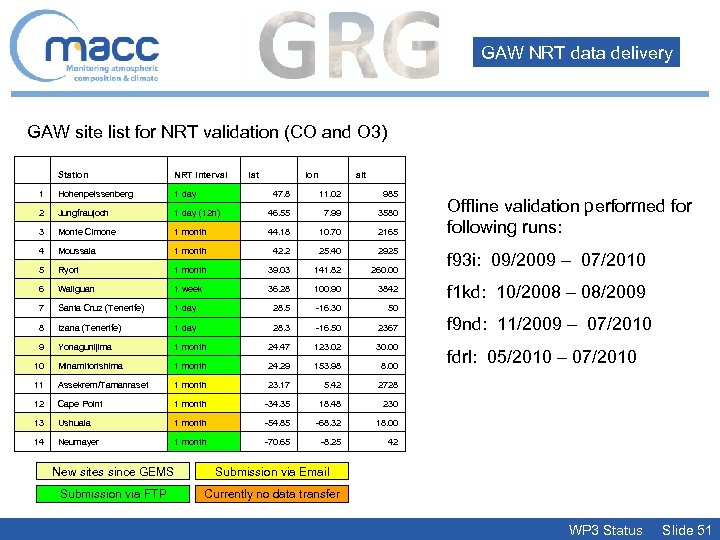
GAW NRT data delivery GAW site list for NRT validation (CO and O 3) Station NRT interval 1 Hohenpeissenberg 1 day 2 Jungfraujoch 3 lat lon alt 47. 8 11. 02 985 1 day (12 h) 46. 55 7. 99 3580 Monte Cimone 1 month 44. 18 10. 70 2165 4 Moussala 1 month 42. 2 25. 40 2925 5 Ryori 1 month 39. 03 141. 82 260. 00 6 Waliguan 1 week 36. 28 100. 90 3842 7 Santa Cruz (Tenerife) 1 day 28. 5 -16. 30 50 8 Izana (Tenerife) 1 day 28. 3 -16. 50 2367 9 Yonagunijima 1 month 24. 47 123. 02 30. 00 10 Minamitorishima 1 month 24. 29 153. 98 8. 00 11 Assekrem/Tamanraset 1 month 23. 17 5. 42 2728 12 Cape Point 1 month -34. 35 18. 48 230 13 Ushuaia 1 month -54. 85 -68. 32 18. 00 14 Neumayer 1 month -70. 65 -8. 25 42 New sites since GEMS f 93 i: 09/2009 – 07/2010 f 1 kd: 10/2008 – 08/2009 f 9 nd: 11/2009 – 07/2010 fdrl: 05/2010 – 07/2010 Submission via Email Submission via FTP Offline validation performed for following runs: Currently no data transfer WP 3 Status Slide 51
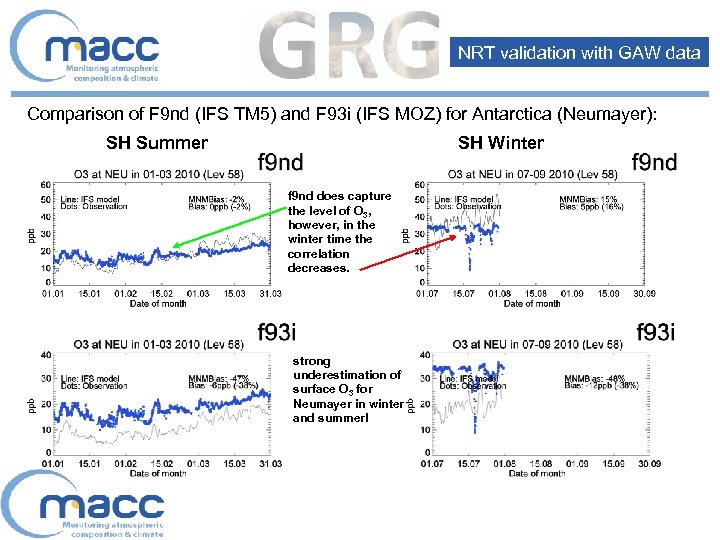
NRT validation with GAW data Comparison of F 9 nd (IFS TM 5) and F 93 i (IFS MOZ) for Antarctica (Neumayer): SH Summer SH Winter f 9 nd does capture the level of O 3, however, in the winter time the correlation decreases. strong underestimation of surface O 3 for Neumayer in winter and summer!
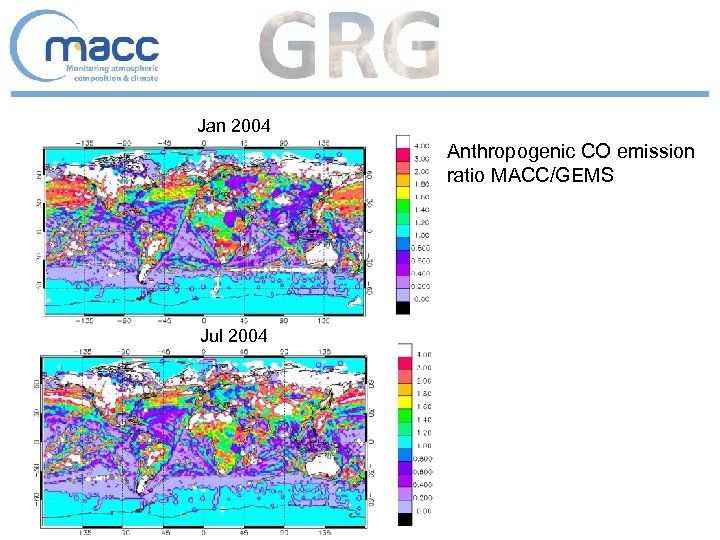
Jan 2004 Anthropogenic CO emission ratio MACC/GEMS Jul 2004
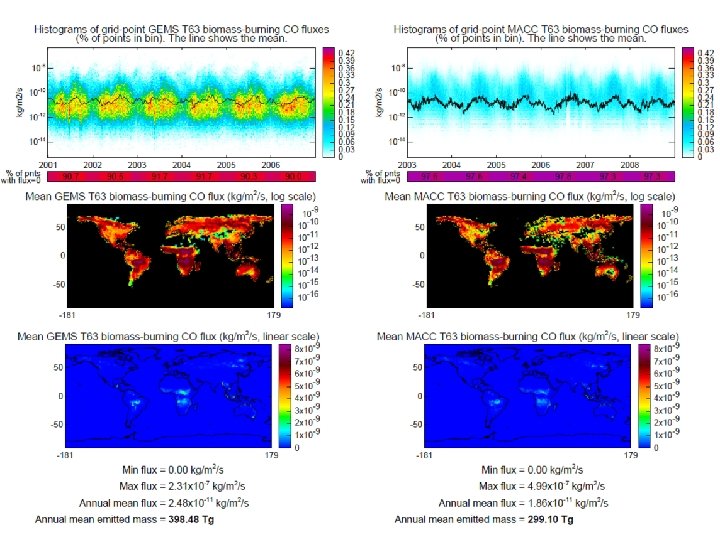
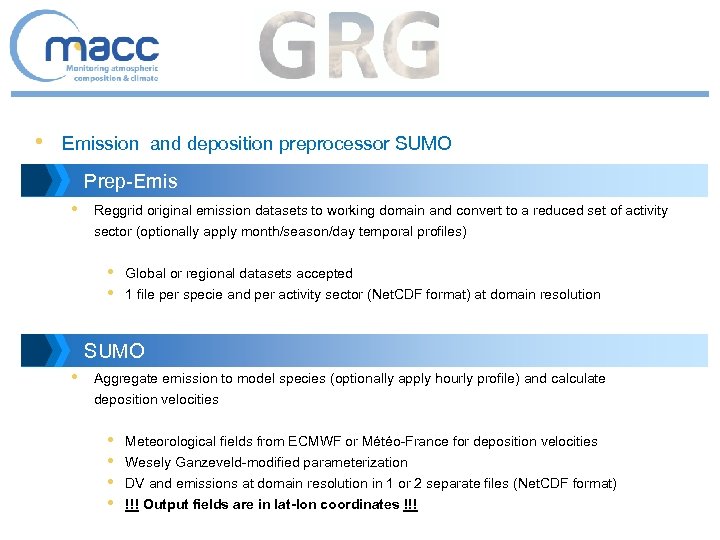
• Emission and deposition preprocessor SUMO Prep-Emis • Reggrid original emission datasets to working domain and convert to a reduced set of activity sector (optionally apply month/season/day temporal profiles) • • Global or regional datasets accepted 1 file per specie and per activity sector (Net. CDF format) at domain resolution SUMO • Aggregate emission to model species (optionally apply hourly profile) and calculate deposition velocities • • Meteorological fields from ECMWF or Météo-France for deposition velocities Wesely Ganzeveld-modified parameterization DV and emissions at domain resolution in 1 or 2 separate files (Net. CDF format) !!! Output fields are in lat-lon coordinates !!!
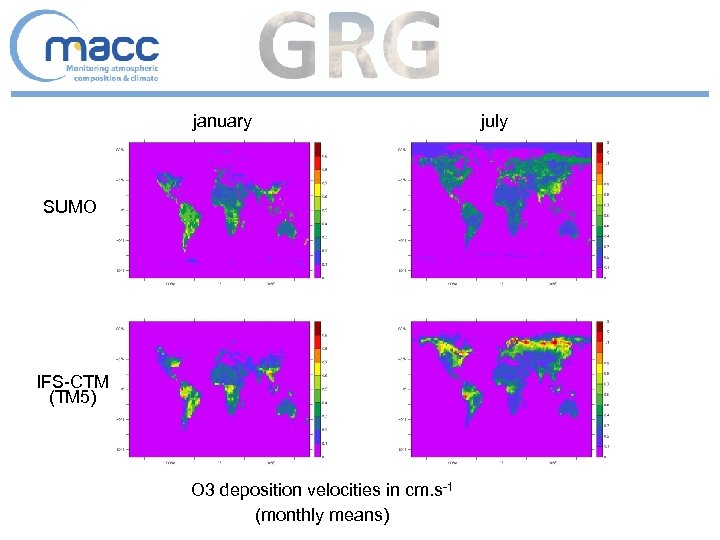
january SUMO IFS-CTM (TM 5) O 3 deposition velocities in cm. s-1 (monthly means) july
Скачать презентацию Global Reactive Gases Martin Schultz IEK-8 Forschungszentrum Jülich
a5aaa5a4dbfdd3582e13d2286a208396.ppt