 Скачать презентацию Global Positioning System Policy and Program Update Inaugural
22d0c6c1bd0d191a3715baf259c9b4d8.ppt
- Количество слайдов: 31



Global Positioning System Policy and Program Update Inaugural Forum Satellite Positioning Research and Application Center Tokyo, Japan 23 April 2007 James J. Miller, Senior GPS Technologist Space Communications and Navigation Space Operations Mission Directorate
Overview • GPS Policy – Objectives and Management • System Improvements & Modernization • Interoperability & International Collaboration • NASA GPS Space Activities • Summary 2
2004 U. S. PNT Policy Overview (GPS!) • • • U. S. Space-Based Positioning, Navigation, and Timing (PNT) Policy – Signed on 8 Dec 04; publicly released on 15 Dec 04 – Updated U. S. policy while retaining prior GPS principles Established a stronger National Space-Based PNT Executive Committee; IGEB disestablished – Chaired by Deputy Secretaries of Defense and Transportation Created a new National Coordination Office Created a new Advisory Board from private sector Enabled new ways to fund future GPS modernization for civil applications 3
U. S. Policy Principles • No direct user fees for civil GPS services • Open public signal structure for all civil services – – • • Promotes equal access for user equipment manufacture, applications development and value-added services Facilitates open market driven competition Use of GPS time, geodesy, and signal standards Global compatibility and interoperability of future systems with GPS Protect the current radionavigation spectrum from disruption and interference Recognition of national and international security issues and protecting against misuse 4
New Policy: Goals • • Provide uninterrupted availability of PNT services Meet growing demands in national, homeland, economic security, scientific, and commercial uses Continue to provide civil PNT services – Ensure they exceed, or are at least equivalent to, those of foreign civil space-based PNT services U. S. space-based PNT services remain essential components of internationally accepted services 5
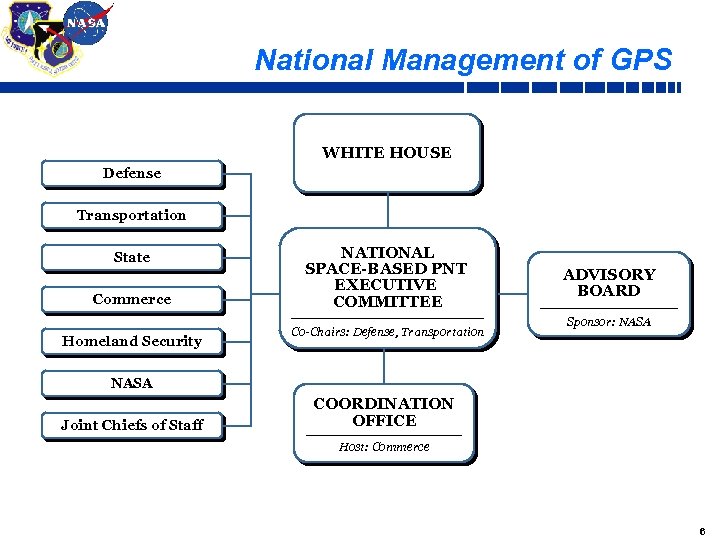
National Management of GPS WHITE HOUSE Defense Transportation State Commerce Homeland Security NATIONAL SPACE-BASED PNT EXECUTIVE COMMITTEE Co-Chairs: Defense, Transportation ADVISORY BOARD Sponsor: NASA Joint Chiefs of Staff COORDINATION OFFICE Host: Commerce 6
Overview • GPS Policy • System Improvements & Modernization – GPS Constellation Status – Next Steps for Space and Control Segments • Interoperability & International Collaboration • NASA R&D Activities • Summary 7
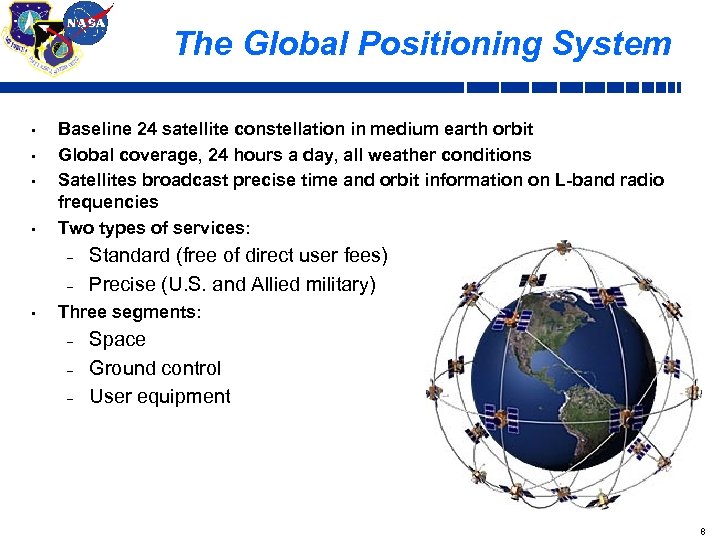
The Global Positioning System • • Baseline 24 satellite constellation in medium earth orbit Global coverage, 24 hours a day, all weather conditions Satellites broadcast precise time and orbit information on L-band radio frequencies Two types of services: – – • Standard (free of direct user fees) Precise (U. S. and Allied military) Three segments: – – – Space Ground control User equipment 8
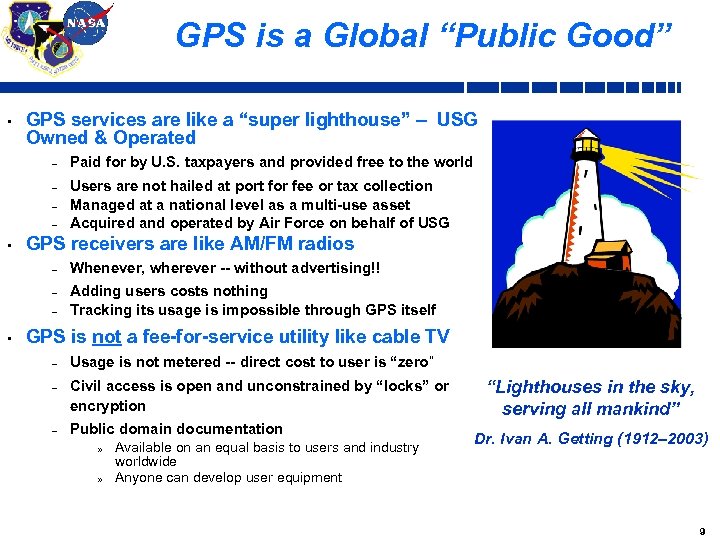
GPS is a Global “Public Good” • GPS services are like a “super lighthouse” – USG Owned & Operated – – • Users are not hailed at port for fee or tax collection Managed at a national level as a multi-use asset Acquired and operated by Air Force on behalf of USG GPS receivers are like AM/FM radios – – – • Paid for by U. S. taxpayers and provided free to the world Whenever, wherever -- without advertising!! Adding users costs nothing Tracking its usage is impossible through GPS itself GPS is not a fee-for-service utility like cable TV – – – Usage is not metered -- direct cost to user is “zero” Civil access is open and unconstrained by “locks” or encryption Public domain documentation » » Available on an equal basis to users and industry worldwide Anyone can develop user equipment “Lighthouses in the sky, serving all mankind” Dr. Ivan A. Getting (1912– 2003) 9
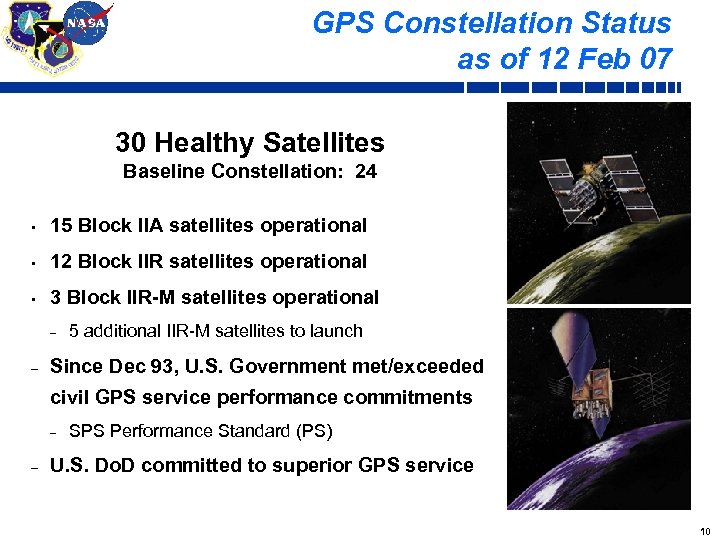
GPS Constellation Status as of 12 Feb 07 30 Healthy Satellites Baseline Constellation: 24 • 15 Block IIA satellites operational • 12 Block IIR satellites operational • 3 Block IIR-M satellites operational – – 5 additional IIR-M satellites to launch Since Dec 93, U. S. Government met/exceeded civil GPS service performance commitments – – SPS Performance Standard (PS) U. S. Do. D committed to superior GPS service 10
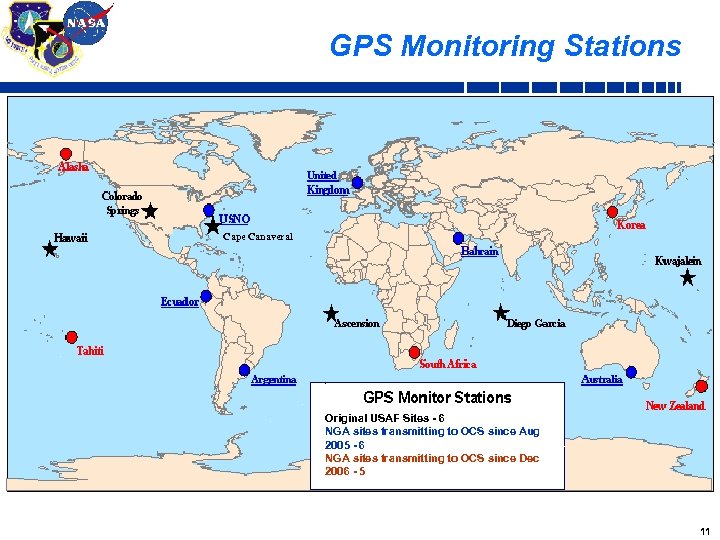
GPS Monitoring Stations Cape Canaveral Original USAF Sites - 6 NGA sites transmitting to OCS since Aug 2005 - 6 NGA sites transmitting to OCS since Dec 2006 - 5 11
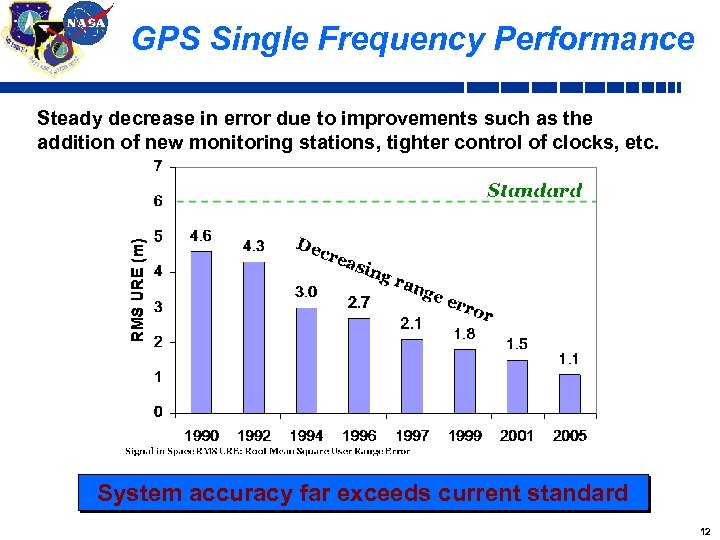
GPS Single Frequency Performance Steady decrease in error due to improvements such as the addition of new monitoring stations, tighter control of clocks, etc. System accuracy far exceeds current standard 12
Overview • GPS Policy • System Improvements & Modernization – GPS Constellation Status – Next Steps for Space and Control Segments • Interoperability & International Collaboration • NASA R&D Activities • Summary 13
GPS Modernization Goals • System-wide improvements in: – Accuracy Availability – Integrity – Reliability Robustness against interference Improved indoor, mobile, and urban use Interoperability with other GNSS constellations Backward compatibility – • • 14
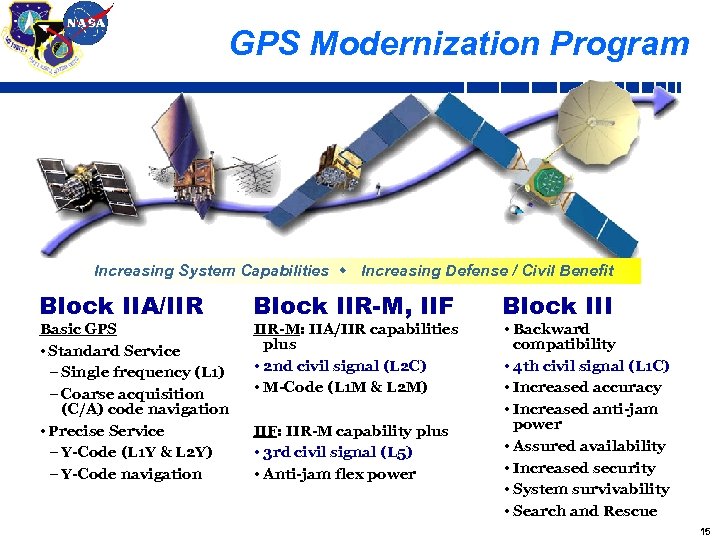
GPS Modernization Program Increasing System Capabilities w Increasing Defense / Civil Benefit Block IIA/IIR Basic GPS • Standard Service – Single frequency (L 1) – Coarse acquisition (C/A) code navigation • Precise Service – Y-Code (L 1 Y & L 2 Y) – Y-Code navigation Block IIR-M, IIF IIR-M: IIA/IIR capabilities plus • 2 nd civil signal (L 2 C) • M-Code (L 1 M & L 2 M) IIF: IIR-M capability plus • 3 rd civil signal (L 5) • Anti-jam flex power Block III • Backward compatibility • 4 th civil signal (L 1 C) • Increased accuracy • Increased anti-jam power • Assured availability • Increased security • System survivability • Search and Rescue 15
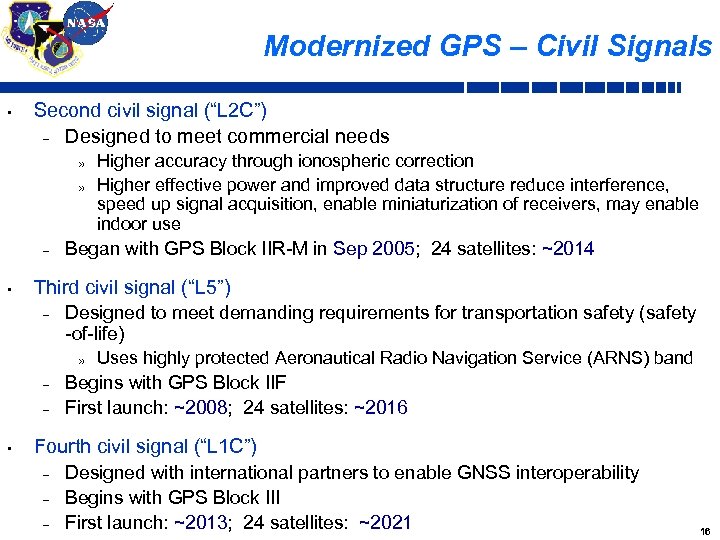
Modernized GPS – Civil Signals • Second civil signal (“L 2 C”) – Designed to meet commercial needs » » – • Began with GPS Block IIR-M in Sep 2005; 24 satellites: ~2014 Third civil signal (“L 5”) – Designed to meet demanding requirements for transportation safety (safety -of-life) » – – • Higher accuracy through ionospheric correction Higher effective power and improved data structure reduce interference, speed up signal acquisition, enable miniaturization of receivers, may enable indoor use Uses highly protected Aeronautical Radio Navigation Service (ARNS) band Begins with GPS Block IIF First launch: ~2008; 24 satellites: ~2016 Fourth civil signal (“L 1 C”) – – – Designed with international partners to enable GNSS interoperability Begins with GPS Block III First launch: ~2013; 24 satellites: ~2021 16
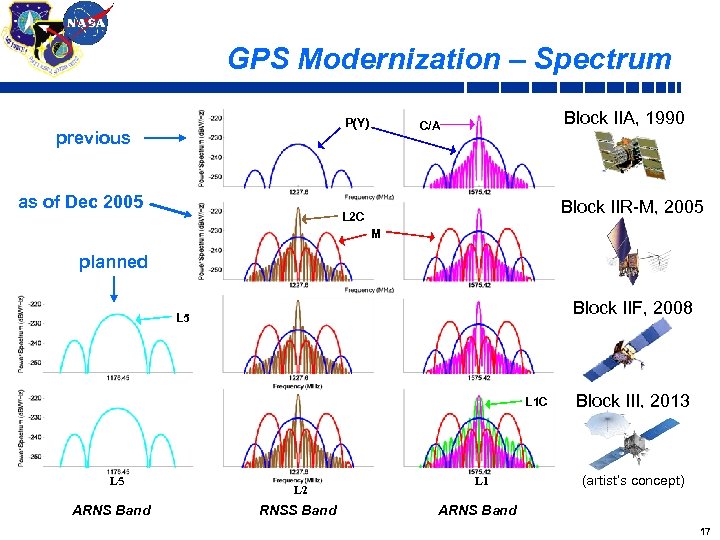
GPS Modernization – Spectrum P(Y) previous as of Dec 2005 Block IIA, 1990 C/A Block IIR-M, 2005 L 2 C M planned Block IIF, 2008 L 5 L 1 C L 5 ARNS Band L 2 RNSS Band L 1 Block III, 2013 (artist’s concept) ARNS Band 17
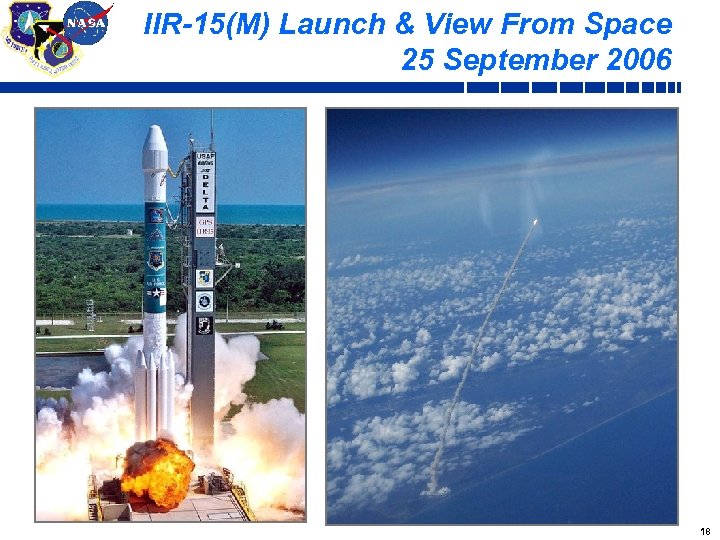
IIR-15(M) Launch & View From Space 25 September 2006 18
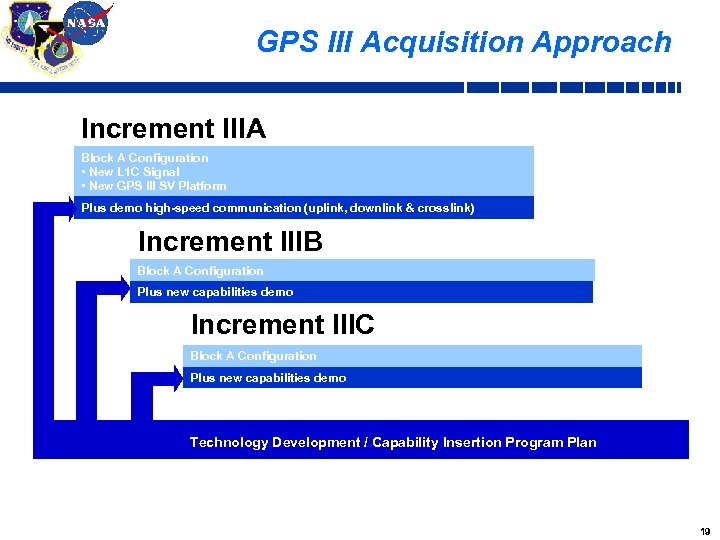
GPS III Acquisition Approach Increment IIIA Block A Configuration • New L 1 C Signal • New GPS III SV Platform Plus demo high-speed communication (uplink, downlink & crosslink) Increment IIIB Block A Configuration Plus new capabilities demo Increment IIIC Block A Configuration Plus new capabilities demo Technology Development / Capability Insertion Program Plan 19
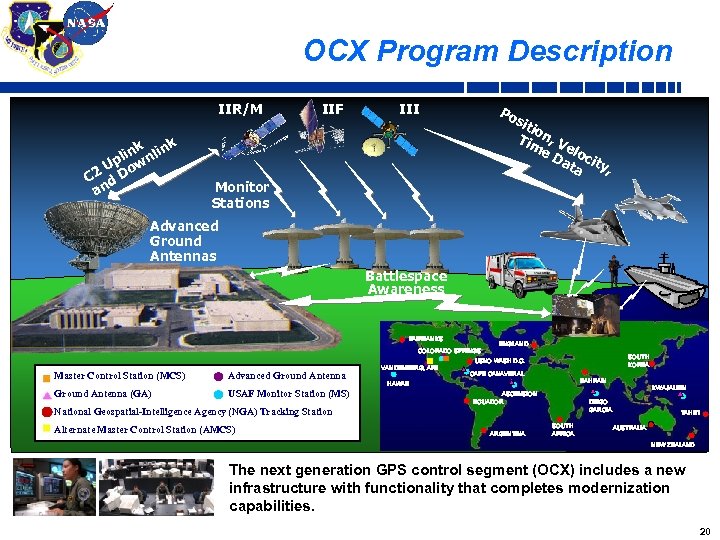
OCX Program Description IIR/M k nk lin nli p w 2 U Do C d an IIF III Po sit io Tim n, V e D eloc ata ity, Monitor Stations Advanced Ground Antennas Battlespace Awareness FAIRBANKS COLORADO SPRINGS Master Control Station (MCS) Advanced Ground Antenna (GA) USAF Monitor Station (MS) National Geospatial-Intelligence Agency (NGA) Tracking Station Alternate Master Control Station (AMCS) VANDENBERG, AFB ENGLAND SOUTH KOREA USNO WASH D. C. CAPE CANAVERAL HAWAII Master Control Station BAHRAIN ASCENSION ECUADOR ARGENTINA KWAJALEIN DIEGO GARCIA SOUTH AFRICA TAHITI AUSTRALIA NEW ZEALAND The next generation GPS control segment (OCX) includes a new infrastructure with functionality that completes modernization capabilities. 20
Overview • GPS Policy • System Improvements & Modernization – – • GPS Constellation Status Next Steps for Space and Control Segments Interoperability & International Collaboration – GPS-QZSS Progress • NASA R&D Activities • Summary 21
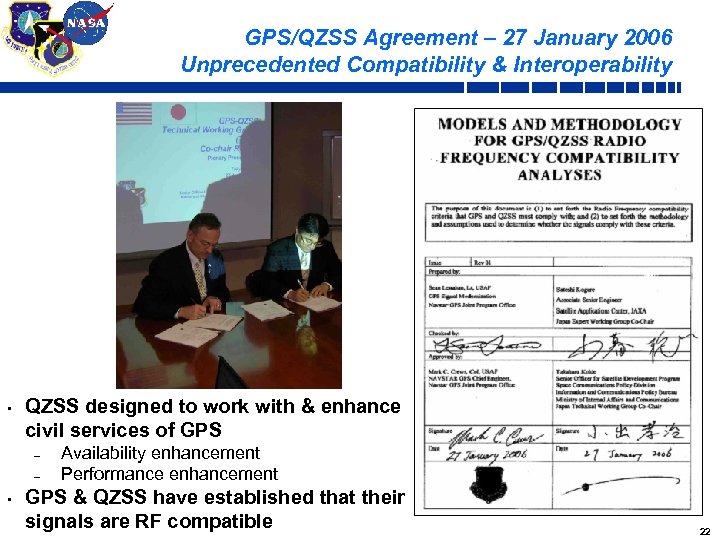
GPS/QZSS Agreement – 27 January 2006 Unprecedented Compatibility & Interoperability • QZSS designed to work with & enhance civil services of GPS – – • Availability enhancement Performance enhancement GPS & QZSS have established that their signals are RF compatible 22
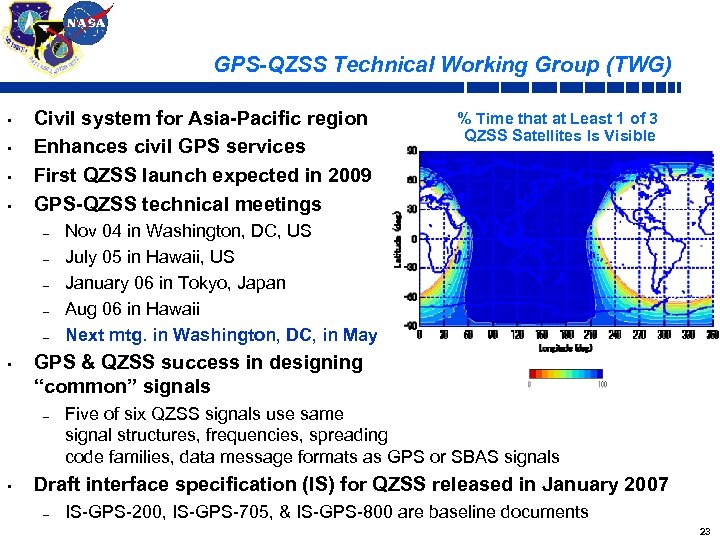
GPS-QZSS Technical Working Group (TWG) • • Civil system for Asia-Pacific region Enhances civil GPS services First QZSS launch expected in 2009 GPS-QZSS technical meetings – – – • Nov 04 in Washington, DC, US July 05 in Hawaii, US January 06 in Tokyo, Japan Aug 06 in Hawaii Next mtg. in Washington, DC, in May GPS & QZSS success in designing “common” signals – • % Time that at Least 1 of 3 QZSS Satellites Is Visible Five of six QZSS signals use same signal structures, frequencies, spreading code families, data message formats as GPS or SBAS signals Draft interface specification (IS) for QZSS released in January 2007 – IS-GPS-200, IS-GPS-705, & IS-GPS-800 are baseline documents 23
Overview • GPS Policy • System Improvements & Modernization – – • GPS Constellation Status Next Steps for Space and Control Segments Interoperability & International Collaboration – • NASA R&D Activities – • GPS-QZSS Progress GPS to Earth Orbit, and Beyond Summary 24
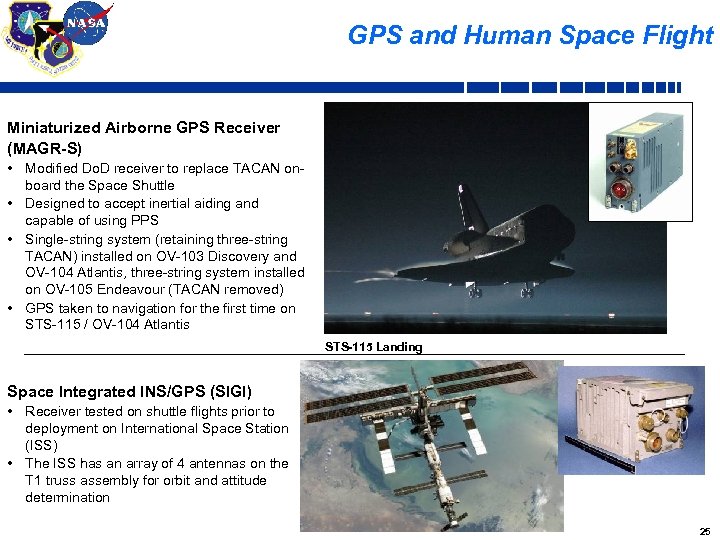
GPS and Human Space Flight Miniaturized Airborne GPS Receiver (MAGR-S) • Modified Do. D receiver to replace TACAN onboard the Space Shuttle • Designed to accept inertial aiding and capable of using PPS • Single-string system (retaining three-string TACAN) installed on OV-103 Discovery and OV-104 Atlantis, three-string system installed on OV-105 Endeavour (TACAN removed) • GPS taken to navigation for the first time on STS-115 / OV-104 Atlantis STS-115 Landing Space Integrated INS/GPS (SIGI) • Receiver tested on shuttle flights prior to deployment on International Space Station (ISS) • The ISS has an array of 4 antennas on the T 1 truss assembly for orbit and attitude determination 25
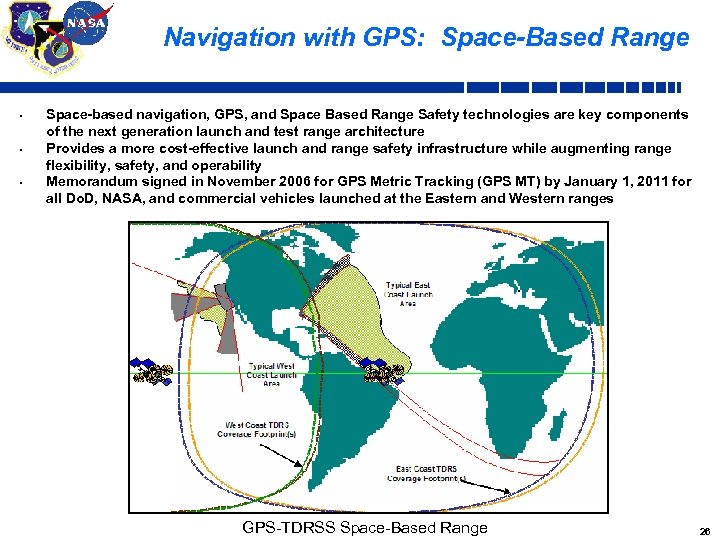
Navigation with GPS: Space-Based Range • • • Space-based navigation, GPS, and Space Based Range Safety technologies are key components of the next generation launch and test range architecture Provides a more cost-effective launch and range safety infrastructure while augmenting range flexibility, safety, and operability Memorandum signed in November 2006 for GPS Metric Tracking (GPS MT) by January 1, 2011 for all Do. D, NASA, and commercial vehicles launched at the Eastern and Western ranges GPS-TDRSS Space-Based Range 26
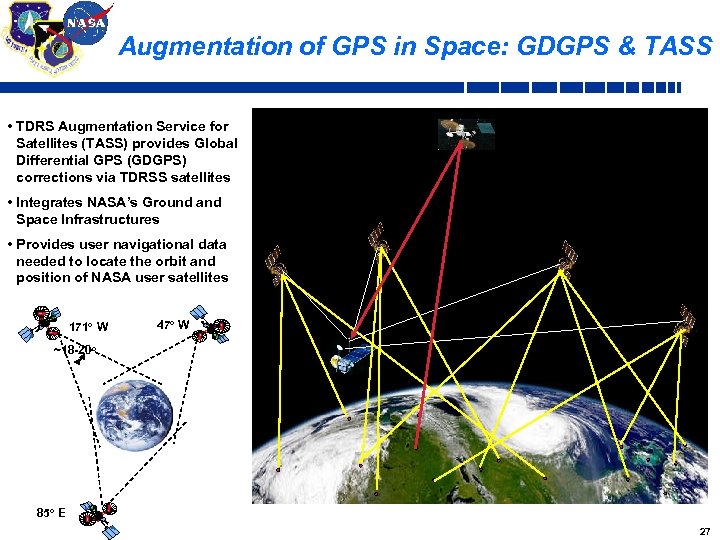
Augmentation of GPS in Space: GDGPS & TASS • TDRS Augmentation Service for Satellites (TASS) provides Global Differential GPS (GDGPS) corrections via TDRSS satellites • Integrates NASA’s Ground and Space Infrastructures • Provides user navigational data needed to locate the orbit and position of NASA user satellites 171 o W 47 o W ~18 -20 o 85 o E 27
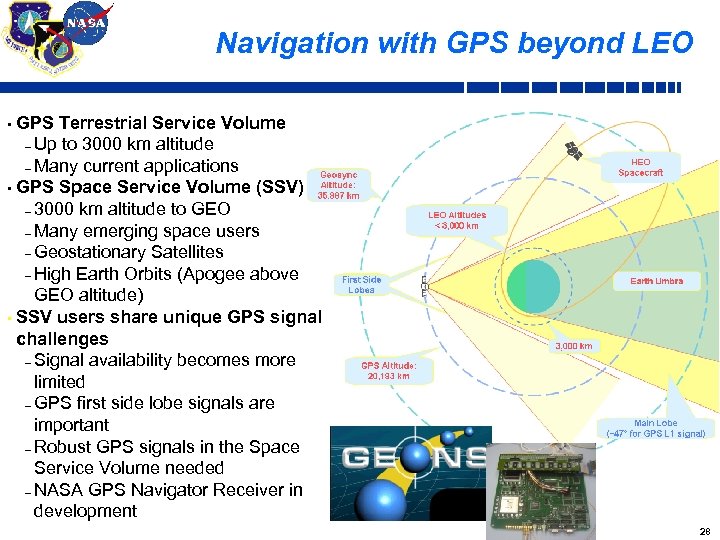
Navigation with GPS beyond LEO GPS Terrestrial Service Volume – Up to 3000 km altitude – Many current applications • GPS Space Service Volume (SSV) – 3000 km altitude to GEO – Many emerging space users – Geostationary Satellites – High Earth Orbits (Apogee above GEO altitude) • SSV users share unique GPS signal challenges – Signal availability becomes more limited – GPS first side lobe signals are important – Robust GPS signals in the Space Service Volume needed – NASA GPS Navigator Receiver in development • 28
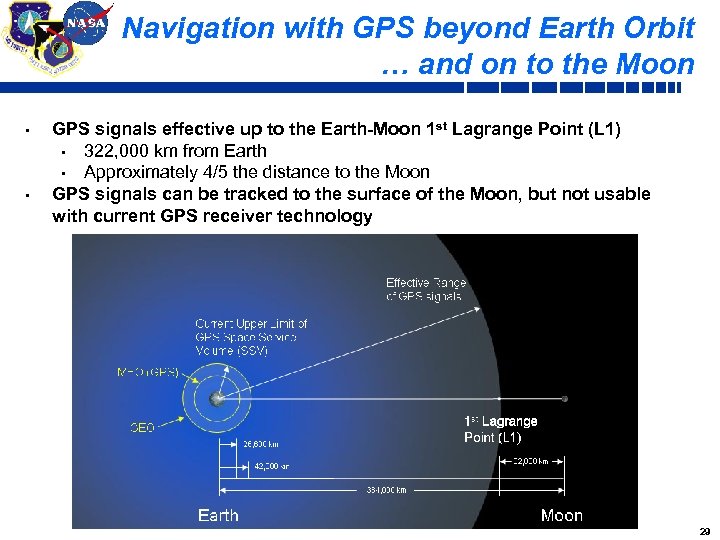
Navigation with GPS beyond Earth Orbit … and on to the Moon • • GPS signals effective up to the Earth-Moon 1 st Lagrange Point (L 1) • 322, 000 km from Earth • Approximately 4/5 the distance to the Moon GPS signals can be tracked to the surface of the Moon, but not usable with current GPS receiver technology 29
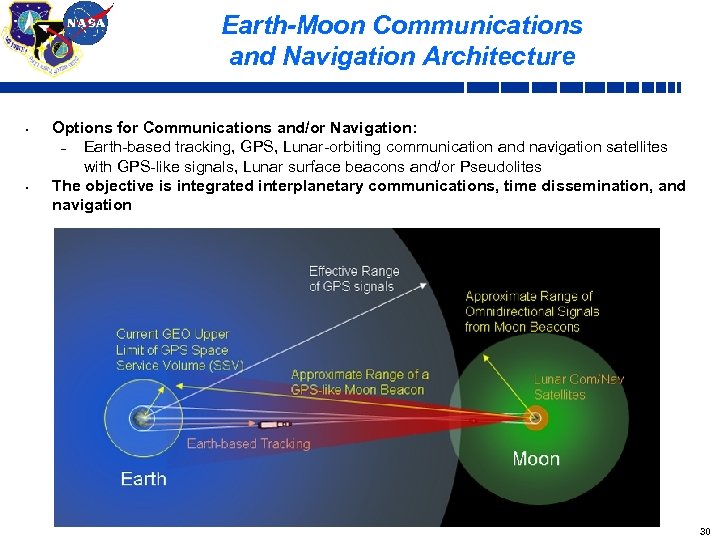
Earth-Moon Communications and Navigation Architecture • • Options for Communications and/or Navigation: – Earth-based tracking, GPS, Lunar-orbiting communication and navigation satellites with GPS-like signals, Lunar surface beacons and/or Pseudolites The objective is integrated interplanetary communications, time dissemination, and navigation 30
Summary • Continuing success in GPS sustainment & modernization – – • • New capabilities delivering enhanced performance Developments on track to enhance space and control segments Civilian use of GPS, and GPS-derived systems, is already extending well beyond Earth International participation will make new worldwide GPS applications grow more robust and valuable for generations to come 31
Скачать презентацию Global Positioning System Policy and Program Update Inaugural
22d0c6c1bd0d191a3715baf259c9b4d8.ppt