 Скачать презентацию Global Perspectives on the Health Workforce l Manuel
49a5f70e1a3ffef2a43f347c0ff7eb06.ppt
- Количество слайдов: 31



Global Perspectives on the Health Workforce l Manuel M. Dayrit MD, MSc Director Department of Human Resources for Health
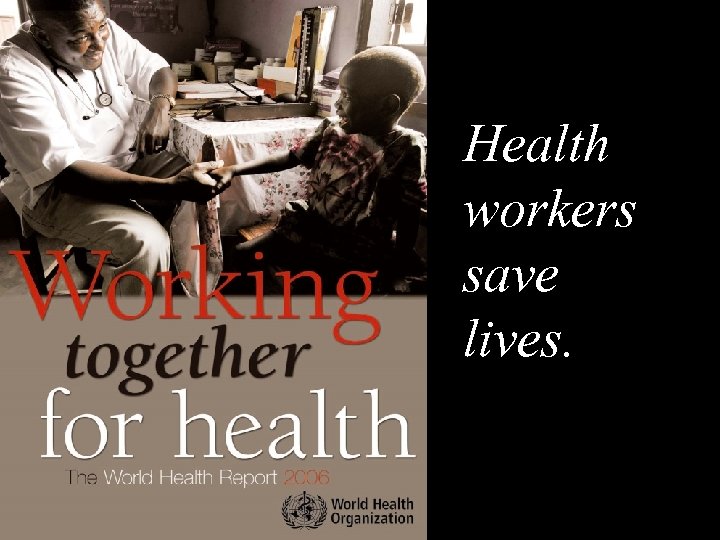
Health workers save lives. 2| Global Perspectives on the Health
What is the health workforce? “People engaged in actions whose primary intent is to enhance health” Source: WHO (2006). The World Health Report 2006 – Working Together for Health. Geneva, World Health Organization 3| Global Perspectives on the Health
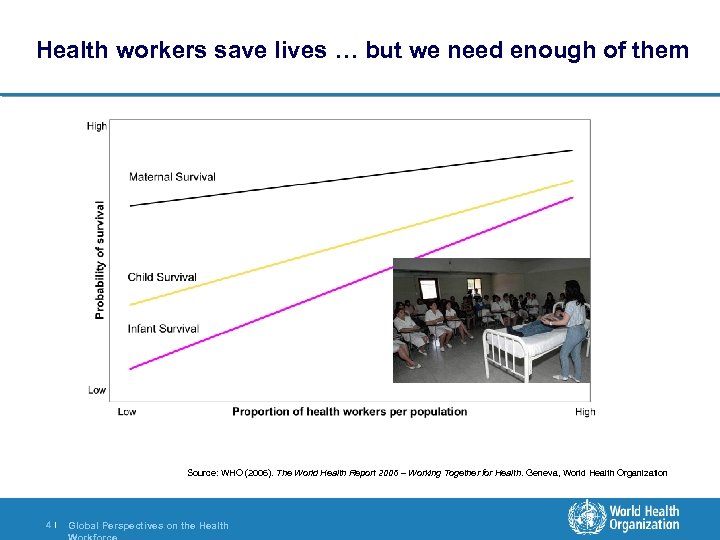
Health workers save lives … but we need enough of them Source: WHO (2006). The World Health Report 2006 – Working Together for Health. Geneva, World Health Organization 4| Global Perspectives on the Health
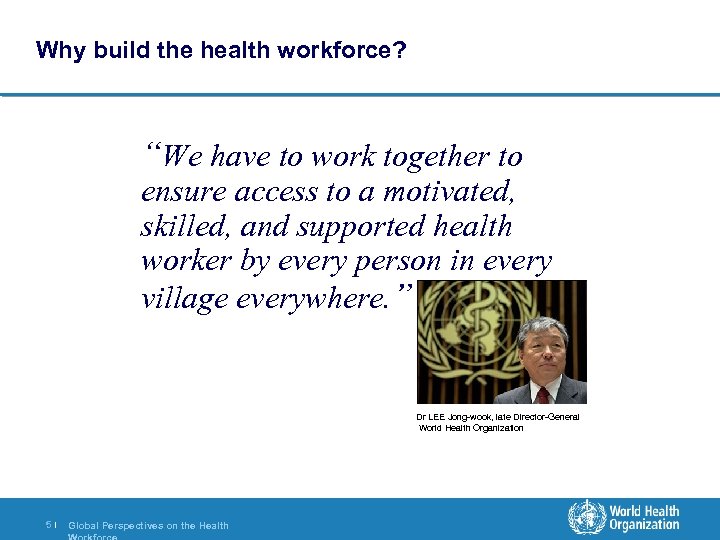
Why build the health workforce? “We have to work together to ensure access to a motivated, skilled, and supported health worker by every person in every village everywhere. ” Dr LEE Jong-wook, late Director-General World Health Organization 5| Global Perspectives on the Health
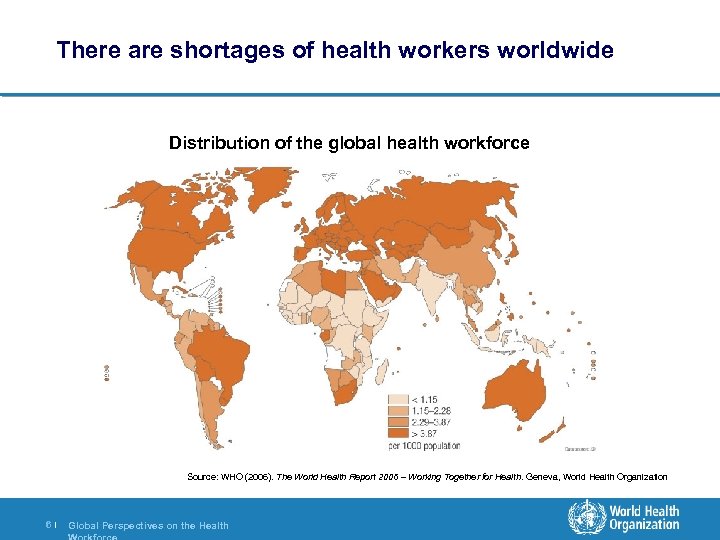
There are shortages of health workers worldwide Distribution of the global health workforce Source: WHO (2006). The World Health Report 2006 – Working Together for Health. Geneva, World Health Organization 6| Global Perspectives on the Health
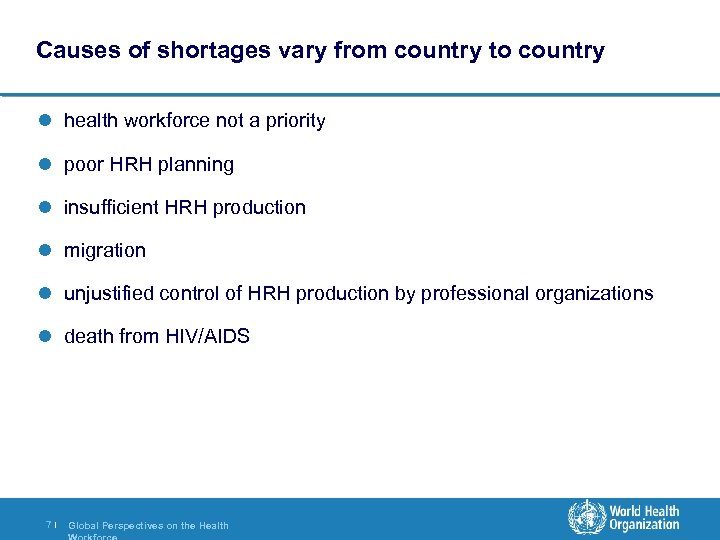
Causes of shortages vary from country to country l health workforce not a priority l poor HRH planning l insufficient HRH production l migration l unjustified control of HRH production by professional organizations l death from HIV/AIDS 7| Global Perspectives on the Health
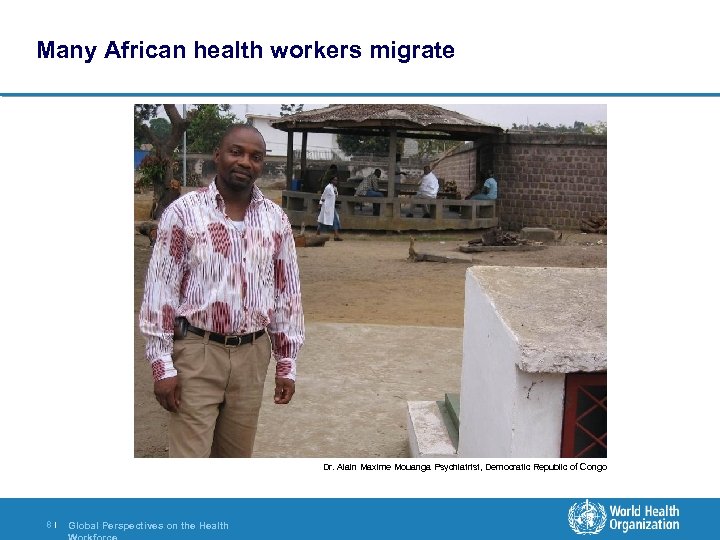
Many African health workers migrate Dr. Alain Maxime Mouanga Psychiatrist, Democratic Republic of Congo 8| Global Perspectives on the Health
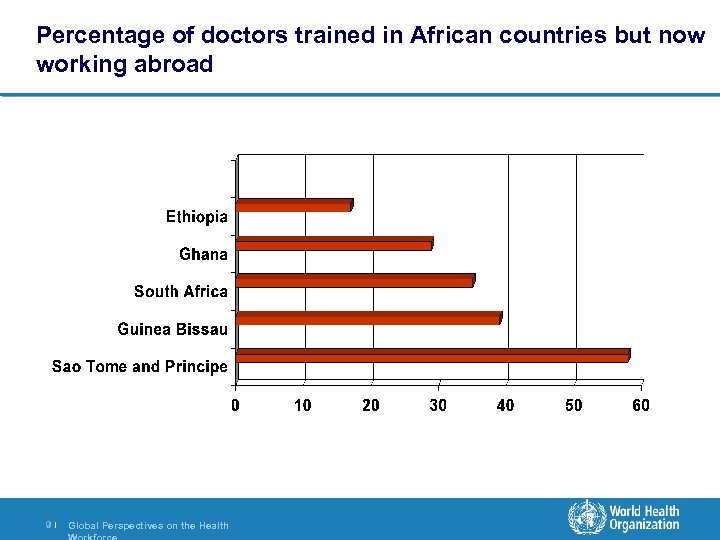
Percentage of doctors trained in African countries but now working abroad 9| Global Perspectives on the Health
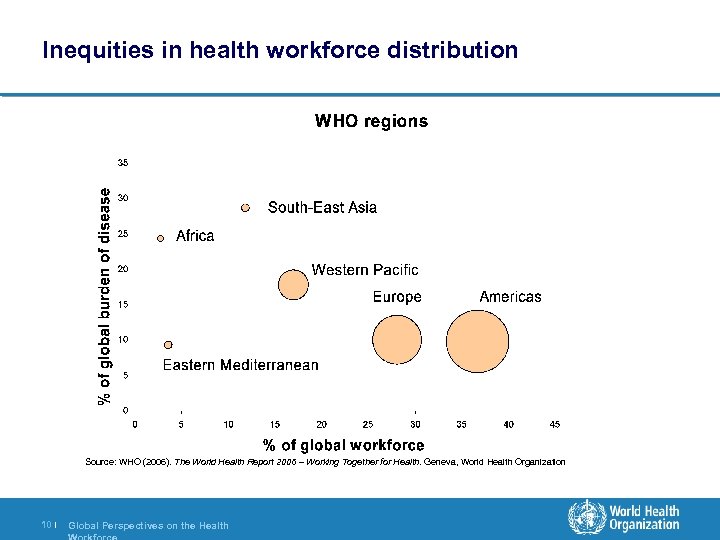
Inequities in health workforce distribution Source: WHO (2006). The World Health Report 2006 – Working Together for Health. Geneva, World Health Organization 10 | Global Perspectives on the Health
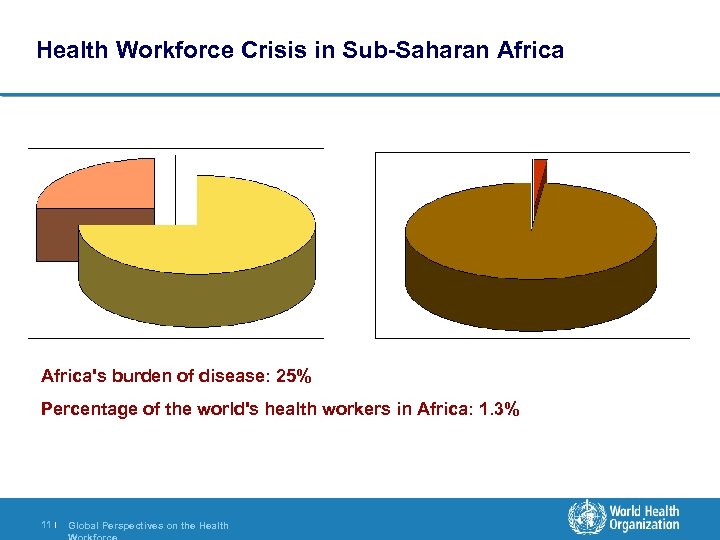
Health Workforce Crisis in Sub-Saharan Africa's burden of disease: 25% Percentage of the world's health workers in Africa: 1. 3% 11 | Global Perspectives on the Health
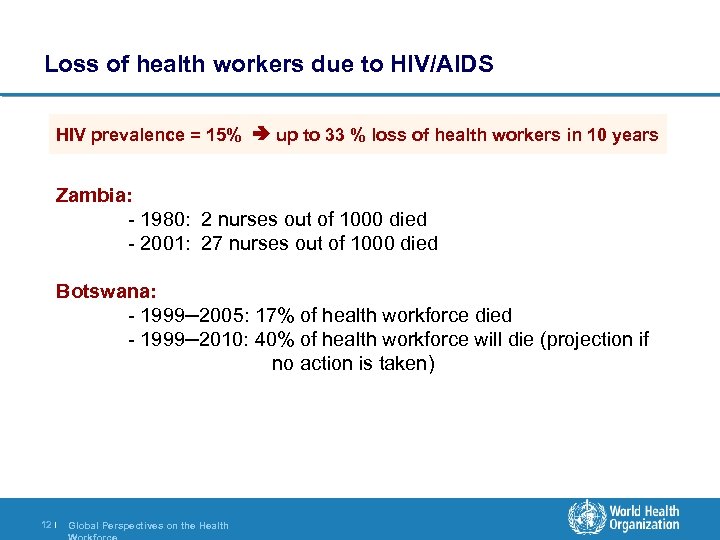
Loss of health workers due to HIV/AIDS HIV prevalence = 15% up to 33 % loss of health workers in 10 years Zambia: - 1980: 2 nurses out of 1000 died - 2001: 27 nurses out of 1000 died Botswana: - 1999─2005: 17% of health workforce died - 1999─2010: 40% of health workforce will die (projection if no action is taken) 12 | Global Perspectives on the Health
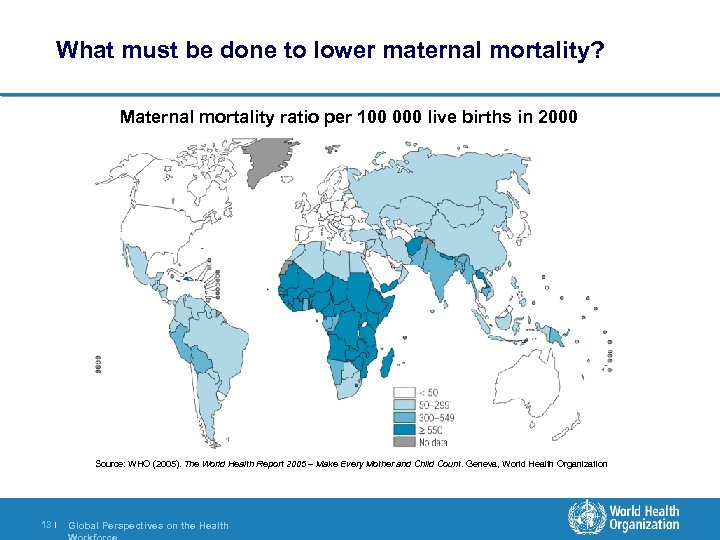
What must be done to lower maternal mortality? Maternal mortality ratio per 100 000 live births in 2000 Source: WHO (2005). The World Health Report 2005 – Make Every Mother and Child Count. Geneva, World Health Organization 13 | Global Perspectives on the Health
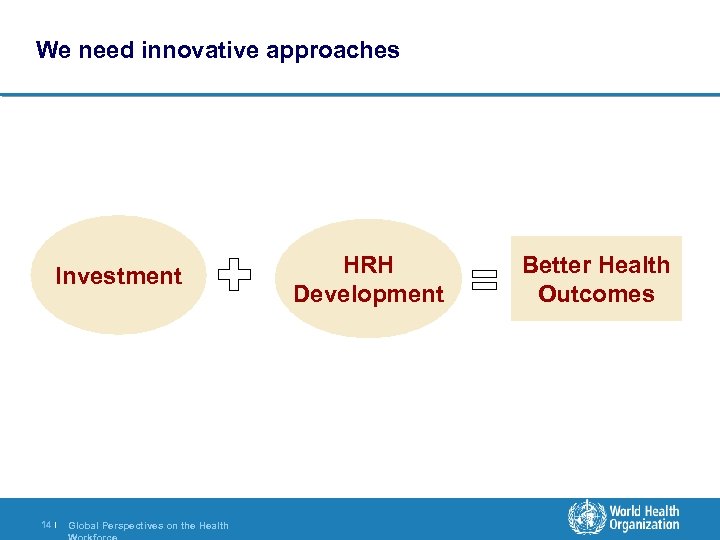
We need innovative approaches Investment 14 | Global Perspectives on the Health HRH Development Better Health Outcomes
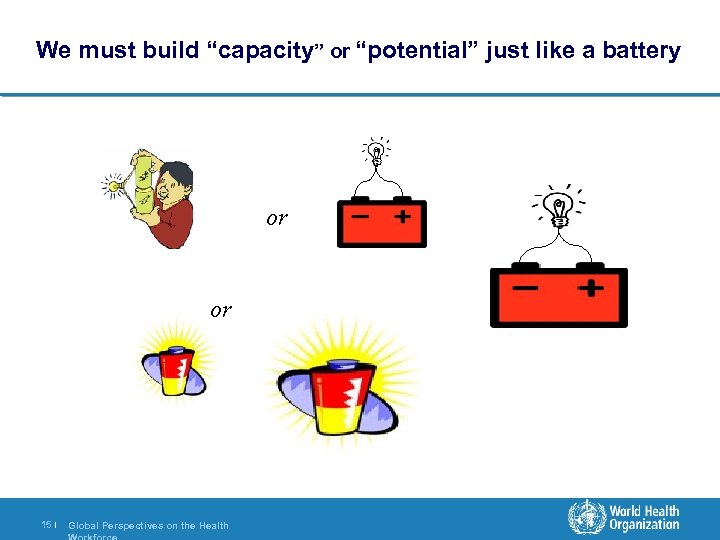
We must build “capacity” or “potential” just like a battery or or 15 | Global Perspectives on the Health
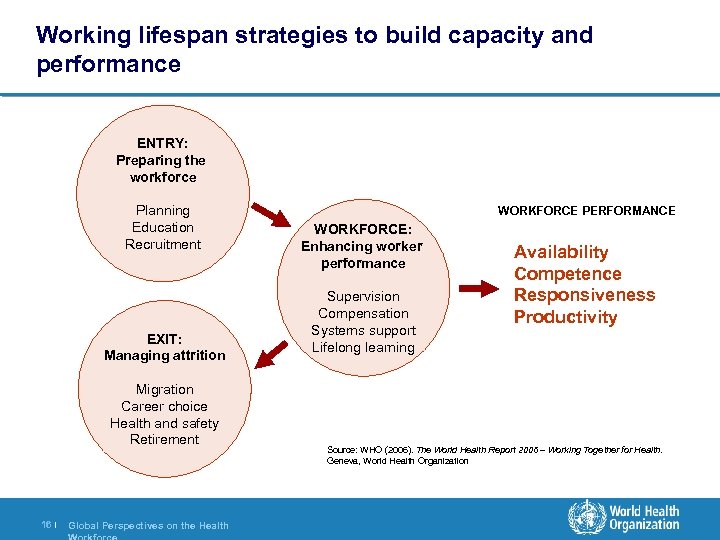
Working lifespan strategies to build capacity and performance ENTRY: Preparing the workforce Planning Education Recruitment EXIT: Managing attrition Migration Career choice Health and safety Retirement 16 | Global Perspectives on the Health WORKFORCE PERFORMANCE WORKFORCE: Enhancing worker performance Supervision Compensation Systems support Lifelong learning Availability Competence Responsiveness Productivity Source: WHO (2006). The World Health Report 2006 – Working Together for Health. Geneva, World Health Organization
What can defeat efforts to build capacity and performance? l migration of health workers l lack of managerial capacity to retain and support them l HIV/AIDS l pull factors from developed countries l unintended negative effects of health system reform, e. g. decentralization 17 | Global Perspectives on the Health
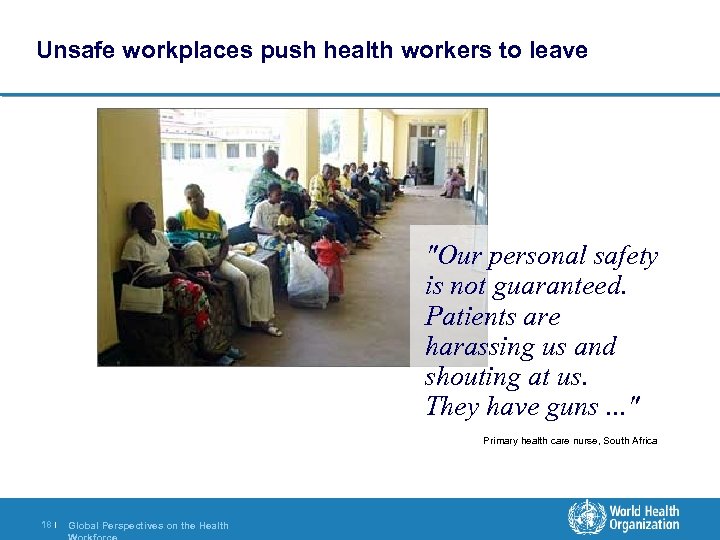
Unsafe workplaces push health workers to leave "Our personal safety is not guaranteed. Patients are harassing us and shouting at us. They have guns. . . " Primary health care nurse, South Africa 18 | Global Perspectives on the Health
19 | Global Perspectives on the Health
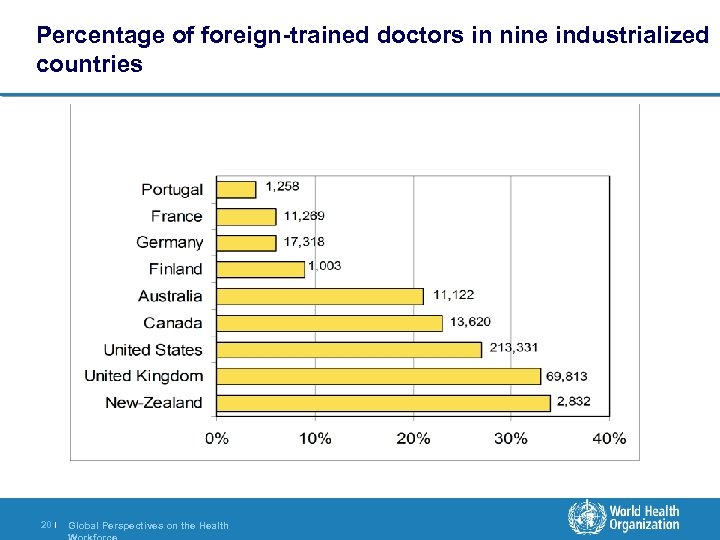
Percentage of foreign-trained doctors in nine industrialized countries 20 | Global Perspectives on the Health
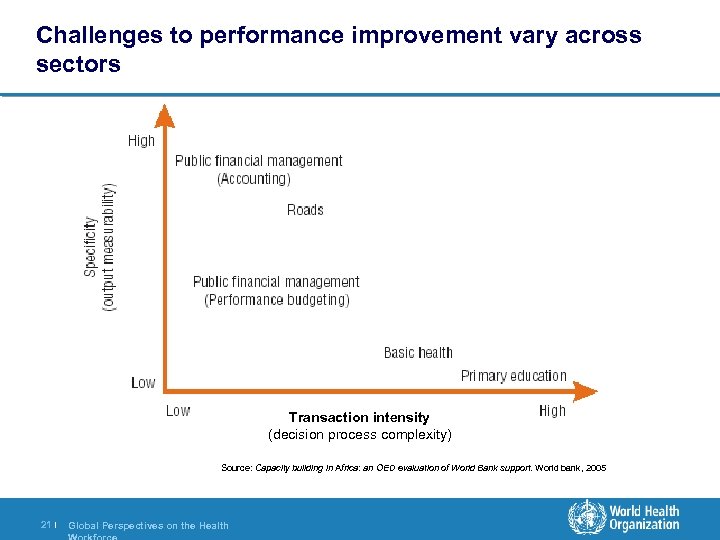
Challenges to performance improvement vary across sectors Transaction intensity (decision process complexity) Source: Capacity building in Africa: an OED evaluation of World Bank support. World bank, 2005 21 | Global Perspectives on the Health
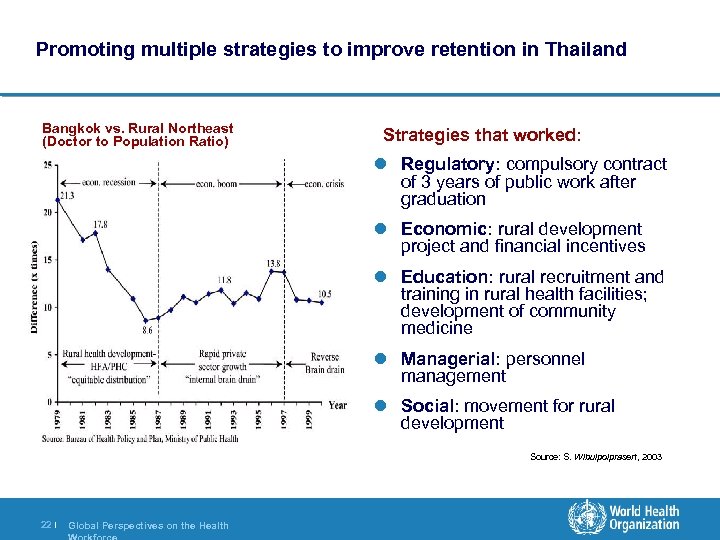
Promoting multiple strategies to improve retention in Thailand Bangkok vs. Rural Northeast (Doctor to Population Ratio) Strategies that worked: l Regulatory: compulsory contract of 3 years of public work after graduation l Economic: rural development project and financial incentives l Education: rural recruitment and training in rural health facilities; development of community medicine l Managerial: personnel management l Social: movement for rural development Source: S. Wibulpolprasert, 2003 22 | Global Perspectives on the Health
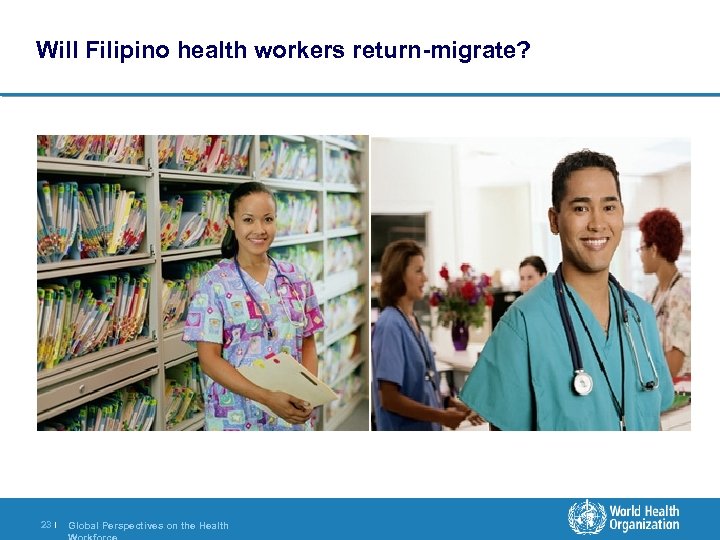
Will Filipino health workers return-migrate? 23 | Global Perspectives on the Health
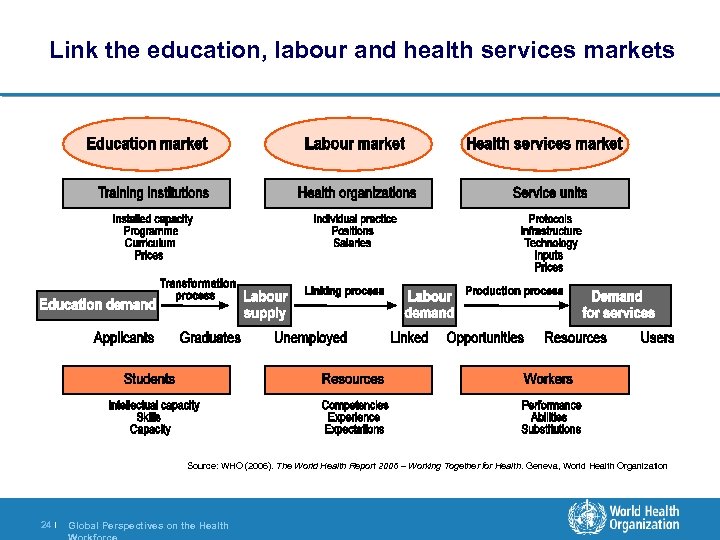
Link the education, labour and health services markets Source: WHO (2006). The World Health Report 2006 – Working Together for Health. Geneva, World Health Organization 24 | Global Perspectives on the Health
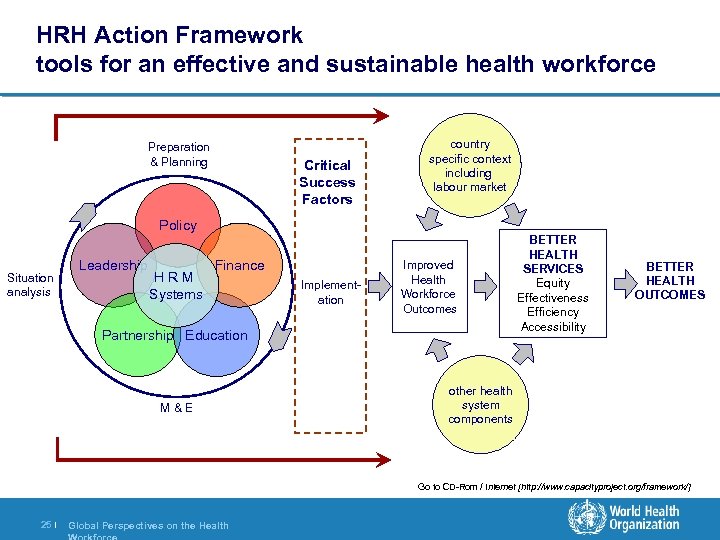
HRH Action Framework tools for an effective and sustainable health workforce Preparation & Planning Critical Success Factors country specific context including labour market Policy Situation analysis Leadership HRM Systems Finance Implementation Improved Health Workforce Outcomes Partnership Education M&E BETTER HEALTH SERVICES Equity Effectiveness Efficiency Accessibility BETTER HEALTH OUTCOMES other health system components Go to CD-Rom / Internet [http: //www. capacityproject. org/framework/] 25 | Global Perspectives on the Health
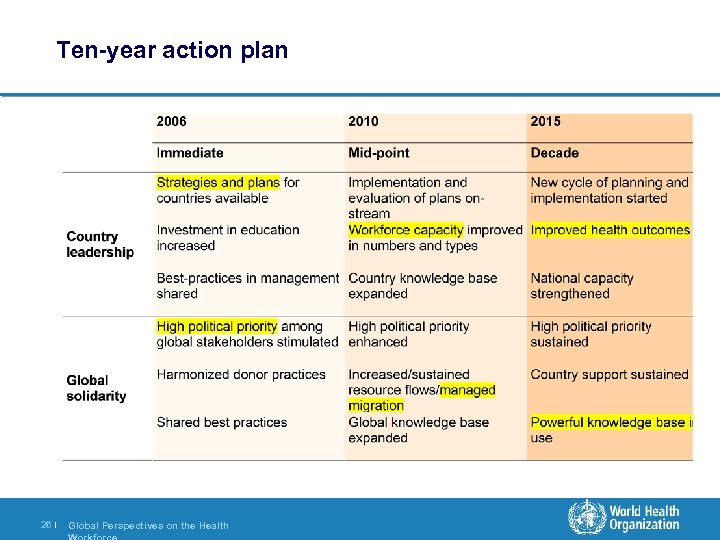
Ten-year action plan 26 | Global Perspectives on the Health
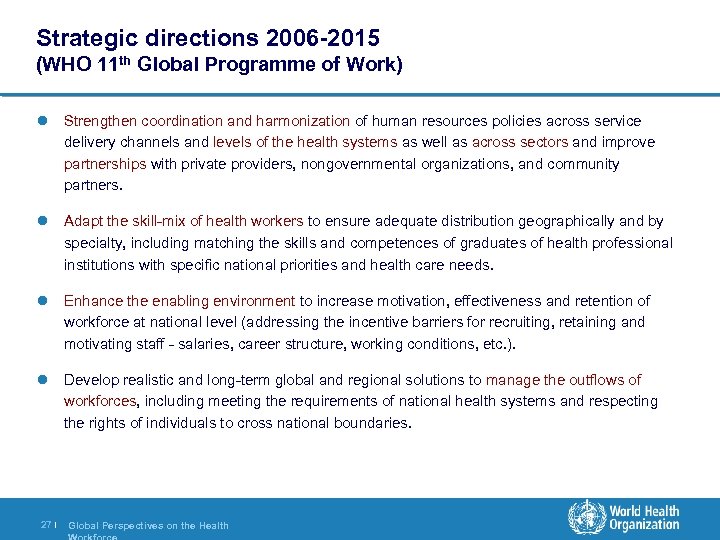
Strategic directions 2006 -2015 (WHO 11 th Global Programme of Work) l Strengthen coordination and harmonization of human resources policies across service delivery channels and levels of the health systems as well as across sectors and improve partnerships with private providers, nongovernmental organizations, and community partners. l Adapt the skill-mix of health workers to ensure adequate distribution geographically and by specialty, including matching the skills and competences of graduates of health professional institutions with specific national priorities and health care needs. l Enhance the enabling environment to increase motivation, effectiveness and retention of workforce at national level (addressing the incentive barriers for recruiting, retaining and motivating staff - salaries, career structure, working conditions, etc. ). l Develop realistic and long-term global and regional solutions to manage the outflows of workforces, including meeting the requirements of national health systems and respecting the rights of individuals to cross national boundaries. 27 | Global Perspectives on the Health
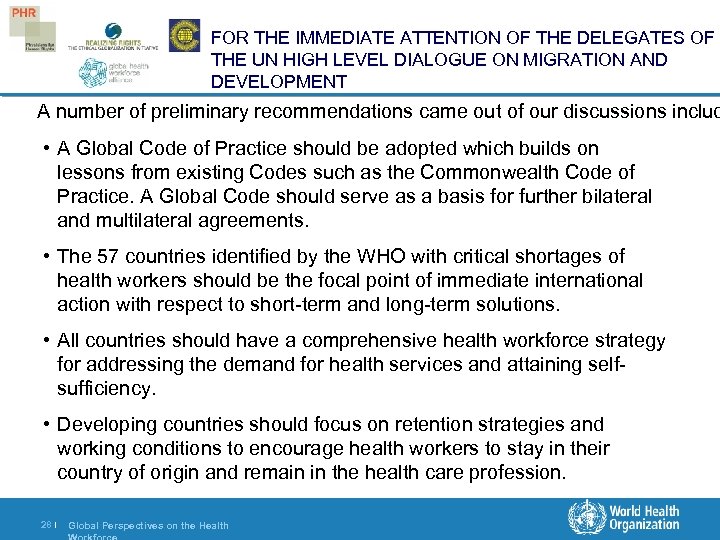
FOR THE IMMEDIATE ATTENTION OF THE DELEGATES OF THE UN HIGH LEVEL DIALOGUE ON MIGRATION AND DEVELOPMENT A number of preliminary recommendations came out of our discussions includ • A Global Code of Practice should be adopted which builds on lessons from existing Codes such as the Commonwealth Code of Practice. A Global Code should serve as a basis for further bilateral and multilateral agreements. • The 57 countries identified by the WHO with critical shortages of health workers should be the focal point of immediate international action with respect to short-term and long-term solutions. • All countries should have a comprehensive health workforce strategy for addressing the demand for health services and attaining selfsufficiency. • Developing countries should focus on retention strategies and working conditions to encourage health workers to stay in their country of origin and remain in the health care profession. 28 | Global Perspectives on the Health
FOR THE IMMEDIATE ATTENTION OF THE DELEGATES OF THE UN HIGH LEVEL DIALOGUE ON MIGRATION AND DEVELOPMENT • Governments should develop policies which allow health workers to move between sending and receiving countries and contribute to the development of both. • The skills of members of diasporas should be harnessed and managed to contribute to development and health care needs in developing countries. • Significant increases in spending on health care needed in developing countries requiring the support of international financial institutions which in some cases still place restrictive ceilings on social spending. • The role of other cadres of health workers including mid-level providers, community health workers and other substitute workers to address the health workers crises and in supporting national health systems should be explored further. 29 | • AGlobal Perspectives on the Health for data collection on health worker mobility Global Observatory
"There is a tide in the affairs of (wo)men Which, taken at the flood, leads on to fortune; Omitted, all the voyage of their life Is bound in shallows and in miseries. On such a full sea are we now afloat; And we must take the current when it serves, Or lose the ventures before us. " William Shakespeare, Julius Caesar 30 | Global Perspectives on the Health
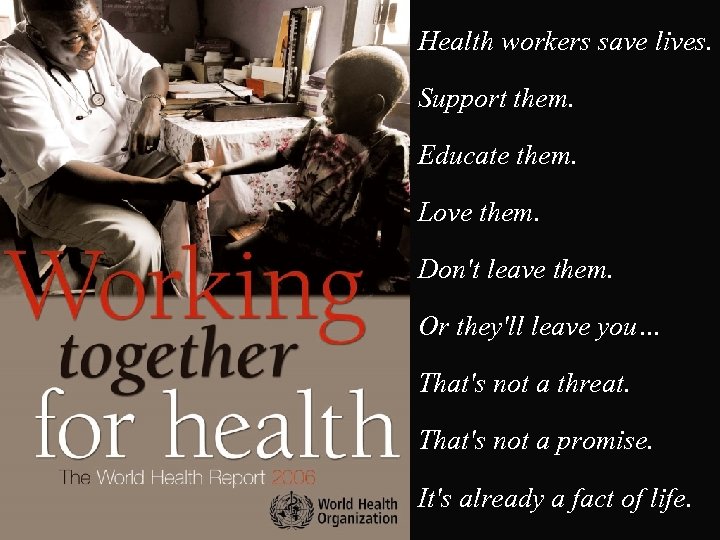
Health workers save lives. Support them. Educate them. Love them. Don't leave them. Or they'll leave you… That's not a threat. That's not a promise. It's already a fact of life. 31 | Global Perspectives on the Health
Скачать презентацию Global Perspectives on the Health Workforce l Manuel
49a5f70e1a3ffef2a43f347c0ff7eb06.ppt