 Скачать презентацию Global observables in the PHENIX experiment Transverse Dynamics
c0c549e00b4a47e73c1664629bad8e3b.ppt
- Количество слайдов: 19



Global observables in the PHENIX experiment Transverse Dynamics at RHIC BNL, March 6 -8, 2003 David Silvermyr, LANL for the PHENIX Collaboration
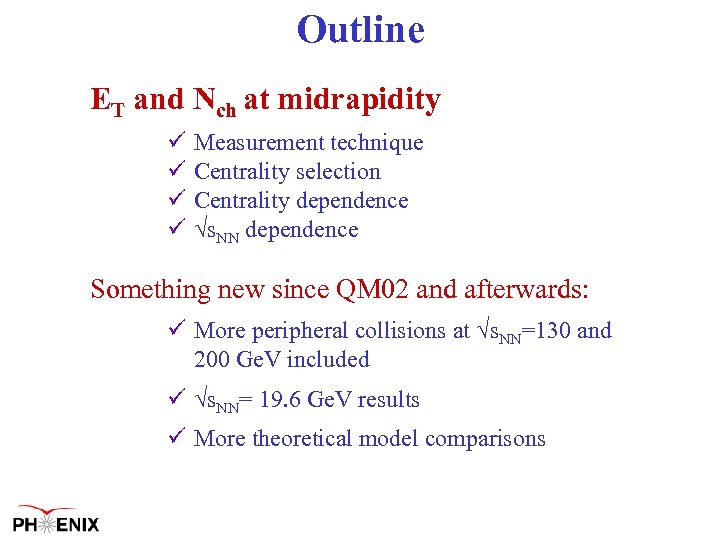
Outline ET and Nch at midrapidity ü ü Measurement technique Centrality selection Centrality dependence s. NN dependence Something new since QM 02 and afterwards: ü More peripheral collisions at s. NN=130 and 200 Ge. V included ü s. NN= 19. 6 Ge. V results ü More theoretical model comparisons
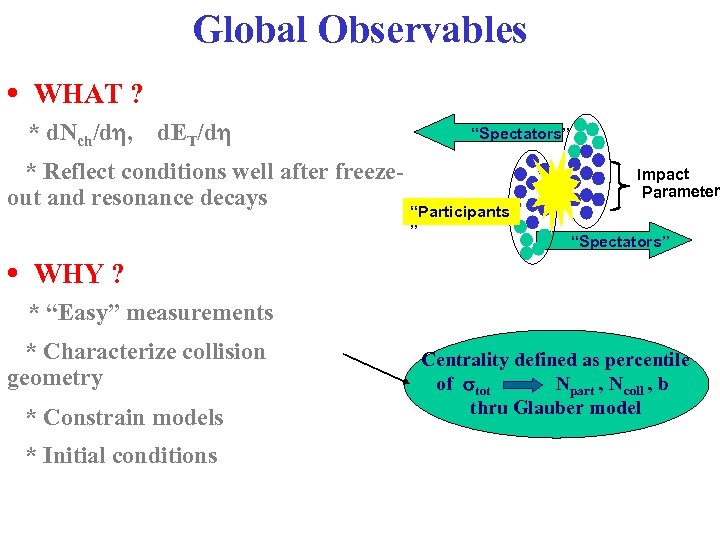
Global Observables • WHAT ? * d. Nch/d , d. ET/d * Reflect conditions well after freezeout and resonance decays “Spectators” Impact Parameter “Participants ” “Spectators” • WHY ? * “Easy” measurements * Characterize collision geometry * Constrain models * Initial conditions Centrality defined as percentile of tot Npart , Ncoll , b thru Glauber model
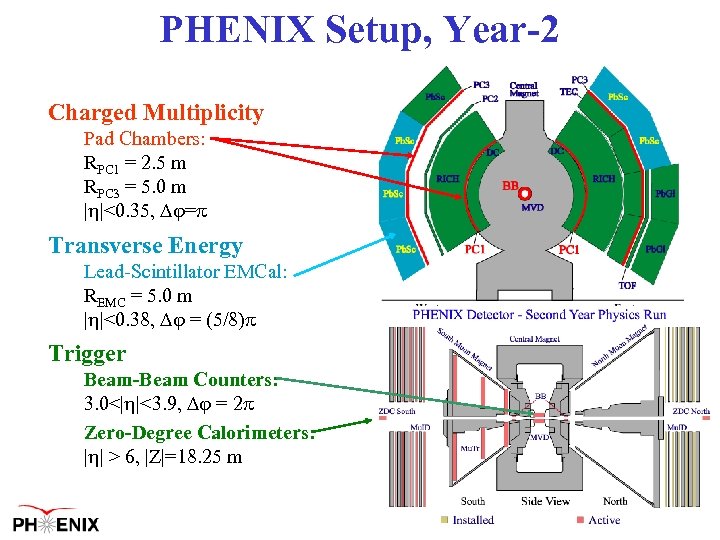
PHENIX Setup, Year-2 Charged Multiplicity Pad Chambers: RPC 1 = 2. 5 m RPC 3 = 5. 0 m | |<0. 35, = Transverse Energy Lead-Scintillator EMCal: REMC = 5. 0 m | |<0. 38, = (5/8) Trigger Beam-Beam Counters: 3. 0<| |<3. 9, = 2 Zero-Degree Calorimeters: | | > 6, |Z|=18. 25 m
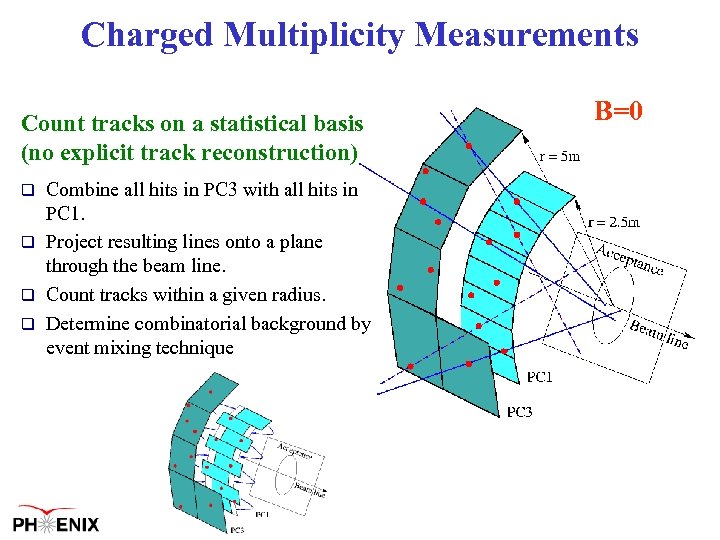
Charged Multiplicity Measurements Count tracks on a statistical basis (no explicit track reconstruction) Combine all hits in PC 3 with all hits in PC 1. q Project resulting lines onto a plane through the beam line. q Count tracks within a given radius. q Determine combinatorial background by event mixing technique q B=0
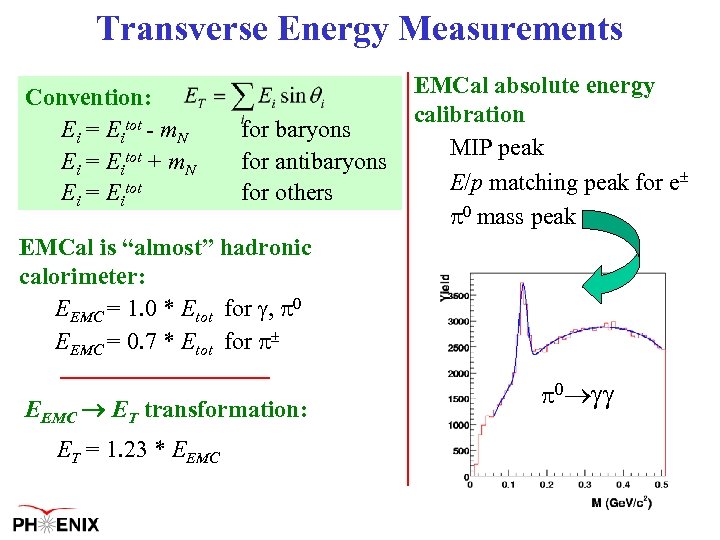
Transverse Energy Measurements Convention: Ei = Eitot - m. N Ei = Eitot + m. N Ei = Eitot for baryons for antibaryons for others EMCal absolute energy calibration MIP peak E/p matching peak for e 0 mass peak EMCal is “almost” hadronic calorimeter: EEMC = 1. 0 * Etot for , 0 EEMC = 0. 7 * Etot for EEMC ET transformation: ET = 1. 23 * EEMC 0
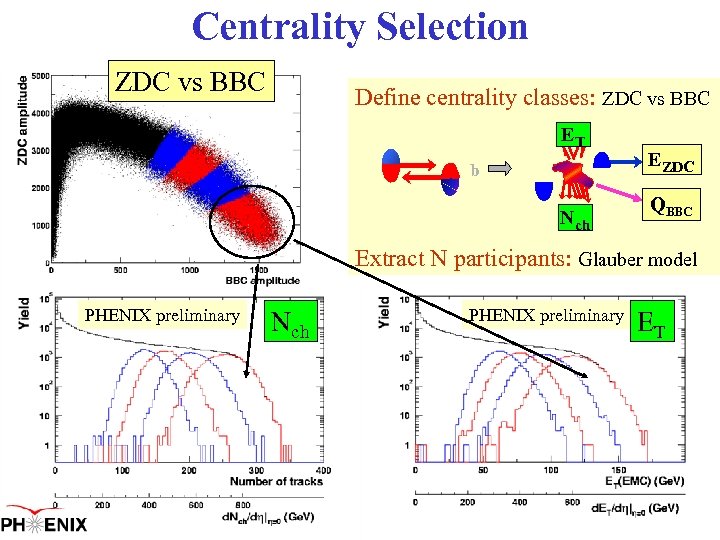
Centrality Selection ZDC vs BBC Define centrality classes: ZDC vs BBC ET b Nch EZDC QBBC Extract N participants: Glauber model PHENIX preliminary Nch PHENIX preliminary ET
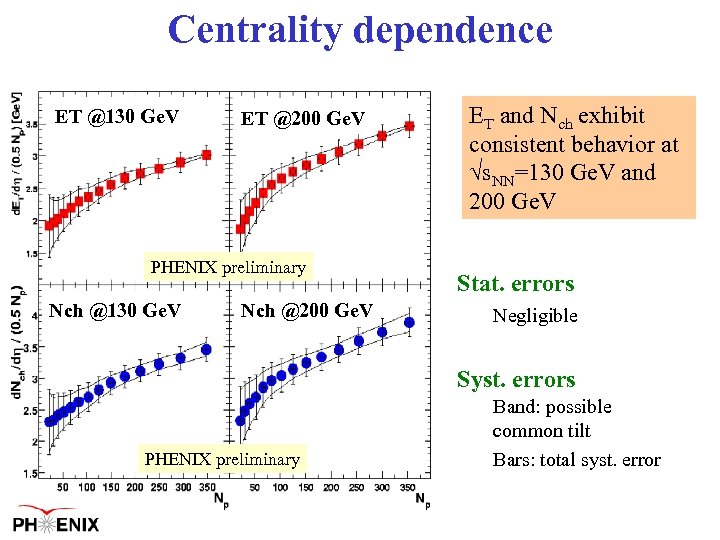
Centrality dependence ET @130 Ge. V ET @200 Ge. V PHENIX preliminary Nch @130 Ge. V Nch @200 Ge. V ET and Nch exhibit consistent behavior at s. NN=130 Ge. V and 200 Ge. V Stat. errors Negligible Syst. errors PHENIX preliminary Band: possible common tilt Bars: total syst. error
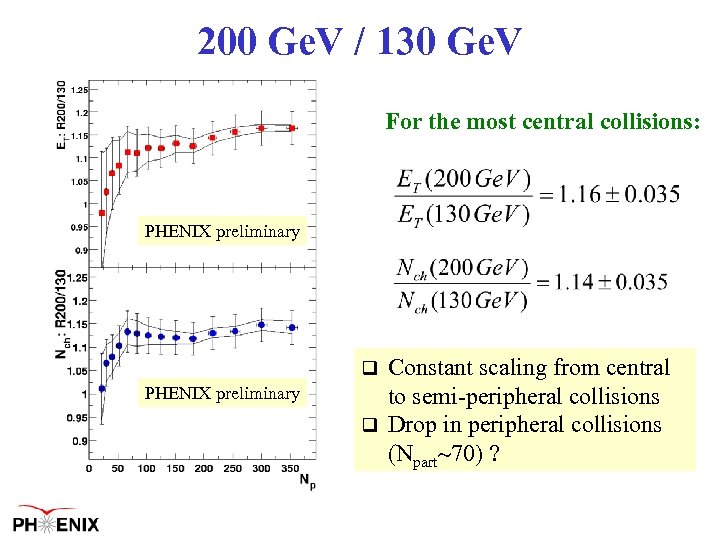
200 Ge. V / 130 Ge. V For the most central collisions: PHENIX preliminary Constant scaling from central to semi-peripheral collisions q Drop in peripheral collisions (Npart 70) ? q PHENIX preliminary
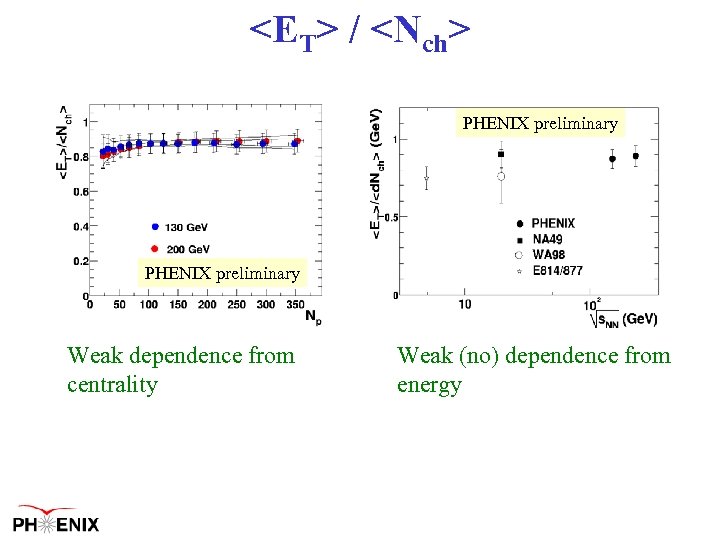
<ET> / <Nch> PHENIX preliminary Weak dependence from centrality Weak (no) dependence from energy
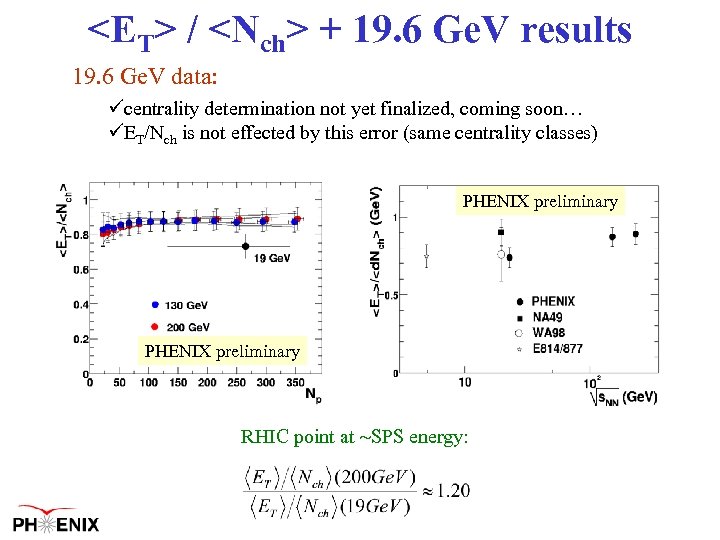
<ET> / <Nch> + 19. 6 Ge. V results 19. 6 Ge. V data: ücentrality determination not yet finalized, coming soon… üET/Nch is not effected by this error (same centrality classes) PHENIX preliminary RHIC point at SPS energy:
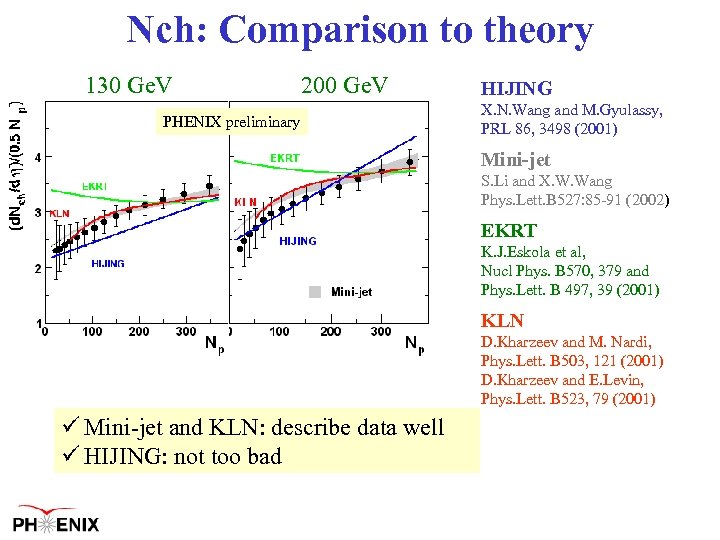
Nch: Comparison to theory 130 Ge. V 200 Ge. V PHENIX preliminary HIJING X. N. Wang and M. Gyulassy, PRL 86, 3498 (2001) Mini-jet S. Li and X. W. Wang Phys. Lett. B 527: 85 -91 (2002) EKRT K. J. Eskola et al, Nucl Phys. B 570, 379 and Phys. Lett. B 497, 39 (2001) KLN D. Kharzeev and M. Nardi, Phys. Lett. B 503, 121 (2001) D. Kharzeev and E. Levin, Phys. Lett. B 523, 79 (2001) ü Mini-jet and KLN: describe data well ü HIJING: not too bad
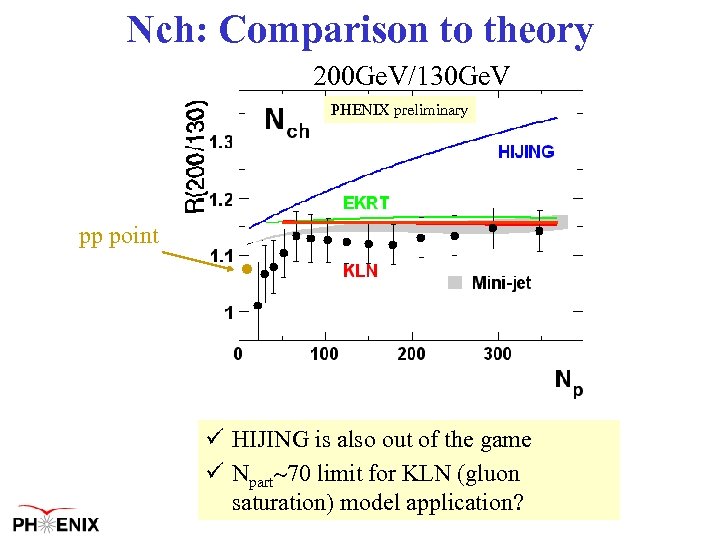
Nch: Comparison to theory 200 Ge. V/130 Ge. V PHENIX preliminary pp point ü HIJING is also out of the game ü Npart 70 limit for KLN (gluon saturation) model application?
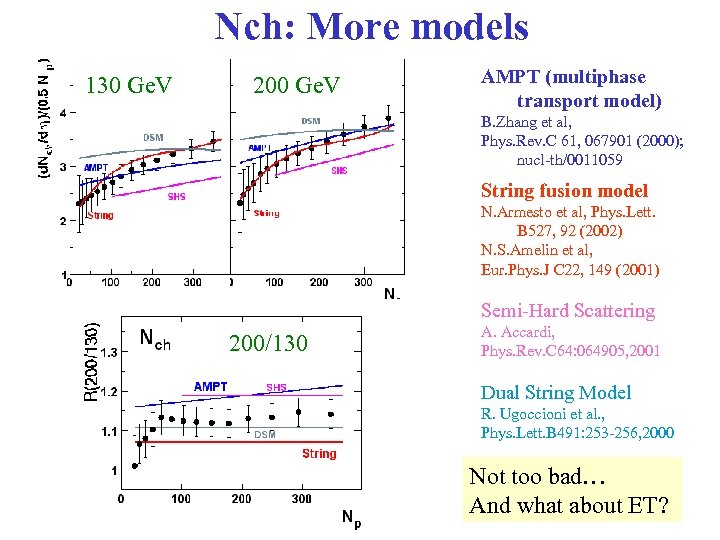
Nch: More models 130 Ge. V 200 Ge. V AMPT (multiphase transport model) B. Zhang et al, Phys. Rev. C 61, 067901 (2000); nucl-th/0011059 String fusion model N. Armesto et al, Phys. Lett. B 527, 92 (2002) N. S. Amelin et al, Eur. Phys. J C 22, 149 (2001) Semi-Hard Scattering 200/130 A. Accardi, Phys. Rev. C 64: 064905, 2001 Dual String Model R. Ugoccioni et al. , Phys. Lett. B 491: 253 -256, 2000 Not too bad… And what about ET?
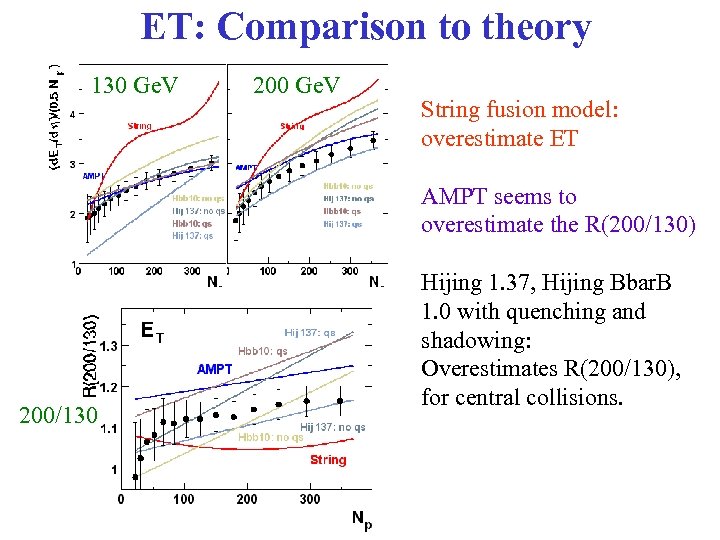
ET: Comparison to theory 130 Ge. V 200 Ge. V String fusion model: overestimate ET AMPT seems to overestimate the R(200/130) 200/130 Hijing 1. 37, Hijing Bbar. B 1. 0 with quenching and shadowing: Overestimates R(200/130), for central collisions.
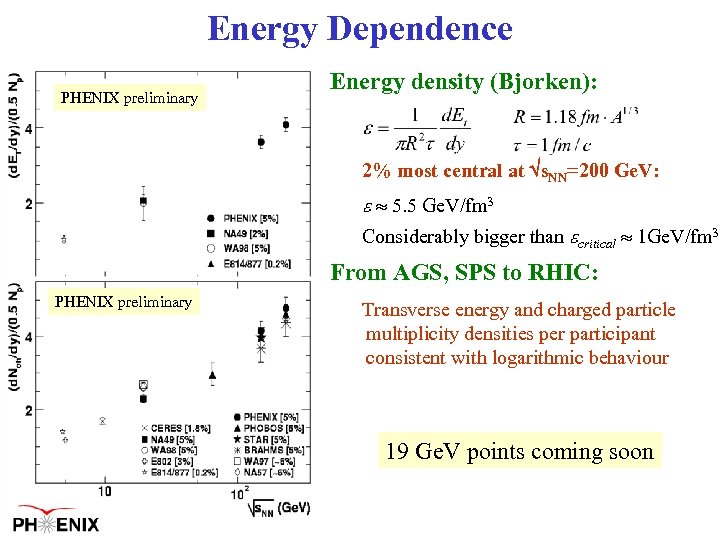
Energy Dependence PHENIX preliminary Energy density (Bjorken): 2% most central at s. NN=200 Ge. V: 5. 5 Ge. V/fm 3 Considerably bigger than critical 1 Ge. V/fm 3 From AGS, SPS to RHIC: PHENIX preliminary Transverse energy and charged particle multiplicity densities per participant consistent with logarithmic behaviour 19 Ge. V points coming soon
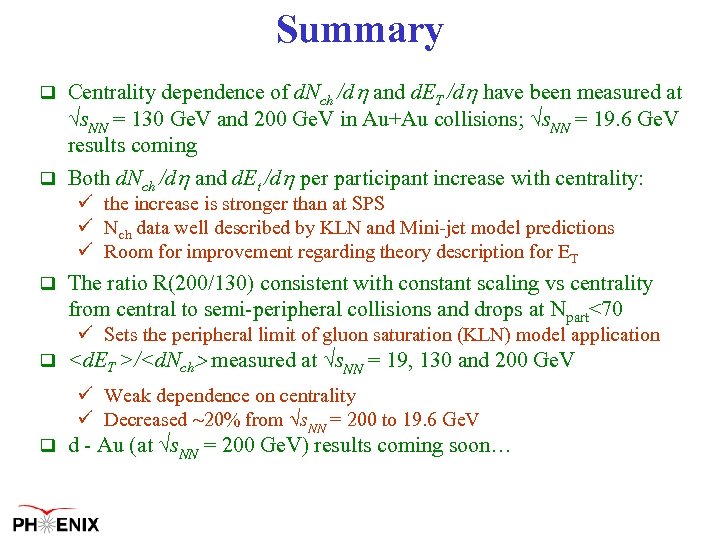
Summary Centrality dependence of d. Nch /dh and d. ET /dh have been measured at s. NN = 130 Ge. V and 200 Ge. V in Au+Au collisions; s. NN = 19. 6 Ge. V results coming q Both d. Nch /dh and d. Et /dh per participant increase with centrality: q ü the increase is stronger than at SPS ü Nch data well described by KLN and Mini-jet model predictions ü Room for improvement regarding theory description for ET q The ratio R(200/130) consistent with constant scaling vs centrality from central to semi-peripheral collisions and drops at Npart<70 ü Sets the peripheral limit of gluon saturation (KLN) model application q <d. ET >/<d. Nch> measured at s. NN = 19, 130 and 200 Ge. V ü Weak dependence on centrality ü Decreased 20% from s. NN = 200 to 19. 6 Ge. V q d - Au (at s. NN = 200 Ge. V) results coming soon…
The PHENIX Collaboration A strongly international venture: 1. 11 nations Brazil, China, France, Germany, India, Israel, Japan, South Korea, Russia, Sweden, United States 51 institutions
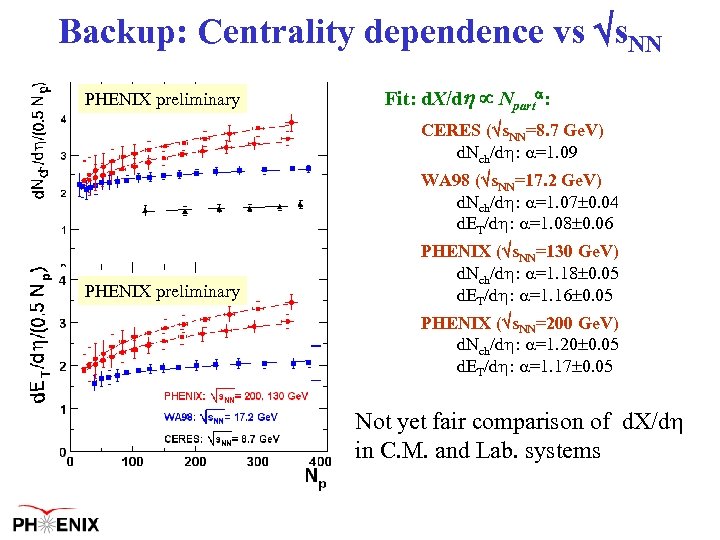
Backup: Centrality dependence vs s. NN PHENIX preliminary Fit: d. X/d Npart : CERES ( s. NN=8. 7 Ge. V) d. Nch/d : =1. 09 WA 98 ( s. NN=17. 2 Ge. V) d. Nch/d : =1. 07 0. 04 d. ET/d : =1. 08 0. 06 PHENIX preliminary PHENIX ( s. NN=130 Ge. V) d. Nch/d : =1. 18 0. 05 d. ET/d : =1. 16 0. 05 PHENIX ( s. NN=200 Ge. V) d. Nch/d : =1. 20 0. 05 d. ET/d : =1. 17 0. 05 Not yet fair comparison of d. X/d in C. M. and Lab. systems
Скачать презентацию Global observables in the PHENIX experiment Transverse Dynamics
c0c549e00b4a47e73c1664629bad8e3b.ppt