 Скачать презентацию Global Manufacturing and Supply Chain Management 18 -1
571def5cfced11c18c98dc563f7e126f.ppt
- Количество слайдов: 26



Global Manufacturing and Supply Chain Management 18 -1
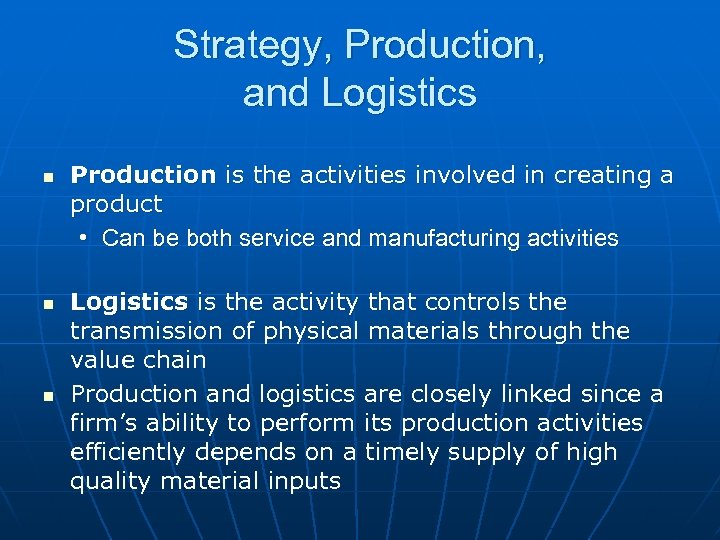
Strategy, Production, and Logistics n n n Production is the activities involved in creating a product • Can be both service and manufacturing activities Logistics is the activity that controls the transmission of physical materials through the value chain Production and logistics are closely linked since a firm’s ability to perform its production activities efficiently depends on a timely supply of high quality material inputs
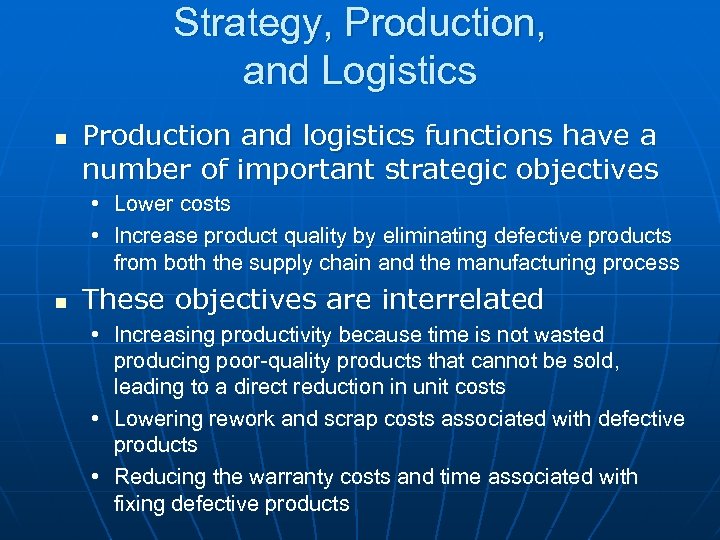
Strategy, Production, and Logistics n Production and logistics functions have a number of important strategic objectives • • n Lower costs Increase product quality by eliminating defective products from both the supply chain and the manufacturing process These objectives are interrelated • Increasing productivity because time is not wasted producing poor-quality products that cannot be sold, leading to a direct reduction in unit costs • Lowering rework and scrap costs associated with defective products • Reducing the warranty costs and time associated with fixing defective products
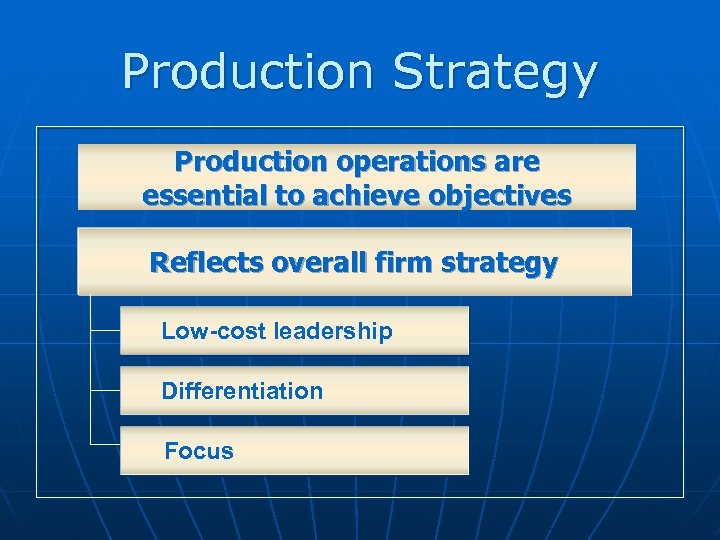
Production Strategy Production operations are essential to achieve objectives Reflects overall firm strategy Low-cost leadership Differentiation Focus
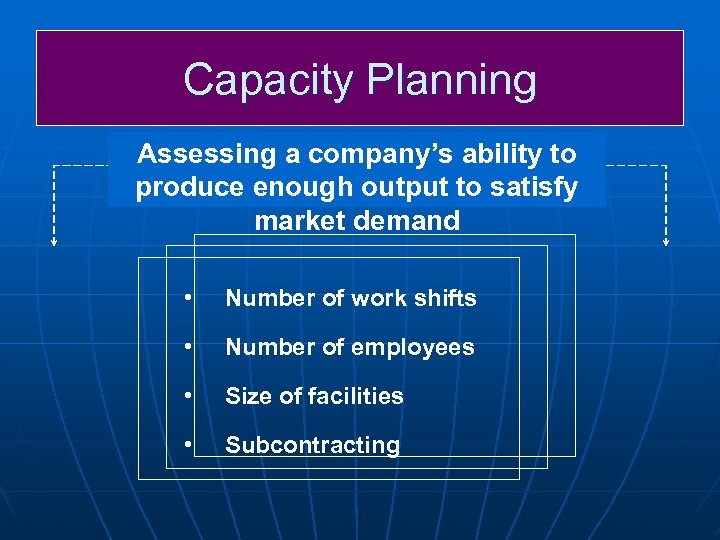
Capacity Planning Assessing a company’s ability to produce enough output to satisfy market demand • Number of work shifts • Number of employees • Size of facilities • Subcontracting
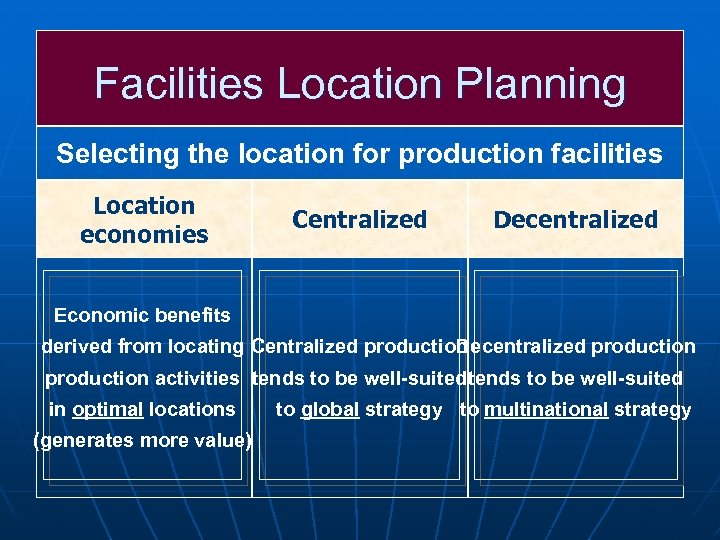
Facilities Location Planning Selecting the location for production facilities Location economies Centralized Decentralized Economic benefits derived from locating Centralized production Decentralized production activities tends to be well-suited in optimal locations (generates more value) to global strategy to multinational strategy
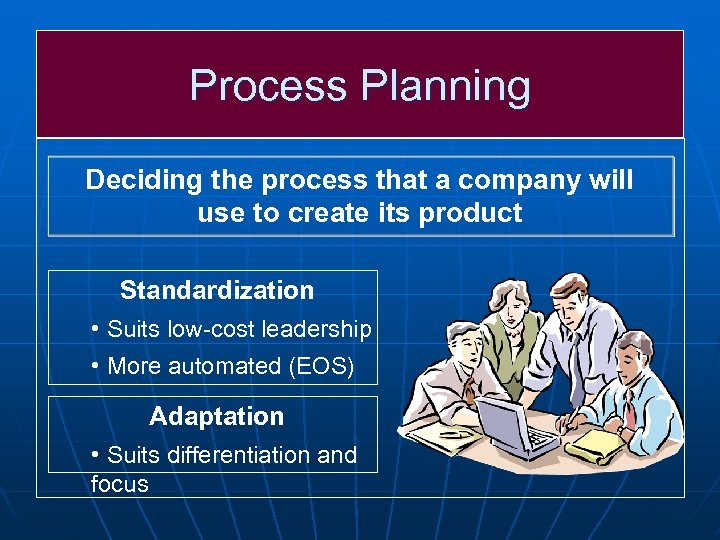
Process Planning Deciding the process that a company will use to create its product Standardization • Suits low-cost leadership • More automated (EOS) Adaptation • Suits differentiation and focus
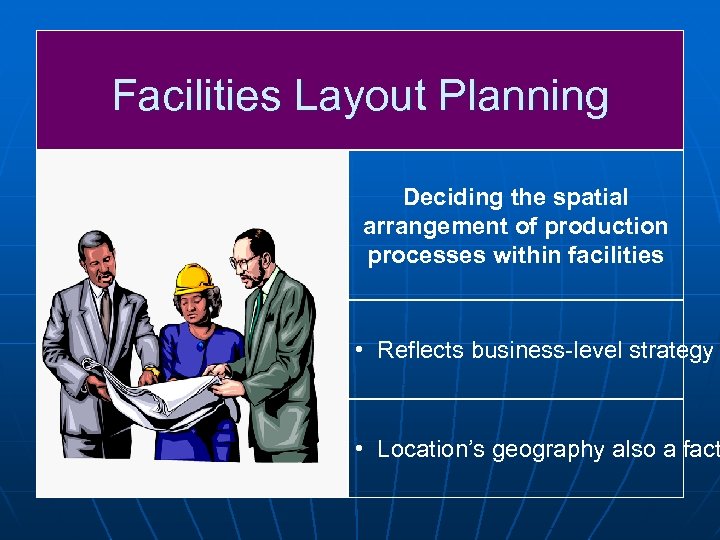
Facilities Layout Planning Deciding the spatial arrangement of production processes within facilities • Reflects business-level strategy • Location’s geography also a fact
Supply Chain Terms n n Supply chains – the coordination of materials, information, and funds from the initial raw material supplier to the ultimate customer Logistics (materials management) – that part of the supply chain process that plans, implements, and controls the efficient, effective flow and storage of goods, services, and related information 18 -3
Factors Managers Must Consider n n n Efficiency/cost-reduction of manufacturing costs Dependability-degree of trust in a company’s products and its delivery and promises Innovation-ability to develop new products and ideas 18 -5
Factors Managers Must Consider, con’t n n Quality-performance reliability, service quality, speed of delivery, and maintenance quality of the product Flexibility-ability of the production process to make different kinds of products and to adjust the volume of output 18 -6
Manufacturing Configurations n n n Centralized manufacturing offering a selection of standard, lower-priced products to different markets Regional manufacturing to serve customers within a specific region Multi-domestic manufacturing (market expansion) in individual countries as their demand becomes significant so manufacturing is closer to customers and meeting local needs 18 -7
Supplier Networks – Acquiring Physical Resources n n n Companies can manufacture parts internally or purchase them from external manufacturers “make or buy” decision Outsourcing is the process of a company having inputs supplied to it from outside suppliers for the production process 18 -13
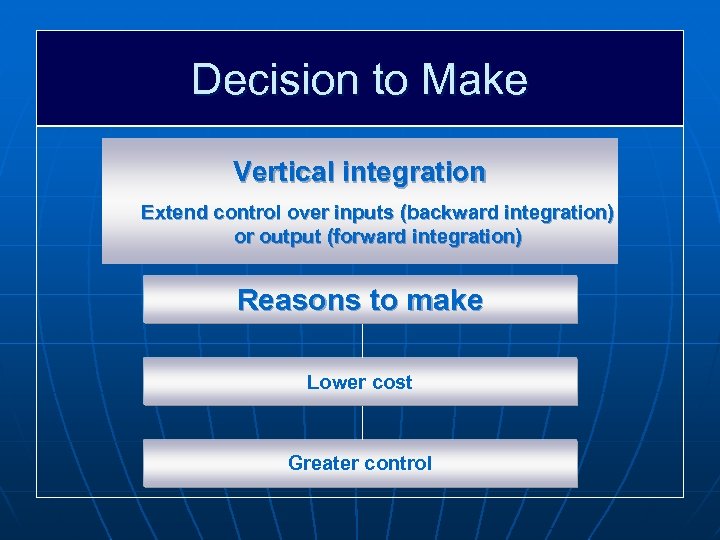
Decision to Make Vertical integration Extend control over inputs (backward integration) or output (forward integration) Reasons to make Lower cost Greater control
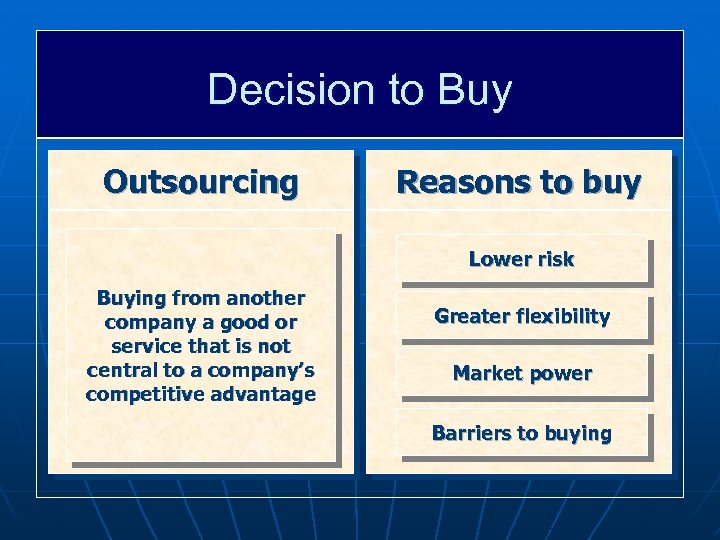
Decision to Buy Outsourcing Reasons to buy Lower risk Buying from another company a good or service that is not central to a company’s competitive advantage Greater flexibility Market power Barriers to buying

18 -14
Global Component Network 18 -15
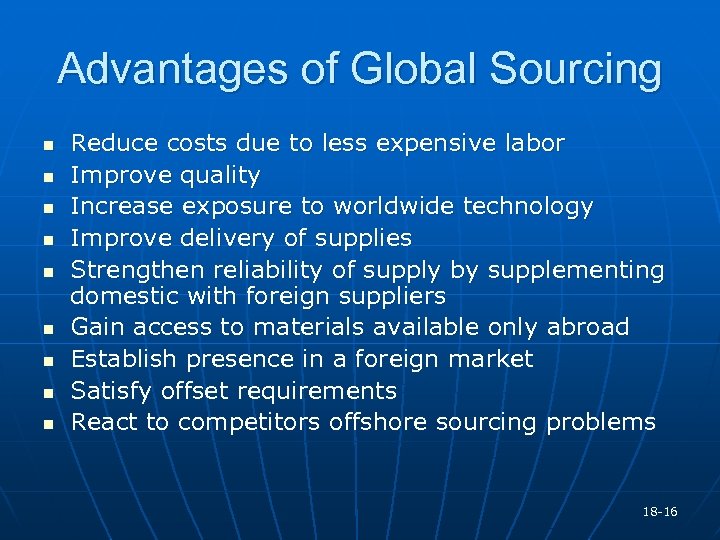
Advantages of Global Sourcing n n n n n Reduce costs due to less expensive labor Improve quality Increase exposure to worldwide technology Improve delivery of supplies Strengthen reliability of supply by supplementing domestic with foreign suppliers Gain access to materials available only abroad Establish presence in a foreign market Satisfy offset requirements React to competitors offshore sourcing problems 18 -16
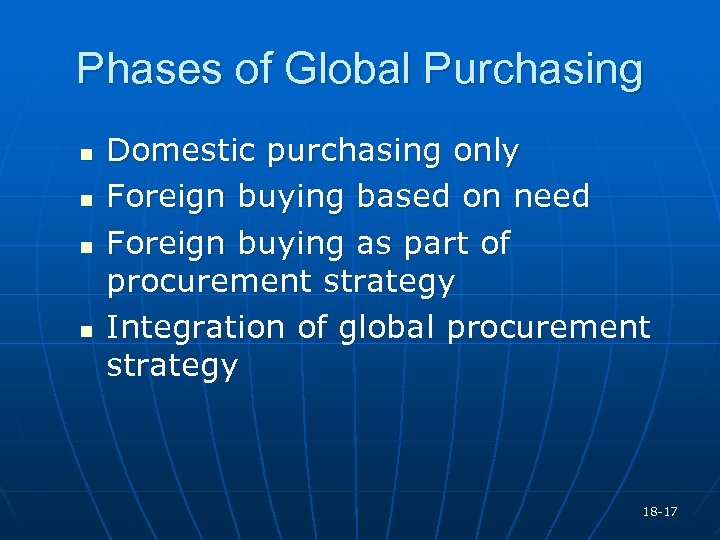
Phases of Global Purchasing n n Domestic purchasing only Foreign buying based on need Foreign buying as part of procurement strategy Integration of global procurement strategy 18 -17

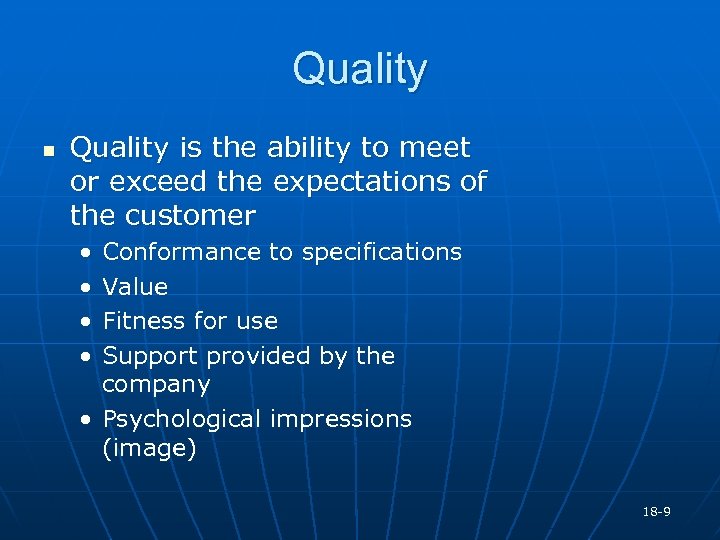
Quality n Quality is the ability to meet or exceed the expectations of the customer • • Conformance to specifications Value Fitness for use Support provided by the company • Psychological impressions (image) 18 -9
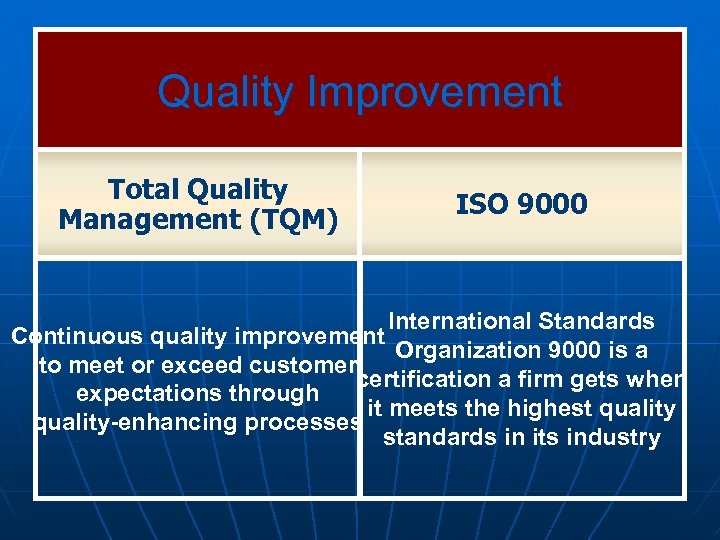
Quality Improvement Total Quality Management (TQM) ISO 9000 International Standards Continuous quality improvement Organization 9000 is a to meet or exceed customer certification a firm gets when expectations through it meets the highest quality-enhancing processes standards in its industry
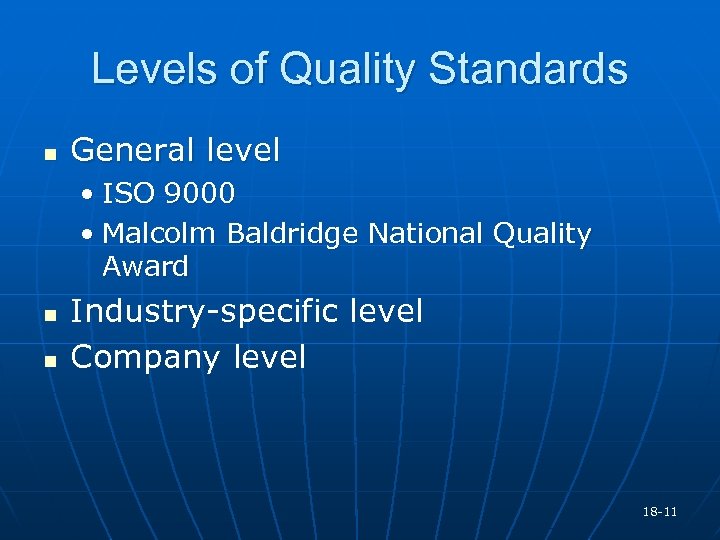
Levels of Quality Standards n General level • ISO 9000 • Malcolm Baldridge National Quality Award n n Industry-specific level Company level 18 -11
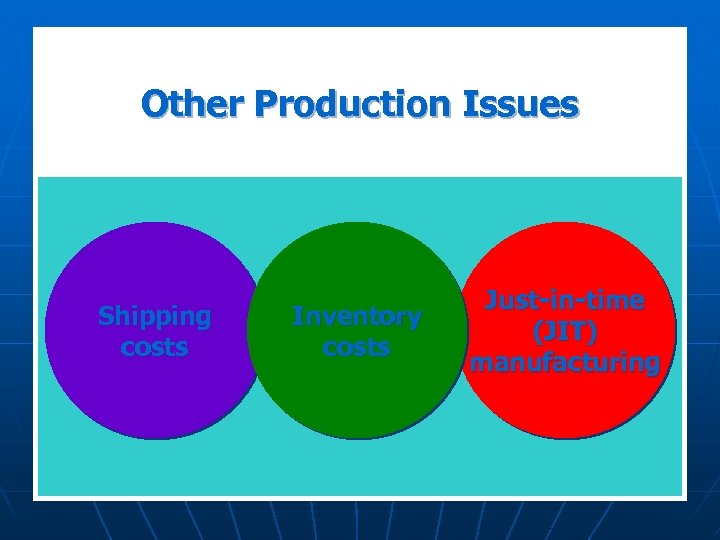
Other Production Issues Shipping costs Inventory costs Just-in-time (JIT) manufacturing
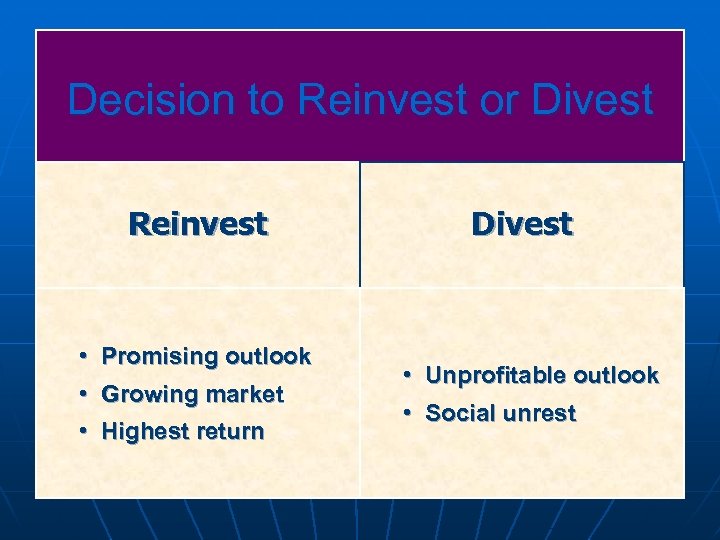
Decision to Reinvest or Divest Reinvest • Promising outlook • Growing market • Highest return Divest • Unprofitable outlook • Social unrest
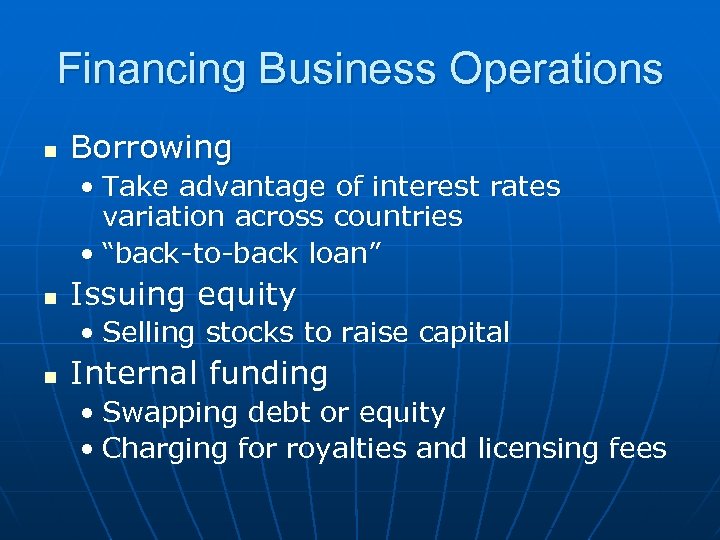
Financing Business Operations n Borrowing • Take advantage of interest rates variation across countries • “back-to-back loan” n Issuing equity • Selling stocks to raise capital n Internal funding • Swapping debt or equity • Charging for royalties and licensing fees
Скачать презентацию Global Manufacturing and Supply Chain Management 18 -1
571def5cfced11c18c98dc563f7e126f.ppt