

Global Manager Lecture 4 What is

Global Manager Lecture 4
What is management? Some definitions Coordination and control of people, material, and processes to achieve organizational objectives as efficiently and effectively as possible. Getting things done through coordinated efforts. Planning, organizing, leading and controlling.
IS MANAGEMENT UNIVERSAL? 1. Are these definitions of management universal or do they vary across different geographic regions? 2. If these definitions are universal, how might their implementation vary across national and regional boundaries?
What Is Leadership?
Leadership has been defined as the ability to persuade others to seek set objectives enthusiastically (Robbins, 1998). …. . “is the ability to influence, motivate and contribute towards the effectiveness of the organizations of which they are members” (House and Wright, 1997).
Project GLOBE (Global Leadership and Organizational Behavior Effectiveness) – attempt to develop an empirically based theory to describe, understand, and predict the impact of specific cultural variables on leadership and organizational processes and the effectiveness of these processes
The GLOBE project conceived in 1991 by Robert J. House of the Wharton School of the University of Pennsylvania. The GLOBE Project directly involved 170 “country co-investigators” based in 62 of the world’s cultures as well as a 14 -member group of coordinators and research associates. This international team collected data from 17, 300 middle managers in 951 organizations.
Nine Basic Cultural Dimensions from the GLOBE Project Power distance – How much unequal distribution of power should there be in organizations and society? Uncertainty-avoidance – How much should people rely on social norms and rules to avoid uncertainty and limit unpredictability?
Nine Basic Cultural Dimensions from the GLOBE Project Institutional collectivism – How much should leaders encourage and reward loyalty to the social unit, as opposed to the pursuit of individual goals? In-group collectivism – How much pride and loyalty should individuals have for their family or organization?
Nine Basic Cultural Dimensions from the GLOBE Project Gender egalitarianism – How much effort should be put into minimizing gender discrimination and role inequalities? Assertiveness – How confrontational and dominant should individuals be in social relationships? Future orientation – How much should people delay gratification by planning and saving for the future?
Nine Basic Cultural Dimensions from the GLOBE Project Performance orientation – How much should individuals be rewarded for improvement and excellence? Humane orientation – How much should society encourage and reward people for being kind, fair, friendly, and generous?
How do different countries score on the GLOBE cultural dimensions? A quick overview shows a great deal of cultural diversity around the world.
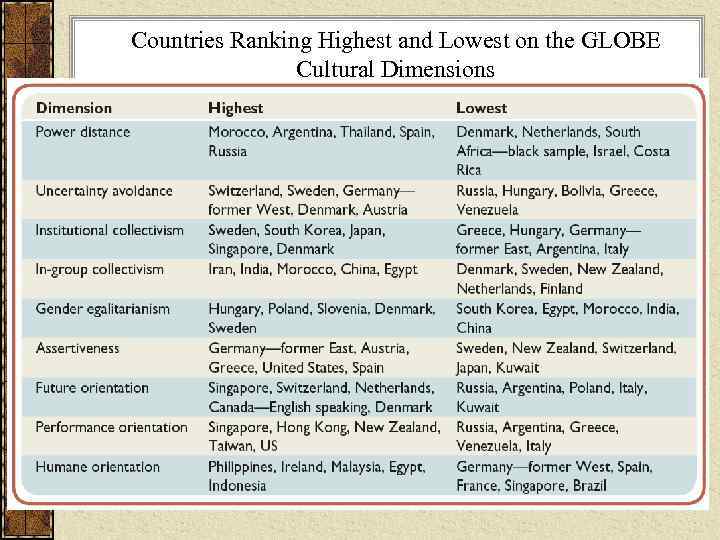
Countries Ranking Highest and Lowest on the GLOBE Cultural Dimensions
GLOBE The project included the development of a research protocol including a questionnaire to measure culturally endorsed implicit leadership theory, as well as interviews and focus theory groups designed to elicit information about the perceived attributes of ideal leaders.
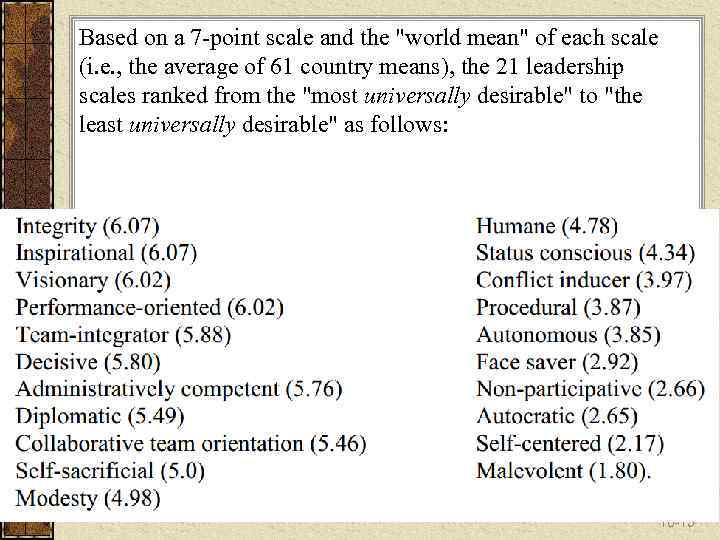
Based on a 7 -point scale and the "world mean" of each scale (i. e. , the average of 61 country means), the 21 leadership scales ranked from the "most universally desirable" to "the least universally desirable" as follows: 10 -15
These 21 leadership scales were statistically and conceptually reduced to six scales, resulting in six leader styles: charismatic team oriented, humane, participative, autonomous, self-protective.
Charismatic leaders are visionary, inspirational, decisive, and performance oriented, and they have high levels of personal integrity. Stresses high standards, decisiveness, and innovation; seeks to inspire people around a vision; creates a passion among them to perform; and does so by firmly holding on to core values.
Team-oriented leaders are team builders, and they are collaborative and diplomatic. Instills pride, loyalty, and collaboration among organizational members; and highly values team cohesiveness and a common purpose or goals
Humane leaders are generous, compassionate, modest, and patient. Stresses compassion and generosity; and it is patient, supportive, and concerned with the well-being of others
Participative leaders act in a nonautocratic and nondictatorial manner, they delegate, and they behave in an egalitarian way. Encourages input from others in decision-making and implementation; and emphasizes delegation and equality
Self-protective leadership – involves being self- centered, face saving, and procedural. Style emphasizes procedural, status-conscious, and 'face-saving' behaviors; and focuses on the safety and security of the individual and the group
Autonomous leaders are individualistic and independent. Style is characterized by an independent, individualistic, and self-centric approach to leadership
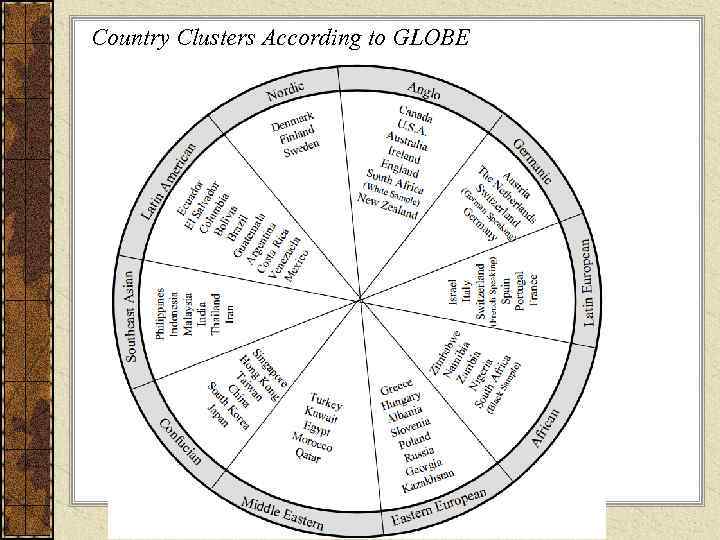
Country Clusters According to GLOBE
Next table groups the country clusters from Figure according to the degree to which they prefer each of the six leader styles. Societal clusters grouped together at the higher or lower end or in the middle differ significantly from the other groups of clusters, but not from each other. There are no statistically significant differences for the team-oriented and autonomous styles across all clusters
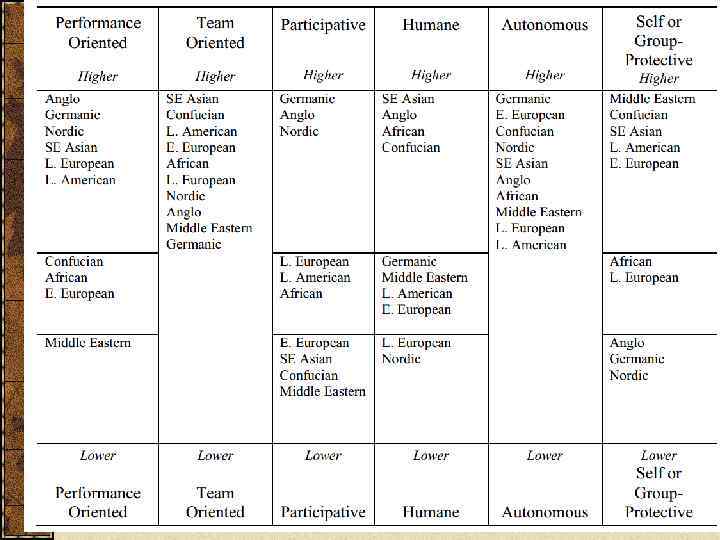
10 -25
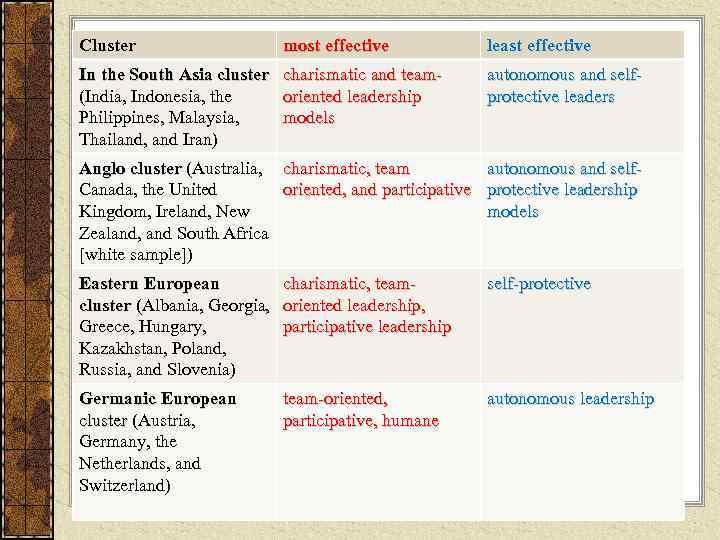
Cluster most effective least effective In the South Asia cluster charismatic and team- autonomous and self- (India, Indonesia, the oriented leadership protective leaders Philippines, Malaysia, models Thailand, and Iran) Anglo cluster (Australia, charismatic, team autonomous and self- Canada, the United oriented, and participative protective leadership Kingdom, Ireland, New models Zealand, and South Africa [white sample]) Eastern European charismatic, team- self-protective cluster (Albania, Georgia, oriented leadership, oriented leadership Greece, Hungary, participative leadership Kazakhstan, Poland, Russia, and Slovenia) Germanic European team-oriented, autonomous leadership cluster (Austria, cluster participative, humane Germany, the Netherlands, and Switzerland)
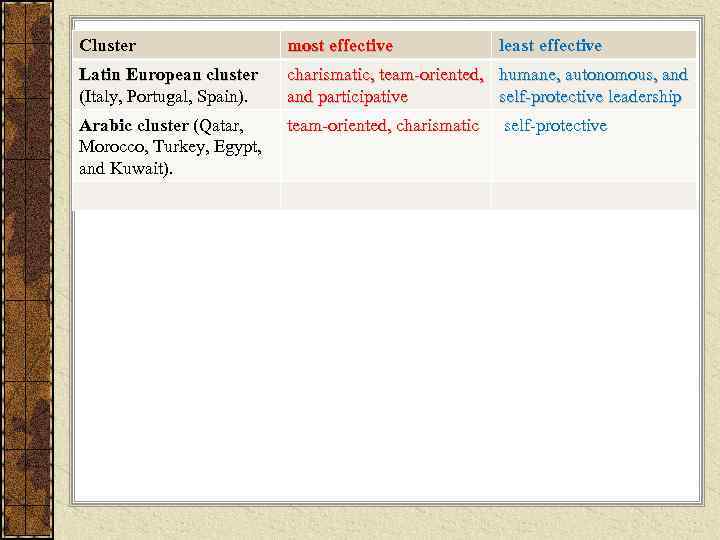
Cluster most effective least effective Latin European cluster charismatic, team-oriented, humane, autonomous, and (Italy, Portugal, Spain). and participative self-protective leadership Arabic cluster (Qatar, team-oriented, charismatic self-protective Morocco, Turkey, Egypt, and Kuwait).
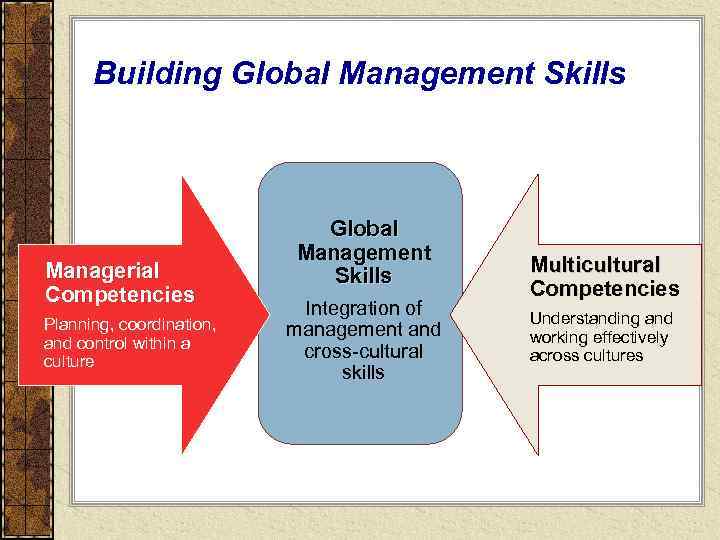
Building Global Management Skills Global Management Managerial Multicultural Skills Competencies Integration of Understanding and Planning, coordination, management and control within a working effectively culture cross-cultural across cultures skills
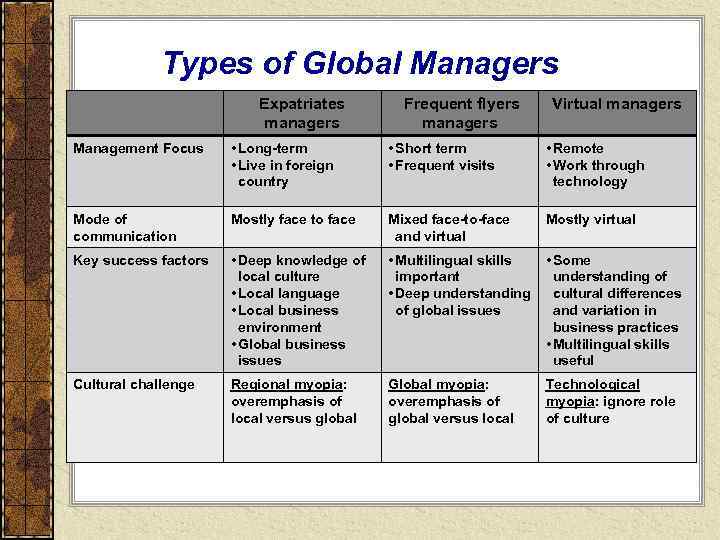
Types of Global Managers Expatriates Frequent flyers Virtual managers managers Management Focus • Long-term • Short term • Remote • Live in foreign • Frequent visits • Work through country technology Mode of Mostly face to face Mixed face-to-face Mostly virtual communication and virtual Key success factors • Deep knowledge of • Multilingual skills • Some local culture important understanding of • Local language • Deep understanding cultural differences • Local business of global issues and variation in environment business practices • Global business • Multilingual skills issues useful Cultural challenge Regional myopia: Global myopia: Technological overemphasis of myopia: ignore role local versus global versus local of culture
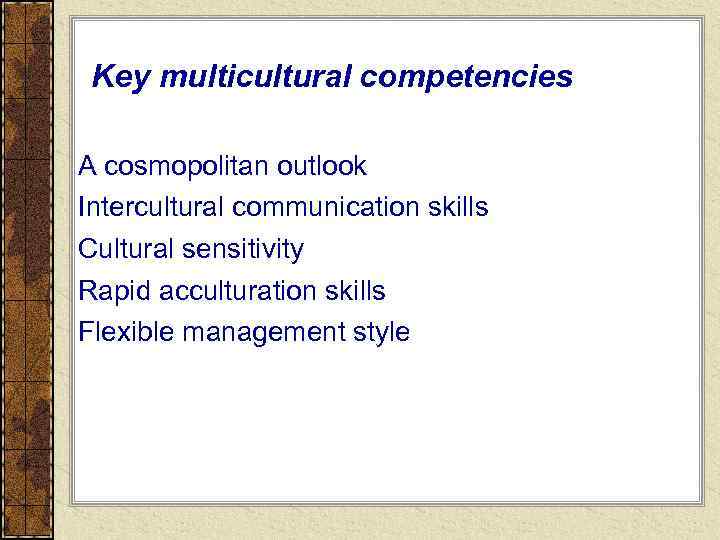
Key multicultural competencies A cosmopolitan outlook Intercultural communication skills Cultural sensitivity Rapid acculturation skills Flexible management style

Preparing for a Foreign Assignment Expatriate – refers to anyone living and/or working outside their home country
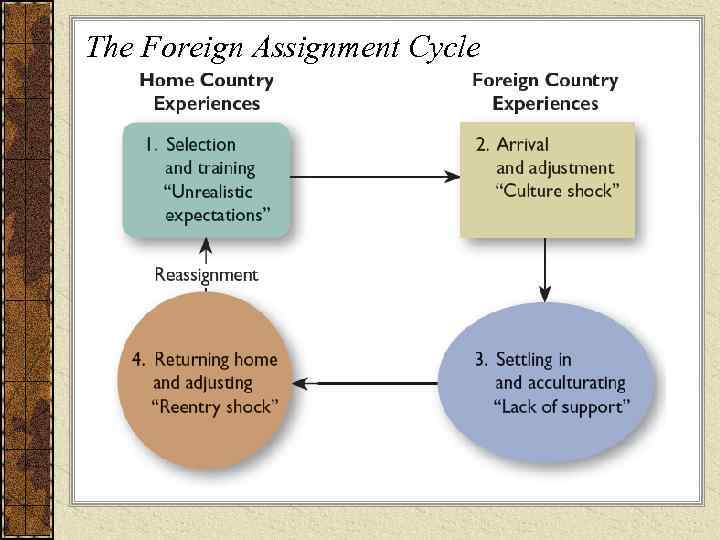
The Foreign Assignment Cycle
Culture Shock – anxiety and doubt caused by an overload of new expectations and information – This is a normal reaction to a new environment where you are no longer in control as you have been at home. – Best defense is comprehensive cross-cultural training, including intensive language study
Symptoms of culture shock People differ greatly in the degree to which culture shock affects them, but almost everyone is affected by it in one way or another. Symptoms vary, but can include: boredom feeling isolated or helpless sleeping a lot or tiring easily suffering from body pains and aches longing to be back home unduly criticizing local customs or ways of doing things
Stages of culture shock The five stages of culture shock are: 1. The Honeymoon Stage - You are very positive, curious, and anticipate new exciting experiences. You even idealize the host culture.
Stages of culture shock 2. Irritability - You start to feel that what is different is actually inferior. The host culture is confusing or the systems are frustrating. It's a small step from saying that they do things in a different way to saying that they do things in a stupid way. You may blame your frustrations on the new culture (and its shortcomings) rather than on the adaptation process.
Stages of culture shock 3. Gradual Adjustment - You feel more relaxed and develop a more balanced, objective view of your experience. 4. Mental isolation 5. Adaptation - You feel a new sense of belonging and sensitivity to the host culture.
Stages of culture shock Re-entry Shock - You go home and it isn't what you expected it to be.
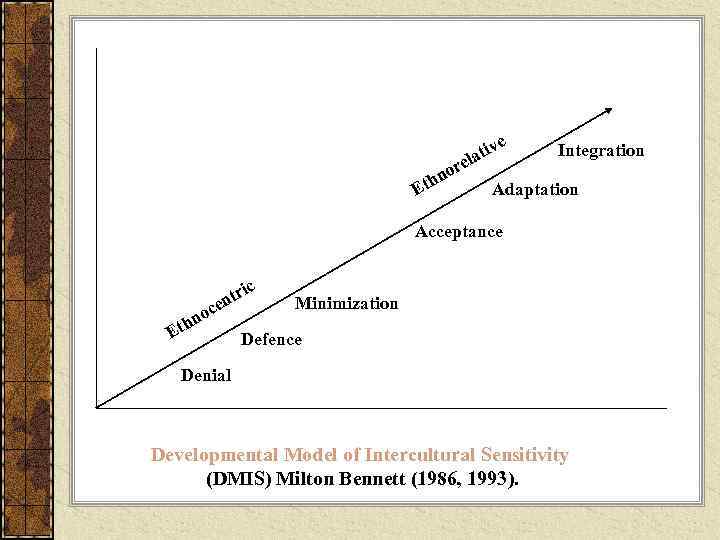
i ve Integration e lat or E thn Adaptation Acceptance tric oc en Minimization hn Et Defence Denial Developmental Model of Intercultural Sensitivity (DMIS) Milton Bennett (1986, 1993).
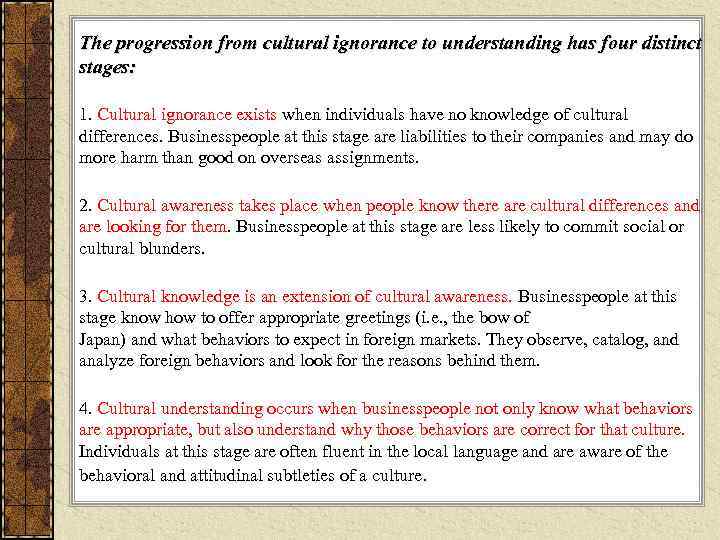
The progression from cultural ignorance to understanding has four distinct stages: 1. Cultural ignorance exists when individuals have no knowledge of cultural differences. Businesspeople at this stage are liabilities to their companies and may do more harm than good on overseas assignments. 2. Cultural awareness takes place when people know there are cultural differences and are looking for them. Businesspeople at this stage are less likely to commit social or cultural blunders. 3. Cultural knowledge is an extension of cultural awareness. Businesspeople at this stage know how to offer appropriate greetings (i. e. , the bow of Japan) and what behaviors to expect in foreign markets. They observe, catalog, and analyze foreign behaviors and look for the reasons behind them. 4. Cultural understanding occurs when businesspeople not only know what behaviors are appropriate, but also understand why those behaviors are correct for that culture. Individuals at this stage are often fluent in the local language and are aware of the behavioral and attitudinal subtleties of a culture.
Ethnocentrism
Ethnocentrism is judging another culture solely by the values and standards of one's own culture. Ethnocentric values and standards of one's own culture. individuals judge other groups relative to their own ethnic group or culture, especially with concern for language, behavior, customs, and religion. These ethnic distinctions and subdivisions serve to define each ethnicity's unique cultural identity. Ethnocentrism may be overt or subtle, and while it is considered a natural proclivity of human psychology, it has developed a generally negative connotation. – belief that one’s native country, culture, language, and behavior are superior to all others.
Research Insight and Dealing with Ethnocentrism Research suggests ethnocentrism is bad for business. A survey of 918 companies with home offices in the United States (272 companies), Japan (309), and Europe (337) found ethnocentric staffing and human resource policies to be associated with increased personnel problems. Those problems included recruiting difficulties, high turnover rates, and lawsuits over personnel policies. Among the three regional samples, Japanese companies had the most ethnocentric human resource practices and the most international human resource problems.
The Role of the Expatriate Spouse We began to realize that the entire effectiveness of the assignment could be compromised by ignoring the spouse. —Steve Ford, Corporation Relocations, Hewlett-Packard Research on 321 American expatriate spouses shows effective cross-cultural adjustment is more likely – When the firms seek the spouse’s opinion about the international assignment – When the spouse initiates his/her own pre-departure training
Preparation Adaptation, and Repatriation Effective HRM ends with the successful repatriation of the executive into company headquarters Companies must prepare to minimize the potential effects of reverse culture shock Ineffective repatriation practices are clear – few managers will be willing to take international assignments
Preparation Adaptation, and Repatriation A mentor program to monitor the expatriate’s career path while abroad and upon repatriation As an alternative to the mentor program, the establishment of a special organizational unit for the purposes of career planning and continuing guidance for the expatriate A system of supplying information and maintaining contacts with the expatriate so that he or she may continue to feel a part of the home organization.
Successful International Assignments 1. Be sure that repatriation is an explicit part of your international assignment plan. A major reason for repatriate dissatisfaction and turnover is upon their return no positions were available for them. Their new skills and experiences were under appreciated and not utilized.
Successful International Assignments 2. Identify, establish, and maintain communications with sources of ongoing support in your home country. Many repatriates complain that they became disconnected and out of the loop while away. They felt that their opportunities were limited once they returned because nobody was looking out for them while they were away (e. g. , manager, mentor, or career coach).
Successful International Assignments 3. Confirm that senior management openly and genuinely values international expertise. For instance, be certain that international expertise is considered and matters when identifying candidates for future opportunities.
 Скачать презентацию Global Manager Lecture 4 What is
Lec 7 Gl. Manager 2017.pptx
- Количество слайдов: 49