 Скачать презентацию Global International Issues Sad but true U S businesspeople
313273f8f0f0b4c76819c72b8c7318a6.ppt
- Количество слайдов: 23




Global/International Issues “Sad but true, U. S. businesspeople have the lowest foreign language proficiency of any major trading nation. U. S. business schools do not emphasize foreign languages, and students traditionally avoid them. ” - Ronald Dulek Copyright © 2011 Pearson Education, Inc. Publishing as Prentice Hall Ch 11 -1
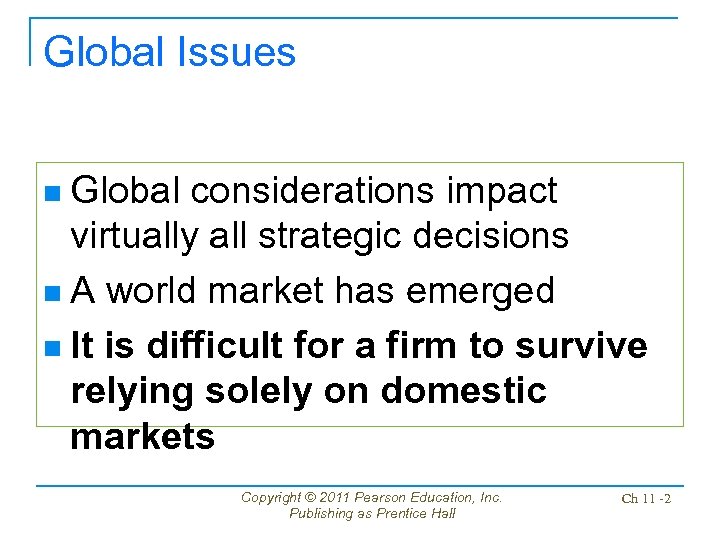
Global Issues Global considerations impact virtually all strategic decisions n A world market has emerged n It is difficult for a firm to survive relying solely on domestic markets n Copyright © 2011 Pearson Education, Inc. Publishing as Prentice Hall Ch 11 -2
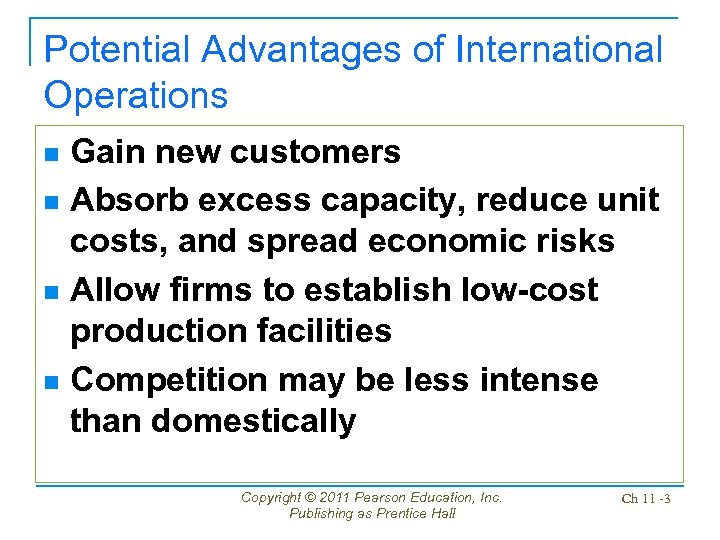
Potential Advantages of International Operations Gain new customers n Absorb excess capacity, reduce unit costs, and spread economic risks n Allow firms to establish low-cost production facilities n Competition may be less intense than domestically n Copyright © 2011 Pearson Education, Inc. Publishing as Prentice Hall Ch 11 -3
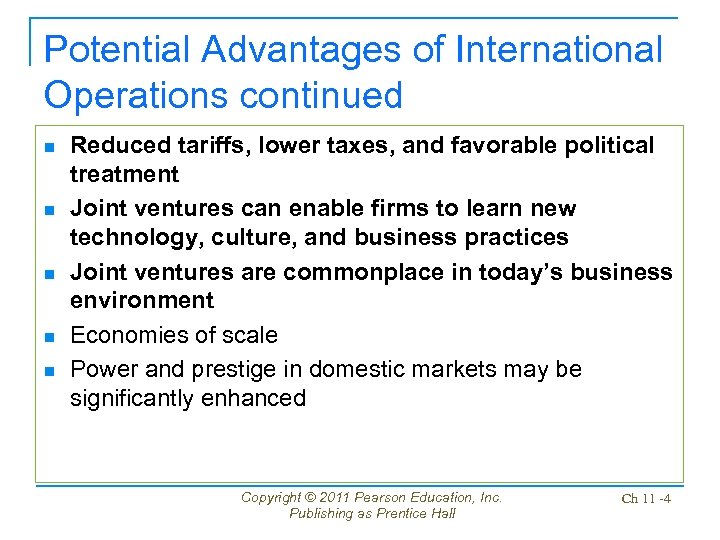
Potential Advantages of International Operations continued n n n Reduced tariffs, lower taxes, and favorable political treatment Joint ventures can enable firms to learn new technology, culture, and business practices Joint ventures are commonplace in today’s business environment Economies of scale Power and prestige in domestic markets may be significantly enhanced Copyright © 2011 Pearson Education, Inc. Publishing as Prentice Hall Ch 11 -4
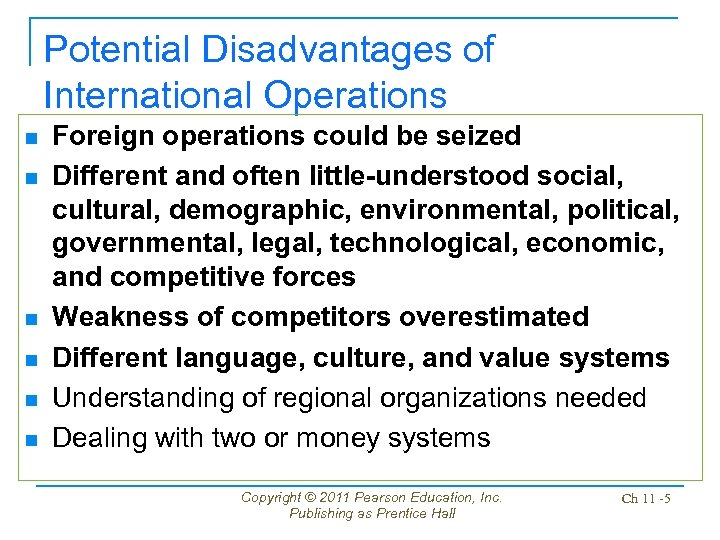
Potential Disadvantages of International Operations n n n Foreign operations could be seized Different and often little-understood social, cultural, demographic, environmental, political, governmental, legal, technological, economic, and competitive forces Weakness of competitors overestimated Different language, culture, and value systems Understanding of regional organizations needed Dealing with two or money systems Copyright © 2011 Pearson Education, Inc. Publishing as Prentice Hall Ch 11 -5

US Industry Challenged Abroad n n n Airline manufacturing Auto makers Tire manufacturers Clothing apparel Heavy Machinery Copyright © 2011 Pearson Education, Inc. Publishing as Prentice Hall Ch 11 -6
Changes in the Global Economy Corporations are obtaining customers globally n Markets are shifting rapidly and converging in tastes, trends, and prices n Innovative transport systems are accelerating transfer of technology n Nature and location of production systems are shifting n Copyright © 2011 Pearson Education, Inc. Publishing as Prentice Hall Ch 11 -7

Protectionism n Countries imposing tariffs, taxes, and regulations on firms outside the country to favor their own companies and people Copyright © 2011 Pearson Education, Inc. Publishing as Prentice Hall Ch 11 -8

Reasons for Global Expansion Advancements in telecommunications n Growth in demand for goods and services outside the U. S. is considerably higher than inside n 95% of the world's population lives outside the U. S. n Copyright © 2011 Pearson Education, Inc. Publishing as Prentice Hall Ch 11 -9
Globalization n Globalization: q n The process of doing business worldwide Global strategy includes considering global needs during q q q Design Production Marketing Copyright © 2011 Pearson Education, Inc. Publishing as Prentice Hall Ch 11 -10
A Weak Economy n Recession q Two consecutive quarters of a decline in real gross domestic product Many countries have recently experienced a recession n Unemployment rates are high across the U. S. and around the world n Copyright © 2011 Pearson Education, Inc. Publishing as Prentice Hall Ch 11 -11
Cultural Differences n n n n n Time Space Family roles Religious factors Family time Values Eating Rules of etiquette Importance of relationships Copyright © 2011 Pearson Education, Inc. Publishing as Prentice Hall Ch 11 -12

US Business Men and Women n Get the idea that rushing off to another meeting can prove to be a valuable day US place a great deal of value on time whereas many foreign businessmen and women place value on relationships Americans usually soften up an individual before criticizing them Copyright © 2011 Pearson Education, Inc. Publishing as Prentice Hall Ch 11 -13
European Business Cultures Participatory management n Most workers are unionized n More frequent vacations and holidays n Guaranteed permanent employment common n Workers often resent pay for performance, commissions, and objective measurement and reward systems n Copyright © 2011 Pearson Education, Inc. Publishing as Prentice Hall Ch 11 -14
Asian Business Cultures First names are not generally used in business n Extended periods of silence are important n A sale is the beginning, not the end of a relationship n Resting, listening, meditating, and thinking are considered productive n Copyright © 2011 Pearson Education, Inc. Publishing as Prentice Hall Ch 11 -15
Mexican Business Culture n n n Low tolerance for adversarial relations or friction at work Employers are paternalistic Workers do not expect self-expression or initiative at work Businesses stress collectivism, continuity, cooperation, belongingness, formality, and doing exactly what you are told Rarely entertain business associates at homes Copyright © 2011 Pearson Education, Inc. Publishing as Prentice Hall Ch 11 -16
Mexican Business Culture continued n n n Preserving one’s honor, saving face, and looking important are valued Opinions expressed by employees are often regarded as back talk Supervisors are viewed as weak if they explain the rationale for their orders to workers Mexicans often do not follow rules Life is slower in Mexico, tardiness is common Copyright © 2011 Pearson Education, Inc. Publishing as Prentice Hall Ch 11 -17
Japanese Business Culture n n n Importance of group loyalty and consensus called “Wa” Constant discussion and compromise Silence is a plus in formal meetings When confronted with disturbing questions, managers often remain silent Managers are reserved, quiet, distant, introspective, and other oriented Copyright © 2011 Pearson Education, Inc. Publishing as Prentice Hall Ch 11 -18
Communication Differences Across Cultures n n Italians, Germans, and French do not soften up executives with praise before a criticism Israelis are accustomed to fast paced meetings British executives complain that Americans chatter too much Europeans feel that they are being treated like children when asked to wear nametags Copyright © 2011 Pearson Education, Inc. Publishing as Prentice Hall Ch 11 -19
Communication Differences Across Cultures continued Executives in India are used to interrupting each other n In Malaysia and Japan periods of silence are appropriate, no silence is needed in Israel n “How was your weekend? ” is considered intrusive by many business people n Copyright © 2011 Pearson Education, Inc. Publishing as Prentice Hall Ch 11 -20
Worldwide Tax Rates n See Table 11. 3 Copyright © 2011 Pearson Education, Inc. Publishing as Prentice Hall Ch 11 -21
India Debt is 65. 53% of GDP (2013) n Gap between rich and poor widening n Middle class is growing n Copyright © 2011 Pearson Education, Inc. Publishing as Prentice Hall Ch 11 -22
Joint Ventures in India Joint ventures are mandatory foreign companies doing business in India n Foreign firms restricted to 74% ownership of India-based firms n Most joint ventures in India fail n Copyright © 2011 Pearson Education, Inc. Publishing as Prentice Hall Ch 11 -23
Скачать презентацию Global International Issues Sad but true U S businesspeople
313273f8f0f0b4c76819c72b8c7318a6.ppt