 Скачать презентацию GLOBAL HISTORY III CHATMAN ENLIGHTENMENT AIM WHO
850f5af5d960db59eed9a86acf7e9f64.ppt
- Количество слайдов: 78




GLOBAL HISTORY III CHATMAN
ENLIGHTENMENT AIM: WHO SHOULD RULE? • DO NOW (5 mins. ) – Is government a natural development? – How did government develop? – Where did the Enlightenment Philosophies look to understand the development?
• Government – Enlightenment/ Age of Reason Key Thinkers: a. Thomas Hobbes – people bad b. John Locke – people good c. Voltaire – meritocracy/equality before the law d. Rousseau- rejects reason, society corrupts people. Key Ideas: a. divine right b. force theory c. evolutionary theory d. social contract theory
Prior to the French Revolution Homework: Chapter 19 section 2 AIM: What challenges did France face before the Revolution? Do Now: Have you ever disobeyed your parents? What led you to challenge their authority? • What happened? What was France like in the 18 th Century? -
AIM: Why did the Ancient Regime fail? Do Now: What special privileges do seniors have that sophomores don’t? Is this fair? LA: Handout [French Peasants]
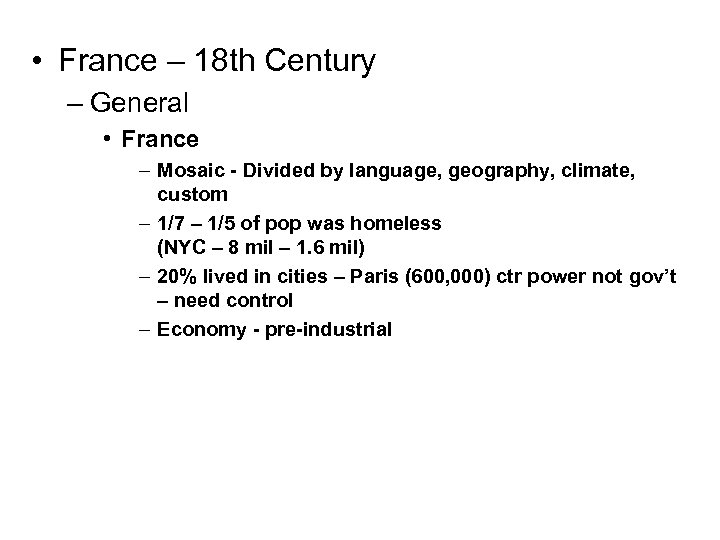
• France – 18 th Century – General • France – Mosaic - Divided by language, geography, climate, custom – 1/7 – 1/5 of pop was homeless (NYC – 8 mil – 1. 6 mil) – 20% lived in cities – Paris (600, 000) ctr power not gov’t – need control – Economy - pre-industrial
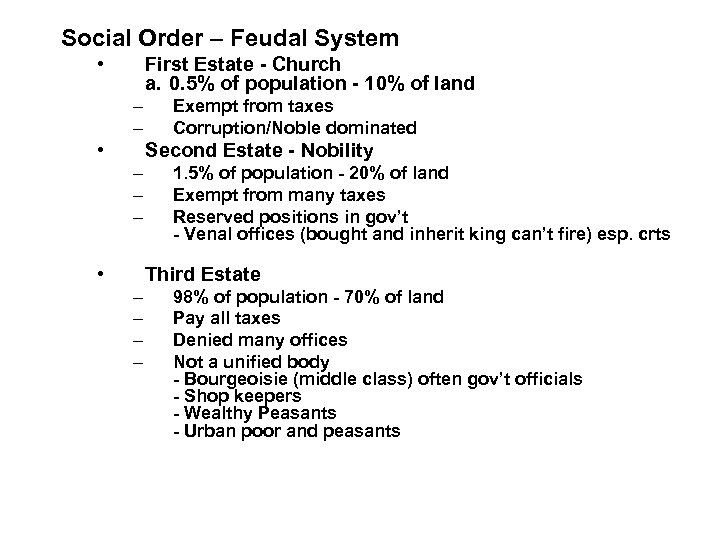
Social Order – Feudal System • First Estate - Church a. 0. 5% of population - 10% of land – – • Exempt from taxes Corruption/Noble dominated Second Estate - Nobility – – – • 1. 5% of population - 20% of land Exempt from many taxes Reserved positions in gov’t - Venal offices (bought and inherit king can’t fire) esp. crts Third Estate – – 98% of population - 70% of land Pay all taxes Denied many offices Not a unified body - Bourgeoisie (middle class) often gov’t officials - Shop keepers - Wealthy Peasants - Urban poor and peasants
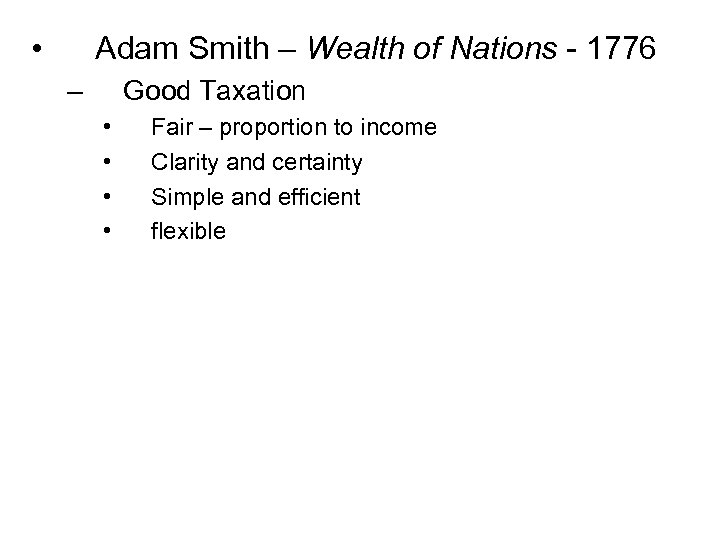
• Adam Smith – Wealth of Nations - 1776 – Good Taxation • • Fair – proportion to income Clarity and certainty Simple and efficient flexible
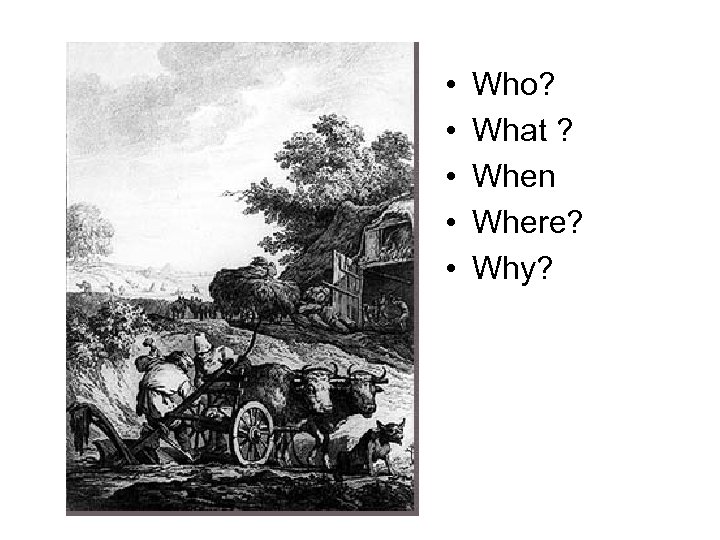
• • • Who? What ? When Where? Why?
“Two Peasants Repairing a Cart" This image of peasants repairing a cart demonstrates both the hard work done by cultivators and their fragile economic situation, which could easily be imperiled by a broken cart. Under such circumstances, poor people constantly repaired durable and personal goods, such as carts or clothing, because they could not afford to replace them with new ones.
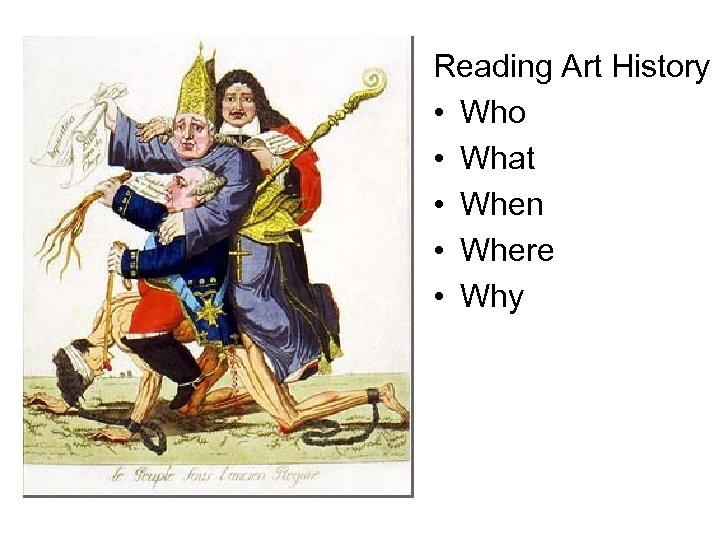
Reading Art History • Who • What • When • Where • Why
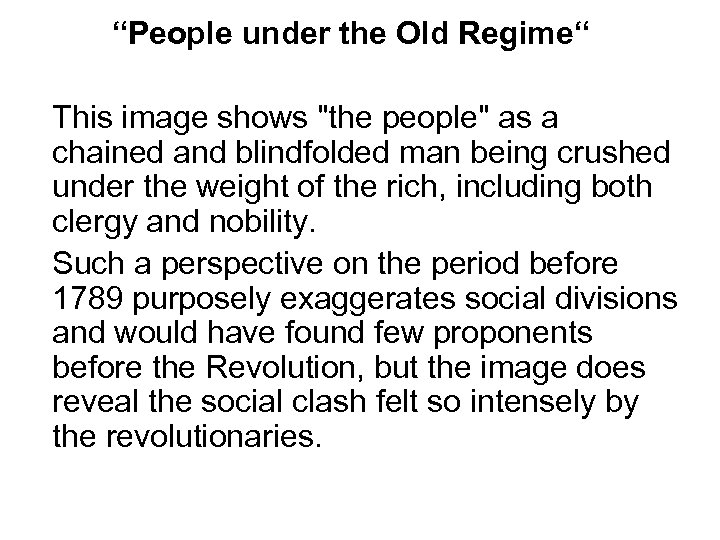
“People under the Old Regime“ This image shows "the people" as a chained and blindfolded man being crushed under the weight of the rich, including both clergy and nobility. Such a perspective on the period before 1789 purposely exaggerates social divisions and would have found few proponents before the Revolution, but the image does reveal the social clash felt so intensely by the revolutionaries.
National Assembly • AIM: How did the National Assembly try to change France? • Do Now: If you could change anything about Bronx Science, what would it be? What problems would you face in making these changes? • Key Ideas: National Assembly brings about reform and a new government to France.
Early Reforms: Estates General – May 1789 – The Cahiers • Lists of grievances from each Estate – – Exposed vast problems No easy solutions
– Voting Power • Each Estate given one vote – – – Third Estate has more people but less power Impossible to compromise Social order already breaking down National Assembly and Tennis Court Oath Seek a constitution Reforms – August 4 • Declaration of the Rights of Man – – – Equality before law Freedom of Speech Freedom of Religion Right to property Participation in government
Rights of Man vs Declaration of Independence • Do the French and US view rights the same? Are some more important? • How many rights are acknowledged? • What other provisions are included? • Which philosophies are represented in the document? • Which document guarantees more rights? • Which document would you rather have as the basis of your government?
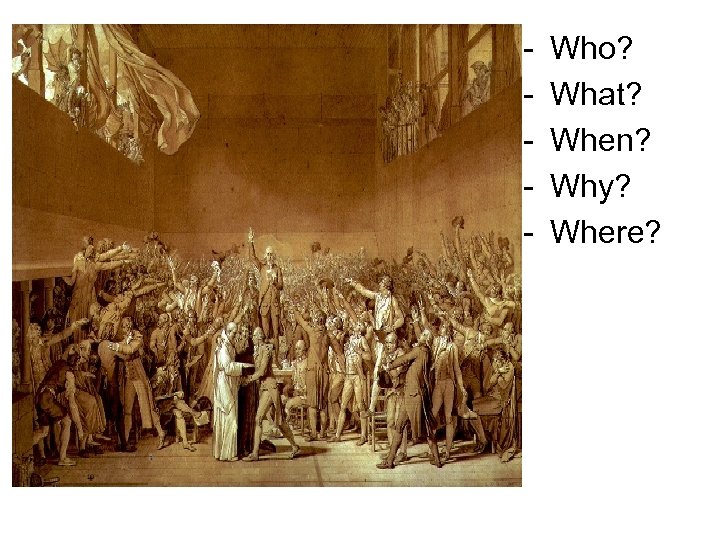
- Who? What? When? Why? Where?
National Assembly - 2 AIM: How did the National Assembly try to change France? DO NOW: Handout: Painting Key Ideas: National Assembly brings about reform and a new government to France.
9/22/09 HW: Chapter 19 section 4 DO NOW: Why is there so much violence on television? AIM: How does the radical phase of the revolution lead to the downfall of the monarchy? Pivotal Questions: (15 mins) 1. Why did radicals abolish the monarchy? 2. How did the excesses of the Convention lead to the Directory? 3. What impact did the Revolution have on women and daily life? Learning Activity: (15 mins) Read Robespierre: 1. What does Robespierre means when he argues that terror flows from virtue? 2. How does the use of terror relates to the essence of the revolution? 3. How this speech might be interpreted as an Enlightenment attack on the Ancien Regime carried to its logical conclusion?
9/23/09 HW: Chapter 19 section 5 DO NOW (5 mins): Do good military leaders make good political leaders? Explain. AIM: How did Napoleon rise to power and build a vast empire that included much of Europe? Pivotal Questions: (15 mins) 1. How did Napoleon rise to power? 2. How were revolutionary reforms changed under Napoleon? 3. How did Napoleon build an empire in Europe? Learning Activity: (15 mins) Read Robespierre: 1. What does Robespierre means when he argues that terror flows from virtue? 2. How does the use of terror relates to the essence of the revolution? 3. How this speech might be interpreted as an Enlightenment attack on the Ancien Regime carried to its logical conclusion?
9/24/09 HW: Chapter 20 section 1 due Tuesday (TEST WEDNESDAY) DO NOW (3 mins): What are the characteristics of a dictator? Examples. AIM: How did Napoleon dominate Europe? Pivotal Questions: (15 mins) 1. What were the social, political and economic conditions that allowed for Napoleon to rise to power? 2. What is nationalism? What were the causes and effects? 3. Compare and Contrast France’s geography before and after the Napoleonic war? Learning Activity: (15 mins) Read Napoleon’s Memoir: • Why was Napoleon appealing to the French? What means did Napoleon use to secure his power? • Is it reasonable for Napoleon to have Fouche’ carry out these activities?
9/24/09 HW: Chapter 21 section 1 -2 due NEXT THURSDAY (TEST WEDNESDAY) DO NOW (3 mins): What words are associated with a “hero”? What people are considered to be heroes? AIM: Napoleon Hero or Villain? Pivotal Questions: (10 mins) 1. What are some examples of Napoleon’s strong leadership? 2. What are some examples of Napoleon’s weak leadership? 3. Did he betray the revolution or did he solidify the transformation of France? Learning Activity: (15 mins) Group Discussion: • Read Handout: Should Napoleon be viewed as a hero or villain? (handout)
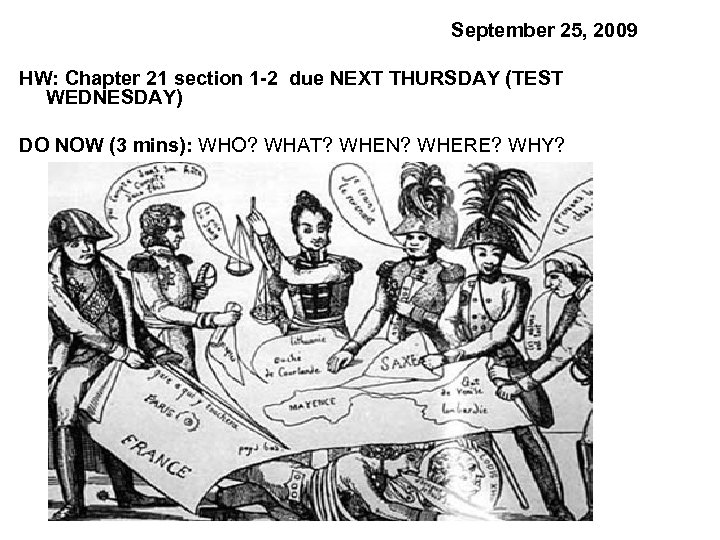
September 25, 2009 HW: Chapter 21 section 1 -2 due NEXT THURSDAY (TEST WEDNESDAY) DO NOW (3 mins): WHO? WHAT? WHEN? WHERE? WHY?
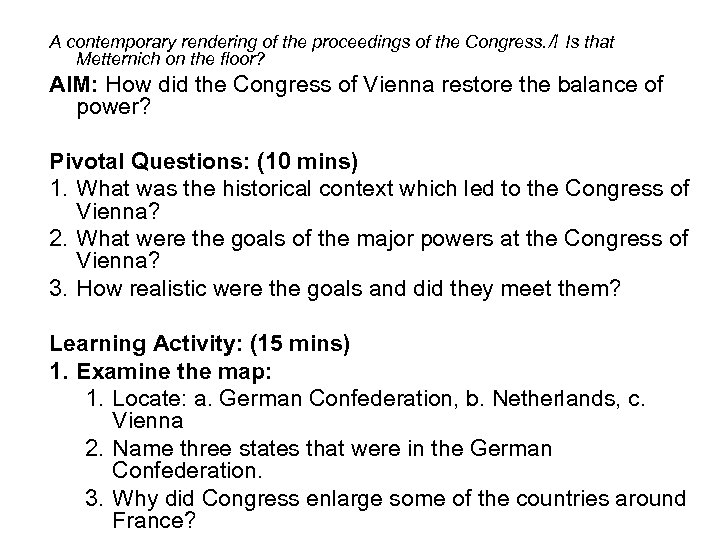
A contemporary rendering of the proceedings of the Congress. ハ Is that Metternich on the floor? AIM: How did the Congress of Vienna restore the balance of power? Pivotal Questions: (10 mins) 1. What was the historical context which led to the Congress of Vienna? 2. What were the goals of the major powers at the Congress of Vienna? 3. How realistic were the goals and did they meet them? Learning Activity: (15 mins) 1. Examine the map: 1. Locate: a. German Confederation, b. Netherlands, c. Vienna 2. Name three states that were in the German Confederation. 3. Why did Congress enlarge some of the countries around France?
September 29, 2009 AIM: How do we write a document-based essay regarding the French Revolution? DN: Examine the graph of the French Revolution. Who, What, When, Where, And Why? PQ: 1. How to write an essay based on the social, political, and economic conditions that led to the French Revolutions? 2. How does the outcome of the French Revolution effect future societies? LA: 1. Handout of DBQ essay on the French Revolution and Ms Chatman’s 3 on 3 essay. 2. Complete the chart.
Liberalism vs Conservatism October 1, 2009 HW: Complete Chapter 21 Section 2 -3 DN: Quiz DN 2: What limits should there be on freedom of speech? AIM: Why did nationalism develop in Europe? Pivotal Questions: 1. How did conservative success in the Congress of Vienna effect nationalist and liberal movements throughout Europe? 2. What were the perspectives of liberals and nationalists and how did they emerge? Learning Activity: 1. What ideologies are described in Chapter 21 section 1? 2. How did the competing ideologies contributed to unrest in Europe after 1815?
Revolutions of 1830 -1848 October 2, 2009 HW: Chapter 21 section 1 -3 due Monday; TEST on Monday ; & due Wednesday Chapter 20 Sections 1 -4 DN: Quiz DN 2: “We are sleeping on a volcano” Alexis de Tocqueville AIM: Why did Europe experience revolutions after the Congress of Vienna? Pivotal Questions: 1. What were the conditions in Europe after the Congress of Vienna? 2. What type of people led these revolutions and why? 3. Should European rulers had granted more autonomy to their citizens? Learning Activity: Read Les Miserables and answer questions Watch video of Les Miserables
October 6, 2009 HW: Begin Chapter 20 sections 1 -4 AIM: Why did revolution in Haiti occur? Pivotal Questions: 1. Why did Haiti seek independence from France? 2. Who led the Haitian Revolution and what were their goals? 3. What were the outcomes of the revolution in Haiti? Learning Activity: Read Toussaint L’Overtures Application: Restavak Foundation - CNN Video
October 8, 2009 Latin American Revolutions HW: Create a chart including the geographical, social, political, and economic demographics for each country in Latin America. Complete the handout: “Why Latin America Wanted Independence” AIM: What were the problems with Latin American’s Social Hierarchy? Pivotal Questions: 1. What events and conditions kept the social hierarchy in Latin America in place? 2. Which economic and political forces motivated revolt in Latin America? 3. How did the ideas and events in Europe effect the independence movements in Latin America? Learning Activity: 1. Map Skills - Color and Identify Locations in Latin America 2. Complete handout Applications:
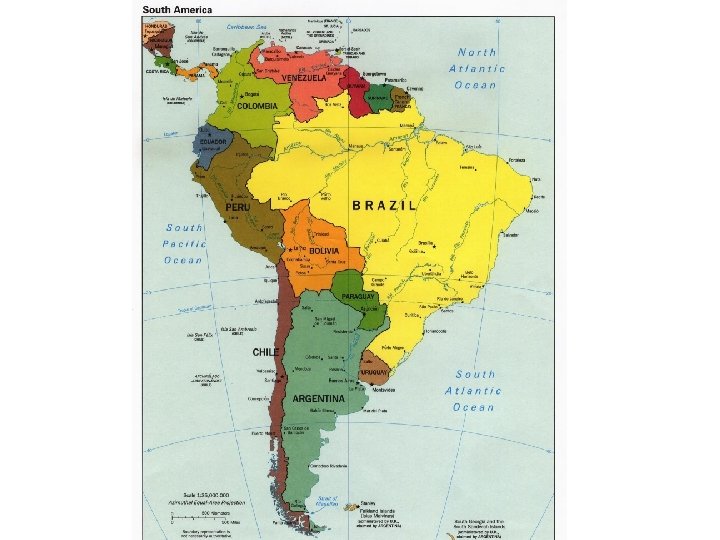
Latin American Revolutions October 8, 2009 HW: Complete Chapter 20 section 1 due Friday; Complete Chapter 20 section 2 -4 due Tuesday Due Tuesday: Create a chart including the geographical, social, political, and economic demographics for each country in Latin America. AIM: What were the problems with Latin American’s Social Hierarchy? Pivotal Questions: 1. What caused discontent in Latin America? 2. How did Mexicans and people in Central America win independence? 3. How did the nations of South America win independence? Learning Activity: Read Miguel Hidalgo’s “Decree of Hidalgo” and Simon Bolivar: Address to the Congress of Venezuela Applications:
Dawn of the Industrial Age October 9, 2009 HW: Complete Chapter 20 section 2 -4 due Tuesday Due Tuesday: Create a chart including the geographical, social, political, and economic demographics for each country in Latin America. DN: What have you recalled about what we have learned about the French & Latin American Revolutions? How do these revolutions effect society and politics? Write 3 descriptions of how the revolutions affected society and politics? AIM: How did the Agricultural Revolution change European Life? Pivotal Questions: 1. What were the causes of the Agricultural Revolution? 2. How did new technology trigger a new industrial revolution? 3. How did improvements in agriculture affect population?
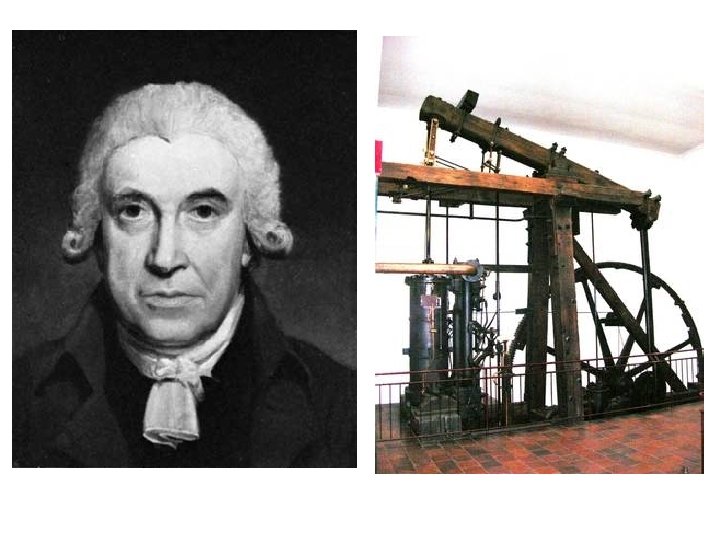
October 13, 2009 Chapter 20 Section 2: Britain Leads the Way HW: Turn in homework DO NOW (3 mins): QUIZ AIM: Why was there an Industrial Revolution in England? Pivotal Questions: (10 mins) 1. Why did the Industrial Revolution begin in England? 2. How did technology change the textile industry? 3. How did transportation advance the Industrial Revolution? Learning Activity: (15 mins) Urban Game Primary Source Activity: Riding the Liverpool-Manchester Line
October 14, 2009 Chapter 20 Section 3: Hardships of Early Industrial Life HW: Notebook Check on Friday and Participation Grade TEST Monday!!! DO NOW (3 mins): QUIZ AIM: How did the Industrial Revolution affect society? Pivotal Questions: (10 mins) 1. Why were people drawn to the city? 2. How did living conditions in cities differ from those in the countryside? 3. How did the factory system effect the working class? Learning Activity: (15 mins) Urban Game Primary Source Activity: The Sadler Committee Parliamentary Investigation, 1832 Application: Writing About Child Labor
October 15, 2009 Chapter 20 Section 4: New Ways of Thinking HW: Chapter 20 Test on Monday and Notebook and Participation due on Friday DO NOW (3 mins): QUIZ AIM: How did the Industrial Revolution change economic thought? Pivotal Questions: (10 mins) 1. How did people conduct business before the use of money? 2. How did economic systems change during the Industrial Revolution? 3. Evaluate the changes in the Industrial Revolution? Learning Activity: (15 mins) Urban Game Primary Source Activity:
October 16, 2009 Chapter 20: Understanding Socialism HW: Read and Outline Chapter 22 sections 1 -4: Life in the Industrial Age/ Test on Monday DO NOW (3 mins): Turn-in Notebooks AIM: How did socialism address the evils of industrialism? Pivotal Questions: (10 mins) 1. What were the characteristics of life during the Industrial Revolution? 2. How did different (Utopia, Karl Marx, ) groups deal with the evils of industrialization? Learning Activity: (15 mins)
Chapter 20: Section 4 New Ways of Thinking HW: Chapter 22 section 1 due Friday 10/23 / due Monday 10/26 Essay and Chapter 22 section 2, then Tuesday 10/27 sections 3 & 4 DN: What is classicism? AIM: How did Marx’s theories of class struggle change the peoples’ perspective? Pivotal Questions : 1. Who is Karl Marx? 2. Who is Engels? 3. How did industrialization motivate the political and economic ideas presented in the work of Marx and Engels? 4. What is class? What is class struggle and what are the implications thereof? 5. How has this changed your ideas about the differences between capitalism and communism? Learning Activity: (15 minutes) Read Karl Marx and answer the pivotal questions APPLICATION: (5 minutes)
Chapter 22: Section 1 The Industrial Revolution Spreads HW: Due Monday 10/26 Essay and Chapter 22 section 2, then Tuesday 10/27 sections 3 & 4 DN: Quiz AIM: Why did capitalism and industrialization spread? Mini-Lesson: How to take notes for Global History Course on the spread of the Second Industrial Revolution? Pivotal Questions : 1. Why did certain industrial powers emerge in the 1800 s? 2. How did new technology affect industry, transportation and communication? 3. How did big business emerge in the late 1800 s? Learning Activity: (15 minutes) Ford Model T - Video Economics and Technology: Based on the video, what words would you use to describe working on an assembly line? Charlie Chaplin - “Modern Times” APPLICATION: (5 minutes) Examine the political cartoon: Do you think this cartoonist favored or opposed
Chapter 22: Section 2 The World of Cities HW: DN: Quiz AIM: How does the second Industrial Revolution increase urbanization? Pivotal Questions : 1. What was the medical impact of medical advances in the 1800 s? 2. How had cities change by 1900 s? 3. How did working class struggles lead to improved conditions for workers? Learning Activity: (15 minutes) Examine video about Florence Nightingale: How did Nightingale achieve reforms in British Army hospitals? How did these changes affect the urbanization in urban centers? APPLICATION: (5 minutes) Complete the Cause and Effect Chart about the 2 nd Industrialization. Utilize your notes…
Theme: Economics and Technology: Do you think this cartoonist favored or opposed government regulation of business? Explain.
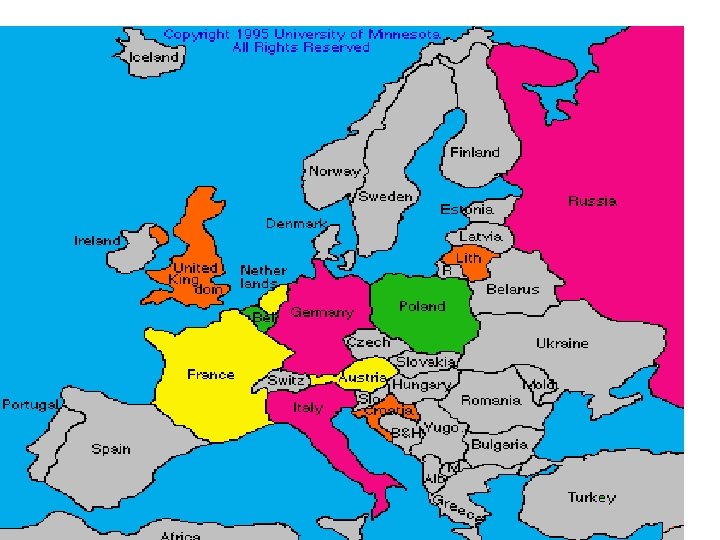
November 2, 2009 HW: Complete Chapter 23 section 1 and 2 AIM: How did Germany unify between 1865 -1871? DN: Quiz Pivotal Questions 1. What is the location of Prussia, Silesia, Vaaria, and Schlesig on the map? 2. What area did Prussia annex to its territory? 3. Why do you think Austrian influence was greater among the southern German states than among the northern ones? Learning Activity: Students will decorate the map of Europe. Application: Create an illustrated map and time line of the unification of Germany.
November 4, 2009 HW: Complete Chapter 23 section 2 AIM: How did Otto von Bismarck, the chancellor of Prussia, lead the drive for Germany unity? DN: Quiz Pivotal Questions 1. What early changes promoted Germany unity? 2. How did Bismarck unify Germany? 3. What was the basic political organization of the new German empire? Learning Activity: Read: Alphonse Daudet “The Last Lesson” then answer the questions Application: What does this story reveal about the times and characters of people during the building of a German nation?
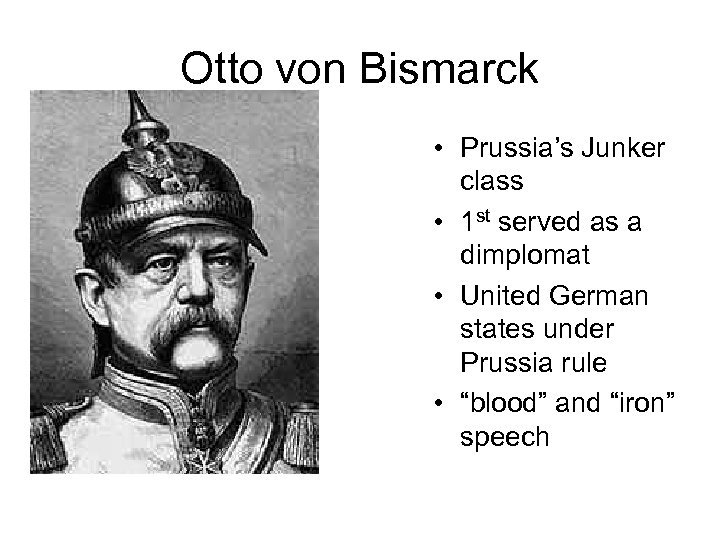
Otto von Bismarck • Prussia’s Junker class • 1 st served as a dimplomat • United German states under Prussia rule • “blood” and “iron” speech
November 5, 2009 HW: Complete Chapter 23 section 3 AIM: How did Germany increase its power by building up its industry and armed forces? DN: Quiz : Explain the meaning the following of Bismarck’s aphorisms*: “When you want to fool the world, tell the truth” “Universal suffrage is the government of a house by its nursery” “People never lie so much as after a hunt, during a war, or before an election” Pivotal Questions 1. What marked Germany as an industrial giant? 2. Why was Bismarck called the Iron Chancellor? 3. What policies did Kaiser William I follow? Learning Activity: ACTIVELY READ: “Speeches on Pragmatism and State Socialism” by Otto von Bismarck Application: • How does Bismarck justify his support of “socialist” policies? • Why would Bismarck support such policies?
November 6, 2009 HW: Complete Chapter 23 section 4 AIM: How did influential leaders help create a unified Italy? DN: Quiz Pivotal Questions 1. How do the circumstances in Italy differ from Germany? 2. What roles did Count Camilo Cavour and Giuseppe Garibaldi play in the struggle for Italy? 3. Should Italy be unified? Learning Activity: ACTIVELY READ: “The Duties of Man” by Giusepe Mazzini Application: • Why does Mazzini’s nationalistic ideas appeal to the Italian working class? • Why might Bismarck approve or disapprove of these ideals?
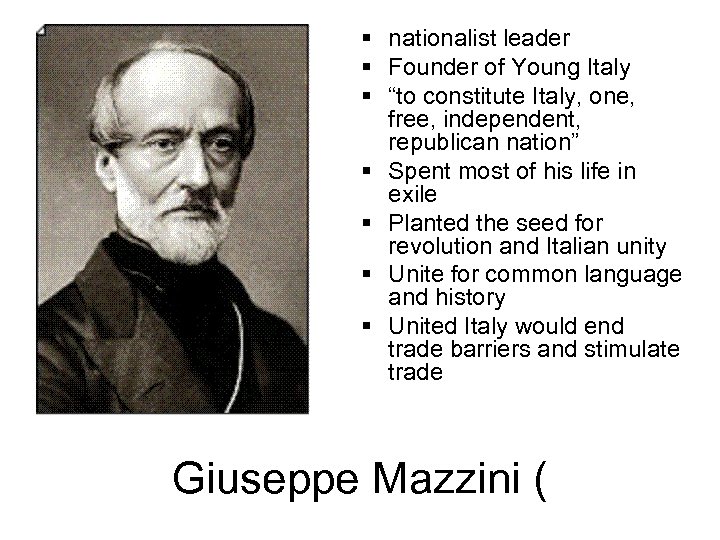
§ nationalist leader § Founder of Young Italy § “to constitute Italy, one, free, independent, republican nation” § Spent most of his life in exile § Planted the seed for revolution and Italian unity § Unite for common language and history § United Italy would end trade barriers and stimulate trade Giuseppe Mazzini (
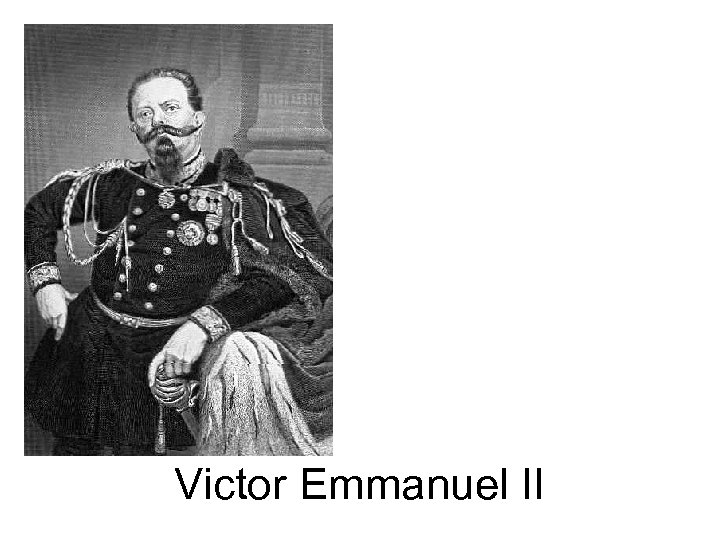
Victor Emmanuel II
November 9, 2009 HW: Complete Chapter 23 section 5 AIM: Can empires survive in a modern world? DN: Quiz Pivotal Questions 1. How did Balkan nationalism contribute to the decline of the Ottoman Empire? 2. How did Francis Joseph maintain power in Austria-Hungary? 3. Could the Hapsburgs or the Ottoman Turks could have built a modern, unified nation from their multinational empires? Learning Activity: 1. Divide into two groups Austrian and Ottoman Empire 2. In each group, outline the conditions that existed in their assigned empire during the mid-1800 s 3. Then compare the Austrian and Ottoman empires Application: • Which of the two empires faced the greatest difficulties and why?
November 10, 2009 HW: Complete Chapter 23 section 5 p. 586 -589 AIM: Why did modernization come to Russian more slowly? DN: Quiz Why do some people resist change? Explain the meaning of the following quote: “It is better to abolish serfdom from above than to wait until it will be abolished by a movement from below. ” Alexander II Pivotal Questions 1. What were the social issues in Russia that led to modernization? 2. What were the economic issues in Russia that led to modernization? 3. What were the political changes in Russia? Learning Activity: ACTIVELY READ: “A Report for Tsar Nicholas II” 1. What is the author’s argument (thesis)? 2. What evidence support’s the author’s thesis? 3. Were you able to make any CONNECTIONS? 4. What information did you TRACK that was important in the reading? Application: • What assessment did Sergei Witte make of the economic position of Russia in relation to the major states of western Europe and to the United States? • What, according to Witte, did Russia lack in comparison with the economically developed countries? • What measures did Witte propose in order to create a Russian “national industry”?
November 10, 2009 HW: Begin Chapter 24 section 1 -4 (scaffold- see website) and Test on 11/18 AIM: How does Russia react? DN: Quiz What is the difference between reacting and responding to a situation? Pivotal Questions 1. Who was George Gapon? 2. How did the desire for change influence Russians to revolt? 3. Did Alexander II react or respond to the “Bloody Sunday” Revolt? Learning Activity: ACTIVELY READ: “The Revolution of 1905” George Gapon and Ivan Vasimov 1. What is the author’s argument (thesis)? 2. What evidence support’s the author’s thesis? 3. Were you able to make any CONNECTIONS? 4. What information did you TRACK that was important in the reading? Application:
November 13, 2009 HW: Begin Chapter 24 section 1 -4 (scaffold- see website) and Test on 11/18 AIM: How is nationalism expressed through art? DN: How has music been an expression of nationalism? Give 3 Examples Pivotal Questions 1. What is nationalism? 2. How does artistic expression (opera) create a unified Italy, Germany and Russia? 2. How did artistic expression influence or change the culture of Eastern Europe? 3. What effects does censorship have on the work of artists, writers, and musicians? Learning Activity: ACTIVELY READ: Biography “Guisseppe Verdi” Application: Examine Verdi’s Opera
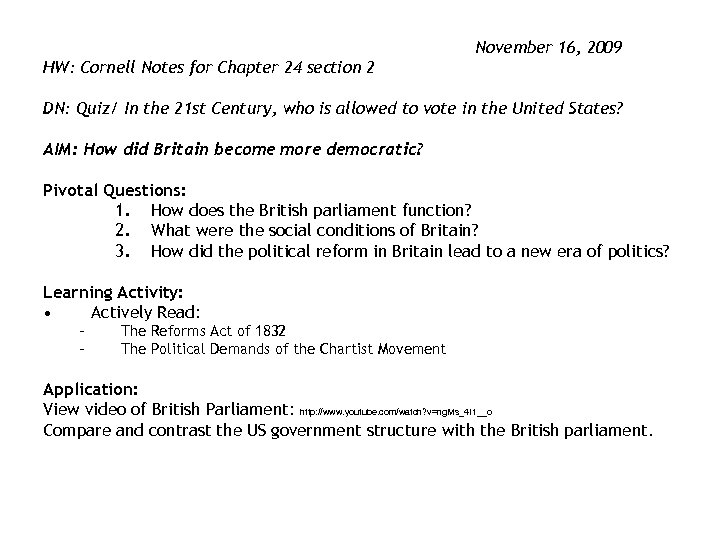
November 16, 2009 HW: Cornell Notes for Chapter 24 section 2 DN: Quiz/ In the 21 st Century, who is allowed to vote in the United States? AIM: How did Britain become more democratic? Pivotal Questions: 1. How does the British parliament function? 2. What were the social conditions of Britain? 3. How did the political reform in Britain lead to a new era of politics? Learning Activity: • Actively Read: – – The Reforms Act of 1832 The Political Demands of the Chartist Movement Application: View video of British Parliament: http: //www. youtube. com/watch? v=ng. Ms_4 I 1__o Compare and contrast the US government structure with the British parliament.
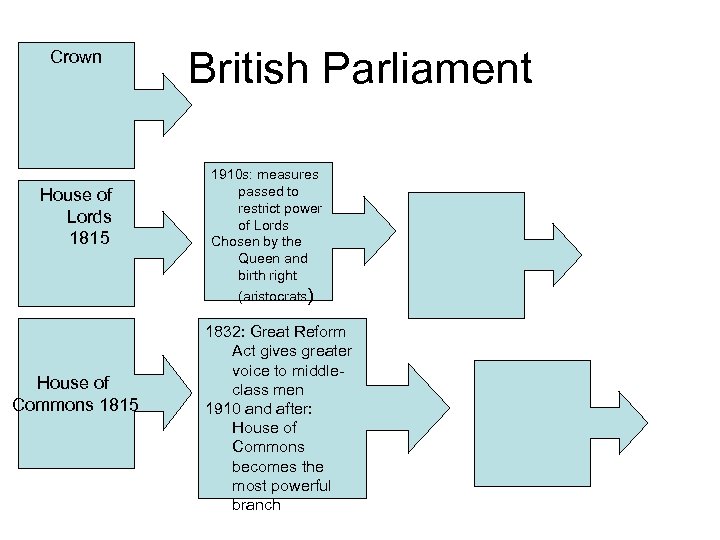
Crown House of Lords 1815 House of Commons 1815 British Parliament 1910 s: measures passed to restrict power of Lords Chosen by the Queen and birth right (aristocrats) 1832: Great Reform Act gives greater voice to middleclass men 1910 and after: House of Commons becomes the most powerful branch
Suffrage
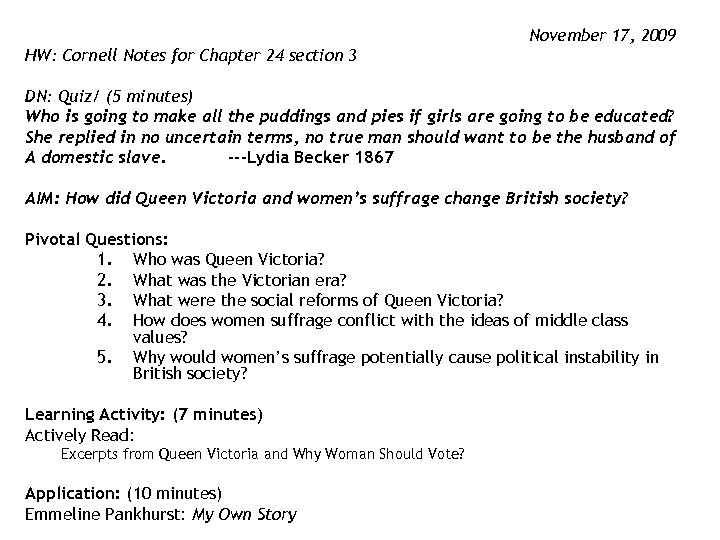
November 17, 2009 HW: Cornell Notes for Chapter 24 section 3 DN: Quiz/ (5 minutes) Who is going to make all the puddings and pies if girls are going to be educated? She replied in no uncertain terms, no true man should want to be the husband of A domestic slave. ---Lydia Becker 1867 AIM: How did Queen Victoria and women’s suffrage change British society? Pivotal Questions: 1. Who was Queen Victoria? 2. What was the Victorian era? 3. What were the social reforms of Queen Victoria? 4. How does women suffrage conflict with the ideas of middle class values? 5. Why would women’s suffrage potentially cause political instability in British society? Learning Activity: (7 minutes) Actively Read: Excerpts from Queen Victoria and Why Woman Should Vote? Application: (10 minutes) Emmeline Pankhurst: My Own Story
November 19, 2009 HW: Cornell Notes for Chapter 24 section 4 DN: Actively Read Quote then decide what should be the AIM? AIM: _____________________________? Pivotal Questions: 1. What was the political relationship of the Irish and British? 2. How did the British utilize the “potato blight” to benefit them economically and politically? 3. How did Daniel O’Connell and Irish nationalists struggle to gain selfindependence from Britain? 4. How did the Irish famine lead to emigration and death? Learning Activity: (7 minutes) Actively Read: O’Connell: “Ireland for the Irish” Application: (10 minutes) Video: Great Potato Famine
November 20, 2009 HW: Cornell Notes for Chapter 24 section 4 DN: Actively Read Quote then decide what should be the AIM? AIM: ___________________________? Pivotal Questions: 1. What were the domestic and foreign polices of Napoleon III? 2. How did challenges of the Third Republic impact France? Learning Activity: (7 minutes) Actively Read: Louis Napoleon Appeals to the People Application: (10 minutes)
November 23, 2009 HW: Cornell Notes for Chapter 24 section 4 DN: Actively Read Quote then decide what should be the AIM? AIM: ___________________________? Pivotal Questions: 1. 2. 3. Who was Alfred Dreyfus? What were the effects of the Dreyfus Affair? What solutions did Zionists propose for the problem of widespread anti-Semitism? Learning Activity: (7 minutes) Actively Read: Edouard Drumon, Jewish France Theodor Herzl: The Jewish State Application: (10 minutes)
HW: Cornell Notes for Chapter 25 section 1 due 11/30 DN: Quiz AIM: ___________________________? Pivotal Questions: 1. 2. 3. What was the significance of the French Revolution? How did the Industrial Revolution impact the world economy? How democratic were Western countries in the 1800 s? Learning Activity: (7 minutes) TABOO Application: (10 minutes) • Students divided into groups of 4 • Students will randomly choose a person to represent their group in each round
HW: Cornell Notes for Chapter 25 section 2 p. 621 -622 DN: Quiz AIM: ___________________________? Pivotal Questions: – – What is imperialism? What are the nationalistic views were expressed in Cecil Rhode’s “Confession of Faith”? What role did the concept of race-the English or Anglo-Saxon race-play in the arguments of Rhodes? According to Chamberlain, were the economic benefits of British expansion? Learning Activity: Complete Chart for Chapter 25 Section 1 Application: (10 minutes) • Pair with a partner to complete chart • Read excerpts on Imperialism: Identify the social, political, and economic issues in each excerpt
December 1, 2009 HW: Cornell Notes for Chapter 25 section 2 p. 623 -626 DN: Quiz : Based on your prior knowledge, create a list of the things you know about Africa? AIM: ___________________________? Pivotal Questions: 1. 2. 3. 4. What were the economic, social, and political forces that shaped Africa in the early 1800 s? How did Western powers gain more global territory in Africa? Why did European contact with Africa increase in the late 1800 s? What were the economic, social, and political forces that impacted Africa in the late 1800 s? Learning Activity: Complete Excerpts Application: (10 minutes) • Read King Leopold’s Heart of Darkness
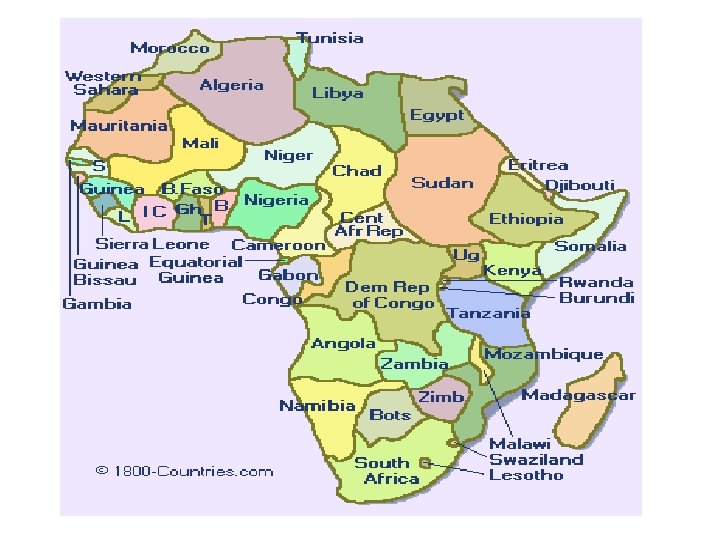
December 2, 2009 HW: Cornell Notes for Chapter 25 section 3 DN: Quiz : AIM: How did the Berlin Conference change Africa? Pivotal Questions: 1. How did European countries partition Africa at the Berlin Conference in 1884? 2. Why did European countries exclude African leaders? Learning Activity: Divide into groups to decide the territory that you desire in Africa Application: (10 minutes) • Scramble for Africa Activity
December 3, 2009 HW: Cornell Notes for Chapter 25 section 3 DN: Quiz : AIM: _______________________? Pivotal Questions: 1. How does Menelik justify Ethiopia’s revolt against imperialism? 2. How did Menelik preserve Ethiopian independence? 3. Why did Europeans criticize African imperialism? Learning Activity: Anti-imperialism handout Application: (10 minutes) • Video clip: The Discover Channel African Colonialism
December 4, 2009 HW: Cornell Notes for Chapter 25 section 4 DN: Quiz : AIM: _______________________? Pivotal Questions: 1. What were the social, economic, and political causes of the decline of the Ottoman Empire? 2. How did the decline of the Empire led to Armenian genocide by the Young Turks? 3. How was technology (Industrial Revolution) used to facilitate mass murders? 4. What were the effects of Genocide? Learning Activity: Armenian Handout Application: (10 minutes) Divide into groups of four
December 8, 2009 HW: Cornell Notes for Chapter 25 section 5 due 12/9 DN: Quiz : AIM: _______________________? Pivotal Questions: 1. How did the Sepoy rebellion change the attitude of Indians and Britians? 2. What were the social, political, and economic advantages of British rule in India? 3. What were the social, political, and economic disadvantages of British rule in India? Learning Activity: Debate at Indian National Congress 1885 Application: (10 minutes) Divide into groups of four
December 7, 2009 HW: Cornell Notes for Chapter 25 section 5 due 12/9 DN: Quiz : AIM: _______________________? Pivotal Questions: 1. Why did the British want to colonize India? 2. What were the social, political, and economic influences of Britain in India? 3. How does the Sepoy Rebellion reflect ideals of Imperialism? Learning Activity: Sepoy Rebellion Application: (10 minutes) Divide into groups of four
December 9, 2009 HW: Cornell Notes for Chapter 26 section 1 due 12/11 DN: Quiz : AIM: _____________________? Pivotal Questions: • • Why were the Europeans interested in Opening China? How did Europeans gain control of the China? How was the Nanjing Treaty an example of imperialism or social Darwinism? How was the Opium War linked to the industrial revolution? Learning Activity: Letter to Queen Victoria The Treaty of Nanjing, August 1842 Application: (10 minutes) Opium Wars
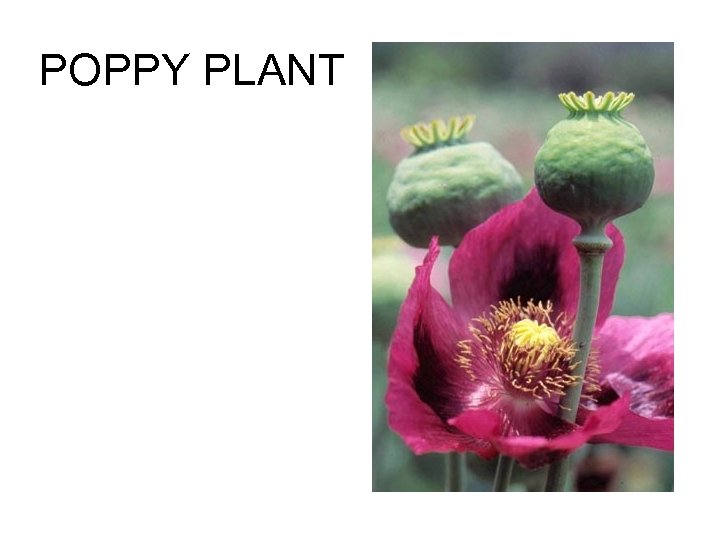
POPPY PLANT
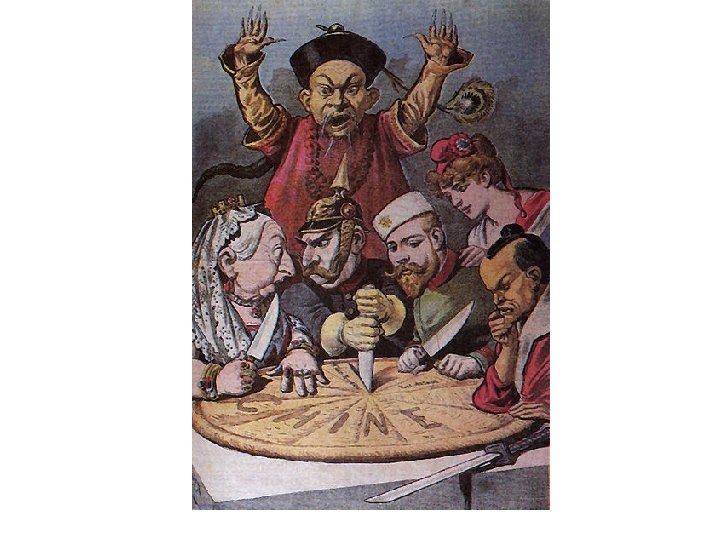
December 10, 2009 HW: Cornell Notes for Chapter 26 section 1 DN: Read quote on handout and answer question AIM: _______________________? Pivotal Questions: 1. 2. 3. 4. What was the Taiping Rebellion? How did the Reformers gain their needs and wants? What were the reformers methods? How did the Boxer Rebellion impact Chinese economically, politically, and socially? Learning Activity: Complete the 100 days of Reforms Application: (10 minutes) Watch video of the Opium War, Taiping Rebellion, and Boxer Rebellion
December 9, 2009 HW: Cornell Notes for Chapter 25 section 5 DN: Quiz : AIM: _______________________? Pivotal Questions: 1. Why did the British want to colonize India? 2. What were the social, political, and economic influences of Britain in India? 3. How does the Sepoy Rebellion reflect ideals of Imperialism? Learning Activity: Sepoy Rebellion Application: (10 minutes) Divide into groups of four
` HW: Cornell Notes for Chapter 26 section 1 December 11, 2009 DN: Read quote on handout and answer question AIM: _____________________? Pivotal Questions: 1. 2. How did the Boxer Rebellion impact Chinese economically, politically, and socially? How is the fall of the Qing Dynasty an example of imperialism? Learning Activity: Read answer DBQ and then complete chart Application: (10 minutes) Watch video of the Boxer Rebellion
December 14, 2009 HW: Cornell Notes for Chapter 26 section 2 Test & Notebook Check on December 21 st and 23 rd DN: Read answer question on handout AIM: __________________? Pivotal Questions: 1. 2. What led to the collapse of the Tokugawa Shogunate? How did Meiji reforms help Japan modernize? Learning Activity: Read answer DBQ and then complete chart Application: (10 minutes) http: //afe. easia. columbia. edu/at/tokugawa/tj 02. html
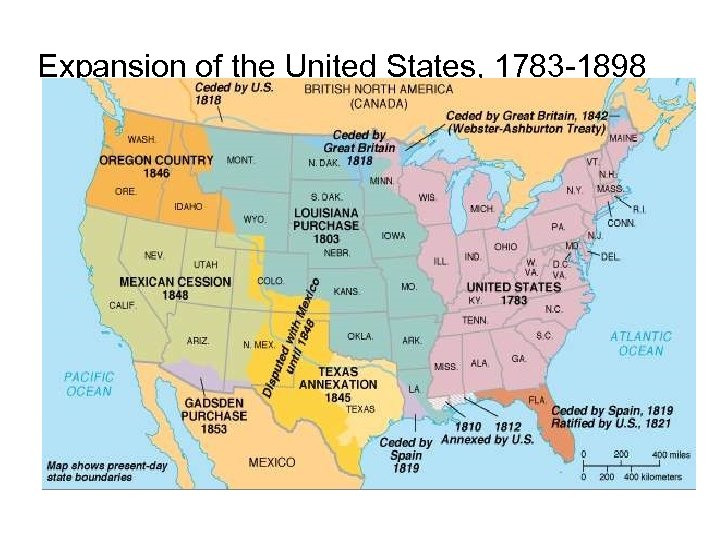
Expansion of the United States, 1783 -1898
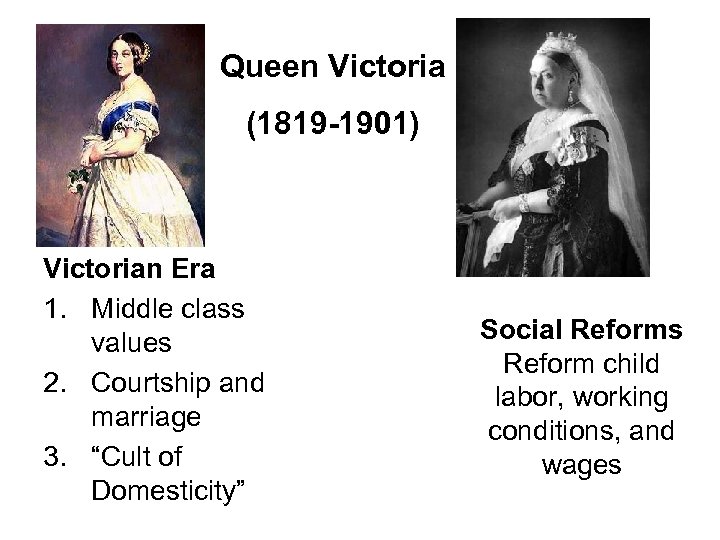
Queen Victoria (1819 -1901) Victorian Era 1. Middle class values 2. Courtship and marriage 3. “Cult of Domesticity” Social Reforms Reform child labor, working conditions, and wages
Скачать презентацию GLOBAL HISTORY III CHATMAN ENLIGHTENMENT AIM WHO
850f5af5d960db59eed9a86acf7e9f64.ppt