 Скачать презентацию Global Health-Malaria Stanita Jackson Ph D student Walden
5fcb1bc9b082cad914c3fefe987aafb7.ppt
- Количество слайдов: 25




Global Health-Malaria Stanita Jackson, Ph. D. student Walden University PUBH 8165 -10 Dr. Robert Marino Spring 2010
Content Significance to Audience Illustrations Life cycle Affected Population Statistical Data Distribution in Africa Prevention/Alternative Measures Contributing Organization Conclusion
Learning Outcomes Identify Malaria Describe signs/symptoms Know the infection rates of the targeted population Discuss the lifecycle Recognize ways to prevent from obtaining the disease. Obtain further information that can be valuable to learning more about Malaria in hopes of eradicating this disease.
What is Malaria & its Significance? “Malaria is a mosquito-borne disease caused by a parasite. People with malaria often experience fever, chills, and flu-like illness” (n. p. ). Left untreated, they may develop severe complications and die. Each year 350 -500 million cases of malaria occur worldwide, and over one million people die, most of them young children in sub-Saharan Africa. Centers for Disease Control & Prevention (2010). Retrieved on April 13, 2010 from: http: //www. cdc. gov/malaria
Target audience The audience targeted to discuss Malaria with are the citizens of Africa due to their endemic of this illness there. This group suffers from this disease with little or no help.
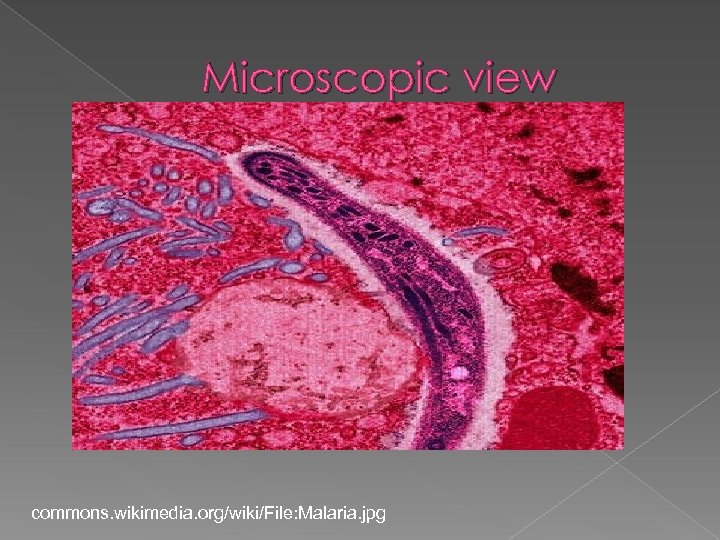
Microscopic view commons. wikimedia. org/wiki/File: Malaria. jpg
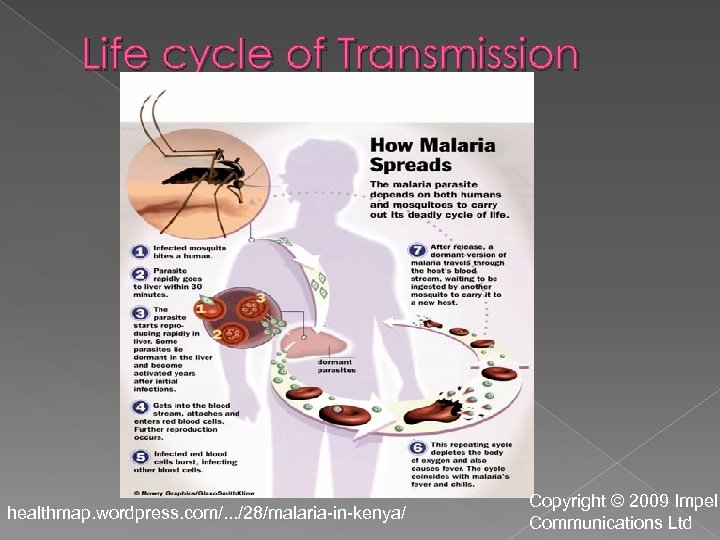
Life cycle of Transmission healthmap. wordpress. com/. . . /28/malaria-in-kenya/ Copyright © 2009 Impel Communications Ltd
Animated Video of Malaria http: //www. youtube. com/watch? v=iw. A Es. Opv. Hn 0 Copyright laws in depth: http: //www. youtube. com/t/dmca_polic y
Discussion of life cycle The Plasmodium parasite is transmitted by bites of the Anopheles female mosquito and then infects human targets infected the liver and red blood cells. There are four species of plasmodium parasite. The cycle continues and infects other human hosts. Symptoms usually appear within 10 -15 days of transmission with fever, headache, and vomiting occurring.
Population Affected Most foreign countries are affected by Malaria especially those people in Africa. “The vast majority of malaria deaths occur in Africa, south of the Sahara, where malaria also presents major obstacles to social and economic development. Malaria has been estimated to cost Africa more than US$ 12 billion every year in lost GDP, even though it could be controlled for a fraction of that sum” (n. p. ). Roll Back Malaria (2010). Retrieved on April 14, 2010 from: http: //www. rollbackmalaria. org/rbmvision. html
Statistics Globally there are nearly 300 million cases of Malaria. 90% of those deaths occur in Africa, mostly in young children. The disease kills more than one million children - 2, 800 per day - each year in Africa alone. In regions of intense transmission, 40% of toddlers may die of acute malaria.
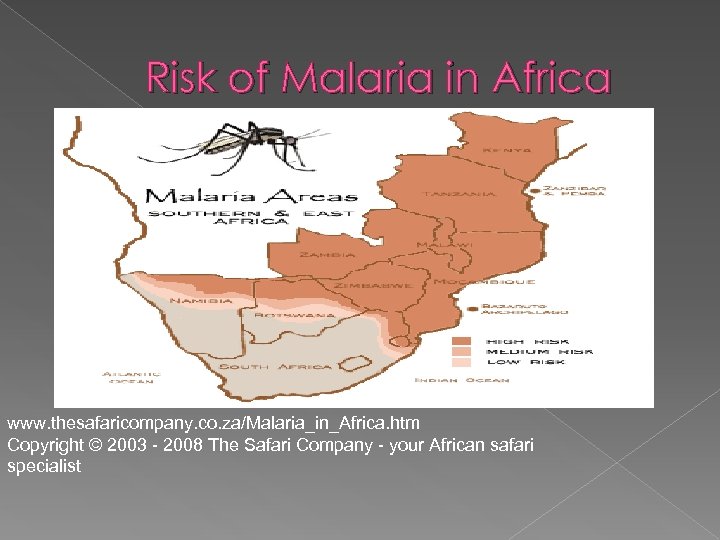
Risk of Malaria in Africa www. thesafaricompany. co. za/Malaria_in_Africa. htm Copyright © 2003 - 2008 The Safari Company - your African safari specialist
Preventative Measures If traveling to malaria infected areas take proper medications and procedures to reduce risk. Educating those in Africa on ways to protect themselves when in these infected areas by using nets and proper gear to avoid being bitten by mosquitoes. Insecticide spraying in homes with nontoxic chemicals.
CDC Tips to Prevent Malaria Use repellent Wear protective clothing Use netting http: //www. mayoclinic. com/health/malaria/DS 00475/DSECTION=prev ention
Contributing Organizations Blue Turtle Group has been trying to find credible alternative methods for controlling tropical and serious chronic diseases in the world. Demal 200 is a vaccine for malaria. It prompts the liver to expel malaria and immune systems forms antibodies. This drug is effective against all strands of malaria.
Contributing Organizations Cont’d Malaria Eradication Research Agenda (mal. ERA) purpose is to develop a multidisciplinary global research and development (R&D) agenda that can be actionable by research and public health agencies and sponsors. “In June 2008, World Vision launched a major initiative to reduce the illness and death caused by malaria. World Vision aims to contribute to a 75 percent reduction in malaria cases, with the end goal of nearly zero preventable malaria deaths by 2015” (n. p. ). End. Malaria (2010) Retrieved on April 13, 2010 from: http: //www. endmalaria. org/about. php
DDT & Malaria Control Dichlorodiphenyltrichloroethane is an insecticide used for malaria control in some countries, but contributes more to severe chronic illnesses. This toxic chemical is not worthy of being used due to its impact on human health. DDT kills mosquitoes, yet causes more issues with individuals when exposed.
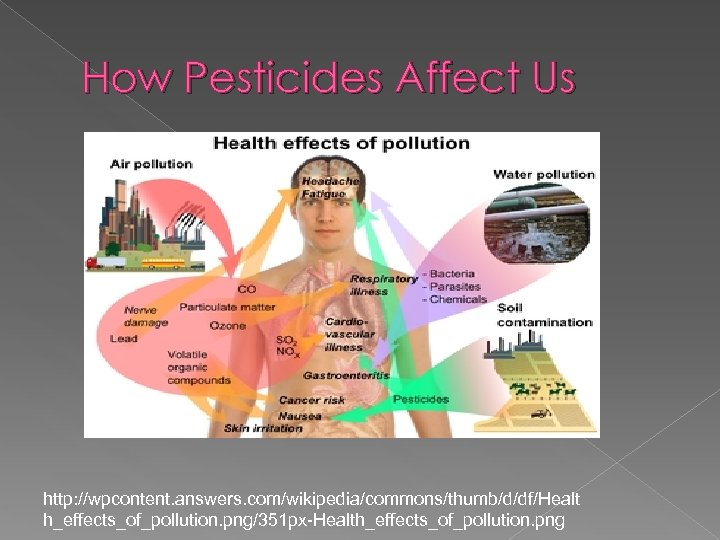
How Pesticides Affect Us http: //wpcontent. answers. com/wikipedia/commons/thumb/d/df/Healt h_effects_of_pollution. png/351 px-Health_effects_of_pollution. png
Alternative Measures Shorten the life span of adult Anopheles mosquitoes. Vector control methods: Indoor residual spraying (IRS) and Insecticide-treated bed nets (ITNs). They have been proven to have an impact on malaria burdens Education is key in preventing any public health issue or disease.
Conclusion Malaria is a serious life-threatening disease that’s leads to millions of deaths yearly. Let’s take a stand educate individual’s properly on this public health issue and eradicate this disease completely. The citizens of Africa need our assistance to help fight this battle. Public health officials save lives by prevention.
Public Health Officials www. jhsph. edu/. . . /archive/Mag_Spring 04/T © 2010, Johns Hopkins University. All rights reserved. Web policies, 615 N. Wolfe Street, Baltimore, MD 21205

Comments/Questions? ? ?
References Centers for Disease Control & Prevention (2010). Retrieved on April 13, 2010 from: http: //www. cdc. gov/malaria Blue Turtle Group (2010). Retrieved on April 13, 2010 from: http: //www. blueturtlegroup. com Global Health Delivery (2010). Retrieved on April 14, 2010 from: http: //www. globalhealthdelivery. org/tag /malaria
References Cont’d Roll Back Malaria (2010). Retrieved on April 14, 2010 from: http: //www. rollbackmalaria. org/rbmvisio n. html Malaria Eradication Research Agenda Retrieved on April 14, 2010 from: http: //malera. tropika. net/ End Malaria(2010). Retrieved on April 14, 2010 from: http: //www. endmalaria. org/about. php
Sources for Further Reading Blumberg, L. , & Frean , J. (2007). Malaria control in South-Africa - challenges and successes. SAMJ 2007, 97: 1193 -1197. Hopkins, H. , Kambale, W. , Kamya, M. R. , Staedke , S. D. , Dorsey , G. , & Rosenthal, P. J. (2007). Comparison of HRP 2 - and p. LDH-based rapid diagnostic tests for malaria with longitudinal follow-up in Kampala, Uganda. Am J Trop Med Hyg 2007, 76: 1092 -1097. Nosten F. , & White , N. J. (2007). Artemisinin-based combination treatment of falciparum malaria. Am J Trop Med Hyg 2007, 77: 181 -192. Mabaso M. L. H. , Sharp, B. L. , & Lengeler, C. (2004). Historical review of malaria control in southern Africa with emphasis on the use of indoor residual housespraying. Trop Med Int Health 2004, 9: 846 -856.
Скачать презентацию Global Health-Malaria Stanita Jackson Ph D student Walden
5fcb1bc9b082cad914c3fefe987aafb7.ppt