 Скачать презентацию Global Economic Crisis and the Health of the
8d328b21dbcf76611e0ade806eb5f0cf.ppt
- Количество слайдов: 45



Global Economic Crisis and the Health of the Region Closing Gaps Protecting achievements Facing new challenges Dr. Mirta Roses Periago Director Ottawa, Canada. Official Visit March 30 th – April 3 rd, 2009
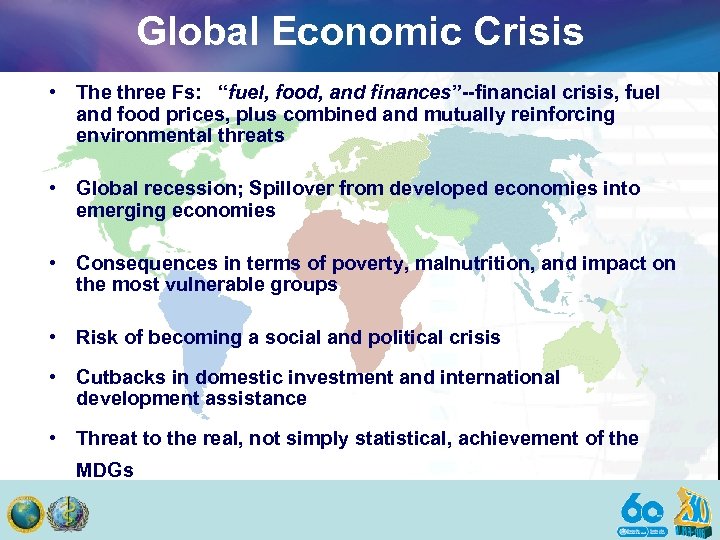
Global Economic Crisis • The three Fs: “fuel, food, and finances”--financial crisis, fuel and food prices, plus combined and mutually reinforcing environmental threats • Global recession; Spillover from developed economies into emerging economies • Consequences in terms of poverty, malnutrition, and impact on the most vulnerable groups • Risk of becoming a social and political crisis • Cutbacks in domestic investment and international development assistance • Threat to the real, not simply statistical, achievement of the MDGs
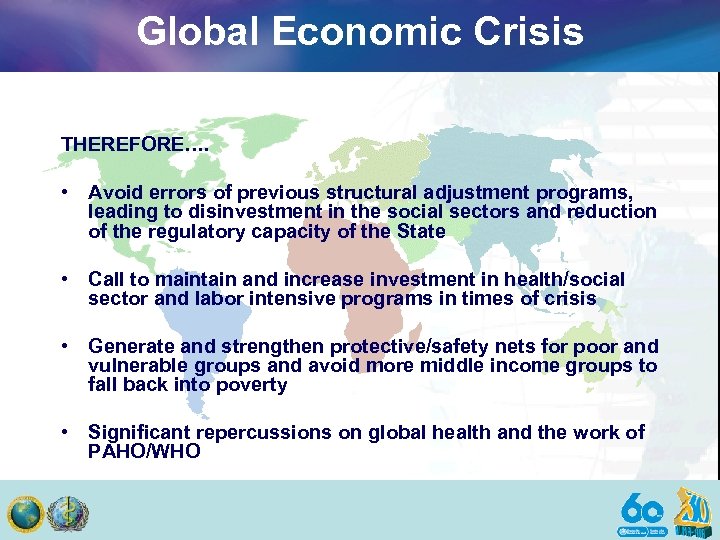
Global Economic Crisis THEREFORE…. • Avoid errors of previous structural adjustment programs, leading to disinvestment in the social sectors and reduction of the regulatory capacity of the State • Call to maintain and increase investment in health/social sector and labor intensive programs in times of crisis • Generate and strengthen protective/safety nets for poor and vulnerable groups and avoid more middle income groups to fall back into poverty • Significant repercussions on global health and the work of PAHO/WHO
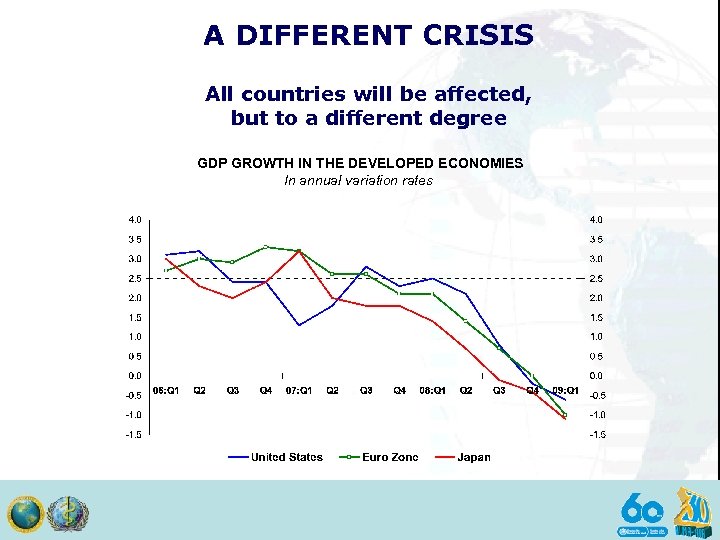
A DIFFERENT CRISIS All countries will be affected, but to a different degree GDP GROWTH IN THE DEVELOPED ECONOMIES In annual variation rates
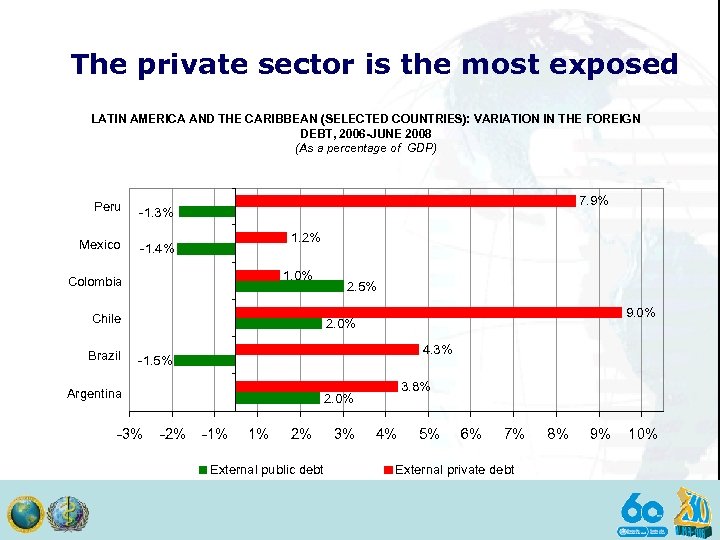
The private sector is the most exposed LATIN AMERICA AND THE CARIBBEAN (SELECTED COUNTRIES): VARIATION IN THE FOREIGN DEBT, 2006 -JUNE 2008 (As a percentage of GDP) Peru Mexico 7. 9% -1. 3% -1. 4% 1. 2% 1. 0% Colombia 2. 5% Chile Brazil 9. 0% 2. 0% 4. 3% -1. 5% Argentina -3% 3. 8% 2. 0% -2% -1% 1% 2% External public debt 3% 4% 5% 6% 7% External private debt 8% 9% 10%
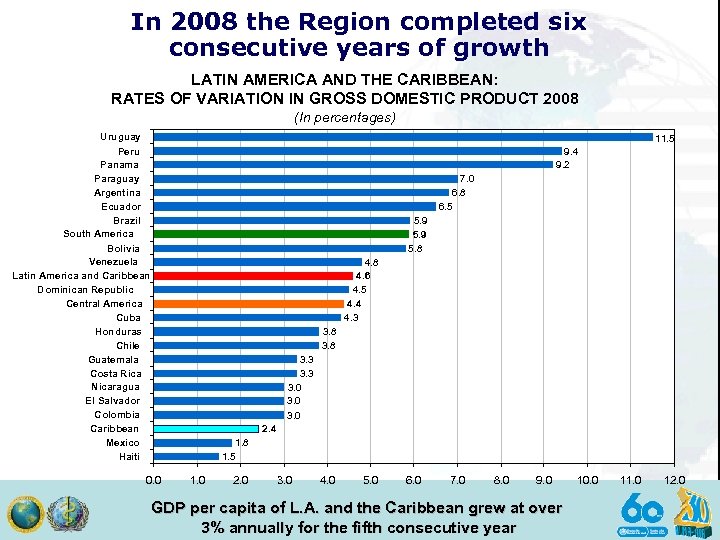
In 2008 the Region completed six consecutive years of growth LATIN AMERICA AND THE CARIBBEAN: RATES OF VARIATION IN GROSS DOMESTIC PRODUCT 2008 (In percentages) Uruguay Peru Panama Paraguay Argentina Ecuador Brazil South America Bolivia Venezuela Latin America and Caribbean Dominican Republic Central America Cuba Honduras Chile Guatemala Costa Rica Nicaragua El Salvador Colombia Caribbean Mexico Haiti 11. 5 9. 4 9. 2 7. 0 6. 8 6. 5 5. 9 5. 8 4. 6 4. 5 4. 4 4. 3 3. 8 3. 3 3. 0 2. 4 1. 8 1. 5 0. 0 1. 0 2. 0 3. 0 4. 0 5. 0 6. 0 7. 0 8. 0 9. 0 GDP per capita of L. A. and the Caribbean grew at over 3% annually for the fifth consecutive year 10. 0 11. 0 12. 0
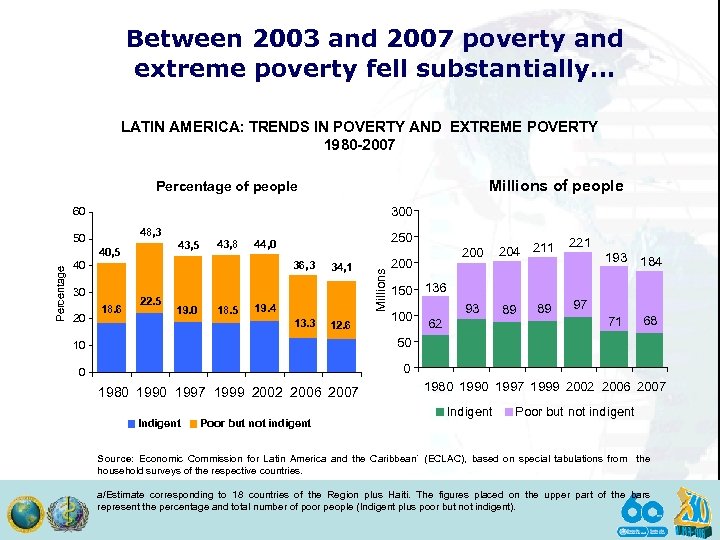
Between 2003 and 2007 poverty and extreme poverty fell substantially. . . LATIN AMERICA: TRENDS IN POVERTY AND EXTREME POVERTY 1980 -2007 Millions of people Percentage of people 300 60 43, 5 Percentage 40, 5 43, 8 40 36, 3 30 20 250 44, 0 18. 6 22. 5 19. 0 18. 5 34, 1 19. 4 13. 3 12. 6 Millions 48, 3 50 200 204 211 221 93 89 89 97 150 136 100 10 184 71 68 50 0 62 193 0 1980 1990 1997 1999 2002 2006 2007 Indigent Poor but not indigent Source: Economic Commission for Latin America and the Caribbean` (ECLAC), based on special tabulations from the household surveys of the respective countries. a/Estimate corresponding to 18 countries of the Region plus Haiti. The figures placed on the upper part of the bars represent the percentage and total number of poor people (Indigent plus poor but not indigent).
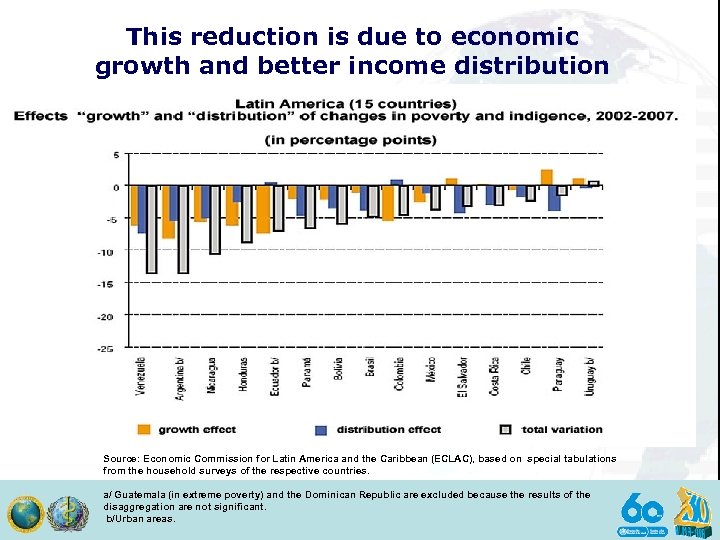
This reduction is due to economic growth and better income distribution Source: Economic Commission for Latin America and the Caribbean (ECLAC), based on special tabulations from the household surveys of the respective countries. a/ Guatemala (in extreme poverty) and the Dominican Republic are excluded because the results of the disaggregation are not significant. b/Urban areas.
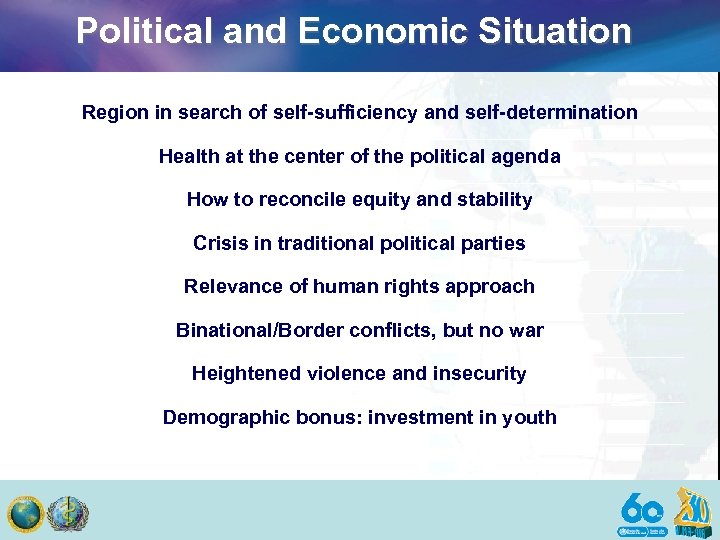
Political and Economic Situation Region in search of self-sufficiency and self-determination Health at the center of the political agenda How to reconcile equity and stability Crisis in traditional political parties Relevance of human rights approach Binational/Border conflicts, but no war Heightened violence and insecurity Demographic bonus: investment in youth
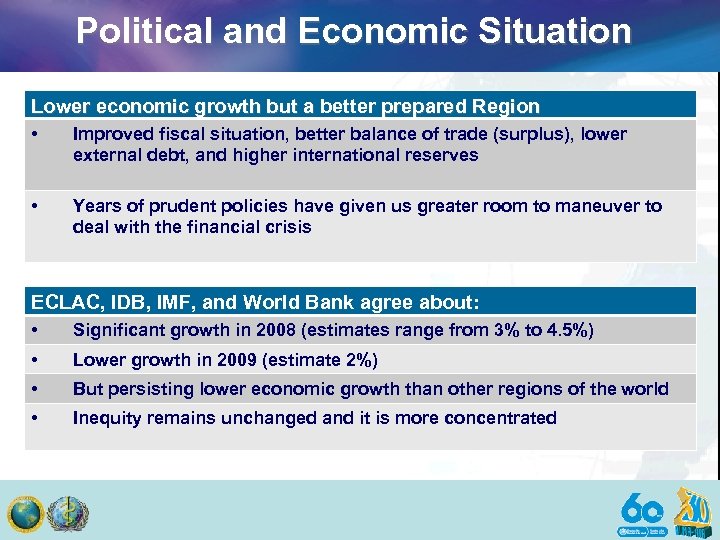
Political and Economic Situation Lower economic growth but a better prepared Region Lower economic growth but a • Improved fiscal situation, better balance of trade (surplus), lower external debt, and higher international reserves • Years of prudent policies have given us greater room to maneuver to deal with the financial crisis ECLAC, IDB, IMF, and World Bank agree about: • Significant growth in 2008 (estimates range from 3% to 4. 5%) • Lower growth in 2009 (estimate 2%) • But persisting lower economic growth than other regions of the world • Inequity remains unchanged and it is more concentrated
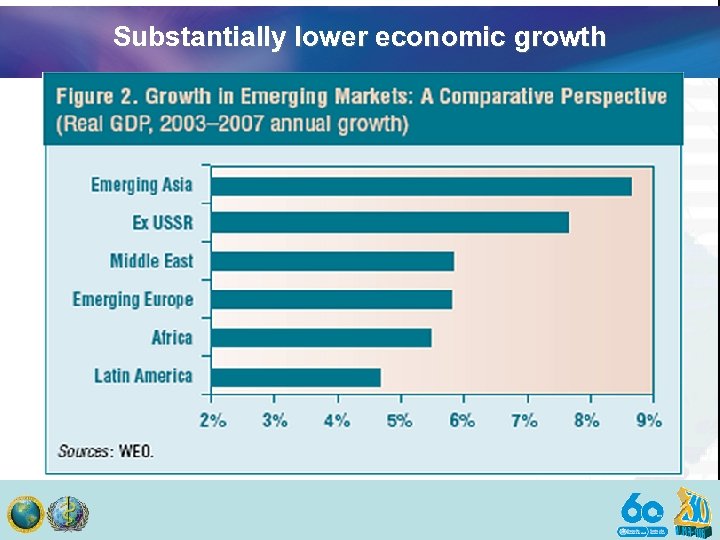
Substantially lower economic growth
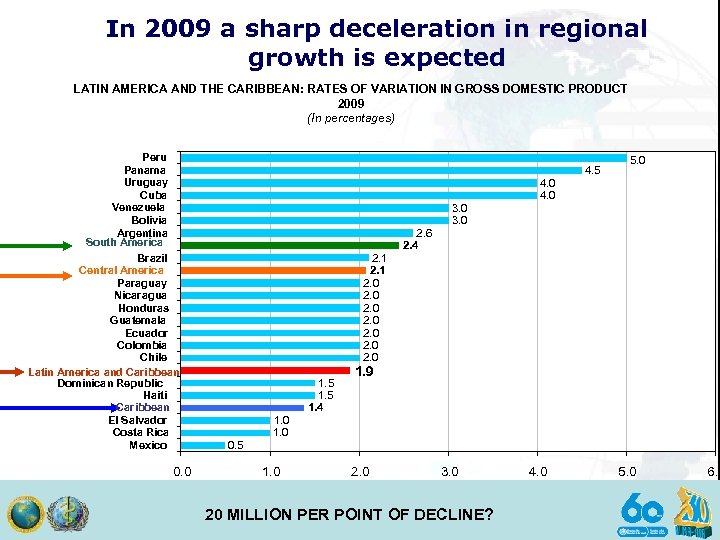
In 2009 a sharp deceleration in regional growth is expected LATIN AMERICA AND THE CARIBBEAN: RATES OF VARIATION IN GROSS DOMESTIC PRODUCT 2009 (In percentages) Peru Panama Uruguay Cuba Venezuela Bolivia Argentina South America Brazil Central America Paraguay Nicaragua Honduras Guatemala Ecuador Colombia Chile Latin America and Caribbean Dominican Republic Haiti Caribbean El Salvador Costa Rica Mexico 0. 0 4. 5 5. 0 4. 0 3. 0 2. 6 2. 4 2. 1 2. 0 2. 0 1. 5 1. 4 1. 9 1. 0 0. 5 1. 0 2. 0 3. 0 20 MILLION PER POINT OF DECLINE? 4. 0 5. 0 6. 0
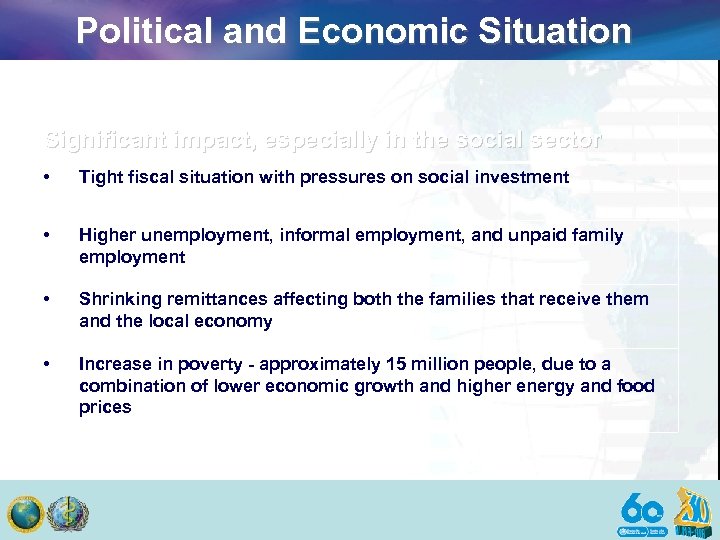
Political and Economic Situation Significant impact, especially in the social sector • Tight fiscal situation with pressures on social investment • Higher unemployment, informal employment, and unpaid family employment • Shrinking remittances affecting both the families that receive them and the local economy • Increase in poverty - approximately 15 million people, due to a combination of lower economic growth and higher energy and food prices
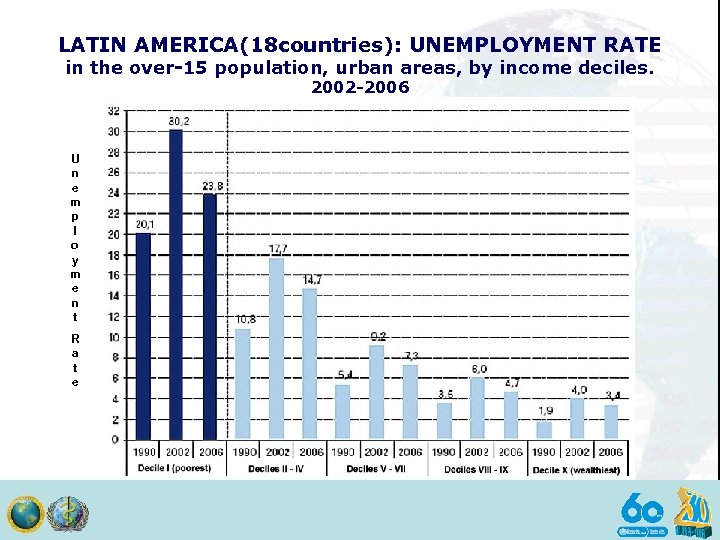
LATIN AMERICA(18 countries): UNEMPLOYMENT RATE in the over-15 population, urban areas, by income deciles. 2002 -2006 U n e m p l o y m e n t R a t e
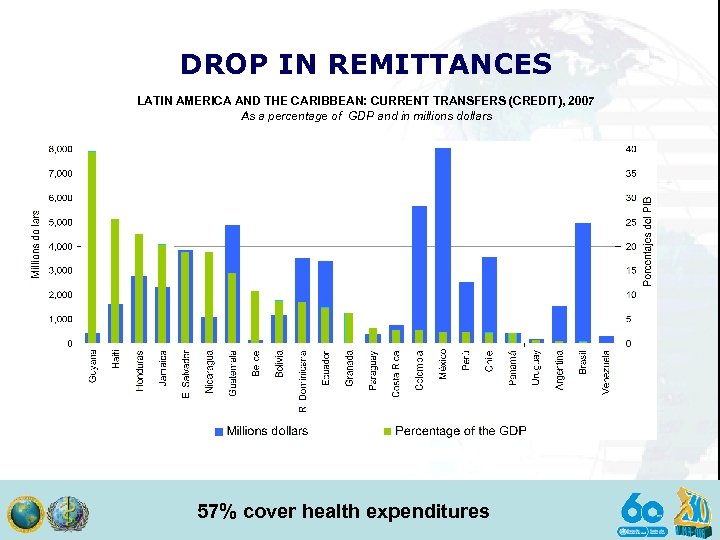
DROP IN REMITTANCES LATIN AMERICA AND THE CARIBBEAN: CURRENT TRANSFERS (CREDIT), 2007 As a percentage of GDP and in millions dollars 57% cover health expenditures
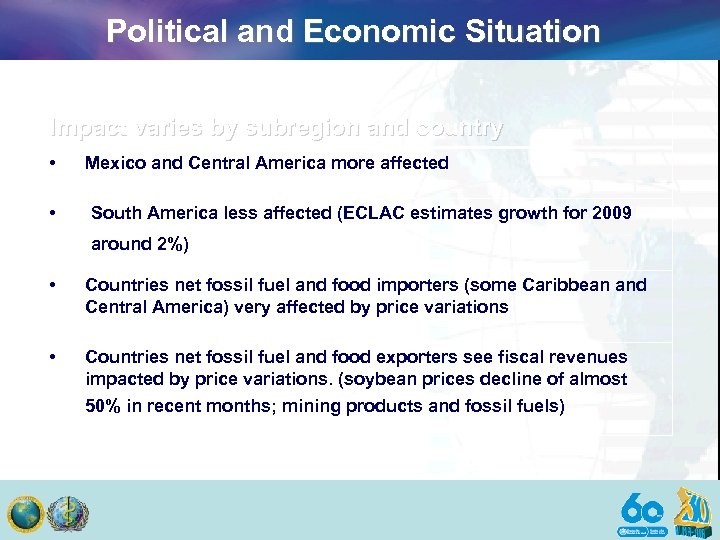
Political and Economic Situation Impact varies by subregion and country • • Mexico and Central America more affected South America less affected (ECLAC estimates growth for 2009 around 2%) • Countries net fossil fuel and food importers (some Caribbean and Central America) very affected by price variations • Countries net fossil fuel and food exporters see fiscal revenues impacted by price variations. (soybean prices decline of almost 50% in recent months; mining products and fossil fuels)
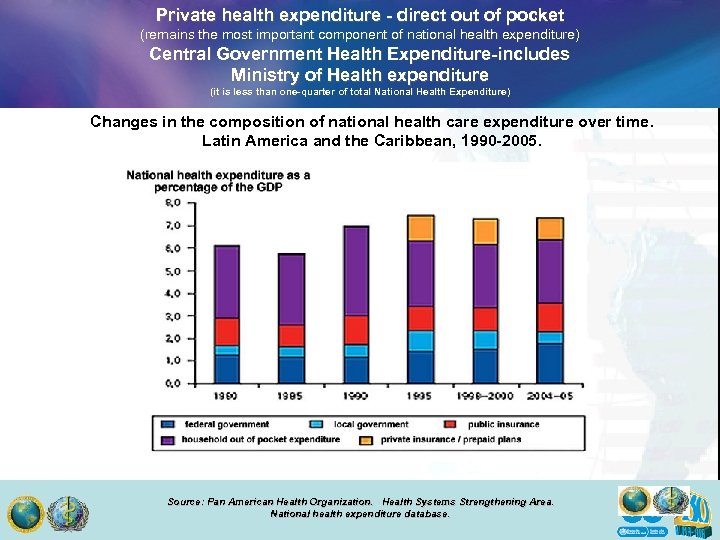
Private health expenditure - direct out of pocket (remains the most important component of national health expenditure) Central Government Health Expenditure-includes Ministry of Health expenditure (it is less than one-quarter of total National Health Expenditure) Changes in the composition of national health care expenditure over time. Latin America and the Caribbean, 1990 -2005. Source: Pan American Health Organization. Health Systems Strengthening Area. National health expenditure database.
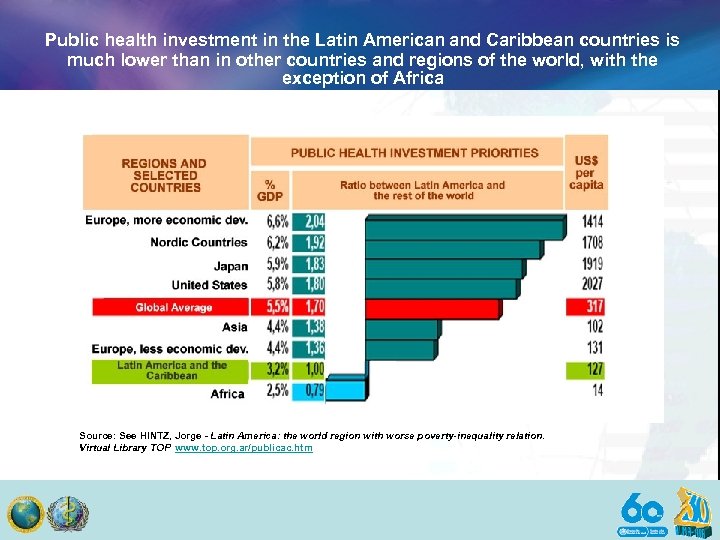
Public health investment in the Latin American and Caribbean countries is much lower than in other countries and regions of the world, with the exception of Africa Source: See HINTZ, Jorge - Latin America: the world region with worse poverty-inequality relation. Virtual Library TOP www. top. org. ar/publicac. htm
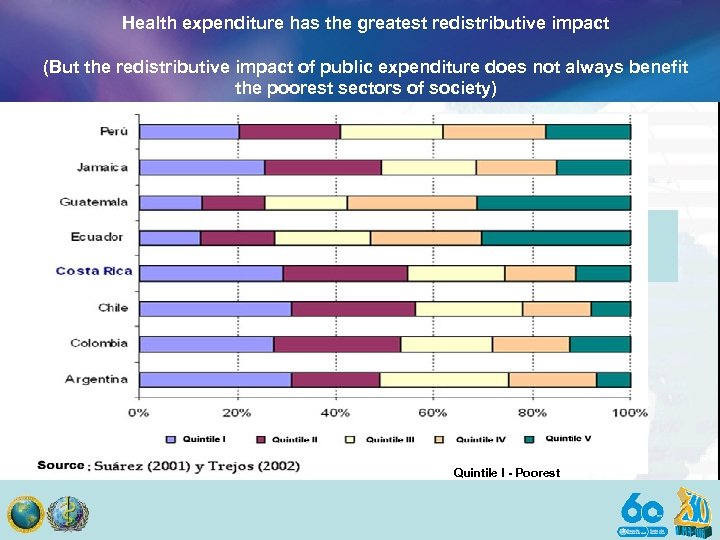
Health expenditure has the greatest redistributive impact (But the redistributive impact of public expenditure does not always benefit the poorest sectors of society) Quintile I - Poorest
A great deal can be done to cushion the impact of the financial crisis • Solidarity in times of crisis: safeguard progress through commitments; • among donor governments and the countries that require their support: maintain promised levels of development assistance; • among governments and their citizens: promote an ethical dimension in public policy, and, in particular, the maintenance of essential social and health services; and • among citizens: share risks and responsibilities as the foundation for strong health systems.
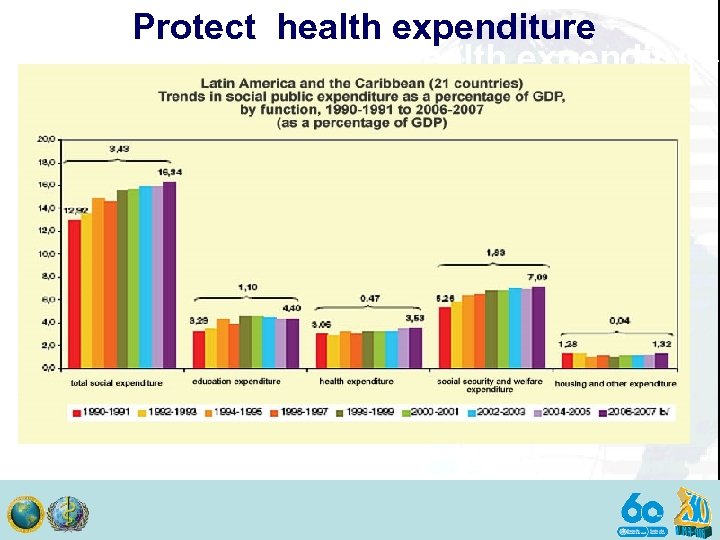
Protect health expenditure Protect the health expenditure
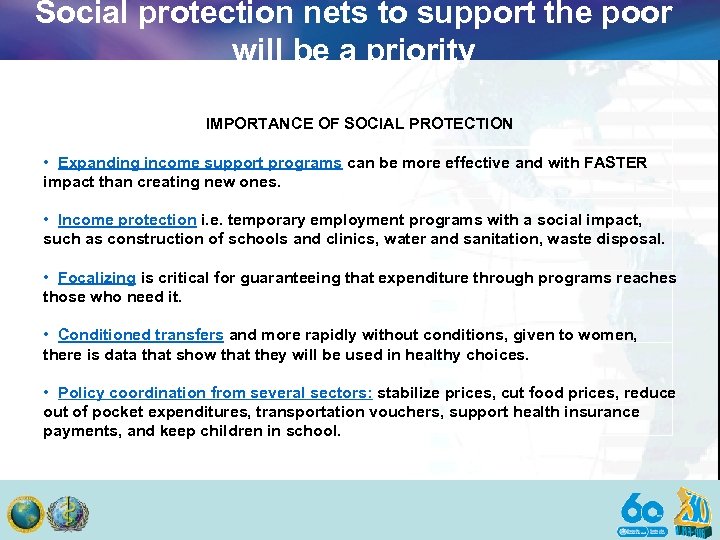
Social protection nets to support the poor will be a priority IMPORTANCE OF SOCIAL PROTECTION • Expanding income support programs can be more effective and with FASTER impact than creating new ones. • Income protection i. e. temporary employment programs with a social impact, such as construction of schools and clinics, water and sanitation, waste disposal. • Focalizing is critical for guaranteeing that expenditure through programs reaches those who need it. • Conditioned transfers and more rapidly without conditions, given to women, there is data that show that they will be used in healthy choices. • Policy coordination from several sectors: stabilize prices, cut food prices, reduce out of pocket expenditures, transportation vouchers, support health insurance payments, and keep children in school.
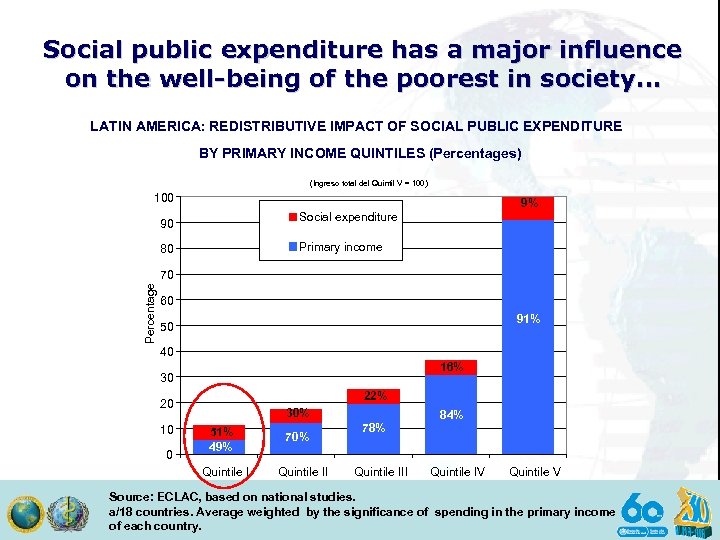
Social public expenditure has a major influence on the well-being of the poorest in society… LATIN AMERICA: REDISTRIBUTIVE IMPACT OF SOCIAL PUBLIC EXPENDITURE BY PRIMARY INCOME QUINTILES (Percentages) (Ingreso total del Quintil V = 100) 100 9% Social expenditure 90 Primary income 80 Percentage 70 60 91% 50 40 16% 30 22% 20 10 0 30% 51% 49% Quintile I 70% Quintile II 84% 78% Quintile III Quintile IV Quintile V Source: ECLAC, based on national studies. a/18 countries. Average weighted by the significance of spending in the primary income of each country.
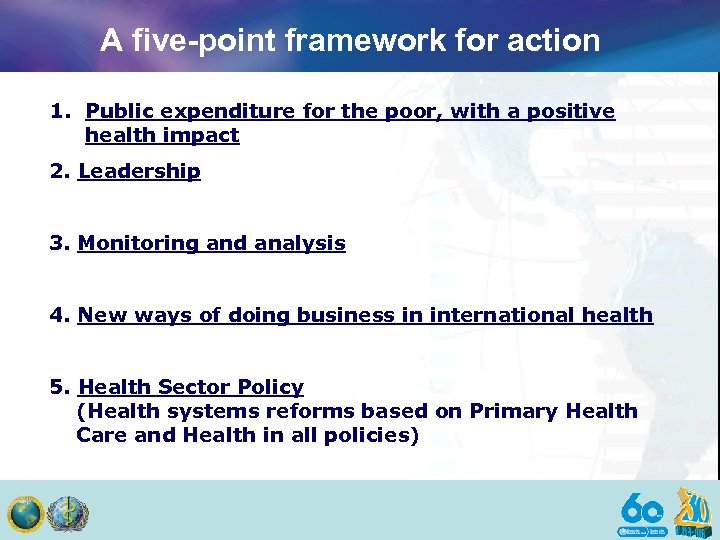
A five-point framework for action 1. Public expenditure for the poor, with a positive health impact 2. Leadership 3. Monitoring and analysis 4. New ways of doing business in international health 5. Health Sector Policy (Health systems reforms based on Primary Health Care and Health in all policies)
A five-point framework for action 1. Public expenditure for the poor, with a positive health impact General agreement about counter-cyclical public spending as a means to reactivate economy Key role in the push needed by many low income countries, since they have no capacity or fiscal space to finance these measures themselves. The challenge is to guarantee that the spending will really favor the poor and have a positive impact on health.
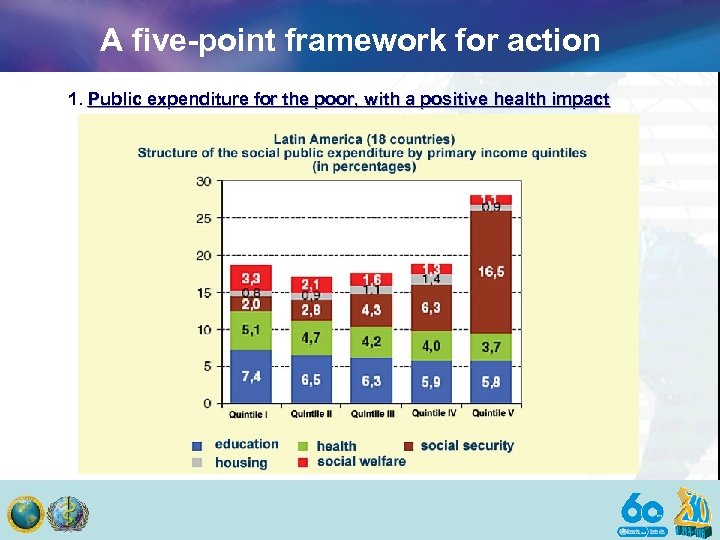
A five-point framework for action 1. Public expenditure for the poor, with a positive health impact
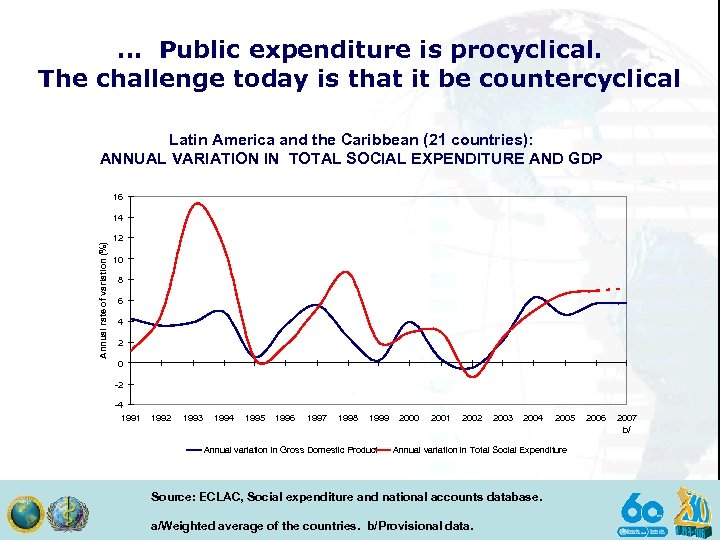
… Public expenditure is procyclical. The challenge today is that it be countercyclical Latin America and the Caribbean (21 countries): ANNUAL VARIATION IN TOTAL SOCIAL EXPENDITURE AND GDP 16 Annual rate of variation (%) 14 12 10 8 6 4 2 0 -2 -4 1991 1992 1993 1994 1995 1996 1997 1998 1999 Annual variation in Gross Domestic Product 2000 2001 2002 2003 2004 2005 Annual variation in Total Social Expenditure Source: ECLAC, Social expenditure and national accounts database. a/Weighted average of the countries. b/Provisional data. 2006 2007 b/
Achieve Good Health Outcomes for ALL PRIMARY HEALTH CARE: TACKLE DETERMINANTS AND STRENGTHEN HEALTH SYSTEMS • Political Action Framework • Convergence and harmonization of institutional agendas at different levels of intervention • Cross-cutting issues to articulate health systems and health determinants
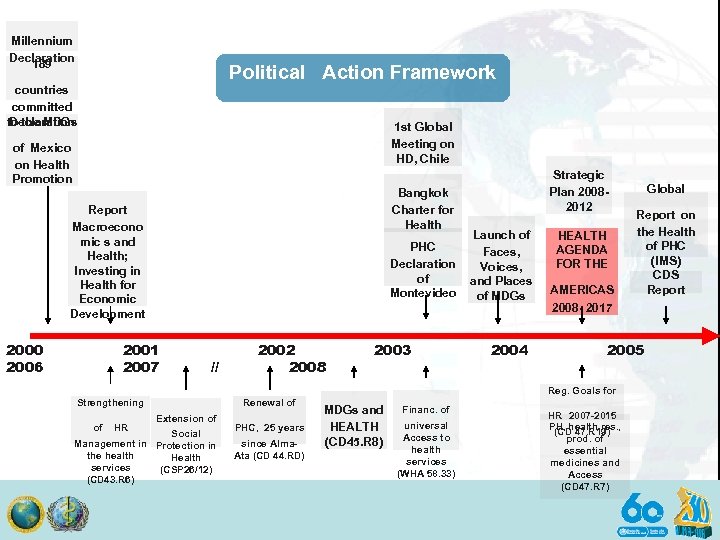
Millennium Declaration 189 Political Action Framework countries committed Declaration to the MDGs 1 st Global Meeting on HD, Chile of Mexico on Health Promotion Bangkok Charter for Health Report Macroecono mic s and Health; Investing in Health for Economic Development 2000 2006 Strategic Plan 2008 - 2012 Launch of PHC Faces, Declaration Voices, of and Places Montevideo of MDGs 2001 2007 // 2002 2008 2003 2004 HEALTH AGENDA FOR THE AMERICAS 2008 - 2017 Global Report on the Health of PHC (IMS) CDS Report 2005 Reg. Goals for Strengthening of HR Renewal of Extension of Social Management in Protection in the health Health services (CSP 26/12) (CD 43. R 6) PHC, 25 years since Alma. Ata (CD 44. RD) MDGs and HEALTH (CD 45. R 8) Financ. of universal Access to health services (WHA 58. 33) HR 2007 -2015 PH, health res. , (CD 47. R 19) prod. of essential medicines and Access (CD 47. R 7)
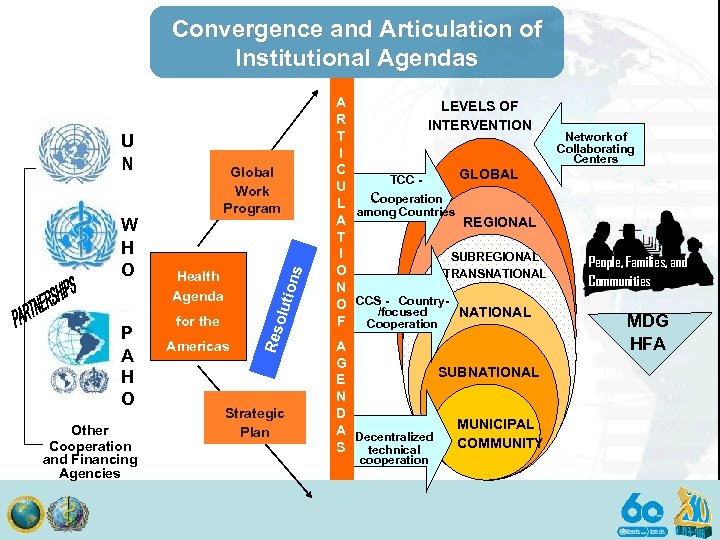
Convergence and Articulation of Institutional Agendas U N P A H O Other Cooperation and Financing Agencies ions Health Agenda for the Americas Res olut W H O Global Work Program Strategic Plan A LEVELS OF R INTERVENTION Network of T Collaborating I Centers C GLOBAL TCC U ooperation L among Countries A REGIONAL T I SUBREGIONAL People, Families, and O TRANSNATIONAL Communities N O CCS - Country/focused NATIONAL F MDG Cooperation c A G SUBNATIONAL E N D MUNICIPAL A Decentralized COMMUNITY S technical cooperation HFA
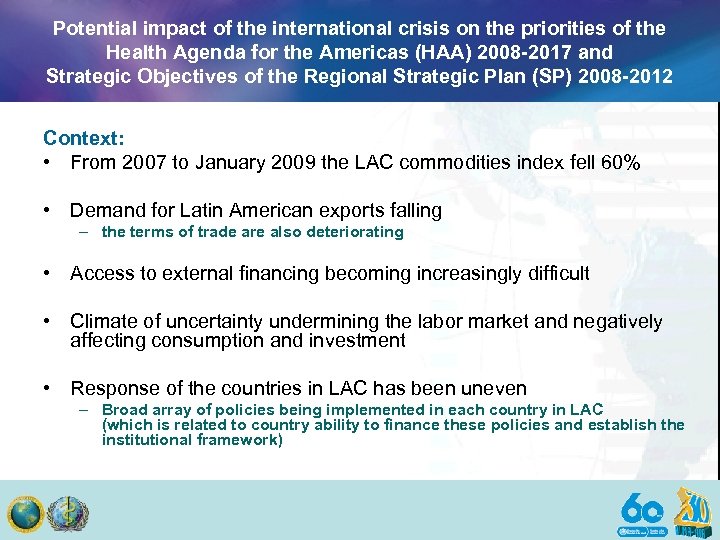
Potential impact of the international crisis on the priorities of the Health Agenda for the Americas (HAA) 2008 -2017 and Strategic Objectives of the Regional Strategic Plan (SP) 2008 -2012 Context: • From 2007 to January 2009 the LAC commodities index fell 60% • Demand for Latin American exports falling – the terms of trade are also deteriorating • Access to external financing becoming increasingly difficult • Climate of uncertainty undermining the labor market and negatively affecting consumption and investment • Response of the countries in LAC has been uneven – Broad array of policies being implemented in each country in LAC (which is related to country ability to finance these policies and establish the institutional framework)
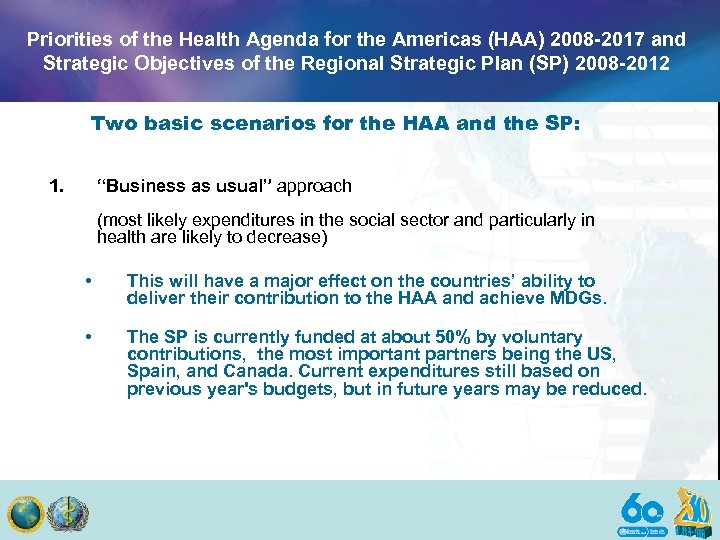
Priorities of the Health Agenda for the Americas (HAA) 2008 -2017 and Strategic Objectives of the Regional Strategic Plan (SP) 2008 -2012 Two basic scenarios for the HAA and the SP: 1. “Business as usual” approach (most likely expenditures in the social sector and particularly in health are likely to decrease) • This will have a major effect on the countries’ ability to deliver their contribution to the HAA and achieve MDGs. • The SP is currently funded at about 50% by voluntary contributions, the most important partners being the US, Spain, and Canada. Current expenditures still based on previous year's budgets, but in future years may be reduced.
Priorities of the Health Agenda for the Americas (HAA) 2008 -2017 and Strategic Objectives of the Regional Strategic Plan (SP) 2008 -2012 Two basic scenarios for the HAA and the SP: 2. Alternative scenario (take advantage of the crisis fostering higher investment in health, or at least protect current status) • Considerations: Health is labor intensive, considered a critical component for successful fiscal interventions • Given the likely high unemployment impact of economic downturns, there will be a need to reduce social impact. Health always a very powerful tool • Long-term effect of decreasing health investments will be much more expensive to correct, plus the obvious ethical impact.
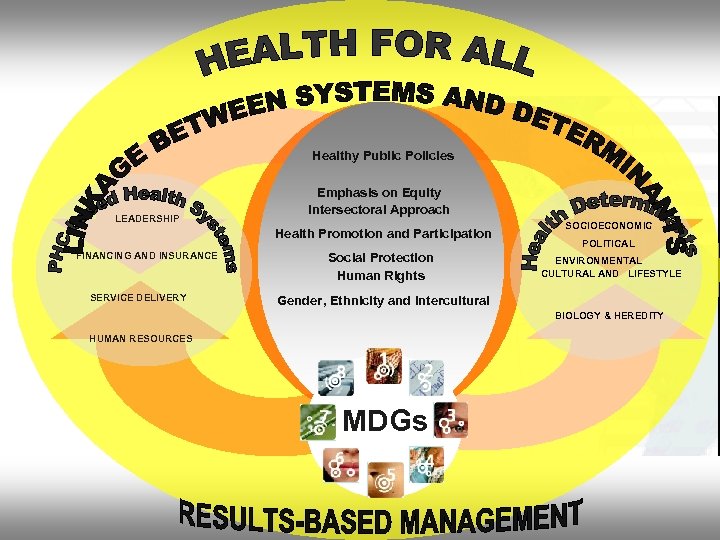
Healthy Public Policies LEADERSHIP Emphasis on Equity Intersectoral Approach Health Promotion and Participation FINANCING AND INSURANCE SERVICE DELIVERY Social Protection Human Rights SOCIOECONOMIC POLITICAL ENVIRONMENTAL CULTURAL AND LIFESTYLE Gender, Ethnicity and Intercultural BIOLOGY & HEREDITY HUMAN RESOURCES MDGs
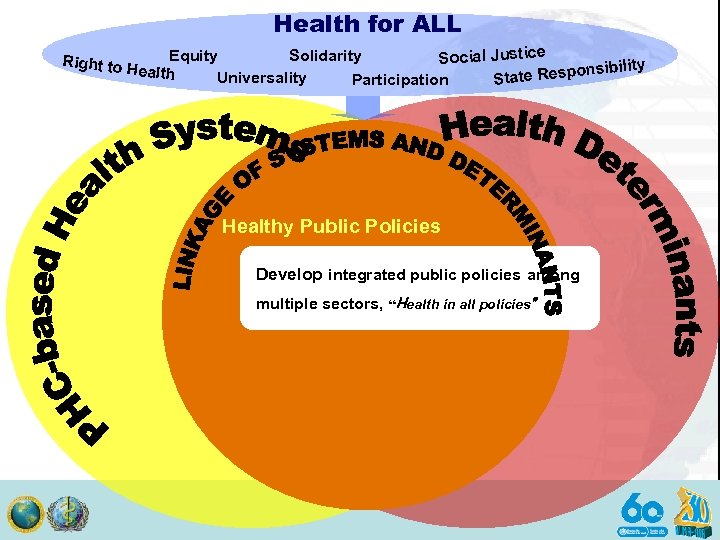
Health for ALL Equity Solidarity Social Justice nsibility ealth Universality tate Respo S Participation Right to H Healthy Public Policies Develop integrated public policies among multiple sectors, “Health in all policies”
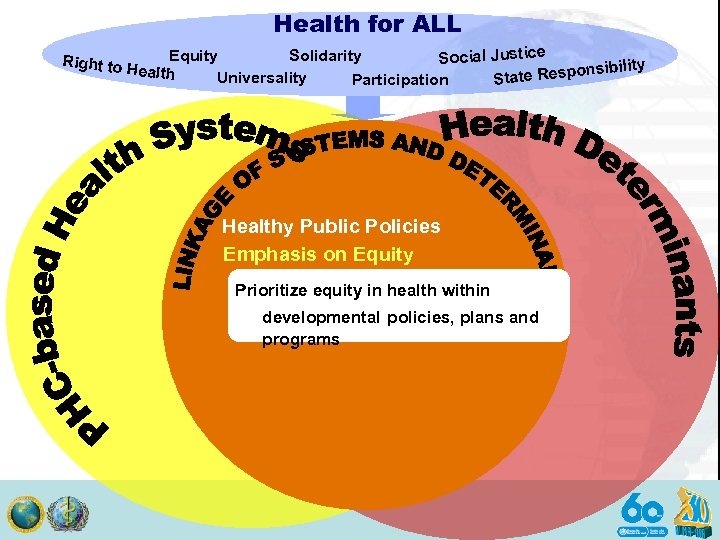
Health for ALL Equity Solidarity Social Justice nsibility ealth Universality tate Respo S Participation Right to H Healthy Public Policies Emphasis on Equity Prioritize equity in health within developmental policies, plans and programs
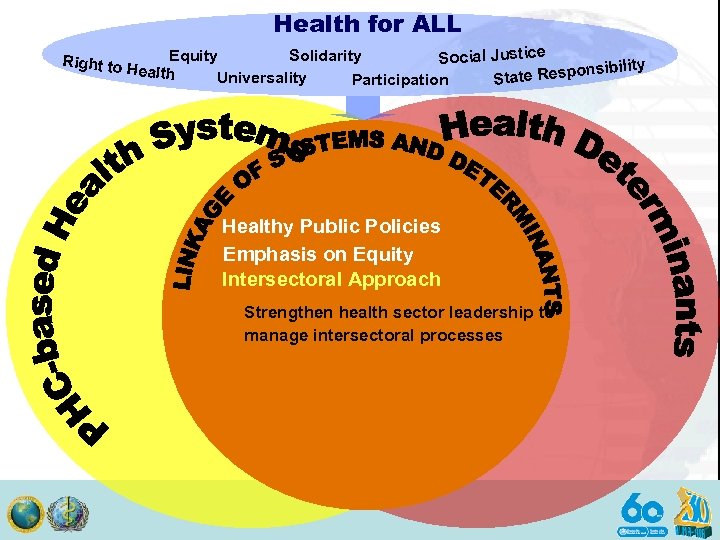
Health for ALL Equity Solidarity Social Justice nsibility ealth Universality tate Respo S Participation Right to H Healthy Public Policies Emphasis on Equity Intersectoral Approach Strengthen health sector leadership to manage intersectoral processes
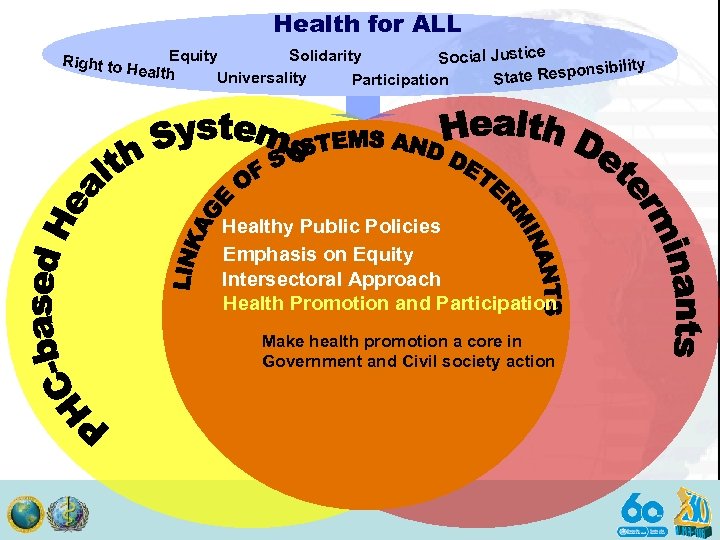
Health for ALL Equity Solidarity Social Justice nsibility ealth Universality tate Respo S Participation Right to H Healthy Public Policies Emphasis on Equity Intersectoral Approach Health Promotion and Participation Make health promotion a core in Government and Civil society action
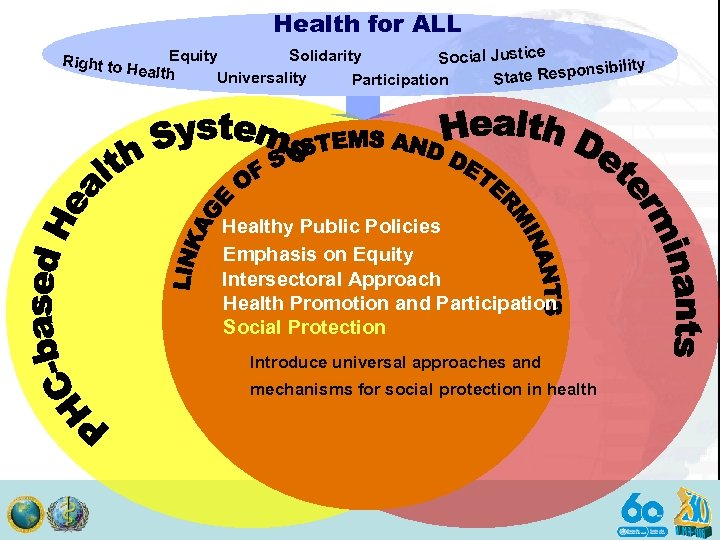
Health for ALL Equity Solidarity Social Justice nsibility ealth Universality tate Respo S Participation Right to H Healthy Public Policies Emphasis on Equity Intersectoral Approach Health Promotion and Participation Social Protection Introduce universal approaches and mechanisms for social protection in health
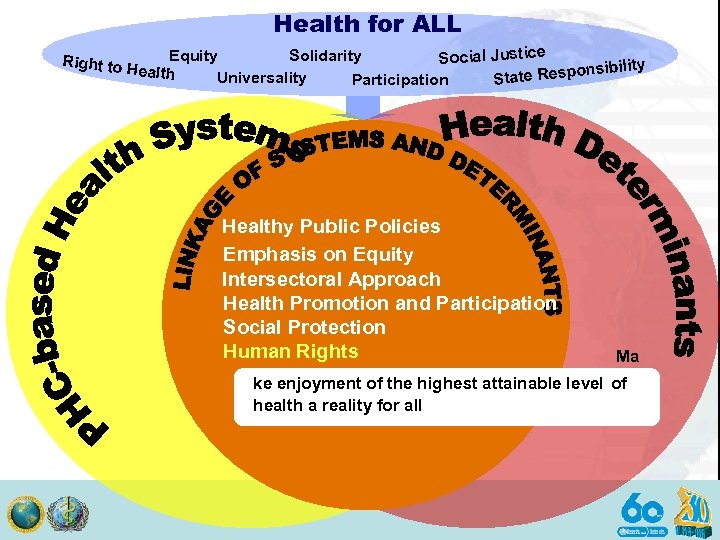
Health for ALL Equity Solidarity Social Justice nsibility ealth Universality tate Respo S Participation Right to H Healthy Public Policies Emphasis on Equity Intersectoral Approach Health Promotion and Participation Social Protection Human Rights Ma ke enjoyment of the highest attainable level of health a reality for all
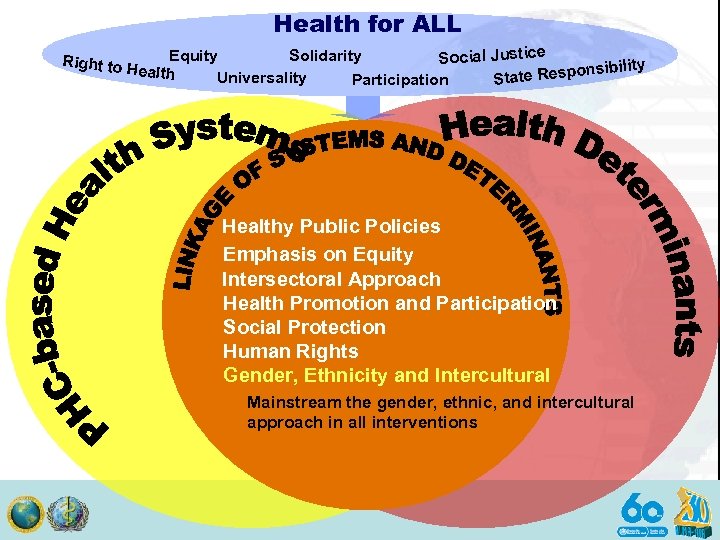
Health for ALL Equity Solidarity Social Justice nsibility ealth Universality tate Respo S Participation Right to H Healthy Public Policies Emphasis on Equity Intersectoral Approach Health Promotion and Participation Social Protection Human Rights Gender, Ethnicity and Intercultural Mainstream the gender, ethnic, and intercultural approach in all interventions
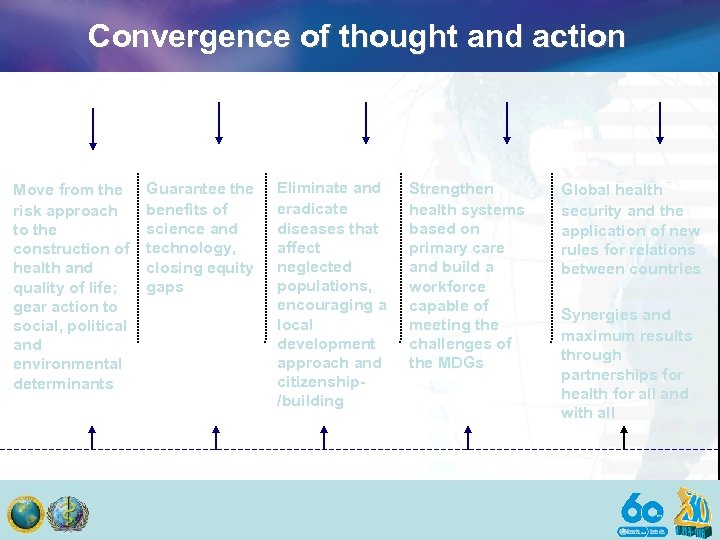
Convergence of thought and action Move from the Guarantee the risk approach benefits of science and to the construction of technology, closing equity health and gaps quality of life; gear action to social, political and environmental determinants Eliminate and eradicate diseases that affect neglected populations, encouraging a local development approach and citizenship/building Strengthen health systems based on primary care and build a workforce capable of meeting the challenges of the MDGs Global health security and the application of new rules for relations between countries Synergies and maximum results through partnerships for health for all and with all
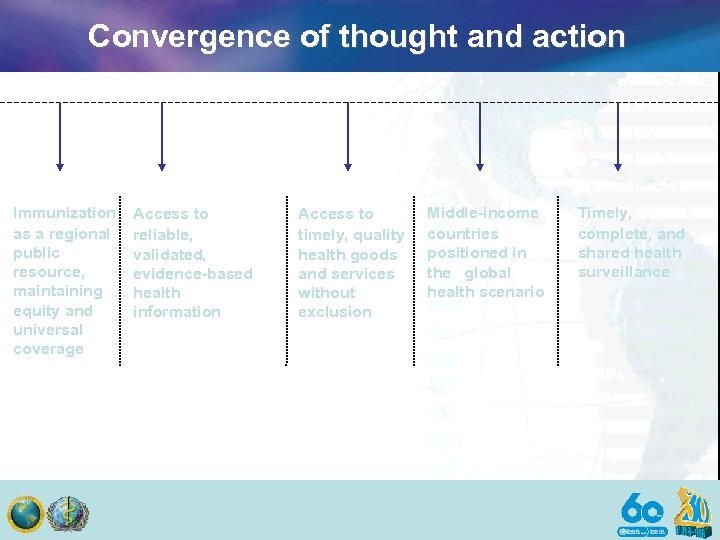
Convergence of thought and action Immunization as a regional public resource, maintaining equity and universal coverage Access to reliable, validated, evidence-based health information Access to timely, quality health goods and services without exclusion Middle-income countries positioned in the global health scenario Timely, complete, and shared health surveillance
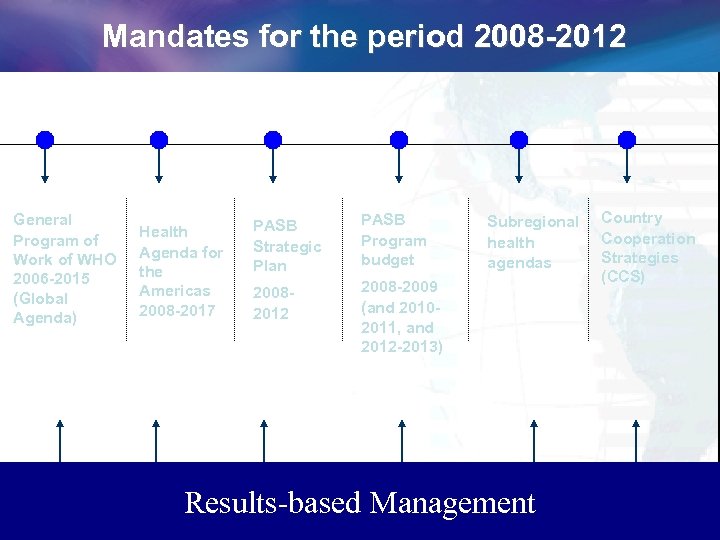
Mandates for the period 2008 -2012 General Program of Work of WHO 2006 -2015 (Global Agenda) Health Agenda for the Americas 2008 -2017 PASB Strategic Plan PASB Program budget 20082012 2008 -2009 (and 2010 - 2011, and 2012 -2013) Subregional health agendas Results-based Management Country Cooperation Strategies (CCS)
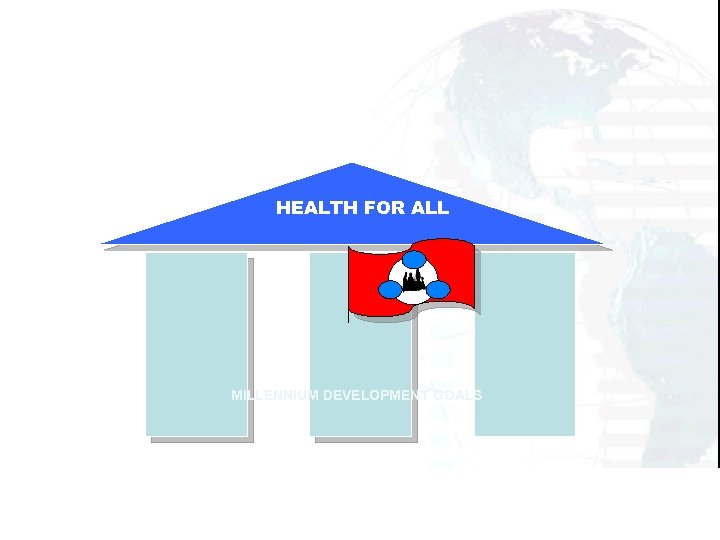
HEALTH FOR ALL MILLENNIUM DEVELOPMENT GOALS
Скачать презентацию Global Economic Crisis and the Health of the
8d328b21dbcf76611e0ade806eb5f0cf.ppt