 Скачать презентацию Global Corruption Perception Index CPI Transparency International 2006
371dd4926785120fdc9740f043fb55ff.ppt
- Количество слайдов: 17



Global Corruption Perception Index (CPI) Transparency International 2006 www. transparentnost. org. yu www. transparency. org/surveys/#cpi

Corruption Perception Index for 2006 • Measures the level in which the corruption of public servants and politicians is perceived • Index is made on the bases of twelve different researches and studies, which were conducted by nine independent institutions questioning businessmen, analysts and local experts
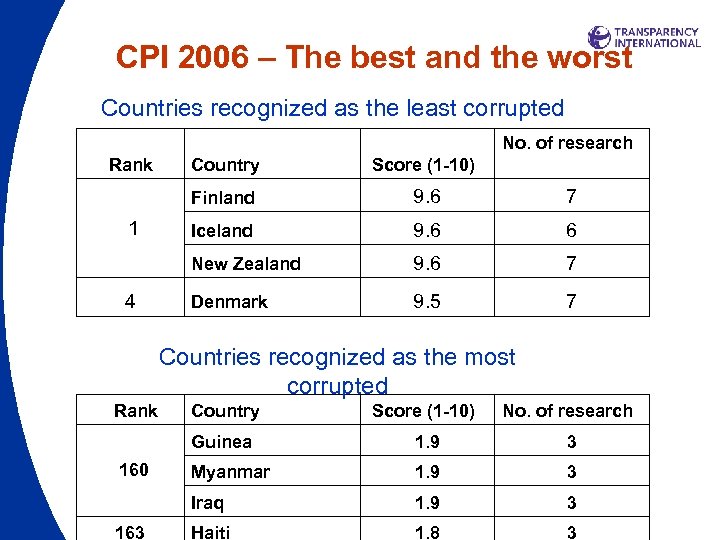
CPI 2006 – The best and the worst Countries recognized as the least corrupted No. of research Rank Country Score (1 -10) Finland 9. 6 7 1 Iceland 9. 6 6 New Zealand 9. 6 7 Denmark 9. 5 7 4 Countries recognized as the most corrupted Rank Country Score (1 -10) No. of research Guinea 1. 9 3 160 Myanmar 1. 9 3 Iraq 1. 9 3 Haiti 1. 8 3 163
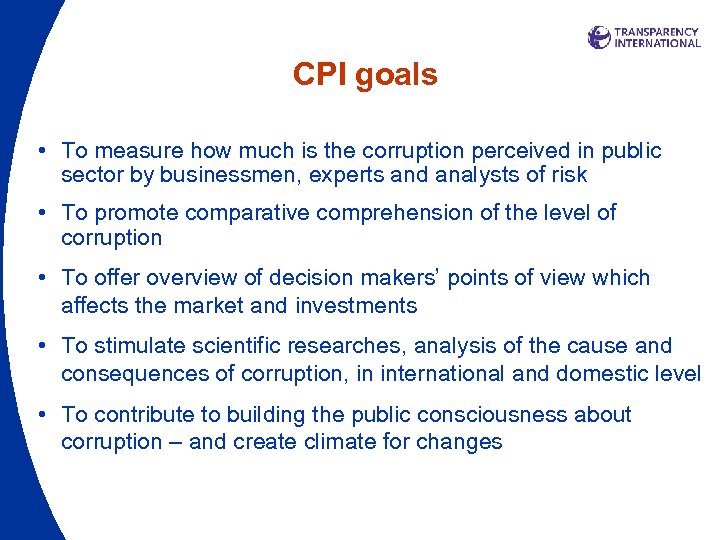
CPI goals • To measure how much is the corruption perceived in public sector by businessmen, experts and analysts of risk • To promote comparative comprehension of the level of corruption • To offer overview of decision makers’ points of view which affects the market and investments • To stimulate scientific researches, analysis of the cause and consequences of corruption, in international and domestic level • To contribute to building the public consciousness about corruption – and create climate for changes
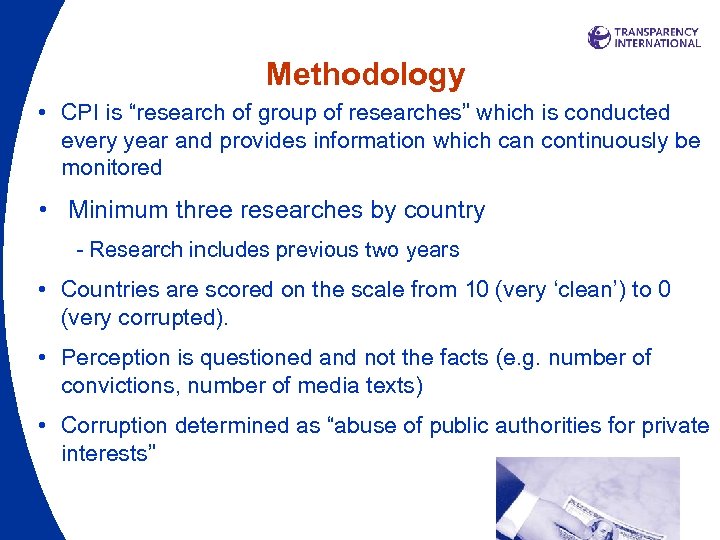
Methodology • CPI is “research of group of researches” which is conducted every year and provides information which can continuously be monitored • Minimum three researches by country - Research includes previous two years • Countries are scored on the scale from 10 (very ‘clean’) to 0 (very corrupted). • Perception is questioned and not the facts (e. g. number of convictions, number of media texts) • Corruption determined as “abuse of public authorities for private interests”
Possibility of comparing • Index represents overview of points of view of businessmen and analysts about certain countries’ situation and doesn’t reflect necessarily trends for certain years • Score is more relevant than the rank on the list (because the number of countries included in the list is constantly increasing) • Index changes of certain countries can be a result of sample changes – researches taken into consideration when creating the index
Disadvantages and advantages of CPI • Index doesn’t reflect the level of efforts invested into fight against corruption • Developing countries can be shown in worse light due to prejudice and pre convictions of foreign investors (that is why other instruments for measuring corruption exist) • Other instruments for measuring corruption also come to similar results as CPI • CPI is good chance to promote public debate on corruption • CPI is good stimulation for conducting further analysis • CPI includes almost all the world countries
Resources • CPIA: Country Policy and Institutional Assessment by the IDA and IBRD • EIU: Economist Intelligence Unit • FH: Freedom House, Nations in Transit • IMD: World Competitiveness Report of the Institute for Management Development • MIG: Merchant International Group • PERC: Political and Economic Risk Consultancy, Hong Kong • UNECA: United Nations Economic Commission for Africa, African Governance Report • WEF: Global Competitiveness Report of the World Economic Forum • WMRC: World Markets Research Centre
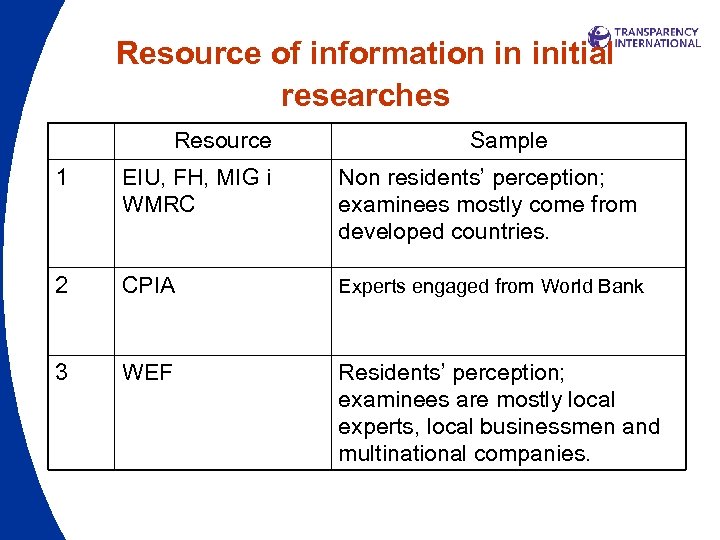
Resource of information in initial researches Resource Sample 1 EIU, FH, MIG i WMRC Non residents’ perception; examinees mostly come from developed countries. 2 CPIA Experts engaged from World Bank 3 WEF Residents’ perception; examinees are mostly local experts, local businessmen and multinational companies.
CPI results and Serbia • SCG is included in seven researches which are taken into consideration when creating the index • Researches published during 2005 and 2006 • Ranking by certain researches is from 2, 3 to 4, 0 • Standard deviation is in acceptable limits (0, 7)
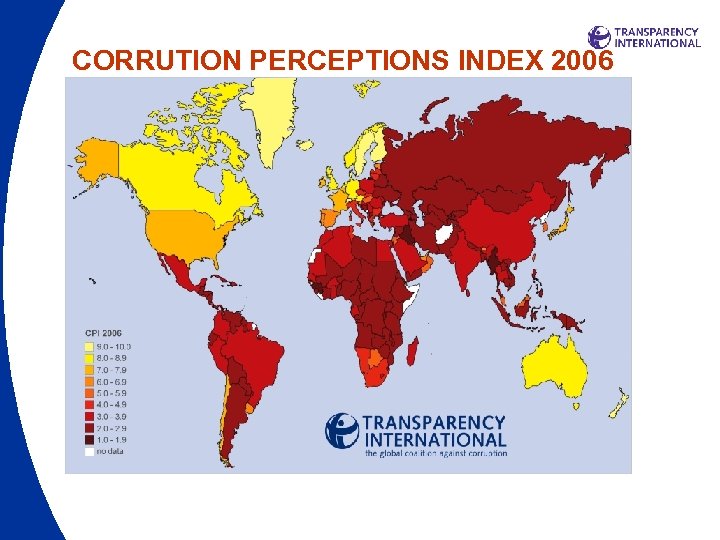
CORRUTION PERCEPTIONS INDEX 2006
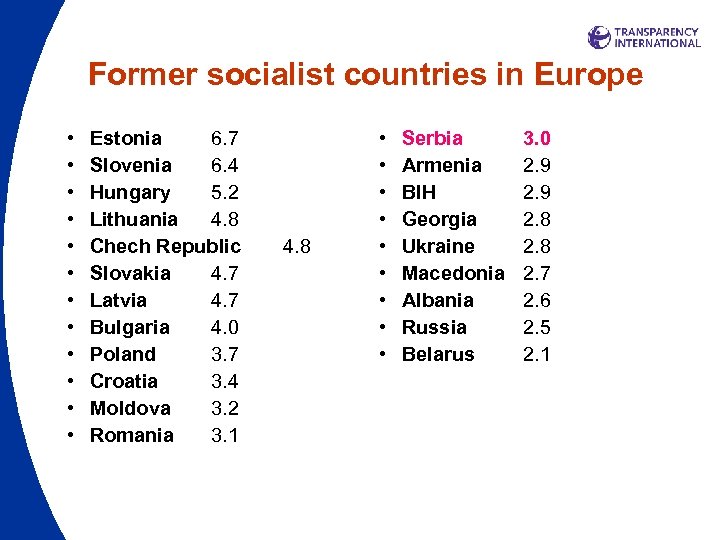
Former socialist countries in Europe • • • Estonia 6. 7 Slovenia 6. 4 Hungary 5. 2 Lithuania 4. 8 Chech Republic Slovakia 4. 7 Latvia 4. 7 Bulgaria 4. 0 Poland 3. 7 Croatia 3. 4 Moldova 3. 2 Romania 3. 1 4. 8 • • • Serbia Armenia BIH Georgia Ukraine Macedonia Albania Russia Belarus 3. 0 2. 9 2. 8 2. 7 2. 6 2. 5 2. 1
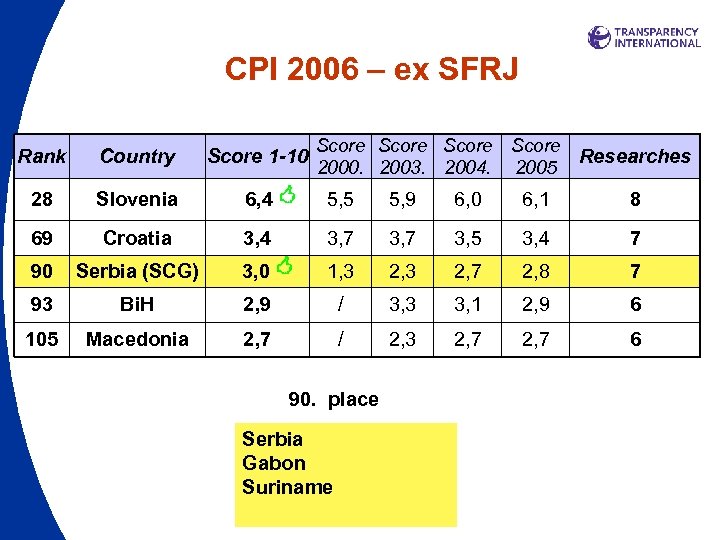
CPI 2006 – ex SFRJ Rank Country 28 Slovenia 69 Croatia 90 Serbia (SCG) 93 Bi. H 105 Macedonia Score 1 -10 Score Researches 2000. 2003. 2004. 2005 6, 4 5, 5 5, 9 6, 0 6, 1 8 3, 4 3, 7 3, 5 3, 4 7 3, 0 1, 3 2, 7 2, 8 7 2, 9 / 3, 3 3, 1 2, 9 6 2, 7 / 2, 3 2, 7 6 90. place Serbia Gabon Suriname
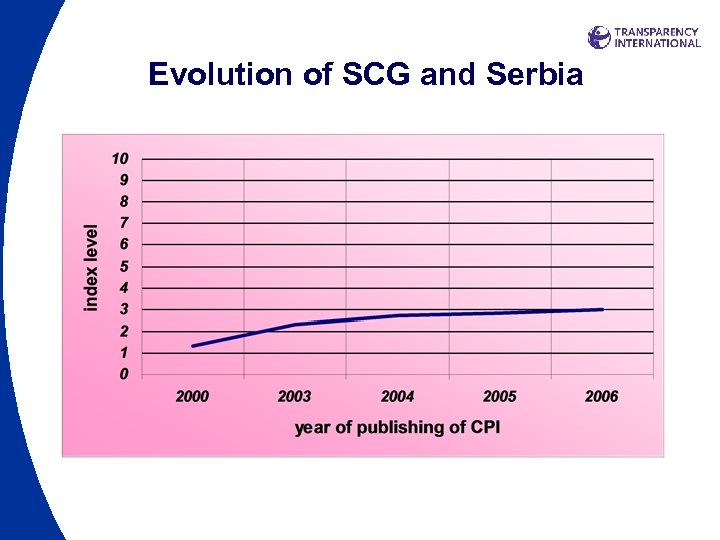
Evolution of SCG and Serbia
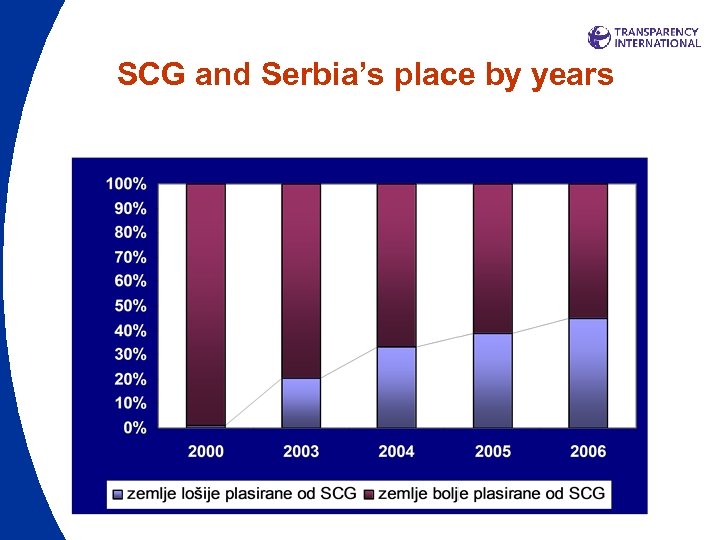
SCG and Serbia’s place by years
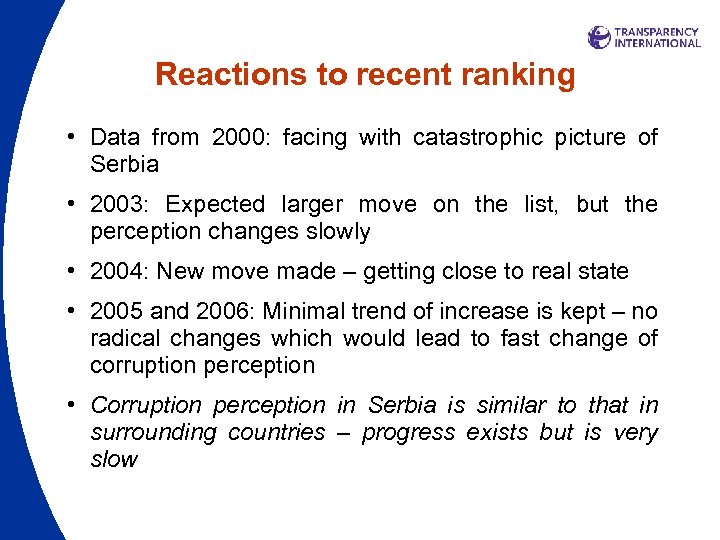
Reactions to recent ranking • Data from 2000: facing with catastrophic picture of Serbia • 2003: Expected larger move on the list, but the perception changes slowly • 2004: New move made – getting close to real state • 2005 and 2006: Minimal trend of increase is kept – no radical changes which would lead to fast change of corruption perception • Corruption perception in Serbia is similar to that in surrounding countries – progress exists but is very slow
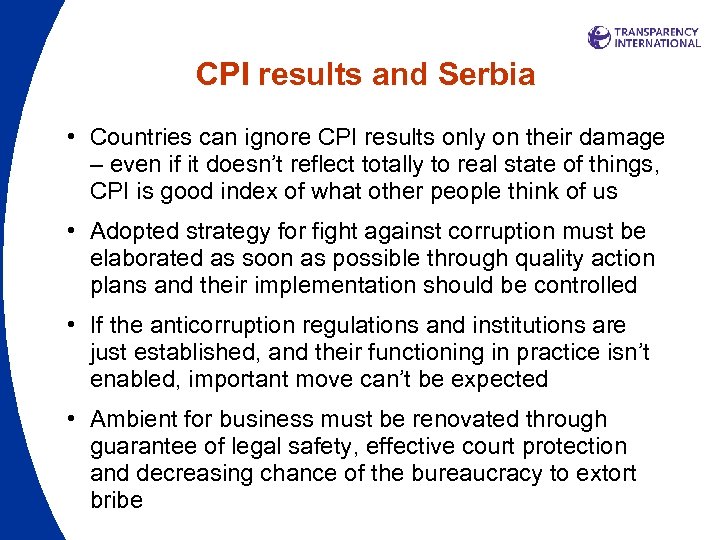
CPI results and Serbia • Countries can ignore CPI results only on their damage – even if it doesn’t reflect totally to real state of things, CPI is good index of what other people think of us • Adopted strategy for fight against corruption must be elaborated as soon as possible through quality action plans and their implementation should be controlled • If the anticorruption regulations and institutions are just established, and their functioning in practice isn’t enabled, important move can’t be expected • Ambient for business must be renovated through guarantee of legal safety, effective court protection and decreasing chance of the bureaucracy to extort bribe
Скачать презентацию Global Corruption Perception Index CPI Transparency International 2006
371dd4926785120fdc9740f043fb55ff.ppt