 Скачать презентацию Global Consumer Buying Power Segmentation and Forecasts Prepared
449c0afab19d4b34b1527df4969da38f.ppt
- Количество слайдов: 40




Global Consumer Buying Power: Segmentation and Forecasts Prepared by Chris Holling, Executive Managing Director, Business Planning Solutions April 7, 2005
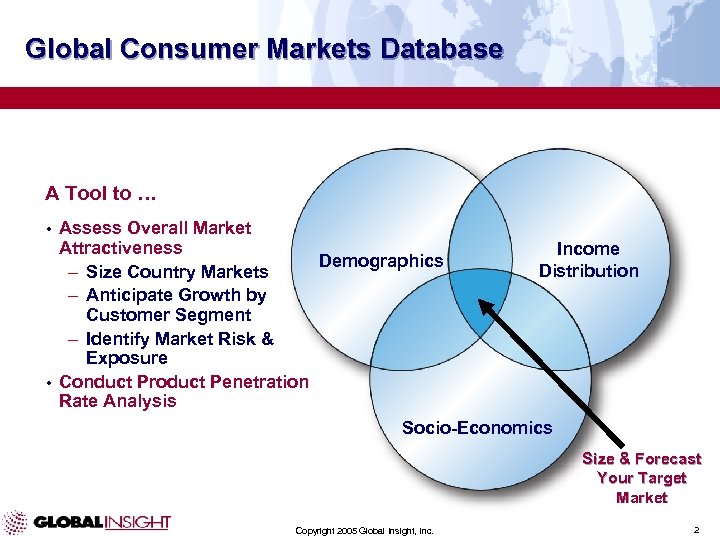
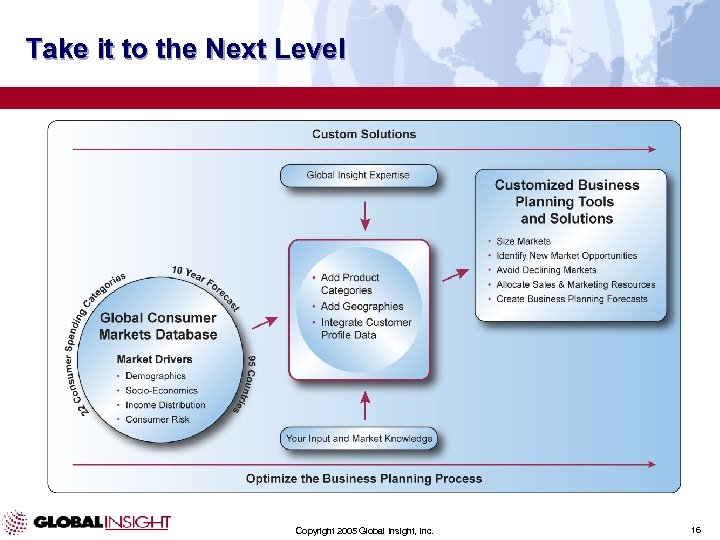
Global Consumer Markets Database A Tool to … w w Assess Overall Market Attractiveness Demographics – Size Country Markets – Anticipate Growth by Customer Segment – Identify Market Risk & Exposure Conduct Product Penetration Rate Analysis Income Distribution Socio-Economics Size & Forecast Your Target Market Copyright 2005 Global Insight, Inc. 2
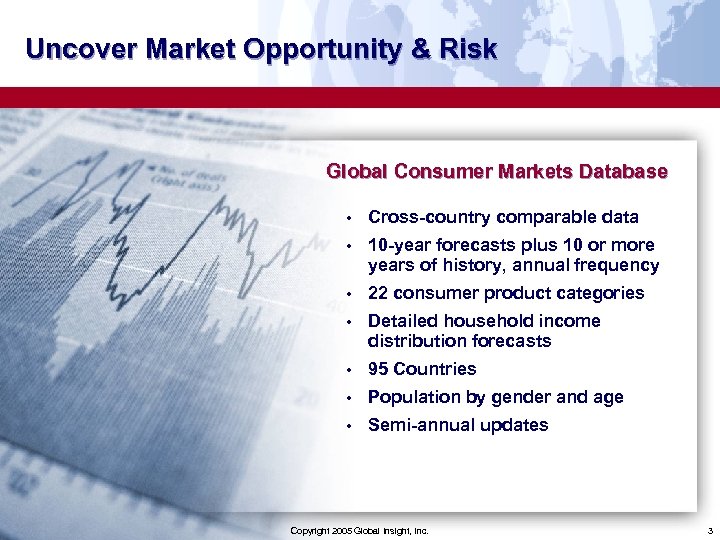
Uncover Market Opportunity & Risk Global Consumer Markets Database w Cross-country comparable data w 10 -year forecasts plus 10 or more years of history, annual frequency w 22 consumer product categories w Detailed household income distribution forecasts w 95 Countries w Population by gender and age w Semi-annual updates Copyright 2005 Global Insight, Inc. 3 3
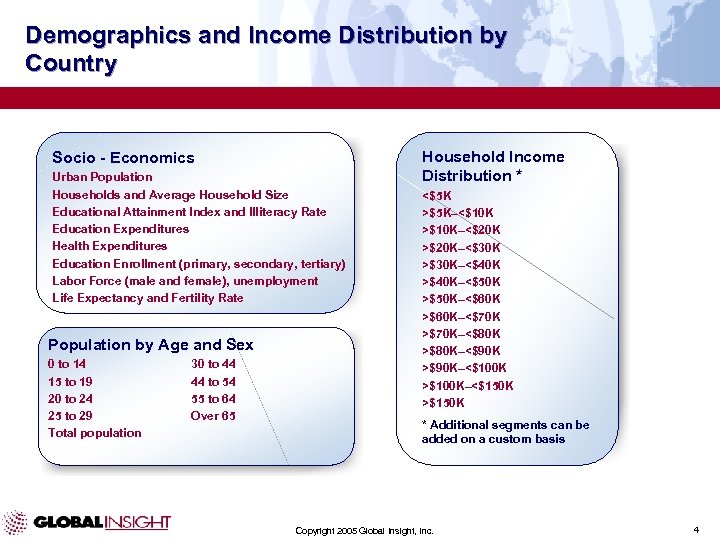
Demographics and Income Distribution by Country Socio - Economics Urban Population Households and Average Household Size Educational Attainment Index and Illiteracy Rate Education Expenditures Health Expenditures Education Enrollment (primary, secondary, tertiary) Labor Force (male and female), unemployment Life Expectancy and Fertility Rate Population by Age and Sex 0 to 14 15 to 19 20 to 24 25 to 29 Total population 30 to 44 44 to 54 55 to 64 Over 65 Household Income Distribution * <$5 K >$5 K–<$10 K >$10 K–<$20 K >$20 K–<$30 K >$30 K–<$40 K >$40 K–<$50 K >$50 K–<$60 K >$60 K–<$70 K >$70 K–<$80 K >$80 K–<$90 K >$90 K–<$100 K >$100 K–<$150 K >$150 K * Additional segments can be added on a custom basis Copyright 2005 Global Insight, Inc. 4
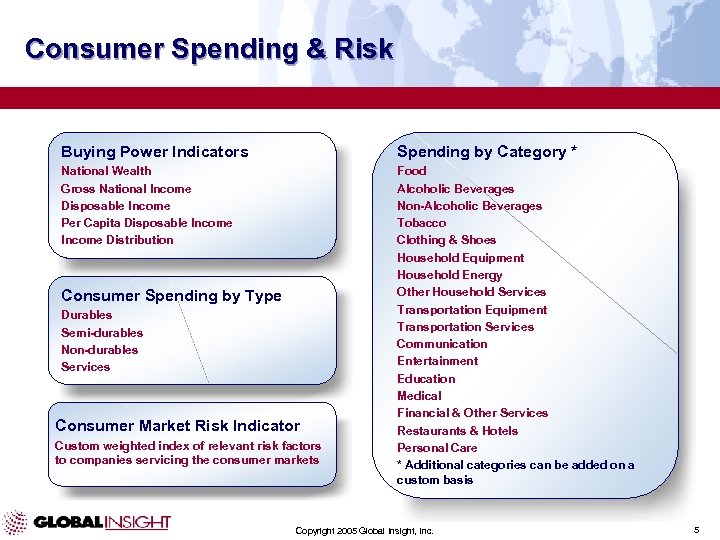
Consumer Spending & Risk Buying Power Indicators Spending by Category * National Wealth Gross National Income Disposable Income Per Capita Disposable Income Distribution Food Alcoholic Beverages Non-Alcoholic Beverages Tobacco Clothing & Shoes Household Equipment Household Energy Other Household Services Transportation Equipment Transportation Services Communication Entertainment Education Medical Financial & Other Services Restaurants & Hotels Personal Care * Additional categories can be added on a custom basis Consumer Spending by Type Durables Semi-durables Non-durables Services Consumer Market Risk Indicator Custom weighted index of relevant risk factors to companies servicing the consumer markets Copyright 2005 Global Insight, Inc. 5
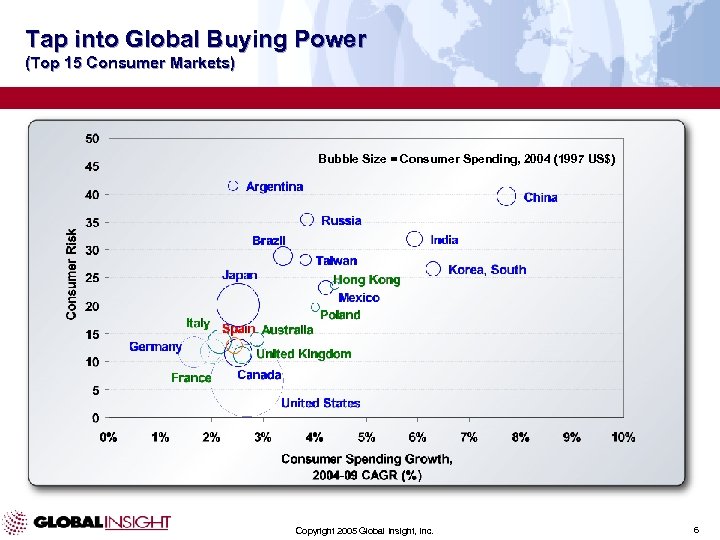
Tap into Global Buying Power (Top 15 Consumer Markets) Bubble Size = Consumer Spending, 2004 (1997 US$) Copyright 2005 Global Insight, Inc. 6
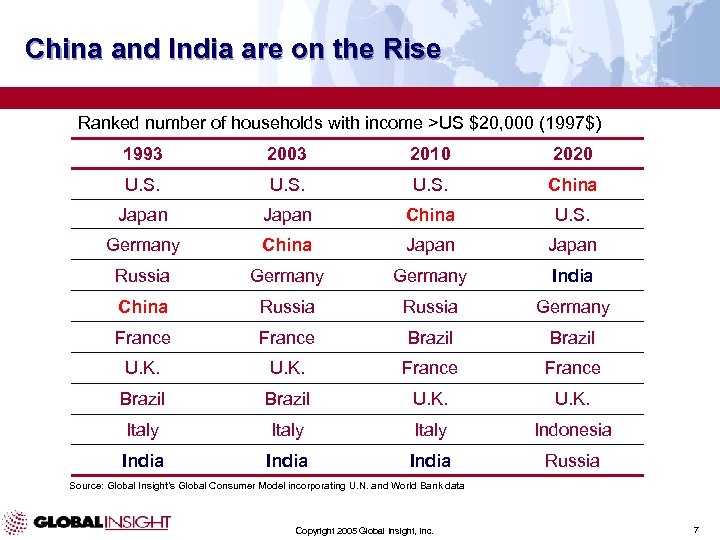
China and India are on the Rise Ranked number of households with income >US $20, 000 (1997$) 1993 2003 2010 2020 U. S. China Japan China U. S. Germany China Japan Russia Germany India China Russia Germany France Brazil U. K. Italy Indonesia India Russia Source: Global Insight’s Global Consumer Model incorporating U. N. and World Bank data Copyright 2005 Global Insight, Inc. 7
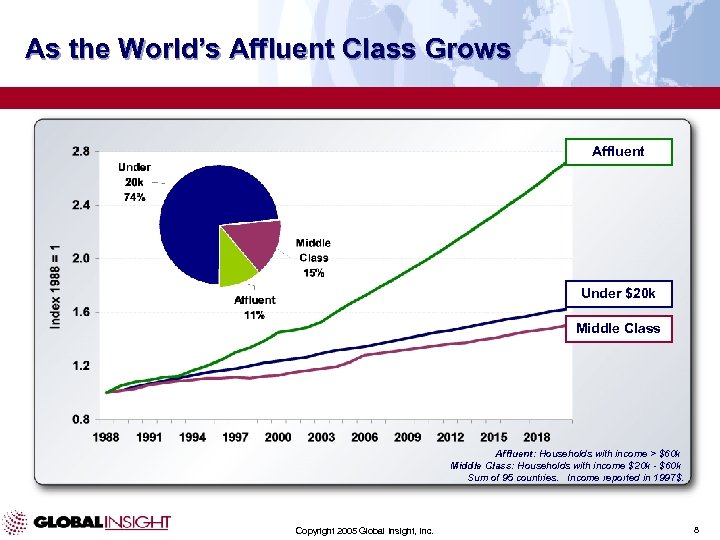
As the World’s Affluent Class Grows Affluent Under $20 k Middle Class Affluent: Households with income > $60 k Middle Class: Households with income $20 k - $60 k Sum of 95 countries. Income reported in 1997$. Copyright 2005 Global Insight, Inc. 8
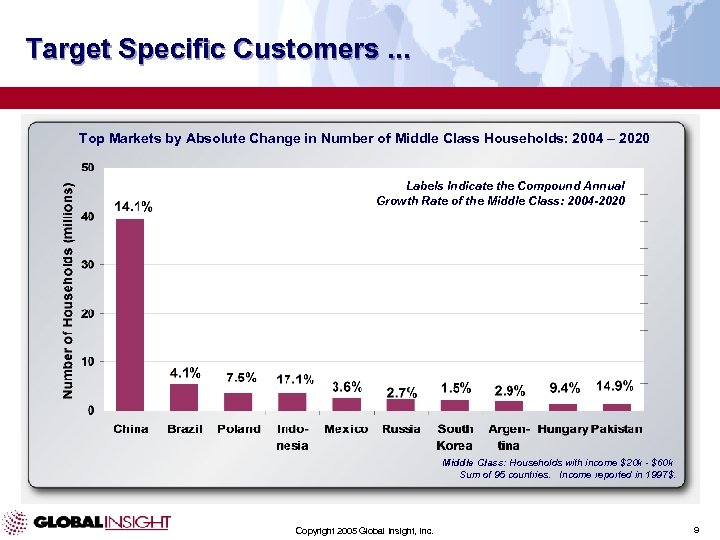
Target Specific Customers. . . Top Markets by Absolute Change in Number of Middle Class Households: 2004 – 2020 Labels Indicate the Compound Annual Growth Rate of the Middle Class: 2004 -2020 Middle Class: Households with income $20 k - $60 k Sum of 95 countries. Income reported in 1997$. Copyright 2005 Global Insight, Inc. 9
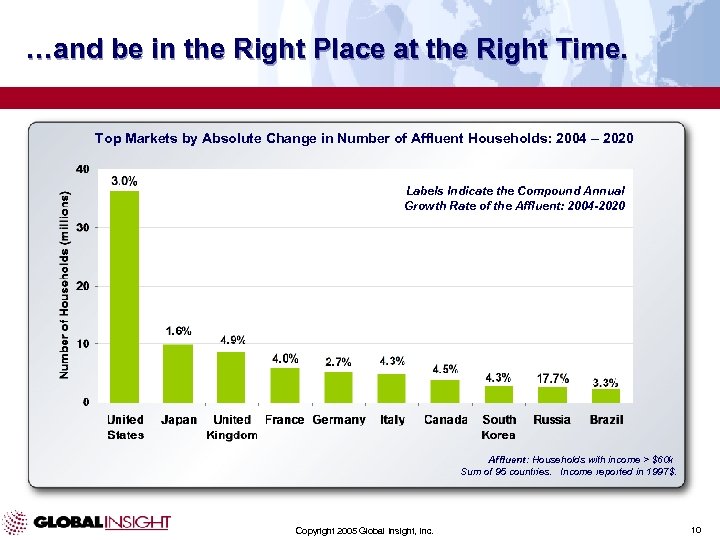
…and be in the Right Place at the Right Time. Top Markets by Absolute Change in Number of Affluent Households: 2004 – 2020 Labels Indicate the Compound Annual Growth Rate of the Affluent: 2004 -2020 Affluent: Households with income > $60 k Sum of 95 countries. Income reported in 1997$. Copyright 2005 Global Insight, Inc. 10
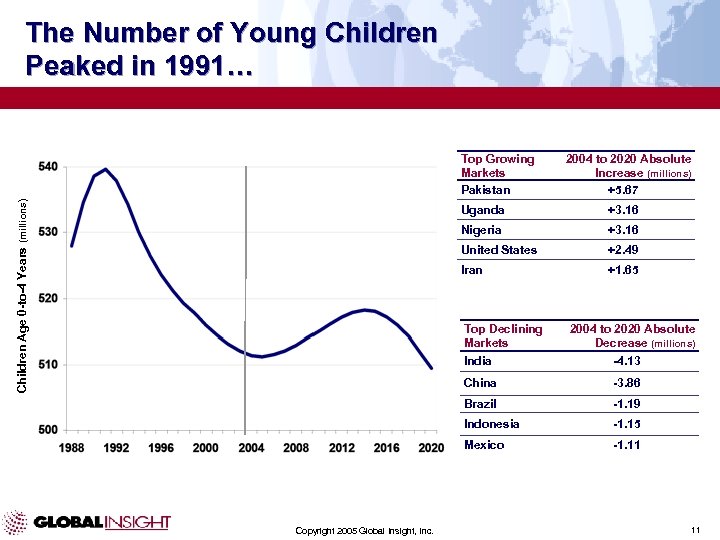
The Number of Young Children Peaked in 1991… Children Age 0 -to-4 Years (millions) Top Growing Markets Pakistan 2004 to 2020 Absolute Increase (millions) +5. 67 Uganda +3. 16 Nigeria +3. 16 United States +2. 49 Iran +1. 65 Top Declining Markets 2004 to 2020 Absolute Decrease (millions) India China -3. 86 Brazil -1. 19 Indonesia -1. 15 Mexico Copyright 2005 Global Insight, Inc. -4. 13 -1. 11 11
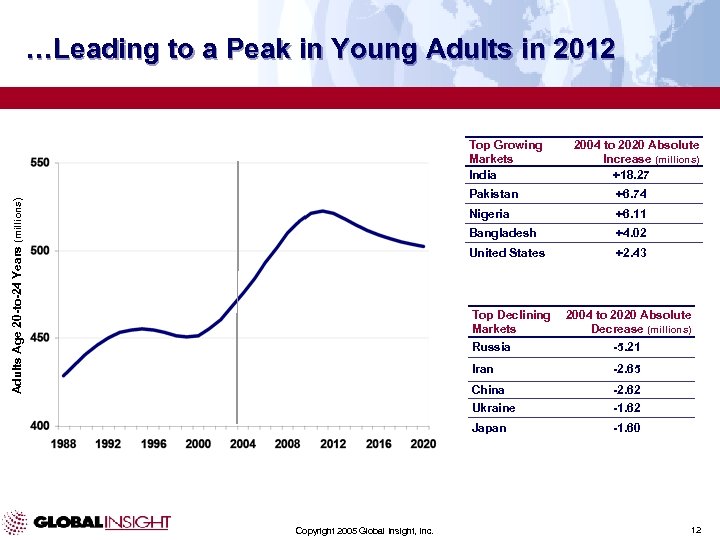
…Leading to a Peak in Young Adults in 2012 Top Growing Markets India 2004 to 2020 Absolute Increase (millions) +18. 27 +6. 74 Nigeria +6. 11 Bangladesh +4. 02 United States Adults Age 20 -to-24 Years (millions) Pakistan +2. 43 Top Declining Markets 2004 to 2020 Absolute Decrease (millions) Russia Iran -2. 65 China -2. 62 Ukraine -1. 62 Japan Copyright 2005 Global Insight, Inc. -5. 21 -1. 60 12
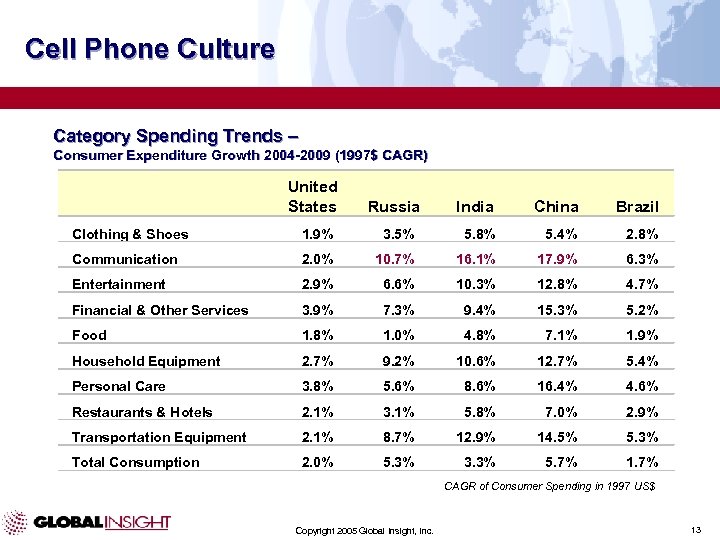
Cell Phone Culture Category Spending Trends – Consumer Expenditure Growth 2004 -2009 (1997$ CAGR) United States Russia India China Brazil Clothing & Shoes 1. 9% 3. 5% 5. 8% 5. 4% 2. 8% Communication 2. 0% 10. 7% 16. 1% 17. 9% 6. 3% Entertainment 2. 9% 6. 6% 10. 3% 12. 8% 4. 7% Financial & Other Services 3. 9% 7. 3% 9. 4% 15. 3% 5. 2% Food 1. 8% 1. 0% 4. 8% 7. 1% 1. 9% Household Equipment 2. 7% 9. 2% 10. 6% 12. 7% 5. 4% Personal Care 3. 8% 5. 6% 8. 6% 16. 4% 4. 6% Restaurants & Hotels 2. 1% 3. 1% 5. 8% 7. 0% 2. 9% Transportation Equipment 2. 1% 8. 7% 12. 9% 14. 5% 5. 3% Total Consumption 2. 0% 5. 3% 3. 3% 5. 7% 1. 7% CAGR of Consumer Spending in 1997 US$ Copyright 2005 Global Insight, Inc. 13
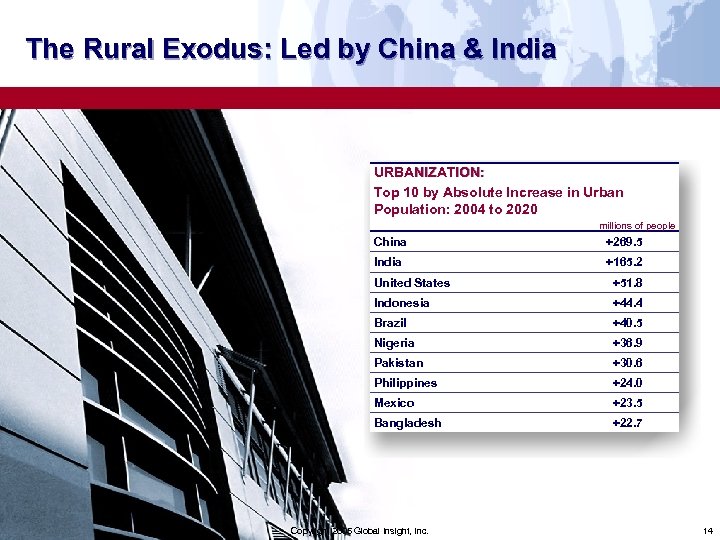
The Rural Exodus: Led by China & India URBANIZATION: Top 10 by Absolute Increase in Urban Population: 2004 to 2020 millions of people China +269. 5 India +165. 2 United States +51. 8 Indonesia +44. 4 Brazil +40. 5 Nigeria +36. 9 Pakistan +30. 6 Philippines +24. 0 Mexico +23. 5 Bangladesh +22. 7 Copyright 2005 Global Insight, Inc. 14 14
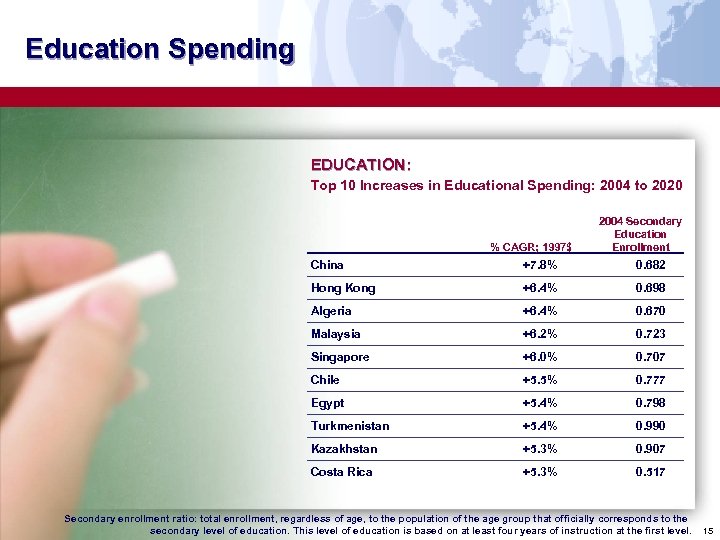
Education Spending EDUCATION: Top 10 Increases in Educational Spending: 2004 to 2020 % CAGR; 1997$ 2004 Secondary Education Enrollment China +7. 8% 0. 682 Hong Kong +6. 4% 0. 698 Algeria +6. 4% 0. 670 Malaysia +6. 2% 0. 723 Singapore +6. 0% 0. 707 Chile +5. 5% 0. 777 Egypt +5. 4% 0. 798 Turkmenistan +5. 4% 0. 990 Kazakhstan +5. 3% 0. 907 Costa Rica +5. 3% 0. 517 Secondary enrollment ratio: total enrollment, regardless of age, to the population of the age group that officially corresponds to the secondary level of education. This level 2005 Global Insight, Inc. on at least four years of instruction at the first level. 15 15 Copyright of education is based
Take it to the Next Level Copyright 2005 Global Insight, Inc. 16
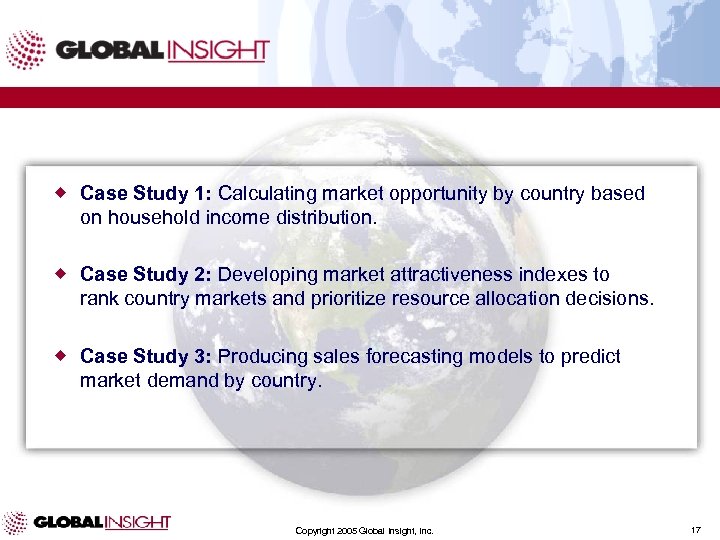
® Case Study 1: Calculating market opportunity by country based on household income distribution. ® Case Study 2: Developing market attractiveness indexes to rank country markets and prioritize resource allocation decisions. ® Case Study 3: Producing sales forecasting models to predict market demand by country. Copyright 2005 Global Insight, Inc. 17
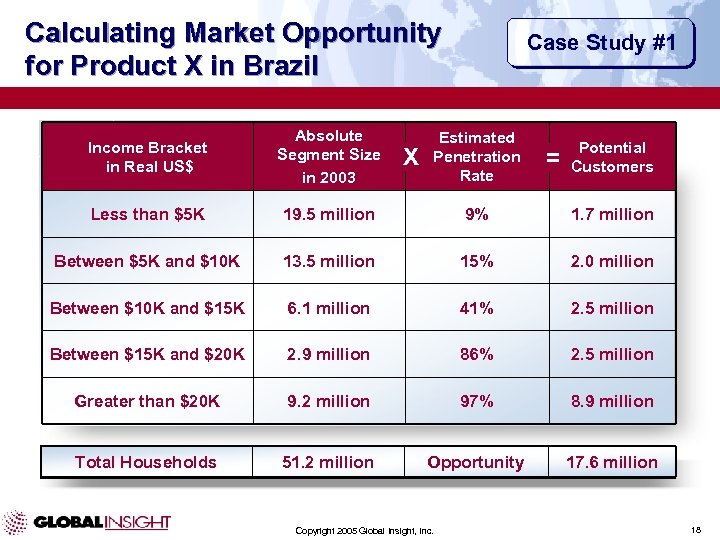
Calculating Market Opportunity for Product X in Brazil Case Study #1 Income Bracket in Real US$ Absolute Segment Size in 2003 Less than $5 K 19. 5 million 9% 1. 7 million Between $5 K and $10 K 13. 5 million 15% 2. 0 million Between $10 K and $15 K 6. 1 million 41% 2. 5 million Between $15 K and $20 K 2. 9 million 86% 2. 5 million Greater than $20 K 9. 2 million 97% 8. 9 million Total Households 51. 2 million Opportunity 17. 6 million X Estimated Penetration Rate Copyright 2005 Global Insight, Inc. = Potential Customers 18
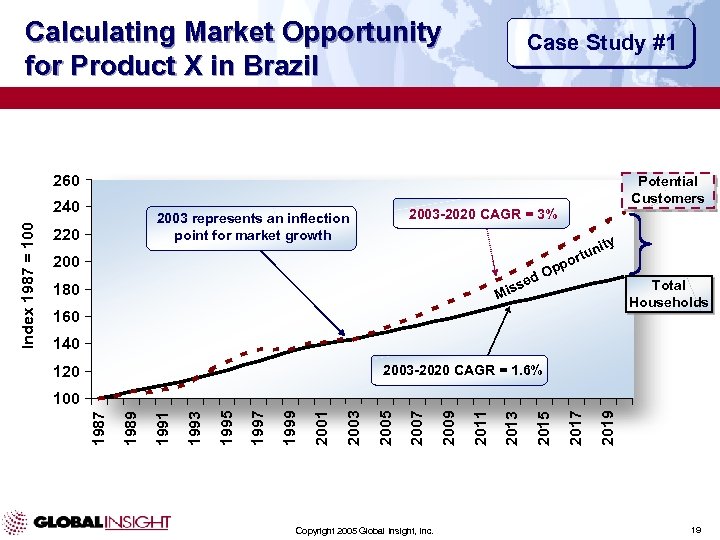
Calculating Market Opportunity for Product X in Brazil Case Study #1 260 Potential Customers 2003 -2020 CAGR = 3% 2003 represents an inflection point for market growth 220 200 ed iss M 180 ity un rt po Op Total Households 160 140 120 2003 -2020 CAGR = 1. 6% Copyright 2005 Global Insight, Inc. 2019 2017 2015 2013 2011 2009 2007 2005 2003 2001 1999 1997 1995 1993 1991 1989 100 1987 Index 1987 = 100 240 19
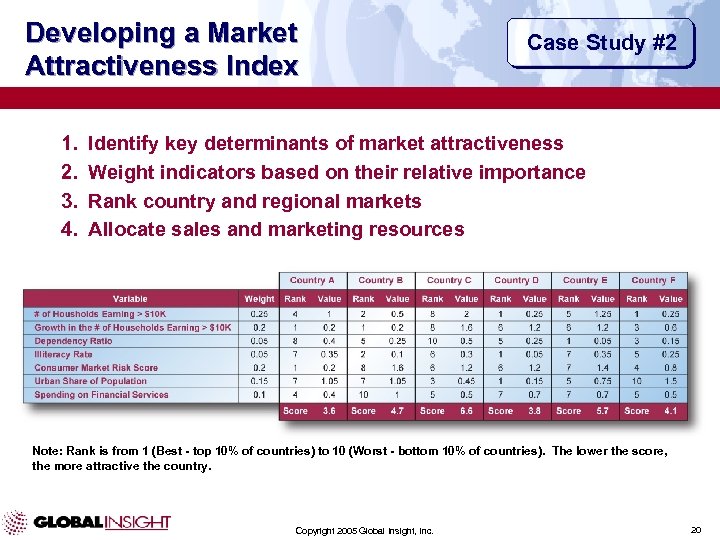
Developing a Market Attractiveness Index 1. 2. 3. 4. Case Study #2 Identify key determinants of market attractiveness Weight indicators based on their relative importance Rank country and regional markets Allocate sales and marketing resources Note: Rank is from 1 (Best - top 10% of countries) to 10 (Worst - bottom 10% of countries). The lower the score, the more attractive the country. Copyright 2005 Global Insight, Inc. 20
Detailed Product Demand Modeling Case Study #3 The following case study presents the methodology of an actual product demand modeling assignment. The product or service cannot be identified for reasons of confidentiality. w A market research company provided product sales history by: • Gender • 8 Age Groups • 20 Product Categories • 10 Distribution Channels • 2 Income Categories w Time series history was limited and samples were not consistent over time. Copyright 2005 Global Insight, Inc. 21
Detailed Product Demand Modeling Case Study #3 Product sales projections by gender, age, product category, channel, and income were generated in five steps. Step 1 Generate aggregate product sales projections for 3 gender/population segments (men & boys, women & girls, infants) consistent with Department of Commerce aggregate product trends and the U. S. economic environment. Step 2 Generate aggregate product sales by gender and all age segments consistent with population growth and spending intensity in each of the age segments. Copyright 2005 Global Insight, Inc. 22
Detailed Product Demand Modeling Case Study #3 Step 3 Generate product sales by gender, age and detailed product categories consistent with Department of Commerce Consumer Expenditure Survey product trends and qualitative product trends. Step 4 Generate product sales by gender, age, product and channel consistent with Global Insight’s channel growth projections. Step 5 Generate product sales by gender, age, product, channel and income range consistent with Global Insight’s household income distribution projections. Copyright 2005 Global Insight, Inc. 23

Appendix: Consumer Market Modeling Approach Copyright 2005 Global Insight, Inc. Copyright 2004 Global Insight, Inc. 24 24
Consumer Market Modeling Understanding Your Market Today… u Improves the accuracy of sales and market forecasts u Provides a better understanding of how sales and markets are influenced by company, market, or economic factors u Solves the market planning puzzle …to compete more effectively tomorrow. Copyright 2005 Global Insight, Inc. 25 25
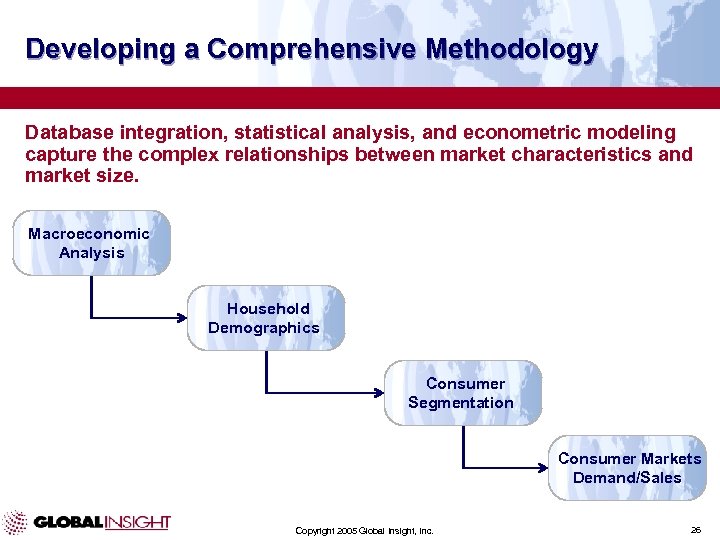
Developing a Comprehensive Methodology Database integration, statistical analysis, and econometric modeling capture the complex relationships between market characteristics and market size. Macroeconomic Analysis Household Demographics Consumer Segmentation Consumer Markets Demand/Sales Copyright 2005 Global Insight, Inc. 26
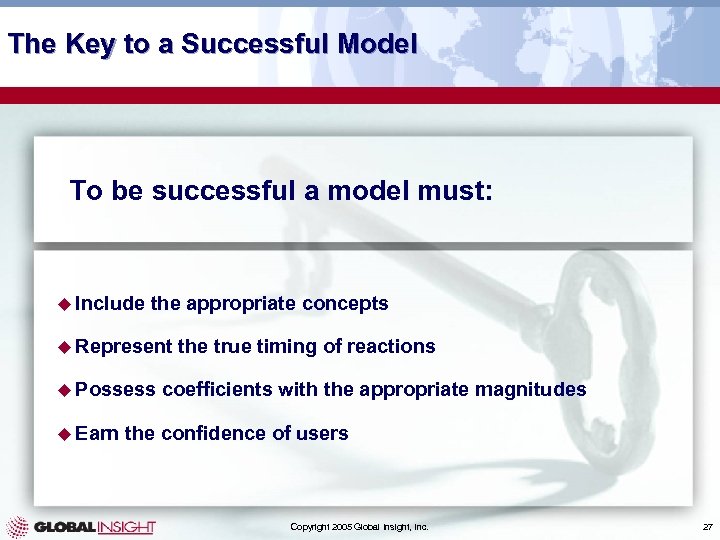
The Key to a Successful Model To be successful a model must: u Include the appropriate concepts u Represent u Possess u Earn the true timing of reactions coefficients with the appropriate magnitudes the confidence of users Copyright 2005 Global Insight, Inc. 27 27
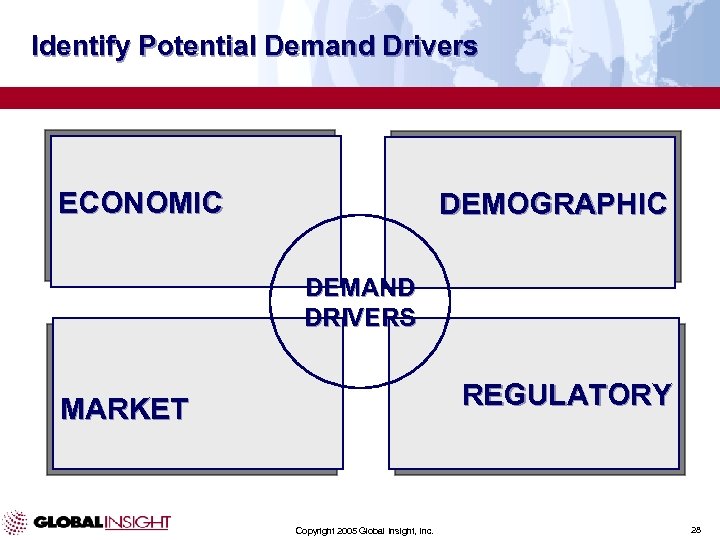
Identify Potential Demand Drivers ECONOMIC DEMOGRAPHIC DEMAND DRIVERS REGULATORY MARKET Copyright 2005 Global Insight, Inc. 28
Identifying Turning Points Can Make You a Hero u IDENTIFY MODEL DRIVERS: Leading indicators or high-frequency economic concepts that will allow the model to identify turning points. u USE TIMELY INPUTS: When structuring highfrequency models, include concepts that are reported in a timely fashion. u EMPLOY FORECAST CONSTRAINTS: Important model drivers with considerable forecast volatility can be used to put bounds around the forecast. u ONE IS NOT ENOUGH: A single set of forecasts is not adequate for a highly volatile industry. Copyright 2005 Global Insight, Inc. 29 29
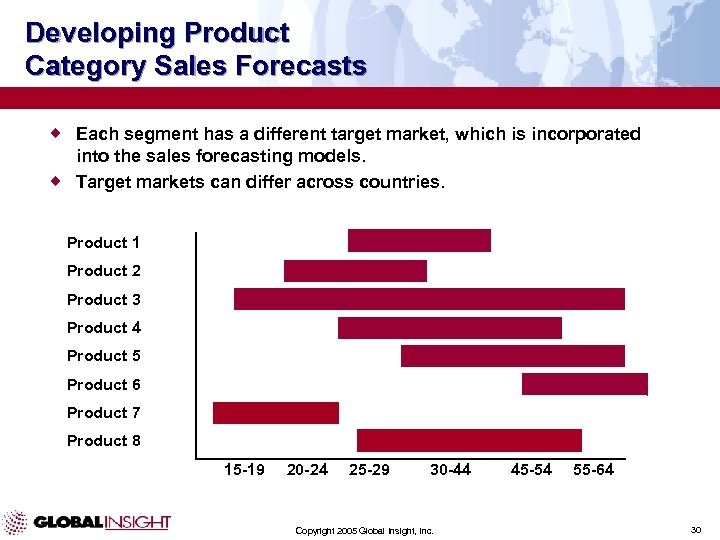
Developing Product Category Sales Forecasts ® Each segment has a different target market, which is incorporated into the sales forecasting models. ® Target markets can differ across countries. Product 1 Product 2 Product 3 Product 4 Product 5 Product 6 Product 7 Product 8 15 -19 20 -24 25 -29 30 -44 Copyright 2005 Global Insight, Inc. 45 -54 55 -64 30
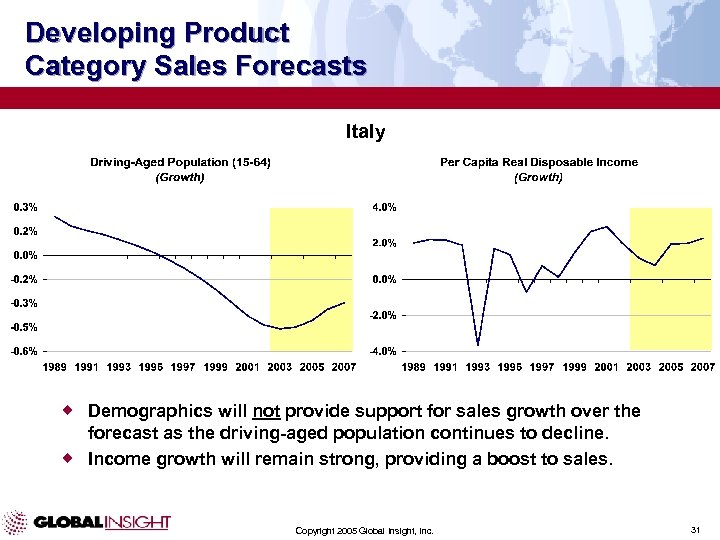
Developing Product Category Sales Forecasts Italy ® Demographics will not provide support for sales growth over the forecast as the driving-aged population continues to decline. ® Income growth will remain strong, providing a boost to sales. Copyright 2005 Global Insight, Inc. 31
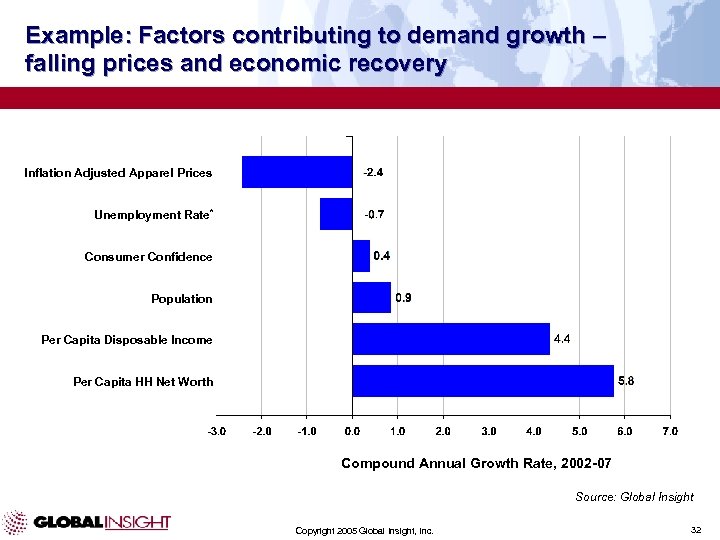
Example: Factors contributing to demand growth – falling prices and economic recovery Inflation Adjusted Apparel Prices Unemployment Rate* Consumer Confidence Population Per Capita Disposable Income Per Capita HH Net Worth Compound Annual Growth Rate, 2002 -07 Source: Global Insight Copyright 2005 Global Insight, Inc. 32
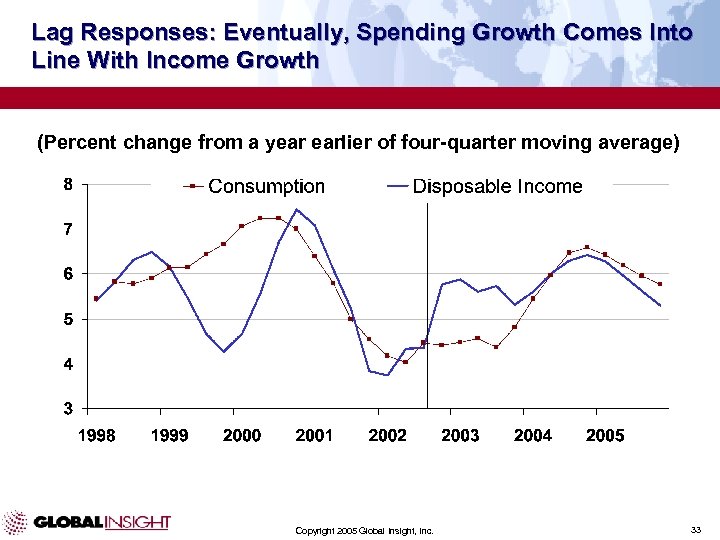
Lag Responses: Eventually, Spending Growth Comes Into Line With Income Growth (Percent change from a year earlier of four-quarter moving average) Copyright 2005 Global Insight, Inc. 33
Fundamental Principles of Forecast Modeling ® ® Examine the data. Data are dumb. You must be smart. Government data should always be used to check trade association or market research data. Benchmark your results against relevant experience. Copyright 2005 Global Insight, Inc. 34
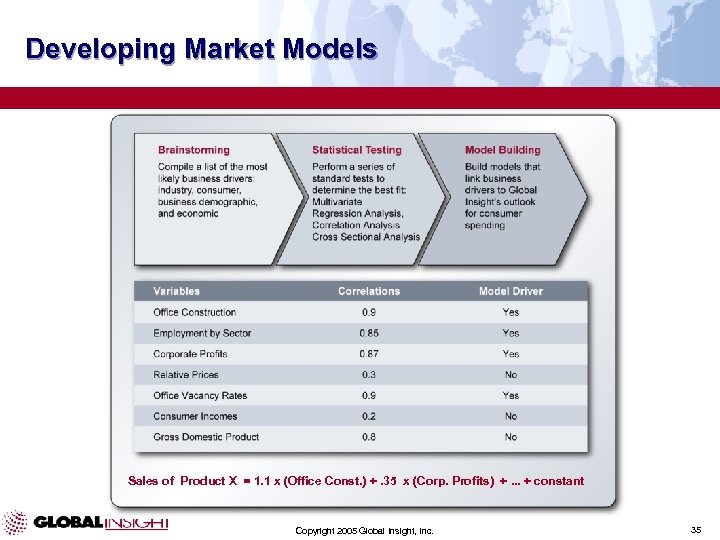
Developing Market Models Sales of Product X = 1. 1 x (Office Const. ) +. 35 x (Corp. Profits) +. . . + constant Copyright 2005 Global Insight, Inc. 35
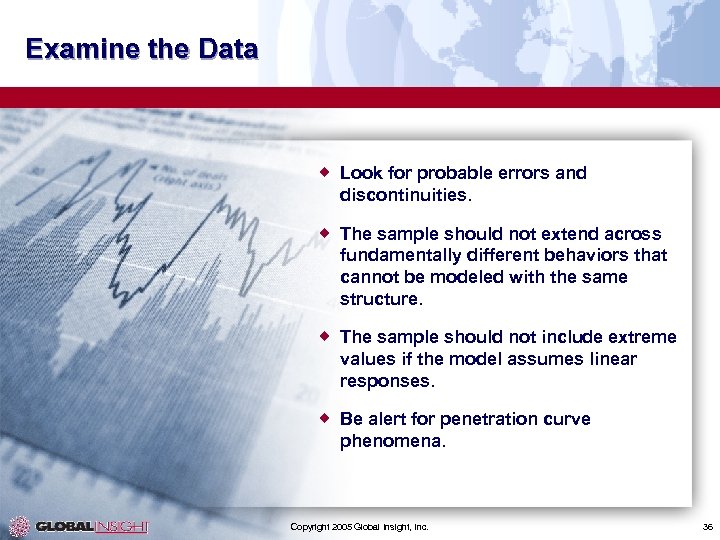
Examine the Data ® Look for probable errors and discontinuities. ® The sample should not extend across fundamentally different behaviors that cannot be modeled with the same structure. ® The sample should not include extreme values if the model assumes linear responses. ® Be alert for penetration curve phenomena. Copyright 2005 Global Insight, Inc. 36 36
Data are Dumb… You Must be Smart ® Structural modeling is the most trustworthy w w Search for causation, not correlation Be clear whether you are modeling demand or supply – only one per equation ® T-statistics are often misinterpreted w w T’s measure precision of estimate, not whether a factor is important Multicolinearity must be dealt with through constraints, not exclusion of good factors Copyright 2005 Global Insight, Inc. 37 37
Use Government Data to Check Trade Association or Market Research Data ® The government is careful to provide consistent consumer demand price series over time. ® The government is even more careful about price and volume separation ® However, government imputations and quality adjustments must be used with care Copyright 2005 Global Insight, Inc. 38 38
Benchmark Results Against Relevant Experience ® Counter-intuitive elasticities are usually a sign of spurious correlation, data errors, or multicolinearity ® Short-run income elasticities should be high for discretionary goods, particularly items that consumers can postpone purchasing ® Price elasticities should be high when close substitutes are available ® Demographic factors, often trend-like, are easily confused with penetration curves Copyright 2005 Global Insight, Inc. 39

Thank you. For Additional Information: Chris Holling, 416 -682 -7303 chris. holling@globalinsight. com Copyright 2005 Global Insight, Inc. 40
Скачать презентацию Global Consumer Buying Power Segmentation and Forecasts Prepared
449c0afab19d4b34b1527df4969da38f.ppt