 Скачать презентацию Global Change New Operations and Modeling Challenges Ants
63a6a32261ab937cfcbcc78a5e159d0e.ppt
- Количество слайдов: 27



Global Change: New Operations and Modeling Challenges Ants Leetmaa Geophysical Fluid Dynamics Laboratory National Oceanic and Atmospheric Administration Princeton, NJ
OVERVIEW Grand Challenges for 21 st Century • population growth • altered biogeochemical cycles • a changing climate A prototype forecast in 2030 Existing capabilities to meet the challenge Institutional challenges for the NWS and NOAA
Population Growth and Associated Issues • 9 billion (B) people by 2050 (50% increase) • Increasing urbanization into mega-cities – 4 B new city dwellers – aging populations • Food availability requires sustainable increases in food output/hectare of 200 -300% • Energy & Security • Others • Water availability • health threats – pollution, others
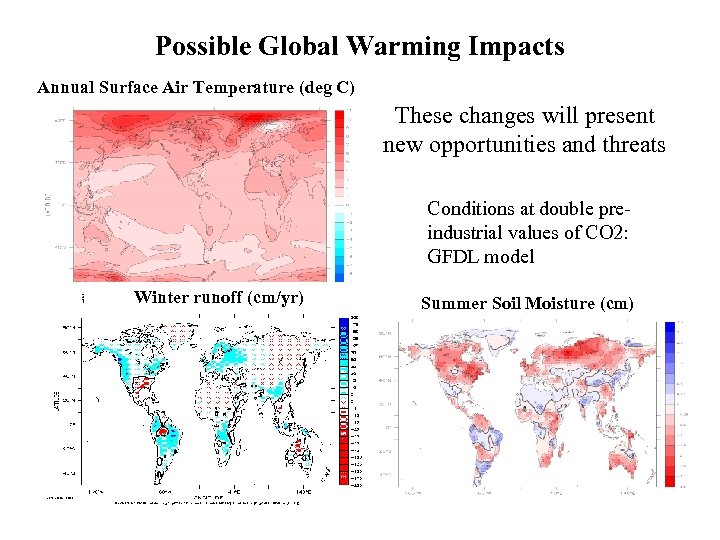
Possible Global Warming Impacts Annual Surface Air Temperature (deg C) These changes will present new opportunities and threats Conditions at double preindustrial values of CO 2: GFDL model Winter runoff (cm/yr) Annual change in runoff (cm/yr) Wetter Drier Summer Soil Moisture (cm)
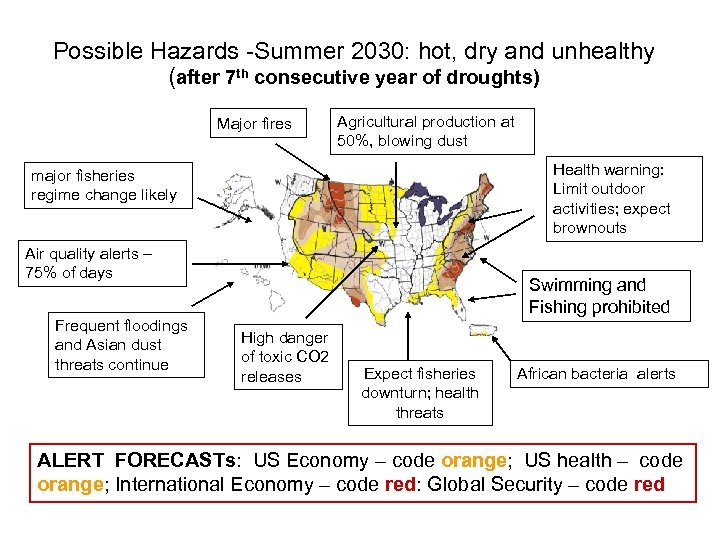
Possible Hazards -Summer 2030: hot, dry and unhealthy (after 7 th consecutive year of droughts) Major fires Agricultural production at 50%, blowing dust Health warning: Limit outdoor activities; expect brownouts major fisheries regime change likely Air quality alerts – 75% of days Frequent floodings and Asian dust threats continue Swimming and Fishing prohibited High danger of toxic CO 2 releases Expect fisheries downturn; health threats African bacteria alerts ALERT FORECASTs: US Economy – code orange; US health – code orange; International Economy – code red: Global Security – code red
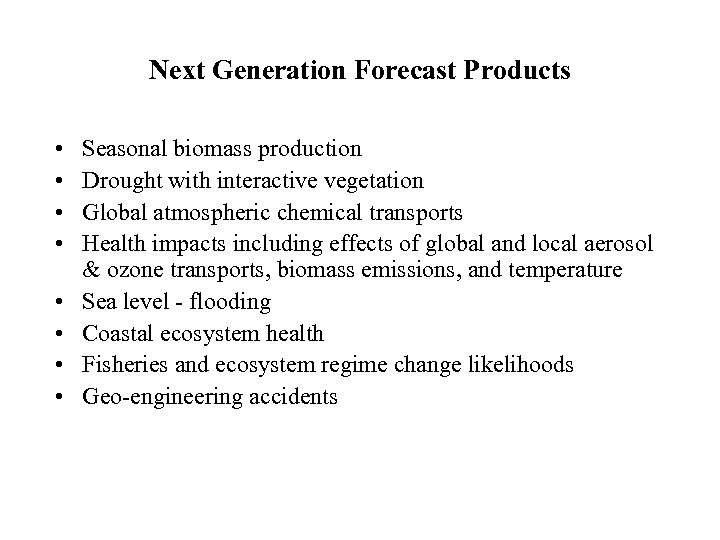
Next Generation Forecast Products • • Seasonal biomass production Drought with interactive vegetation Global atmospheric chemical transports Health impacts including effects of global and local aerosol & ozone transports, biomass emissions, and temperature Sea level - flooding Coastal ecosystem health Fisheries and ecosystem regime change likelihoods Geo-engineering accidents
Extending the Product Suite: Institutional Challenges • Your focus on current product delivery will limit investment in new areas • New products entail risks • Technology progresses faster than NOAA • Challenge for NOAA is to develop a common architecture to foster transition to NOAA-next.
Some Issues to Ponder • What will be NOAA’s most important future product suites? (hint – economy, health, environment) • How will you develop the appropriate modeling and product delivery mechanisms? (hint – it won’t all be done in house) • How are you going to work with the rest of NOAA to meet these future challenges
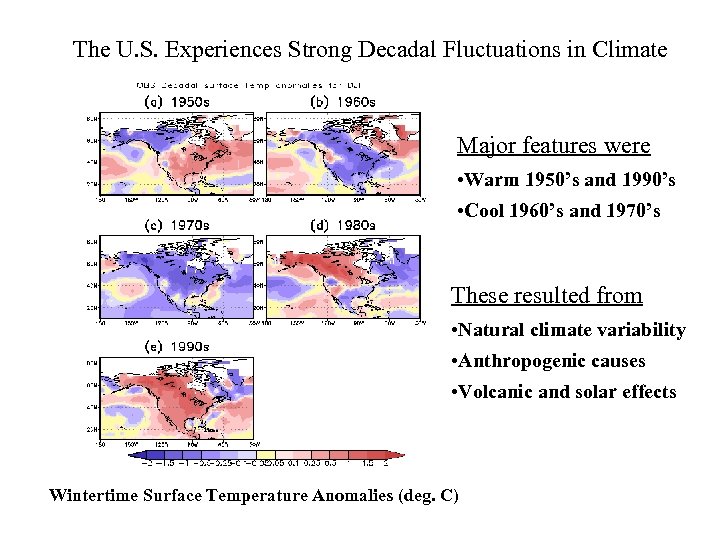
The U. S. Experiences Strong Decadal Fluctuations in Climate Major features were • Warm 1950’s and 1990’s • Cool 1960’s and 1970’s These resulted from • Natural climate variability • Anthropogenic causes • Volcanic and solar effects Wintertime Surface Temperature Anomalies (deg. C)
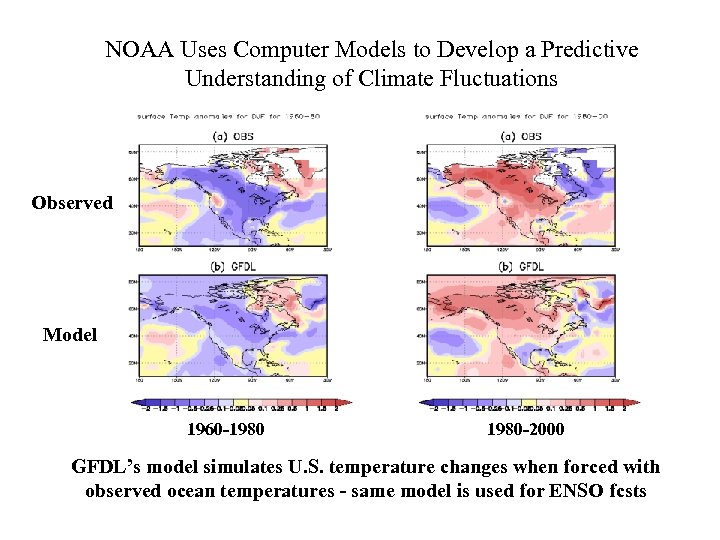
NOAA Uses Computer Models to Develop a Predictive Understanding of Climate Fluctuations Observed Model 1960 -1980 -2000 GFDL’s model simulates U. S. temperature changes when forced with observed ocean temperatures - same model is used for ENSO fcsts
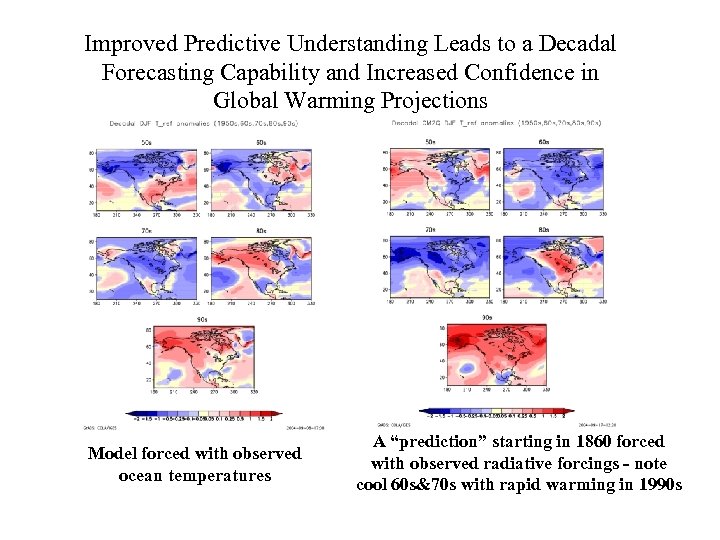
Improved Predictive Understanding Leads to a Decadal Forecasting Capability and Increased Confidence in Global Warming Projections Model forced with observed ocean temperatures A “prediction” starting in 1860 forced with observed radiative forcings - note cool 60 s&70 s with rapid warming in 1990 s
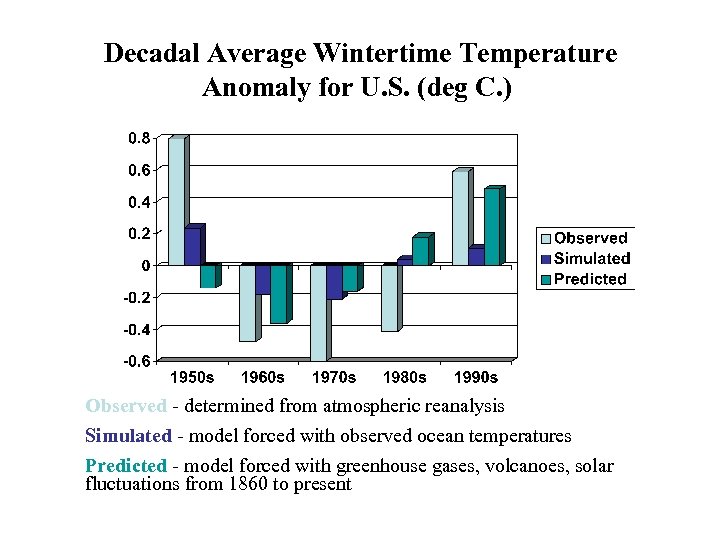
Decadal Average Wintertime Temperature Anomaly for U. S. (deg C. ) Observed - determined from atmospheric reanalysis Simulated - model forced with observed ocean temperatures Predicted - model forced with greenhouse gases, volcanoes, solar fluctuations from 1860 to present
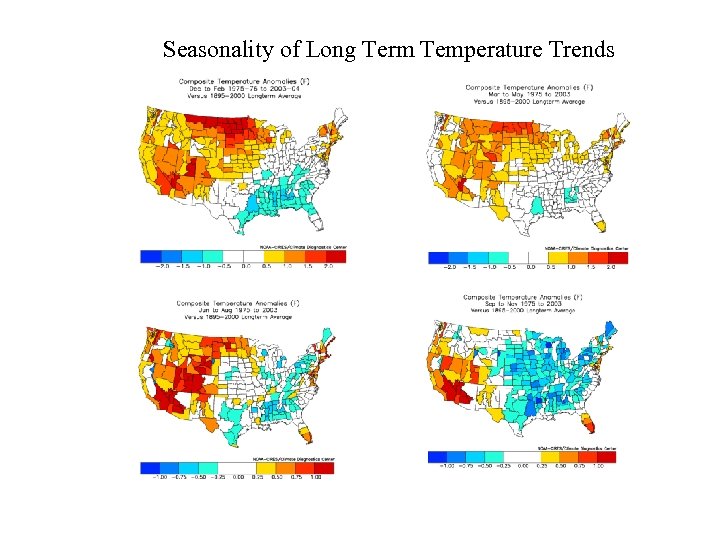
Seasonality of Long Term Temperature Trends
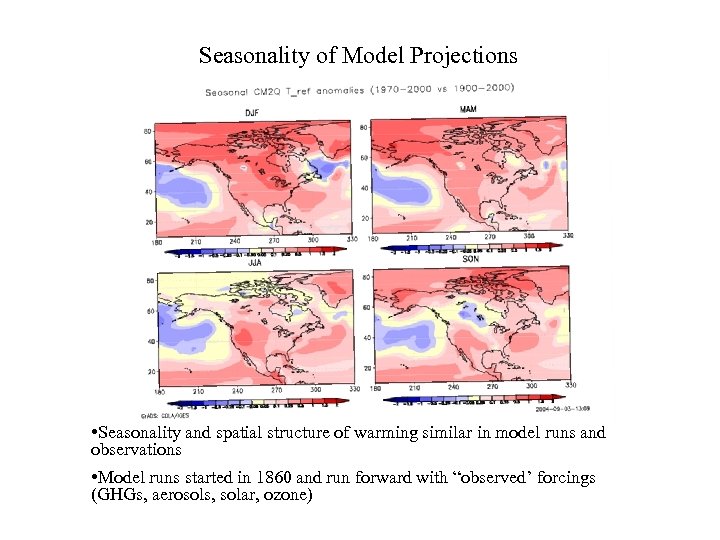
Seasonality of Model Projections • Seasonality and spatial structure of warming similar in model runs and observations • Model runs started in 1860 and run forward with “observed’ forcings (GHGs, aerosols, solar, ozone)
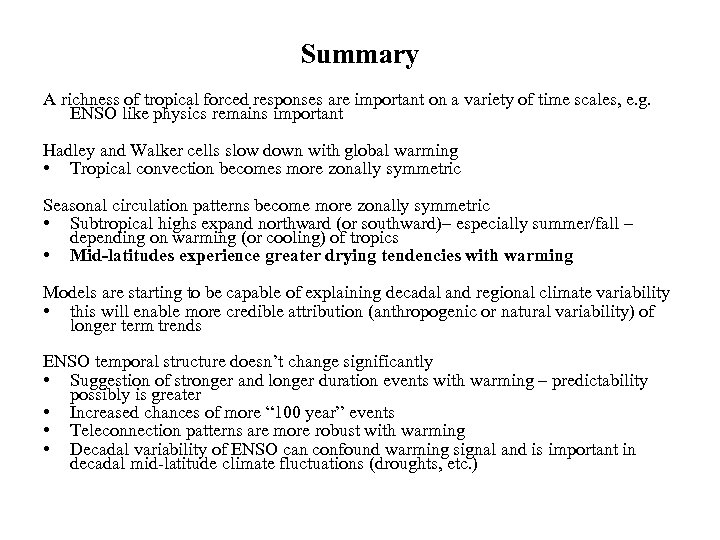
Summary A richness of tropical forced responses are important on a variety of time scales, e. g. ENSO like physics remains important Hadley and Walker cells slow down with global warming • Tropical convection becomes more zonally symmetric Seasonal circulation patterns become more zonally symmetric • Subtropical highs expand northward (or southward)– especially summer/fall – depending on warming (or cooling) of tropics • Mid-latitudes experience greater drying tendencies with warming Models are starting to be capable of explaining decadal and regional climate variability • this will enable more credible attribution (anthropogenic or natural variability) of longer term trends ENSO temporal structure doesn’t change significantly • Suggestion of stronger and longer duration events with warming – predictability possibly is greater • Increased chances of more “ 100 year” events • Teleconnection patterns are more robust with warming • Decadal variability of ENSO can confound warming signal and is important in decadal mid-latitude climate fluctuations (droughts, etc. )

End
Predictability of Atmospheric Variations: Present and Future Tony Rosati and Gabriel Vecchi Geophysical Fluid Dynamics Laboratory NOAA/OAR Princeton, NJ 08542
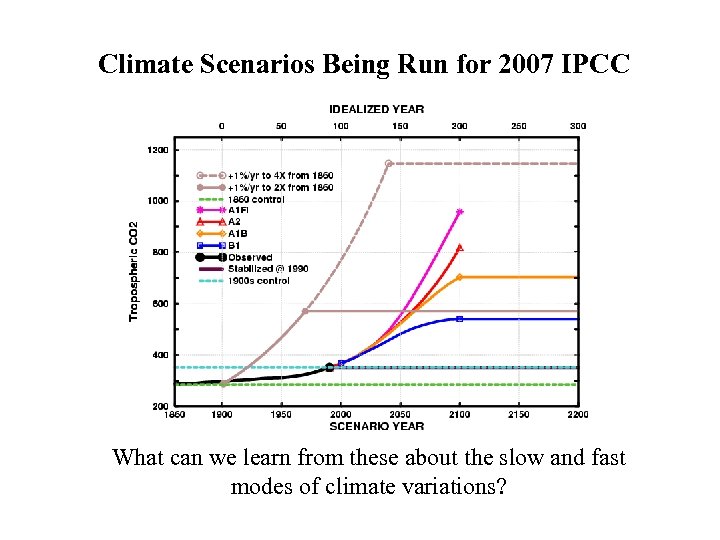
Climate Scenarios Being Run for 2007 IPCC What can we learn from these about the slow and fast modes of climate variations?
Preliminary Results from IPCC 2007 Runs The slow modes - changes to the general circulation • Hadley and Walker cells • Season means The fast modes -impacts of change on climate variability (ENSO)
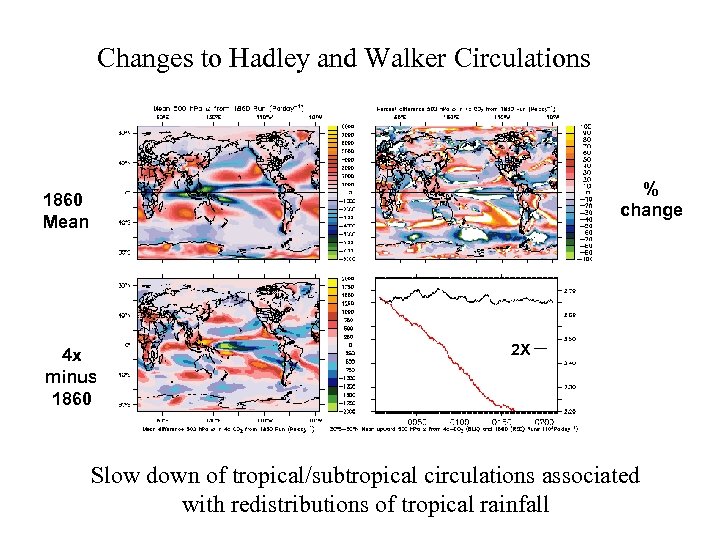
Changes to Hadley and Walker Circulations ( 500 mb vertical velocity field) % change 1860 Mean 1860 4 x minus 1860 2 X 2 x Slow down of tropical/subtropical circulations associated with redistributions of tropical rainfall
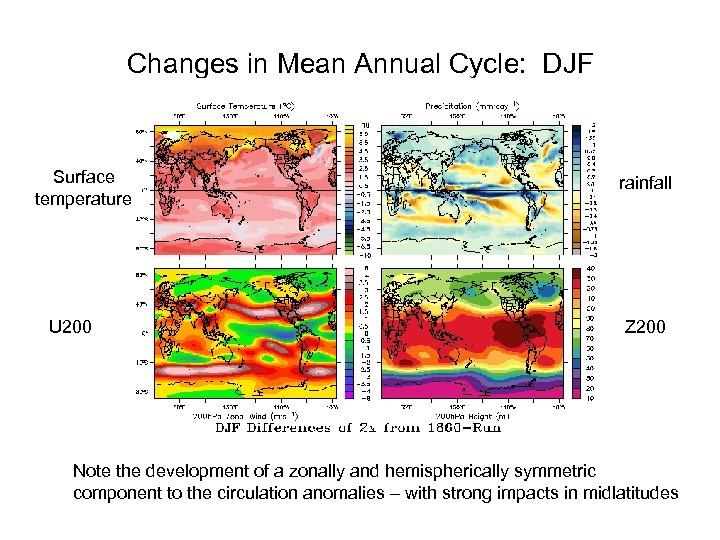
Changes in Mean Annual Cycle: DJF Surface temperature U 200 rainfall Z 200 Note the development of a zonally and hemispherically symmetric component to the circulation anomalies – with strong impacts in midlatitudes
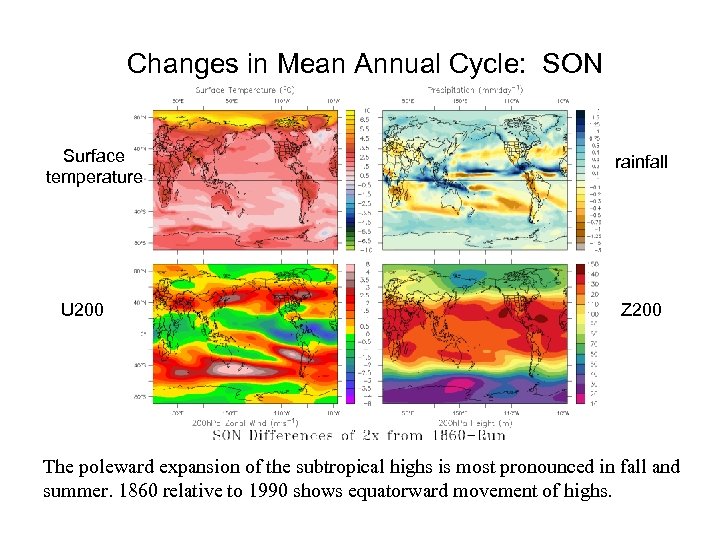
Changes in Mean Annual Cycle: SON Surface temperature U 200 rainfall Z 200 The poleward expansion of the subtropical highs is most pronounced in fall and summer. 1860 relative to 1990 shows equatorward movement of highs.
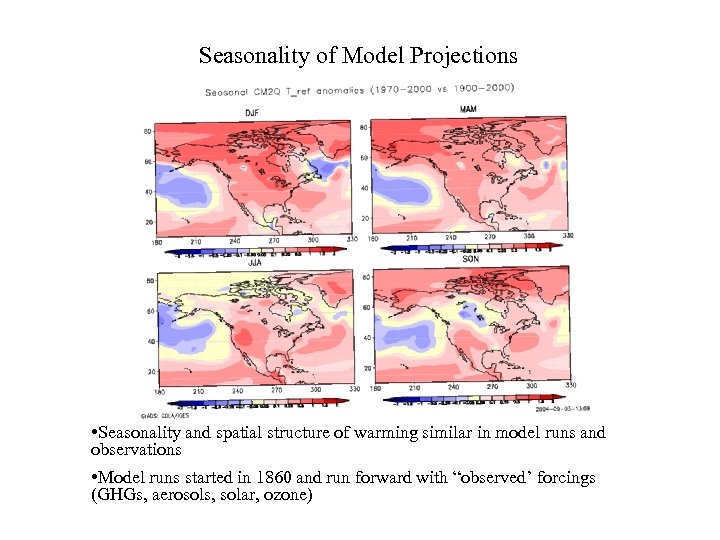
Seasonality of Model Projections • Seasonality and spatial structure of warming similar in model runs and observations • Model runs started in 1860 and run forward with “observed’ forcings (GHGs, aerosols, solar, ozone)
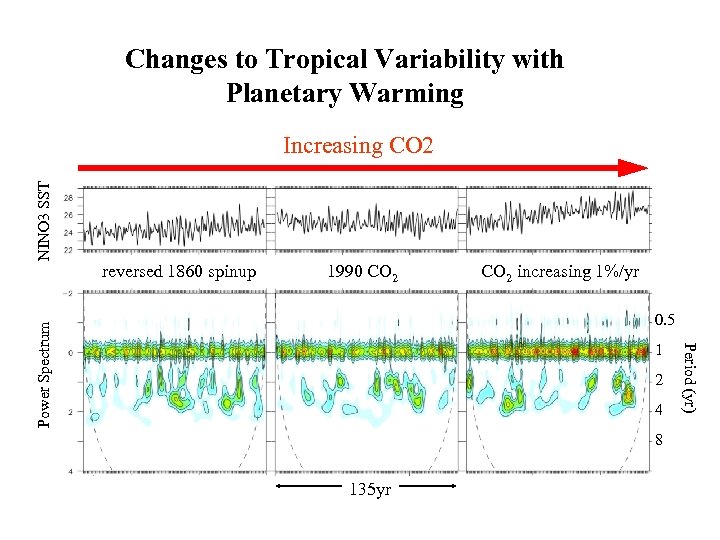
Changes to Tropical Variability with Planetary Warming NINO 3 SST Increasing CO 2 1990 CO 2 increasing 1%/yr 0. 5 1 2 4 8 135 yr Period (yr) Power Spectrum reversed 1860 spinup
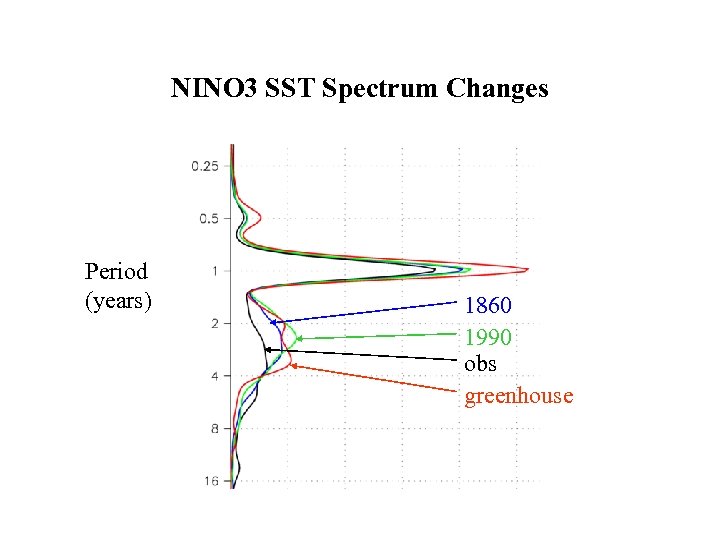
NINO 3 SST Spectrum Changes Period (years) 1860 1990 obs greenhouse
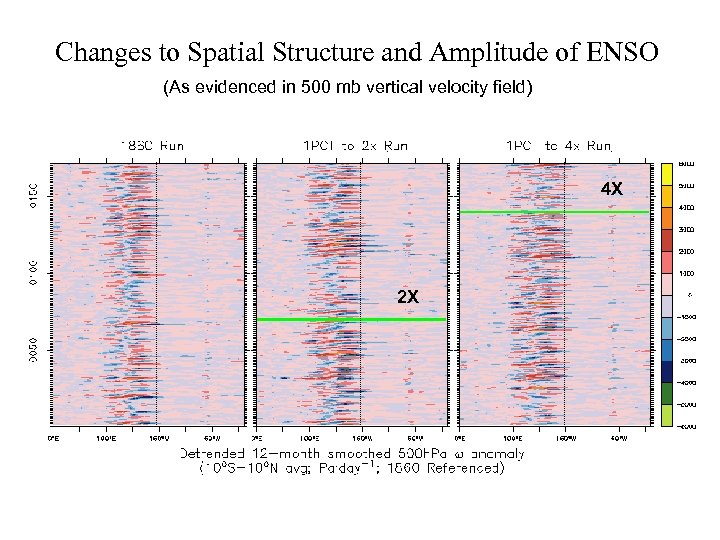
Changes to Spatial Structure and Amplitude of ENSO (As evidenced in 500 mb vertical velocity field) 4 X 2 X
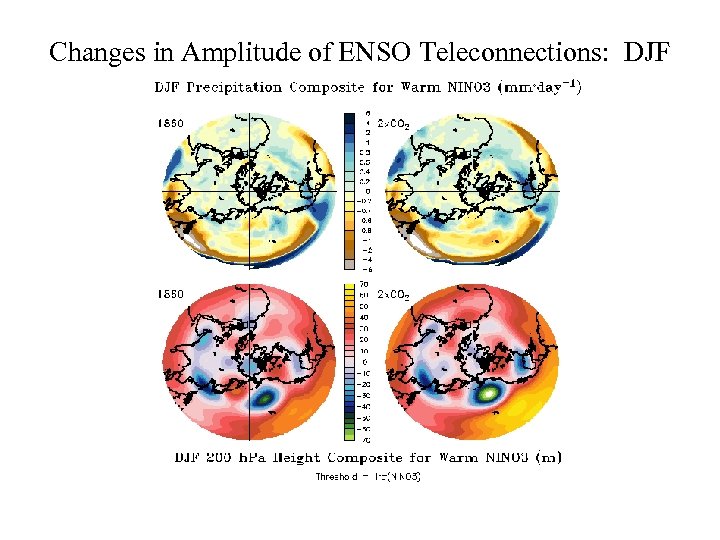
Changes in Amplitude of ENSO Teleconnections: DJF
Скачать презентацию Global Change New Operations and Modeling Challenges Ants
63a6a32261ab937cfcbcc78a5e159d0e.ppt