 Скачать презентацию Global Change and Air Pollution Shiliang Wu 1
715545a2a0cddc218451a73542674e49.ppt
- Количество слайдов: 1



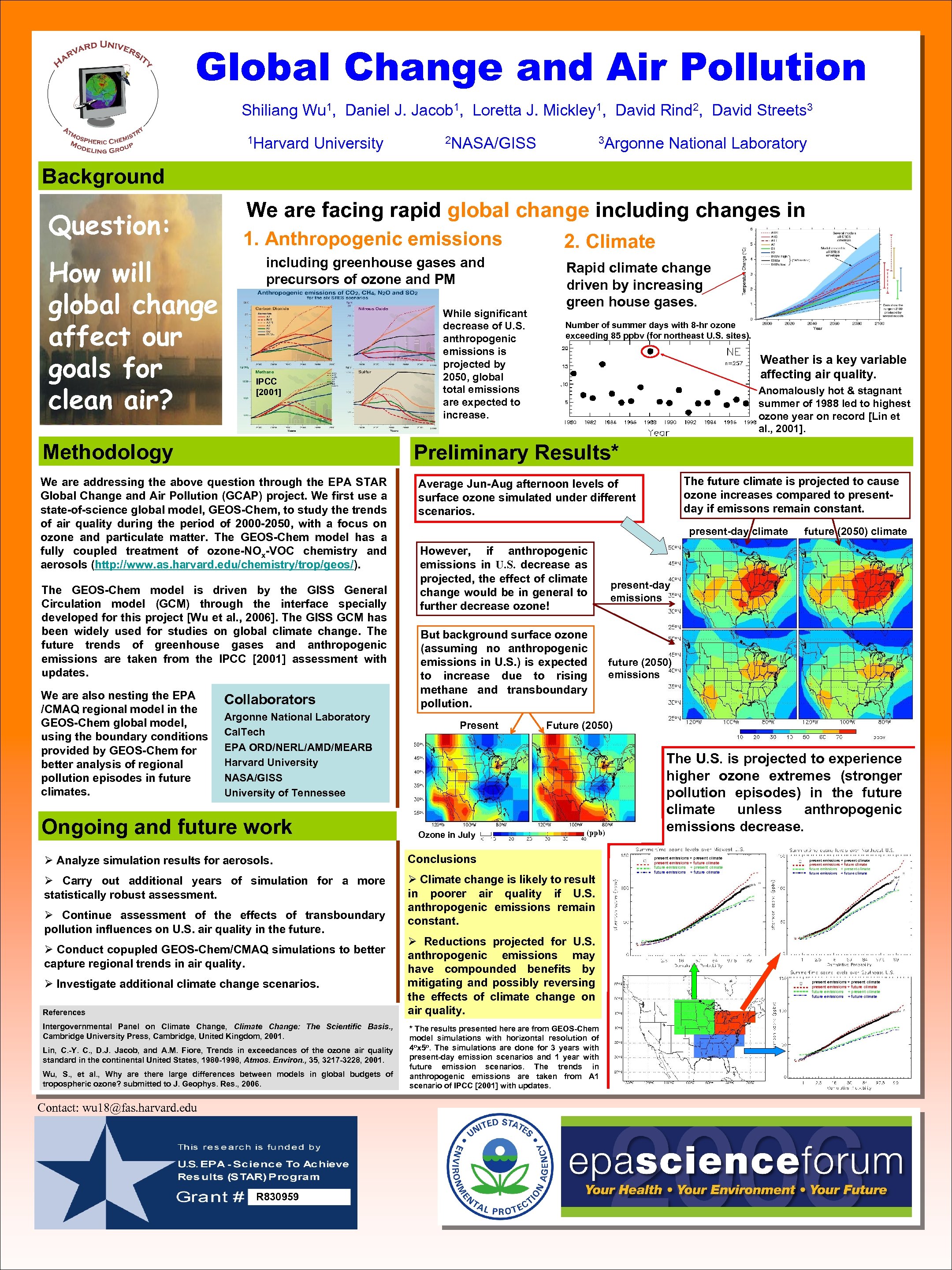
Global Change and Air Pollution Shiliang Wu 1, Daniel J. Jacob 1, Loretta J. Mickley 1, David Rind 2, David Streets 3 1 Harvard University 2 NASA/GISS 3 Argonne National Laboratory Background How will global change affect our goals for clean air? 1. Anthropogenic emissions including greenhouse gases and precursors of ozone and PM IPCC [2001] Methodology Rapid climate change driven by increasing green house gases. IPCC [2001] Number of summer days with 8 -hr ozone exceeding 85 ppbv (for northeast U. S. sites). Weather is a key variable affecting air quality. Anomalously hot & stagnant summer of 1988 led to highest ozone year on record [Lin et al. , 2001]. Preliminary Results* We are addressing the above question through the EPA STAR Global Change and Air Pollution (GCAP) project. We first use a state-of-science global model, GEOS-Chem, to study the trends of air quality during the period of 2000 -2050, with a focus on ozone and particulate matter. The GEOS-Chem model has a fully coupled treatment of ozone-NOx-VOC chemistry and aerosols (http: //www. as. harvard. edu/chemistry/trop/geos/). The GEOS-Chem model is driven by the GISS General Circulation model (GCM) through the interface specially developed for this project [Wu et al. , 2006]. The GISS GCM has been widely used for studies on global climate change. The future trends of greenhouse gases and anthropogenic emissions are taken from the IPCC [2001] assessment with updates. We are also nesting the EPA /CMAQ regional model in the GEOS-Chem global model, using the boundary conditions provided by GEOS-Chem for better analysis of regional pollution episodes in future climates. While significant decrease of U. S. anthropogenic emissions is projected by 2050, global total emissions are expected to increase. 2. Climate days Question: We are facing rapid global change including changes in Collaborators Argonne National Laboratory Cal. Tech EPA ORD/NERL/AMD/MEARB Harvard University NASA/GISS University of Tennessee Ongoing and future work present-day climate However, if anthropogenic emissions in U. S. decrease as projected, the effect of climate change would be in general to further decrease ozone! But background surface ozone (assuming no anthropogenic emissions in U. S. ) is expected to increase due to rising methane and transboundary pollution. Present Ozone in July (ppb) Conclusions Ø Carry out additional years of simulation for a more statistically robust assessment. Ø Climate change is likely to result in poorer air quality if U. S. anthropogenic emissions remain constant. Ø Conduct copupled GEOS-Chem/CMAQ simulations to better capture regional trends in air quality. Ø Investigate additional climate change scenarios. References Intergovernmental Panel on Climate Change, Climate Change: The Scientific Basis. , Cambridge University Press, Cambridge, United Kingdom, 2001. Lin, C. -Y. C. , D. J. Jacob, and A. M. Fiore, Trends in exceedances of the ozone air quality standard in the continental United States, 1980 -1998, Atmos. Environ. , 35, 3217 -3228, 2001. Wu, S. , et al. , Why are there large differences between models in global budgets of tropospheric ozone? submitted to J. Geophys. Res. , 2006. Contact: wu 18@fas. harvard. edu R 830959 future (2050) climate present-day emissions future (2050) emissions Future (2050) Ø Analyze simulation results for aerosols. Ø Continue assessment of the effects of transboundary pollution influences on U. S. air quality in the future. The future climate is projected to cause ozone increases compared to presentday if emissons remain constant. Average Jun-Aug afternoon levels of surface ozone simulated under different scenarios. Ø Reductions projected for U. S. anthropogenic emissions may have compounded benefits by mitigating and possibly reversing the effects of climate change on air quality. * The results presented here are from GEOS-Chem model simulations with horizontal resolution of 4 ox 5 o. The simulations are done for 3 years with present-day emission scenarios and 1 year with future emission scenarios. The trends in anthropogenic emissions are taken from A 1 scenario of IPCC [2001] with updates. The U. S. is projected to experience higher ozone extremes (stronger pollution episodes) in the future climate unless anthropogenic emissions decrease. present emissions + present climate present emissions + future climate future emissions + present climate future emissions + future climate
Скачать презентацию Global Change and Air Pollution Shiliang Wu 1
715545a2a0cddc218451a73542674e49.ppt