 Скачать презентацию Global Business Services Сервисно-ориентированная архитектура СОА Теория и
8cd95128c91b04d200eb9053b7a1586d.ppt
- Количество слайдов: 58



Global Business Services Сервисно-ориентированная архитектура (СОА). Теория и практика интеграционных проектов ВЫСШАЯ ШКОЛА МЕНЕДЖМЕНТА Санкт-Петербургского государственного университета 28 апреля 2008 г.
Global Business Services Сущность и цели подхода СОА 2 © Copyright IBM Corporation 2008
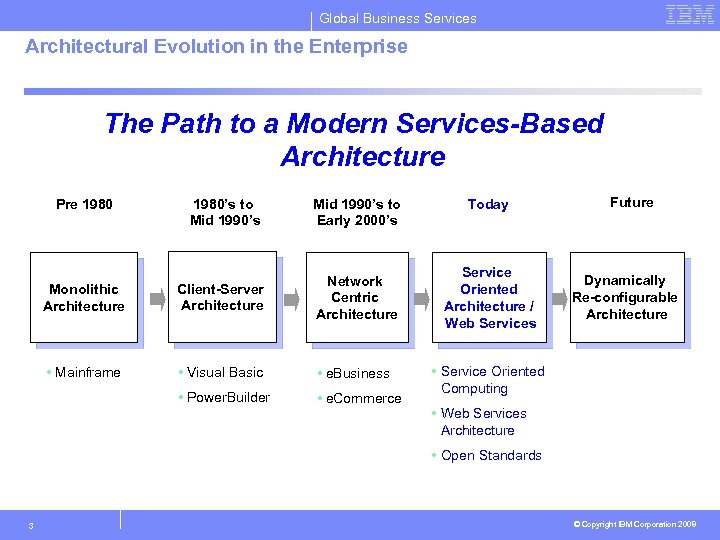
Global Business Services Architectural Evolution in the Enterprise The Path to a Modern Services-Based Architecture 1980’s to Mid 1990’s to Early 2000’s Monolithic Architecture Client-Server Architecture Network Centric Architecture Service Oriented Architecture / Web Services • Mainframe • Visual Basic • e. Business • Power. Builder • e. Commerce Future • Service Oriented Computing Pre 1980 Today Dynamically Re-configurable Architecture • Web Services Architecture • Open Standards 3 © Copyright IBM Corporation 2008
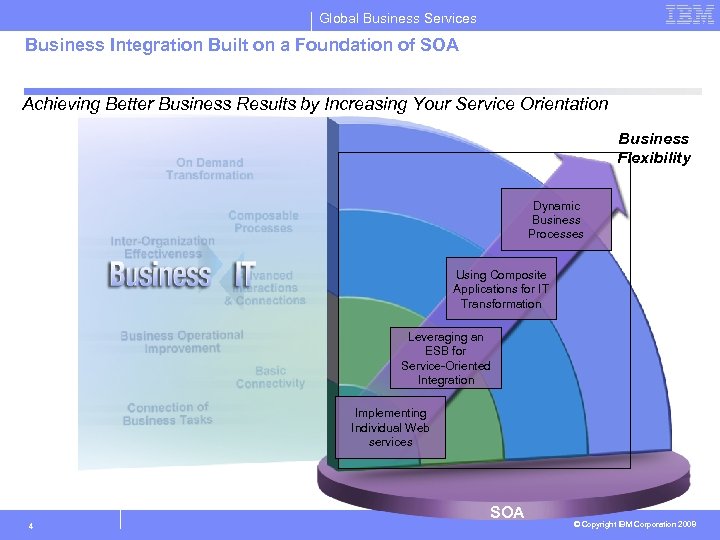
Global Business Services Business Integration Built on a Foundation of SOA Achieving Better Business Results by Increasing Your Service Orientation Business Flexibility Dynamic Business Processes Using Composite Applications for IT Transformation Leveraging an ESB for Service-Oriented Integration Implementing Individual Web services SOA 4 © Copyright IBM Corporation 2008
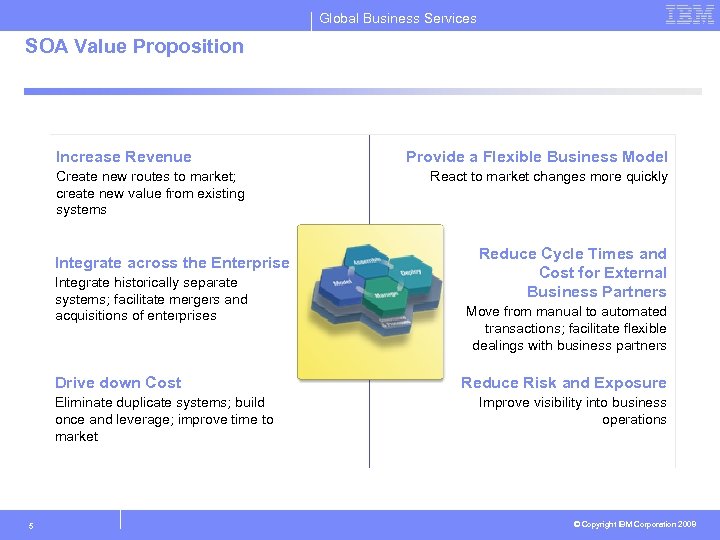
Global Business Services SOA Value Proposition Increase Revenue Create new routes to market; create new value from existing systems Integrate across the Enterprise Integrate historically separate systems; facilitate mergers and acquisitions of enterprises Drive down Cost Eliminate duplicate systems; build once and leverage; improve time to market 5 Provide a Flexible Business Model React to market changes more quickly Reduce Cycle Times and Cost for External Business Partners Move from manual to automated transactions; facilitate flexible dealings with business partners Reduce Risk and Exposure Improve visibility into business operations © Copyright IBM Corporation 2008
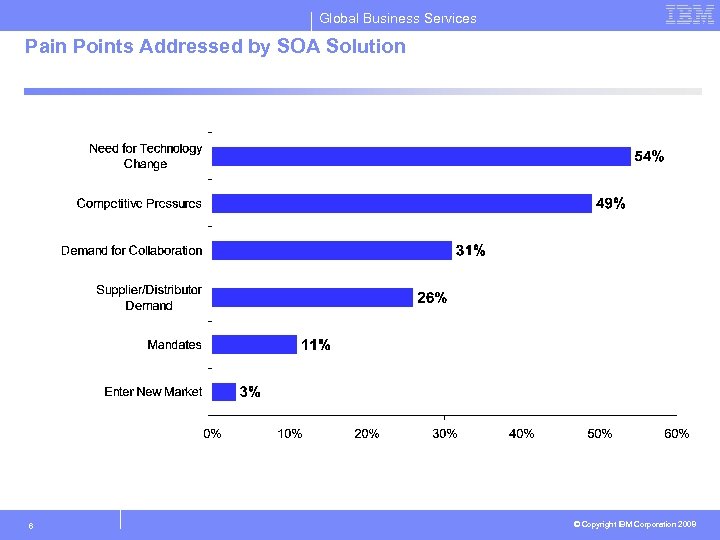
Global Business Services Pain Points Addressed by SOA Solution 6 © Copyright IBM Corporation 2008
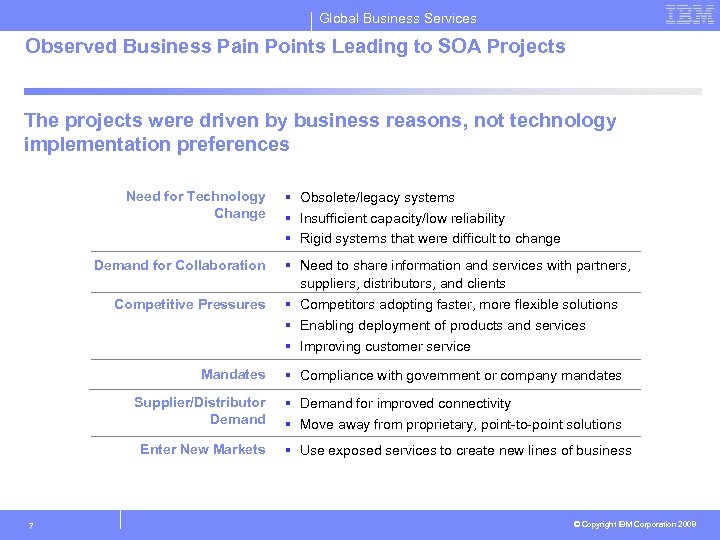
Global Business Services Observed Business Pain Points Leading to SOA Projects The projects were driven by business reasons, not technology implementation preferences Need for Technology Change Demand for Collaboration Competitive Pressures § Obsolete/legacy systems § Insufficient capacity/low reliability § Rigid systems that were difficult to change § Need to share information and services with partners, suppliers, distributors, and clients § Competitors adopting faster, more flexible solutions § Enabling deployment of products and services § Improving customer service Mandates § Compliance with government or company mandates Supplier/Distributor Demand § Demand for improved connectivity § Move away from proprietary, point-to-point solutions Enter New Markets 7 § Use exposed services to create new lines of business © Copyright IBM Corporation 2008
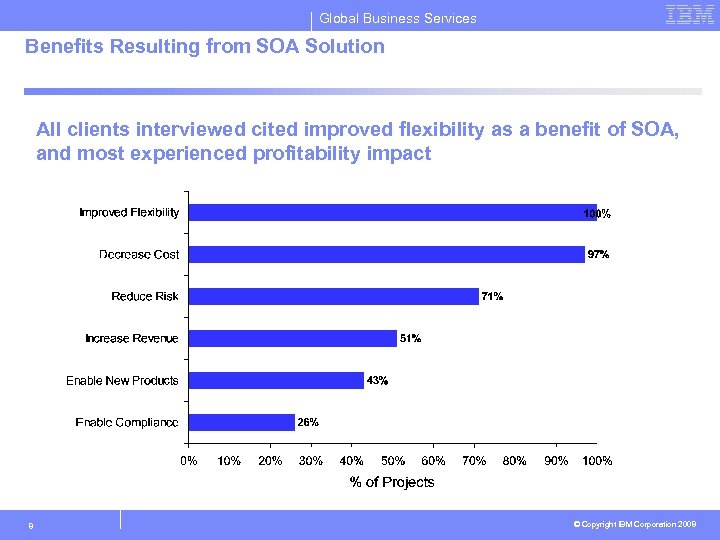
Global Business Services Benefits Resulting from SOA Solution All clients interviewed cited improved flexibility as a benefit of SOA, and most experienced profitability impact 8 © Copyright IBM Corporation 2008
Global Business Services Characteristics of an SOA Strong Business-IT alignment – ability to clearly articulate and optimise business value of technology Agility - Changing business requirements can rapidly be supported Build on existing investments – no need to re-implement components every time a new technology comes along Enterprise level focus – avoid duplication of function, achieve consistency, joined up business processes 9 © Copyright IBM Corporation 2008
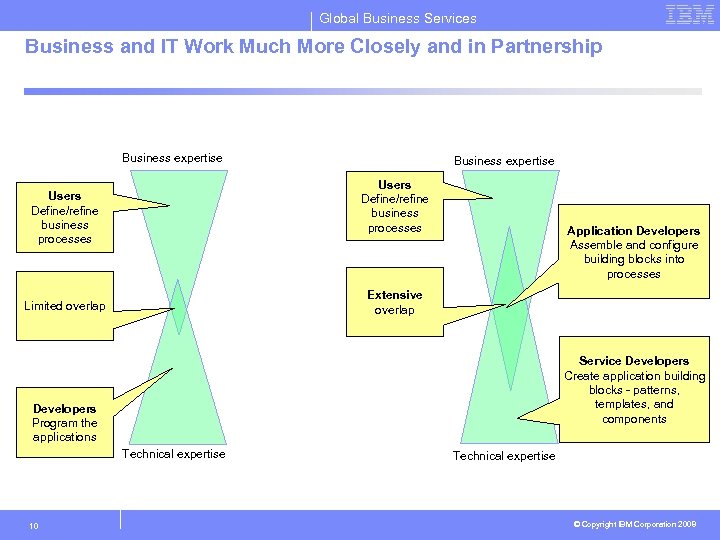
Global Business Services Business and IT Work Much More Closely and in Partnership Business expertise Users Define/refine business processes Application Developers Assemble and configure building blocks into processes Extensive overlap Limited overlap Service Developers Create application building blocks - patterns, templates, and components Developers Program the applications Technical expertise 10 Technical expertise © Copyright IBM Corporation 2008
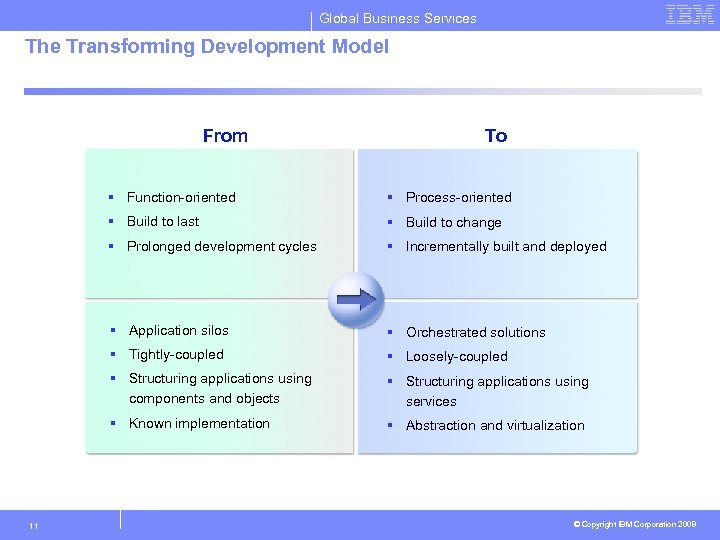
Global Business Services The Transforming Development Model From To § Function-oriented § Build to last § Build to change § Prolonged development cycles § Incrementally built and deployed § Application silos § Orchestrated solutions § Tightly-coupled § Loosely-coupled § Structuring applications using components and objects § Structuring applications using services § Known implementation 11 § Process-oriented § Abstraction and virtualization © Copyright IBM Corporation 2008
Global Business Services Определение СОА 12 © Copyright IBM Corporation 2008
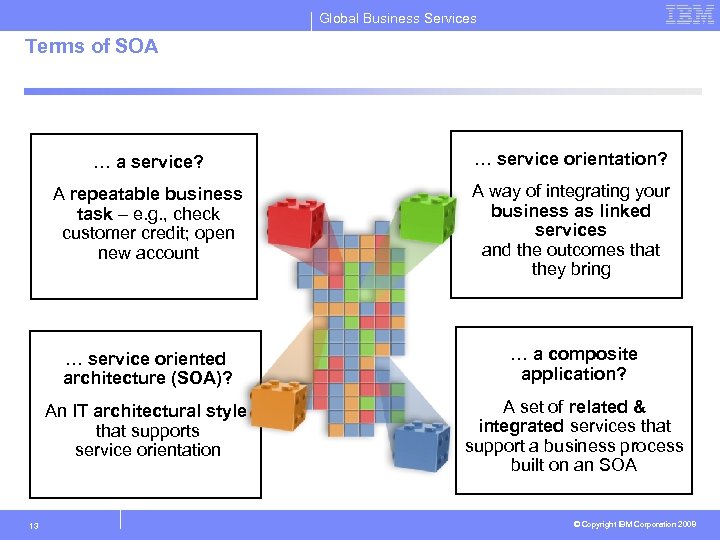
Global Business Services Terms of SOA … a service? A repeatable business task – e. g. , check customer credit; open new account A way of integrating your business as linked services and the outcomes that they bring … service oriented architecture (SOA)? … a composite application? An IT architectural style that supports service orientation 13 … service orientation? A set of related & integrated services that support a business process built on an SOA © Copyright IBM Corporation 2008
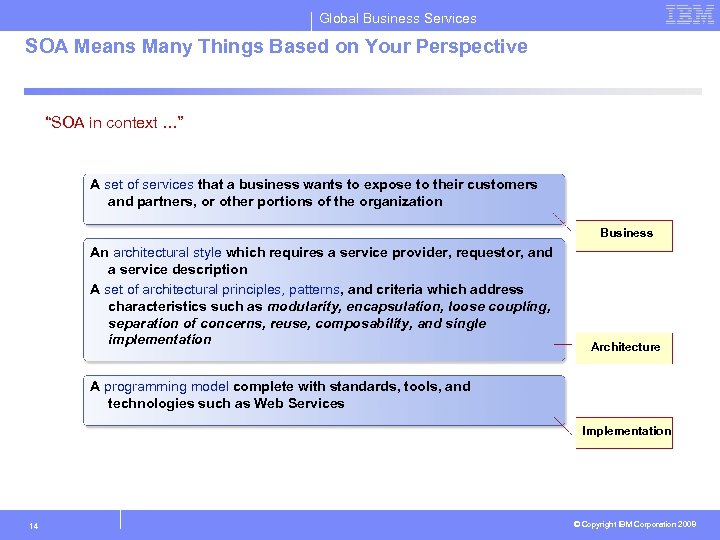
Global Business Services SOA Means Many Things Based on Your Perspective “SOA in context …” A set of services that a business wants to expose to their customers and partners, or other portions of the organization Business An architectural style which requires a service provider, requestor, and a service description A set of architectural principles, patterns, and criteria which address characteristics such as modularity, encapsulation, loose coupling, separation of concerns, reuse, composability, and single implementation Architecture A programming model complete with standards, tools, and technologies such as Web Services Implementation 14 © Copyright IBM Corporation 2008
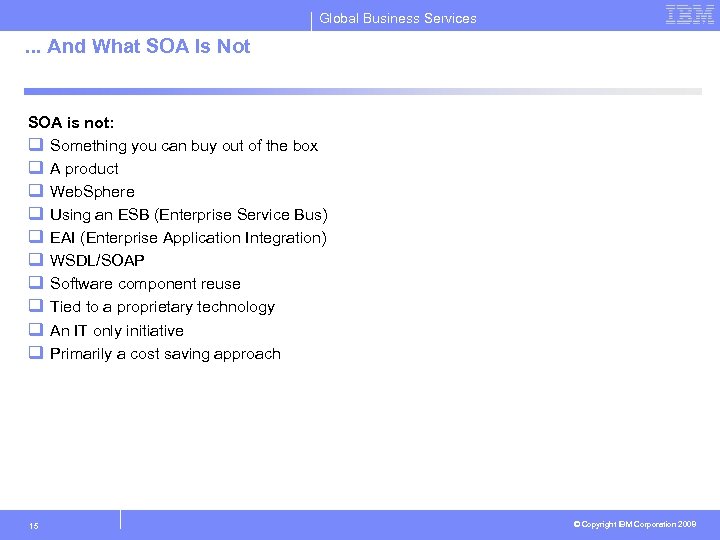
Global Business Services . . . And What SOA Is Not SOA is not: q Something you can buy out of the box q A product q Web. Sphere q Using an ESB (Enterprise Service Bus) q EAI (Enterprise Application Integration) q WSDL/SOAP q Software component reuse q Tied to a proprietary technology q An IT only initiative q Primarily a cost saving approach 15 © Copyright IBM Corporation 2008
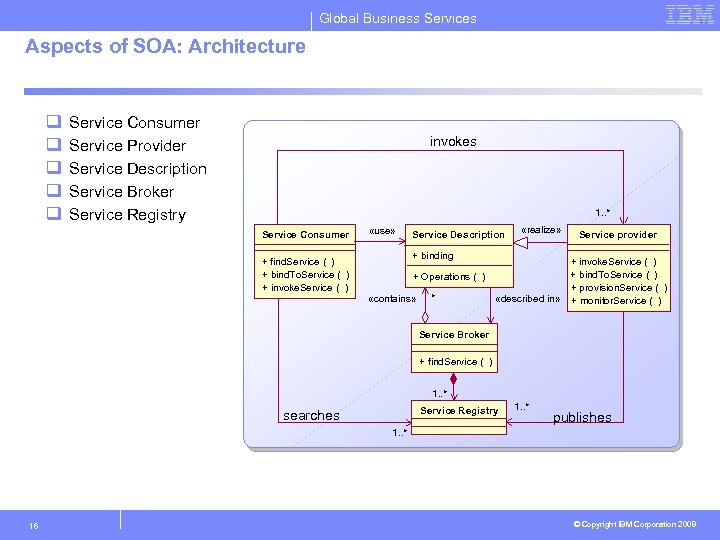
Global Business Services Aspects of SOA: Architecture q q q Service Consumer Service Provider Service Description Service Broker Service Registry invokes 1. . * Service Consumer + find. Service ( ) + bind. To. Service ( ) + invoke. Service ( ) «use» Service Description «realize» + binding + Operations ( ) «contains» * «described in» Service provider + invoke. Service ( ) + bind. To. Service ( ) + provision. Service ( ) + monitor. Service ( ) Service Broker + find. Service ( ) 1. . * Service Registry searches 1. . * publishes 1. . * 16 © Copyright IBM Corporation 2008
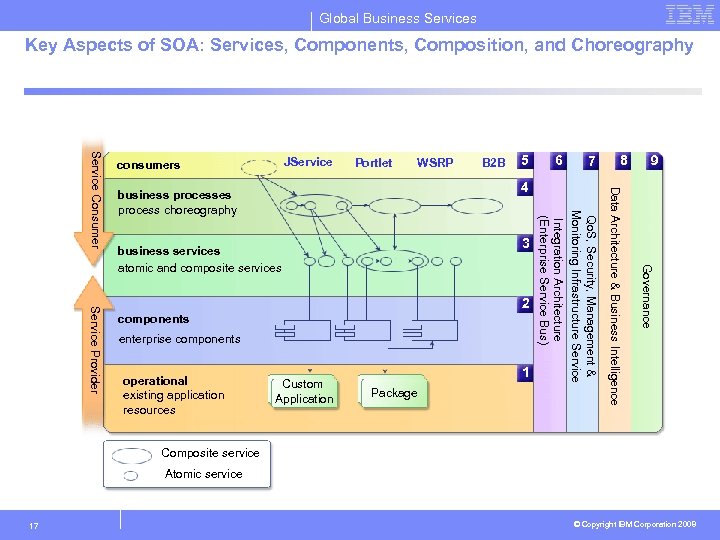
Global Business Services Key Aspects of SOA: Services, Components, Composition, and Choreography WSRP B 2 B 5 3 2 components enterprise components Custom Application 1 Package 9 Governance business services atomic and composite services 8 Data Architecture & Business Intelligence Service Provider 7 4 business processes process choreography operational existing application resources 6 Qo. S, Security, Management & Monitoring Infrastructure Service Portlet Integration Architecture (Enterprise Service Bus) Service Consumer JService consumers Composite service Atomic service 17 © Copyright IBM Corporation 2008
Global Business Services Сервисно-ориентированный подход является результатом развития методов интеграции 18 © Copyright IBM Corporation 2008
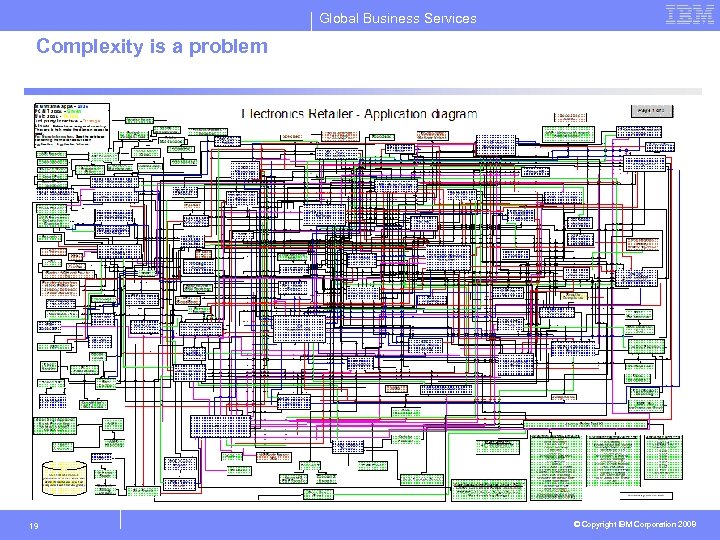
Global Business Services Complexity is a problem 19 © Copyright IBM Corporation 2008
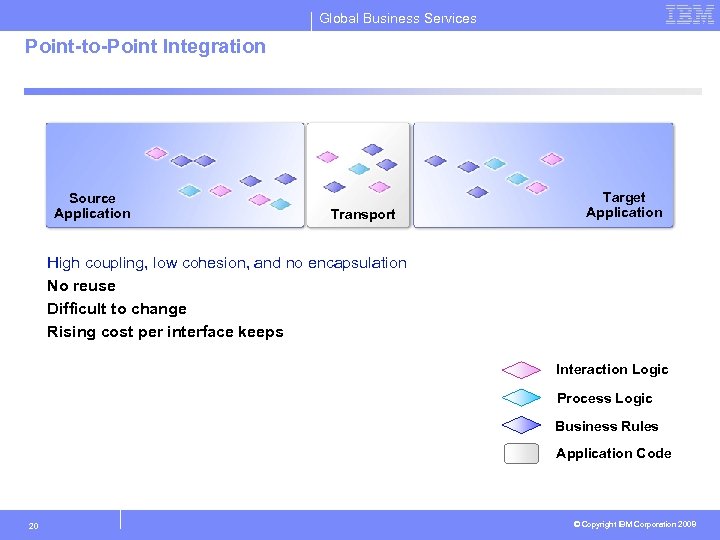
Global Business Services Point-to-Point Integration Source Application Transport Target Application High coupling, low cohesion, and no encapsulation No reuse Difficult to change Rising cost per interface keeps Interaction Logic Process Logic Business Rules Application Code 20 © Copyright IBM Corporation 2008
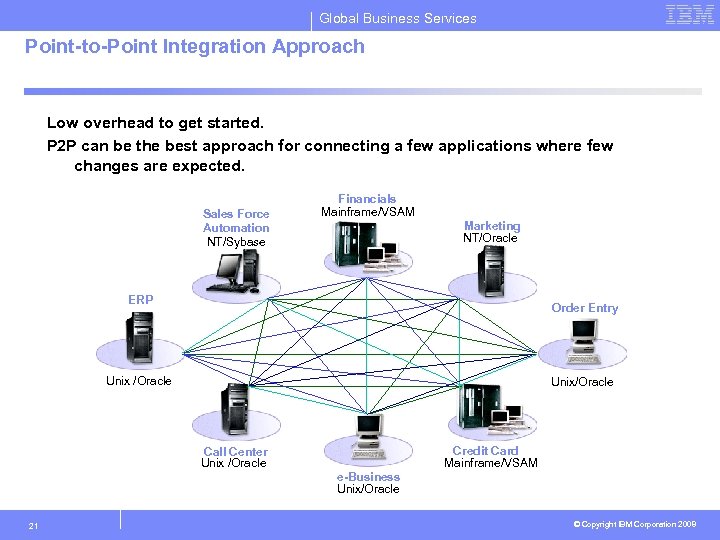
Global Business Services Point-to-Point Integration Approach Low overhead to get started. P 2 P can be the best approach for connecting a few applications where few changes are expected. Sales Force Automation NT/Sybase Financials Mainframe/VSAM Marketing NT/Oracle ERP Order Entry Unix /Oracle Unix/Oracle Credit Card Mainframe/VSAM Call Center Unix /Oracle e-Business Unix/Oracle 21 © Copyright IBM Corporation 2008
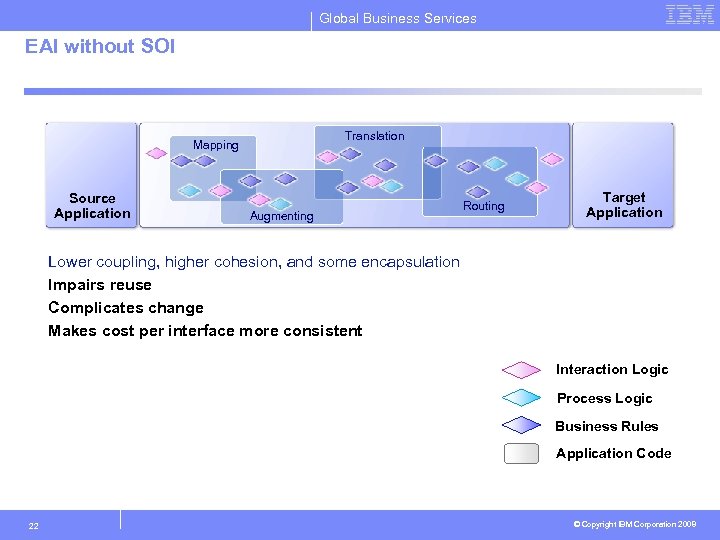
Global Business Services EAI without SOI Translation Mapping Source Application Augmenting Routing Target Application Lower coupling, higher cohesion, and some encapsulation Impairs reuse Complicates change Makes cost per interface more consistent Interaction Logic Process Logic Business Rules Application Code 22 © Copyright IBM Corporation 2008
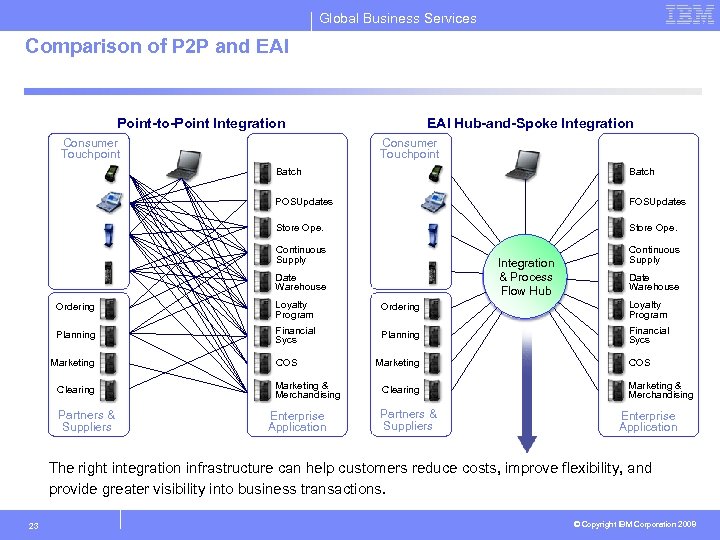
Global Business Services Comparison of P 2 P and EAI Point-to-Point Integration Consumer Touchpoint EAI Hub-and-Spoke Integration Consumer Touchpoint Batch POSUpdates FOSUpdates Store Ope. Continuous Supply Integration & Process Flow Hub Date Warehouse Continuous Supply Date Warehouse Ordering Loyalty Program Planning Financial Sycs Marketing Clearing Partners & Suppliers COS Marketing & Merchandising Enterprise Application The right integration infrastructure can help customers reduce costs, improve flexibility, and provide greater visibility into business transactions. 23 © Copyright IBM Corporation 2008
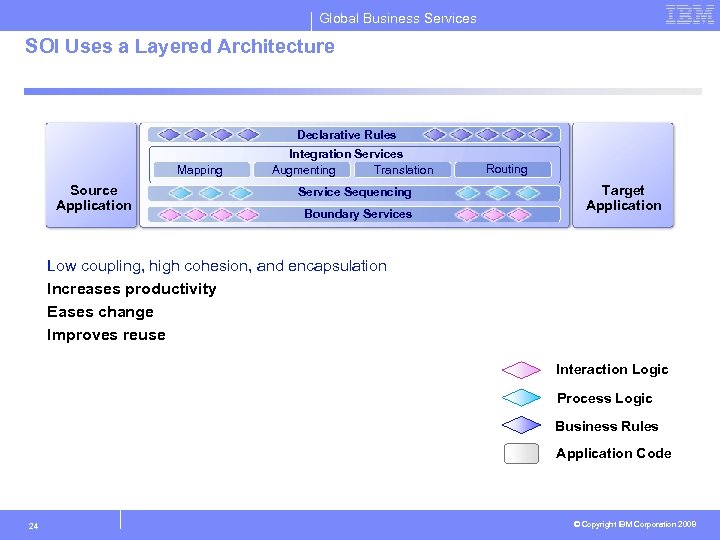
Global Business Services SOI Uses a Layered Architecture Declarative Rules Mapping Source Application Integration Services Translation Augmenting Service Sequencing Boundary Services Routing Target Application Low coupling, high cohesion, and encapsulation Increases productivity Eases change Improves reuse Interaction Logic Process Logic Business Rules Application Code 24 © Copyright IBM Corporation 2008
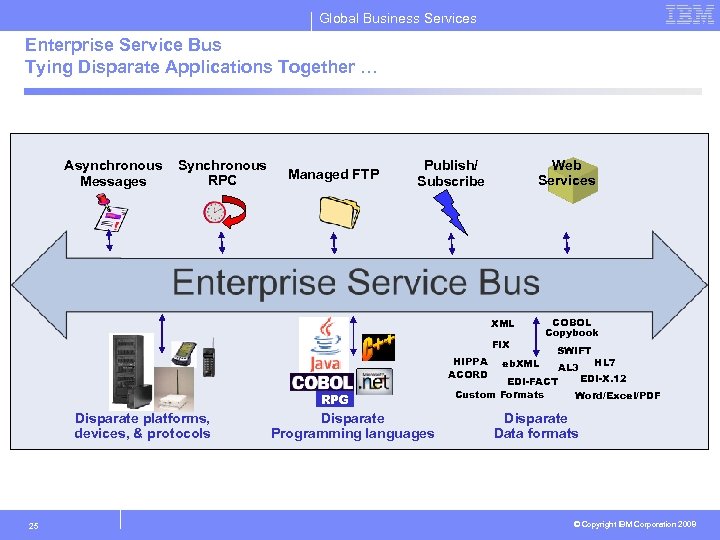
Global Business Services Enterprise Service Bus Tying Disparate Applications Together … Asynchronous Messages Synchronous RPC Managed FTP Web Services Publish/ Subscribe XML FIX HIPPA ACORD RPG Disparate platforms, devices, & protocols 25 Disparate Programming languages COBOL Copybook SWIFT HL 7 AL 3 EDI-X. 12 EDI-FACT Custom Formats Word/Excel/PDF eb. XML Disparate Data formats © Copyright IBM Corporation 2008
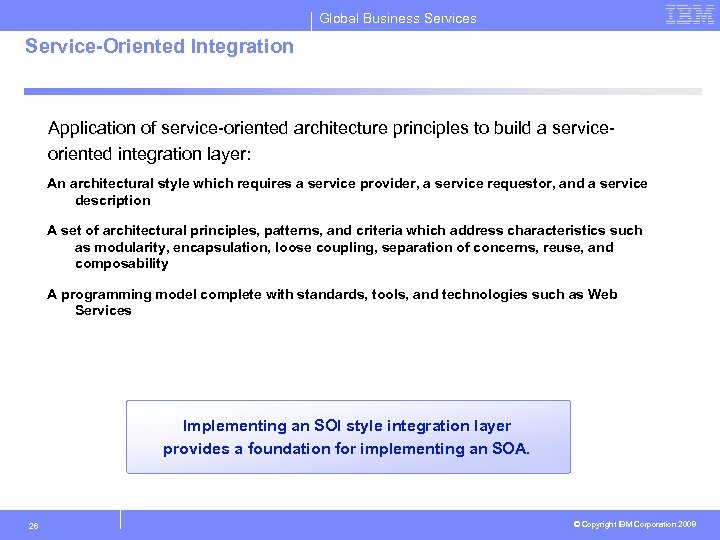
Global Business Service-Oriented Integration Application of service-oriented architecture principles to build a serviceoriented integration layer: An architectural style which requires a service provider, a service requestor, and a service description A set of architectural principles, patterns, and criteria which address characteristics such as modularity, encapsulation, loose coupling, separation of concerns, reuse, and composability A programming model complete with standards, tools, and technologies such as Web Services Implementing an SOI style integration layer provides a foundation for implementing an SOA. 26 © Copyright IBM Corporation 2008
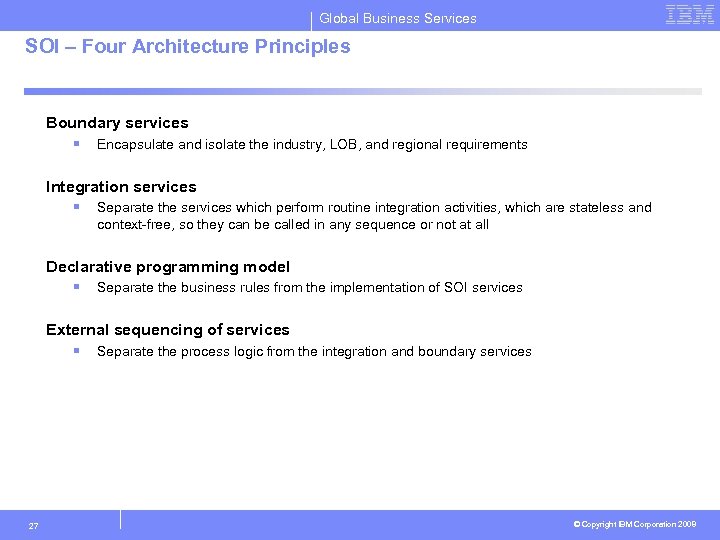
Global Business Services SOI – Four Architecture Principles Boundary services § Encapsulate and isolate the industry, LOB, and regional requirements Integration services § Separate the services which perform routine integration activities, which are stateless and context-free, so they can be called in any sequence or not at all Declarative programming model § Separate the business rules from the implementation of SOI services External sequencing of services § Separate the process logic from the integration and boundary services 27 © Copyright IBM Corporation 2008
Global Business Services Справочная модель СОА 28 © Copyright IBM Corporation 2008
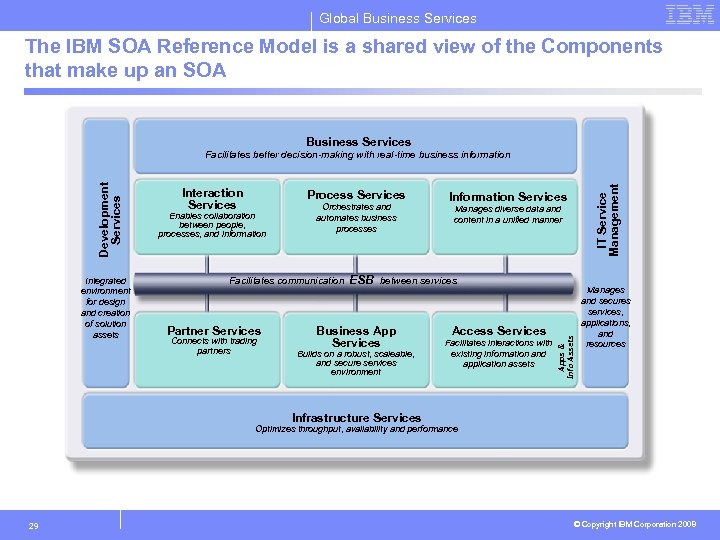
Global Business Services The IBM SOA Reference Model is a shared view of the Components that make up an SOA Business Services Integrated environment for design and creation of solution assets Process Services Enables collaboration between people, processes, and information Orchestrates and automates business processes Facilitates communication Partner Services Connects with trading partners IT Service Management Interaction Services Information Services Manages diverse data and content in a unified manner ESB between services Business App Services Builds on a robust, scaleable, and secure services environment Access Services Facilitates interactions with existing information and application assets Apps & Info Assets Development Services Facilitates better decision-making with real-time business information Manages and secures services, applications, and resources Infrastructure Services Optimizes throughput, availability and performance 29 © Copyright IBM Corporation 2008
Global Business Services Подход к построению СОА 30 © Copyright IBM Corporation 2008
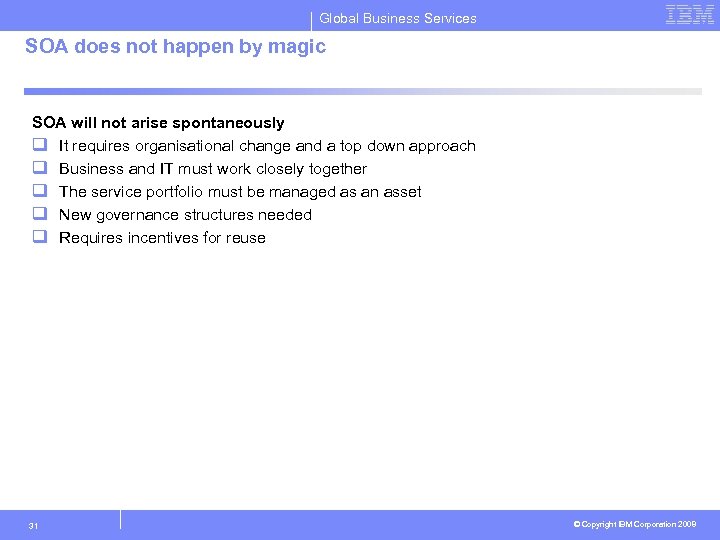
Global Business Services SOA does not happen by magic SOA will not arise spontaneously q It requires organisational change and a top down approach q Business and IT must work closely together q The service portfolio must be managed as an asset q New governance structures needed q Requires incentives for reuse 31 © Copyright IBM Corporation 2008
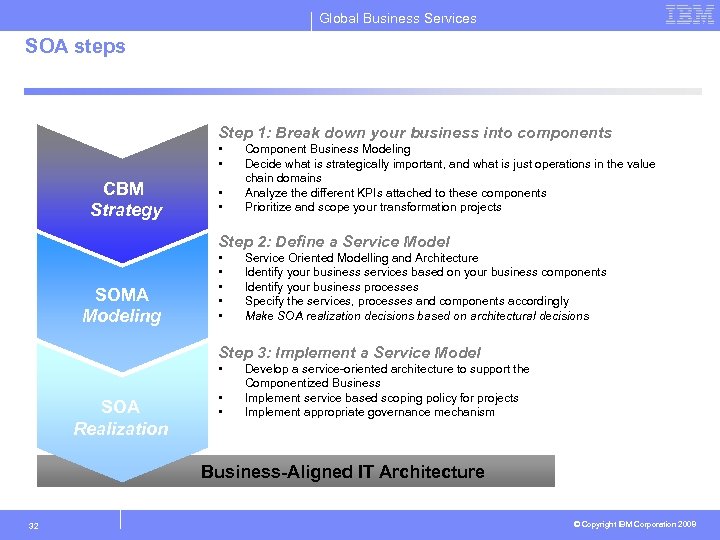
Global Business Services SOA steps Step 1: Break down your business into components • • CBM Strategy • • Component Business Modeling Decide what is strategically important, and what is just operations in the value chain domains Analyze the different KPIs attached to these components Prioritize and scope your transformation projects Step 2: Define a Service Model SOMA Modeling • • • Service Oriented Modelling and Architecture Identify your business services based on your business components Identify your business processes Specify the services, processes and components accordingly Make SOA realization decisions based on architectural decisions Step 3: Implement a Service Model • SOA Realization • • Develop a service-oriented architecture to support the Componentized Business Implement service based scoping policy for projects Implement appropriate governance mechanism Business-Aligned IT Architecture 32 © Copyright IBM Corporation 2008
Global Business Services Шаг 1. Построение Компонентной модели бизнеса (CBM) 33 © Copyright IBM Corporation 2008
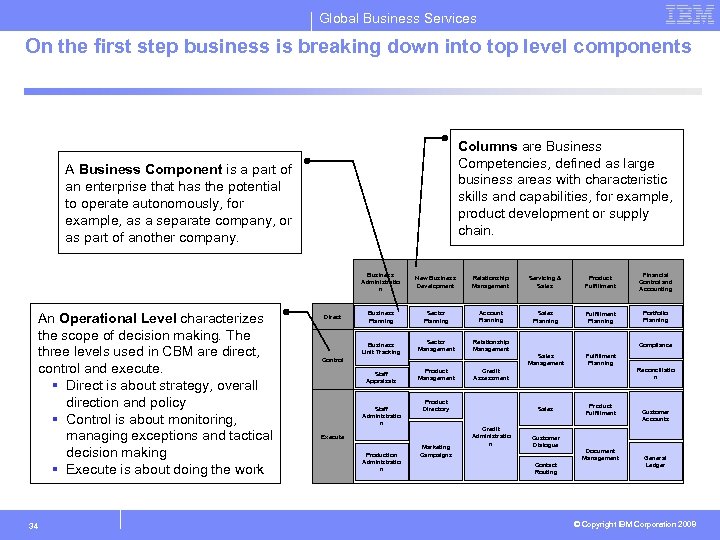
Global Business Services On the first step business is breaking down into top level components Columns are Business Competencies, defined as large business areas with characteristic skills and capabilities, for example, product development or supply chain. A Business Component is a part of an enterprise that has the potential to operate autonomously, for example, as a separate company, or as part of another company. Business Administratio n An Operational Level characterizes the scope of decision making. The three levels used in CBM are direct, control and execute. § Direct is about strategy, overall direction and policy § Control is about monitoring, managing exceptions and tactical decision making § Execute is about doing the work 34 Direct New Business Development Relationship Management Servicing & Sales Product Fulfillment Financial Control and Accounting Business Planning Sector Planning Account Planning Sales Planning Fulfillment Planning Portfolio Planning Sector Management Relationship Management Sales Management Fulfillment Planning Business Unit Tracking Control Staff Appraisals Staff Administratio n Product Management Production Administratio n Marketing Campaigns Reconciliatio n Credit Assessment Product Directory Execute Compliance Sales Credit Administratio n Customer Dialogue Contact Routing Product Fulfillment Document Management Customer Accounts General Ledger © Copyright IBM Corporation 2008
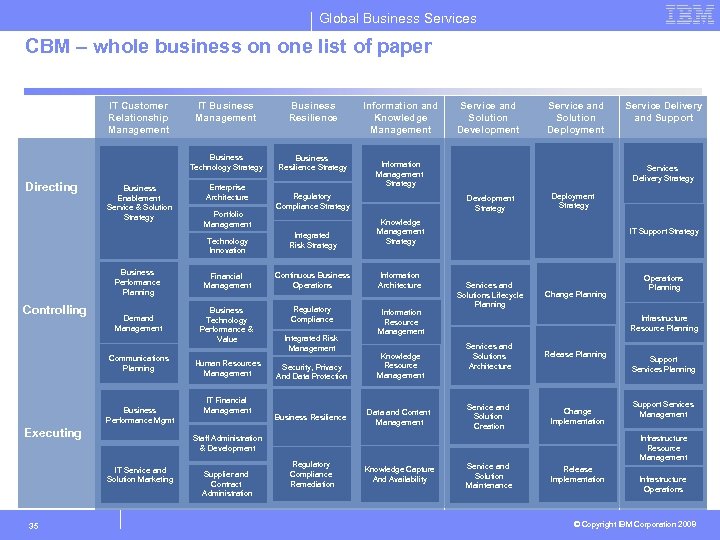
Global Business Services CBM – whole business on one list of paper IT Customer Relationship Management Business Enablement Service & Solution Strategy Business Resilience Business Technology Strategy Directing IT Business Management Business Resilience Strategy Enterprise Architecture Portfolio Management Technology Innovation Information and Knowledge Management Regulatory Compliance Strategy Integrated Risk Strategy Information Architecture Demand Management Business Technology Performance & Value Regulatory Compliance Information Resource Management Business Performance Mgmt Executing IT Financial Management Integrated Risk Management Security, Privacy And Data Protection Business Resilience Knowledge Resource Management Data and Content Management IT Support Strategy Services and Solutions Lifecycle Planning Change Planning Supplier and Contract Administration Regulatory Compliance Remediation Knowledge Capture And Availability Operations Planning Infrastructure Resource Planning Services and Solutions Architecture Release Planning Service and Solution Creation Change Implementation Service and Solution Maintenance Support Services Planning Support Services Management Infrastructure Resource Management Staff Administration & Development IT Service and Solution Marketing 35 Human Resources Management Deployment Strategy Knowledge Management Strategy Continuous Business Operations Service Delivery and Support Services Delivery Strategy Development Strategy Financial Management Communications Planning Service and Solution Deployment Information Management Strategy Business Performance Planning Controlling Service and Solution Development Release Implementation Infrastructure Operations © Copyright IBM Corporation 2008
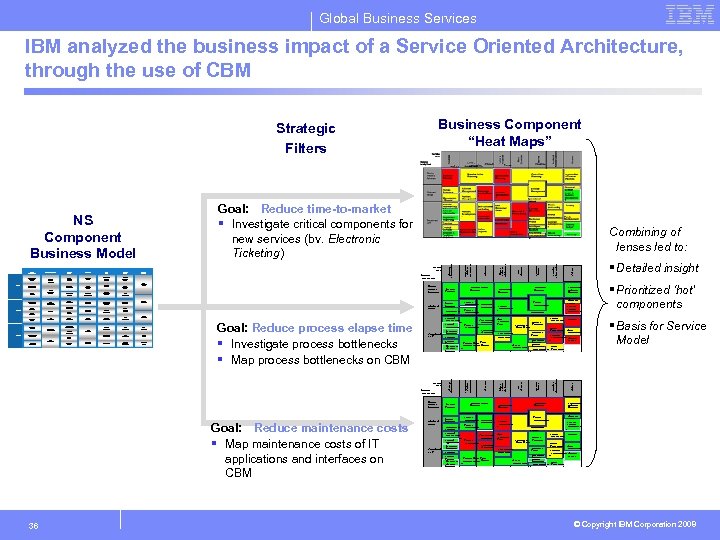
Global Business Services IBM analyzed the business impact of a Service Oriented Architecture, through the use of CBM Business Component “Heat Maps” Strategic Filters Goal: Reduce time-to-market § Investigate critical components for new services (bv. Electronic Ticketing) Change Management Quality Management Mechanical/ Electrical Design Accounting & General Ledger In-vehicle System Design Tool Design & Build Logistics Management Relationship Monitoring Warranty Management Monitor and Manage Demand Forecast & Analysis Dealer Management Lease Management Parts Management Transportation Management Order Management Vehicle Service Procurement Customer Relationship Management End-of-Life Vehicle Goal: Reduce process elapse time § Investigate process bottlenecks § Map process bottlenecks on CBM Execution and (S)TP Human Resource The Value Chain Planning Analysis & Refinement Goal: Reduce maintenance costs § Map maintenance costs of IT applications and interfaces on CBM Monitor and Manage Finance Contract Administration Customer Service New Business Marketing Training Operational Control n Product Profile Sales Implementatio Support s Manufacturing Planning Business Planning Product Management Advisor/ Intermediary Administratio n. Advisor/ Intermediar y Setup Regulatory Reporting Product Developmen t Fees & Commission e Campaign Execution Inforce Processing Conservation Product Profile Sales Implementatio Support s Trading Contract Administratio General Intelligent n Ledger Routing Contact Repository Check Correspondenc Processing Contact Servicing Customer Profile Fees & Commission e § Prioritized ‘hot’ components § Basis for Service Model Accounting &Finance Planning Financial Control Operational Control Contract & Policy Setup Asset & Liability Managemen Funds Management Service Management Channel Managemen Wholesales n t Claims processing Operations Planning End customer Consumer marketing Sales Training Council Services Systems & Facilities Helpdesk Customer Profile Distribution Planning Alliance Management Campaign Managemen Human Resource Contact Servicing Contract & Policy Setup Wholesales Managemen t Manual Execution and (S)TP t Financial Control Service Management Channel Managemen § Detailed insight Accounting &Finance Planning Operations Planning Distribution Planning Advisor/ End Intermediary End customer Consumer Administratio marketing Sales n. Advisor/ Product Intermediar Developmen y Setup Campaign t Regulatory Execution Reporting Conservation Council Services Systems & Facilities Helpdesk Business Activity Level 36 Alliance Management Campaign Managemen t Product Managemen t Manual Quality Management Inventory Management Maintenance Management Manufacturing Planning Business Planning Brand Management Plant Operations Process Design Cost Management Supplier Management Planning Analysis & Refinement Finance Production Monitoring Design Validation Tax Management Building/Facilities & Equipment IT Systems & Operations Supplier Relationship Planning Supply Chain Performance Monitoring Configuration Management Treasury Execute Production Scheduling Sales & Promotion Planning Business Activity Level Post Vehicle Sale Strategy Contract Administration Production Rules & Policies Program Management Demand Planning Service & Aftersales Customer Service Design Rules & Policies Marketing & Sales Customer Relationship Strategy New Business Master Production Planning Supply Chain Strategy & Planning Sales & Channel Management Risk Management & Internal Audit Legal & Regulatory Knowledge & Learning Production Strategy Marketing Capital Appropriation Planning Business Performance Intellectual Property Production Asset Mgmt & Product Development Alliance Strategies Product/ Process Portfolio Strategy & Planning Research & Development Organization & Process Policies Human Capital Management Control Financial Planning & Forecasting Business Administration Direct Financial Management Asset Mgmt & Product Development The Value Chain Business Administration Corporate/LOB Strategy & Planning Sales & Channel Management Combining of lenses led to: Business Administration NS Component Business Model t Claims processing Inforce Processing Asset & Liability Managemen Trading Funds Management Contract Administratio General Intelligent n Ledger Routing Contact Repository Check Correspondenc Processing © Copyright IBM Corporation 2008
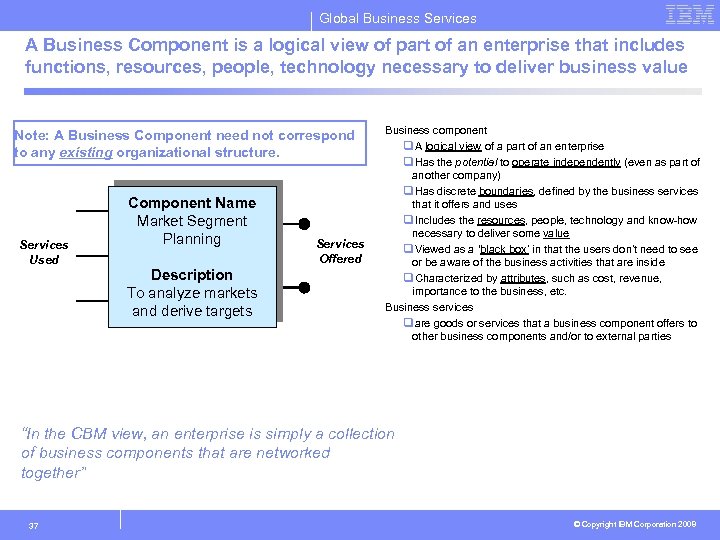
Global Business Services A Business Component is a logical view of part of an enterprise that includes functions, resources, people, technology necessary to deliver business value Note: A Business Component need not correspond to any existing organizational structure. Services Used Component Name Market Segment Planning Description To analyze markets and derive targets Services Offered Business component q. A logical view of a part of an enterprise q. Has the potential to operate independently (even as part of another company) q. Has discrete boundaries, defined by the business services that it offers and uses q. Includes the resources, people, technology and know-how necessary to deliver some value q. Viewed as a ‘black box’ in that the users don’t need to see or be aware of the business activities that are inside q. Characterized by attributes, such as cost, revenue, importance to the business, etc. Business services qare goods or services that a business component offers to other business components and/or to external parties “In the CBM view, an enterprise is simply a collection of business components that are networked together” 37 © Copyright IBM Corporation 2008
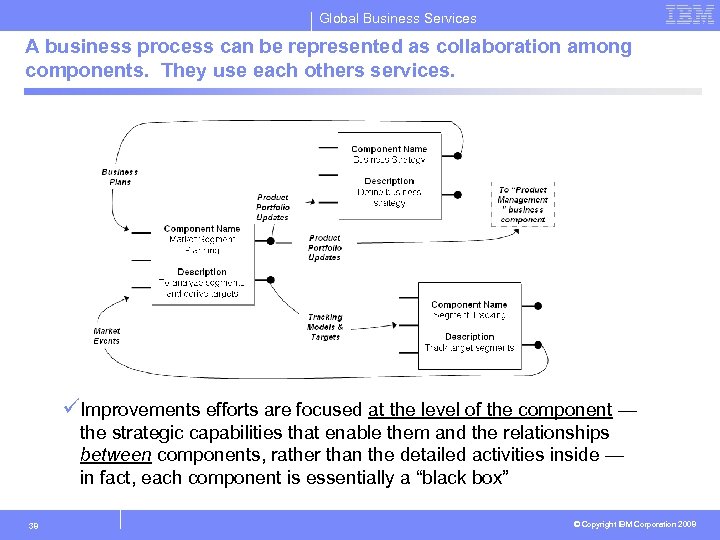
Global Business Services A business process can be represented as collaboration among components. They use each others services. üImprovements efforts are focused at the level of the component — the strategic capabilities that enable them and the relationships between components, rather than the detailed activities inside — in fact, each component is essentially a “black box” 38 © Copyright IBM Corporation 2008
Global Business Services Шаг 2. Построение сервисно-ориентированной модели 39 © Copyright IBM Corporation 2008
Global Business Services SOMA is … Service-Oriented Modeling and Architecture (SOMA) is a modeling and design method aimed at enabling target business processes through the identification, specification, and realization of business-aligned services that form the Service. Oriented Architecture (SOA) foundation. The SOMA method provides in-depth guidance on how to move from the business models created through the IBM Component Business Modeling (CBM) or similar business analysis techniques, to the IT models required by an SOA. SOMA leverages the IBM Global Services method (The Method) execution models, work product descriptions (WPDs) and techniques. 40 © Copyright IBM Corporation 2008
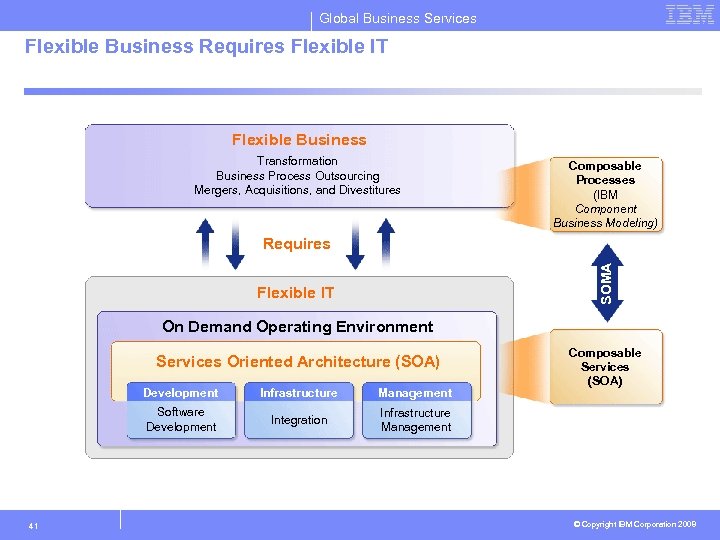
Global Business Services Flexible Business Requires Flexible IT Flexible Business Transformation Business Process Outsourcing Mergers, Acquisitions, and Divestitures Composable Processes (IBM Component Business Modeling) SOMA Requires Flexible IT On Demand Operating Environment Services Oriented Architecture (SOA) Development Management Software Development 41 Infrastructure Integration Composable Services (SOA) Infrastructure Management © Copyright IBM Corporation 2008
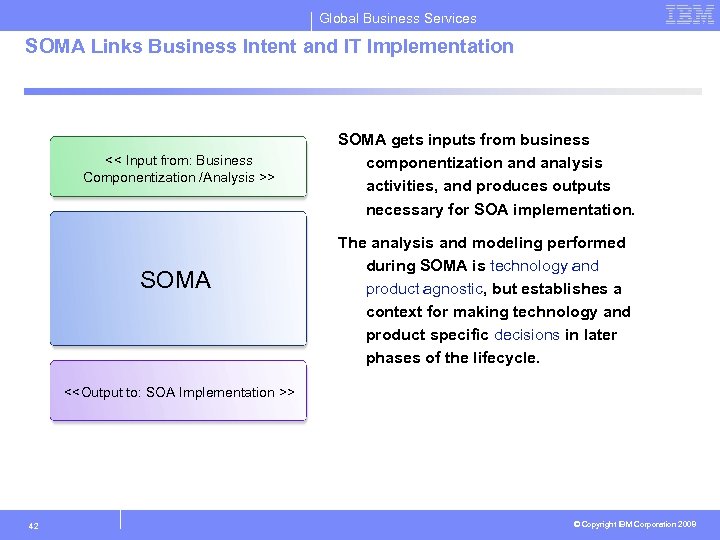
Global Business Services SOMA Links Business Intent and IT Implementation << Input from: Business Componentization /Analysis >> SOMA gets inputs from business componentization and analysis activities, and produces outputs necessary for SOA implementation. The analysis and modeling performed during SOMA is technology and product agnostic, but establishes a context for making technology and product specific decisions in later phases of the lifecycle. <<Output to: SOA Implementation >> 42 © Copyright IBM Corporation 2008
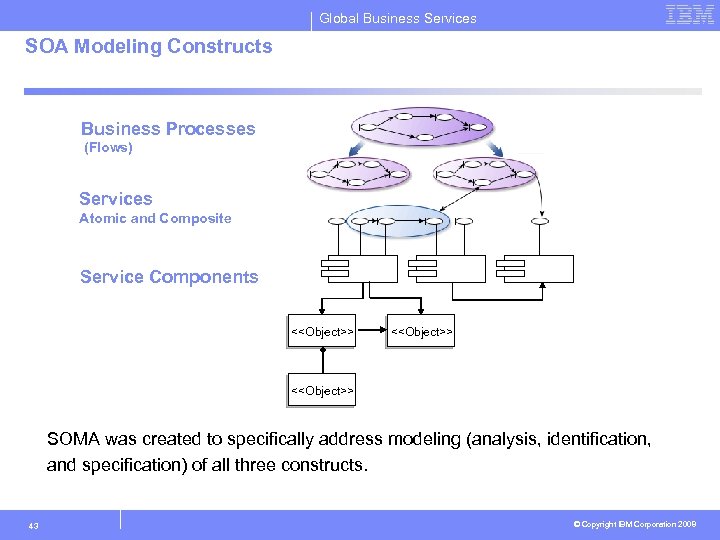
Global Business Services SOA Modeling Constructs Business Processes (Flows) Services Atomic and Composite Service Components <<Object>> SOMA was created to specifically address modeling (analysis, identification, and specification) of all three constructs. 43 © Copyright IBM Corporation 2008
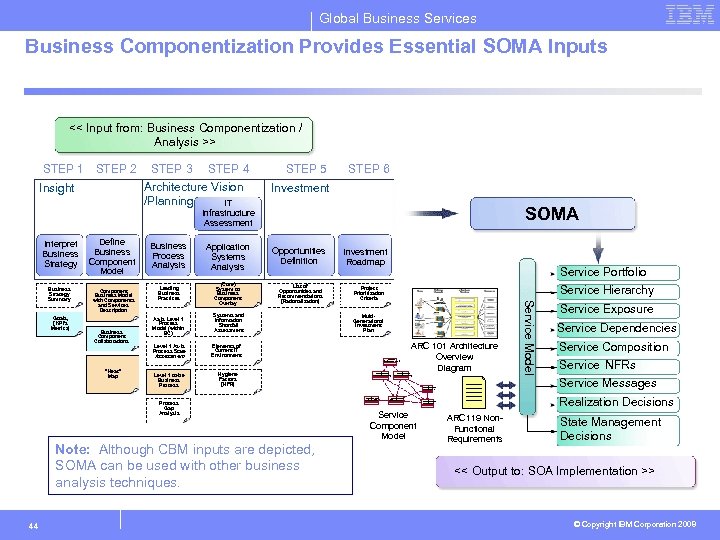
Global Business Services Business Componentization Provides Essential SOMA Inputs << Input from: Business Componentization / Analysis >> STEP 1 STEP 2 STEP 3 STEP 4 Architecture Vision /Planning IT Insight STEP 5 STEP 6 Investment SOMA Infrastructure Assessment Interpret Business Strategy Goals, [ KPI’s Metrics] Component Business Model with Components and Services Description Business Component Collaborations Business Process Analysis Application Systems Analysis Opportunities Definition Leading Business Practices (Core) System to Business Component Overlay List of Opportunities and Recommendations [Rationalization] As-Is Level 1 Process Model (within BC) Level 1 As-Is Process State Assessment Systems and Information Shortfall Assessment Investment Roadmap Service Portfolio Service Hierarchy Project Prioritization Criteria Multi. Generational Investment Plan Elements of Current IT Environment <<component>> Dialogue. Control “Heat” Map Level 1 to-be Business Process Hygiene Factors [NFR] Process Gap Analysis Note: Although CBM inputs are depicted, SOMA can be used with other business analysis techniques. 44 <<component>> Security. Processing ARC 101 Architecture Overview Diagram <<component>> Account. Processing <<component>> Application. Server Service Component Model Service Exposure Service Dependencies Service Composition Service NFRs Service Messages <<component>> Account. Mgr <<component>> Relational. DBMS Service Model Business Strategy Summary Define Business Component Model Realization Decisions <<component>> Security. Mgr ARC 119 Non. Functional Requirements State Management Decisions << Output to: SOA Implementation >> © Copyright IBM Corporation 2008
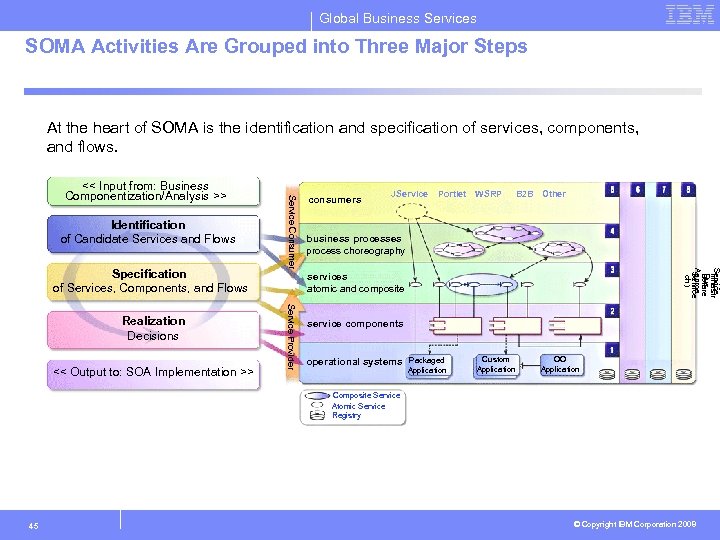
Global Business Services SOMA Activities Are Grouped into Three Major Steps At the heart of SOMA is the identification and specification of services, components, and flows. Identification of Candidate Services and Flows << Output to: SOA Implementation >> JService Portlet WSRP B 2 B Other business processes process choreography services atomic and composite Service Provider Realization Decisions consumers Service Infrastr Bus ucture Approa Service ch) Specification of Services, Components, and Flows Service Consumer << Input from: Business Componentization/Analysis >> service components operational systems Packaged Application Custom Application OO Application Composite Service Atomic Service Registry 45 © Copyright IBM Corporation 2008
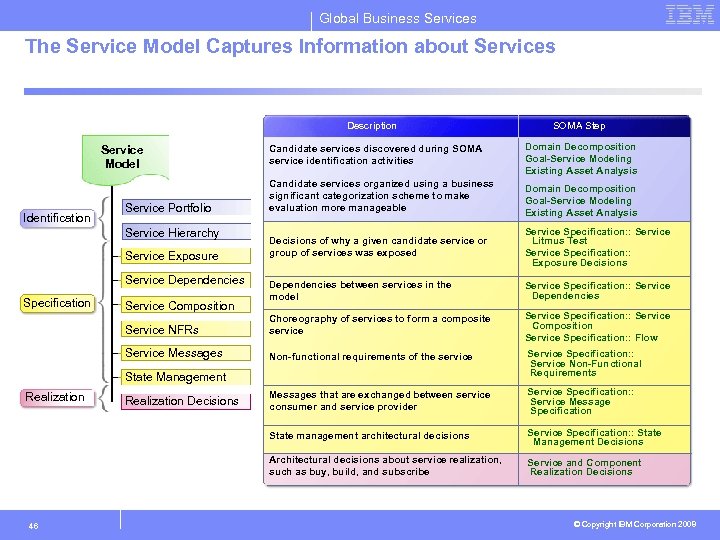
Global Business Services The Service Model Captures Information about Services Description SOMA Step Candidate services discovered during SOMA service identification activities Domain Decomposition Goal-Service Modeling Existing Asset Analysis Candidate services organized using a business significant categorization scheme to make evaluation more manageable Domain Decomposition Goal-Service Modeling Existing Asset Analysis Decisions of why a given candidate service or group of services was exposed Service Specification: : Service Litmus Test Service Specification: : Exposure Decisions Dependencies between services in the model Service Specification: : Service Dependencies Service NFRs Choreography of services to form a composite service Specification: : Service Composition Service Specification: : Flow Service Messages Non-functional requirements of the service Specification: : Service Non-Functional Requirements Messages that are exchanged between service consumer and service provider Service Specification: : Service Message Specification State management architectural decisions Service Specification: : State Management Decisions Architectural decisions about service realization, such as buy, build, and subscribe Service and Component Realization Decisions Service Model Identification Service Portfolio Service Hierarchy Service Exposure Service Dependencies Specification Service Composition State Management Realization 46 Realization Decisions © Copyright IBM Corporation 2008
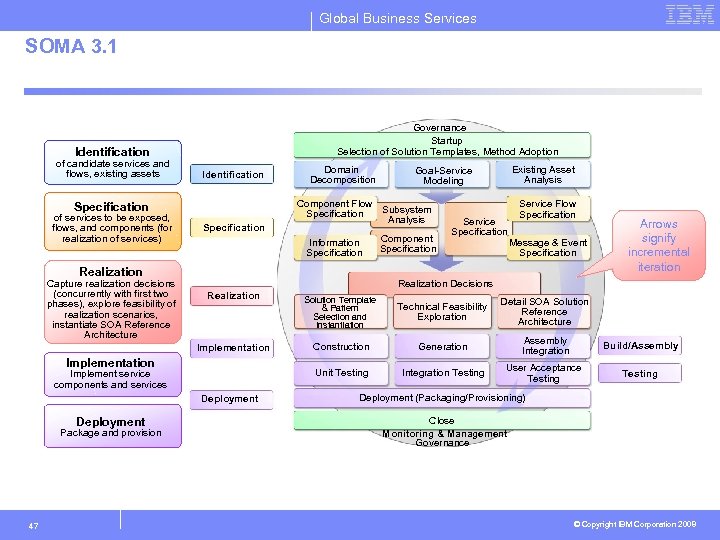
Global Business Services SOMA 3. 1 Governance Startup Selection of Solution Templates, Method Adoption Identification of candidate services and flows, existing assets Identification Specification of services to be exposed, flows, and components (for realization of services) Specification Domain Decomposition Component Flow Subsystem Specification Analysis Information Specification Realization Capture realization decisions (concurrently with first two phases), explore feasibility of realization scenarios, instantiate SOA Reference Architecture Implement service components and services Deployment 47 Message & Event Specification Arrows signify incremental iteration Solution Template & Pattern Selection and Instantiation Technical Feasibility Exploration Detail SOA Solution Reference Architecture Construction Generation Assembly Integration Build/Assembly Unit Testing Implementation Package and provision Component Specification Service Flow Specification Realization Decisions Realization Implementation Deployment Existing Asset Analysis Goal-Service Modeling Integration Testing User Acceptance Testing Deployment (Packaging/Provisioning) Close Monitoring & Management Governance © Copyright IBM Corporation 2008
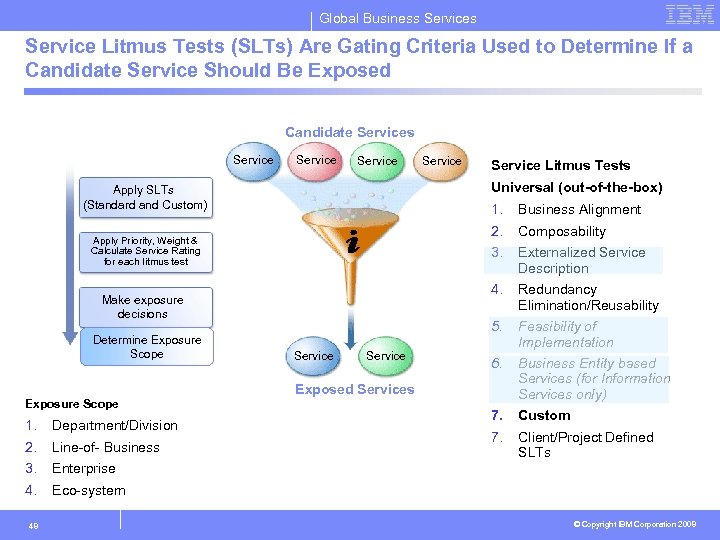
Global Business Service Litmus Tests (SLTs) Are Gating Criteria Used to Determine If a Candidate Service Should Be Exposed Candidate Services Service Litmus Tests Universal (out-of-the-box) Apply SLTs (Standard and Custom) 1. Redundancy Elimination/Reusability 5. Service Externalized Service Description 4. Service Composability 3. Make exposure decisions Business Alignment 2. Apply Priority, Weight & Calculate Service Rating for each litmus test Determine Exposure Scope Service Feasibility of Implementation 6. Business Entity based Services (for Information Services only) 7. Custom 7. Client/Project Defined SLTs Exposed Services Exposure Scope 1. Department/Division 2. Line-of- Business 3. Enterprise 4. Eco-system 48 © Copyright IBM Corporation 2008
Global Business Services Шаг 3. Внедрение сервисно-ориентированной модели 49 © Copyright IBM Corporation 2008
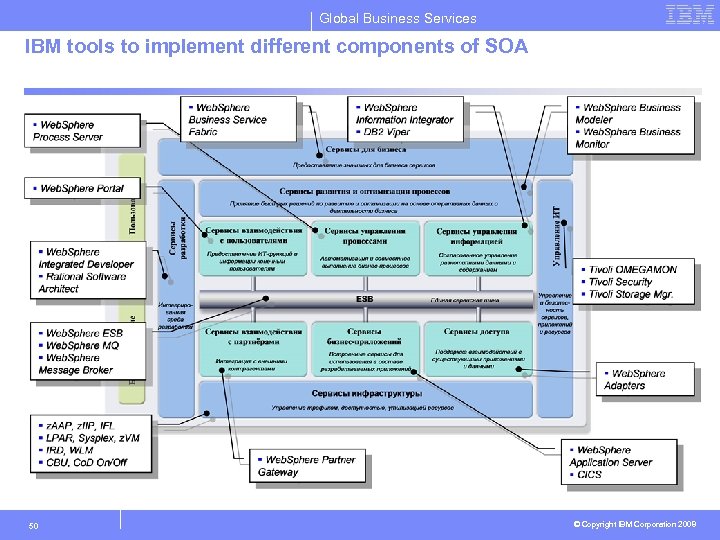
Global Business Services IBM tools to implement different components of SOA 50 © Copyright IBM Corporation 2008
Global Business Services Управление сервисно-ориентированной архитектурой 51 © Copyright IBM Corporation 2008
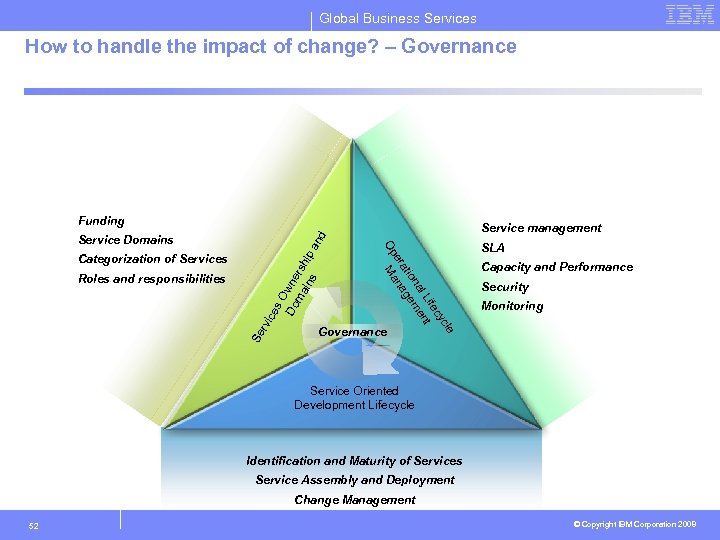
Global Business Services How to handle the impact of change? – Governance Funding Service management Se rvi ce Roles and responsibilities le yc ec Lif nt e al on em ati g er ana M Categorization of Services Op s. O Do wne ma rsh ins ip an d Service Domains SLA Capacity and Performance Security Monitoring Governance Service Oriented Development Lifecycle Identification and Maturity of Services Service Assembly and Deployment Change Management 52 © Copyright IBM Corporation 2008
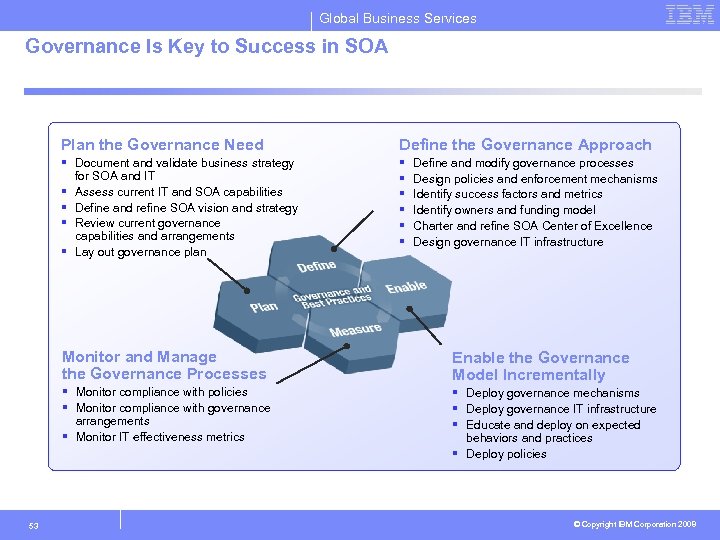
Global Business Services Governance Is Key to Success in SOA Plan the Governance Need Define the Governance Approach § Document and validate business strategy for SOA and IT § Assess current IT and SOA capabilities § Define and refine SOA vision and strategy § Review current governance capabilities and arrangements § Lay out governance plan § § § Define and modify governance processes Design policies and enforcement mechanisms Identify success factors and metrics Identify owners and funding model Charter and refine SOA Center of Excellence Design governance IT infrastructure Monitor and Manage the Governance Processes § Monitor compliance with policies § Monitor compliance with governance arrangements § Monitor IT effectiveness metrics 53 Enable the Governance Model Incrementally § Deploy governance mechanisms § Deploy governance IT infrastructure § Educate and deploy on expected behaviors and practices § Deploy policies © Copyright IBM Corporation 2008
Global Business Services Трансформация на сервисно-ориентированную платформу 54 © Copyright IBM Corporation 2008
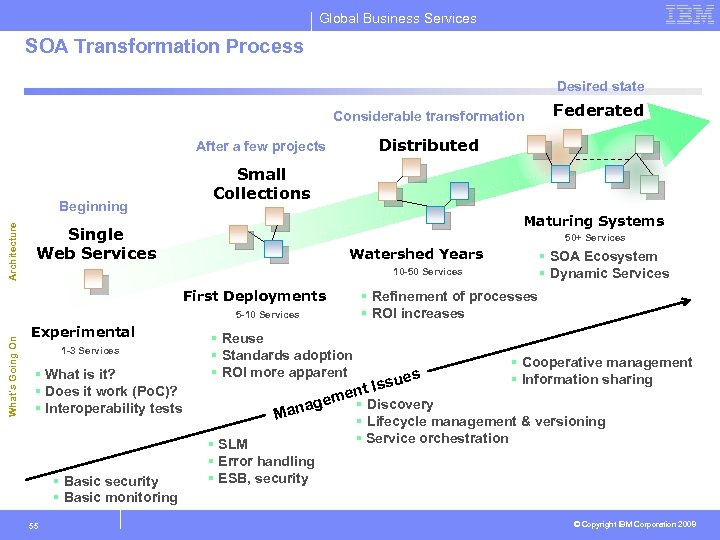
Global Business Services SOA Transformation Process Desired state Considerable transformation Distributed After a few projects Architecture Beginning Small Collections Maturing Systems Single Web Services 50+ Services Watershed Years First Deployments § Refinement of processes § ROI increases 5 -10 Services What’s Going On § SOA Ecosystem § Dynamic Services 10 -50 Services Experimental 1 -3 Services § What is it? § Does it work (Po. C)? § Interoperability tests § Basic security § Basic monitoring 55 Federated § Reuse § Standards adoption § ROI more apparent ues ss ent I § Cooperative management § Information sharing m § Discovery age Man § SLM § Error handling § ESB, security § Lifecycle management & versioning § Service orchestration © Copyright IBM Corporation 2008
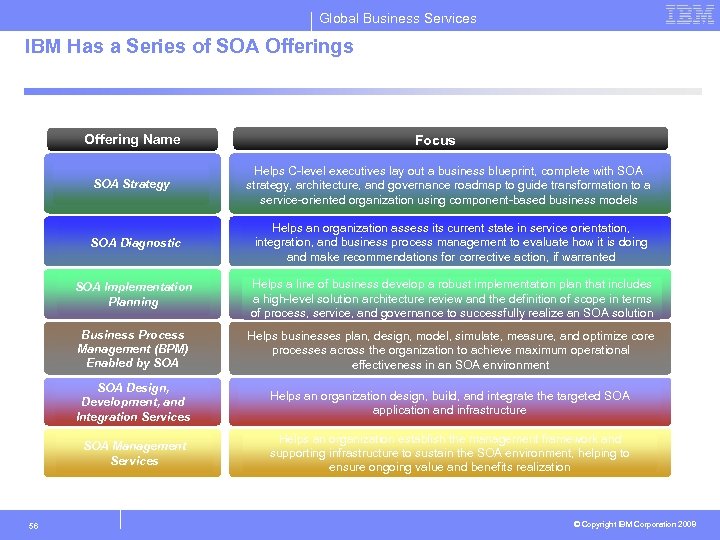
Global Business Services IBM Has a Series of SOA Offerings Offering Name SOA Strategy Focus Helps C-level executives lay out a business blueprint, complete with SOA strategy, architecture, and governance roadmap to guide transformation to a service-oriented organization using component-based business models SOA Diagnostic SOA Implementation Planning Helps a line of business develop a robust implementation plan that includes a high-level solution architecture review and the definition of scope in terms of process, service, and governance to successfully realize an SOA solution Business Process Management (BPM) Enabled by SOA Helps businesses plan, design, model, simulate, measure, and optimize core processes across the organization to achieve maximum operational effectiveness in an SOA environment SOA Design, Development, and Integration Services Helps an organization design, build, and integrate the targeted SOA application and infrastructure SOA Management Services 56 Helps an organization assess its current state in service orientation, integration, and business process management to evaluate how it is doing and make recommendations for corrective action, if warranted Helps an organization establish the management framework and supporting infrastructure to sustain the SOA environment, helping to ensure ongoing value and benefits realization © Copyright IBM Corporation 2008
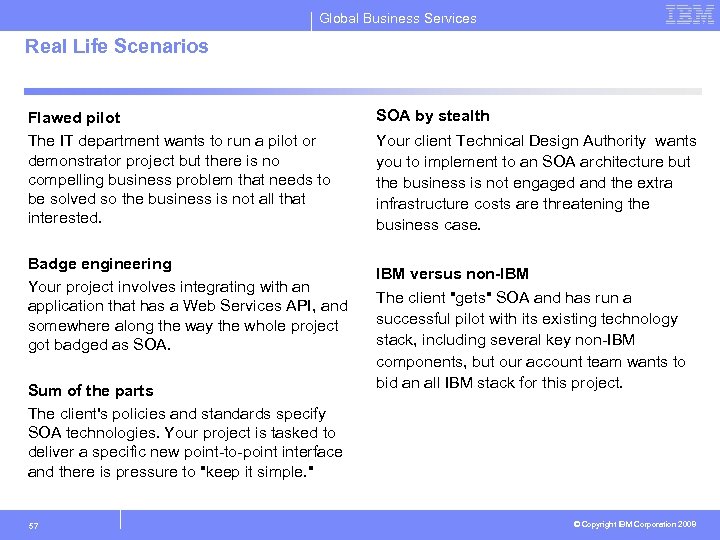
Global Business Services Real Life Scenarios Flawed pilot The IT department wants to run a pilot or demonstrator project but there is no compelling business problem that needs to be solved so the business is not all that interested. Badge engineering Your project involves integrating with an application that has a Web Services API, and somewhere along the way the whole project got badged as SOA. Sum of the parts The client's policies and standards specify SOA technologies. Your project is tasked to deliver a specific new point-to-point interface and there is pressure to "keep it simple. " 57 SOA by stealth Your client Technical Design Authority wants you to implement to an SOA architecture but the business is not engaged and the extra infrastructure costs are threatening the business case. IBM versus non-IBM The client "gets" SOA and has run a successful pilot with its existing technology stack, including several key non-IBM components, but our account team wants to bid an all IBM stack for this project. © Copyright IBM Corporation 2008
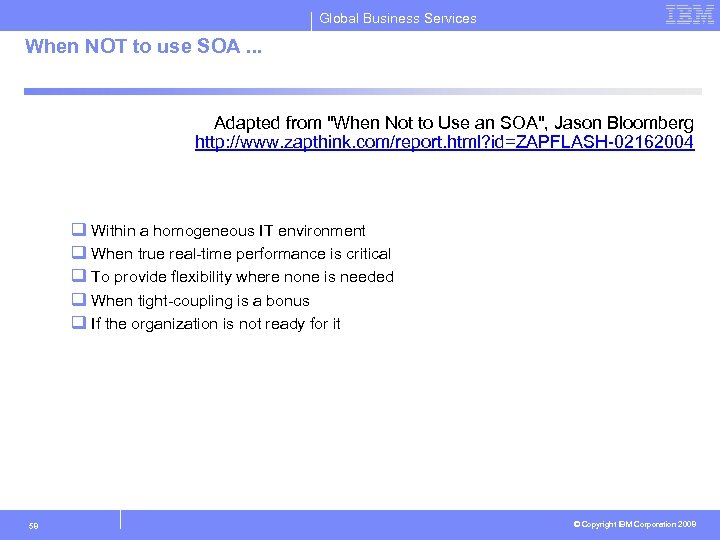
Global Business Services When NOT to use SOA. . . Adapted from "When Not to Use an SOA", Jason Bloomberg http: //www. zapthink. com/report. html? id=ZAPFLASH-02162004 q Within a homogeneous IT environment q When true real-time performance is critical q To provide flexibility where none is needed q When tight-coupling is a bonus q If the organization is not ready for it 58 © Copyright IBM Corporation 2008
Скачать презентацию Global Business Services Сервисно-ориентированная архитектура СОА Теория и
8cd95128c91b04d200eb9053b7a1586d.ppt