 Скачать презентацию GLOBAL AND LOCAL TRENDS IN CORPORATE AND ACADEMIC
03ca2553312a3335d8956c34fadb84a6.ppt
- Количество слайдов: 26




GLOBAL AND LOCAL TRENDS IN CORPORATE AND ACADEMIC WELLNESS AND EAP Tracy Harper & Associates
TRENDS International and National § Requirements ü Employer ü Employee § Organisational § Delivery § Implementation and Management
EMPLOYER Global and Local Context § Today's organisations and academic institutions need to be flexible and hardy § Manage changing employee and/or student demographics § Ever increasing productivity § Every increasing Health Care costs § Increased reliance on knowledge work § Attraction and retention of the best workers § Importance of discretionary effort by engaged employees ©Tracy Harper t/a Tracy Harper & Associates 2005/6/7
EMPLOYER Global and Local Context § There is a reciprocal relationship between well organizations/academic institutions and well and engaged employees and leading organisations/academic institutions § Business strategy and operations success depends: § on the effectiveness of the people who implement them § how well people effectiveness is maximized § While benefits, compensation always been important total work experience is now a focal point – a culture of wellness is a core component § Employees are being seen no longer as cost to manage but as a Capital Asset to Nurture § Corporate Wellness and Employee Assistance are seen as key business tools to attracting, retaining, engaging and optimizing the effectiveness of “Human Capital” as well as managing risk and cost ©Tracy Harper t/a Tracy Harper & Associates 2005/6/7
EMPLOYER Global and Local Context How High Performance Organisations Get the Most From Their People • Tough but fun • Recruiting and retaining best people • Have a challenging and stimulating environment • Nurture creativity • Enhancing well-being • Apply of marketing and sales strategies and methodology internally ©Tracy Harper t/a Tracy Harper & Associates 2005/6/7 • Maximising human capitalminimizing liability • Tons of opportunity for learning or contributing to learning • Sense of ownership & belonging • Support during difficult times • Recognition & reward • Constructive & timely feedback • Communication
EMPLOYEE Global and Local Context § A positive work environment that promotes health, safety, and respect along with appropriate wages and benefits. § Benefits alone are no longer enough; total work experience is the focal point. § Organisational practices and resources that help in balancing the demands of work and family/personal life and academic satisfaction § Being treated as a complete person If the workplace acknowledges and supports our diverse needs, we are more likely to give the workplace extra effort, expertise, and loyalty. ©Tracy Harper t/a Tracy Harper & Associates 2005/6/7
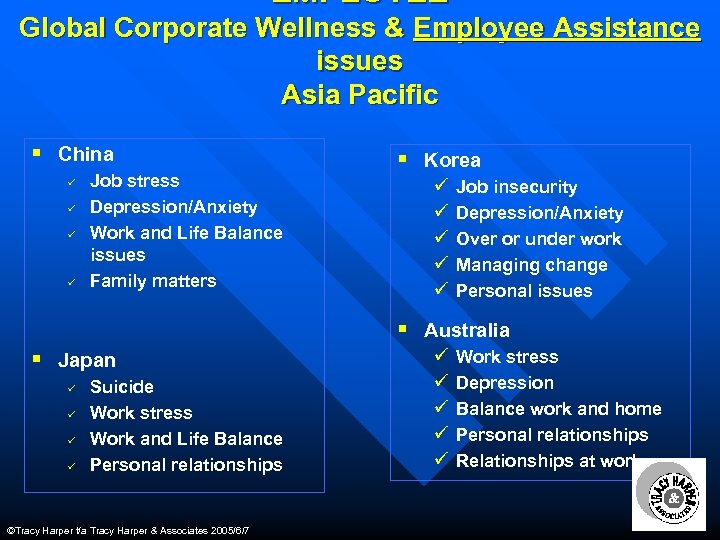
EMPLOYEE Global Corporate Wellness & Employee Assistance issues Asia Pacific § China ü ü Job stress Depression/Anxiety Work and Life Balance issues Family matters § Korea ü ü ü Job insecurity Depression/Anxiety Over or under work Managing change Personal issues § Australia § Japan ü ü Suicide Work stress Work and Life Balance Personal relationships ©Tracy Harper t/a Tracy Harper & Associates 2005/6/7 ü ü ü Work stress Depression Balance work and home Personal relationships Relationships at work
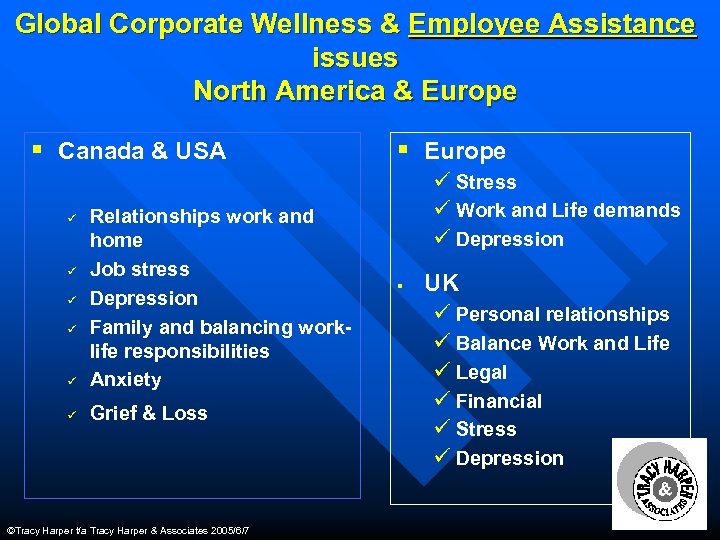
EMPLOYEE Global Corporate Wellness & Employee Assistance issues North America & Europe § Canada & USA ü Relationships work and home Job stress Depression Family and balancing worklife responsibilities Anxiety ü Grief & Loss ü ü ©Tracy Harper t/a Tracy Harper & Associates 2005/6/7 § Europe ü Stress ü Work and Life demands ü Depression § UK ü Personal relationships ü Balance Work and Life ü Legal ü Financial ü Stress ü Depression
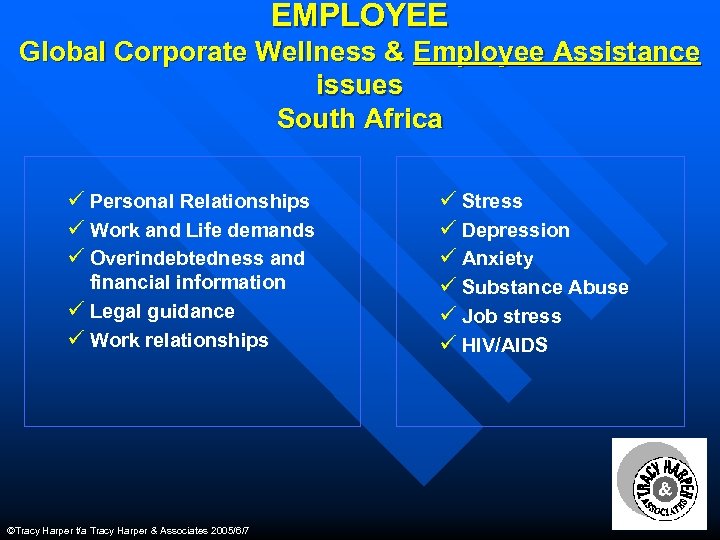
EMPLOYEE Global Corporate Wellness & Employee Assistance issues South Africa ü Personal Relationships ü Work and Life demands ü Overindebtedness and financial information ü Legal guidance ü Work relationships ©Tracy Harper t/a Tracy Harper & Associates 2005/6/7 ü Stress ü Depression ü Anxiety ü Substance Abuse ü Job stress ü HIV/AIDS
WELLNESS & EMPLOYEE ASSISTANCE DELIVERY SOLUTION TRENDS § Focus on both the “healthy” and the “unhealthy § Solutions can no longer be “nice to have”; it must show a contribution to the organisation's mission and effectiveness § Individually tailored support services, e. g. wellness coaching, EAP counselling, work/life initiatives § Carefully selected options for face-to-face, telephonic, SMS, and internet services § Sophisticated targeting of interventions for specific populations § Strategically focused promotional campaigns with top management support ©Tracy Harper t/a Tracy Harper & Associates 2005/6/7
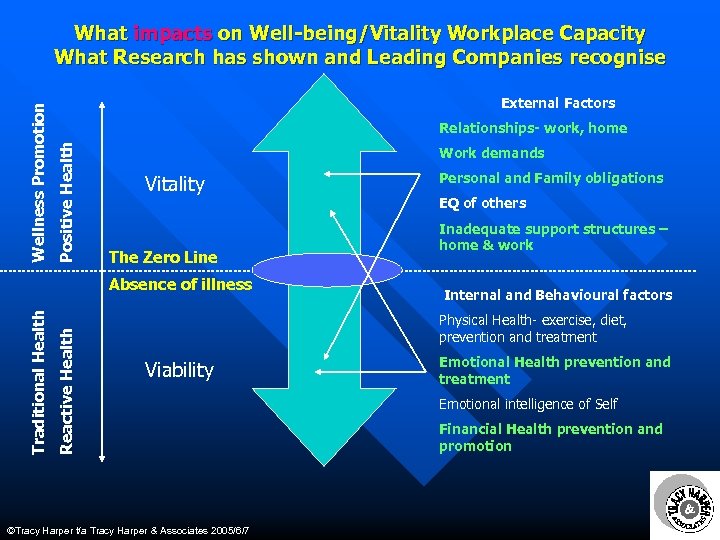
External Factors Relationships- work, home Positive Health Wellness Promotion What impacts on Well-being/Vitality Workplace Capacity What Research has shown and Leading Companies recognise Work demands Vitality The Zero Line Reactive Health Traditional Health Absence of illness Personal and Family obligations EQ of others Inadequate support structures – home & work Internal and Behavioural factors Physical Health- exercise, diet, prevention and treatment Viability ©Tracy Harper t/a Tracy Harper & Associates 2005/6/7 Emotional Health prevention and treatment Emotional intelligence of Self Financial Health prevention and promotion
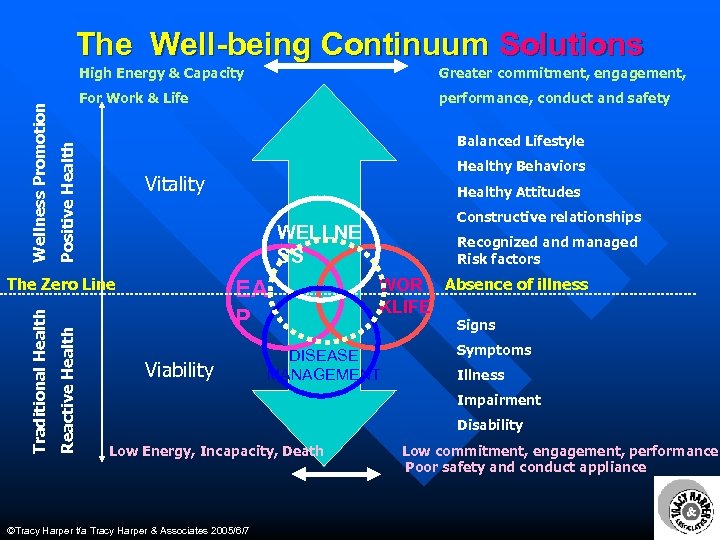
The Well-being Continuum Solutions Greater commitment, engagement, For Work & Life performance, conduct and safety Balanced Lifestyle Positive Health Wellness Promotion High Energy & Capacity Vitality Reactive Healthy Attitudes Constructive relationships WELLNE SS The Zero Line Traditional Healthy Behaviors EA P Viability Recognized and managed Risk factors WOR Absence of illness KLIFE DISEASE MANAGEMENT Signs Symptoms Illness Impairment Disability Low Energy, Incapacity, Death ©Tracy Harper t/a Tracy Harper & Associates 2005/6/7 Low commitment, engagement, performance Poor safety and conduct appliance
DELIVERY SOLUTION KEY LEARNINGS n One size does not fill all n One stop provider to multi providers n Outsourced providers and in-house providers n Organisationally focused- to - Health Management/Insurance focused n Comparable and appropriate services in all locations ©Tracy Harper t/a Tracy Harper & Associates 2005/6/7
DELIVERY SOLUTION KEY LEARNINGS Avoid the Commodity Trap n Global trend for prices for these services decreasing n Some cost savings occur because of efficiency n Reduced prices have led to service reductions n Commodity pricing leads to a product approach rather than a service approach n Minimal programme deliverables provide minimal Return on Investment ©Tracy Harper t/a Tracy Harper & Associates 2005/6/7
Strategic Management Integration trends § Corporate Wellness and Employee Assistance branding becoming part of Organisational branding § Responsibility and directing programme strategies and initiatives stays with the employer § Organisational Health Deliverables are part of a comprehensive approach to people management, including policies and training § Deliverables contracted to specialist providers or provided internally are being managed as a partnership and through service level ©Tracy Harper t/a Tracy Harper & Associates 2005/6/7
INTEGRATION TRENDS Principals § Ease of Administration § Initiatives can no longer be “nice to have”; must show a contribution to the organisation’s mission § Results must be measurable! § Concern for providing comparable and appropriate services to employees in all locations § Services must be accountable to local and global standards § Metrics must be meaningful to guide decisionmaking. ©Tracy Harper t/a Tracy Harper & Associates 2005/6/7
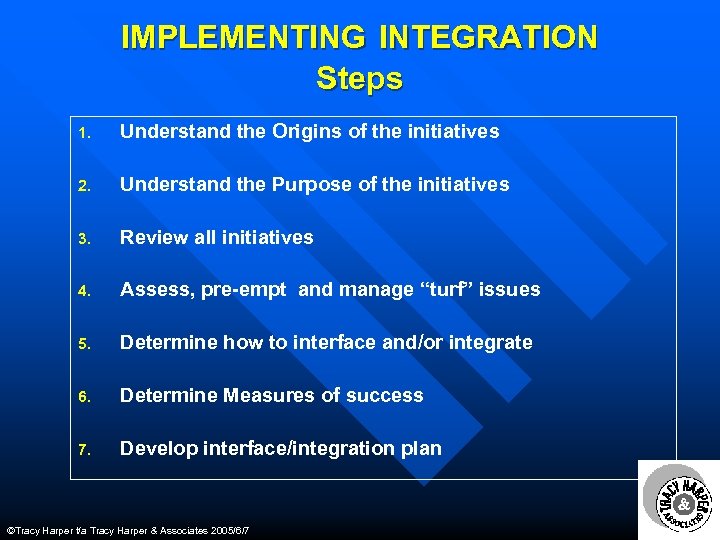
IMPLEMENTING INTEGRATION Steps 1. Understand the Origins of the initiatives 2. Understand the Purpose of the initiatives 3. Review all initiatives 4. Assess, pre-empt and manage “turf” issues 5. Determine how to interface and/or integrate 6. Determine Measures of success 7. Develop interface/integration plan ©Tracy Harper t/a Tracy Harper & Associates 2005/6/7
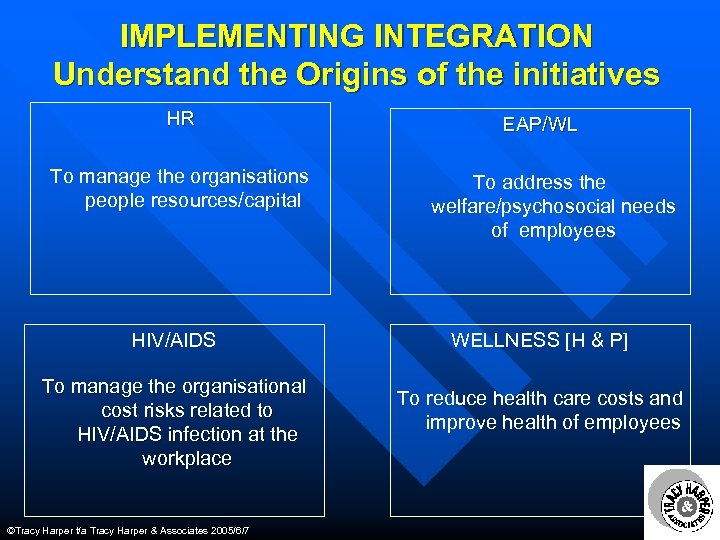
IMPLEMENTING INTEGRATION Understand the Origins of the initiatives HR To manage the organisations people resources/capital HIV/AIDS To manage the organisational cost risks related to HIV/AIDS infection at the workplace ©Tracy Harper t/a Tracy Harper & Associates 2005/6/7 EAP/WL To address the welfare/psychosocial needs of employees WELLNESS [H & P] To reduce health care costs and improve health of employees
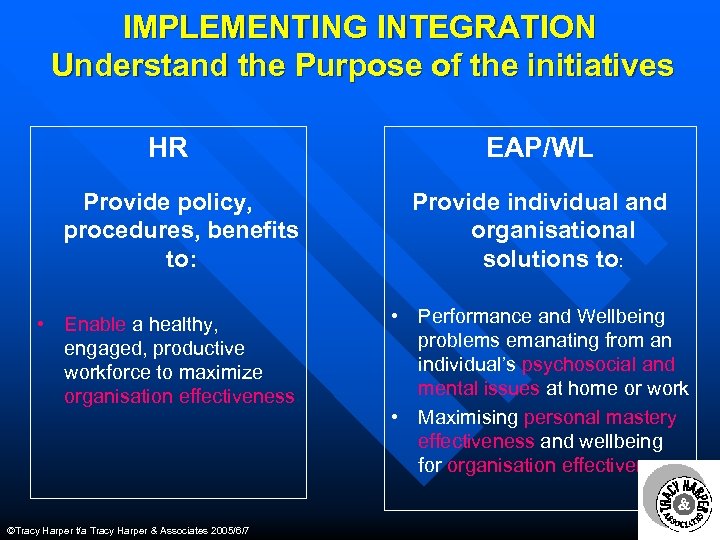
IMPLEMENTING INTEGRATION Understand the Purpose of the initiatives HR Provide policy, procedures, benefits to: • Enable a healthy, engaged, productive workforce to maximize organisation effectiveness ©Tracy Harper t/a Tracy Harper & Associates 2005/6/7 EAP/WL Provide individual and organisational solutions to: • Performance and Wellbeing problems emanating from an individual’s psychosocial and mental issues at home or work • Maximising personal mastery effectiveness and wellbeing for organisation effectiveness
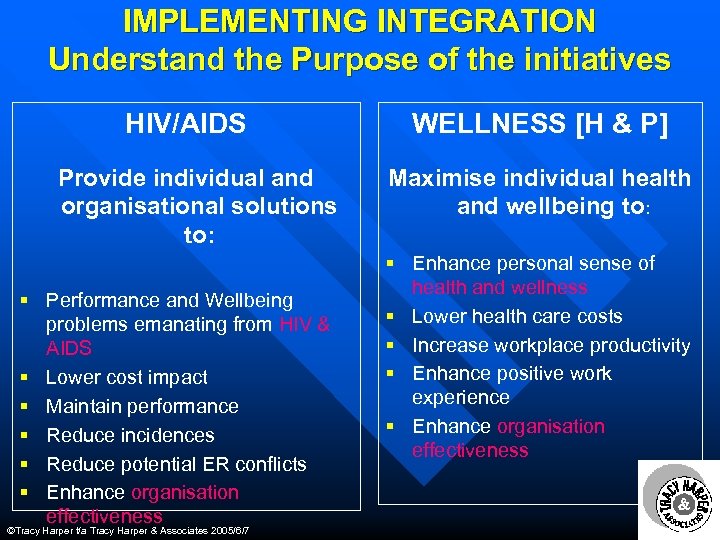
IMPLEMENTING INTEGRATION Understand the Purpose of the initiatives HIV/AIDS Provide individual and organisational solutions to: § Performance and Wellbeing problems emanating from HIV & AIDS § Lower cost impact § Maintain performance § Reduce incidences § Reduce potential ER conflicts § Enhance organisation effectiveness ©Tracy Harper t/a Tracy Harper & Associates 2005/6/7 WELLNESS [H & P] Maximise individual health and wellbeing to: § Enhance personal sense of health and wellness § Lower health care costs § Increase workplace productivity § Enhance positive work experience § Enhance organisation effectiveness
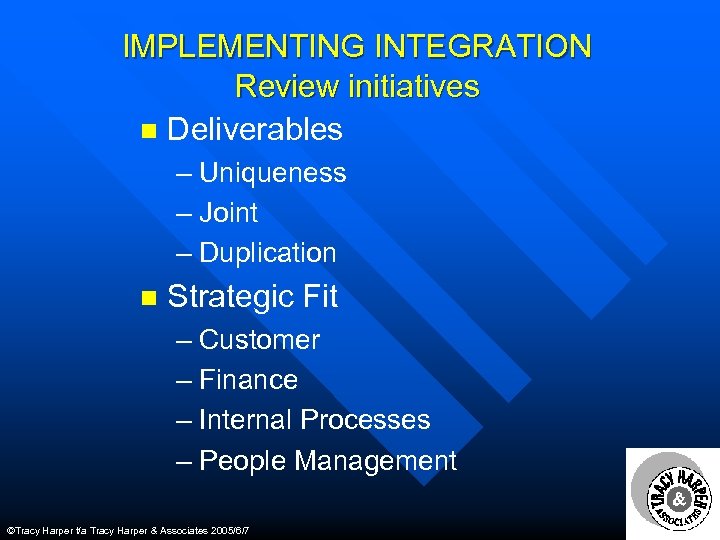
IMPLEMENTING INTEGRATION Review initiatives n Deliverables – Uniqueness – Joint – Duplication n Strategic Fit – Customer – Finance – Internal Processes – People Management ©Tracy Harper t/a Tracy Harper & Associates 2005/6/7
IMPLEMENTING INTEGRATION Review Roles and Responsibilities vs. Initiatives n Organisational – – – HR Line Employees SS Consultant ©Tracy Harper t/a Tracy Harper & Associates 2005/6/7 n Providers – Internal – External n Benefit – Provider/s – Managers
IMPLEMENTING INTEGRATION Organisational and Delivery Solutions n Evaluate, pre-empt and manage turf issues n Determine how to interface/integrate and align – Create a tailored operational model – Ensure Buy-in from all stakeholders – Develop guidelines and standards ©Tracy Harper t/a Tracy Harper & Associates 2005/6/7
SUMMARY OF KEY POINTS § Successful employers in a global and local environment realize the importance of attracting and retaining a vital, engaged and healthy workforce. § Organisational Health and Wellness efforts are increasingly integrated and focused on achieving common goals that are aligned with the organization's mission and objectives § Solutions are increasingly addressing both the vitality and viability factors of wellbeing and should maintaining the core technology of both § An Organisational “wellness culture” is a core and integral part of an employer’s competitive strategy. ©Tracy Harper t/a Tracy Harper & Associates 2005/6/7
SUMMARY OF KEY POINTS § Programme design must be strategic, with built-in partnerships and accountability. § Services must be accountable to local and global standards § Metrics must be meaningful to guide decision-making. § Integration is a process Always remember: • You get what you pay for. Cheaper is often NOT better. • Packaged solutions are not necessarily better ØAlways unwrap the packaging . …. accountability, results, intelligence, and measurements are essential. ©Tracy Harper t/a Tracy Harper & Associates 2005/6/7

CONTACT INFORMATION Tracy Harper Consultant Tracy Harper & Associates 9 Sixth Street, Houghton 2198 Tel + 27 11 447 1679 Fax + 27 11 442 5126 Cell 083 407 7616 tharper@pixie. co. za
Скачать презентацию GLOBAL AND LOCAL TRENDS IN CORPORATE AND ACADEMIC
03ca2553312a3335d8956c34fadb84a6.ppt