 Скачать презентацию Global Alliance for Vaccines and Immunization WHAT
28b80ebab9500d5462e200b6ffbf2d33.ppt
- Количество слайдов: 27



Global Alliance for Vaccines and Immunization
WHAT IS GAVI ?
What is GAVI ? n n An Alliance u. Traditional and new partners u. Public and private sector Partners have in common: u. Situation Analysis u. Vision u. Set of strategic objectives
Situation analysis: Three Gaps +Stagnation of immunization coverage with decline in certain countries and regional discrepancies + Lack of introduction into the poorer developing countries of newly-developed vaccines against major child killers + Limited investment into vaccine research for diseases with high burden in developing countries
Vision: GAVI Mission “To save children’s lives and protect people’s health through the widespread use of vaccines with a particular emphasis on developing countries”
Five Strategic Objectives +Improve access to sustainable immunization services +Expand use of all existing cost-effective vaccines +Accelerate introduction of new vaccines +Accelerate R&D on vaccines for developing countries, (HIV/AIDS, malaria and tuberculosis ) +Make immunization coverage a centrepiece in international development efforts
Milestones +By 2002, 80% countries with adequate delivery system will introduce Hepatitis B vaccine and all countries by 2007 +By 2005, 80% developing countries will have routine immunization coverage of at least 80% in all districts +By 2005, 50% of poorest countries with high burden of disease and adequate delivery systems will have introduced Hib vaccine +By 2005, the vaccine efficacy and BOD will be known for all regions for rotavirus and pneumococcal vaccines, and mechanisms identified to make the vaccines available to poorest countries
GAVI and THE VACCINE FUND
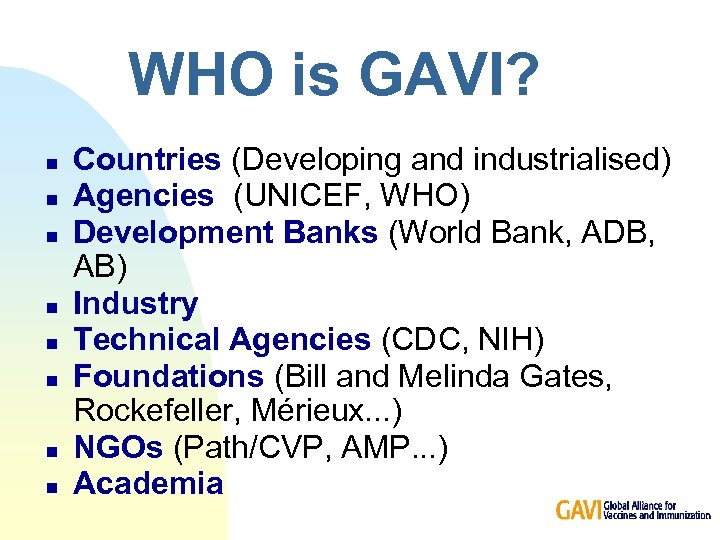
WHO is GAVI? n n n n Countries (Developing and industrialised) Agencies (UNICEF, WHO) Development Banks (World Bank, ADB, AB) Industry Technical Agencies (CDC, NIH) Foundations (Bill and Melinda Gates, Rockefeller, Mérieux. . . ) NGOs (Path/CVP, AMP. . . ) Academia
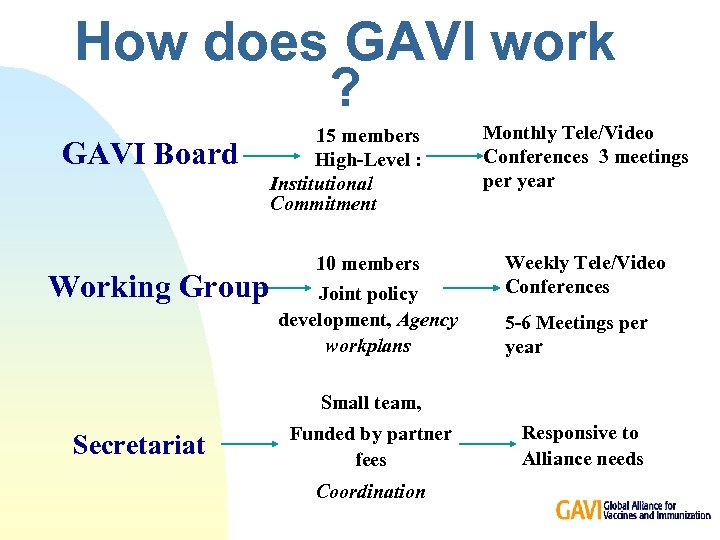
How does GAVI work ? GAVI Board Working Group 15 members High-Level : Institutional Commitment 10 members Joint policy development, Agency workplans Monthly Tele/Video Conferences 3 meetings per year Weekly Tele/Video Conferences 5 -6 Meetings per year Small team, Secretariat Funded by partner fees Coordination Responsive to Alliance needs
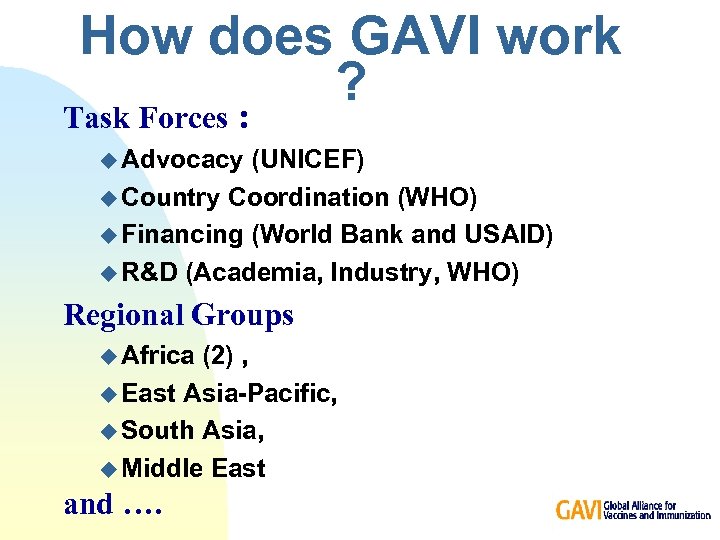
How does GAVI work ? Task Forces : u Advocacy (UNICEF) u Country Coordination (WHO) u Financing (World Bank and USAID) u R&D (Academia, Industry, WHO) Regional Groups u Africa (2) , u East Asia-Pacific, u South Asia, u Middle East and ….
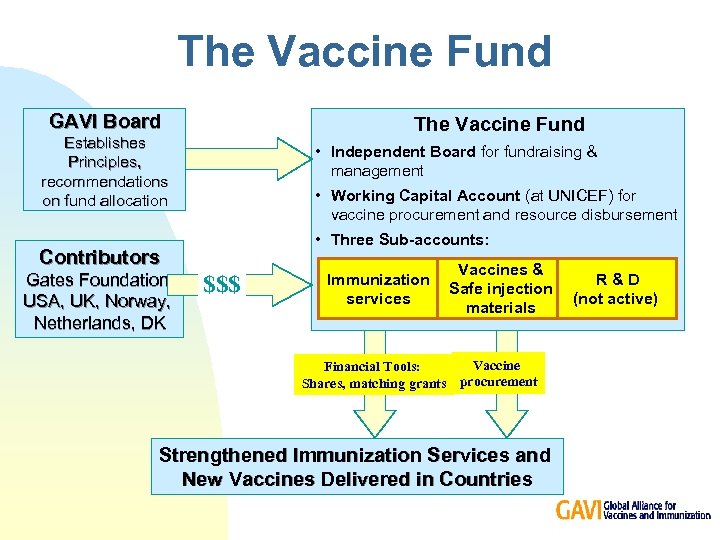
The Vaccine Fund GAVI Board The Vaccine Fund Establishes Principles, recommendations on fund allocation • Independent Board for fundraising & management • Working Capital Account (at UNICEF) for vaccine procurement and resource disbursement • Three Sub-accounts: Contributors Gates Foundation USA, UK, Norway, Netherlands, DK $$$ Immunization services Vaccines & Safe injection materials Vaccine Financial Tools: Shares, matching grants procurement Strengthened Immunization Services and New Vaccines Delivered in Countries R&D (not active)
THE VACCINE FUND
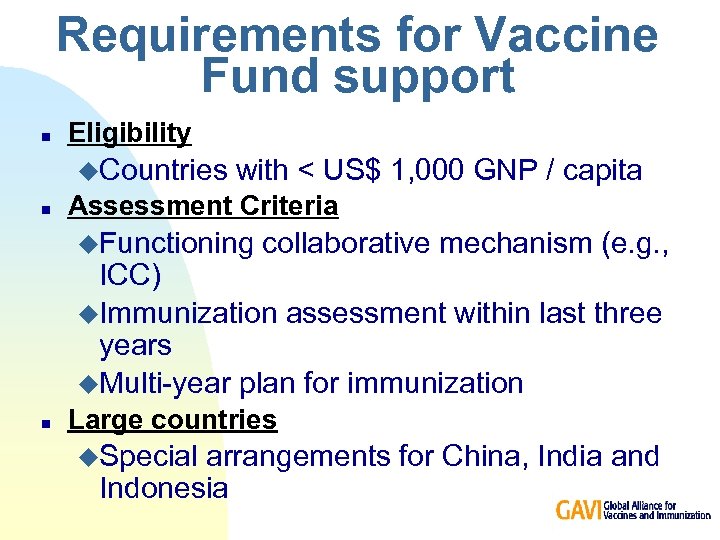
Requirements for Vaccine Fund support n Eligibility u. Countries n with < US$ 1, 000 GNP / capita Assessment Criteria u. Functioning collaborative mechanism (e. g. , ICC) u. Immunization assessment within last three years u. Multi-year plan for immunization n Large countries u. Special arrangements for China, India and Indonesia
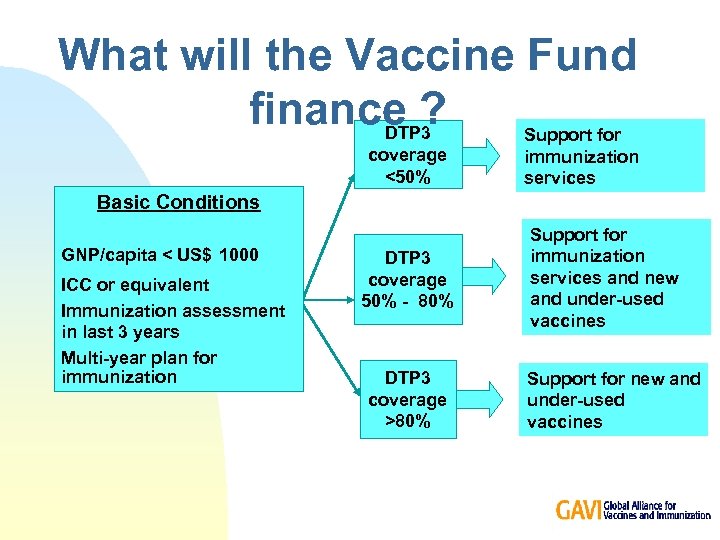
What will the Vaccine Fund finance ? DTP 3 coverage <50% Support for immunization services Basic Conditions GNP/capita < US$ 1000 ICC or equivalent Immunization assessment in last 3 years Multi-year plan for immunization DTP 3 coverage 50% - 80% DTP 3 coverage >80% Support for immunization services and new and under-used vaccines Support for new and under-used vaccines
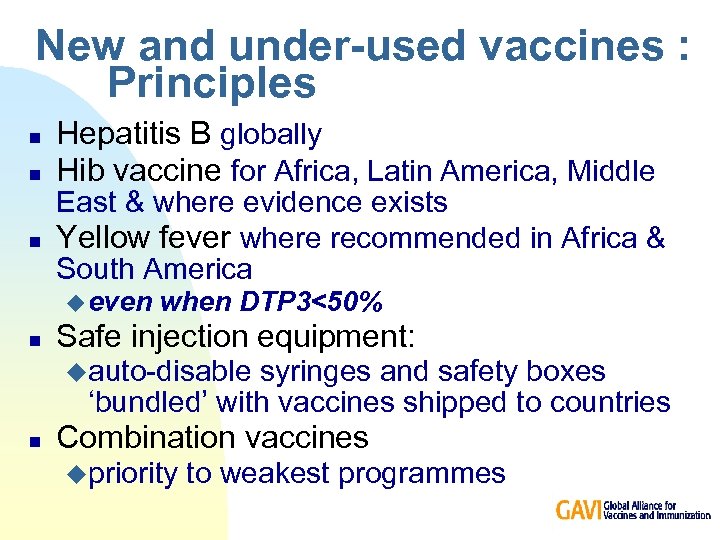
New and under-used vaccines : Principles n n n Hepatitis B globally Hib vaccine for Africa, Latin America, Middle East & where evidence exists Yellow fever where recommended in Africa & South America u even n when DTP 3<50% Safe injection equipment: uauto-disable syringes and safety boxes ‘bundled’ with vaccines shipped to countries n Combination vaccines upriority to weakest programmes
Immunization services subaccount: q q q Add to pool of existing funding Invest in advance, on the basis of set targets for the improvement of the programme Reward progress according to performance Monitor progress by reporting of district performance, according to standard indicators and annual review to ICC, to GAVI partners Delegate allocation of funds through government, partner agency, or other ICC mechanism - ‘no strings’, no international input monitoring system.
Functioning coordination mechanism (ICC) n n Senior Chair from MOH as confirmed by membership and minutes Broad terms of reference, covering all aspects of immunization, including polio, general EPI and new vaccines introduction : Regular meetings (minutes) Broad partnership ëIn many cases, ICCs will require strengthening : staff budgets, etc. .
Recent assessment of immunization programmes n n n Are recommendations being implemented ? (reflected in the plan) Surveillance (including AFP surveillance) Safety of immunization (injections, waste management) Cold chain, logistics, vaccine wastage Financing
Multi-year plan for immunization Reflect recommendations of the assessment n Consistent with global polio eradication strategies, measles control and MNT elimination n Plan to ensure safety of injections n Targets for improving coverage and reaching unreached n Disease surveillance n New vaccines introduction n Budget forecast, financing plan and sustainability strategy n
n n n n How are applications assessed ? (9 members) Independent review committee Mali, Tunisia, Philippines, Ghana, Tanzania, Bahamas, USA, Thailand, Slovenia Majority from developing countries Strong immunization programme management experience Meets for 10 days- 2 weeks for in-depth review each application reviewed by 3 members Members declare any conflict of interest recommendations to the GAVI Board
ROLES AND RESPONSIBILITIES OF PARTNERS
What is expected of countries ? Increased commitment to strengthen immunization u Establish, strengthen and manage an Inter-Agency Coordination mechanism u Develop, monitor and update a multi-year plan for immunization including: F Polio eradication F Injection safety F Resource mobilization plan u Negotiate and secure financing from F National Budgets (including loans) F Bilateral and Multi-lateral Partners’ support F The Global Fund for Children’s vaccines
What are Partners responsible for? Increased commitment to immunization u Increased coordination of technical and financial support u Procurement of vaccines and goods u Consultants, Funding u Training (technical, management, financing) u Capacity building to develop regional expertise u Networking with other countries to learn from experiences
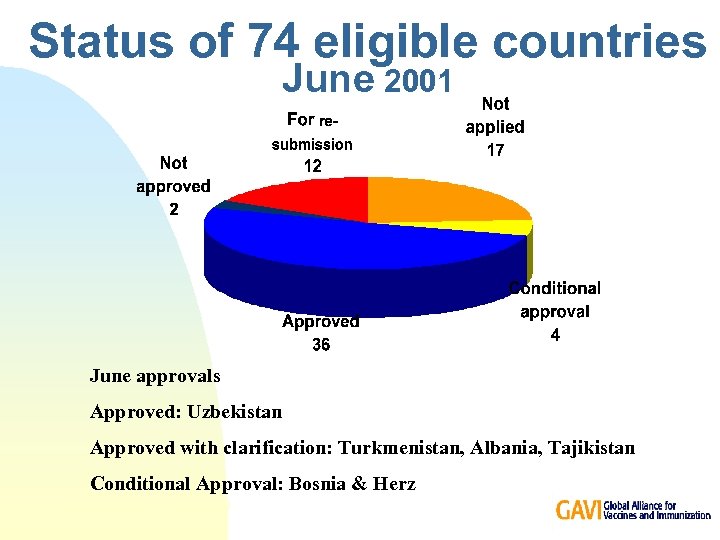
Status of 74 eligible countries June 2001 June approvals Approved: Uzbekistan Approved with clarification: Turkmenistan, Albania, Tajikistan Conditional Approval: Bosnia & Herz * (GNP per capita < US$ 1, 000)
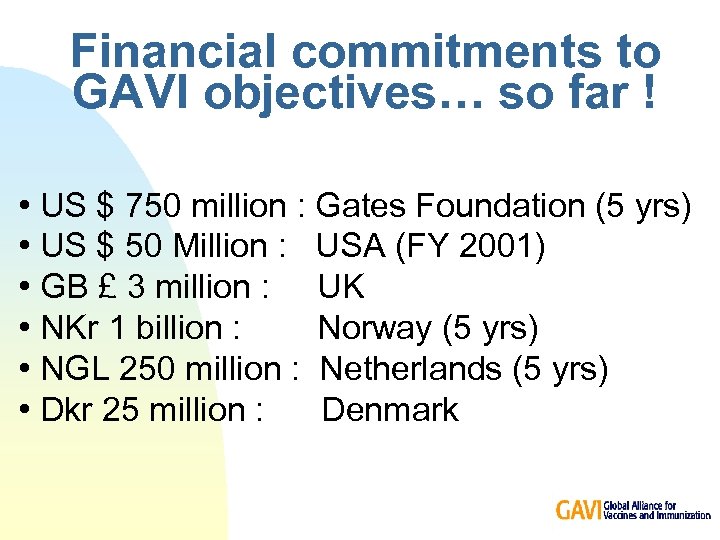
Financial commitments to GAVI objectives… so far ! • US $ 750 million : Gates Foundation (5 yrs) • US $ 50 Million : USA (FY 2001) • GB £ 3 million : UK • NKr 1 billion : Norway (5 yrs) • NGL 250 million : Netherlands (5 yrs) • Dkr 25 million : Denmark
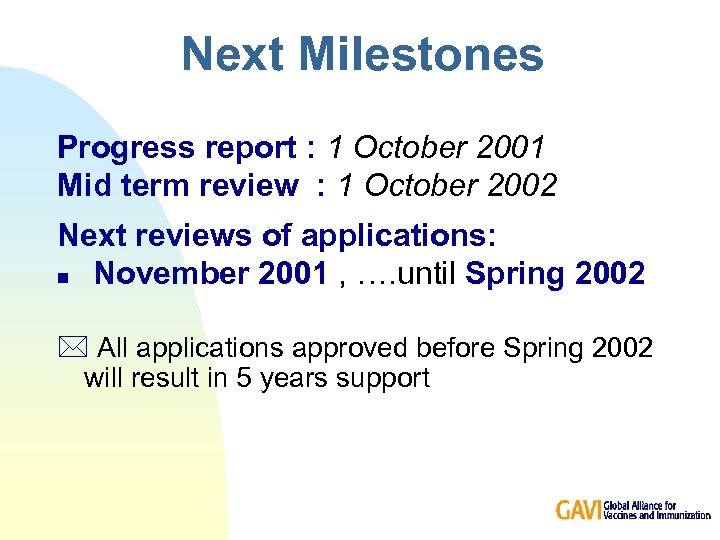
Next Milestones Progress report : 1 October 2001 Mid term review : 1 October 2002 Next reviews of applications: n November 2001 , …. until Spring 2002 * All applications approved before Spring 2002 will result in 5 years support
Скачать презентацию Global Alliance for Vaccines and Immunization WHAT
28b80ebab9500d5462e200b6ffbf2d33.ppt