


 Скачать презентацию Gleneagles follow up creating the conditions for an
72046288efa9700209bf7dd6059ff32b.ppt
- Количество слайдов: 18
 Gleneagles follow up: creating the conditions for an international agreement Amal-Lee Amin International Climate Change Policy Global Atmosphere Department for Environment, Food and Rural Affairs UK
 Progressing Action to Create Basis for Agreement on a Future Climate Process through the Gleneagles Dialogue • • • Gleneagles Outcomes on Climate Change Mexico Ministerial meeting of the Dialogue 3 - 4 Oct 2006 Stern Review IEA Energy Technology Perspectives World Bank – led work to develop global investment framework to address climate change challenges • Gleneagles Dialogue Moving Forward
 G 8 and EU Presidencies 2005 • February: Avoiding Dangerous Climate Change – Science conference • March: Energy and Environment Ministers meeting of 20 countries with large and growing energy needs • March: G 8 Environment and Development: focus on climate risks and threats to Africa’s development • May: Workshop on Innovation and Research on Energy (WIRE) • 7 th July G 8 Summit at Gleneagles • September: EU Summits with China and India – launched partnerships on climate change • 1 st November first meeting of the Gleneagles Dialogue • Announce Stern Review on the economics of climate change • Ongoing outreach events with business, civil society and legislators
 Progress in 2005 • Widening and deepening climate change debate beyond Environment Ministries (energy, development, finance) • Clear recognition on developing countries needs for increasing energy for sustainable development – challenge to address energy and climate security • Debate moved beyond the science of climate change to. . • …. . how to promote the investment necessary to enable global transition to a secure and low carbon economy? • Strengthened support for international cooperation on technology development and deployment (and transfer) • Awareness of climate impacts, threats to development and the achievement of the MDGs (World Summit) • Confidence and understanding – basis for positive outcome at Montreal and momentum for discussions on the future
 Key elements of the G 8 Political Agreement To act with resolve and urgency now to meet the shared and multiple objectives of reducing greenhouse gas emissions, enhancing energy security and efforts to reduce poverty. . Need to work together, and in partnership with major emerging economies, to find ways to achieve substantial reductions in greenhouse gas emissions. . through promotion of low-emitting energy systems To take further action to • promote innovation, energy efficiency, conservation, improve policy, regulatory and financing frameworks; and accelerate deployment of low carbon technology • work with developing countries to enhance private investment and transfer of technologies, taking into account their own energy needs and priorities • raise awareness of climate change and our other multiple challenges, and the means of dealing with them;
 Gleneagles 7 th July 2005 • Heads of the G 8 countries and Brazil, China, India, Mexico and South Africa (the +5) • G 8 Agreement to Gleneagles Plan of Action on Climate Change Clean Energy and Sustainable Development, in particular recognising the need for G 8 to work with developing countries to: • enable a global transition to low carbon economy • improve resilience to climate impacts and integration of adaptation strategies • The +5 proposal for a “new paradigm” on international technology cooperation • Gleneagles Dialogue between the G 8 and countries with large and growing energy needs • Report to Japan’s G 8 Summit in 2008
 Gleneagles Dialogue • To address the strategic challenge of transforming our energy systems for secure and sustainable future • Monitor implementation the Gleneagles Plan of Action and explore how to build on this progress • Share best practice between participating governments • Work with appropriate partnerships, institutions and initiatives including: • the IEA on alternative energy scenarios and strategies aimed at a clean clever and competitive energy future • the World Bank will take a leadership role in creating an new investment framework for clean energy and development • Stern Review on the costs of action and inaction
 Key initiatives that will inform the Gleneagles Dialogue • Low Carbon Societies Workshop: Japan 2006 • Energy Research and Innovation Workshop (WIRE): Brazil hosting follow-up 19 -20 Sep 2006 • EU-China Near Zero Emissions from Coal (NZEC) using Carbon Capture and Storage • Asia Pacific Partnership • Partnerships and initiatives REN 21 and REEEP, new Global Bioenergy Partnership, CSLF etc • Joint UK-India Technology Transfer Study (including IPR) • World Economic Forum and World Business Council on Sustainable Development • GLOBE – parallel legislators dialogue up until 2008 • Outreach activities with civil society (Chatham House)
 Gleneagles Dialogue in 2006 • Mexico Ministerial Meeting to consider three major challenges for addressing energy and climate security: • Economic challenge – Stern Review • Technology challenge – IEA energy technology perspectives (June 2006) • Investment challenge – World Bank leading process for a global Investment Framework • Aim for agreement on: • Challenges and opportunities at the national level • Potential for enhancing international cooperation and elements of a “new paradigm” • Joint initiatives and practical cooperation for scaling-up climate related investment
 Stern Review • Implications for energy demand emissions as a result of economic growth over the coming decades • Economic, social and environmental consequences of climate change • Impact and effectiveness of national and international policies and arrangements in reducing net emissions in a cost-effective way • Economics of moving to a low-carbon global economy, focusing on the medium to long-term perspective, and drawing implications for the timescales for action, and choice of policies and institutions • An assessment of the potential of different approaches for adaptation to changes in the climate
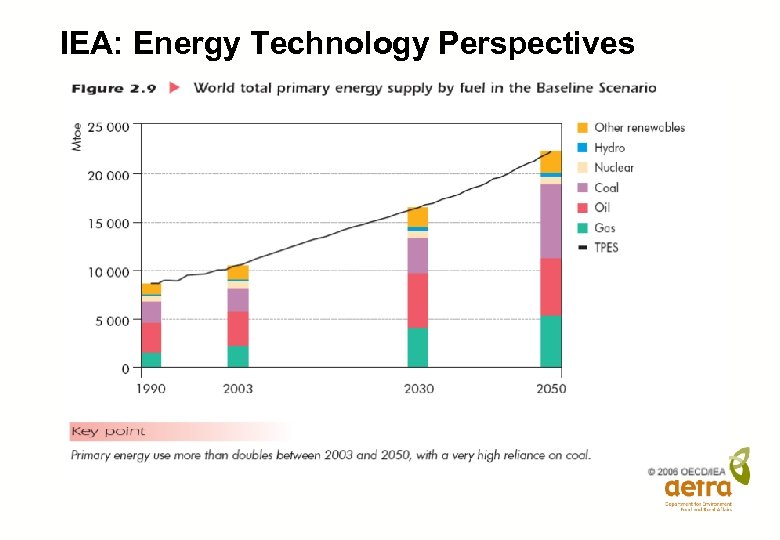 IEA: Energy Technology Perspectives
 IEA: Energy Technology Perspectives • Possible to return energy-related emissions to current levels by 2050 • Using technologies that already exist or are under development (energy efficiency, decarbonisation of electricity and bio-fuels for transport) • Costs are not disproportionate (< US$25/te CO 2) but will require substantial effort and investment by both public and private sector • Policy implications • Energy efficiency is top priority • Well focussed R&D programmes are essential and transition from R&D to deployment critical • Governments must create a stable policy environment that promotes low-carbon energy options that are global in scope • Non-economic barriers must receive attention • Collaboration with developing countries essential
 Aims of World Bank led work on a global Investment Framework • IFIs have a critical role in mobilising investment from a range of sources, including public and private sector • Improve coordination and coherence of existing sources of energy investment: public sector; domestic and international capital markets; multilateral institutions; sources of concessionary finance as well as; carbon finance • Assist in overcoming obstacles to investment in developing countries • Facilitate the transfer of finance and technology • Allow financing from different sources to be combined effectively, to catalyse the investment needed • World Bank to lead – work closely with Regional Development Banks which are now establishing their own work programmes and activities
 World Bank Activities So Far • WB programme of work focused on three pillars: access to energy; low carbon technology and; adaptation. • Work proceeding on two-tracks: • Track 1: Until Annual Meeting Sep 2006 – further work to develop the Framework and detailed work programme 2006 – 2008, including proposals for country case studies • Track 2: Implementation of the 2006 -2008 work programme • Emphasis on ensuring existing financing instruments work most effectively to address energy and climate security • Also propose new Clean Energy Financing Vehicle (CEFV): • assist in scaling up and commercialisation new technology • buy down the costs of low carbon technologies/infrastructure • mitigate technology risks by blending different types of finance (loans, grants, carbon finance)
 Realising the Vision for a Global Investment Framework to Achieve Energy and Climate Security • Potential for transforming global investment patterns – to support energy and climate security • Realising this requires long-term commitment for financing, human and institutional capacity building • Requires broad support and high level of ambition from the banks’ stakeholders, both developed and developing countries • Encourage the banks to work together to produce an integrated Framework that promotes shift in global investment patterns • Strengthen linkages with the work of other international and regional organisations including IEA and relevant partnerships • Further engagement with business, industry and civil society • Need to demonstrate potential early on – explore with developing countries how the new initiatives and instruments can benefit in national efforts to attract investment in low carbon energy and adaptation
 Gleneagles Dialogue Moving Forward • Need to understand challenges for making the transition to a low carbon economy globally… and the opportunities for working together to achieve this • Identify incentives for channelling investment in low carbon technology and adaptation at the national level • Elaborate the concept of a “new paradigm” for technology cooperation, including technology transfer N-S, S-S and S-N as well as how to drive innovation into new technologies • Practical cooperation to pilot projects and programmes to demonstrate successful investment and financing approaches – utilising the new financing instruments developed • Demonstrate tangible progress on technology cooperation - example: UK-Brazil-South Africa Taskforce on Biofuels • Ongoing outreach to all key stakeholders – business, civil society and legislators
 Finally… • Demonstrating that all countries can make the transition to a secure and low carbon economy consistent with strong economic growth will create a firmer basis for agreement to a future climate change process that involves all Parties • Enabling such a transition requires a concerted global effort involving all Governments and all stakeholders at the national and international level • Japan G 8 Summit 2008 key milestone in global efforts to combat climate change and achieve long-term sustainable development
 Thank You