 Скачать презентацию Glavne značajke klimatskih promjena i klimatskih scenarija Branko
aab967d3461a156791ca405dc436a63a.ppt
- Количество слайдов: 22



Glavne značajke klimatskih promjena i klimatskih scenarija Branko Grisogono Geofizički odsjek, PMF Zagreb Hvala: Č. Branković & I. Güttler, DHMZ
OUTLINE Ø Data: Global Past, Present → Future Ø Clearing out the Denial of Climate Change Ø Numerical Meteorological & Climate Models Simulators Ø Climate vs. Weather: expect ≠ get Ø More of Current Results: Present → Future Ø Regional Climate Change Ø Tentative Conclusions → Discussion
OUTLINE Ø Data: Global Past, Present → Future Ø Clearing out the Denial of Climate Change Ø Numerical Meteorological & Climate Models Simulators Ø Climate vs. Weather: expect ≠ get Ø More of Current Results: Present → Future Ø Regional Climate Change Ø Tentative Conclusions → Discussion
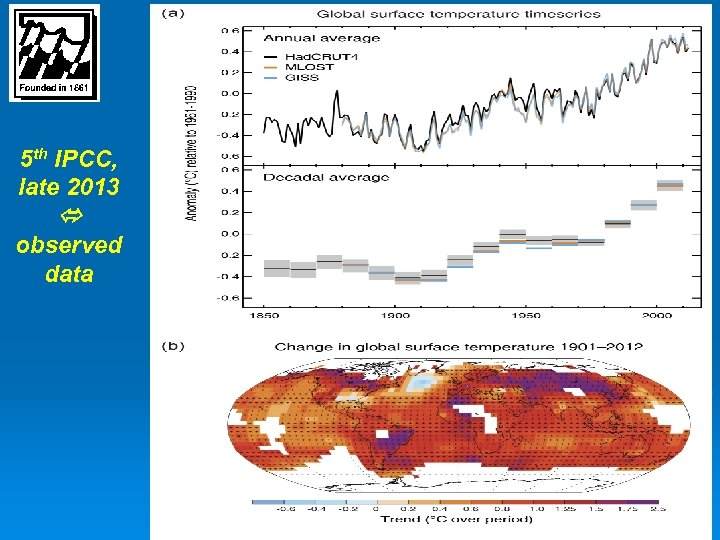
5 th IPCC, late 2013 observed data
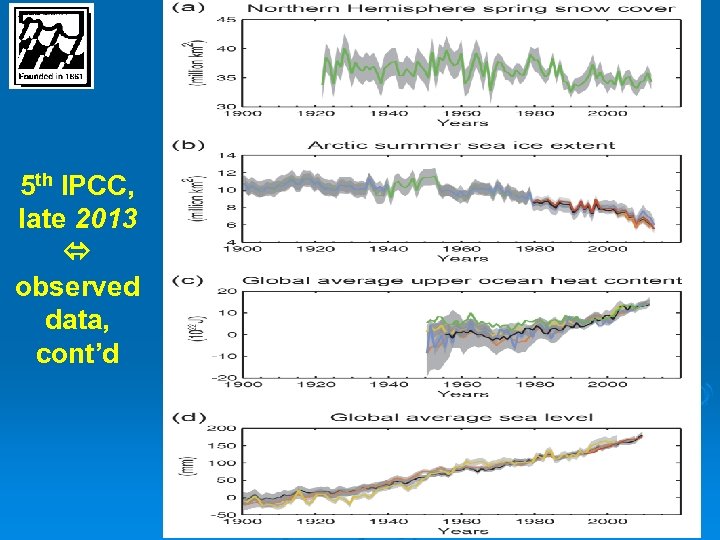
5 th IPCC, late 2013 observed data, cont’d
![Climate last ~ 140 yr: economy ↔ 2 x [economy] ↔ 2 x [CO](https://present5.com/presentation/aab967d3461a156791ca405dc436a63a/image-6.jpg "Climate last ~ 140 yr: economy ↔ 2 x [economy] ↔ 2 x [CO")
Climate last ~ 140 yr: economy ↔ 2 x [economy] ↔ 2 x [CO 2, CH 4, aerosol, land-use, …] → 2 x [warming, …] ≈> Global CO 2 as a linear surrogate for all the anthropogenic forcings ≈2. 33 o. C /[2 x CO 2] ↓ b) Residues ≈ Actual T - Anthropogenic T Mean Residues ≈ ± 0. 11 o. C errors in 1 -yr GCM hindcasts Ø Probability that it’s simply a giant natural fluctuation –how much rare? Ø Estimate the likelihood of a given amount of natural temp. change → bell curve chance of a 1 o. C fluct. over 125 yr. as natural is ≈ 1: 105 or 1: 3∙ 106 1 o. C fluct. ↔ 5σ Ø Nonlin. Geophys. → extremes far stronger than from bell curve; maybe 100 x more likely → 1: 1000; yet small enough to reject the possibility
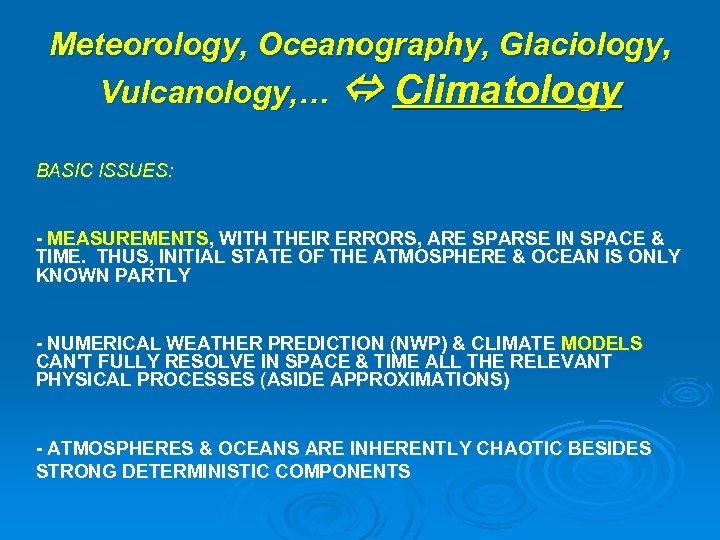
Meteorology, Oceanography, Glaciology, Vulcanology, … Climatology BASIC ISSUES: - MEASUREMENTS, WITH THEIR ERRORS, ARE SPARSE IN SPACE & TIME. THUS, INITIAL STATE OF THE ATMOSPHERE & OCEAN IS ONLY KNOWN PARTLY - NUMERICAL WEATHER PREDICTION (NWP) & CLIMATE MODELS CAN'T FULLY RESOLVE IN SPACE & TIME ALL THE RELEVANT PHYSICAL PROCESSES (ASIDE APPROXIMATIONS) - ATMOSPHERES & OCEANS ARE INHERENTLY CHAOTIC BESIDES STRONG DETERMINISTIC COMPONENTS
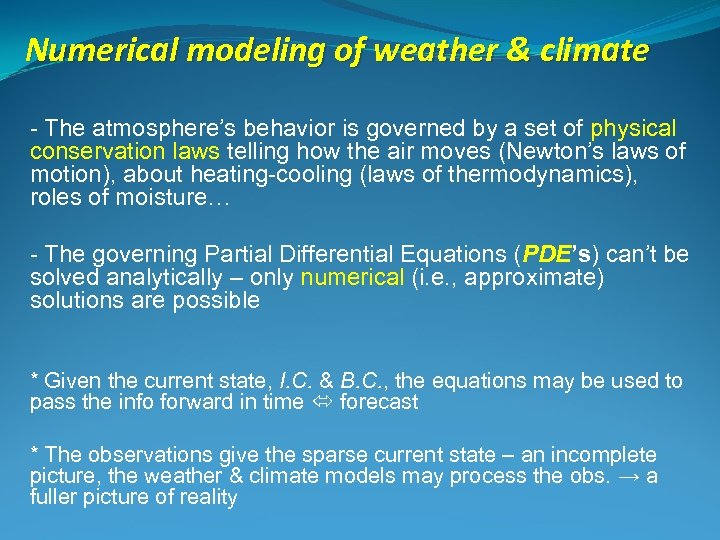
Numerical modeling of weather & climate - The atmosphere’s behavior is governed by a set of physical conservation laws telling how the air moves (Newton’s laws of motion), about heating-cooling (laws of thermodynamics), roles of moisture… - The governing Partial Differential Equations (PDE’s) can’t be solved analytically – only numerical (i. e. , approximate) solutions are possible * Given the current state, I. C. & B. C. , the equations may be used to pass the info forward in time forecast * The observations give the sparse current state – an incomplete picture, the weather & climate models may process the obs. → a fuller picture of reality
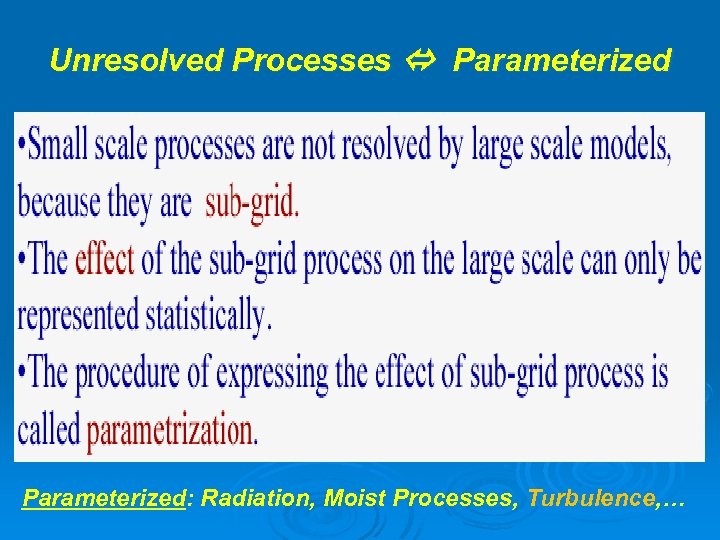
Unresolved Processes Parameterized: Radiation, Moist Processes, Turbulence, …
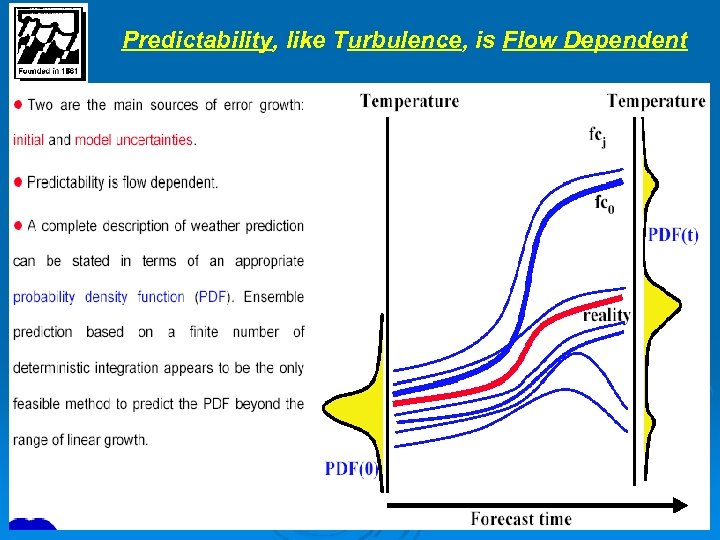
Predictability, like Turbulence, is Flow Dependent
Weather vs. Climate Models • Resolution & integration length of the governing PDE’s (motion, mass, thermodynamics, spicies) • Parameterizations (different space - & time-scales) e. g. , weather models might have slight drift (may avoid some feedbacks, etc. ) …climate modes not! • Sometimes numerics, due to numerous couplings (feedbacks) being modeled differently, etc. • Oceans, soil, biosphere, ice, … treated differently
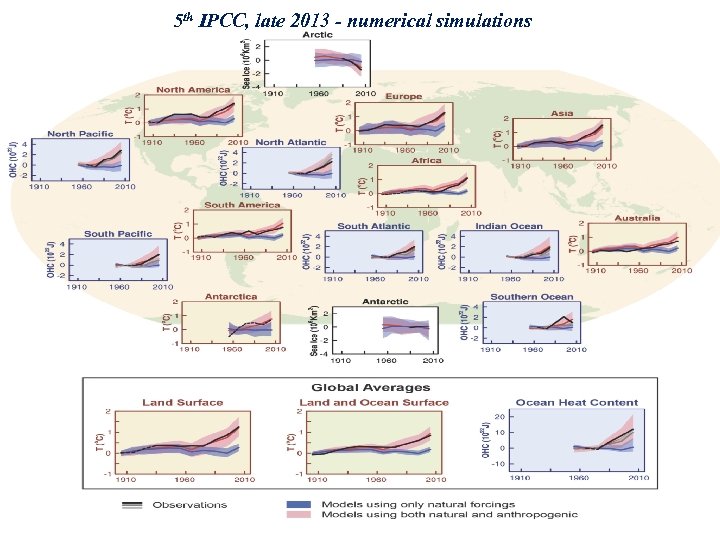
5 th IPCC, late 2013 - numerical simulations
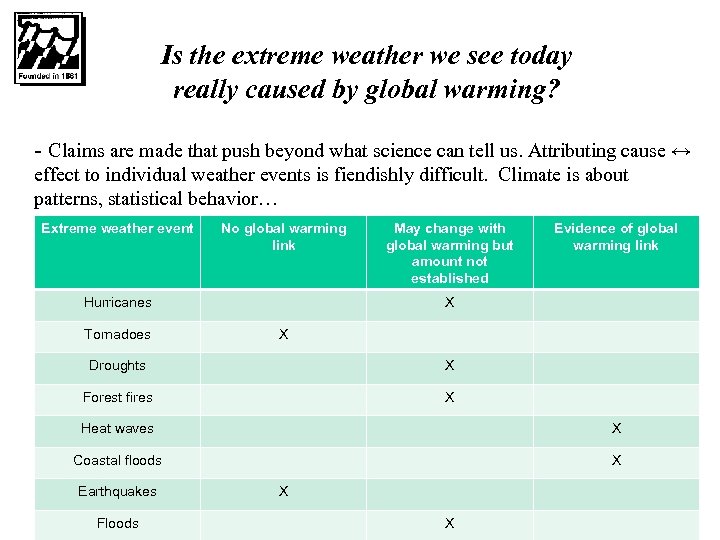
Is the extreme weather we see today really caused by global warming? - Claims are made that push beyond what science can tell us. Attributing cause ↔ effect to individual weather events is fiendishly difficult. Climate is about patterns, statistical behavior… Extreme weather event No global warming link Hurricanes Tornadoes May change with global warming but amount not established Evidence of global warming link X X Droughts X Forest fires X Heat waves X Coastal floods X Earthquakes Floods X X
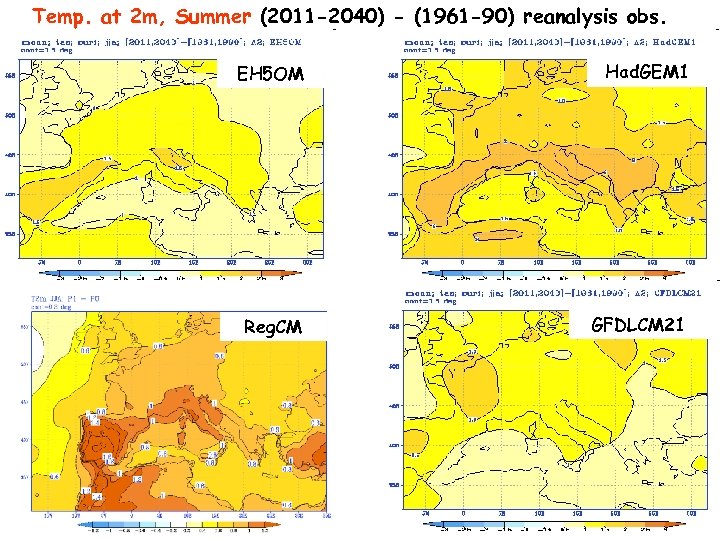
Temp. at 2 m, Summer (2011 -2040) - (1961 -90) reanalysis obs. EH 5 OM Had. GEM 1 Reg. CM GFDLCM 21 srednjak ansambla
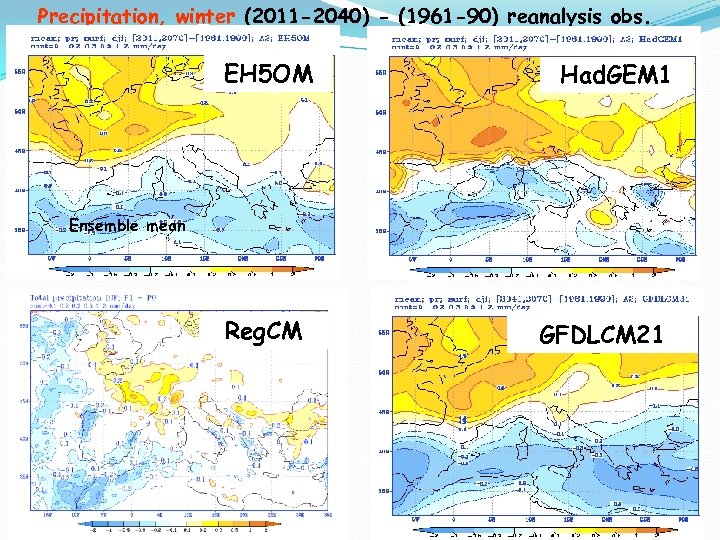
Precipitation, winter (2011 -2040) - (1961 -90) reanalysis obs. EH 5 OM Had. GEM 1 Ensemble mean Reg. CM GFDLCM 21
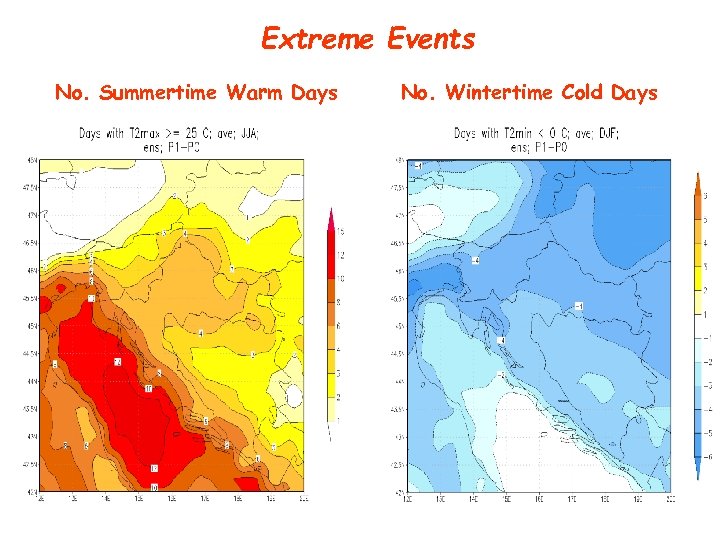
Extreme Events No. Summertime Warm Days No. Wintertime Cold Days
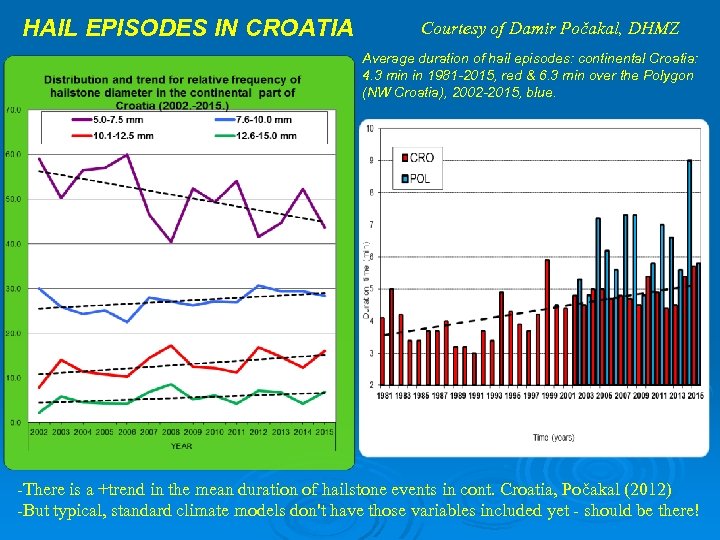
HAIL EPISODES IN CROATIA Courtesy of Damir Počakal, DHMZ Average duration of hail episodes: continental Croatia: 4. 3 min in 1981 -2015, red & 6. 3 min over the Polygon (NW Croatia), 2002 -2015, blue. -There is a +trend in the mean duration of hailstone events in cont. Croatia, Počakal (2012) -But typical, standard climate models don't have those variables included yet - should be there!
TENTATIVE CONCLUSIONS Ø Current surface temp. upward trends & future predictions are unusual, unexplained by natural internal climate variability at ≈ 99 % confidence Ø “Predictions” based on greenhouse gas emission scenarios & links the gases concentrations temp. via modeling & simulations Ø Included: population growth, economic development, technol. change, social interactions Ø Besides large spatio-temporal variations, global warming is real, it exceeds in magnitude & pace natural changes over more than the last 10 3 yr. Ø No detailed clim. projections for hail-storms and wind fields in/around Croatia
TENTATIVE CONCLUSIONS cont’d Ø Immediate changes seem needed: lowering emissions of greenhouse gasses to meet the scenario with global ~ +2 o. C in ≈ yr. 2100 Ø Targeting and promoting more human technologies, renewable energies, healthier food & water Humanistic approach needed! Ø It is wrong to deploy “instrumental rationalism” (max. efficiency only) & blind pragmatism based on e. g. , large resources & markets Ø Make reliable regional climate – economy projections & spacetime variability for next few decades (agronomy, energy, tourism, education, traffic, etc. )

The End
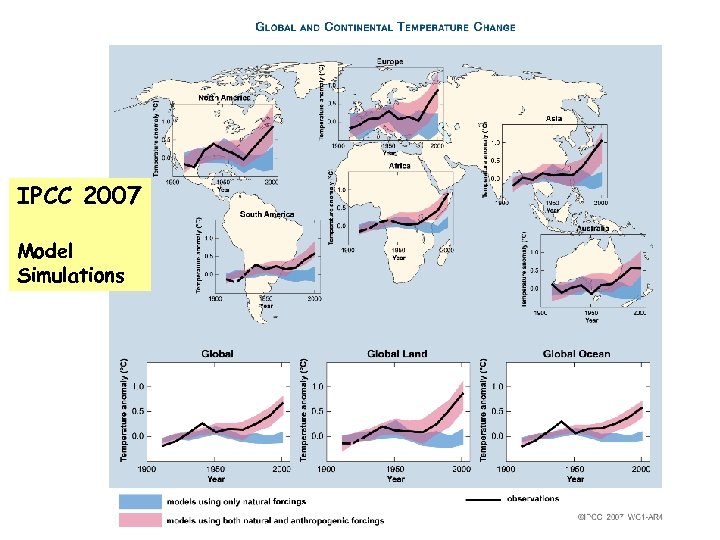
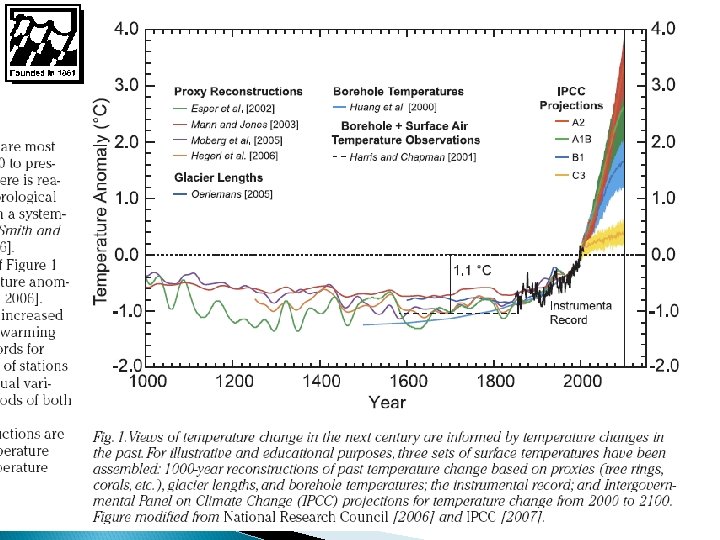
IPCC 2007 Model Simulations
 Скачать презентацию Glavne značajke klimatskih promjena i klimatskih scenarija Branko
aab967d3461a156791ca405dc436a63a.ppt