


 Скачать презентацию GLAST LAT Project DOE NASA Review of the GLAST LAT
1bb0aa42efc49d77379fe8cac2b7f491.ppt
- Количество слайдов: 13
 GLAST LAT Project DOE/NASA Review of the GLAST/LAT Project, Feb. 13 -15, 2001 Mechanical Systems: Supporting Information Martin Nordby 1
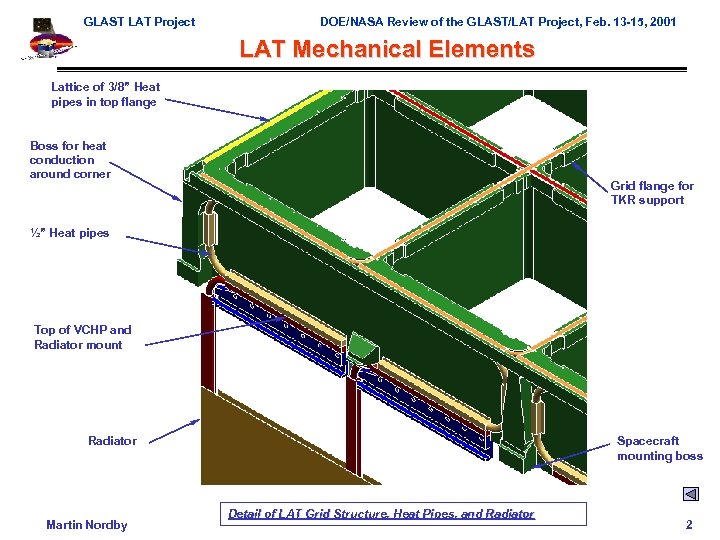 GLAST LAT Project DOE/NASA Review of the GLAST/LAT Project, Feb. 13 -15, 2001 LAT Mechanical Elements Lattice of 3/8” Heat pipes in top flange Boss for heat conduction around corner Grid flange for TKR support ½” Heat pipes Top of VCHP and Radiator mount Radiator Martin Nordby Spacecraft mounting boss Detail of LAT Grid Structure, Heat Pipes, and Radiator 2
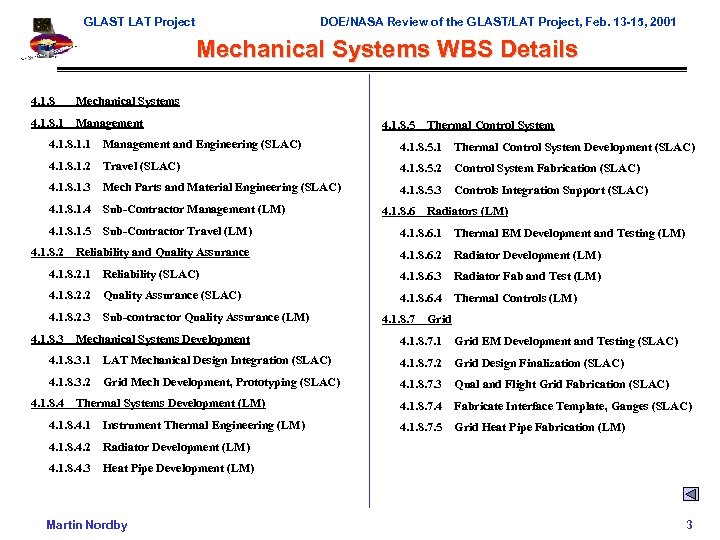 GLAST LAT Project DOE/NASA Review of the GLAST/LAT Project, Feb. 13 -15, 2001 Mechanical Systems WBS Details 4. 1. 8 Mechanical Systems 4. 1. 8. 1 Management 4. 1. 8. 5 Thermal Control System 4. 1. 8. 1. 1 Management and Engineering (SLAC) 4. 1. 8. 5. 1 Thermal Control System Development (SLAC) 4. 1. 8. 1. 2 Travel (SLAC) 4. 1. 8. 5. 2 Control System Fabrication (SLAC) 4. 1. 8. 1. 3 Mech Parts and Material Engineering (SLAC) 4. 1. 8. 5. 3 Controls Integration Support (SLAC) 4. 1. 8. 1. 4 Sub-Contractor Management (LM) 4. 1. 8. 1. 5 Sub-Contractor Travel (LM) 4. 1. 8. 6. 1 Thermal EM Development and Testing (LM) 4. 1. 8. 2 Reliability and Quality Assurance 4. 1. 8. 6. 2 Radiator Development (LM) 4. 1. 8. 6 Radiators (LM) 4. 1. 8. 2. 1 Reliability (SLAC) 4. 1. 8. 6. 3 Radiator Fab and Test (LM) 4. 1. 8. 2. 2 Quality Assurance (SLAC) 4. 1. 8. 6. 4 Thermal Controls (LM) 4. 1. 8. 2. 3 Sub-contractor Quality Assurance (LM) 4. 1. 8. 3 Mechanical Systems Development 4. 1. 8. 7 Grid 4. 1. 8. 7. 1 Grid EM Development and Testing (SLAC) 4. 1. 8. 3. 1 LAT Mechanical Design Integration (SLAC) 4. 1. 8. 7. 2 Grid Design Finalization (SLAC) 4. 1. 8. 3. 2 Grid Mech Development, Prototyping (SLAC) 4. 1. 8. 7. 3 Qual and Flight Grid Fabrication (SLAC) 4. 1. 8. 7. 4 Fabricate Interface Template, Gauges (SLAC) 4. 1. 8. 7. 5 Grid Heat Pipe Fabrication (LM) 4. 1. 8. 4 Thermal Systems Development (LM) 4. 1. 8. 4. 1 Instrument Thermal Engineering (LM) 4. 1. 8. 4. 2 Radiator Development (LM) 4. 1. 8. 4. 3 Heat Pipe Development (LM) Martin Nordby 3
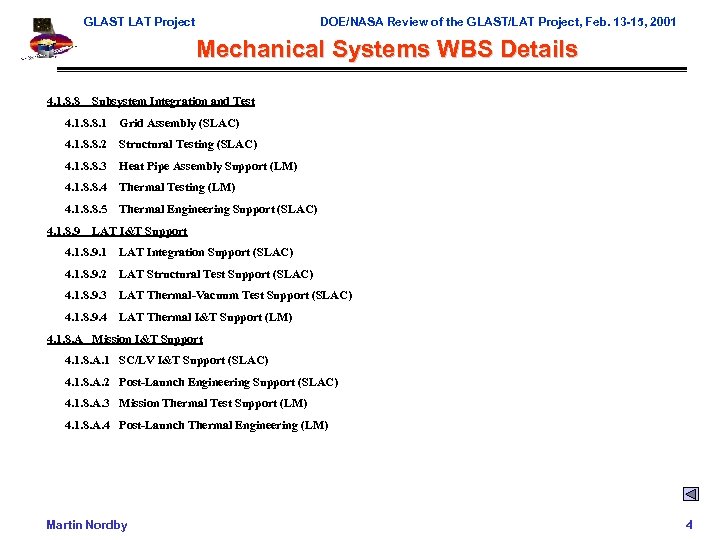 GLAST LAT Project DOE/NASA Review of the GLAST/LAT Project, Feb. 13 -15, 2001 Mechanical Systems WBS Details 4. 1. 8. 8 Subsystem Integration and Test 4. 1. 8. 8. 1 Grid Assembly (SLAC) 4. 1. 8. 8. 2 Structural Testing (SLAC) 4. 1. 8. 8. 3 Heat Pipe Assembly Support (LM) 4. 1. 8. 8. 4 Thermal Testing (LM) 4. 1. 8. 8. 5 Thermal Engineering Support (SLAC) 4. 1. 8. 9 LAT I&T Support 4. 1. 8. 9. 1 LAT Integration Support (SLAC) 4. 1. 8. 9. 2 LAT Structural Test Support (SLAC) 4. 1. 8. 9. 3 LAT Thermal-Vacuum Test Support (SLAC) 4. 1. 8. 9. 4 LAT Thermal I&T Support (LM) 4. 1. 8. A Mission I&T Support 4. 1. 8. A. 1 SC/LV I&T Support (SLAC) 4. 1. 8. A. 2 Post-Launch Engineering Support (SLAC) 4. 1. 8. A. 3 Mission Thermal Test Support (LM) 4. 1. 8. A. 4 Post-Launch Thermal Engineering (LM) Martin Nordby 4
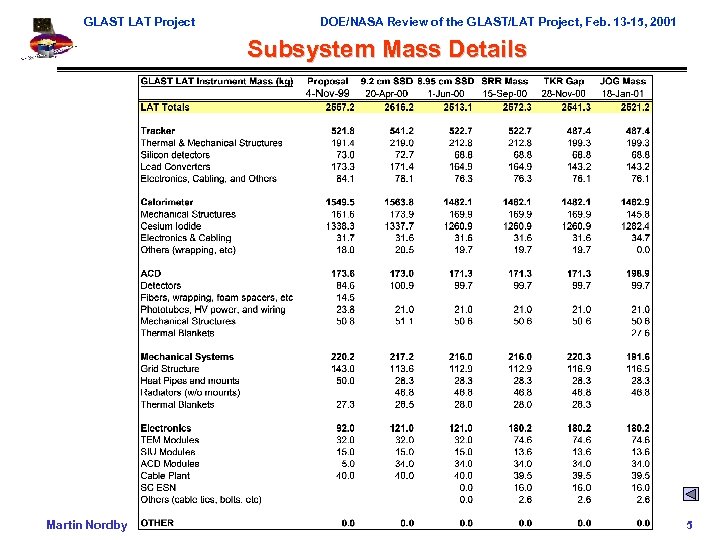 GLAST LAT Project DOE/NASA Review of the GLAST/LAT Project, Feb. 13 -15, 2001 Subsystem Mass Details Martin Nordby 5
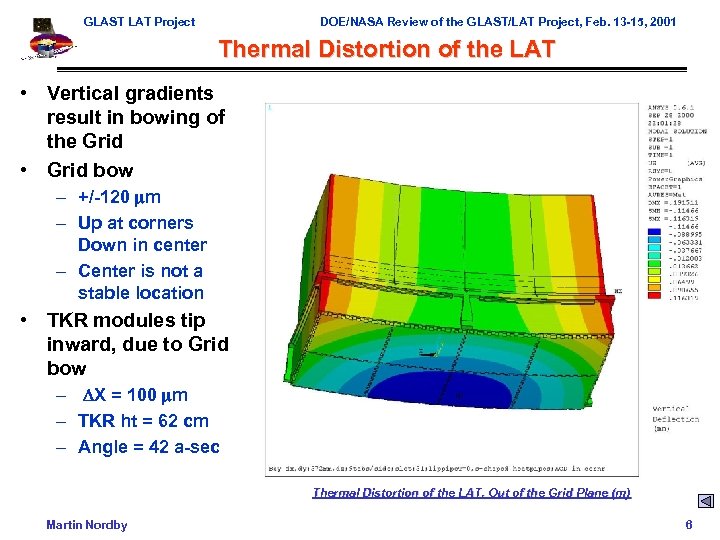 GLAST LAT Project DOE/NASA Review of the GLAST/LAT Project, Feb. 13 -15, 2001 Thermal Distortion of the LAT • Vertical gradients result in bowing of the Grid • Grid bow – +/-120 mm – Up at corners Down in center – Center is not a stable location • TKR modules tip inward, due to Grid bow – DX = 100 mm – TKR ht = 62 cm – Angle = 42 a-sec Thermal Distortion of the LAT, Out of the Grid Plane (m) Martin Nordby 6
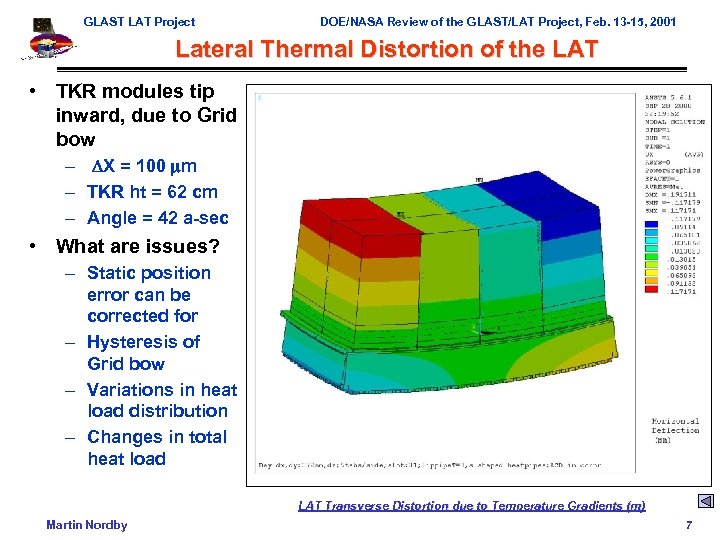 GLAST LAT Project DOE/NASA Review of the GLAST/LAT Project, Feb. 13 -15, 2001 Lateral Thermal Distortion of the LAT • TKR modules tip inward, due to Grid bow – DX = 100 mm – TKR ht = 62 cm – Angle = 42 a-sec • What are issues? – Static position error can be corrected for – Hysteresis of Grid bow – Variations in heat load distribution – Changes in total heat load LAT Transverse Distortion due to Temperature Gradients (m) Martin Nordby 7
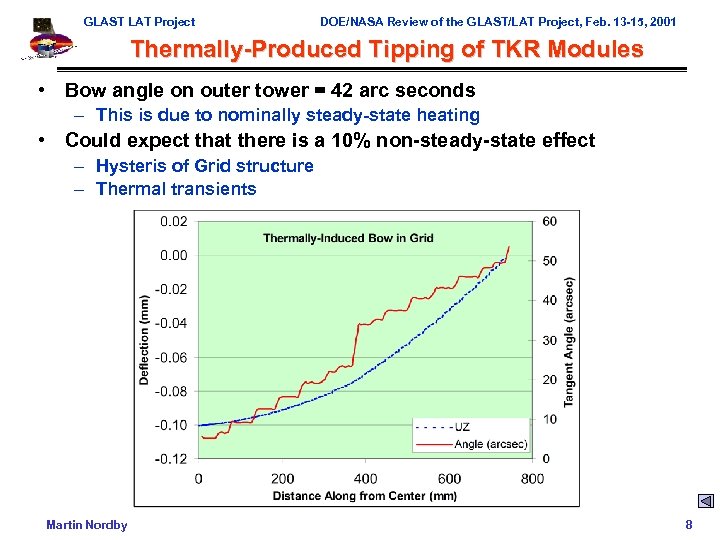 GLAST LAT Project DOE/NASA Review of the GLAST/LAT Project, Feb. 13 -15, 2001 Thermally-Produced Tipping of TKR Modules • Bow angle on outer tower = 42 arc seconds – This is due to nominally steady-state heating • Could expect that there is a 10% non-steady-state effect – Hysteris of Grid structure – Thermal transients Martin Nordby 8
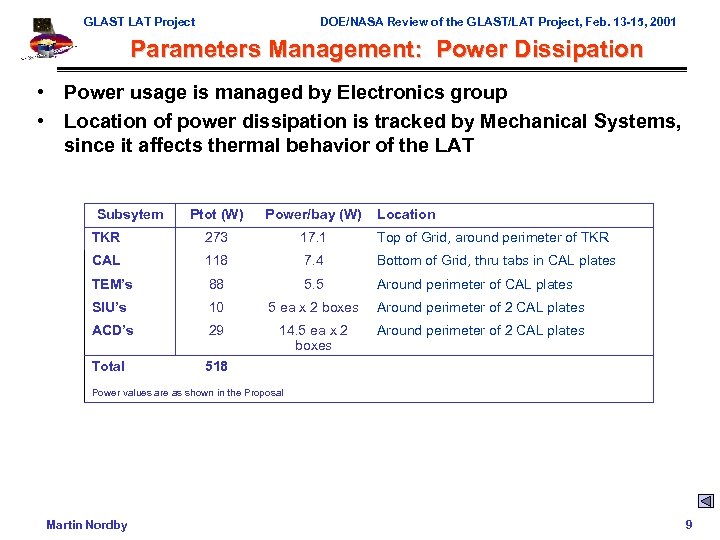 GLAST LAT Project DOE/NASA Review of the GLAST/LAT Project, Feb. 13 -15, 2001 Parameters Management: Power Dissipation • Power usage is managed by Electronics group • Location of power dissipation is tracked by Mechanical Systems, since it affects thermal behavior of the LAT Subsytem Ptot (W) Power/bay (W) Location TKR 273 17. 1 Top of Grid, around perimeter of TKR CAL 118 7. 4 Bottom of Grid, thru tabs in CAL plates TEM’s 88 5. 5 Around perimeter of CAL plates SIU’s 10 5 ea x 2 boxes Around perimeter of 2 CAL plates ACD’s 29 14. 5 ea x 2 boxes Around perimeter of 2 CAL plates Total 518 Power values are as shown in the Proposal Martin Nordby 9
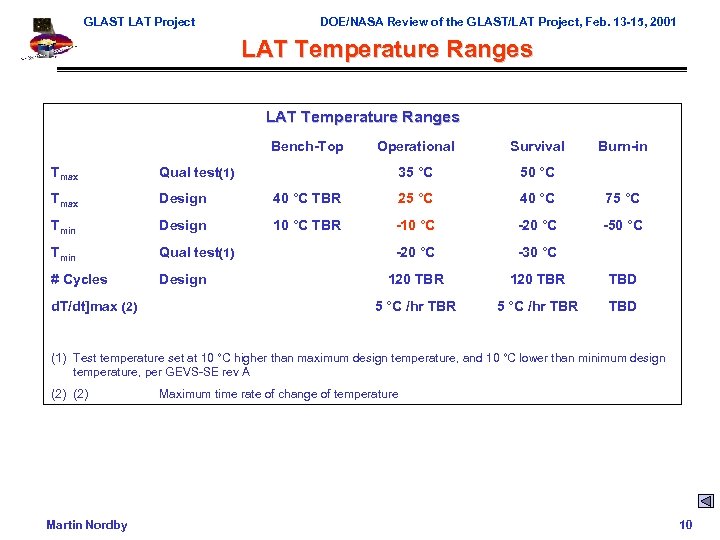 GLAST LAT Project DOE/NASA Review of the GLAST/LAT Project, Feb. 13 -15, 2001 LAT Temperature Ranges Bench-Top Operational Survival 35 °C Burn-in 50 °C Tmax Qual test(1) Tmax Design 40 °C TBR 25 °C 40 °C 75 °C Tmin Design 10 °C TBR -10 °C -20 °C -50 °C Tmin Qual test(1) -20 °C -30 °C # Cycles Design 120 TBR TBD 5 °C /hr TBR TBD d. T/dt]max (2) (1) Test temperature set at 10 °C higher than maximum design temperature, and 10 °C lower than minimum design temperature, per GEVS-SE rev A (2) Martin Nordby Maximum time rate of change of temperature 10
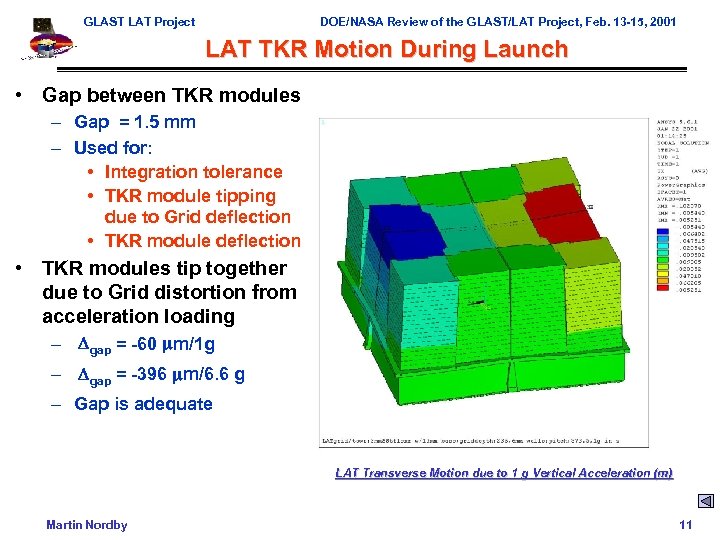 GLAST LAT Project DOE/NASA Review of the GLAST/LAT Project, Feb. 13 -15, 2001 LAT TKR Motion During Launch • Gap between TKR modules – Gap = 1. 5 mm – Used for: • Integration tolerance • TKR module tipping due to Grid deflection • TKR module deflection • TKR modules tip together due to Grid distortion from acceleration loading – Dgap = -60 mm/1 g – Dgap = -396 mm/6. 6 g – Gap is adequate LAT Transverse Motion due to 1 g Vertical Acceleration (m) Martin Nordby 11
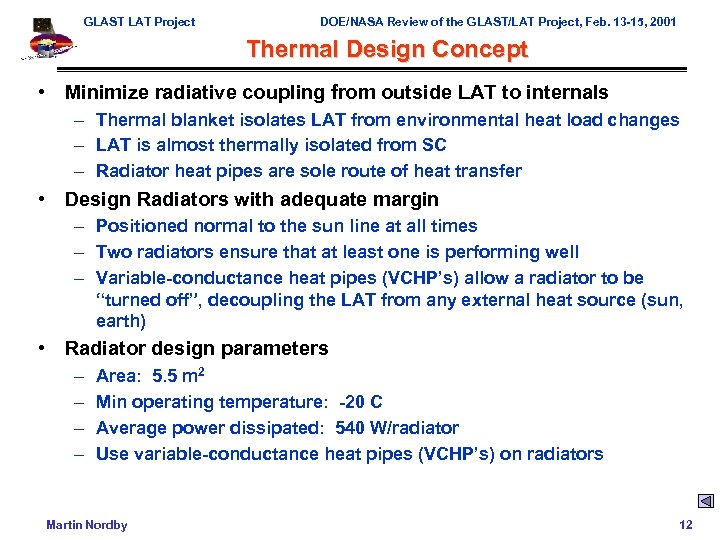 GLAST LAT Project DOE/NASA Review of the GLAST/LAT Project, Feb. 13 -15, 2001 Thermal Design Concept • Minimize radiative coupling from outside LAT to internals – Thermal blanket isolates LAT from environmental heat load changes – LAT is almost thermally isolated from SC – Radiator heat pipes are sole route of heat transfer • Design Radiators with adequate margin – Positioned normal to the sun line at all times – Two radiators ensure that at least one is performing well – Variable-conductance heat pipes (VCHP’s) allow a radiator to be “turned off”, decoupling the LAT from any external heat source (sun, earth) • Radiator design parameters – – Area: 5. 5 m 2 Min operating temperature: -20 C Average power dissipated: 540 W/radiator Use variable-conductance heat pipes (VCHP’s) on radiators Martin Nordby 12
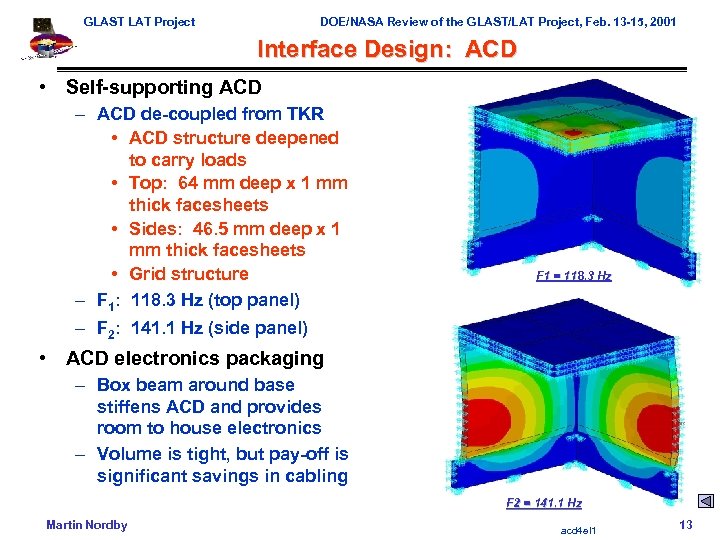 GLAST LAT Project DOE/NASA Review of the GLAST/LAT Project, Feb. 13 -15, 2001 Interface Design: ACD • Self-supporting ACD – ACD de-coupled from TKR • ACD structure deepened to carry loads • Top: 64 mm deep x 1 mm thick facesheets • Sides: 46. 5 mm deep x 1 mm thick facesheets • Grid structure – F 1: 118. 3 Hz (top panel) F 1 = 118. 3 Hz – F 2: 141. 1 Hz (side panel) • ACD electronics packaging – Box beam around base stiffens ACD and provides room to house electronics – Volume is tight, but pay-off is significant savings in cabling F 2 = 141. 1 Hz Martin Nordby acd 4 el 1 13