 Скачать презентацию GLAST Large Area Telescope Overview Elliott Bloom SLAC
0c303e6d0817d7d459189d32223a459b.ppt
- Количество слайдов: 39



GLAST Large Area Telescope Overview Elliott Bloom SLAC - KIPAC Stanford University SLAC Do. E Review June 14 -16, 2005
GLAST Large Area Telescope: Gamma-ray Large Area Space Telescope Introduction
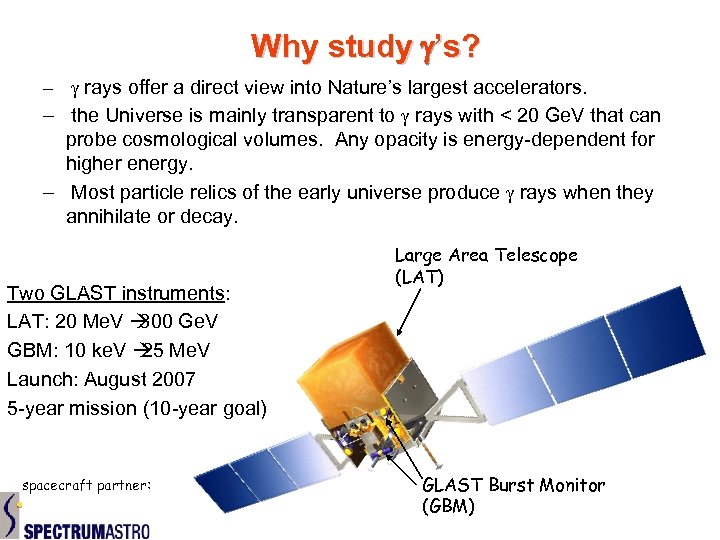
Why study ’s? – g rays offer a direct view into Nature’s largest accelerators. – the Universe is mainly transparent to g rays with < 20 Ge. V that can probe cosmological volumes. Any opacity is energy-dependent for higher energy. – Most particle relics of the early universe produce g rays when they annihilate or decay. Two GLAST instruments: LAT: 20 Me. V à Ge. V 300 GBM: 10 ke. V à Me. V 25 Launch: August 2007 5 -year mission (10 -year goal) spacecraft partner: Large Area Telescope (LAT) GLAST Burst Monitor (GBM)
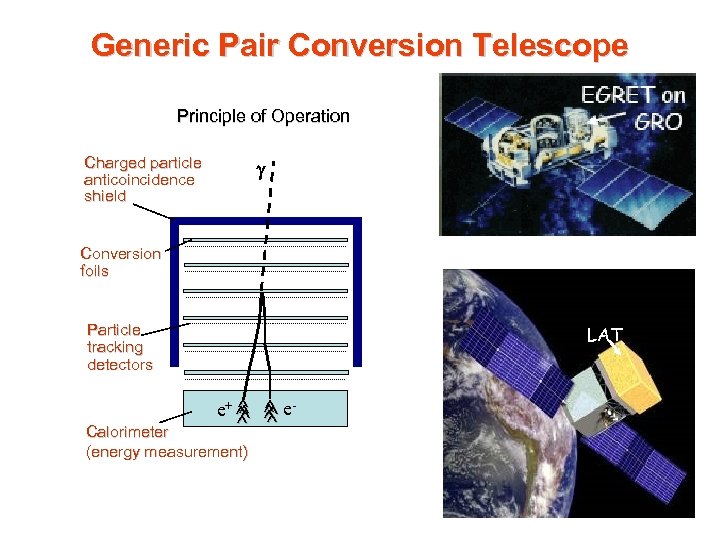
Generic Pair Conversion Telescope Principle of Operation Charged particle anticoincidence shield Conversion foils Particle tracking detectors LAT ^ e+ ^ ^ e^ ^ ^ Calorimeter (energy measurement)
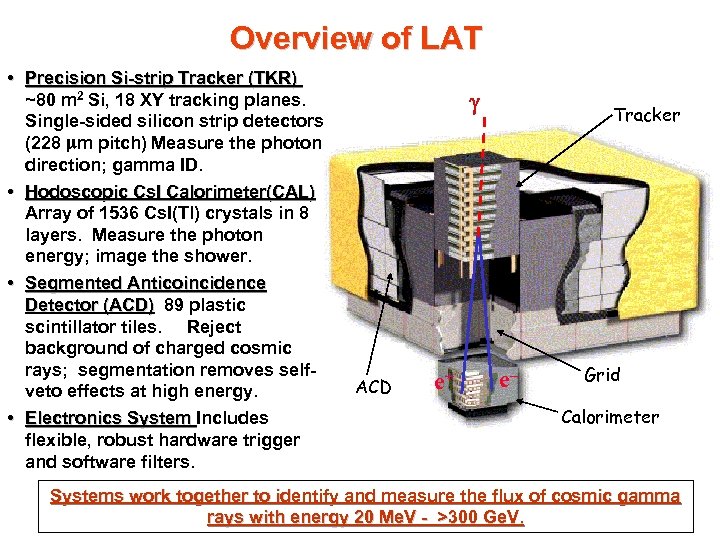
Overview of LAT • Precision Si-strip Tracker (TKR) ~80 m 2 Si, 18 XY tracking planes. Single-sided silicon strip detectors (228 mm pitch) Measure the photon direction; gamma ID. • Hodoscopic Cs. I Calorimeter(CAL) Array of 1536 Cs. I(Tl) crystals in 8 layers. Measure the photon energy; image the shower. • Segmented Anticoincidence Detector (ACD) 89 plastic scintillator tiles. Reject background of charged cosmic rays; segmentation removes selfveto effects at high energy. • Electronics System Includes flexible, robust hardware trigger and software filters. ACD e+ Tracker e– Grid Calorimeter Systems work together to identify and measure the flux of cosmic gamma rays with energy 20 Me. V - >300 Ge. V.
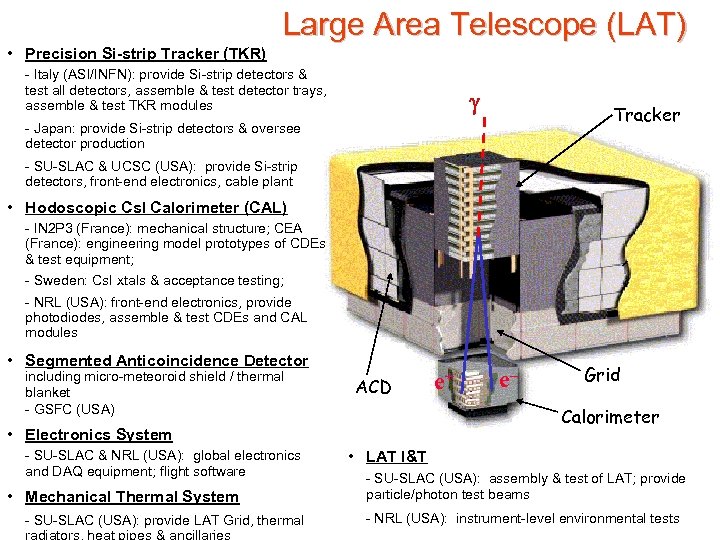
Large Area Telescope (LAT) • Precision Si-strip Tracker (TKR) - Italy (ASI/INFN): provide Si-strip detectors & test all detectors, assemble & test detector trays, assemble & test TKR modules Tracker - Japan: provide Si-strip detectors & oversee detector production - SU-SLAC & UCSC (USA): provide Si-strip detectors, front-end electronics, cable plant • Hodoscopic Cs. I Calorimeter (CAL) - IN 2 P 3 (France): mechanical structure; CEA (France): engineering model prototypes of CDEs & test equipment; - Sweden: Cs. I xtals & acceptance testing; - NRL (USA): front-end electronics, provide photodiodes, assemble & test CDEs and CAL modules • Segmented Anticoincidence Detector including micro-meteoroid shield / thermal blanket - GSFC (USA) ACD • Mechanical Thermal System - SU-SLAC (USA): provide LAT Grid, thermal e– Grid Calorimeter • Electronics System - SU-SLAC & NRL (USA): global electronics and DAQ equipment; flight software e+ • LAT I&T - SU-SLAC (USA): assembly & test of LAT; provide particle/photon test beams - NRL (USA): instrument-level environmental tests
GLAST Large Area Telescope: Gamma-ray Large Area Space Telescope GLAST Organization
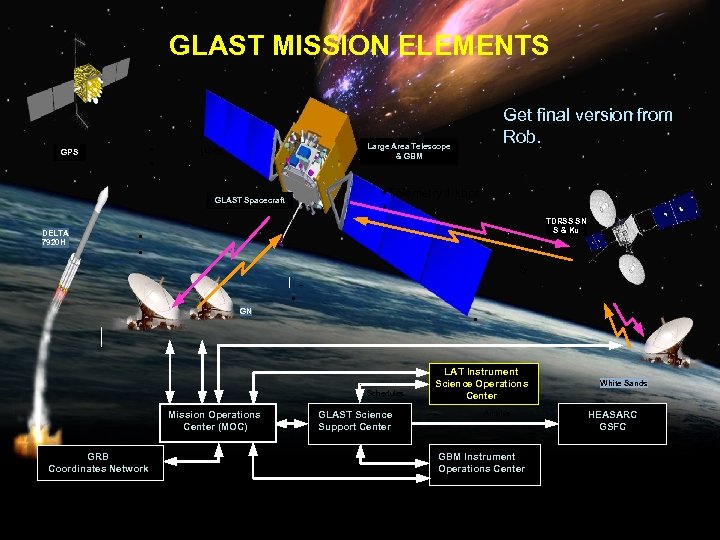
GLAST MISSION ELEMENTS • • GPS msec Large Area Telescope & GBM - • Telemetry 1 kbps • GLAST Spacecraft DELTA 7920 H Get final version from Rob. TDRSS SN S & Ku • • S - • GN • Schedules Mission Operations Center (MOC) GRB Coordinates Network GLAST Science Support Center Schedules Alerts Data, Command Loads LAT Instrument Science Operations Center Archive GBM Instrument Operations Center White Sands HEASARC GSFC
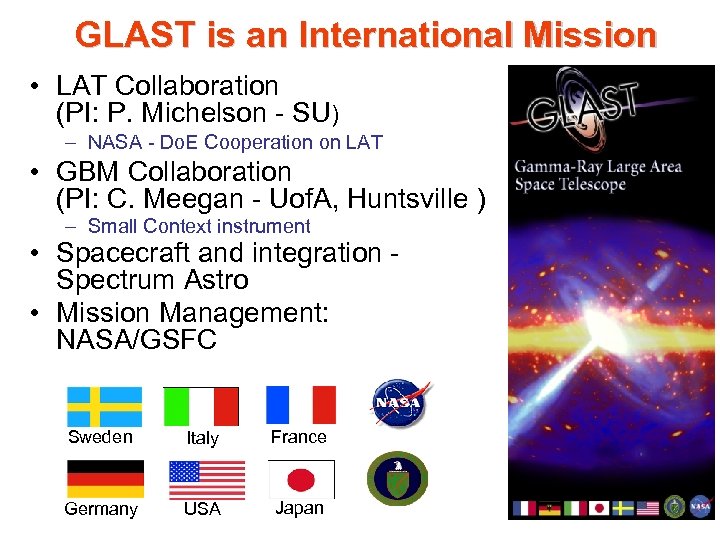
GLAST is an International Mission • LAT Collaboration (PI: P. Michelson - SU) – NASA - Do. E Cooperation on LAT • GBM Collaboration (PI: C. Meegan - Uof. A, Huntsville ) – Small Context instrument • Spacecraft and integration Spectrum Astro • Mission Management: NASA/GSFC Sweden Italy France Germany USA Japan
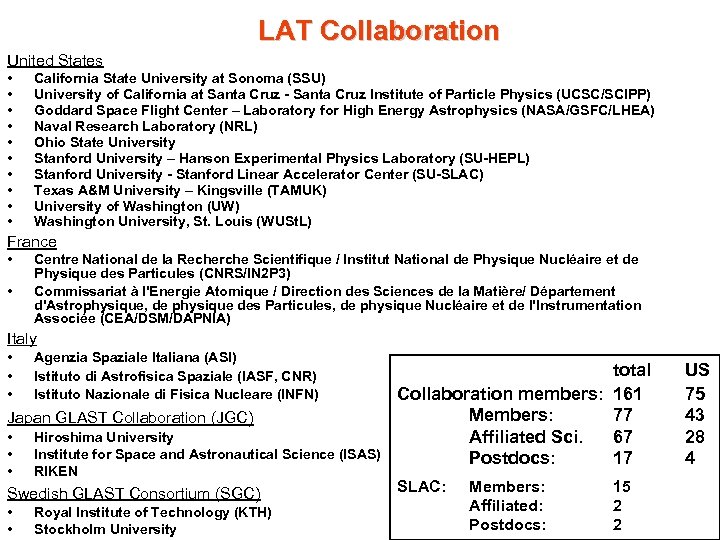
LAT Collaboration United States • • • California State University at Sonoma (SSU) University of California at Santa Cruz - Santa Cruz Institute of Particle Physics (UCSC/SCIPP) Goddard Space Flight Center – Laboratory for High Energy Astrophysics (NASA/GSFC/LHEA) Naval Research Laboratory (NRL) Ohio State University Stanford University – Hanson Experimental Physics Laboratory (SU-HEPL) Stanford University - Stanford Linear Accelerator Center (SU-SLAC) Texas A&M University – Kingsville (TAMUK) University of Washington (UW) Washington University, St. Louis (WUSt. L) France • • Centre National de la Recherche Scientifique / Institut National de Physique Nucléaire et de Physique des Particules (CNRS/IN 2 P 3) Commissariat à l'Energie Atomique / Direction des Sciences de la Matière/ Département d'Astrophysique, de physique des Particules, de physique Nucléaire et de l'Instrumentation Associée (CEA/DSM/DAPNIA) Italy • • • Agenzia Spaziale Italiana (ASI) Istituto di Astrofisica Spaziale (IASF, CNR) Istituto Nazionale di Fisica Nucleare (INFN) Japan GLAST Collaboration (JGC) • • • Hiroshima University Institute for Space and Astronautical Science (ISAS) RIKEN Swedish GLAST Consortium (SGC) • • Royal Institute of Technology (KTH) Stockholm University total Collaboration members: 161 Members: 77 Affiliated Sci. 67 Postdocs: 17 SLAC: Members: Affiliated: Postdocs: 15 2 2 US 75 43 28 4
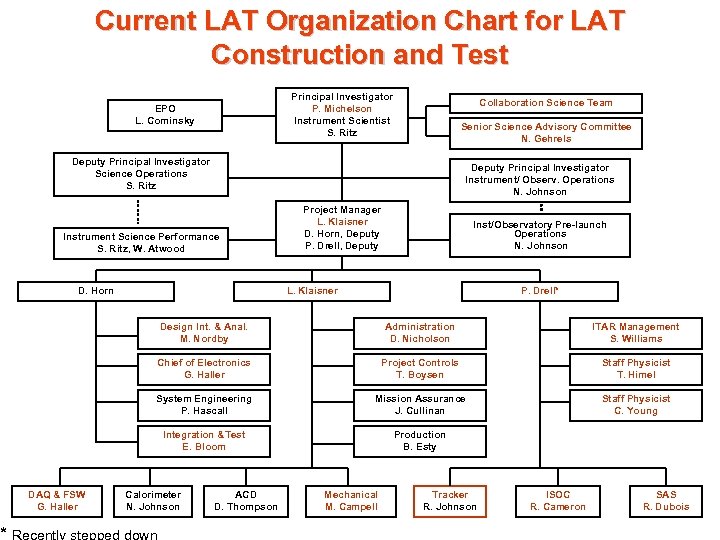
Current LAT Organization Chart for LAT Construction and Test Principal Investigator P. Michelson Instrument Scientist S. Ritz EPO L. Cominsky Collaboration Science Team Senior Science Advisory Committee N. Gehrels Deputy Principal Investigator Science Operations S. Ritz Deputy Principal Investigator Instrument/ Observ. Operations N. Johnson Instrument Science Performance S. Ritz, W. Atwood D. Horn Project Manager L. Klaisner D. Horn, Deputy P. Drell, Deputy Inst/Observatory Pre-launch Operations N. Johnson L. Klaisner P. Drell* Design Int. & Anal. M. Nordby ITAR Management S. Williams Chief of Electronics G. Haller Project Controls T. Boysen Staff Physicist T. Himel System Engineering P. Hascall Mission Assurance J. Cullinan Staff Physicist C. Young Integration &Test E. Bloom DAQ & FSW G. Haller Administration D. Nicholson Production B. Esty Calorimeter N. Johnson * Recently stepped down ACD D. Thompson Mechanical M. Campell Tracker R. Johnson ISOC R. Cameron SAS R. Dubois
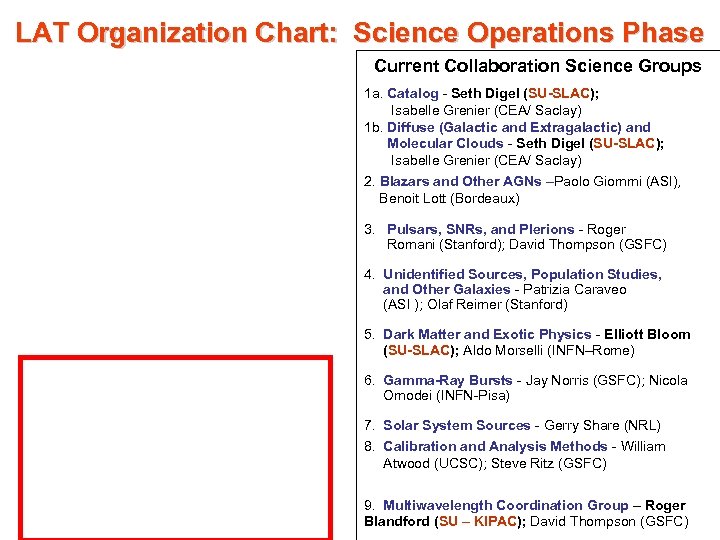
LAT Organization Chart: Science Operations Phase Current Collaboration Science Groups 1 a. Catalog - Seth Digel (SU-SLAC); Isabelle Grenier (CEA/ Saclay) 1 b. Diffuse (Galactic and Extragalactic) and Molecular Clouds - Seth Digel (SU-SLAC); Isabelle Grenier (CEA/ Saclay) 2. Blazars and Other AGNs –Paolo Giommi (ASI), Benoit Lott (Bordeaux) 3. Pulsars, SNRs, and Plerions - Roger Romani (Stanford); David Thompson (GSFC) 4. Unidentified Sources, Population Studies, and Other Galaxies - Patrizia Caraveo (ASI ); Olaf Reimer (Stanford) 5. Dark Matter and Exotic Physics - Elliott Bloom (SU-SLAC); Aldo Morselli (INFN–Rome) 6. Gamma-Ray Bursts - Jay Norris (GSFC); Nicola Omodei (INFN-Pisa) 7. Solar System Sources - Gerry Share (NRL) 8. Calibration and Analysis Methods - William Atwood (UCSC); Steve Ritz (GSFC) 9. Multiwavelength Coordination Group – Roger Blandford (SU – KIPAC); David Thompson (GSFC)
GLAST Large Area Telescope: Gamma-ray Large Area Space Telescope LAT Performance
GLAST LAT High Energy Capabilities EGRET on CGRO firmly established the field of high-energy gamma-ray astrophysics and demonstrated the importance and potential of this energy band. GLAST is the next great step beyond EGRET, providing a leap in capabilities: • Very large Field of View (FOV) (~20% of sky), factor 4 greater than EGRET • Broadband (4 decades in energy, including unexplored region E > 10 Ge. V) • Unprecedented Point Spread function (PSF) for gamma rays (factor > 3 better than EGRET for E>1 Ge. V). On axis >10 Ge. V, 68% containment < 0. 12 degrees (7. 2 arc-minutes) • Large effective area (factor > 5 better than EGRET) • Results in factor > 30 improvement in sensitivity below < 10 Ge. V, and >100 at higher energies. • Much smaller deadtime per event (27 msec, factor ~4, 000 better than EGRET - 0. 1 s) • No expendables è long mission without degradation (5 year requirement , 10 year goal).
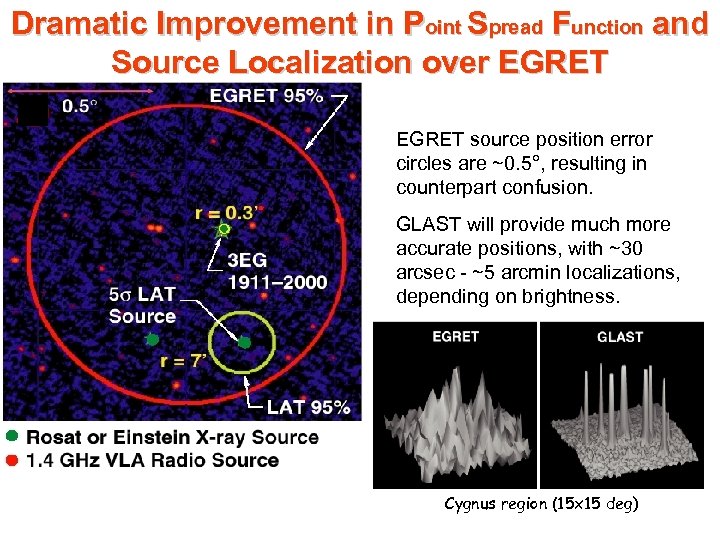
Dramatic Improvement in Point Spread Function and Source Localization over EGRET source position error circles are ~0. 5°, resulting in counterpart confusion. GLAST will provide much more accurate positions, with ~30 arcsec - ~5 arcmin localizations, depending on brightness. Cygnus region (15 x 15 deg)
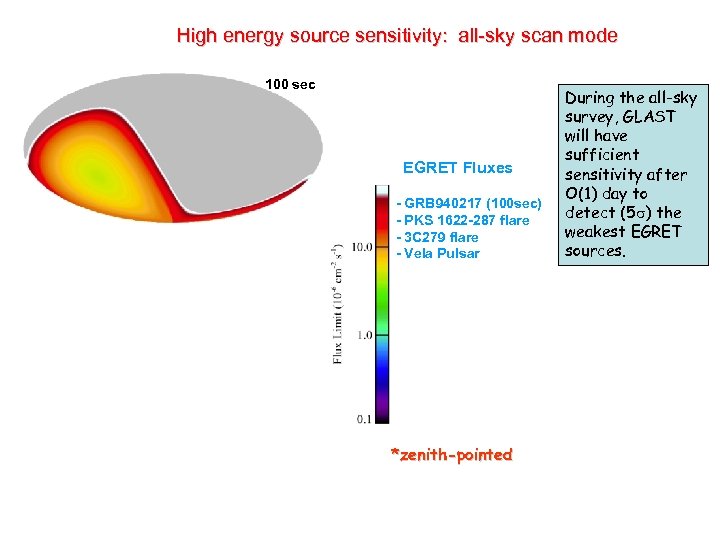
High energy source sensitivity: all-sky scan mode 100 sec EGRET Fluxes 1 orbit* - GRB 940217 (100 sec) - PKS 1622 -287 flare - 3 C 279 flare - Vela Pulsar During the all-sky survey, GLAST will have sufficient sensitivity after O(1) day to detect (5 s) the weakest EGRET sources. - Crab Pulsar - 3 EG 2020+40 (SNR Cygni? ) 1 day^ - 3 EG 1835+59 - 3 C 279 lowest 5 s detection - 3 EG 1911 -2000 (AGN) - Mrk 421 - Weakest 5 s EGRET source *zenith-pointed ^“rocking” all-sky scan: alternating orbits point above/below the orbit plane
GLAST Large Area Telescope: Gamma-ray Large Area Space Telescope LAT Science
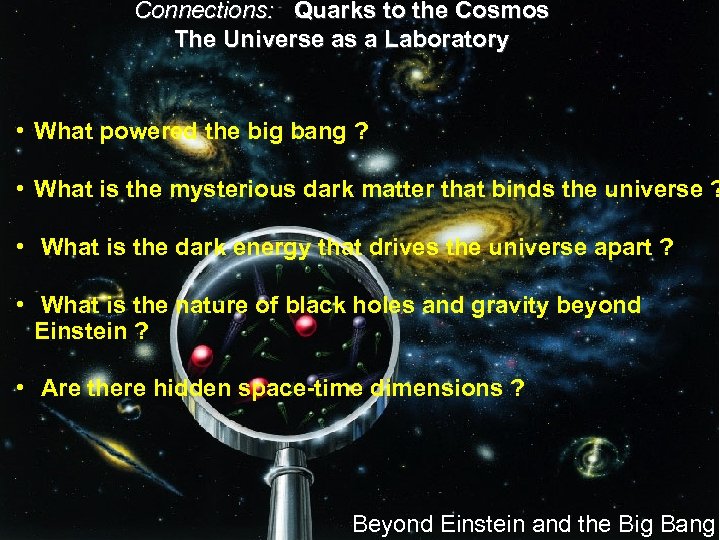
Connections: Quarks to the Cosmos The Universe as a Laboratory • What powered the big bang ? • What is the mysterious dark matter that binds the universe ? • What is the dark energy that drives the universe apart ? • What is the nature of black holes and gravity beyond Einstein ? • Are there hidden space-time dimensions ? Beyond Einstein and the Big Bang
GLAST addresses a broad science menu of interest to both the High Energy Particle Physics and High Energy Astrophysics communities. • Systems with super massive black holes & relativistic jets* • Gamma-ray bursts (GRBs)* • Pulsars • Origin of Cosmic Rays • Probing the era of galaxy formation* • Discovery! Particle Dark Matter? * Other relics from the Big Bang? * Extra dimensions? * New source classes? - Tune Kamae will explore the discovery space further in his talk tomorrow. Recommended by the National Academy of Sciences in their 2000 decadal study as the highest priority mid-sized mission * Connections related
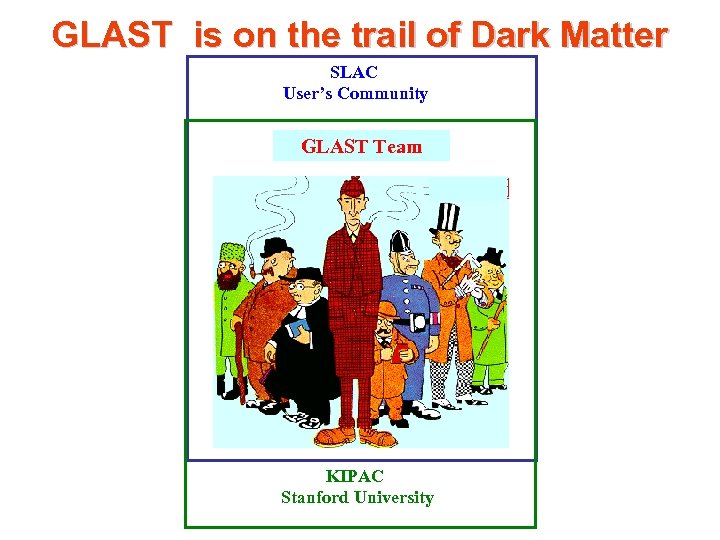
GLAST is on the trail of Dark Matter SLAC User’s Community GLAST Team KIPAC Stanford University
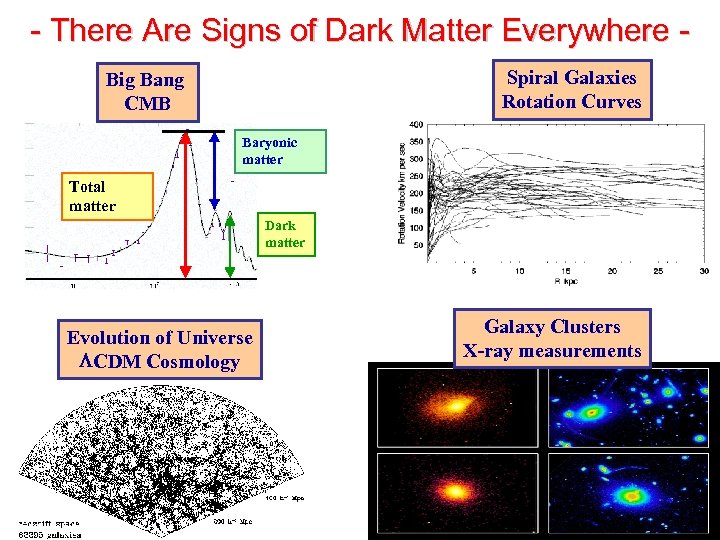
- There Are Signs of Dark Matter Everywhere Spiral Galaxies Rotation Curves Big Bang CMB Baryonic matter Total matter Dark matter Evolution of Universe LCDM Cosmology Galaxy Clusters X-ray measurements
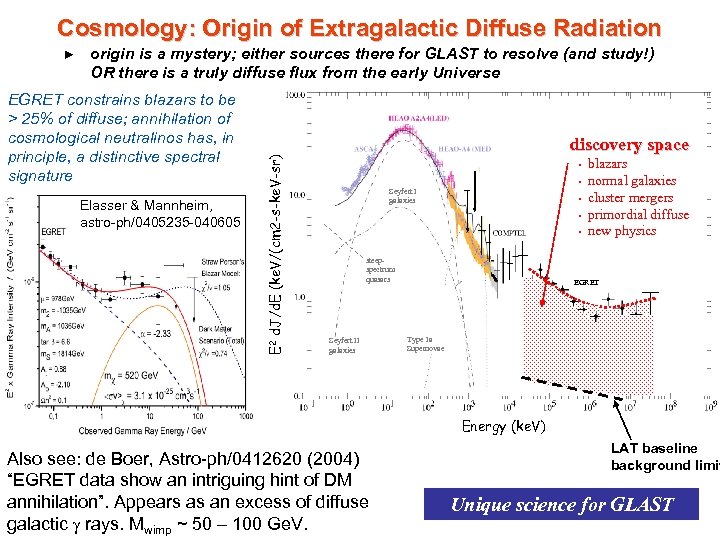
Cosmology: Origin of Extragalactic Diffuse Radiation origin is a mystery; either sources there for GLAST to resolve (and study!) OR there is a truly diffuse flux from the early Universe EGRET constrains blazars to be > 25% of diffuse; annihilation of cosmological neutralinos has, in principle, a distinctive spectral signature Elasser & Mannheim, astro-ph/0405235 -040605 E 2 d. J/d. E (ke. V/(cm 2 -s-ke. V-sr) ► discovery space • • Seyfert I galaxies • • • steepspectrum quasars Seyfert II galaxies blazars normal galaxies cluster mergers primordial diffuse new physics EGRET Type 1 a Supernovae Energy (ke. V) Also see: de Boer, Astro-ph/0412620 (2004) “EGRET data show an intriguing hint of DM annihilation”. Appears as an excess of diffuse galactic g rays. Mwimp ~ 50 – 100 Ge. V. LAT baseline background limit Unique science for GLAST
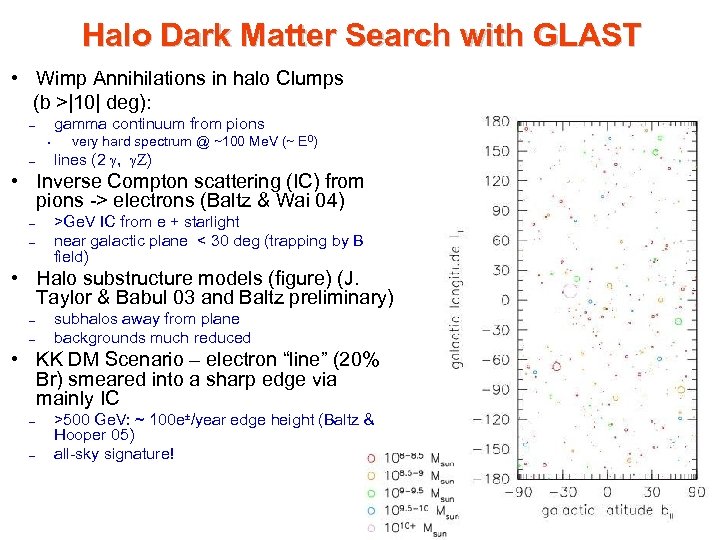
Halo Dark Matter Search with GLAST • Wimp Annihilations in halo Clumps (b >|10| deg): gamma continuum from pions – • – very hard spectrum @ ~100 Me. V (~ E 0) lines (2 g, g. Z) • Inverse Compton scattering (IC) from pions -> electrons (Baltz & Wai 04) – – >Ge. V IC from e + starlight near galactic plane < 30 deg (trapping by B field) • Halo substructure models (figure) (J. Taylor & Babul 03 and Baltz preliminary) – – subhalos away from plane backgrounds much reduced • KK DM Scenario – electron “line” (20% Br) smeared into a sharp edge via mainly IC – – >500 Ge. V: ~ 100 e±/year edge height (Baltz & Hooper 05) all-sky signature!
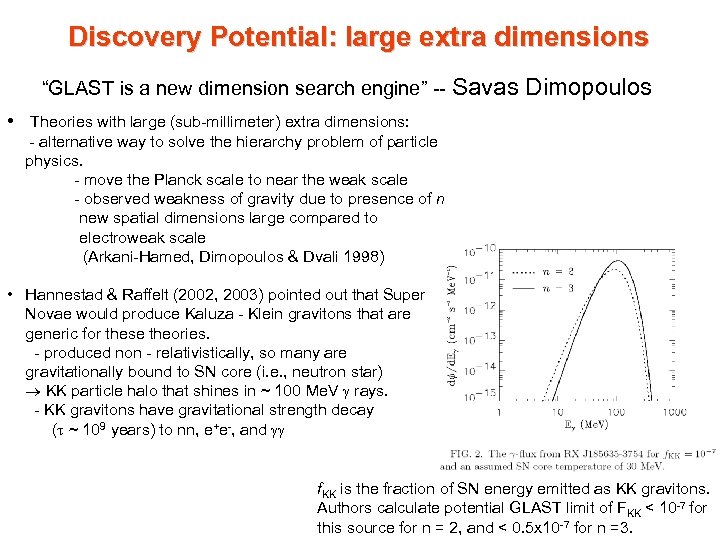
Discovery Potential: large extra dimensions “GLAST is a new dimension search engine” -- Savas Dimopoulos • Theories with large (sub-millimeter) extra dimensions: - alternative way to solve the hierarchy problem of particle physics. - move the Planck scale to near the weak scale - observed weakness of gravity due to presence of n new spatial dimensions large compared to electroweak scale (Arkani-Hamed, Dimopoulos & Dvali 1998) • Hannestad & Raffelt (2002, 2003) pointed out that Super Novae would produce Kaluza - Klein gravitons that are generic for these theories. - produced non - relativistically, so many are gravitationally bound to SN core (i. e. , neutron star) KK particle halo that shines in ~ 100 Me. V g rays. - KK gravitons have gravitational strength decay (t ~ 109 years) to nn, e+e-, and gg f. KK is the fraction of SN energy emitted as KK gravitons. Authors calculate potential GLAST limit of FKK < 10 -7 for this source for n = 2, and < 0. 5 x 10 -7 for n =3.
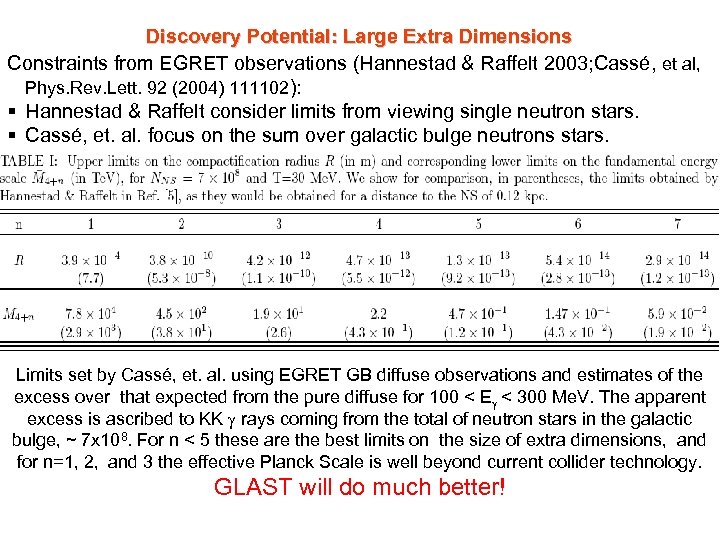
Discovery Potential: Large Extra Dimensions Constraints from EGRET observations (Hannestad & Raffelt 2003; Cassé, et al, Phys. Rev. Lett. 92 (2004) 111102): § Hannestad & Raffelt consider limits from viewing single neutron stars. § Cassé, et. al. focus on the sum over galactic bulge neutrons stars. Limits set by Cassé, et. al. using EGRET GB diffuse observations and estimates of the excess over that expected from the pure diffuse for 100 < Eg < 300 Me. V. The apparent excess is ascribed to KK g rays coming from the total of neutron stars in the galactic bulge, ~ 7 x 10⁸. For n < 5 these are the best limits on the size of extra dimensions, and for n=1, 2, and 3 the effective Planck Scale is well beyond current collider technology. GLAST will do much better!
GLAST Large Area Telescope: Gamma-ray Large Area Space Telescope Integration and Test Overview
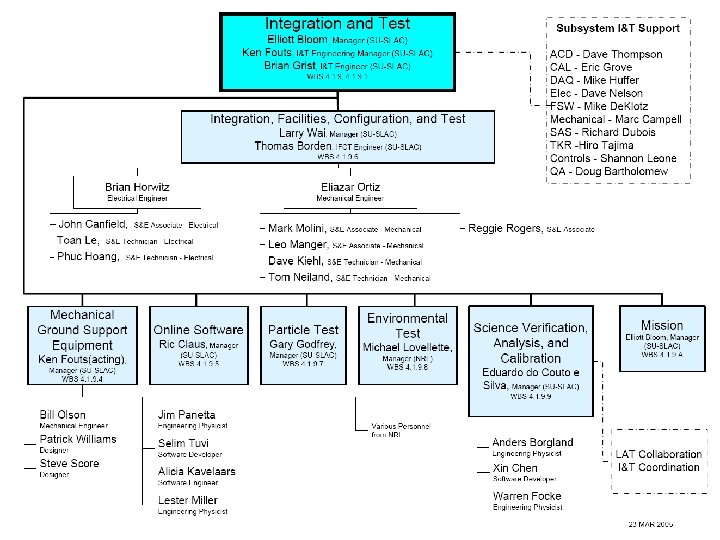
Organization of I&T – Overview Mechanical Ground Support Equipment (MGSE) Electrical Ground Support Equipment (EGSE) / Online Software Particle Test Science Verification Analysis and Calibration (SVAC) Integration Facilities Configuration and Test (IFCT) Integration, Test, and Calibration Management
I&T Operations • All operations in I&T are controlled by released procedures that outline each operation or test in detailed steps. • Job Hazard Analysis and Mitigation (JHAM) forms are developed to identify potential hazards and highlight the mitigation plans for operations contained in the procedures. • The JHAM is read, discussed and signed by operators prior to procedure execution as a review of potential hazards. • Procedures for mechanical integration and electrical test are developed, and practiced with engineering models and mock-ups prior to use with flight hardware. • A detailed LAT I&T daily schedule is updated and reviewed twice daily with the team to communicate planned activities and program priorities. • A weekly meeting is held to provide a two week look ahead for subsystems to plan resources and identify shortages.
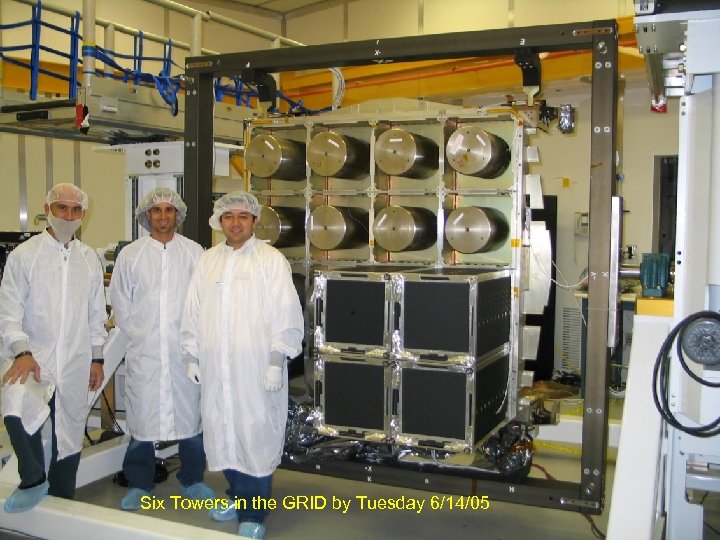
GLAST LAT Technical Status 14 CAL modules at SLAC. 7 Trackers @ SLAC. ~80 m 2 of silicon detectors in hand. Two Towers in the GRID 04/11/05 ACD being tested at Six Towers in the GRID by Tuesday 6/14/05 GSFC. Delivery to SLAC in July.
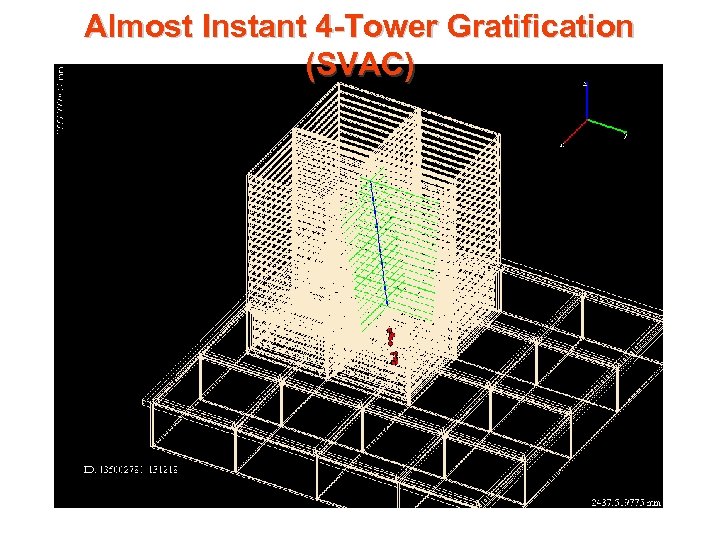
Almost Instant 4 -Tower Gratification (SVAC)
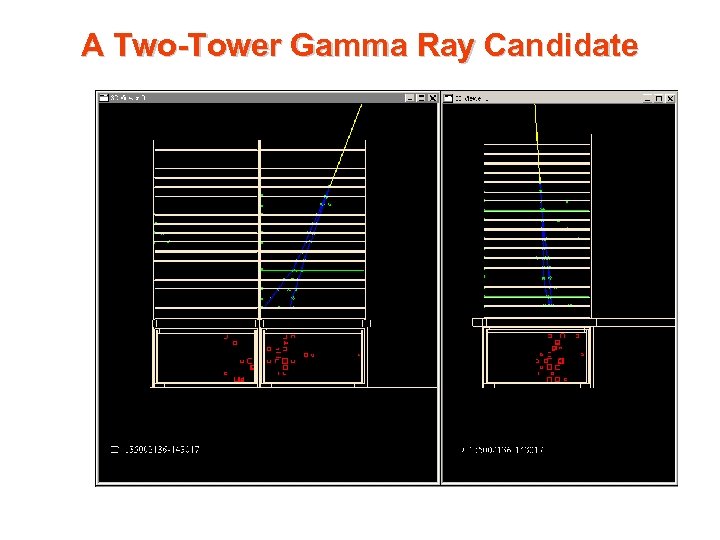
A Two-Tower Gamma Ray Candidate
GLAST Large Area Telescope: Gamma-ray Large Area Space Telescope Science Analysis Software (SAS)
LAT Data Challenges • Brings the collaboration together to work on science related activities, and encourages LAT collaborators to really focus on the science that the LAT will do. This provides a taste for what things might be like after launch. • Drives a detailed study of the high level performance of the LAT. A detailed description of the instrument response over all energies and inclination angles is necessary for the high level analysis tools. • “End-to-end” test of the simulation and analysis software all the way from low level detector simulations through to high level science analysis and source catalog generation. • Design a progression of studies: – DC 1. Modest goals. Contains most essential features of a data challenge. – DC 2 in early 2006. More ambitious goals, incorporate lessons learned from DC 1. ~One simulated month. – DC 3 in 2007. Support for flight science production.
DC Components • Focal point for many threads – – – – – Orbit, rocking, celestial coordinates, pointing history Plausible model of the sky Background rejection and event selection Instrument Response Functions Data formats for input to high level tools First look at major science tools – Likelihood, Observation Simulator Generation of datasets Populate and exercise data servers at SSC & LAT Code distribution on windows and Linux • Involve new users from across the collaboration • Teamwork! see http: //www-glast. slac. stanford. edu/software/Workshops/Feb 04 DC 1 Close. Out/coverpage. htm R. Dubois
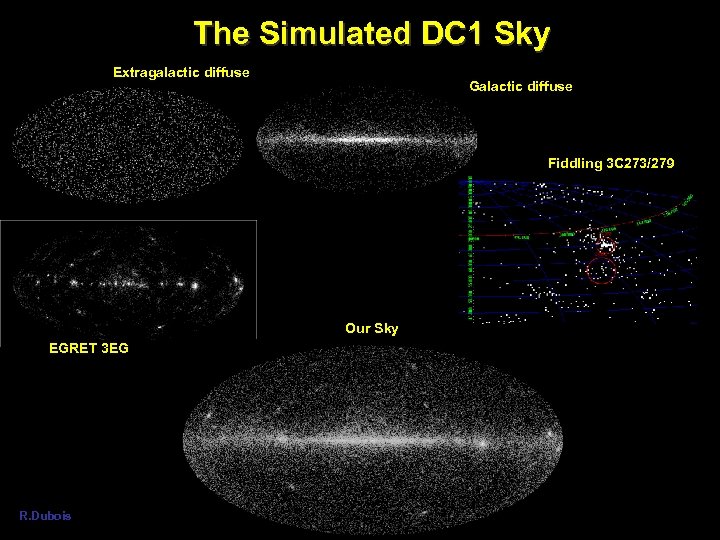
The Simulated DC 1 Sky Extragalactic diffuse Galactic diffuse Fiddling 3 C 273/279 Our Sky EGRET 3 EG R. Dubois
GLAST Large Area Telescope: Gamma-ray Large Area Space Telescope Schedule and Conclusions
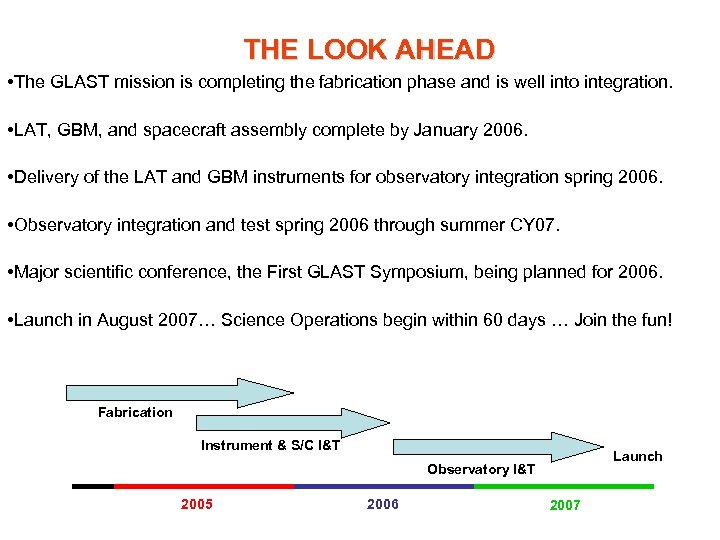
THE LOOK AHEAD • The GLAST mission is completing the fabrication phase and is well into integration. • LAT, GBM, and spacecraft assembly complete by January 2006. • Delivery of the LAT and GBM instruments for observatory integration spring 2006. • Observatory integration and test spring 2006 through summer CY 07. • Major scientific conference, the First GLAST Symposium, being planned for 2006. • Launch in August 2007… Science Operations begin within 60 days … Join the fun! Fabrication Instrument & S/C I&T Launch Observatory I&T 2005 2006 2007
Extra Slides Follow
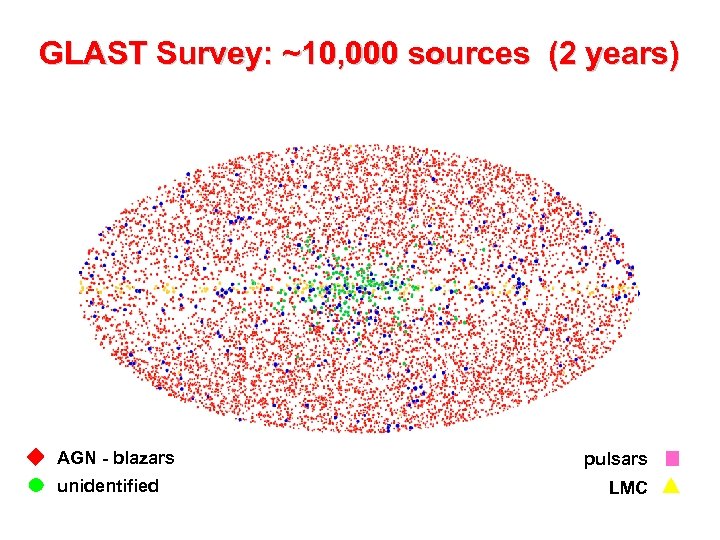
GLAST Survey: ~10, 000 sources (2 days) GLAST Survey: ~300 sources (2 years) 3 rd EGRET Catalog AGN - blazars unidentified pulsars LMC
Скачать презентацию GLAST Large Area Telescope Overview Elliott Bloom SLAC
0c303e6d0817d7d459189d32223a459b.ppt