


 Скачать презентацию Giving wings to emission trading Inclusion of aviation
35ab557dbd3c09d84e01ae571eb11ef3.ppt
- Количество слайдов: 18
 Giving wings to emission trading Inclusion of aviation under the EU ETS: Design and Impacts Ron Wit, ECCP II, Brussels 24 th October 2005
 Overview of talk Objectives of study Design • Key design elements • Pros and cons of elements • Selection of policy options Impacts • • Impacts on ticket prices Environmental impacts Economic impacts Marginal impact on EU ETS Overall conclusion
 Objectives of study • Overarching objective: – To develop concepts for amending Directive 2003/87/EC to address the full climate change impact of aviation through emission trading • Specific goals: – How to address non-CO 2 climate effects? – Design viable systems • Geographical scope • Allocation and surrendering of allowances • Monitoring, reporting verification, etc. – Impact analysis
 Design: key elements • • Coverage of climate impacts Geographical scope Trading entity Decision on allocation rules Interplay with Kyoto Protocol Allocation method Monitoring method • >> choices within each key design element
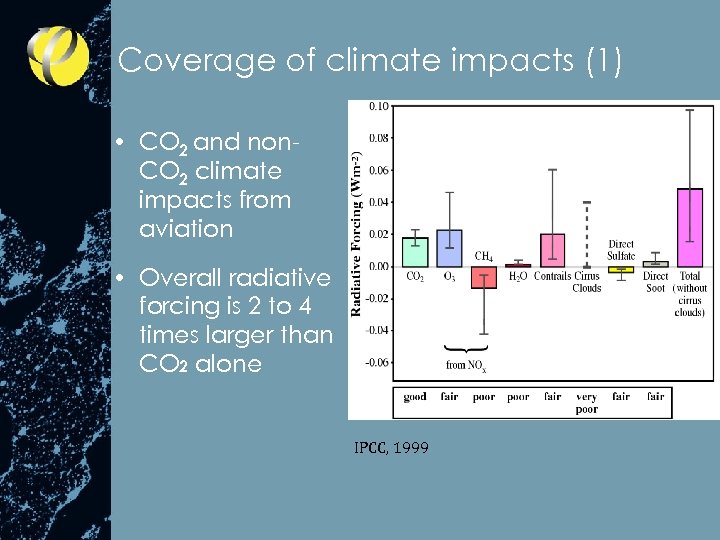 Coverage of climate impacts (1) • CO 2 and non. CO 2 climate impacts from aviation • Overall radiative forcing is 2 to 4 times larger than CO 2 alone IPCC, 1999
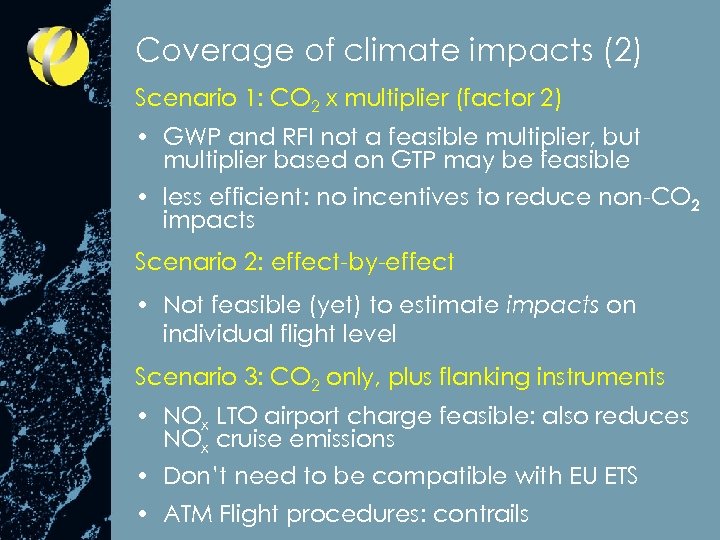 Coverage of climate impacts (2) Scenario 1: CO 2 x multiplier (factor 2) • GWP and RFI not a feasible multiplier, but multiplier based on GTP may be feasible • less efficient: no incentives to reduce non-CO 2 impacts Scenario 2: effect-by-effect • Not feasible (yet) to estimate impacts on individual flight level Scenario 3: CO 2 only, plus flanking instruments • NOx LTO airport charge feasible: also reduces NOx cruise emissions • Don’t need to be compatible with EU ETS • ATM Flight procedures: contrails
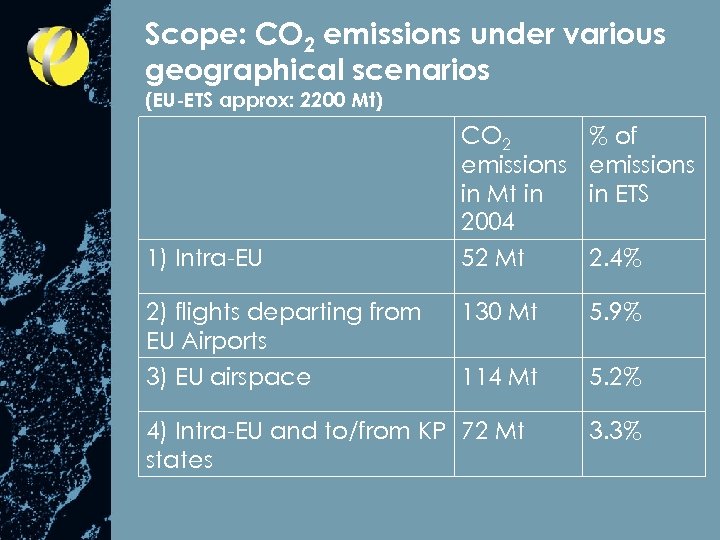 Scope: CO 2 emissions under various geographical scenarios (EU-ETS approx: 2200 Mt) 1) Intra-EU 2) flights departing from EU Airports 3) EU airspace CO 2 emissions in Mt in 2004 52 Mt % of emissions in ETS 130 Mt 5. 9% 114 Mt 5. 2% 4) Intra-EU and to/from KP 72 Mt states 2. 4% 3. 3%
 Trading entity? • Aircraft operator most suitable • Other options (fuel supplier, airport, ATM, manufacturer) have one or more decisive disadvantages
 Decision on allocation rules • Level to set total amount of allowances and rules to distribute allowances • EU or member states? • EU ETS: some degree of subsidiarity • Two arguments for EU approach: – International aviation not included in EU’s Burden Sharing agreement – Prevention of competitive distortions
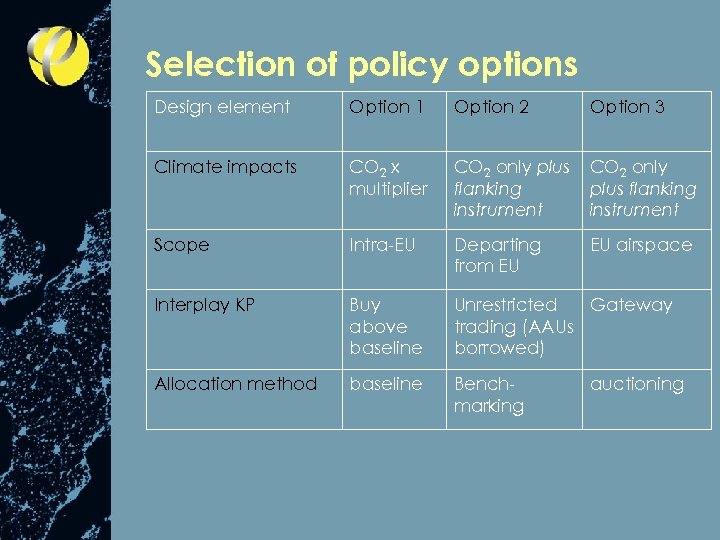 Selection of policy options Design element Option 1 Option 2 Option 3 Climate impacts CO 2 x multiplier CO 2 only plus flanking instrument Scope Intra-EU Departing from EU EU airspace Interplay KP Buy above baseline Unrestricted Gateway trading (AAUs borrowed) Allocation method baseline Benchmarking auctioning
 Impact assessment • Assumptions: – Emissions 2008 historic baseline – Results for the year 2012 – Emissions growth 4% per annum – permit price of 10 to 30 euro/tonne CO 2 – Multiplier of 2 (option 1 only)
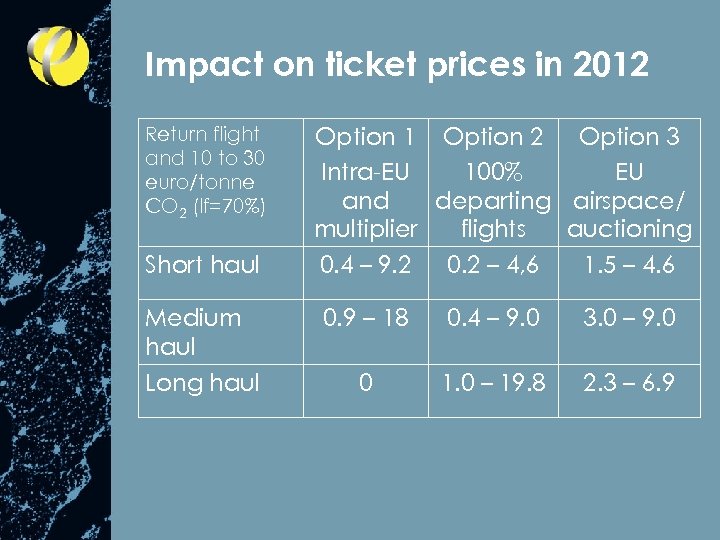 Impact on ticket prices in 2012 Return flight and 10 to 30 euro/tonne CO 2 (lf=70%) Option 1 Option 2 Option 3 Intra-EU 100% EU and departing airspace/ multiplier flights auctioning Short haul 0. 4 – 9. 2 0. 2 – 4, 6 1. 5 – 4. 6 Medium haul 0. 9 – 18 0. 4 – 9. 0 3. 0 – 9. 0 0 1. 0 – 19. 8 2. 3 – 6. 9 Long haul
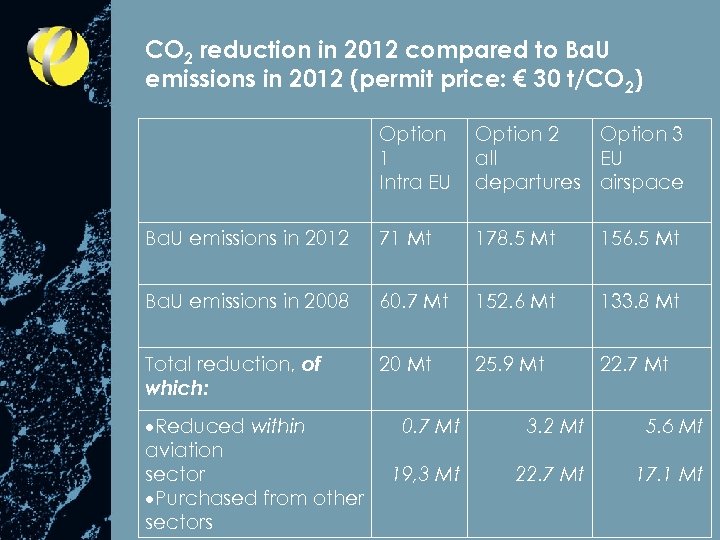 CO 2 reduction in 2012 compared to Ba. U emissions in 2012 (permit price: € 30 t/CO 2) Option 1 Intra EU Option 2 Option 3 all EU departures airspace Ba. U emissions in 2012 71 Mt 178. 5 Mt 156. 5 Mt Ba. U emissions in 2008 60. 7 Mt 152. 6 Mt 133. 8 Mt Total reduction, of which: 20 Mt 25. 9 Mt 22. 7 Mt Reduced within aviation sector Purchased from other sectors 0. 7 Mt 3. 2 Mt 5. 6 Mt 19, 3 Mt 22. 7 Mt 17. 1 Mt
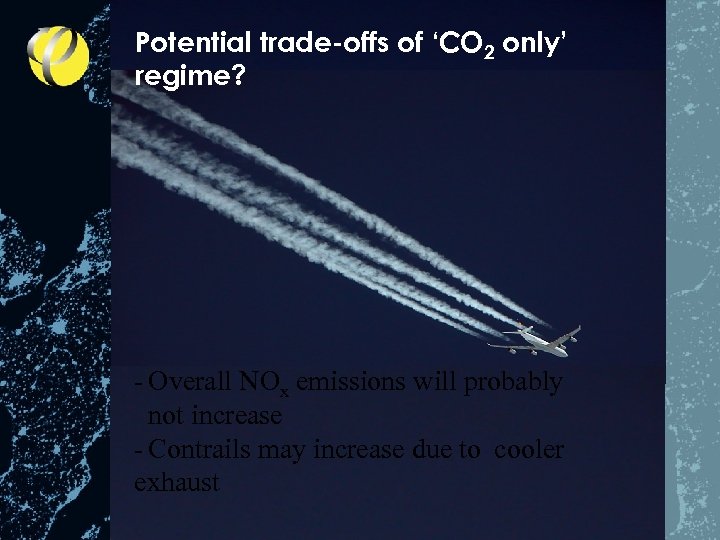 Potential trade-offs of ‘CO 2 only’ regime? - Overall NOx emissions will probably not increase - Contrails may increase due to cooler exhaust
 Economic impacts • All carriers irrespective of nationality and operator are subject to the same scheme • Decrease in growth by 0. 2 to 1. 3% (option 1), 0. 4 to 2. 1% (option 2) and 1. 4% (option 3), (permit price € 30 per t/CO 2 ) • Therefore no significant impact on EU carriers’ economies of scale • However: non EU carriers can more easy fly most efficient (=new) aircraft on EU routes • Auction revenues: 1. 3 to 4 billion euro (based on 2008 emissions and a permit price of 10 to 30 euro)
 Marginal impact on EU ETS Aviation would buy about 1% of allowances under the present EU ETS This percentage would be lower in case JI and CDM markets are taken into account - In the short term no significant rise in the allowance price - Long term impacts need further research
 Overall Conclusion • Inclusion of aviation in the EU ETS is feasible • Effectiveness and economic impacts depend on design choices • Emission trading is a policy option that can be considered alongside emissions charges and fuel taxation to tackle the climate impact of aviation.
 achterpagina CE Thank you! E-mail: wit@ce. nl Final report and a separate management summary can be downloaded from: WWW. CE. NL