 Скачать презентацию Giving Them What They Want Branding and Positioning
09bf59673cd05806dbf5553aba51c2e7.ppt
- Количество слайдов: 58



Giving Them What They Want Branding and Positioning for Your Targeted Segment Dr. Judy K. Frels Robert H. Smith School of Business University of Maryland jfrels@rhsmith. umd. edu © 2008 Robert H. Smith School of Business University of Maryland
What do you think of when you think of marketing? Not exactly… © 2008 Robert H. Smith School of Business University of Maryland ?
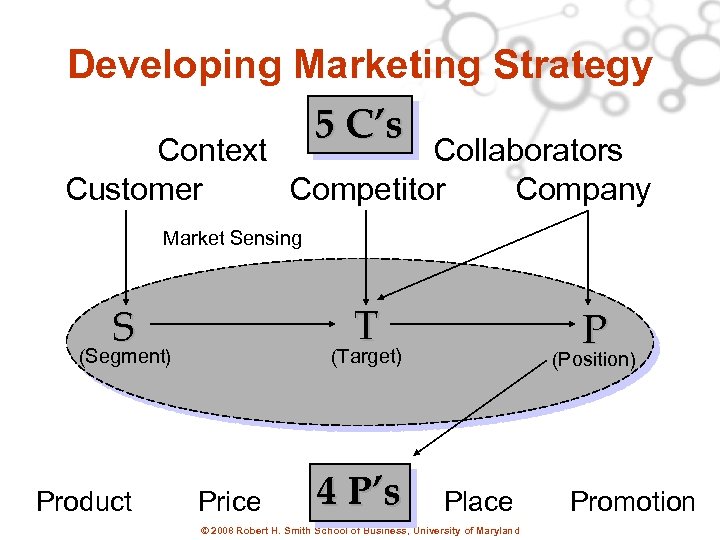
Developing Marketing Strategy 5 C’s Context Collaborators Customer Competitor Company Market Sensing T S (Segment) Product P (Target) Price 4 P’s (Position) Place © 2008 Robert H. Smith School of Business, University of Maryland Promotion
Why do We do “Marketing”? • The purpose of marketing is to make selling superfluous. Peter Drucker, 1973 • There is only one valid definition of business purpose: to create a customer. Peter Drucker • Marketing means solving customers’ problems profitably. Randall G. Chapman, Ph. D © 2008 Robert H. Smith School of Business, University of Maryland
Choosing the Right Customer If marketing means solving customers’ problems profitably, then exactly whose problems can we solve profitably? © 2008 Robert H. Smith School of Business, University of Maryland
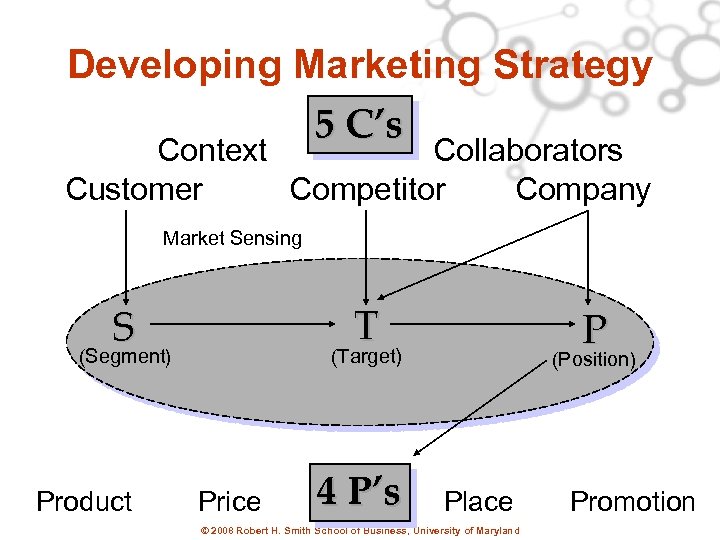
Developing Marketing Strategy 5 C’s Context Collaborators Customer Competitor Company Market Sensing T S (Segment) Product P (Target) Price 4 P’s (Position) Place © 2008 Robert H. Smith School of Business, University of Maryland Promotion
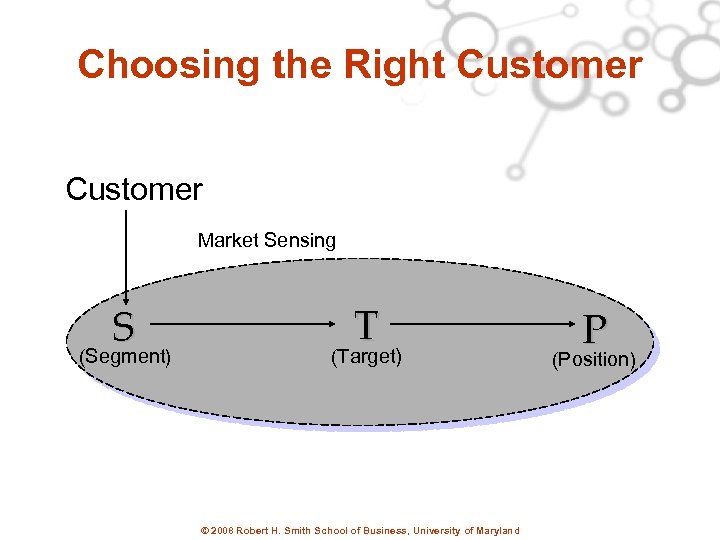
Choosing the Right Customer Market Sensing S (Segment) T (Target) © 2008 Robert H. Smith School of Business, University of Maryland P (Position)
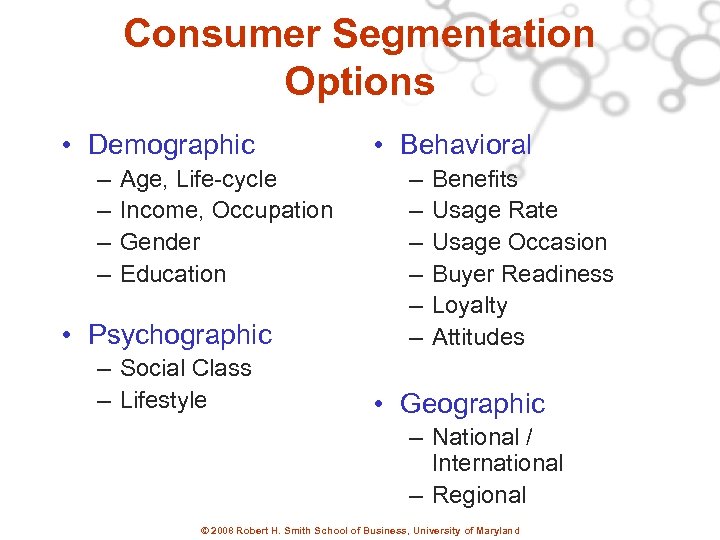
Consumer Segmentation Options • Demographic – – Age, Life-cycle Income, Occupation Gender Education • Psychographic – Social Class – Lifestyle • Behavioral – – – Benefits Usage Rate Usage Occasion Buyer Readiness Loyalty Attitudes • Geographic – National / International – Regional © 2008 Robert H. Smith School of Business, University of Maryland
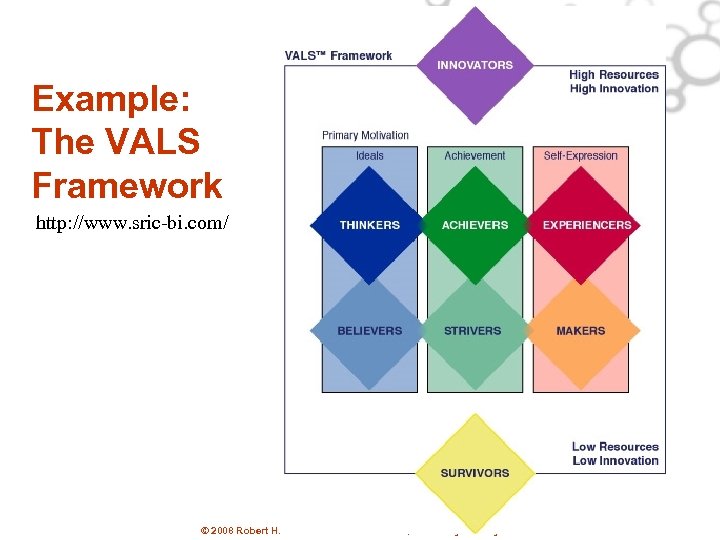
Example: The VALS Framework http: //www. sric-bi. com/ © 2008 Robert H. Smith School of Business, University of Maryland
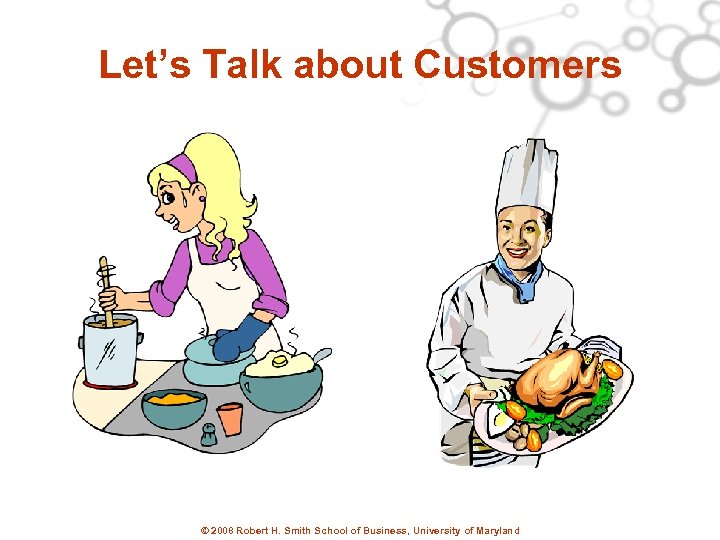
Let’s Talk about Customers © 2008 Robert H. Smith School of Business, University of Maryland
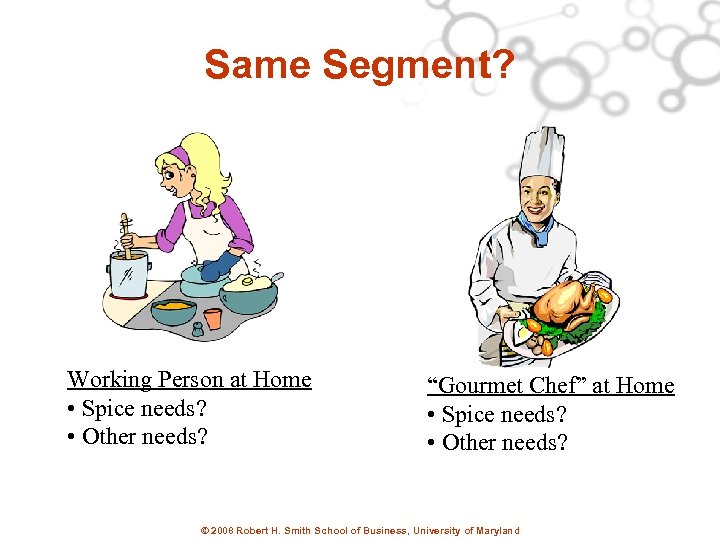
Same Segment? Working Person at Home • Spice needs? • Other needs? “Gourmet Chef” at Home • Spice needs? • Other needs? © 2008 Robert H. Smith School of Business, University of Maryland
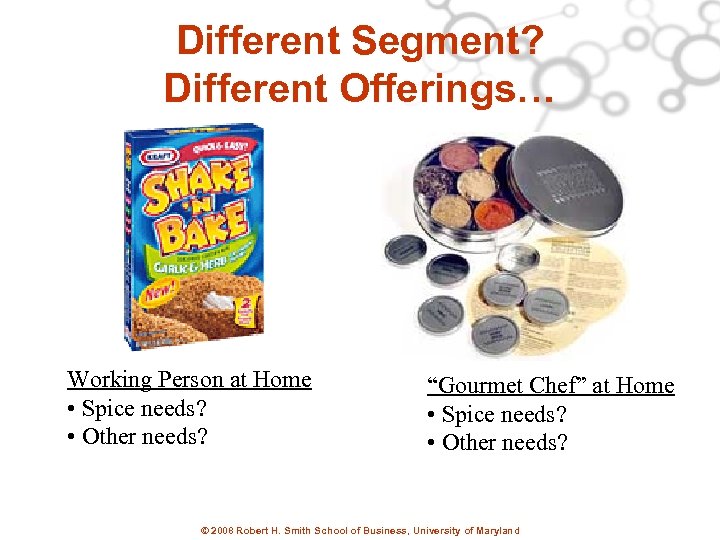
Different Segment? Different Offerings… Working Person at Home • Spice needs? • Other needs? “Gourmet Chef” at Home • Spice needs? • Other needs? © 2008 Robert H. Smith School of Business, University of Maryland
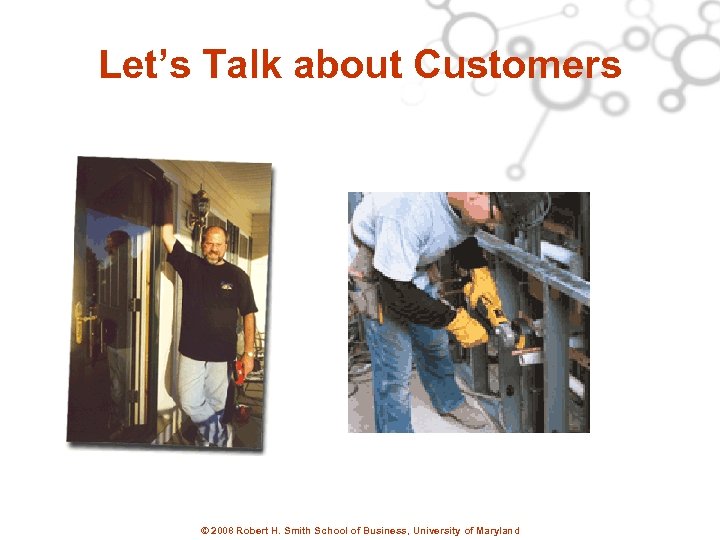
Let’s Talk about Customers © 2008 Robert H. Smith School of Business, University of Maryland
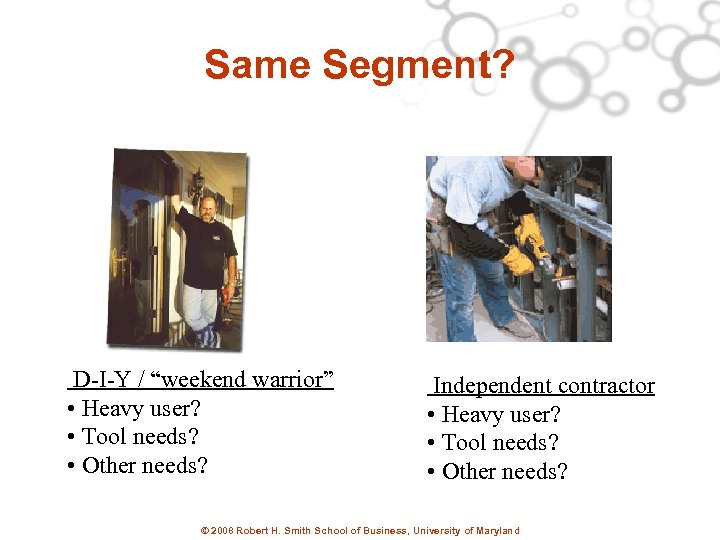
Same Segment? D-I-Y / “weekend warrior” • Heavy user? • Tool needs? • Other needs? Independent contractor • Heavy user? • Tool needs? • Other needs? © 2008 Robert H. Smith School of Business, University of Maryland
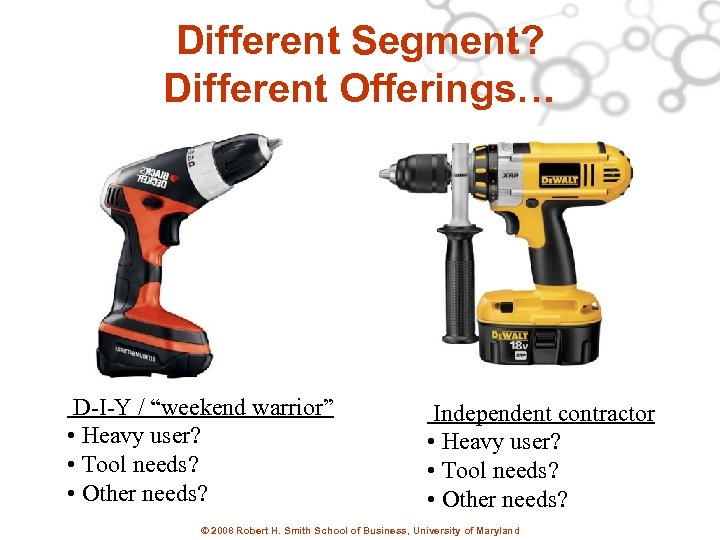
Different Segment? Different Offerings… D-I-Y / “weekend warrior” • Heavy user? • Tool needs? • Other needs? Independent contractor • Heavy user? • Tool needs? • Other needs? © 2008 Robert H. Smith School of Business, University of Maryland
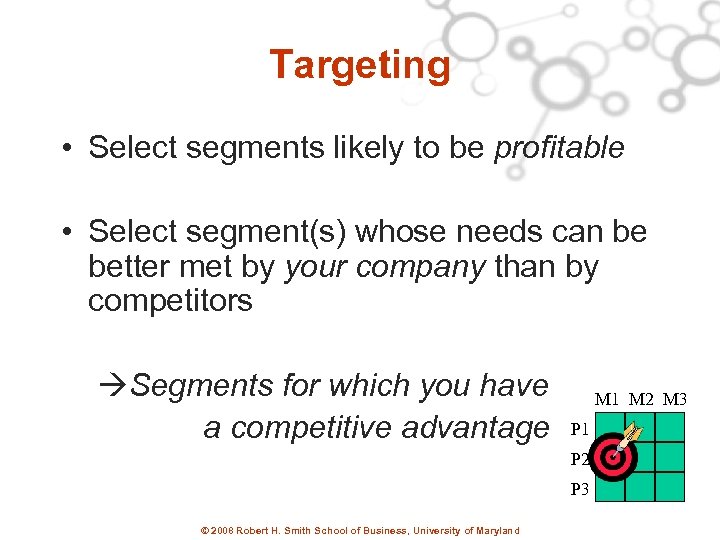
Targeting • Select segments likely to be profitable • Select segment(s) whose needs can be better met by your company than by competitors Segments for which you have a competitive advantage M 1 M 2 M 3 P 1 P 2 P 3 © 2008 Robert H. Smith School of Business, University of Maryland
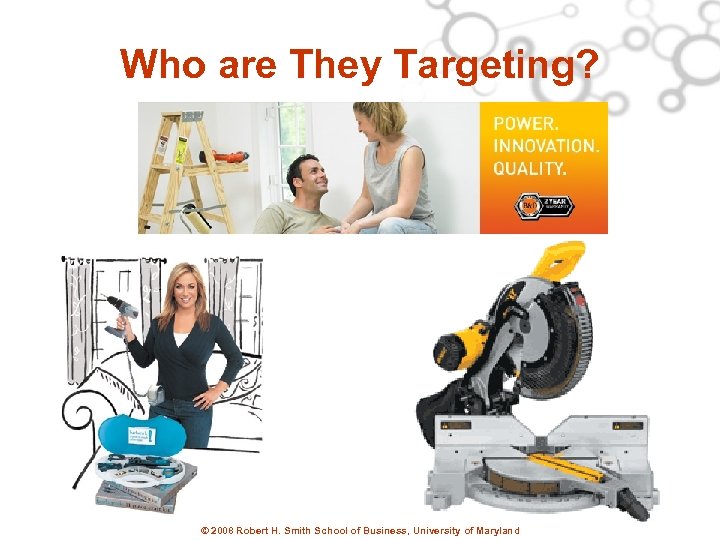
Who are They Targeting? © 2008 Robert H. Smith School of Business, University of Maryland
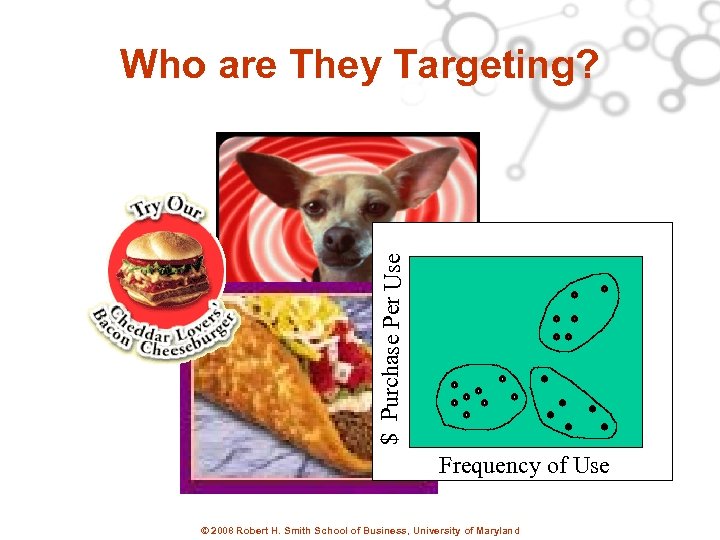
$ Purchase Per Use Who are They Targeting? Frequency of Use © 2008 Robert H. Smith School of Business, University of Maryland
Positioning The Core of Marketing © 2008 Robert H. Smith School of Business University of Maryland
What do we mean by positioning? Creating distinct and valued physical and perceptual differences between one’s product and its competitors, as perceived by the target customer. © 2008 Robert H. Smith School of Business, University of Maryland
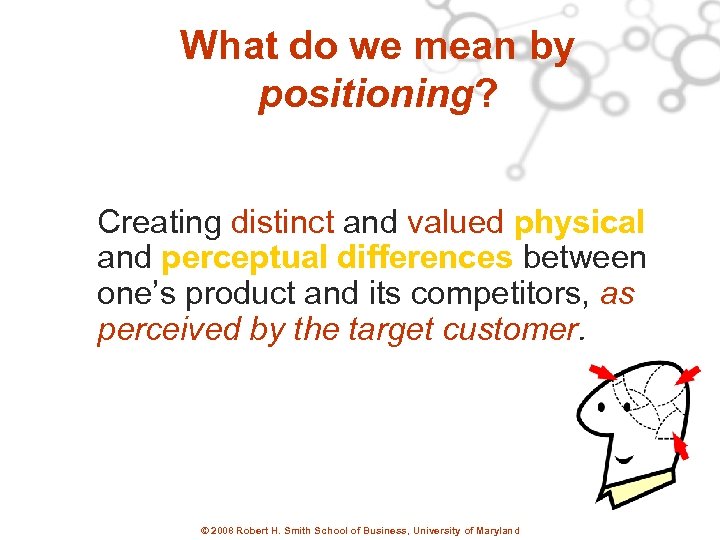
What do we mean by positioning? Creating distinct and valued physical and perceptual differences between one’s product and its competitors, as perceived by the target customer. © 2008 Robert H. Smith School of Business, University of Maryland
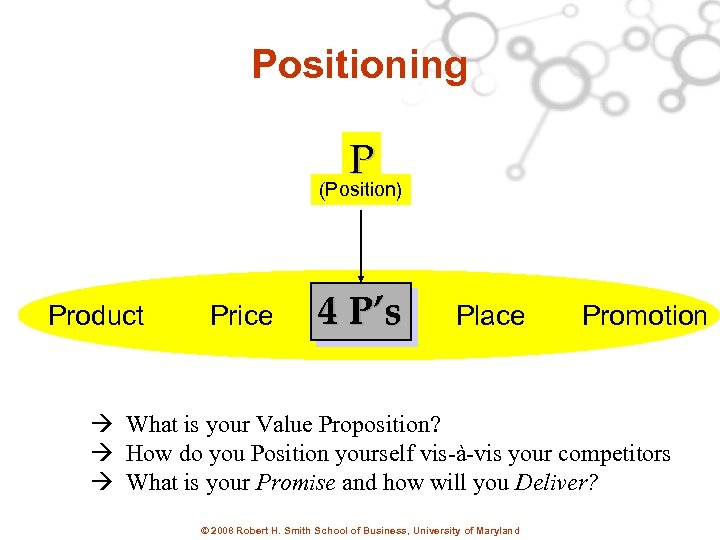
Positioning P (Position) Product Price 4 P’s Place Promotion What is your Value Proposition? How do you Position yourself vis-à-vis your competitors What is your Promise and how will you Deliver? © 2008 Robert H. Smith School of Business, University of Maryland
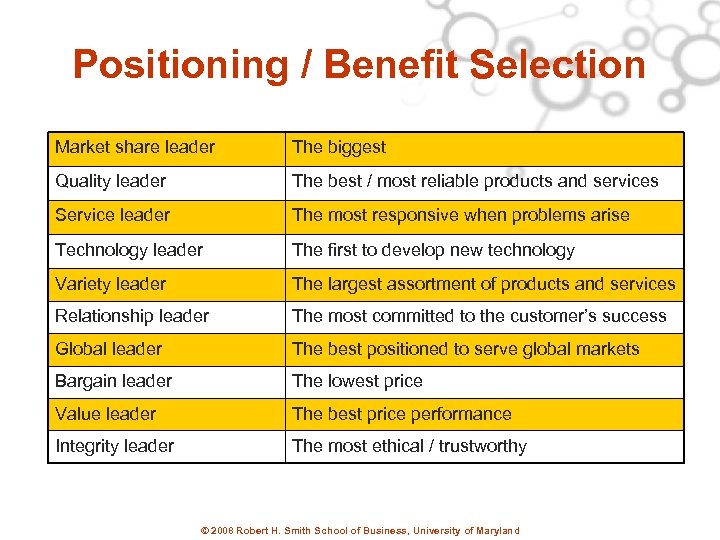
Positioning / Benefit Selection Market share leader The biggest Quality leader The best / most reliable products and services Service leader The most responsive when problems arise Technology leader The first to develop new technology Variety leader The largest assortment of products and services Relationship leader The most committed to the customer’s success Global leader The best positioned to serve global markets Bargain leader The lowest price Value leader The best price performance Integrity leader The most ethical / trustworthy © 2008 Robert H. Smith School of Business, University of Maryland
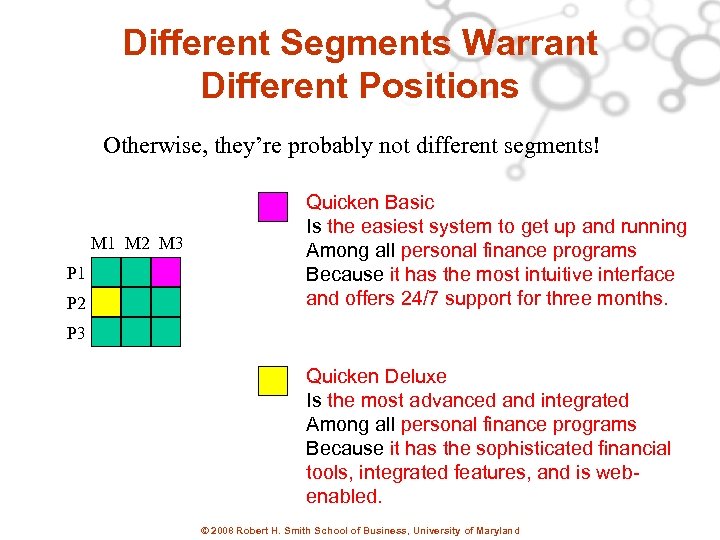
Different Segments Warrant Different Positions Otherwise, they’re probably not different segments! M 1 M 2 M 3 P 1 P 2 Quicken Basic Is the easiest system to get up and running Among all personal finance programs Because it has the most intuitive interface and offers 24/7 support for three months. P 3 Quicken Deluxe Is the most advanced and integrated Among all personal finance programs Because it has the sophisticated financial tools, integrated features, and is webenabled. © 2008 Robert H. Smith School of Business, University of Maryland
Why Bother? • Different segments • …have different needs • …and will pay different prices! © 2008 Robert H. Smith School of Business, University of Maryland
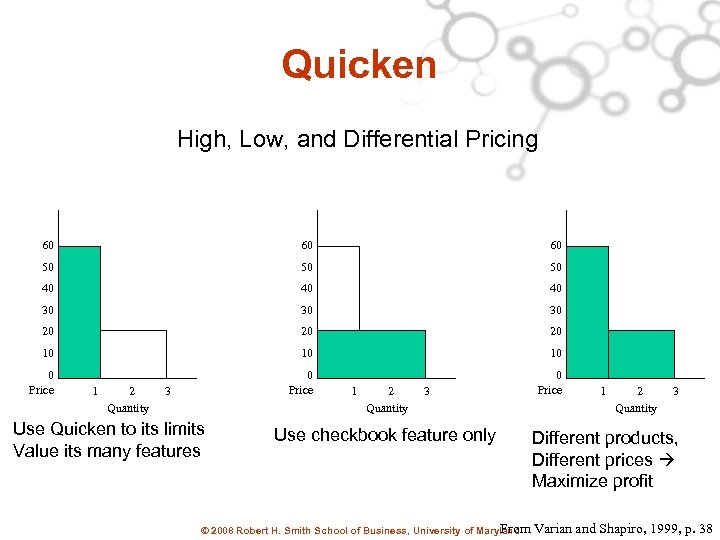
Quicken High, Low, and Differential Pricing 60 60 60 50 50 50 40 40 40 30 30 30 20 20 20 10 10 10 0 Price 1 2 Quantity 3 Use Quicken to its limits Value its many features 1 2 Quantity 3 Use checkbook feature only From © 2008 Robert H. Smith School of Business, University of Maryland 1 2 Quantity 3 Different products, Different prices Maximize profit Varian and Shapiro, 1999, p. 38
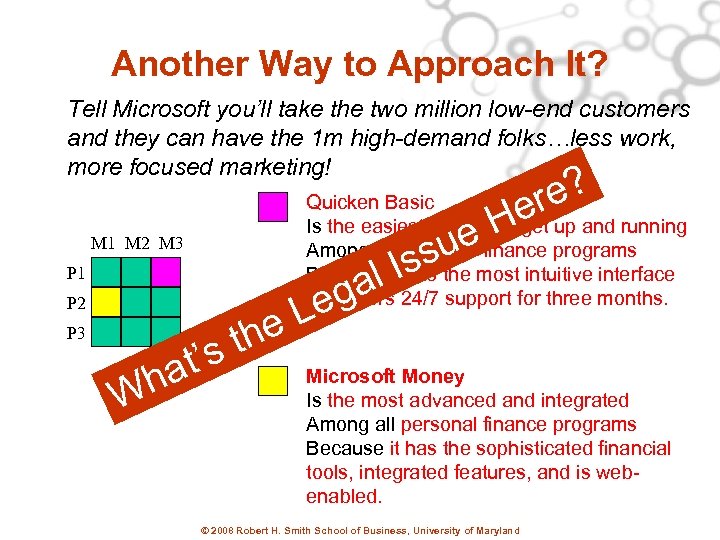
Another Way to Approach It? Tell Microsoft you’ll take the two million low-end customers and they can have the 1 m high-demand folks…less work, more focused marketing! M 1 M 2 M 3 al eg P 1 P 2 P 3 t’s ha W e? er Quicken Basic Is the easiest system to get up and running Among all personal finance programs Because it has the most intuitive interface and offers 24/7 support for three months. su Is H e e. L th Microsoft Money Is the most advanced and integrated Among all personal finance programs Because it has the sophisticated financial tools, integrated features, and is webenabled. © 2008 Robert H. Smith School of Business, University of Maryland
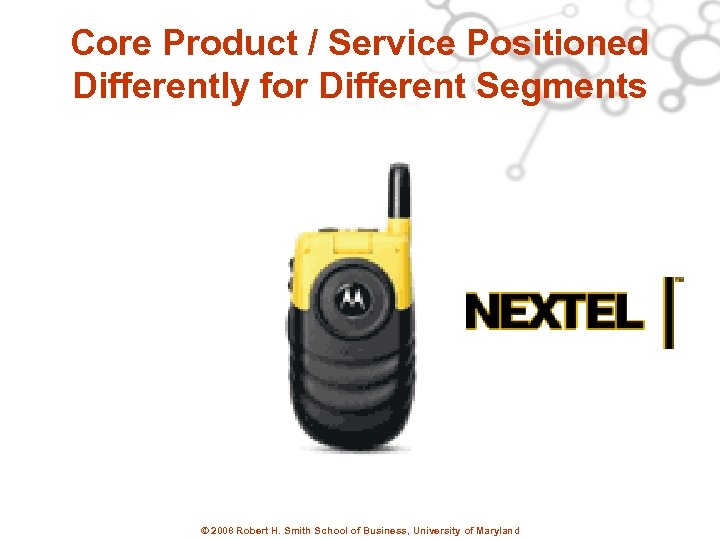
Core Product / Service Positioned Differently for Different Segments © 2008 Robert H. Smith School of Business, University of Maryland
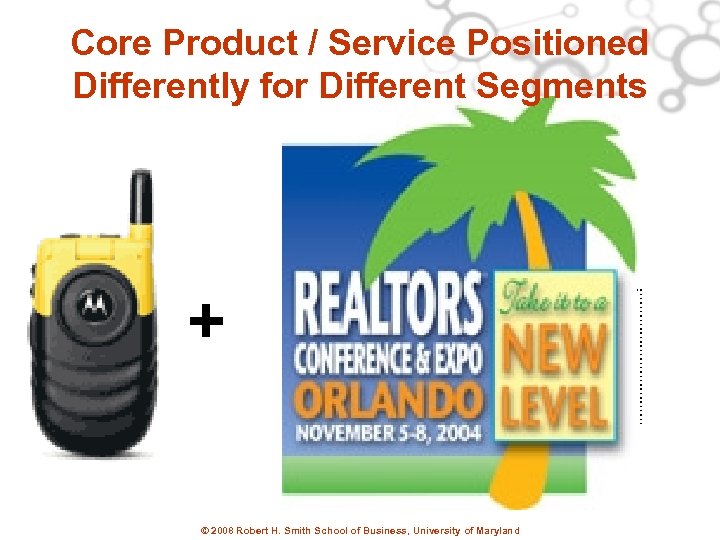
Core Product / Service Positioned Differently for Different Segments + Purchase products from REALTOR VIP® Alliance Partners and leverage NAR's group buying power. © 2008 Robert H. Smith School of Business, University of Maryland
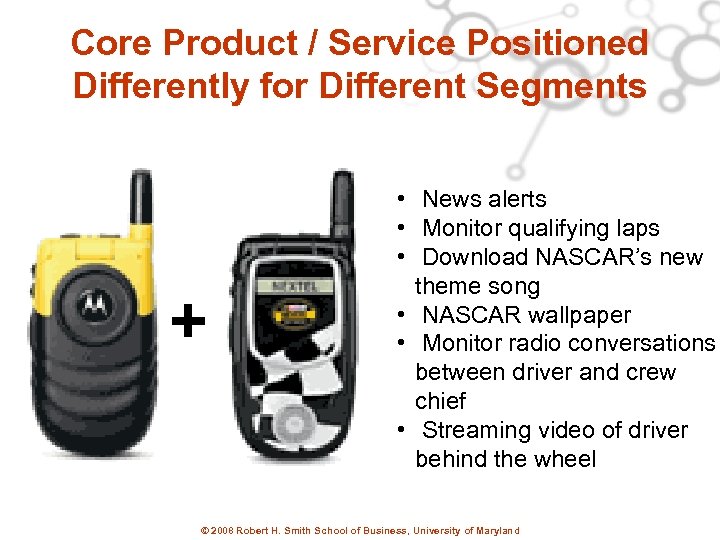
Core Product / Service Positioned Differently for Different Segments + • News alerts • Monitor qualifying laps • Download NASCAR’s new theme song • NASCAR wallpaper • Monitor radio conversations between driver and crew chief • Streaming video of driver behind the wheel © 2008 Robert H. Smith School of Business, University of Maryland
Compare that to the Positioning for Another Segment… © 2008 Robert H. Smith School of Business, University of Maryland
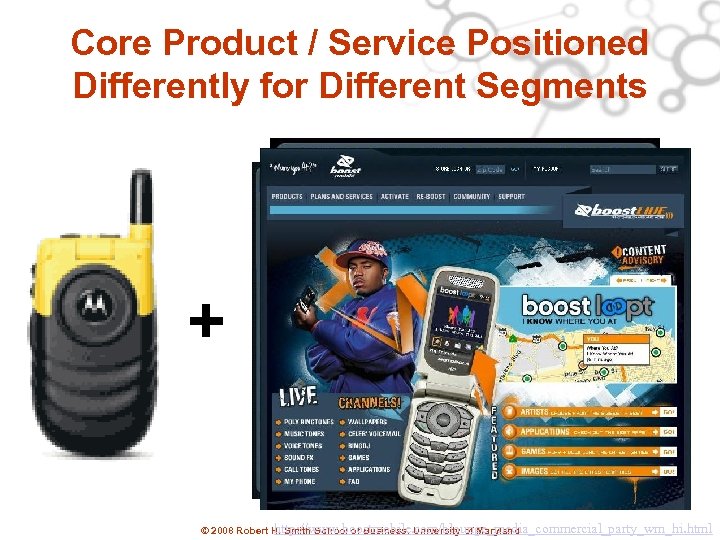
Core Product / Service Positioned Differently for Different Segments + http: //www. boostmobile. com/blounge_media_commercial_party_wm_hi. html © 2008 Robert H. Smith School of Business, University of Maryland
Positioning • Creating distinct and valued physical and perceptual differences between one’s product and its competitors, as perceived by the target customer. © 2008 Robert H. Smith School of Business, University of Maryland
What’s positioning’s role, once a product’s positioning has been determined? It is the foundation from which all marketing mix decisions are made. © 2008 Robert H. Smith School of Business, University of Maryland
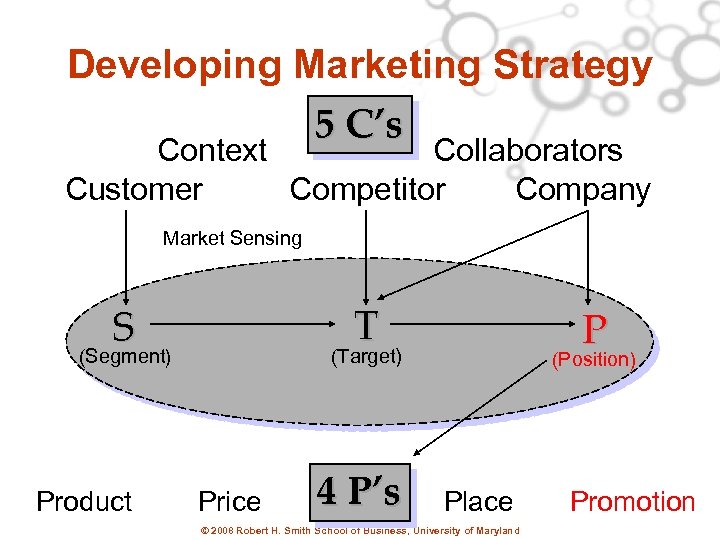
Developing Marketing Strategy 5 C’s Context Collaborators Customer Competitor Company Market Sensing T S (Segment) Product P (Target) Price 4 P’s (Position) Place © 2008 Robert H. Smith School of Business, University of Maryland Promotion
What is a Brand? • A brand is a company’s promise to its customers. • Brands are not about logic and reason; they are about emotion, feeling, and perception. More and more, that promise is about an experience. © 2008 Robert H. Smith School of Business, University of Maryland
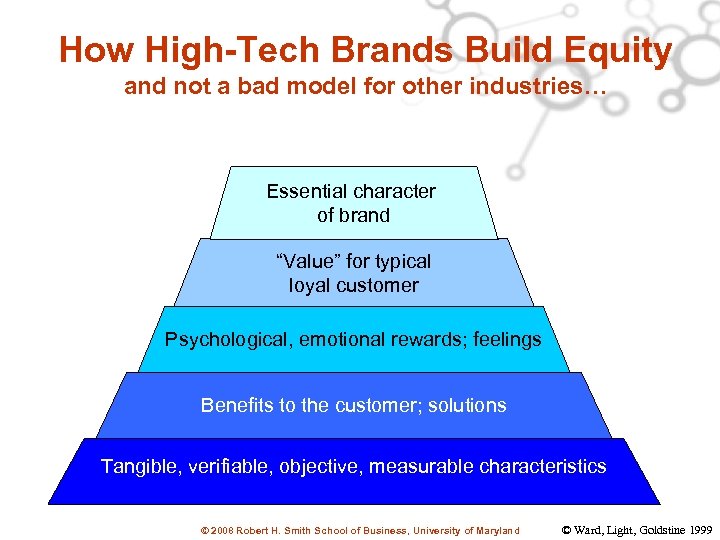
How High-Tech Brands Build Equity and not a bad model for other industries… Essential character of brand “Value” for typical loyal customer Psychological, emotional rewards; feelings Benefits to the customer; solutions Tangible, verifiable, objective, measurable characteristics © 2008 Robert H. Smith School of Business, University of Maryland © Ward, Light, Goldstine 1999
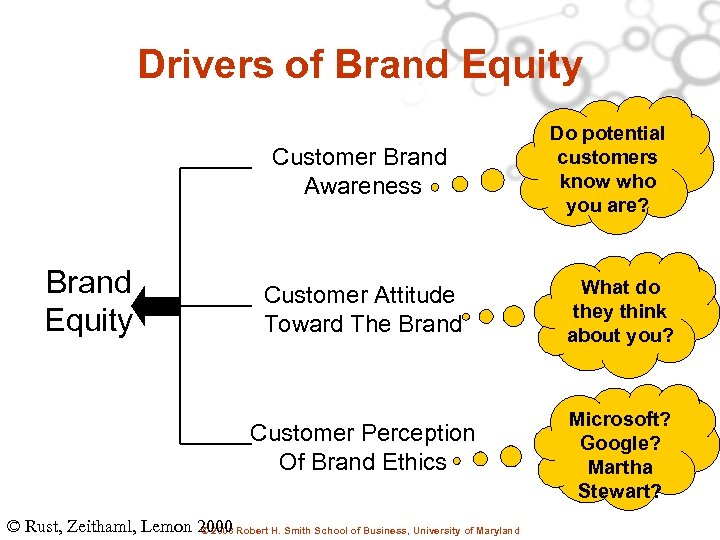
Drivers of Brand Equity Customer Brand Awareness Brand Equity Do potential customers know who you are? Customer Attitude Toward The Brand What do they think about you? Customer Perception Of Brand Ethics Microsoft? Google? Martha Stewart? © Rust, Zeithaml, Lemon 2000 Robert H. Smith School of Business, University of Maryland © 2008
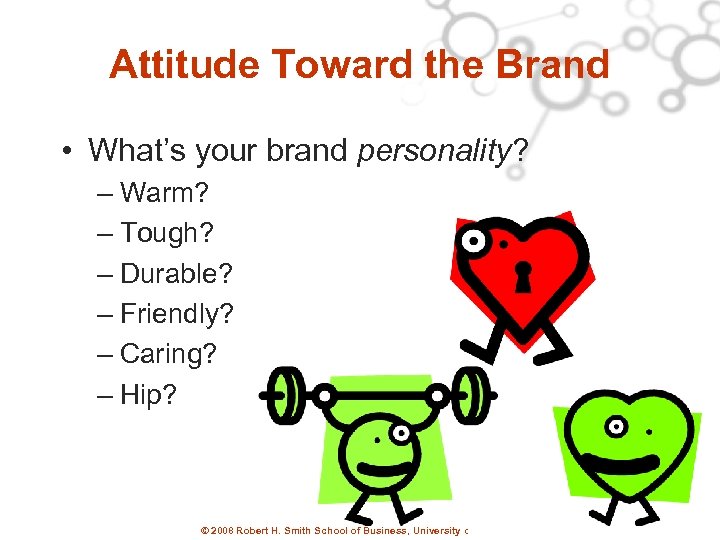
Attitude Toward the Brand • What’s your brand personality? – Warm? – Tough? – Durable? – Friendly? – Caring? – Hip? © 2008 Robert H. Smith School of Business, University of Maryland
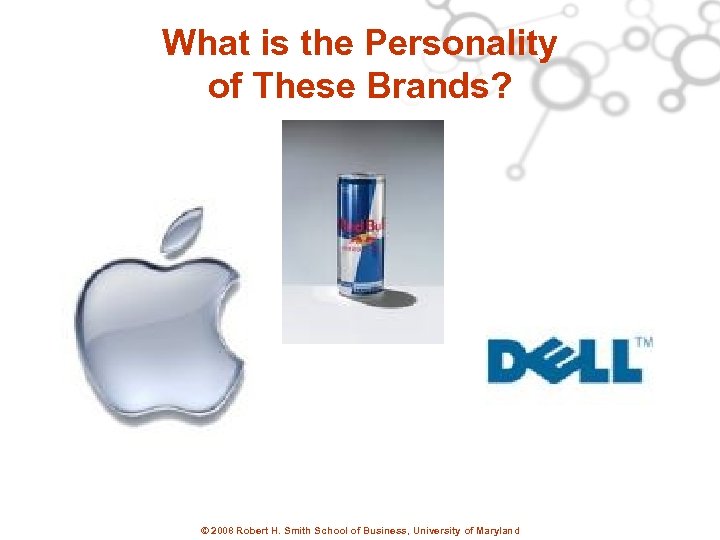
What is the Personality of These Brands? © 2008 Robert H. Smith School of Business, University of Maryland
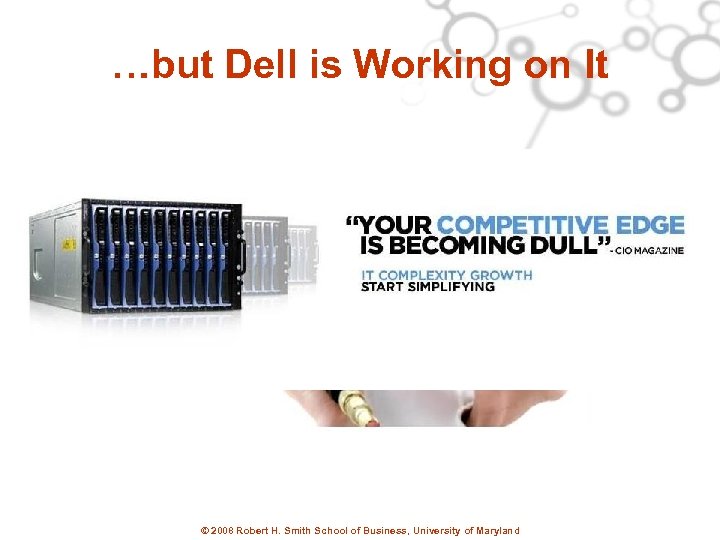
…but Dell is Working on It © 2008 Robert H. Smith School of Business, University of Maryland
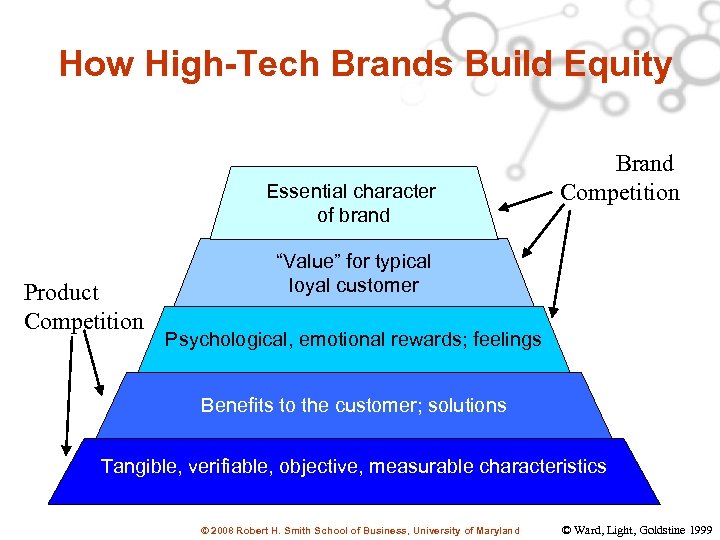
How High-Tech Brands Build Equity Essential character of brand Product Competition Brand Competition “Value” for typical loyal customer Psychological, emotional rewards; feelings Benefits to the customer; solutions Tangible, verifiable, objective, measurable characteristics © 2008 Robert H. Smith School of Business, University of Maryland © Ward, Light, Goldstine 1999
Black and Decker Power Tools Black and Decker Commercials © 2008 Robert H. Smith School of Business, University of Maryland
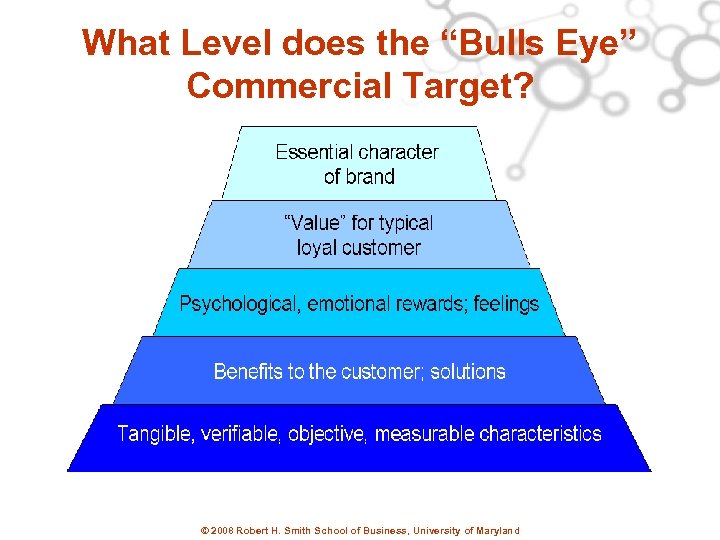
What Level does the “Bulls Eye” Commercial Target? © 2008 Robert H. Smith School of Business, University of Maryland
Contrast that with this from De. Walt’s Web Site © 2008 Robert H. Smith School of Business, University of Maryland
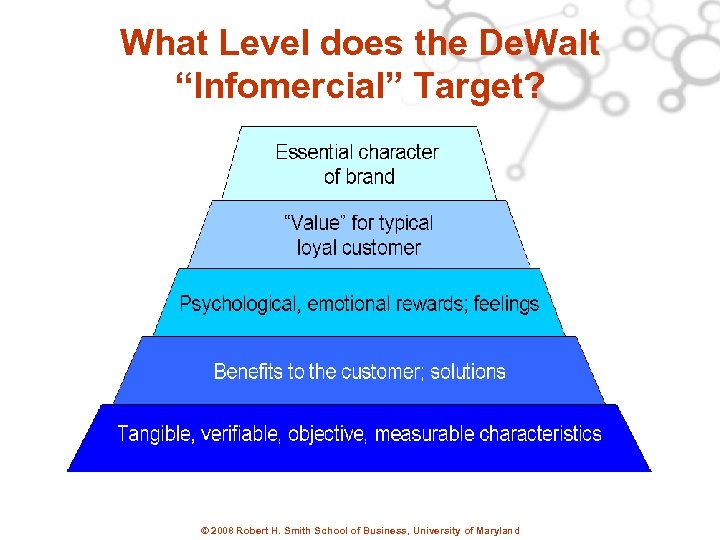
What Level does the De. Walt “Infomercial” Target? © 2008 Robert H. Smith School of Business, University of Maryland
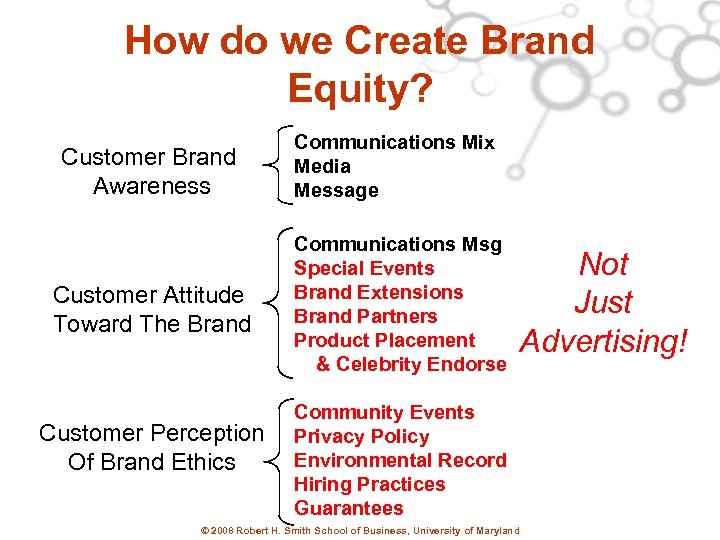
How do we Create Brand Equity? Customer Brand Awareness Customer Attitude Toward The Brand Customer Perception Of Brand Ethics Communications Mix Media Message Communications Msg Special Events Brand Extensions Brand Partners Product Placement & Celebrity Endorse Not Just Advertising! Community Events Privacy Policy Environmental Record Hiring Practices Guarantees © 2008 Robert H. Smith School of Business, University of Maryland
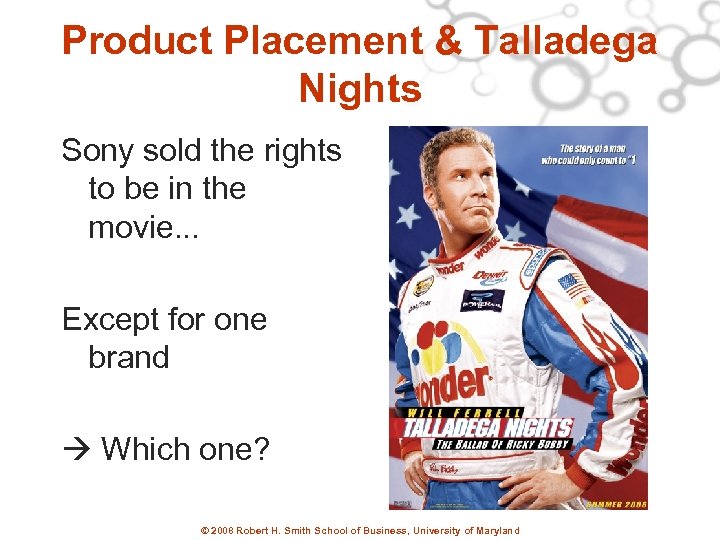
Product Placement & Talladega Nights Sony sold the rights to be in the movie. . . Except for one brand Which one? © 2008 Robert H. Smith School of Business, University of Maryland
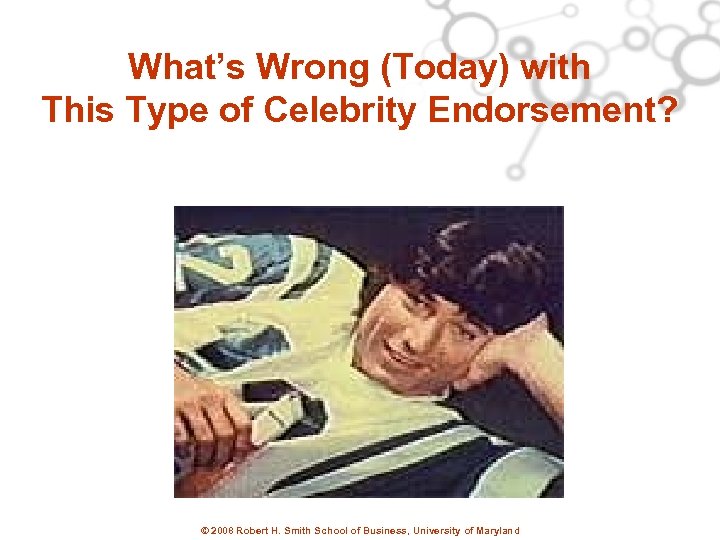
What’s Wrong (Today) with This Type of Celebrity Endorsement? © 2008 Robert H. Smith School of Business, University of Maryland
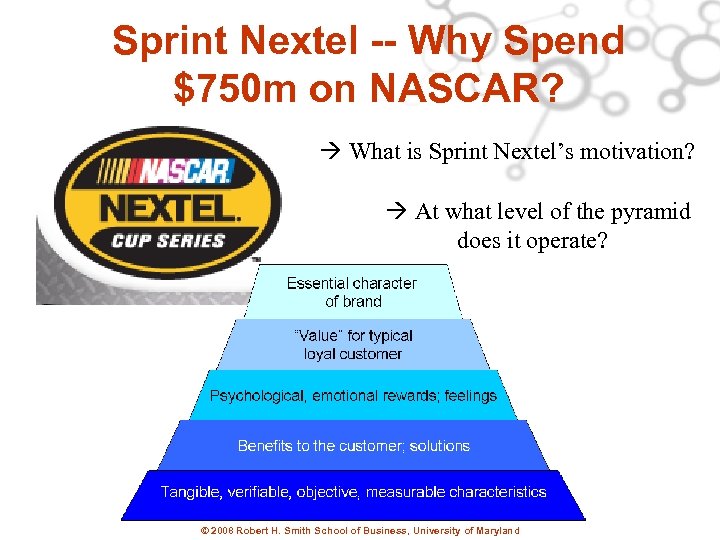
Sprint Nextel -- Why Spend $750 m on NASCAR? What is Sprint Nextel’s motivation? At what level of the pyramid does it operate? © 2008 Robert H. Smith School of Business, University of Maryland
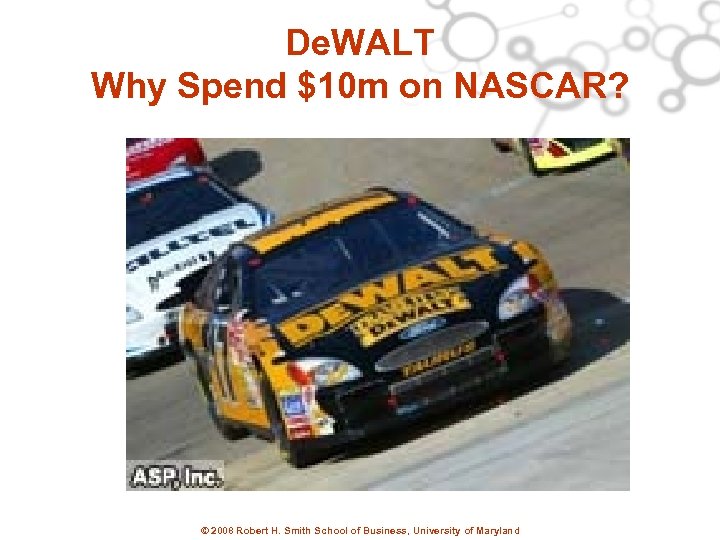
De. WALT Why Spend $10 m on NASCAR? © 2008 Robert H. Smith School of Business, University of Maryland
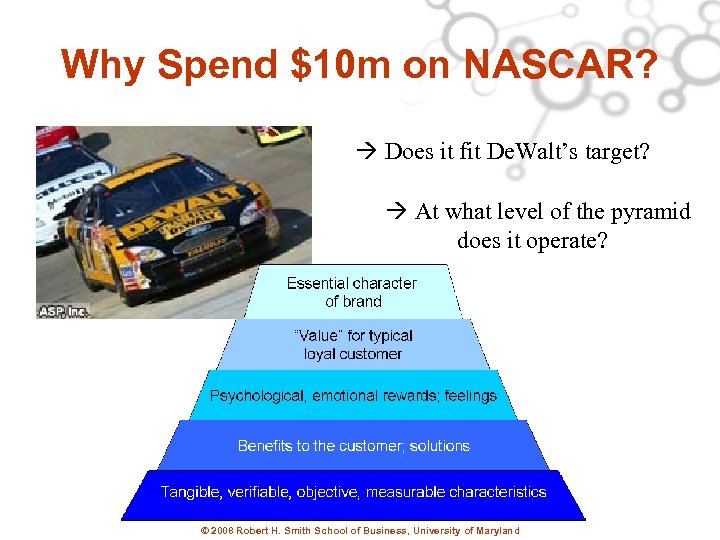
Why Spend $10 m on NASCAR? Does it fit De. Walt’s target? At what level of the pyramid does it operate? © 2008 Robert H. Smith School of Business, University of Maryland
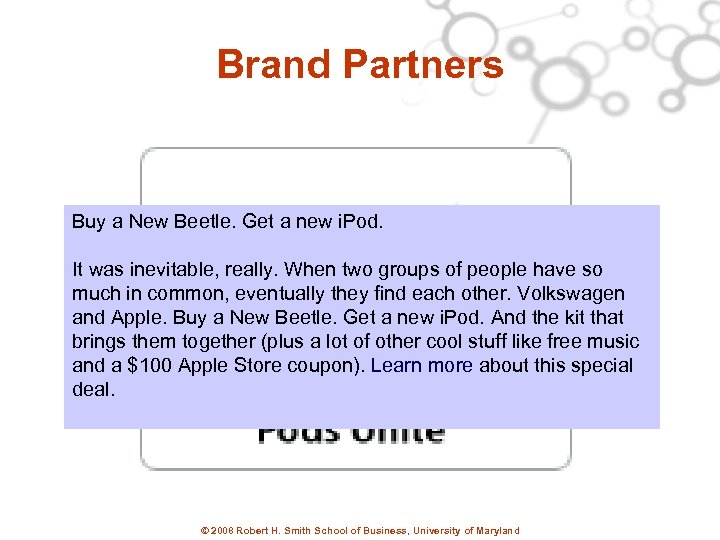
Brand Partners Buy a New Beetle. Get a new i. Pod. It was inevitable, really. When two groups of people have so much in common, eventually they find each other. Volkswagen and Apple. Buy a New Beetle. Get a new i. Pod. And the kit that brings them together (plus a lot of other cool stuff like free music and a $100 Apple Store coupon). Learn more about this special deal. © 2008 Robert H. Smith School of Business, University of Maryland
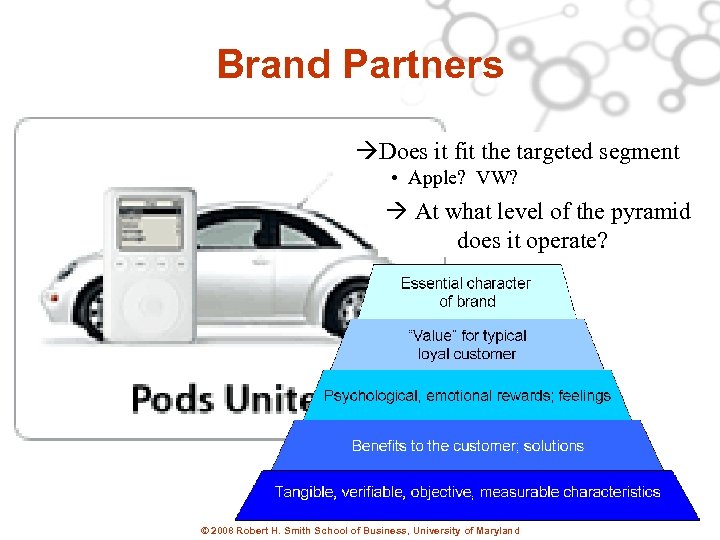
Brand Partners Does it fit the targeted segment • Apple? VW? At what level of the pyramid does it operate? © 2008 Robert H. Smith School of Business, University of Maryland
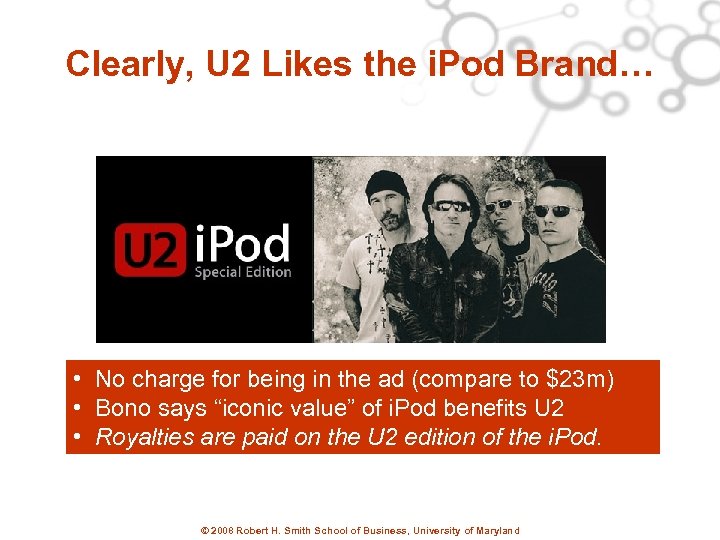
Clearly, U 2 Likes the i. Pod Brand… • No charge for being in the ad (compare to $23 m) • Bono says “iconic value” of i. Pod benefits U 2 • Royalties are paid on the U 2 edition of the i. Pod. © 2008 Robert H. Smith School of Business, University of Maryland
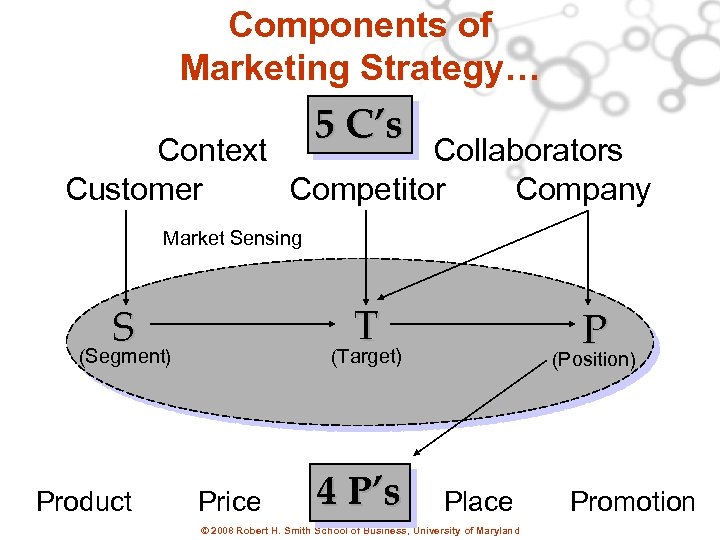
Components of Marketing Strategy… 5 C’s Context Collaborators Customer Competitor Company Market Sensing T S (Segment) Product P (Target) Price 4 P’s (Position) Place © 2008 Robert H. Smith School of Business, University of Maryland Promotion
…And Marketing’s Role! • The purpose of marketing is to make selling superfluous. Peter Drucker, 1973 • There is only one valid definition of business purpose: to create a customer. Peter Drucker • Marketing means solving customers’ problems profitably. Randall G. Chapman, Ph. D © 2008 Robert H. Smith School of Business, University of Maryland
Thank You Judy Frels Senior Director of Custom Programs Marketing Lecturer jfrels@rhsmith. umd. edu © 2008 Robert H. Smith School of Business, University of Maryland
Скачать презентацию Giving Them What They Want Branding and Positioning
09bf59673cd05806dbf5553aba51c2e7.ppt