 Скачать презентацию Give the official name of this building Where
b1b87630867c2fe6289d1c8444d88a5f.ppt
- Количество слайдов: 14



![Give the official name of this building. Where does it get this name? [ACH]](https://present5.com/presentation/b1b87630867c2fe6289d1c8444d88a5f/image-1.jpg "Give the official name of this building. Where does it get this name? [ACH]")
Give the official name of this building. Where does it get this name? [ACH] The Flavian Amphitheatre: Named after the family name Vespasian – the Emperor who gifted it to the people of Rome, and had it built (but died before its completion.
![Give the popular name of this building. Where does it get this name? [ACH]](https://present5.com/presentation/b1b87630867c2fe6289d1c8444d88a5f/image-2.jpg "Give the popular name of this building. Where does it get this name? [ACH]")
Give the popular name of this building. Where does it get this name? [ACH] The Colosseum (Colissium – altnative spelling): Named after Colossal statue Nero had built of himself beside the Amphitheatre. IT was later altered to represent the god Helios or Apollo.
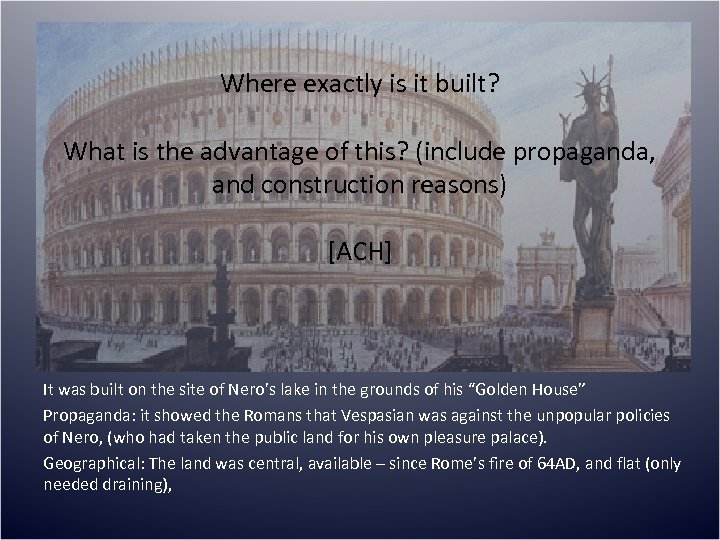
Where exactly is it built? What is the advantage of this? (include propaganda, and construction reasons) [ACH] It was built on the site of Nero’s lake in the grounds of his “Golden House” Propaganda: it showed the Romans that Vespasian was against the unpopular policies of Nero, (who had taken the public land for his own pleasure palace). Geographical: The land was central, available – since Rome’s fire of 64 AD, and flat (only needed draining),
![When was it built? From when to when) [ACH] Vespasian began it in 70](https://present5.com/presentation/b1b87630867c2fe6289d1c8444d88a5f/image-4.jpg "When was it built? From when to when) [ACH] Vespasian began it in 70")
When was it built? From when to when) [ACH] Vespasian began it in 70 AD (approx) His son Domitian completed it in 81 AD (approx) (It was inaugurated (opened) by Vespasian’s son Titus in 80 AD)
![Who were the 3 people responsible for its construction, and name their contribution? [ACH]](https://present5.com/presentation/b1b87630867c2fe6289d1c8444d88a5f/image-5.jpg "Who were the 3 people responsible for its construction, and name their contribution? [ACH]")
Who were the 3 people responsible for its construction, and name their contribution? [ACH] Vespasian began it completing the first 3 levels but died in 69 before completing it son Titus finished the 4 rd level Brother Domitian enlarged with the top level with a gallery, the underground levels fo animals gladiators and machinery, and the sun shade (Velarium) by 81
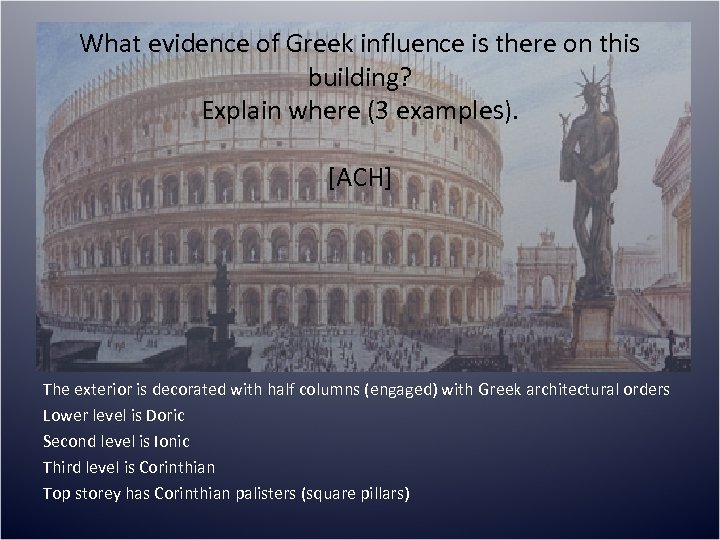
What evidence of Greek influence is there on this building? Explain where (3 examples). [ACH] The exterior is decorated with half columns (engaged) with Greek architectural orders Lower level is Doric Second level is Ionic Third level is Corinthian Top storey has Corinthian palisters (square pillars)
![What materials were used in its construction? [ACH] Travertine (local limestone) lower 2 levels,](https://present5.com/presentation/b1b87630867c2fe6289d1c8444d88a5f/image-7.jpg "What materials were used in its construction? [ACH] Travertine (local limestone) lower 2 levels,")
What materials were used in its construction? [ACH] Travertine (local limestone) lower 2 levels, Cement (stronger with volcanic sand from MT Vesuvius. Marble facing for seats etc Brick-faced concrete (upper levels) - lighter
![Briefly describe the exterior of the building. (2 marks) [ACH] Three levels with 80](https://present5.com/presentation/b1b87630867c2fe6289d1c8444d88a5f/image-8.jpg "Briefly describe the exterior of the building. (2 marks) [ACH] Three levels with 80")
Briefly describe the exterior of the building. (2 marks) [ACH] Three levels with 80 open archways (the ground floor being vaulted entries ), the 2 nd and 3 rd containing statues. The 4 th level closed. Decorate with Greek pillars (Doric, Ionic, Corinthian) 240 masts on the top 48, 5 m high, eliptical - 188 m long & 156 m wide
![Identify and explain TWO Roman innovations of construction that were employed. [MER] ARCHES AND](https://present5.com/presentation/b1b87630867c2fe6289d1c8444d88a5f/image-9.jpg "Identify and explain TWO Roman innovations of construction that were employed. [MER] ARCHES AND")
Identify and explain TWO Roman innovations of construction that were employed. [MER] ARCHES AND VAULTS: to lighten the structure but spread the stress of the weight of the building plus 50, 000 spectators without too much heavy material CONCRETE: a light but very strong building material used to reinforce the brickwork.
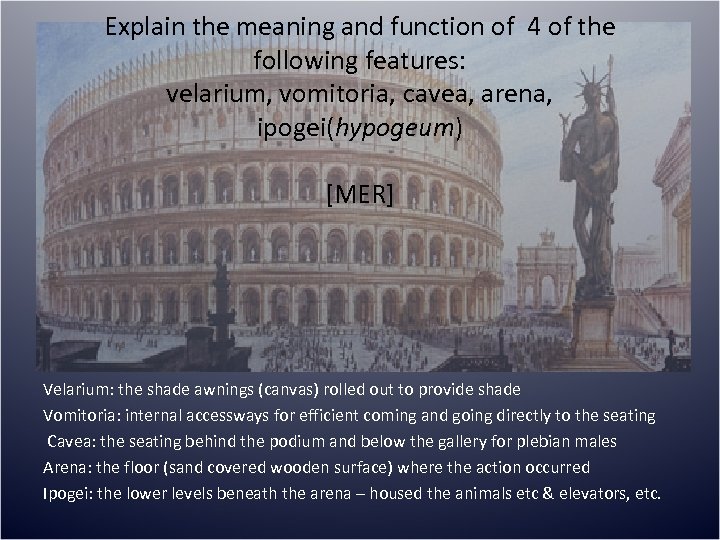
Explain the meaning and function of 4 of the following features: velarium, vomitoria, cavea, arena, ipogei(hypogeum) [MER] Velarium: the shade awnings (canvas) rolled out to provide shade Vomitoria: internal accessways for efficient coming and going directly to the seating Cavea: the seating behind the podium and below the gallery for plebian males Arena: the floor (sand covered wooden surface) where the action occurred Ipogei: the lower levels beneath the arena – housed the animals etc & elevators, etc.
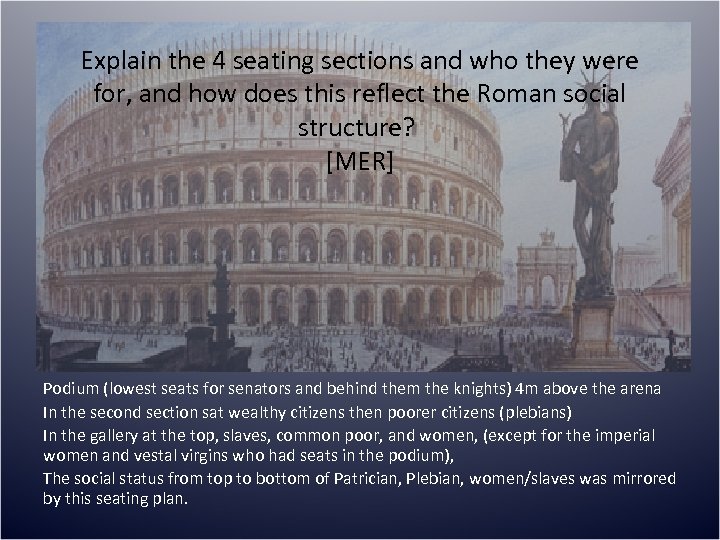
Explain the 4 seating sections and who they were for, and how does this reflect the Roman social structure? [MER] Podium (lowest seats for senators and behind them the knights) 4 m above the arena In the second section sat wealthy citizens then poorer citizens (plebians) In the gallery at the top, slaves, common poor, and women, (except for the imperial women and vestal virgins who had seats in the podium), The social status from top to bottom of Patrician, Plebian, women/slaves was mirrored by this seating plan.
![Identify and explain 3 features of design/form that were determined by its function. [MER]](https://present5.com/presentation/b1b87630867c2fe6289d1c8444d88a5f/image-12.jpg "Identify and explain 3 features of design/form that were determined by its function. [MER]")
Identify and explain 3 features of design/form that were determined by its function. [MER] FUNCTION – an arena for of 50, 000 spectators…. . thus Tiered seating so all got a good view Near circular so action was central 80 entrances and vaulted galleries for quick access to seats and exit. Dens cages elevators below the arena (underground) for ease of “scene changes” Arches/ vaults/cement for strength as it carried such a load
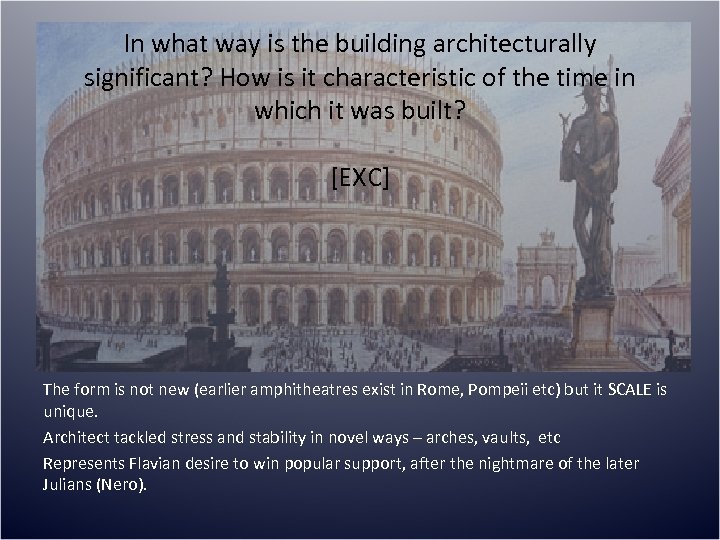
In what way is the building architecturally significant? How is it characteristic of the time in which it was built? [EXC] The form is not new (earlier amphitheatres exist in Rome, Pompeii etc) but it SCALE is unique. Architect tackled stress and stability in novel ways – arches, vaults, etc Represents Flavian desire to win popular support, after the nightmare of the later Julians (Nero).
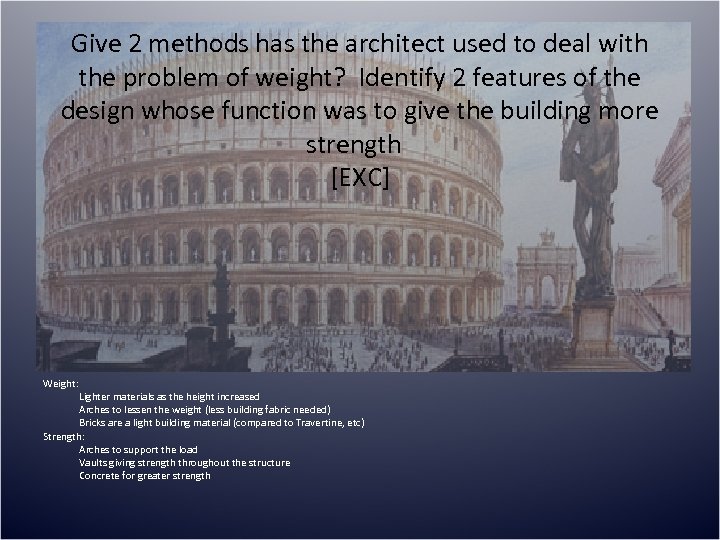
Give 2 methods has the architect used to deal with the problem of weight? Identify 2 features of the design whose function was to give the building more strength [EXC] Weight: Lighter materials as the height increased Arches to lessen the weight (less building fabric needed) Bricks are a light building material (compared to Travertine, etc) Strength: Arches to support the load Vaults giving strength throughout the structure Concrete for greater strength
Скачать презентацию Give the official name of this building Where
b1b87630867c2fe6289d1c8444d88a5f.ppt