 Скачать презентацию Give me a loan so there will be
9196c81bbcc7211fbda70fd78637fe71.ppt
- Количество слайдов: 57




Give me a loan so there will be more DD in the system. How Banks Create Money [MS] MS = Currency + DD of Public Banks [thru loans] Create More DD

How Banks and Thrifts Create Money
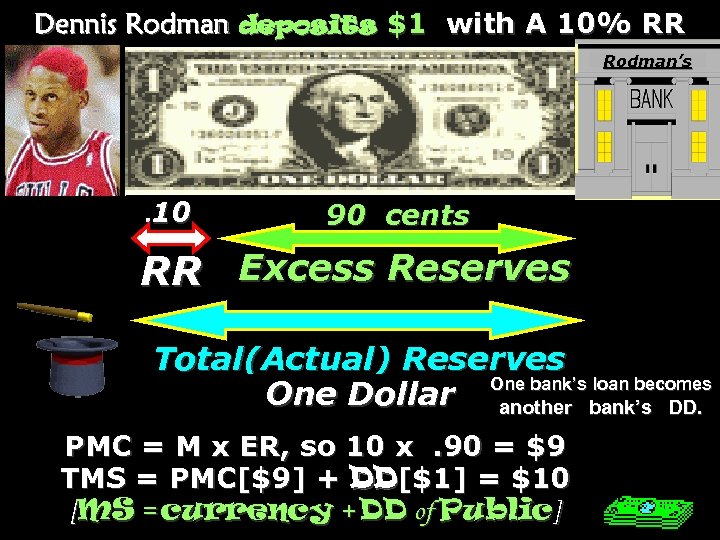
Dennis Rodman deposits $1 with A 10% RR Rodman’s . 10 90 cents RR Excess Reserves Total(Actual) Reserves One bank’s loan becomes One Dollar another bank’s DD. PMC = M x ER, so 10 x. 90 = $9 TMS = PMC[$9] + DD[$1] = $10 [MS = currency + DD of Public]
![Rodman’s Bank Borrows $1 From The Fed [10% RR] Fed Rodman’s Bank 0 One](https://present5.com/presentation/9196c81bbcc7211fbda70fd78637fe71/image-4.jpg "Rodman’s Bank Borrows $1 From The Fed [10% RR] Fed Rodman’s Bank 0 One")
Rodman’s Bank Borrows $1 From The Fed [10% RR] Fed Rodman’s Bank 0 One Dollar RR Excess Reserves Total(Actual) Reserves One Dollar PMC = M x ER, so 10 x $1 = $10 TMS [$10] = PMC[$10] [MS = currency + DD of public]
![BALANCE SHEET OF A COMMERCIAL BANK ASSETS [cash] = [The cash is property of](https://present5.com/presentation/9196c81bbcc7211fbda70fd78637fe71/image-5.jpg "BALANCE SHEET OF A COMMERCIAL BANK ASSETS [cash] = [The cash is property of")
BALANCE SHEET OF A COMMERCIAL BANK ASSETS [cash] = [The cash is property of the bank] Cash $100, 000 LIABILITIES[DD] [“liable”, DDs are owed to depositors] DD $100, 000 The Goldsmiths Fractional Reserve Banking System Money Creation & Reserves [The current 10% RR is kept in a bank’s vault or in a Fed vault. ] Bank Panics and Regulation

![$1, 000 DD by Ann [MS=Currency+DD of Public] Public New Deposits [New Reserves] Bank](https://present5.com/presentation/9196c81bbcc7211fbda70fd78637fe71/image-7.jpg "$1, 000 DD by Ann [MS=Currency+DD of Public] Public New Deposits [New Reserves] Bank")
$1, 000 DD by Ann [MS=Currency+DD of Public] Public New Deposits [New Reserves] Bank DD DD Created By New Loans [equal to new ER] New Required Reserves RR=10% A $1, 000. 00 $100. 00 900. 00 B 900. 00 $90. 00 810. 00 C 810. 00 $81. 00 729. 00 D 729. 00 $72. 90 656. 10 PMC = ER[$900] x M[10] Ann’s DD + PMC $1, 000. 00 + $9, 000. 00 = One year “all u can eat” hot wings at Hooters $729. 00 for a “cat bodyguard” PMC =$9, 000. 00 TMS = Dog that can Yo. Yo Smoking cat $10, 000. 00 MS grows by multiple of 10
![$1, 000 DD by Katy [MS=Currency+DD of Public] Public New Deposits [New Reserves] DD](https://present5.com/presentation/9196c81bbcc7211fbda70fd78637fe71/image-8.jpg "$1, 000 DD by Katy [MS=Currency+DD of Public] Public New Deposits [New Reserves] DD")
$1, 000 DD by Katy [MS=Currency+DD of Public] Public New Deposits [New Reserves] DD Bank DD Created By New Loans [equal to new ER] New Required Reserves RR=20% A $1, 000. 00 $200. 00 800. 00 B 800. 00 $160. 00 640. 00 $128. 00 512. 00 D 512. 00 $102. 40 Purchase of a donkey 640. 00 C Hair care for 1 year 409. 60 PMC = ER[$800 x M[5] Katy’s DD + PMC $1, 000. 00 + $4, 000. 00 = = Two Monkeys PMC = $4, 000. 00 TMS $5, 000. 00 A chauffeur dog MS grows by multiple of 5
![$1, 000 DD by Allison [MS=Currency+DD of Public] Public New Deposits [New Reserves] Bank](https://present5.com/presentation/9196c81bbcc7211fbda70fd78637fe71/image-9.jpg "$1, 000 DD by Allison [MS=Currency+DD of Public] Public New Deposits [New Reserves] Bank")
$1, 000 DD by Allison [MS=Currency+DD of Public] Public New Deposits [New Reserves] Bank DD DD Created By New Loans [equal to new ER] New Required Reserves RR=25% A $1, 000. 00 $250. 00 750. 00 B 750. 00 $188. 00 562. 00 C 562. 00 $140. 00 422. 00 D 422. 00 $105. 00 317. 00 E 317. 00 $80. 00 Shark to keep in bathtub Prom date w. Linda Blair Frog with teeth 237. 00 PMC = ER[$750] x M[4] Allison’s DD + PMC $1, 000. 00 + $3, 000. 00 PMC = $ = = Teach Stuart Little how to brush his teeth Cat with human teeth TMS $4, 000. 00 MS grows by multiple of 4
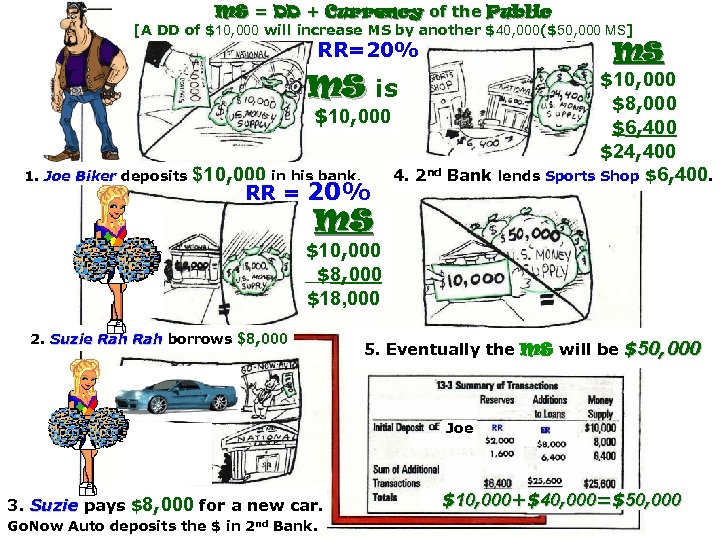
MS = DD + Currency of the Public [A DD of $10, 000 will increase MS by another $40, 000($50, 000 MS] MS RR=20% MS is $10, 000 $8, 000 $6, 400 $24, 400 $10, 000 1. Joe Biker deposits $10, 000 in his bank. RR = 20% 4. 2 nd Bank lends Sports Shop $6, 400. MS $10, 000 $8, 000 $18, 000 2. Suzie Rah borrows $8, 000 5. Eventually the MS will be $50, 000 Joe 3. Suzie pays $8, 000 for a new car. Go. Now Auto deposits the $ in 2 nd Bank. $10, 000+$40, 000=$50, 000
![How Banks Create Money [Vocabulary] 1. Fractional Reserve Banking System – a fraction of](https://present5.com/presentation/9196c81bbcc7211fbda70fd78637fe71/image-11.jpg "How Banks Create Money [Vocabulary] 1. Fractional Reserve Banking System – a fraction of")
How Banks Create Money [Vocabulary] 1. Fractional Reserve Banking System – a fraction of DD are kept in reserve(say, 10%) at either the banks vault or at the Fed. 2. Vault cash – cash held by a bank (banks rarely keep more than 2% of their in cash) 3. Required Reserve(RR) –specified percentage of DD that banks must keep as RR. 4. Excess reserves – total reserves(TR) – RR. ER is what can be loaned out. 5. 6. Also some ER is used to meet sudden withdrawal demands. Actual(Total) reserves – RR + ER. Deposit Multiplier – one/RR or 1/. 10 or $1/10 cents or 10 Multipliers 1/RR[$1/5 cents = 20] 1/5% = 20 1/25% = 4 1/10% = 10 1/33. 3%= 3 1/12. 5% = 8 1/40 = 2. 5 1/20% = 5 1/50% = 2 7. Balance Sheet–statement of assets & liabilities[assets=liabilities]. assets=liabilities 8. Discount Rate – when banks borrow from the Fed. [symbolic-emergencies] Fed “wholesale price of money” 9. Federal Funds Rate – banks borrow from other banks for overnight loans. 10. Prime Rate – when a bank’s prime customers [good credit] get loans. “retail price of money” 11. Buying Bonds – “buying” bonds means “bigger ” supply of money and “lower interest rates”. [So, more “C”, “Ig”, and “Xn” ] 12. Selling Bonds – “selling” bonds mea ns “smaller” supply of money and “higher interest rates”. [So, less “C”, “Ig”, and “Xn”]
Most Famous “Panic Run” in Movie History
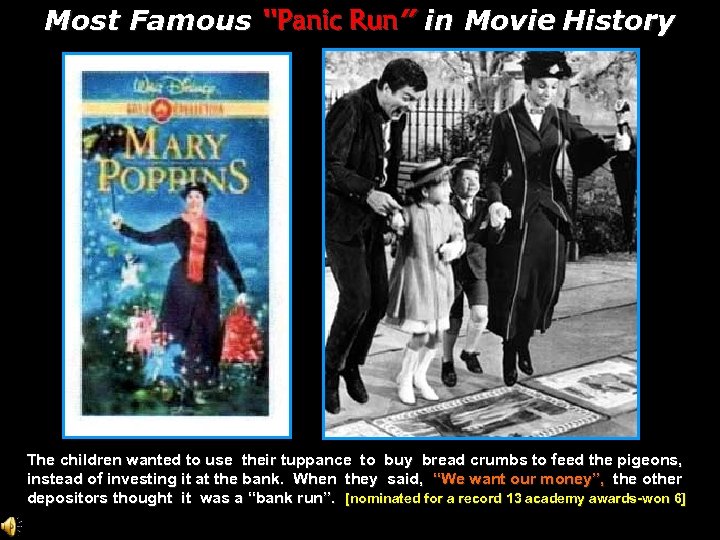
Most Famous “Panic Run” in Movie History The children wanted to use their tuppance to buy bread crumbs to feed the pigeons, instead of investing it at the bank. When they said, “We want our money”, the other depositors thought it was a “bank run”. [nominated for a record 13 academy awards-won 6]
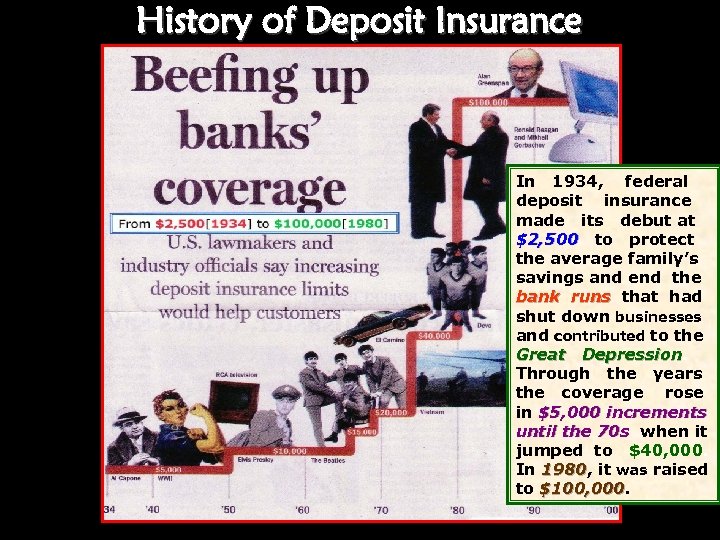
History of Deposit Insurance In 1934, federal deposit insurance made its debut at $2, 500 to protect the average family’s savings and end the bank runs that had shut down businesses and contributed to the Great Depression Through the years the coverage rose in $5, 000 increments until the 70 s when it jumped to $40, 000. In 1980, it was raised 1980 to $100, 000
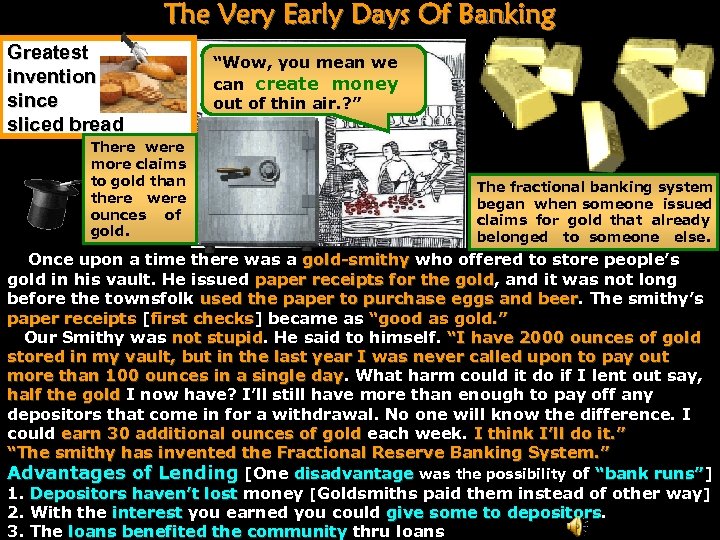
The Very Early Days Of Banking Greatest invention since sliced bread There were more claims to gold than there were ounces of gold. “Wow, you mean we can create money out of thin air. ? ” The fractional banking system began when someone issued claims for gold that already belonged to someone else. Once upon a time there was a gold-smithy who offered to store people’s gold in his vault. He issued paper receipts for the gold, and it was not long gold before the townsfolk used the paper to purchase eggs and beer. The smithy’s beer paper receipts [first checks] became as “good as gold. ” checks Our Smithy was not stupid. He said to himself. “I have 2000 ounces of gold stupid stored in my vault, but in the last year I was never called upon to pay out more than 100 ounces in a single day. What harm could it do if I lent out say, day half the gold I now have? I’ll still have more than enough to pay off any depositors that come in for a withdrawal. No one will know the difference. I could earn 30 additional ounces of gold each week. I think I’ll do it. ” “The smithy has invented the Fractional Reserve Banking System. ” Advantages of Lending [One disadvantage was the possibility of “bank runs”] runs” 1. Depositors haven’t lost money [Goldsmiths paid them instead of other way] 2. With the interest you earned you could give some to depositors 3. The loans benefited the community thru loans
![FORMATION OF A COMMERCIAL BANK In Lovelady, ASSETS [own] TRANSACTION 1 Creating a bank](https://present5.com/presentation/9196c81bbcc7211fbda70fd78637fe71/image-16.jpg "FORMATION OF A COMMERCIAL BANK In Lovelady, ASSETS [own] TRANSACTION 1 Creating a bank")
FORMATION OF A COMMERCIAL BANK In Lovelady, ASSETS [own] TRANSACTION 1 Creating a bank $250, 000 Cash for Capital Stock Texas LIABILITIES & NET WORTH [owe]
![FORMATION OF A COMMERCIAL BANK In Lovelady, LIABILITIES & NET WORTH [owe] ASSETS [own]](https://present5.com/presentation/9196c81bbcc7211fbda70fd78637fe71/image-17.jpg "FORMATION OF A COMMERCIAL BANK In Lovelady, LIABILITIES & NET WORTH [owe] ASSETS [own]")
FORMATION OF A COMMERCIAL BANK In Lovelady, LIABILITIES & NET WORTH [owe] ASSETS [own] Cash Texas $250, 000 Capital Stock $250, 000 Deposit Added to Vault Cash
![FORMATION OF A COMMERCIAL BANK In Lovelady, LIABILITIES & NET WORTH [owe] ASSETS [own]](https://present5.com/presentation/9196c81bbcc7211fbda70fd78637fe71/image-18.jpg "FORMATION OF A COMMERCIAL BANK In Lovelady, LIABILITIES & NET WORTH [owe] ASSETS [own]")
FORMATION OF A COMMERCIAL BANK In Lovelady, LIABILITIES & NET WORTH [owe] ASSETS [own] Cash Texas $250, 000 TRANSACTION 2 Acquiring Property and Equipment $240, 000 Cash Capital Stock $250, 000
![Birth OF A COMMERCIAL BANK In Lovelady, Texas ASSETS [own] Cash Property LIABILITIES &](https://present5.com/presentation/9196c81bbcc7211fbda70fd78637fe71/image-19.jpg "Birth OF A COMMERCIAL BANK In Lovelady, Texas ASSETS [own] Cash Property LIABILITIES &")
Birth OF A COMMERCIAL BANK In Lovelady, Texas ASSETS [own] Cash Property LIABILITIES & NET WORTH [owe] $ 10, 000 240, 000 Capital Stock Lovelady Bank $250, 000
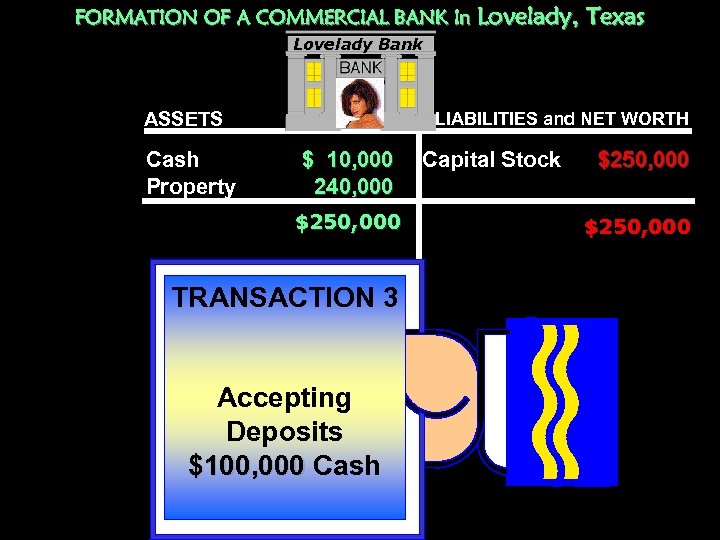
FORMATION OF A COMMERCIAL BANK In Lovelady, Texas Lovelady Bank ASSETS Cash Property LIABILITIES and NET WORTH $ 10, 000 240, 000 $250, 000 TRANSACTION 3 Accepting Deposits $100, 000 Cash Capital Stock $250, 000
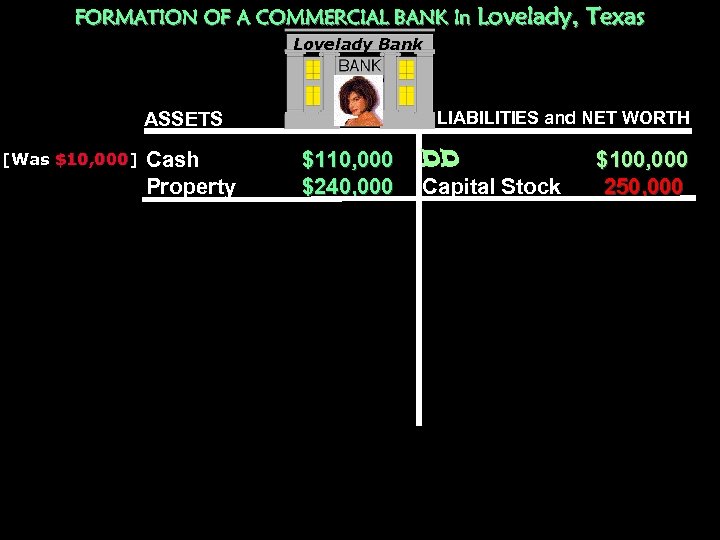
FORMATION OF A COMMERCIAL BANK In Lovelady, Texas Lovelady Bank LIABILITIES and NET WORTH ASSETS [Was $10, 000] Cash Property $110, 000 $240, 000 DD Capital Stock $100, 000 250, 000
![FORMATION OF A COMMERCIAL BANK In Lovelady, Texas Lovelady Bank ASSETS [Was $10, 000]](https://present5.com/presentation/9196c81bbcc7211fbda70fd78637fe71/image-22.jpg "FORMATION OF A COMMERCIAL BANK In Lovelady, Texas Lovelady Bank ASSETS [Was $10, 000]")
FORMATION OF A COMMERCIAL BANK In Lovelady, Texas Lovelady Bank ASSETS [Was $10, 000] Cash Property LIABILITIES and NET WORTH $110, 000 240, 000 $350, 000 DD Capital Stock $100, 000 250, 000 $350, 000
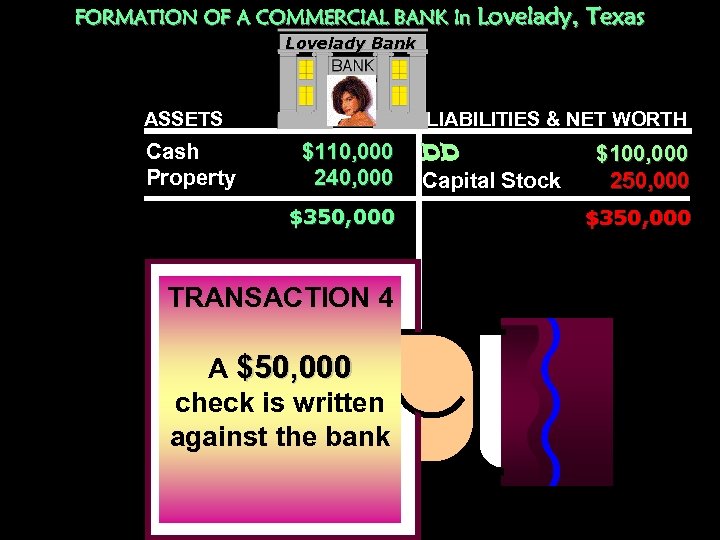
FORMATION OF A COMMERCIAL BANK In Lovelady, Texas Lovelady Bank ASSETS Cash Property LIABILITIES & NET WORTH $110, 000 240, 000 $350, 000 TRANSACTION 4 A $50, 000 check is written against the bank DD Capital Stock $100, 000 250, 000 $350, 000
![FORMATION OF A COMMERCIAL BANK In Lovelady, Texas Lovelady Bank ASSETS [was $110, 000]](https://present5.com/presentation/9196c81bbcc7211fbda70fd78637fe71/image-24.jpg "FORMATION OF A COMMERCIAL BANK In Lovelady, Texas Lovelady Bank ASSETS [was $110, 000]")
FORMATION OF A COMMERCIAL BANK In Lovelady, Texas Lovelady Bank ASSETS [was $110, 000] Cash Property LIABILITIES & NET WORTH $ 60, 000 240, 000 $300, 000 DD Capital Stock $ 50, 000 250, 000 $300, 000
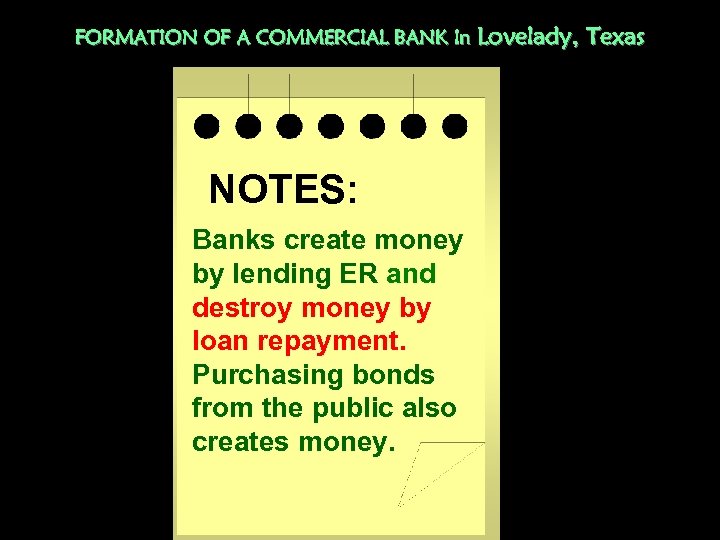
FORMATION OF A COMMERCIAL BANK In Lovelady, NOTES: Banks create money by lending ER and destroy money by loan repayment. Purchasing bonds from the public also creates money. Texas
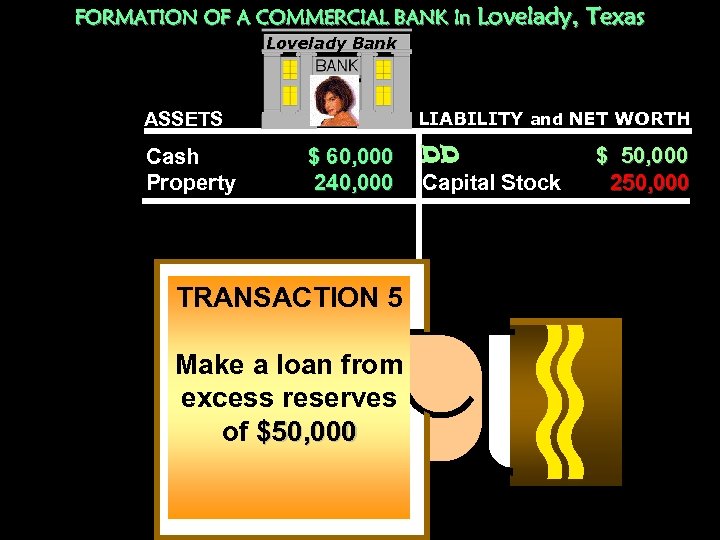
FORMATION OF A COMMERCIAL BANK In Lovelady, Texas Lovelady Bank LIABILITY and NET WORTH ASSETS Cash Property $ 60, 000 240, 000 TRANSACTION 5 Make a loan from excess reserves of $50, 000 DD Capital Stock $ 50, 000 250, 000
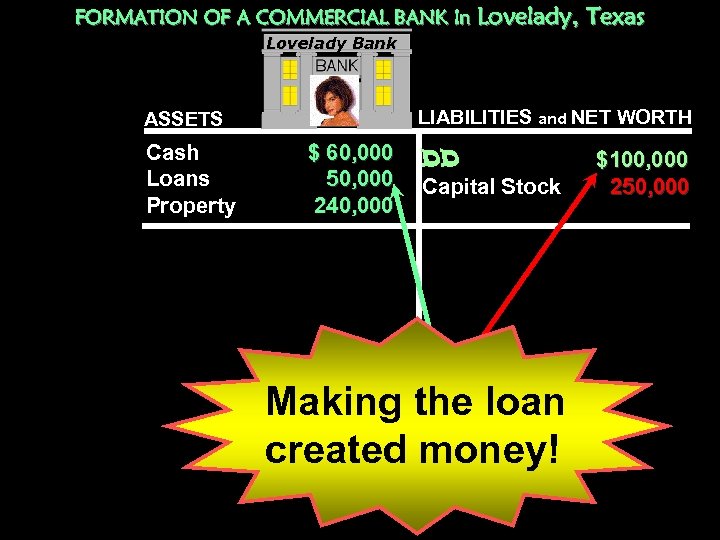
FORMATION OF A COMMERCIAL BANK In Lovelady, Texas Lovelady Bank LIABILITIES and NET WORTH ASSETS Cash Loans Property $ 60, 000 50, 000 240, 000 DD Capital Stock Making the loan created money! $100, 000 250, 000
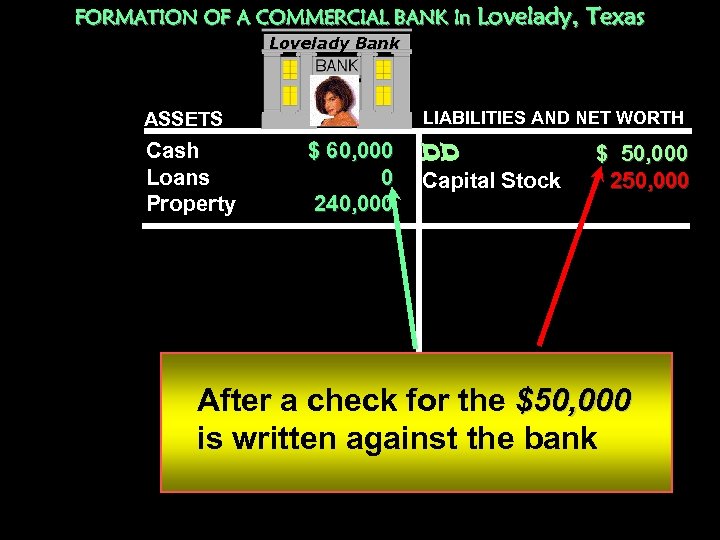
FORMATION OF A COMMERCIAL BANK In Lovelady, Texas Lovelady Bank LIABILITIES AND NET WORTH ASSETS Cash Loans Property $ 60, 000 0 240, 000 DD Capital Stock $ 50, 000 250, 000 After a check for the $50, 000 is written against the bank
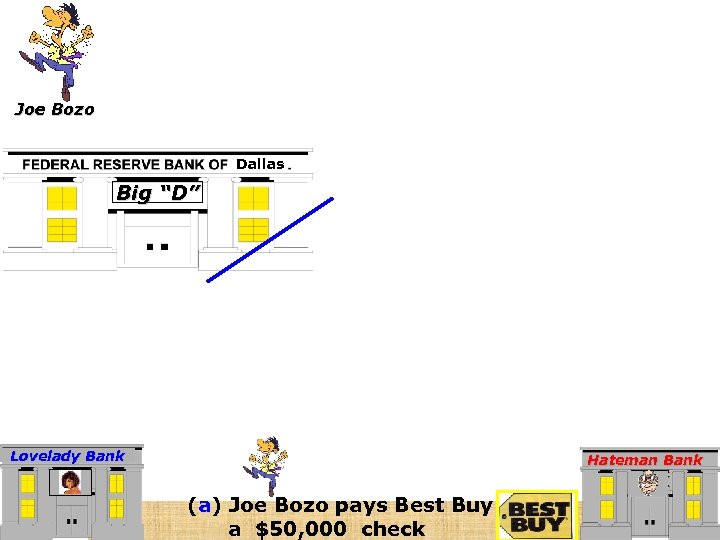
Joe Bozo Dallas Big “D” Lovelady Bank Hateman Bank (a) Joe Bozo pays Best Buy a $50, 000 check
And What Happens If A Turtle Doesn’t Keep Up with His Mortgage Payments
This turtle is subject to Here, he has lost his foreclosure on his house.
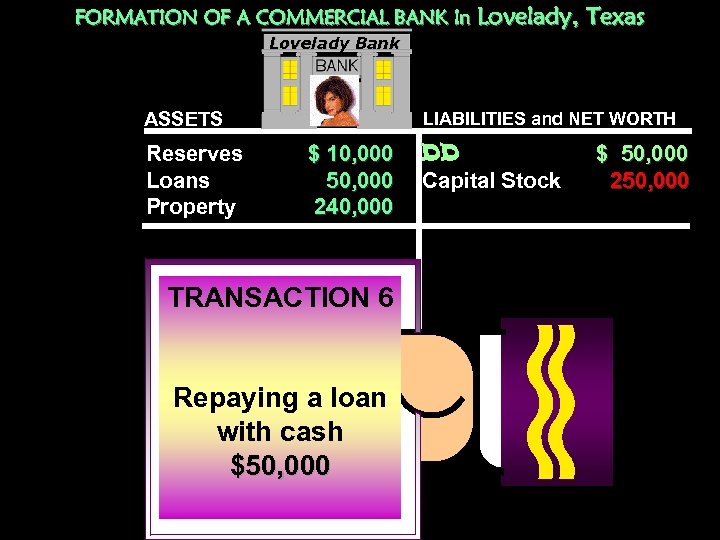
FORMATION OF A COMMERCIAL BANK In Lovelady, Texas Lovelady Bank ASSETS Reserves Loans Property LIABILITIES and NET WORTH $ 10, 000 50, 000 240, 000 TRANSACTION 6 Repaying a loan with cash $50, 000 DD Capital Stock $ 50, 000 250, 000
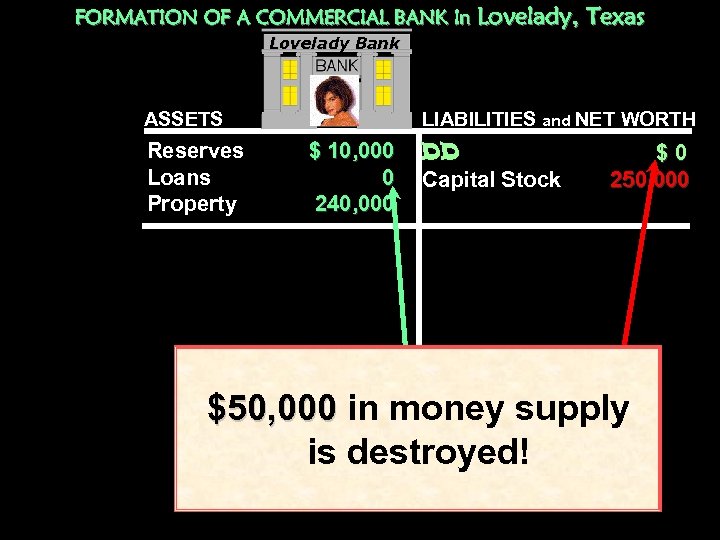
FORMATION OF A COMMERCIAL BANK In Lovelady, Texas Lovelady Bank ASSETS Reserves Loans Property LIABILITIES and NET WORTH $ 10, 000 0 240, 000 DD Capital Stock $0 250, 000 $50, 000 in money supply is destroyed!
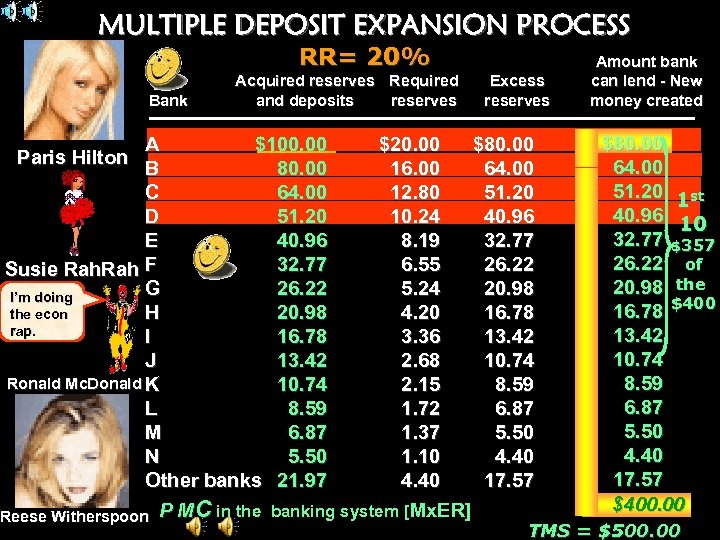
MULTIPLE DEPOSIT EXPANSION PROCESS RR= 20% Bank Acquired reserves Required and deposits reserves Excess reserves A $100. 00 $20. 00 $80. 00 B 80. 00 16. 00 64. 00 C 64. 00 12. 80 51. 20 D 51. 20 10. 24 40. 96 E 40. 96 8. 19 32. 77 6. 55 26. 22 Susie Rah F G 26. 22 5. 24 20. 98 I’m doing H 20. 98 4. 20 16. 78 the econ rap. I 16. 78 3. 36 13. 42 J 13. 42 2. 68 10. 74 Ronald Mc. Donald K 10. 74 2. 15 8. 59 L 8. 59 1. 72 6. 87 M 6. 87 1. 37 5. 50 N 5. 50 1. 10 4. 40 Other banks 21. 97 4. 40 17. 57 Reese Witherspoon P MC in the banking system [Mx. ER] Paris Hilton Amount bank can lend - New money created $80. 00 64. 00 51. 20 1 st 40. 96 10 32. 77 $357 26. 22 of 20. 98 the 16. 78 $400 13. 42 10. 74 8. 59 6. 87 5. 50 4. 40 17. 57 $400. 00 TMS = $500. 00
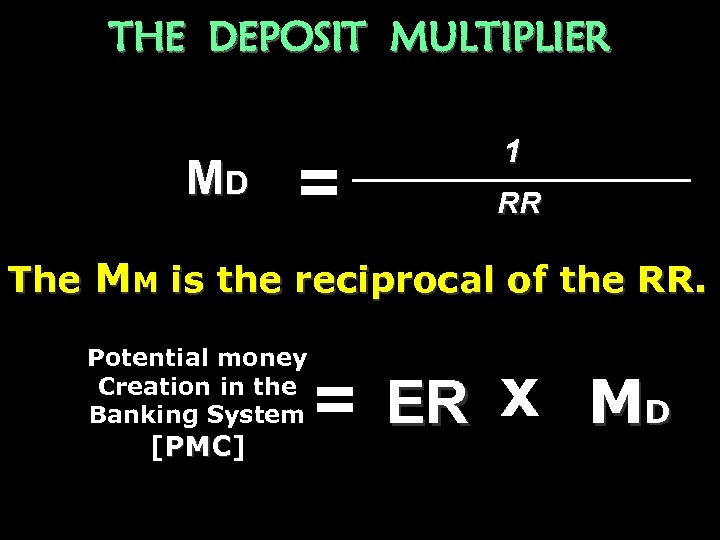
THE DEPOSIT MULTIPLIER MD = 1 RR The MM is the reciprocal of the RR. Maximum Potential money checkable. Creation in the Banking System deposit [PMC] PMC expansion = ER x MD
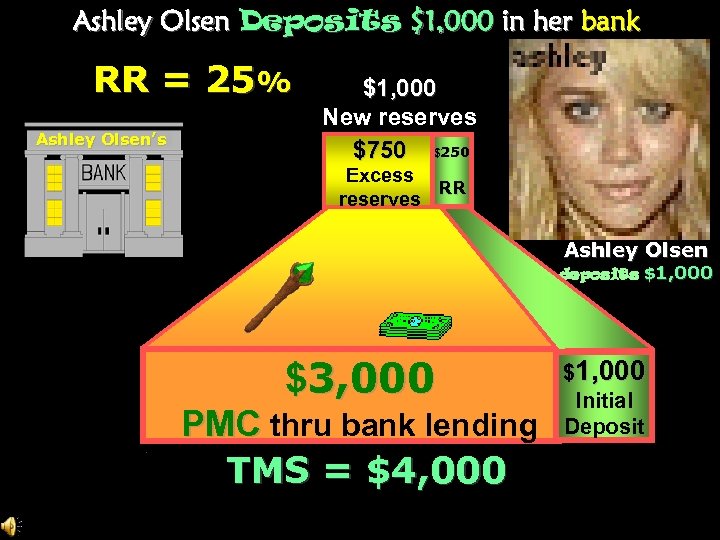
Ashley Olsen Deposits $1, 000 in her bank RR = 25% Ashley Olsen’s $1, 000 New reserves $750 $250 Excess RR reserves Ashley Olsen deposits $1, 000 $3, 000 PMC thru bank lending TMS = $4, 000 $1, 000 Initial Deposit
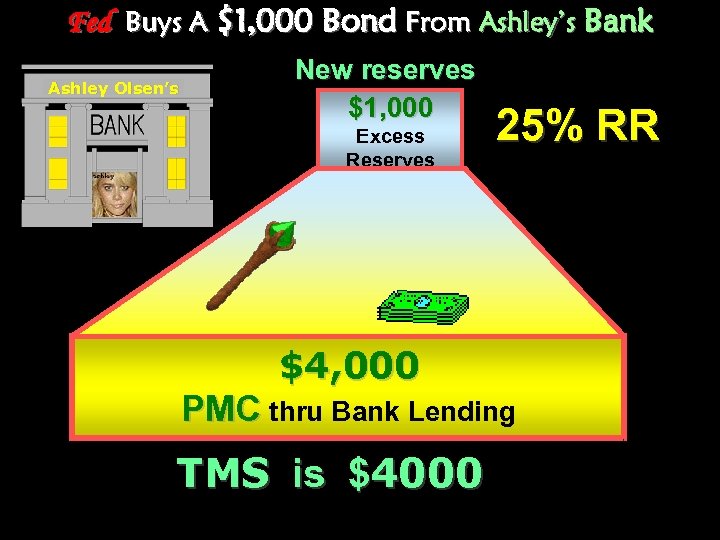
Fed Buys A $1, 000 Bond From Ashley’s Bank Ashley Olsen’s New reserves $1, 000 Excess Reserves 25% RR $4, 000 PMC thru Bank Lending TMS is $4000
![NS 31 -35 AP Econ [MS = Currrency+DD of Public] RR+ER=TR; TR-RR=ER; TR-ER=RR; MXER=PMC;](https://present5.com/presentation/9196c81bbcc7211fbda70fd78637fe71/image-38.jpg "NS 31 -35 AP Econ [MS = Currrency+DD of Public] RR+ER=TR; TR-RR=ER; TR-ER=RR; MXER=PMC;")
NS 31 -35 AP Econ [MS = Currrency+DD of Public] RR+ER=TR; TR-RR=ER; TR-ER=RR; MXER=PMC; PMC(Public)+DD=TMS; PMC(Fed)=TMS Excess Reserves prior to new currency deposit (DD) = $0 Britney Spears deposits in the banking system = $40 billion Legal Reserve Requirement [RR] = 20% 31. The $40 billion deposit of Currency into DD will result in MS staying at ($8/$40/$160) billion. 32. The $40 billion deposit of currency into checking accounts will create ER of ($20/$32/$40) billion. 33. The Potential Money Creation of the banking system through loans is ($40/$160/$$200) bil. The Potential TMS [all DD of the public] could be as much as ($40/$160/$200) 34. The RR applies to checkable deposits at (banks/S&Ls/ credit unions/ all depository institutions). 35. If the Duck National Bank has ER of $6, 000 & DD of $100, 000 what is the size of the bank’s TR if the RR is 25%? 25% 25, 000 6, 000 31, 000 ($25, 000/$75, 000/$31, 000) [RR($____)+ER($___)+TR($____)
![NS 36 -45 [MS = Currrency+DD of Public] RR+ER=TR; TR-RR=ER; TR-ER=RR; MXER=PMC; PMC(Public)+DD=TMS; PMC(Fed)=TMS](https://present5.com/presentation/9196c81bbcc7211fbda70fd78637fe71/image-39.jpg "NS 36 -45 [MS = Currrency+DD of Public] RR+ER=TR; TR-RR=ER; TR-ER=RR; MXER=PMC; PMC(Public)+DD=TMS; PMC(Fed)=TMS")
NS 36 -45 [MS = Currrency+DD of Public] RR+ER=TR; TR-RR=ER; TR-ER=RR; MXER=PMC; PMC(Public)+DD=TMS; PMC(Fed)=TMS 36. A stranger deposits $1, 000 in a bank that has a RR of 10%. The maximum possible change in the dollar value of the local bank’s loans would 900 9, 000 be $______. PMC[M X ER] in the banking system is $_____. Potential TMS PMC ER 10, 000 could become as high as $_______. 37. Suppose a commercial bank has DD of $100, 000 and the RR is 10% If the bank’s RR & ER are equal, then its TR are ($10, 000/$20, 000/$30, 000). equal 38. Total Reserves (minus/plus) RR = ER. ER 39. Suppose the Thunderduck Bank has DD of $500, 000 & the RR is 10% If the institution has ER of $4, 000 then its TR are ($46, 000/$54, 000/$4, 000). 40. If ER in a bank are $4, 000, DD are $40, 000, & the RR is 10%, then $4, 000 $40, 000 10% TR are ($4, 000/$8, 000). 41. The main purpose of the RR is to (have funds for emergency withdrawals/ influence the lending ability of commercial banks). 42. If I write you a check for $1 & we both have our checking accts at the Poorman Bank, the bank’s balance sheet will (increase/decrease/be unchanged). 43. Banks (create/destroy) money when they make loans and repaying bank loans (create/destroy) money. 44. When a bank loan is repaid the MS is (increased/decreased). 45. The Fed Funds rate is a loan by one bank (to another bank/from the Fed).
![NS 46 -47 [MS = Currrency+DD of Public] RR+ER=TR; TR-RR=ER; TR-ER=RR; MXER=PMC; PMC(Public)+DD=TMS; PMC(Fed)=TMS](https://present5.com/presentation/9196c81bbcc7211fbda70fd78637fe71/image-40.jpg "NS 46 -47 [MS = Currrency+DD of Public] RR+ER=TR; TR-RR=ER; TR-ER=RR; MXER=PMC; PMC(Public)+DD=TMS; PMC(Fed)=TMS")
NS 46 -47 [MS = Currrency+DD of Public] RR+ER=TR; TR-RR=ER; TR-ER=RR; MXER=PMC; PMC(Public)+DD=TMS; PMC(Fed)=TMS 46. If the RR was lowered [say, from 50% to 10%], the size of the monetary multiplier [MM] would (increase/decrease). Leakages(limitations) of the Money Creating Process 1. Cash leakages [taking part of loan in cash] 2. ER (banks don’t loan it or we don’t borrow] 47. If borrowers take a portion of their loans as cash, the maximum amount by cash which the banking system increases the MS by lending will (increase/decrease).
![Money Supply = DD + Currency of the Public ER “PMC” Loans $100[10% RR]](https://present5.com/presentation/9196c81bbcc7211fbda70fd78637fe71/image-41.jpg "Money Supply = DD + Currency of the Public ER “PMC” Loans $100[10% RR]")
Money Supply = DD + Currency of the Public ER “PMC” Loans $100[10% RR] [1 st Bank] Banks/Public DD [$100] $90 Fed /Public/Banks DD[$100] $90 “PMC” C rea. In “TMS” “Potential” System Total MS $900 $1, 000 [*Fed buys bonds from public who put the money in their DD] Banks/Fed Loan[$100] $100 [or sells bonds to Fed] ER $100 $1, 000 “PMC” Loans “PMC” Crea. In $100 [20% RR] [1 st Bank] System Banks/Public DD [$100] $80 $400 Fed/Public/Banks DD [$100] $80 $400 $1, 000 “TMS” “Potential” Total MS $500 [*Fed buys bonds from public who put the money in their DD] Banks/Fed Loan[$100] $100 [or sells bonds to Fed] $100 $500
![Mischa Barton Deposits $1, 000 In Her Bank [RR is 20%] New reserves $800](https://present5.com/presentation/9196c81bbcc7211fbda70fd78637fe71/image-42.jpg "Mischa Barton Deposits $1, 000 In Her Bank [RR is 20%] New reserves $800")
Mischa Barton Deposits $1, 000 In Her Bank [RR is 20%] New reserves $800 $200 Excess Reserves Mischa Barton’s RR Mischa from the O. C. [member of the public] $4000 PMC thru Bank Lending TMS is $5, 000 $1000 Initial Deposit
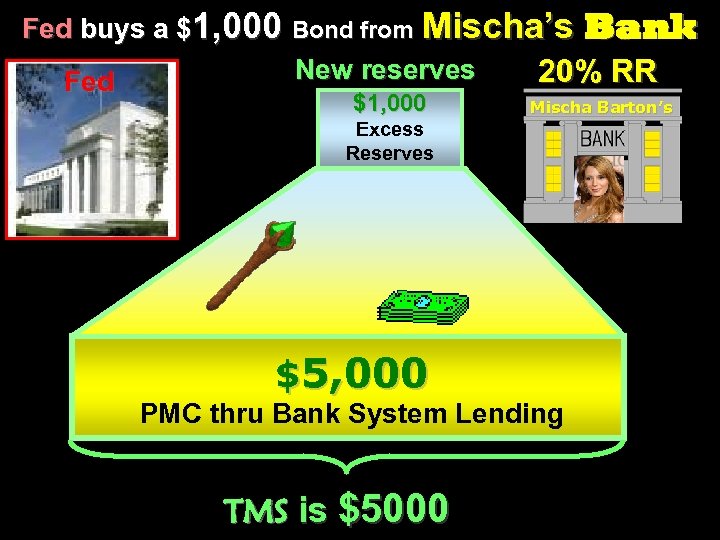
Fed buys a $1, 000 Bond from Mischa’s Bank New reserves 20% RR Fed $1, 000 Mischa Barton’s Excess Reserves $5, 000 PMC thru Bank System Lending TMS is $5000
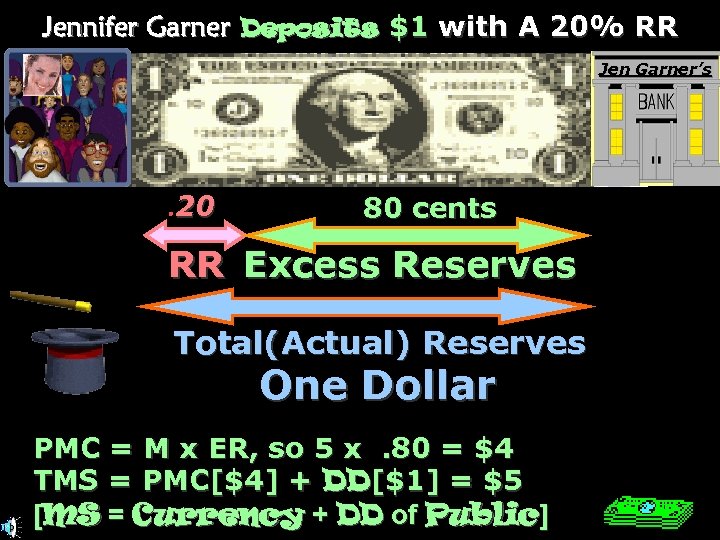
Jennifer Garner Deposits $1 with A 20% RR Jen Garner’s . 20 80 cents RR Excess Reserves Total(Actual) Reserves One Dollar PMC = M x ER, so 5 x. 80 = $4 TMS = PMC[$4] + DD[$1] = $5 [MS = Currency + DD of Public]
![Jennifer’s Bank Borrows $1 From The Fed [20% RR] Fed Jen Garner’s 0 One](https://present5.com/presentation/9196c81bbcc7211fbda70fd78637fe71/image-45.jpg "Jennifer’s Bank Borrows $1 From The Fed [20% RR] Fed Jen Garner’s 0 One")
Jennifer’s Bank Borrows $1 From The Fed [20% RR] Fed Jen Garner’s 0 One Dollar RR Excess Reserves Total(Actual) Reserves One Dollar PMC = M x ER, so 5 x $1 = $5 TMS [$5] = PMC [$5] [MS = currency + DD of Public]

![$1, 000 DD by Katy New Deposits [New Reserves] DD Bank [MS=Currency+DD of Public]](https://present5.com/presentation/9196c81bbcc7211fbda70fd78637fe71/image-47.jpg "$1, 000 DD by Katy New Deposits [New Reserves] DD Bank [MS=Currency+DD of Public]")
$1, 000 DD by Katy New Deposits [New Reserves] DD Bank [MS=Currency+DD of Public] DD Created By New Required Reserves New Loans [equal to new ER] RR=50% A $5, 000. 00 $2, 500. 00 B 2, 500. 00 $1, 250. 00 C 1, 250. 00 $625. 00 D 625. 00 $312. 50 PMC = ER[$2, 500 x M[2] PMC = $5, 000. 00 Katy’s DD + PMC $5, 000. 00 + $5, 000. 00 = = Duck that can dance Dance Lessons w. Laura Bush Hunting with Dick Cheney Prom Dance lessons with N. Dynamite TMS $10, 000. 00 MS grows by multiple of 2
![Money Creation Formulas [MS = Currency + DD of public] Public: Student deposits $1.](https://present5.com/presentation/9196c81bbcc7211fbda70fd78637fe71/image-48.jpg "Money Creation Formulas [MS = Currency + DD of public] Public: Student deposits $1.")
Money Creation Formulas [MS = Currency + DD of public] Public: Student deposits $1. 00 in a bank 1. RR+ER=TR; TR–RR=ER; TR–ER=RR 2. ER x MM = PMC 3. PMC + 1 st DD =TMS Fed No Public: [Fed gives $1. 00 loan to a bank] 1. RR+ER=TR; TR-RR=ER; TR-ER=RR 2. ER x MM = PMC & TMS
![Banks and the Fed [RR+ER=TR; TR-RR=ER; TR-ER=RR; Mx. ER=PMC; PMC(Public)+1 st DD=TMS; PMC(Fed)=TMS] MS](https://present5.com/presentation/9196c81bbcc7211fbda70fd78637fe71/image-49.jpg "Banks and the Fed [RR+ER=TR; TR-RR=ER; TR-ER=RR; Mx. ER=PMC; PMC(Public)+1 st DD=TMS; PMC(Fed)=TMS] MS")
Banks and the Fed [RR+ER=TR; TR-RR=ER; TR-ER=RR; Mx. ER=PMC; PMC(Public)+1 st DD=TMS; PMC(Fed)=TMS] MS = Currency + DD of Public [Money borrowed from the Fed [or gained thru bond sales] is ER & can be loaned out] 9. RR is 25%; Econ Bank borrows $25, 000 from the Fed; its ER are increased by 100, 000 25, 000 $______. Potential Money Creation in the system is $_______. Potential TMS is $_______. 10. RR is 50%; a bank borrows $20, 000 from the Fed; this one bank’s ER are increased 40, 000 by $_____. Potential Money Creation in the system is $______. Potential TMS is $______ 20, 000 11. RR is 20%; the Duck Bank sells $10 M of bonds to the Fed; Duck Bank’s ER are increased by $______mil. PMC in the system is $______. TMS is $_____. 50 million 10 50 million 12. RR is 20%; Fed buys $50, 000 of securities from Keynes Bank. Its ER are increased by $______. Potential Money Creation in the banking system is 50, 000 $_______. Potential TMS is $_______. 250, 000 13. 25% RR; Fed buys $400 million of bonds from the Friar Bank. This one 400 bank’s ER are increased by $_______million. 14. RR is 50%; the Fed sells $200 million of bonds to a bank; its ER are 200 M (increased/decreased) by $_______. Potential Money Creation in the 400 M banking system is (increased/decreased) by $____. 15. RR is 10%; a bank borrows $10 million from the Fed; this one bank’s 10 ER are increased by $_______ million. PMC in the banking system is 100 $_______million. Potential TMS is $_______million. 100
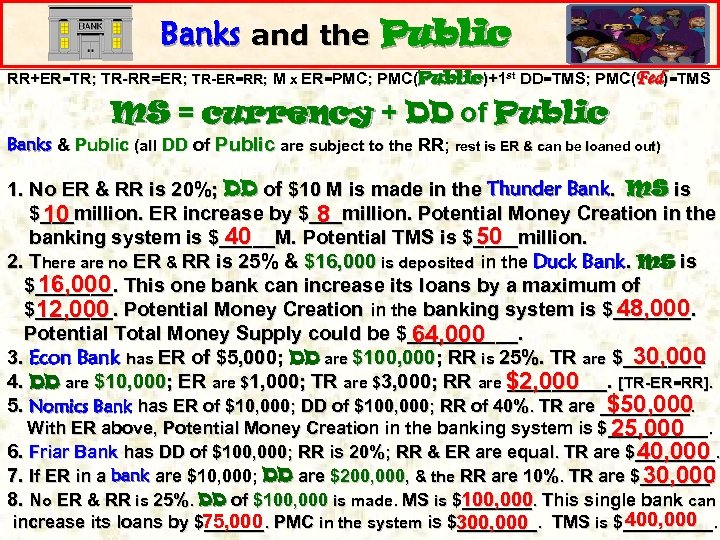
Banks and the Public RR+ER=TR; TR-RR=ER; TR-ER=RR; M x ER=PMC; PMC(Public)+1 st DD=TMS; PMC(Fed)=TMS MS = currency + DD of Public Banks & Public (all DD of Public are subject to the RR; rest is ER & can be loaned out) 1. No ER & RR is 20%; DD of $10 M is made in the Thunder Bank. MS is $___million. ER increase by $___million. Potential Money Creation in the 10 8 banking system is $_____M. Potential TMS is $____million. 40 50 2. There are no ER & RR is 25% & $16, 000 is deposited in the Duck Bank. MS is $_______. This one bank can increase its loans by a maximum of 16, 000 48, 000 $_______. Potential Money Creation in the banking system is $_______. 12, 000 Potential Total Money Supply could be $_____. 64, 000 3. Econ Bank has ER of $5, 000; DD are $100, 000; RR is 25%. TR are $_______. 30, 000 4. DD are $10, 000; ER are $1, 000; TR are $3, 000; RR are $2, 000 _____. [TR-ER=RR]. $50, 000 5. Nomics Bank has ER of $10, 000; DD of $100, 000; RR of 40%. TR are _____. With ER above, Potential Money Creation in the banking system is $_____. 25, 000 6. Friar Bank has DD of $100, 000; RR is 20%; RR & ER are equal. TR are $____. 40, 000 7. If ER in a bank are $10, 000; DD are $200, 000, & the RR are 10%. TR are $_______. 30, 000 100, 000 8. No ER & RR is 25%. DD of $100, 000 is made. MS is $_______. This single bank can 400, 000 75, 000 increase its loans by $______. PMC in the system is $____. TMS is $_____. 300, 000
![Fed and the Public [RR+ER=TR; TR-RR=ER; TR-ER=RR; Mx. ER=PMC; PMC(Public)+1 st DD=TMS; PMC(Fed)=TMS] MS](https://present5.com/presentation/9196c81bbcc7211fbda70fd78637fe71/image-51.jpg "Fed and the Public [RR+ER=TR; TR-RR=ER; TR-ER=RR; Mx. ER=PMC; PMC(Public)+1 st DD=TMS; PMC(Fed)=TMS] MS")
Fed and the Public [RR+ER=TR; TR-RR=ER; TR-ER=RR; Mx. ER=PMC; PMC(Public)+1 st DD=TMS; PMC(Fed)=TMS] MS = Currency + DD of the Public [When Fed buys securities from Public, they will put the money in their DD] Public DD 16. RR is 50%; Fed buys $10 M of bonds from the Public. MS is increased by$10 M _______. $20 M ER are increased by $5 M PMC in the system is $10 M _______. Potential TMS is _______. 17. RR is 25%; Fed buys $100 M of bonds from the Public. The MS is increased $100 M _______. ER are increased by ______. PMC in the system is $300 M Potential TMS is $400 M _______. $75 M 18. RR is 50%; Fed sells $200 M of bonds to the Public. The MS is (incr/decr) by Public $100 M _____. ER are (incr/decr) by _____. PMC in the banking system is $200 M (increased/decreased) by $200 M Potential TMS is (incr/decr) by $400 M _______. 19. RR is 20%; Fed buys $5 million of securities from the Public. The MS $5 M is increased by _______. ER are increased by _______. Potential Money $4 M $25 M Creation in the banking system is$20 M Potential TMS is _______. 20. RR is 10%; Fed buys $50 million of bonds from the Public. The MS is $50 M $45 M increased by _______. ER are increased by _______. PMC in the banking $500 M $450 M system is _____. Potential Total Money Supply is _____.
![Practice Money Quiz [MS=Curr. + DD of Public] [RR+ER=TR; TR-RR=ER; TR-ER=RR; Mx. ER=PMC; PMC(Public)+1](https://present5.com/presentation/9196c81bbcc7211fbda70fd78637fe71/image-52.jpg "Practice Money Quiz [MS=Curr. + DD of Public] [RR+ER=TR; TR-RR=ER; TR-ER=RR; Mx. ER=PMC; PMC(Public)+1")
Practice Money Quiz [MS=Curr. + DD of Public] [RR+ER=TR; TR-RR=ER; TR-ER=RR; Mx. ER=PMC; PMC(Public)+1 st. DD=TMS; PMC(Fed)=TMS] Commercial Banks Fed Public 1. The Flores Bank [with no ER] borrows $100, 000 from the Fed. With a RR of 50% $100, 000 the Flores Bank can increase its loans by a maximum of _____. PMC in $200, 000 the banking system is _____. Potential TMS is _______. $200, 000 $2, 000 2. The Clear Bank has DD of $10, 000; RR is 10%; RR & ER are equal. TR are _______. 3. RR is 20%; Fed buys $50, 000 of securities from the public [C. Hovitz] $200, 000 PMC in the banking system is _____. Potential TMS is ______. $250, 000 4. RR is 40%; Farrell Bank borrows $1 million from the Fed. This bank can increase $2. 5 mil. $2. 5 M its loans by a maximum of $1 million PMC is _____. TMS is _______ __. 5. RR is 10% & there are no ER; $10, 000 is deposited in the Merkel Bank. $9, 000 This bank can increase its loans by a maximum of _____. Possible Money $100, 000 Creation in the banking system is ______. Potential TMs is _______. $90, 000 6. There are no ER in the Roberts Bank. Nicole now deposits $10. 00. With $40. 00 $50. 00 a RR of 20%, PMC in the system is _____. Potential TMS is ______. 7. The Daniel Bank has a RR of 50%; the Fed buys $50 million of bonds from this bank. PMC in the system is _____. Potential TMS is _____. $100 M $70, 000 8. Rau Bank has ER of $50, 000; DD of $100, 000, & a RR of 20%. TR are ____. 9. RR is 40%; the Schipper Bank borrows $10 million from the Fed. This bank’s ER $25 M are increased by _____. PMC is _____. Potential TMS is ______. $10 M 10. RR is 10%; Edwards Bank borrows $5 from the Fed; the Edwards Bank’s ER $5. 00 are increased by _______. PMC is _____. Potential TMS is _____. $50. 00
![Money Quiz 1 [MS = Currency + DD of Public] [RR+ER=TR; TR-RR=ER; TR=ER=RR; Mx.](https://present5.com/presentation/9196c81bbcc7211fbda70fd78637fe71/image-53.jpg "Money Quiz 1 [MS = Currency + DD of Public] [RR+ER=TR; TR-RR=ER; TR=ER=RR; Mx.")
Money Quiz 1 [MS = Currency + DD of Public] [RR+ER=TR; TR-RR=ER; TR=ER=RR; Mx. ER=PMC; PMC(Public)+1 st DD=PMC; PMC(Fed)=PMC] Banks Fed $100, 000 Public 1. RR is 25% & the Suchta Bank has no ER. Suzy deposits(DD) $100, 000 there. This bank can increase its loans by a maximum of $75, 000 PMC is $300, 000 TMS is $400, 000 _______. 2. RR is 50%; the Brockman Bank borrows $100, 000 from the Fed. This one bank can $100, 000 increase its loans by a maximum of ____. PMC is$200, 000 TMS is $200, 000 _______ 3. RR is 25%; Fed buys $100, 000 of securities from the public [W. Patterson]. Potential Money Creation in the system is $300, 000 Potential TMS is _____. $400, 000 4. The Richa Bank has DD of $200, 000; RR is 10%; RR & ER are equal. TR are _______. $40, 000 5. The Mosmeyer Bank, with no ER, borrows $200, 000 from the Fed. With a RR of 10%, $2 million this bank can increase its loans by _____. PMC in the system is _____. $200, 000 6. RR are 20%; the Norwood Bank borrows $1 from the Fed; this bank can increase its loans by a maximum of _____. PMC in the banking system is _____. $1. 00 $5. 00 7. RR is 50%; the Fitzharis Bank borrows $1 million from the Fed; this bank’s ER are increased by $1 mil. PMC in the system is $2 million TMS is $2 million __________. 8. The Meehan Bank has ER of $20, 000; DD of $200, 000, & a RR of 10%. TR are ______. $40, 000 9. RR is 25%; Fed buys $100 million of bonds from the Mendenhal Bank. Potential $400 million $400 mil. Money creation in the banking system is ____. Potential TMS is ______. 10. There are no ER in the Sweeney Bank. Nick deposits $2. 50. With RR of 20%, $12. 50 PMC in the banking system is ______. Potential TMS is _______. $10. 00
![Money Quiz 2 [MS = Curr. + DD of Public] [RR+ER=TR; TR-RR=ER; TR-ER=RR; Mx.](https://present5.com/presentation/9196c81bbcc7211fbda70fd78637fe71/image-54.jpg "Money Quiz 2 [MS = Curr. + DD of Public] [RR+ER=TR; TR-RR=ER; TR-ER=RR; Mx.")
Money Quiz 2 [MS = Curr. + DD of Public] [RR+ER=TR; TR-RR=ER; TR-ER=RR; Mx. ER=PMC; PMC(Public)+1 st DD=TMS; PMC(Fed)=TMS] Commercial Banks Fed Public 1. RR is 5% & there are no ER in the Flores Bank. Lu deposits[DD] $1. 00. 95 there. This one bank can increase its loans by a maximum of _______. 2. RR is 25%; the Roberts Bank borrows $1 million from the Fed. $1 million This one bank can increase its loans by a maximum of ______. 3. RR is 50%; the Fed buys $100, 000 of securities from the public [R. Edwards]. $100, 000 Potential Money Creation in the banking system is ______. 4. The Brockman Bank has DD of $400, 000; RR is 10%; RR & ER are equal. $80, 000 TR are ______. 5. The Schipper Bank , with no ER, borrows $500, 000 from the Fed. With a RR $500, 000 of 10%, how much can this single bank increase its loans? ______ 6. RR are 20%; the Fed buys $25, 000 of securities from the public [E. Sweeney]. $100, 000 Potential Money Creation in the banking system is ______. 7. RR is 20%; the Hovitz-Sorry Bank borrows $1 million from the Fed. $1 million This single bank’s ER are increased by ______. 8. RR is 25%; Fed buys $200 million of securities from the public [Tony Rau]. $800 million Potential Total Money Supply[TMS] could be as much as ________. 9. The RR is 25% & the Fed buys $10 million of bonds from the Daniel Bank. $40 million Potential Money Creation in the banking system could be ______. 10. There are no excess reserves in the Flores Bank. With RR of 50%, Angela $50. 00 deposits [DD] $50. 00 there. Potential Money Creation in the system is _____.
![Additional Practice on Money Creation RR+ER=TR; TR-RR=ER; TR-ER=RR; Mx. ER=PMC; PMC[Public]+1 st DD=TMS; PMC[Fed]=](https://present5.com/presentation/9196c81bbcc7211fbda70fd78637fe71/image-55.jpg "Additional Practice on Money Creation RR+ER=TR; TR-RR=ER; TR-ER=RR; Mx. ER=PMC; PMC[Public]+1 st DD=TMS; PMC[Fed]=")
Additional Practice on Money Creation RR+ER=TR; TR-RR=ER; TR-ER=RR; Mx. ER=PMC; PMC[Public]+1 st DD=TMS; PMC[Fed]= TMS 1. If the RR is 40% and the Fed buys $100 M of bonds from $100 M the public [Kevin], then the MS is increased by _______. ER are $60 M $150 M $250 M increased by ______. PMC is _______. TMS would be ______. 2. RR is 50% and the Fitzharris Bank borrows $100 M from the 0 Fed. As a result, RR are increased by ______. ER is increased Fed $200 M $100 M by _______. PMC and TMS is increased by ____. 3. Mosmeyer bank has DD of $400, 000 and the RR is 25%. If RR $200, 000 and ER are equal, then TR are _______. 4. The Patterson Bank has ER of $60, 000 & DD is $200, 000 $100, 000 If the RR is 20%, TR are _____. 5. RR is 20% & the Fed buys $50 million of bonds from the $50 M public [Petra]. The MS is increased by _______. ER are increased $200 M $250 M $40 M by _______. PMC is _______. TMS would be _____. Banks Public Fed

The End
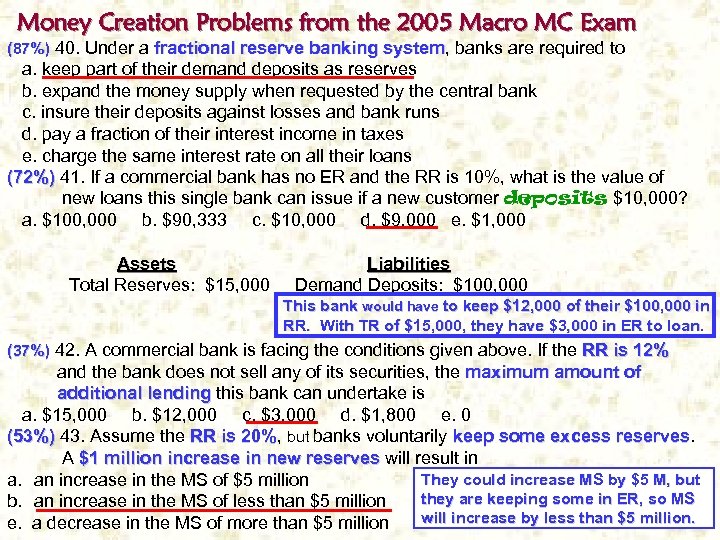
Money Creation Problems from the 2005 Macro MC Exam (87%) 40. Under a fractional reserve banking system, banks are required to system a. keep part of their demand deposits as reserves b. expand the money supply when requested by the central bank c. insure their deposits against losses and bank runs d. pay a fraction of their interest income in taxes e. charge the same interest rate on all their loans (72%) 41. If a commercial bank has no ER and the RR is 10%, what is the value of new loans this single bank can issue if a new customer deposits $10, 000? a. $100, 000 b. $90, 333 c. $10, 000 d. $9, 000 e. $1, 000 Assets Total Reserves: $15, 000 Liabilities Demand Deposits: $100, 000 This bank would have to keep $12, 000 of their $100, 000 in RR. With TR of $15, 000, they have $3, 000 in ER to loan. (37%) 42. A commercial bank is facing the conditions given above. If the RR is 12% and the bank does not sell any of its securities, the maximum amount of additional lending this bank can undertake is a. $15, 000 b. $12, 000 c. $3, 000 d. $1, 800 e. 0 (53%) 43. Assume the RR is 20%, but banks voluntarily keep some excess reserves. 20% reserves A $1 million increase in new reserves will result in Theydecrease in MS of by $5 M, but a. an increase in the MS of $5 million c. could increase MS $1 million they are keeping some in ER, somillion b. an increase in the MS of less than $5 million d. decrease in the MS of $5 MS will increase by less than $5 million. e. a decrease in the MS of more than $5 million
Скачать презентацию Give me a loan so there will be
9196c81bbcc7211fbda70fd78637fe71.ppt