


 Скачать презентацию GIS in Water Resources Review for Midterm Exam
b672fd8a4b2ff8c0678c871832a682af.ppt
- Количество слайдов: 78
 GIS in Water Resources Review for Midterm Exam
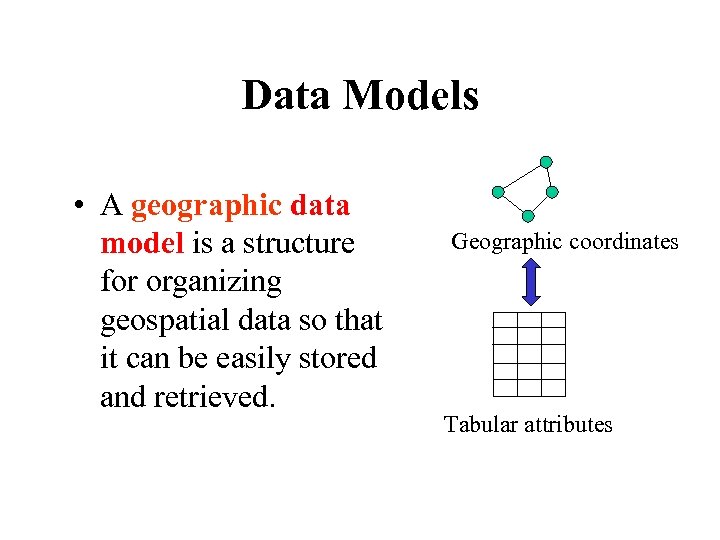 Data Models • A geographic data model is a structure for organizing geospatial data so that it can be easily stored and retrieved. Geographic coordinates Tabular attributes
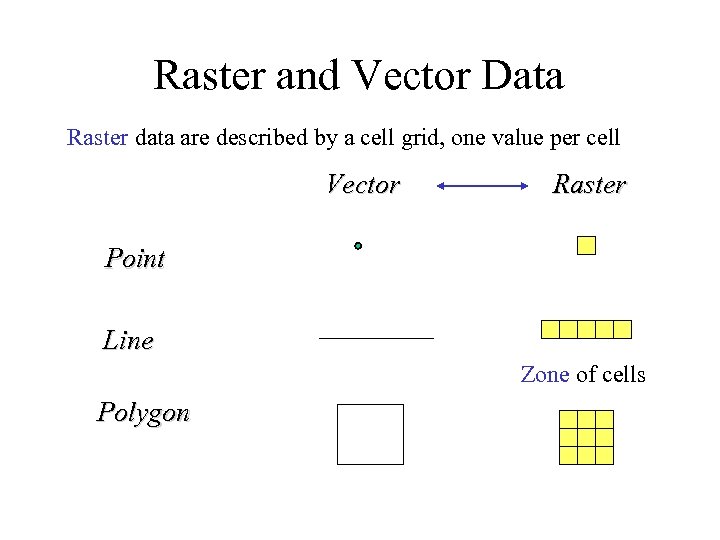 Raster and Vector Data Raster data are described by a cell grid, one value per cell Vector Raster Point Line Zone of cells Polygon
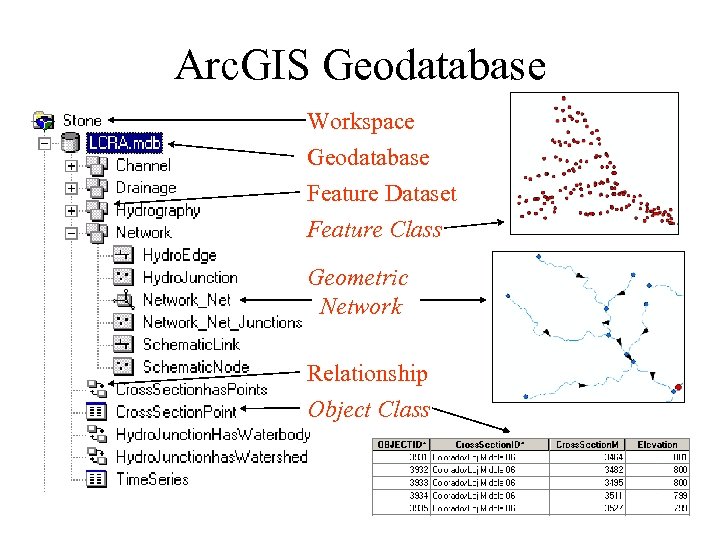 Arc. GIS Geodatabase Workspace Geodatabase Feature Dataset Feature Class Geometric Network Relationship Object Class
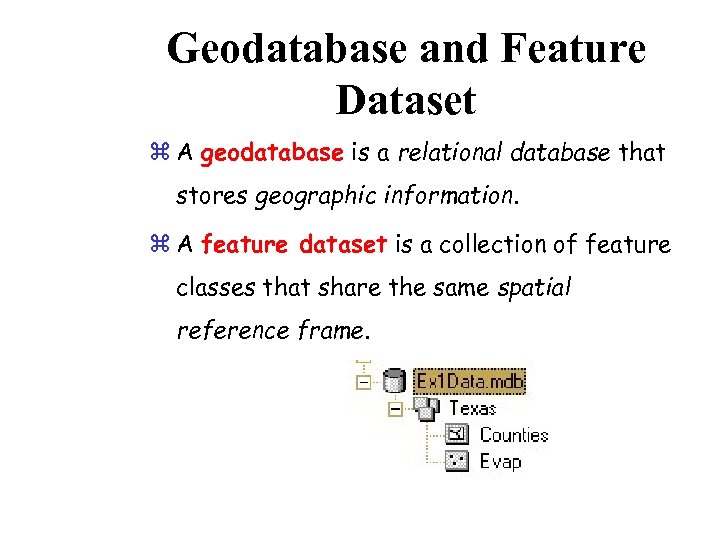 Geodatabase and Feature Dataset z A geodatabase is a relational database that stores geographic information. z A feature dataset is a collection of feature classes that share the same spatial reference frame.
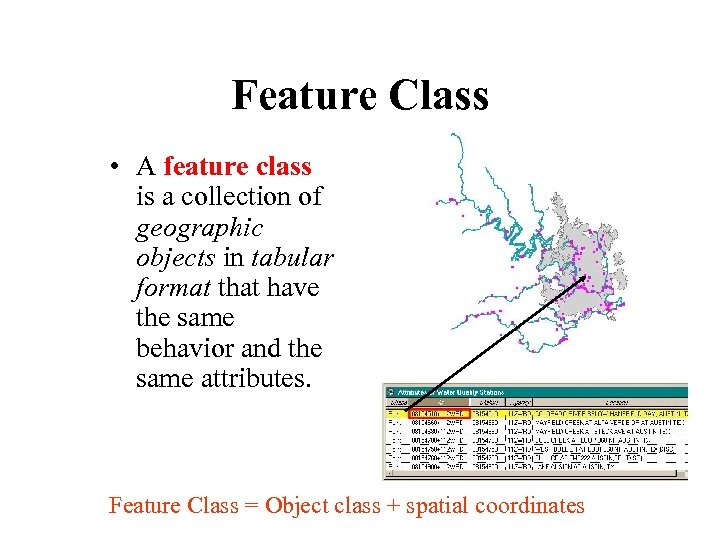 Feature Class • A feature class is a collection of geographic objects in tabular format that have the same behavior and the same attributes. Feature Class = Object class + spatial coordinates
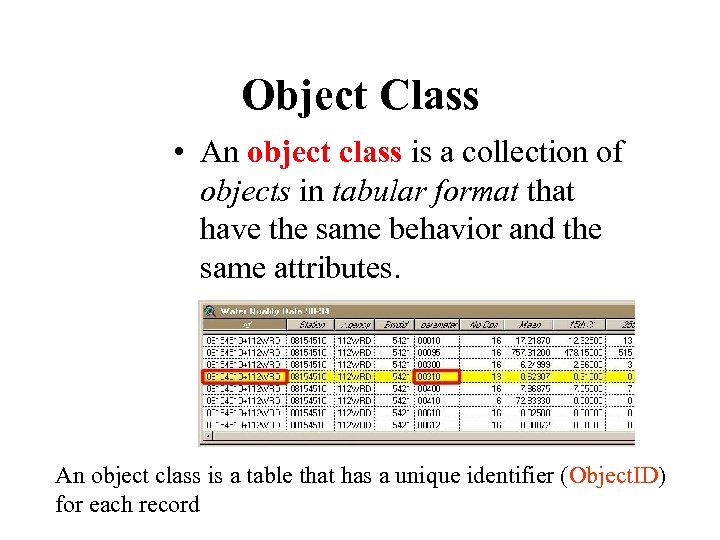 Object Class • An object class is a collection of objects in tabular format that have the same behavior and the same attributes. An object class is a table that has a unique identifier (Object. ID) for each record
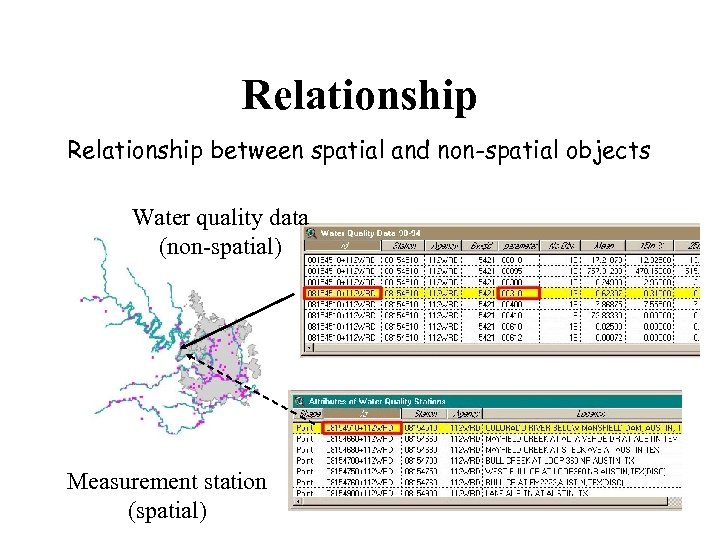 Relationship between spatial and non-spatial objects Water quality data (non-spatial) Measurement station (spatial)
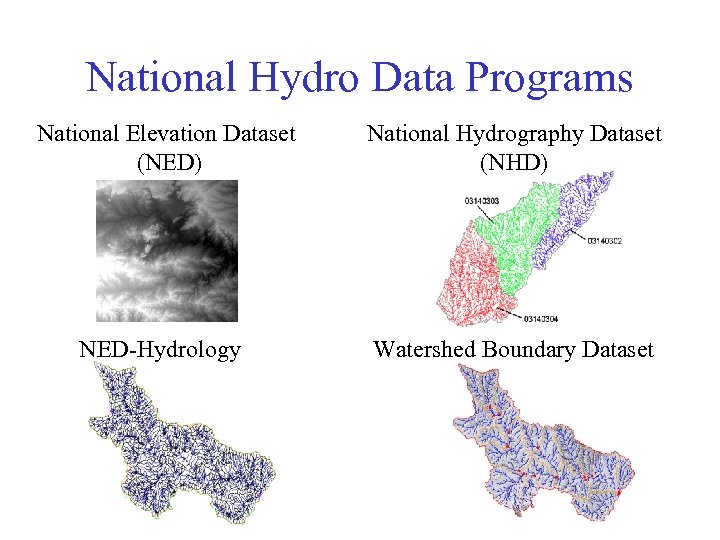 National Hydro Data Programs National Elevation Dataset (NED) National Hydrography Dataset (NHD) NED-Hydrology Watershed Boundary Dataset
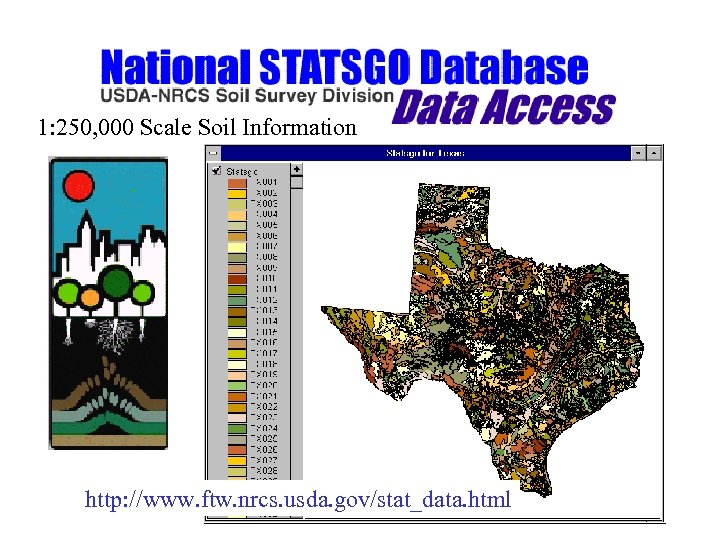 1: 250, 000 Scale Soil Information http: //www. ftw. nrcs. usda. gov/stat_data. html
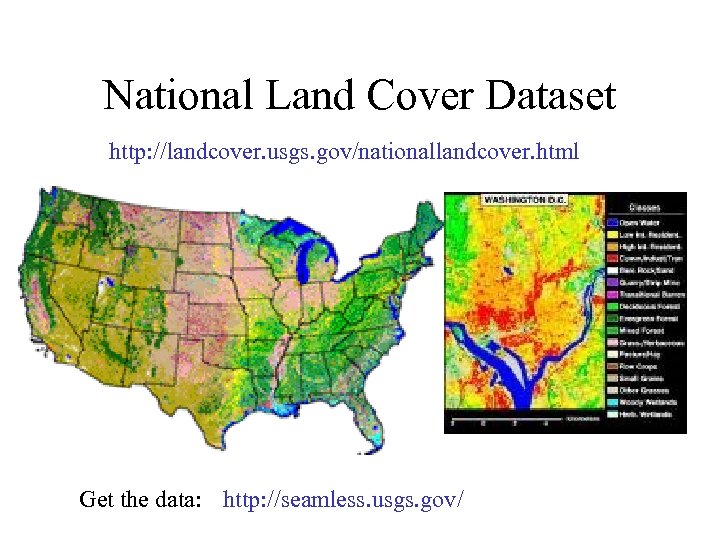 National Land Cover Dataset http: //landcover. usgs. gov/nationallandcover. html Get the data: http: //seamless. usgs. gov/
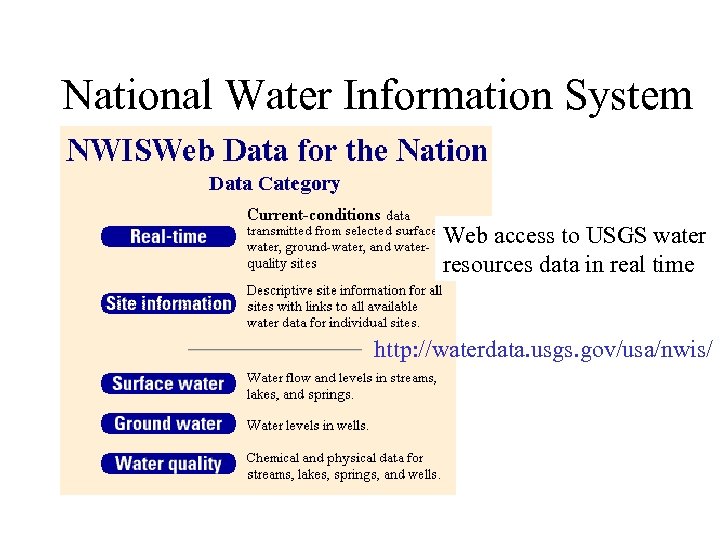 National Water Information System Web access to USGS water resources data in real time http: //waterdata. usgs. gov/usa/nwis/
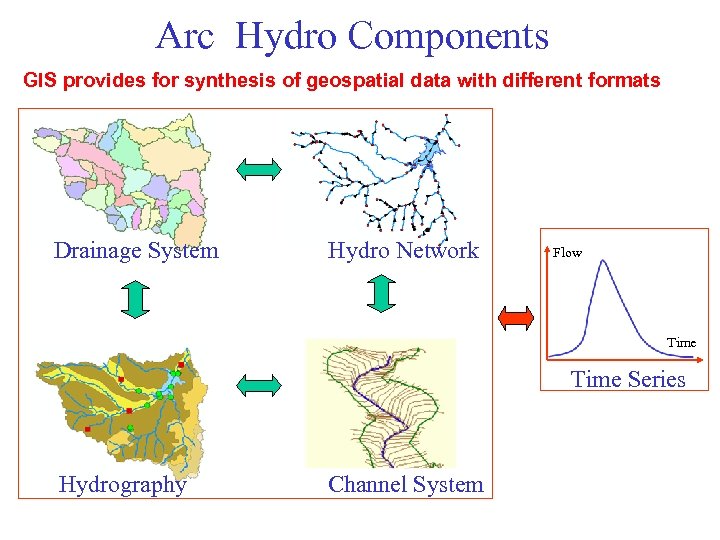 Arc Hydro Components GIS provides for synthesis of geospatial data with different formats Drainage System Hydro Network Flow Time Series Hydrography Channel System
 Geodesy, Map Projections and Coordinate Systems • Geodesy - the shape of the earth and definition of earth datums • Map Projection - the transformation of a curved earth to a flat map • Coordinate systems - (x, y) coordinate systems for map data
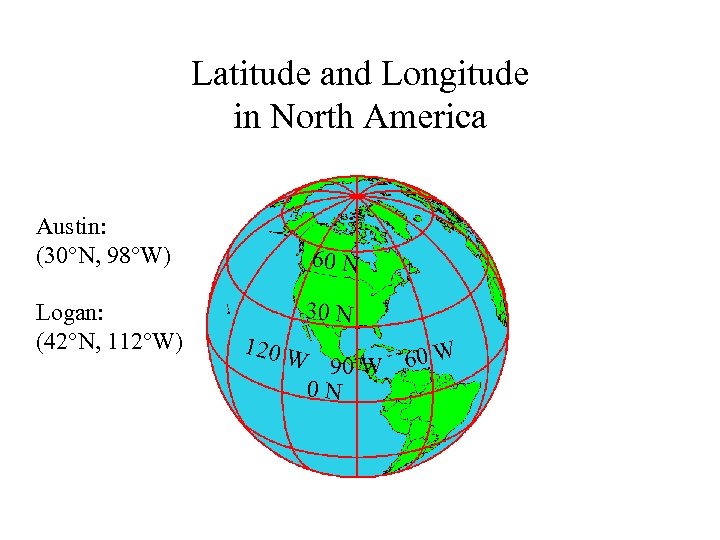 Latitude and Longitude in North America Austin: (30°N, 98°W) Logan: (42°N, 112°W) 60 N 30 N 120 W W 90 W 60 0 N
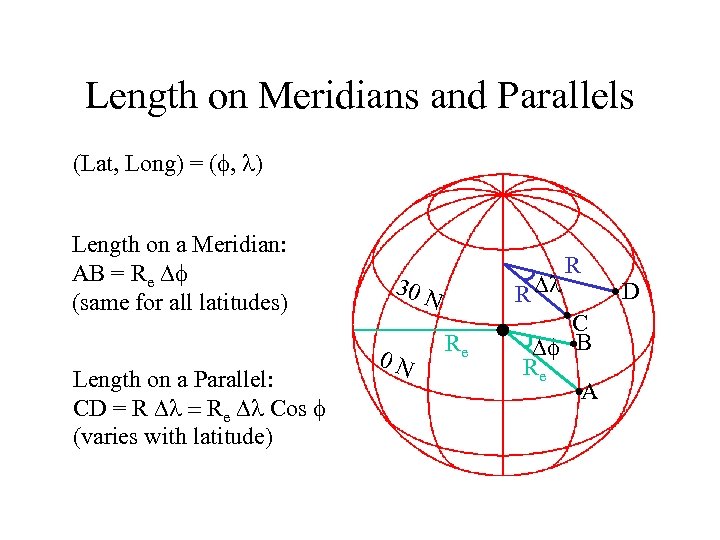 Length on Meridians and Parallels (Lat, Long) = (f, l) Length on a Meridian: AB = Re Df (same for all latitudes) Length on a Parallel: CD = R Dl = Re Dl Cos f (varies with latitude) R Dl 30 N 0 N Re R C Df B Re A D
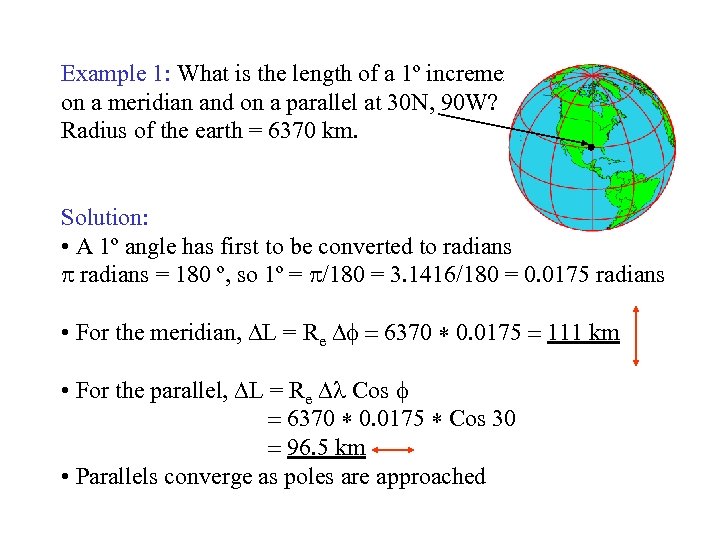 Example 1: What is the length of a 1º increment along on a meridian and on a parallel at 30 N, 90 W? Radius of the earth = 6370 km. Solution: • A 1º angle has first to be converted to radians p radians = 180 º, so 1º = p/180 = 3. 1416/180 = 0. 0175 radians • For the meridian, DL = Re Df = 6370 * 0. 0175 = 111 km • For the parallel, DL = Re Dl Cos f • = 6370 * 0. 0175 * Cos 30 • = 96. 5 km • Parallels converge as poles are approached
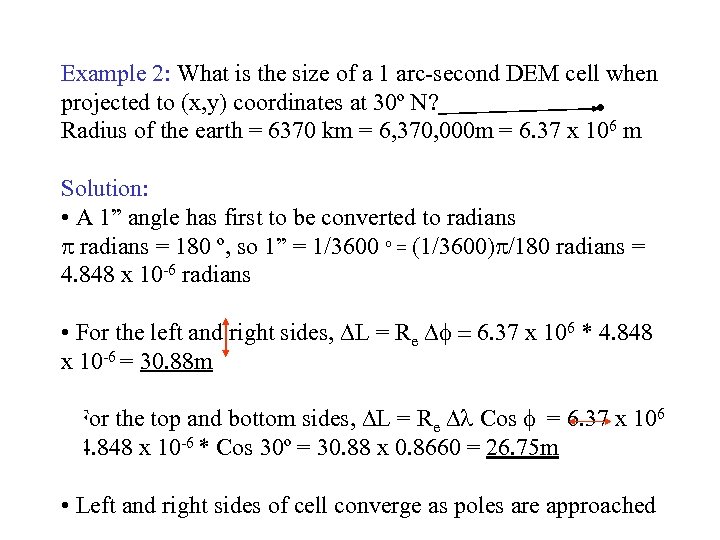 Example 2: What is the size of a 1 arc-second DEM cell when projected to (x, y) coordinates at 30º N? Radius of the earth = 6370 km = 6, 370, 000 m = 6. 37 x 106 m Solution: • A 1” angle has first to be converted to radians p radians = 180 º, so 1” = 1/3600 º = (1/3600)p/180 radians = 4. 848 x 10 -6 radians • For the left and right sides, DL = Re Df = 6. 37 x 106 * 4. 848 x 10 -6 = 30. 88 m • For the top and bottom sides, DL = Re Dl Cos f = 6. 37 x 106 * 4. 848 x 10 -6 * Cos 30º = 30. 88 x 0. 8660 = 26. 75 m • Left and right sides of cell converge as poles are approached
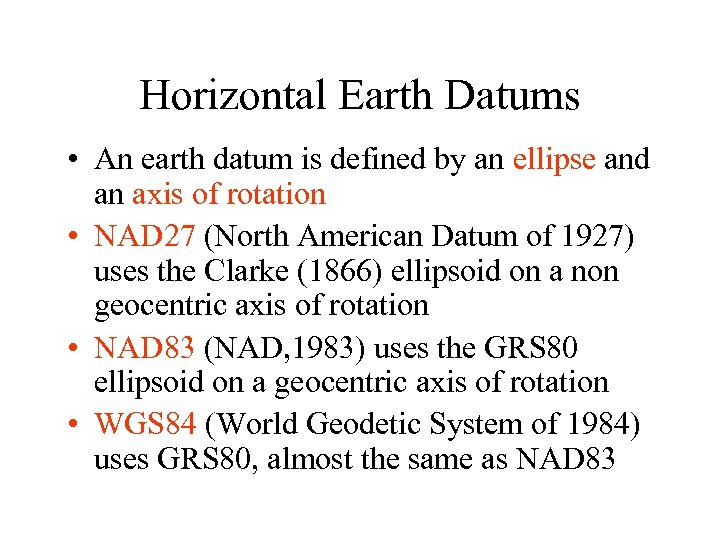 Horizontal Earth Datums • An earth datum is defined by an ellipse and an axis of rotation • NAD 27 (North American Datum of 1927) uses the Clarke (1866) ellipsoid on a non geocentric axis of rotation • NAD 83 (NAD, 1983) uses the GRS 80 ellipsoid on a geocentric axis of rotation • WGS 84 (World Geodetic System of 1984) uses GRS 80, almost the same as NAD 83
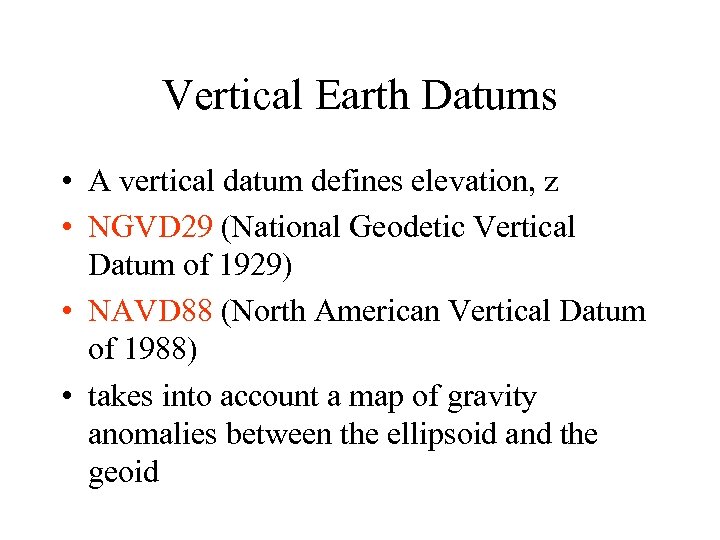 Vertical Earth Datums • A vertical datum defines elevation, z • NGVD 29 (National Geodetic Vertical Datum of 1929) • NAVD 88 (North American Vertical Datum of 1988) • takes into account a map of gravity anomalies between the ellipsoid and the geoid
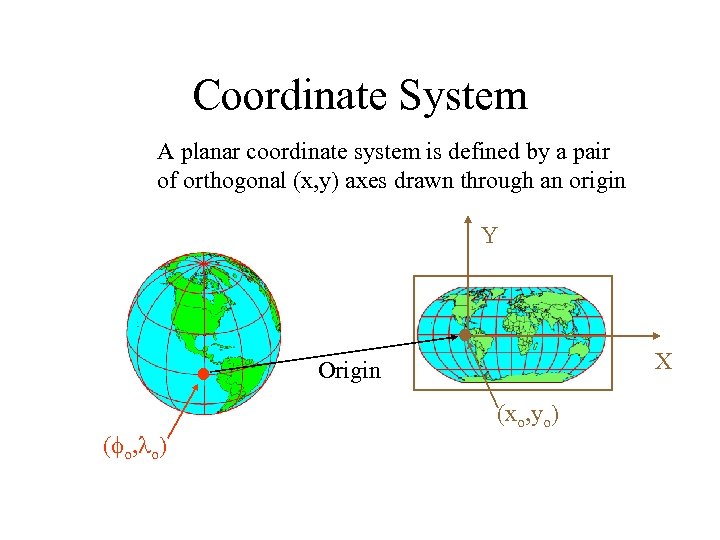 Coordinate System A planar coordinate system is defined by a pair of orthogonal (x, y) axes drawn through an origin Y X Origin (xo, yo) (fo, lo)
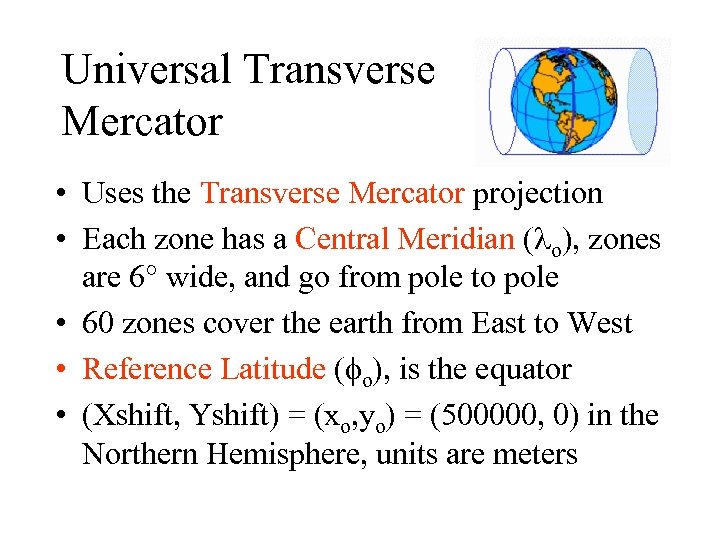 Universal Transverse Mercator • Uses the Transverse Mercator projection • Each zone has a Central Meridian (lo), zones are 6° wide, and go from pole to pole • 60 zones cover the earth from East to West • Reference Latitude (fo), is the equator • (Xshift, Yshift) = (xo, yo) = (500000, 0) in the Northern Hemisphere, units are meters
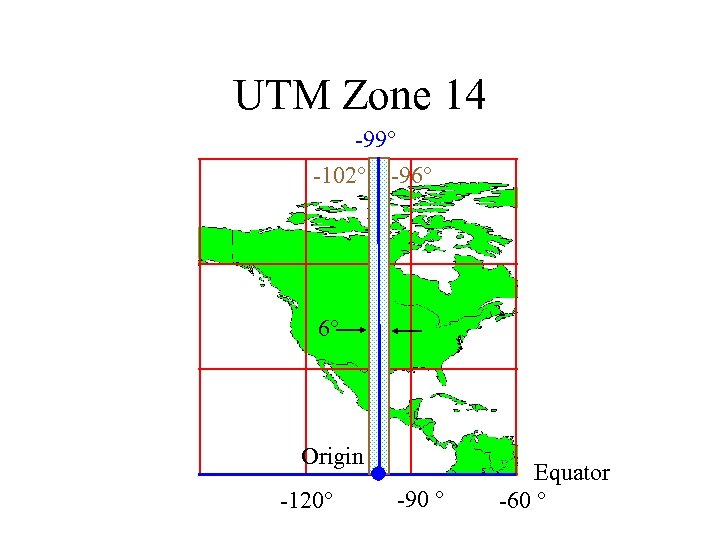 UTM Zone 14 -99° -102° -96° 6° Origin -120° -90 ° Equator -60 °
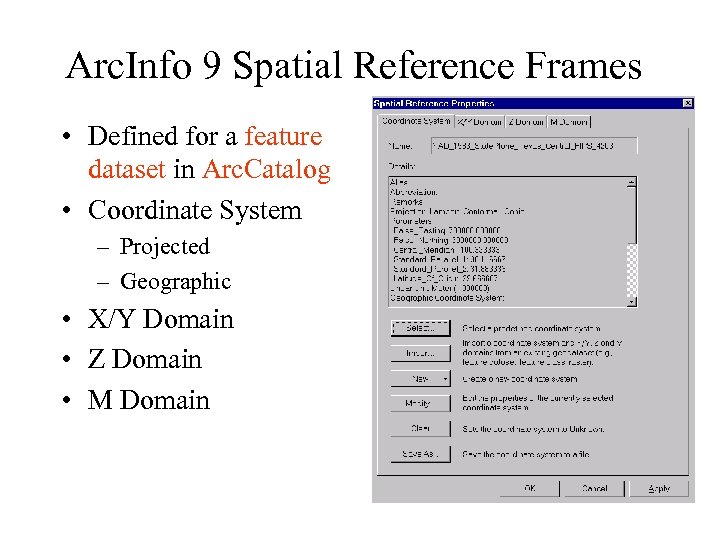 Arc. Info 9 Spatial Reference Frames • Defined for a feature dataset in Arc. Catalog • Coordinate System – Projected – Geographic • X/Y Domain • Z Domain • M Domain
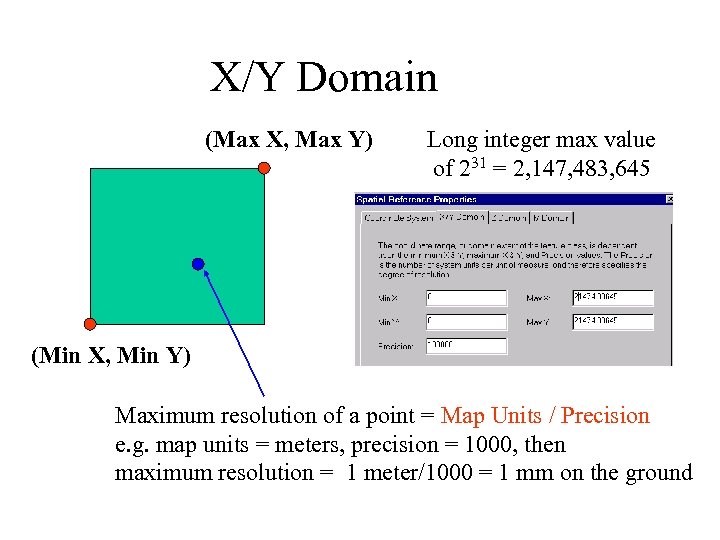 X/Y Domain (Max X, Max Y) Long integer max value of 231 = 2, 147, 483, 645 (Min X, Min Y) Maximum resolution of a point = Map Units / Precision e. g. map units = meters, precision = 1000, then maximum resolution = 1 meter/1000 = 1 mm on the ground
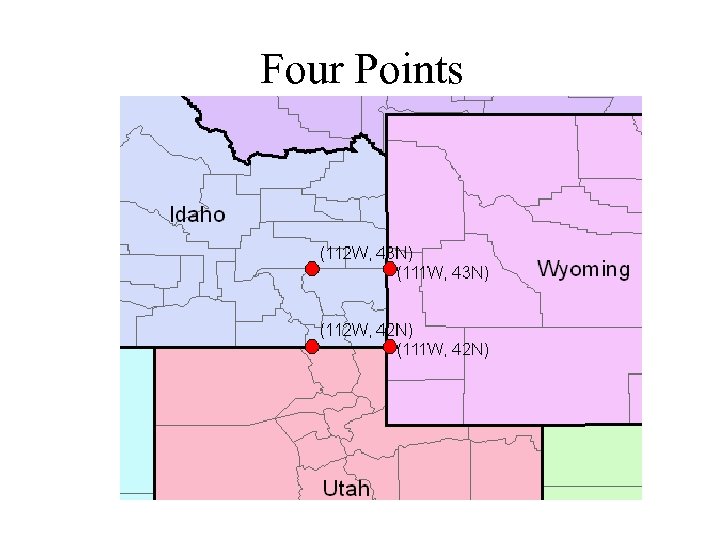 Four Points
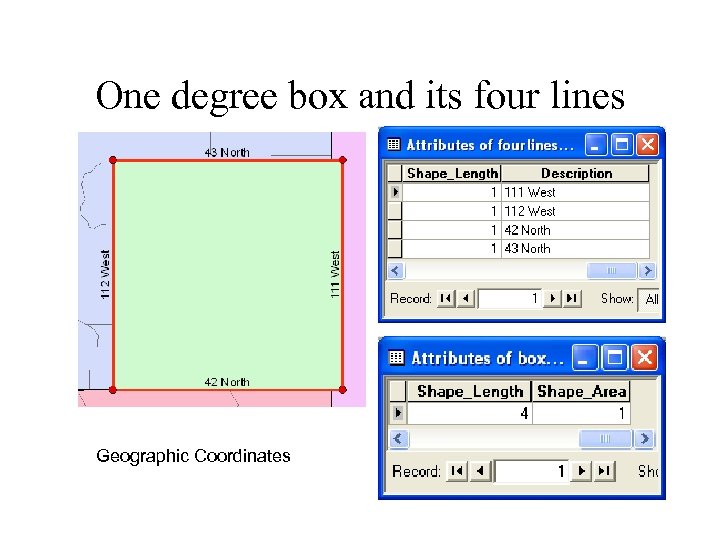 One degree box and its four lines Geographic Coordinates
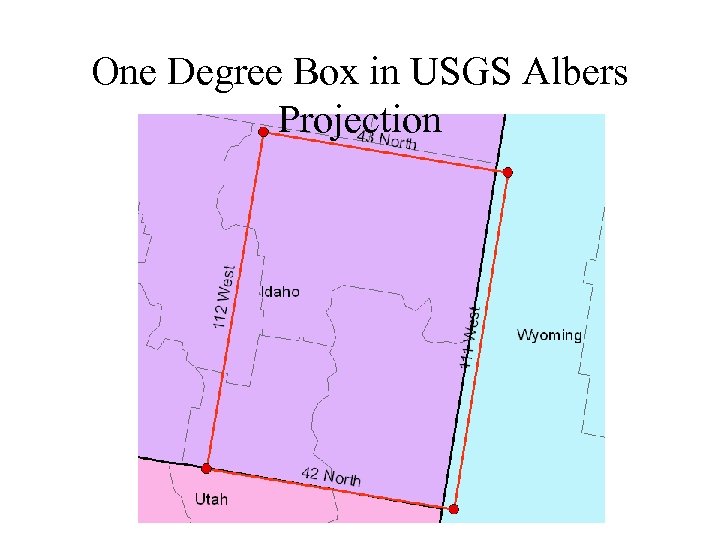 One Degree Box in USGS Albers Projection
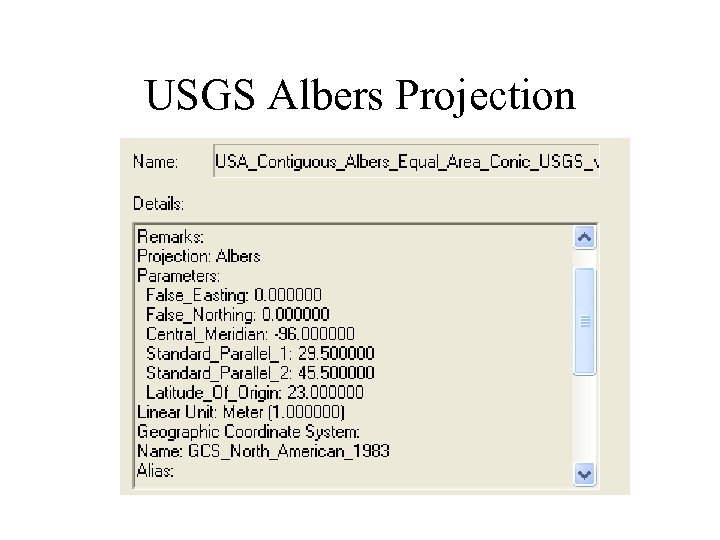 USGS Albers Projection
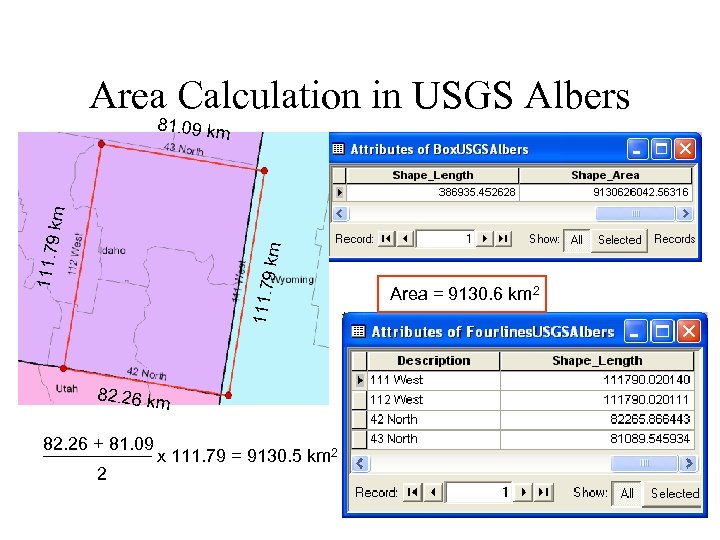 Area Calculation in USGS Albers 111. 79 km 81. 09 km 82. 26 + 81. 09 2 x 111. 79 = 9130. 5 km 2 Area = 9130. 6 km 2
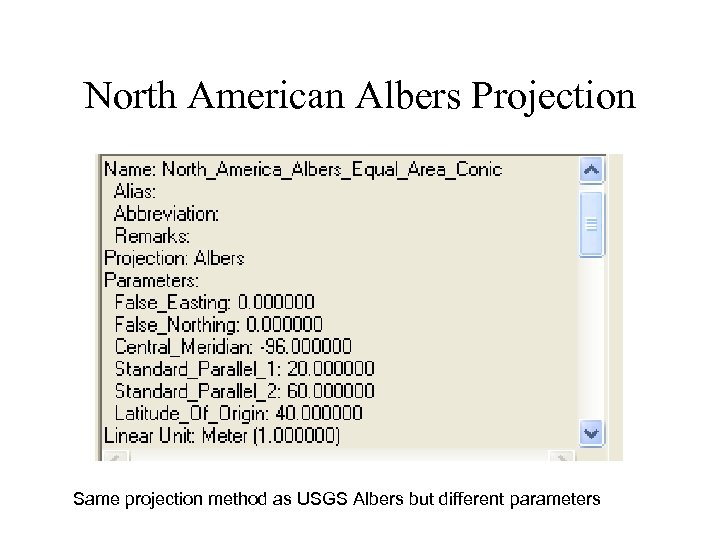 North American Albers Projection Same projection method as USGS Albers but different parameters
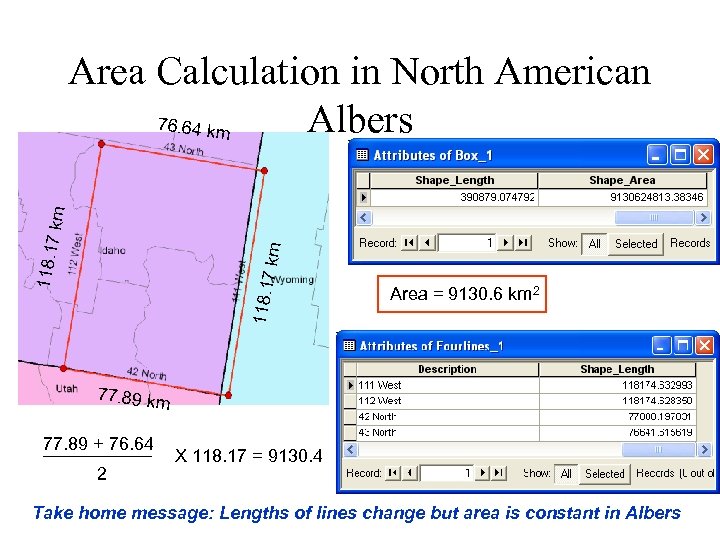 118. 17 km Area Calculation in North American 76. 64 km Albers Area = 9130. 6 km 2 77. 89 km 77. 89 + 76. 64 2 X 118. 17 = 9130. 4 Take home message: Lengths of lines change but area is constant in Albers
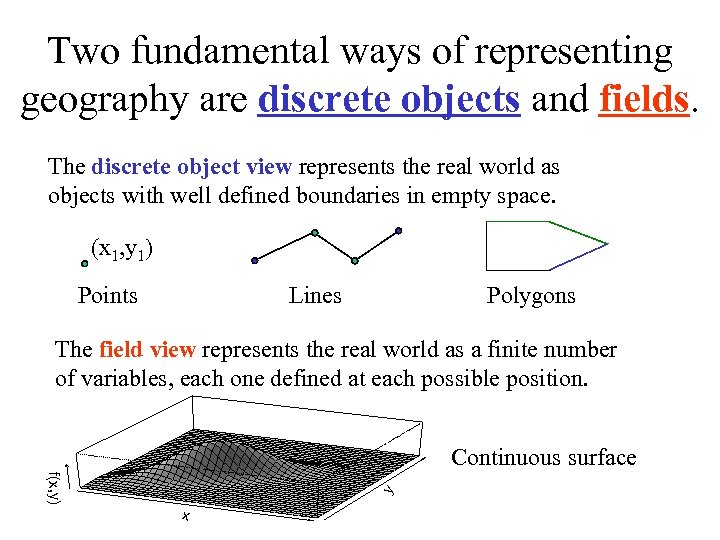 Two fundamental ways of representing geography are discrete objects and fields. The discrete object view represents the real world as objects with well defined boundaries in empty space. (x 1, y 1) Points Lines Polygons The field view represents the real world as a finite number of variables, each one defined at each possible position. f(x, y) y Continuous surface x
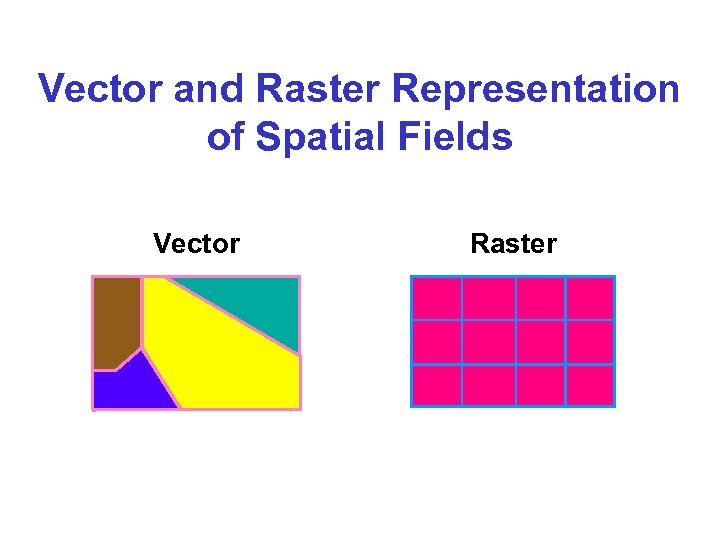 Vector and Raster Representation of Spatial Fields Vector Raster
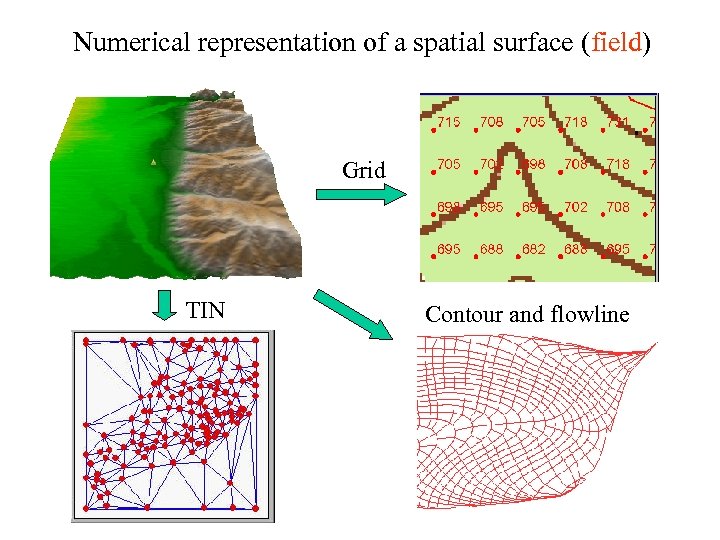 Numerical representation of a spatial surface (field) Grid TIN Contour and flowline
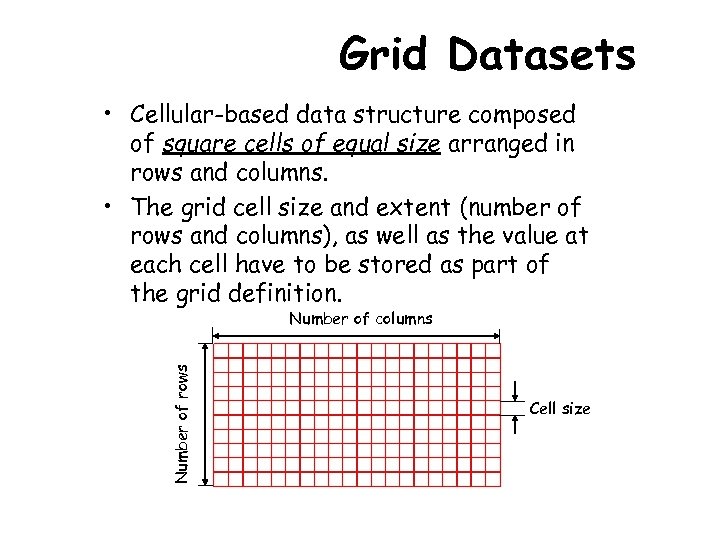 Grid Datasets • Cellular-based data structure composed of square cells of equal size arranged in rows and columns. • The grid cell size and extent (number of rows and columns), as well as the value at each cell have to be stored as part of the grid definition. Number of rows Number of columns Cell size
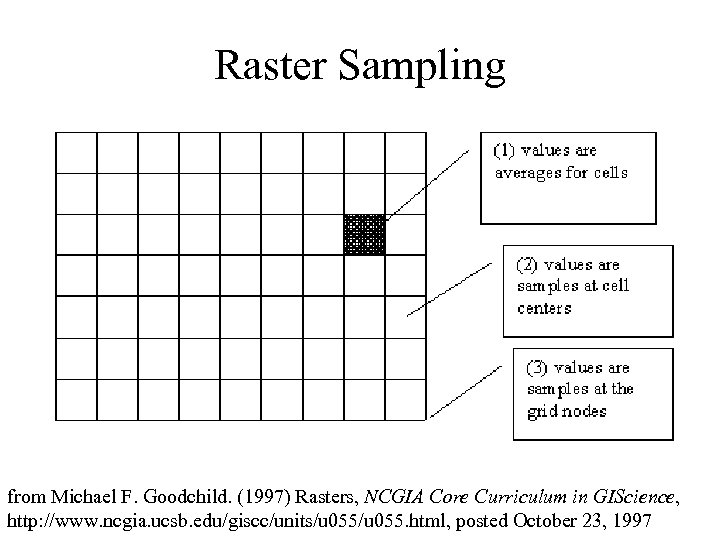 Raster Sampling from Michael F. Goodchild. (1997) Rasters, NCGIA Core Curriculum in GIScience, http: //www. ncgia. ucsb. edu/giscc/units/u 055. html, posted October 23, 1997
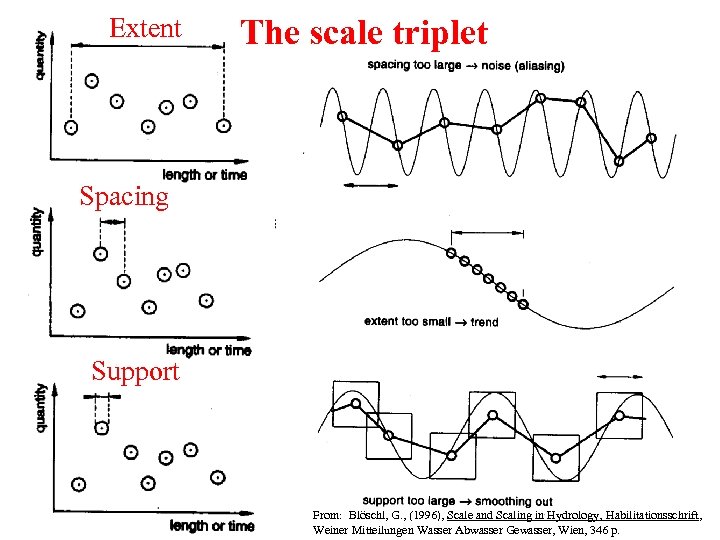 Extent The scale triplet Spacing Support From: Blöschl, G. , (1996), Scale and Scaling in Hydrology, Habilitationsschrift, Weiner Mitteilungen Wasser Abwasser Gewasser, Wien, 346 p.
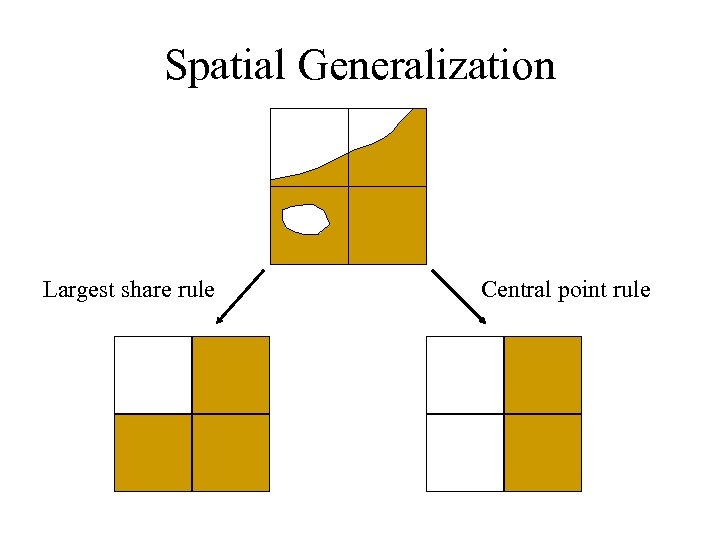 Spatial Generalization Largest share rule Central point rule
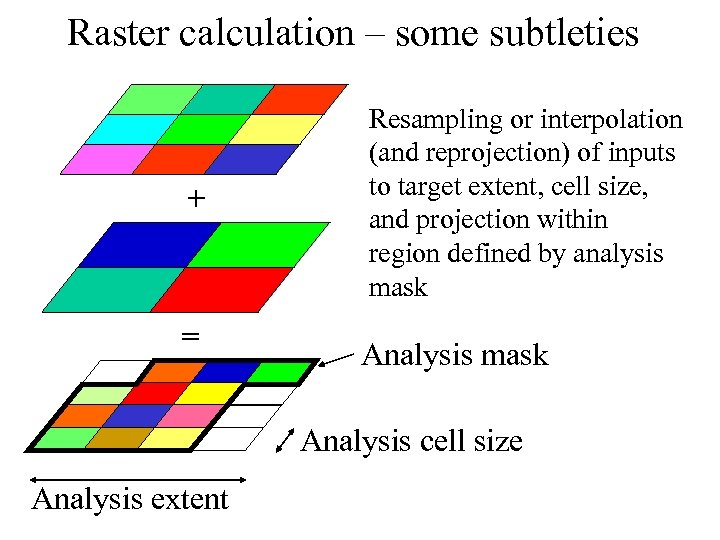 Raster calculation – some subtleties + = Resampling or interpolation (and reprojection) of inputs to target extent, cell size, and projection within region defined by analysis mask Analysis cell size Analysis extent
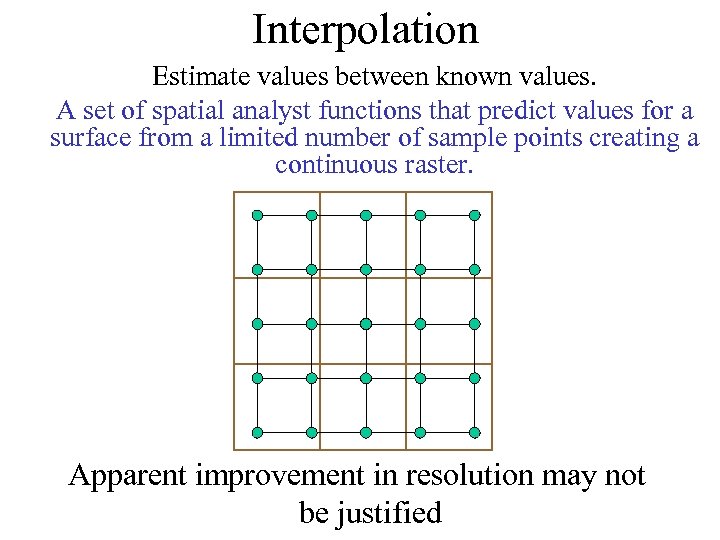 Interpolation Estimate values between known values. A set of spatial analyst functions that predict values for a surface from a limited number of sample points creating a continuous raster. Apparent improvement in resolution may not be justified
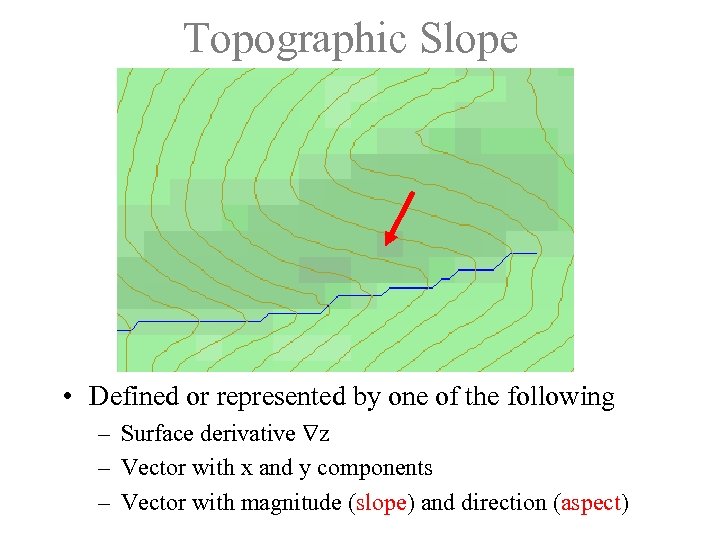 Topographic Slope • Defined or represented by one of the following – Surface derivative z – Vector with x and y components – Vector with magnitude (slope) and direction (aspect)
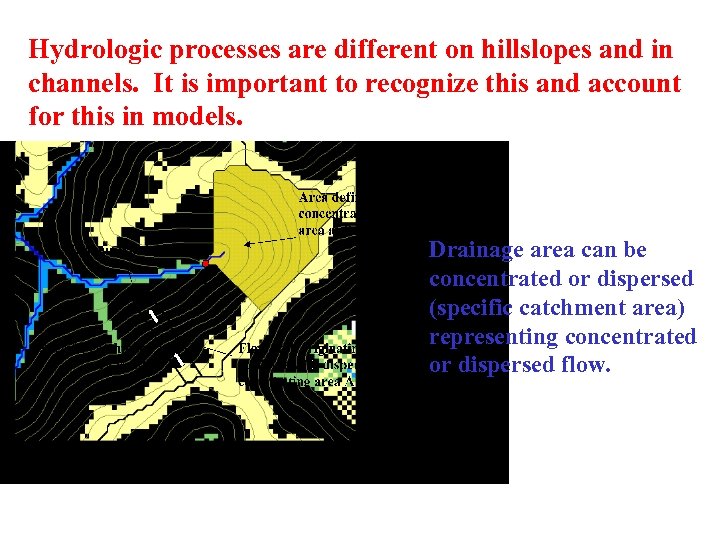 Hydrologic processes are different on hillslopes and in channels. It is important to recognize this and account for this in models. Drainage area can be concentrated or dispersed (specific catchment area) representing concentrated or dispersed flow.
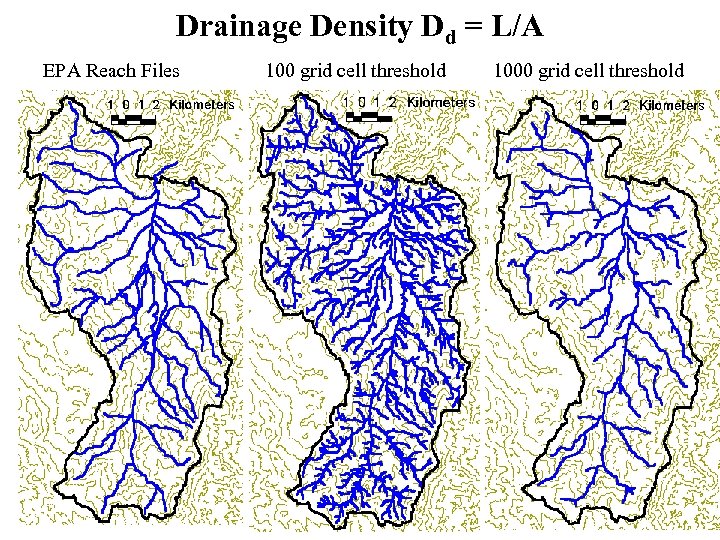 Drainage Density Dd = L/A EPA Reach Files 100 grid cell threshold 1000 grid cell threshold
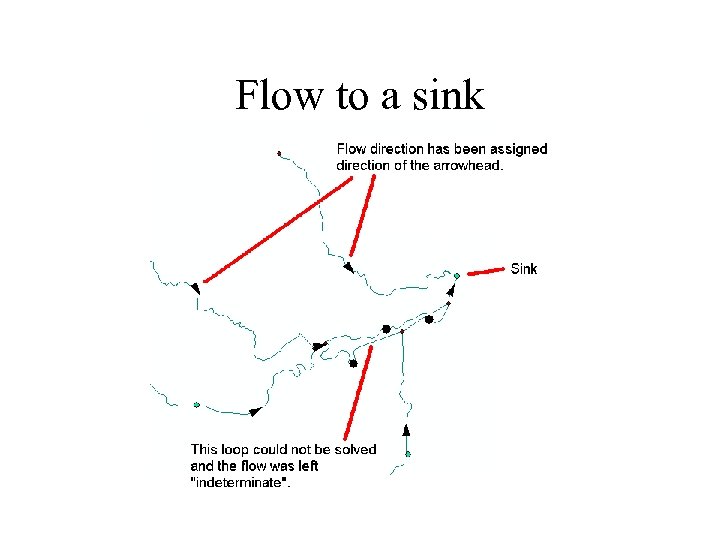
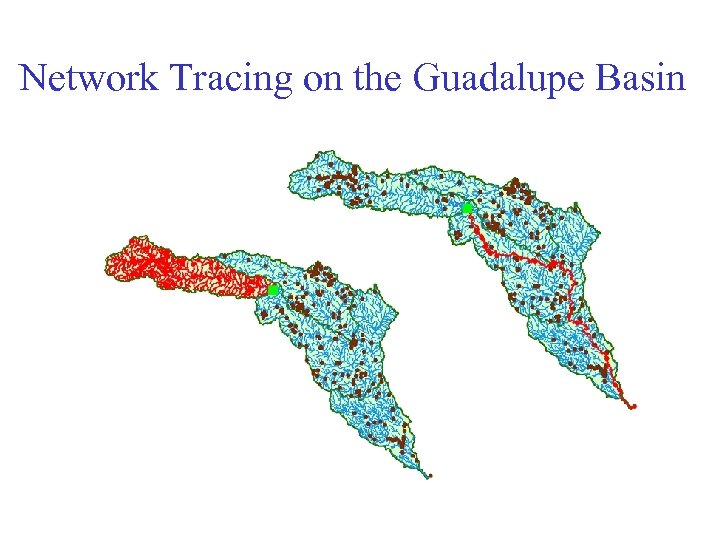
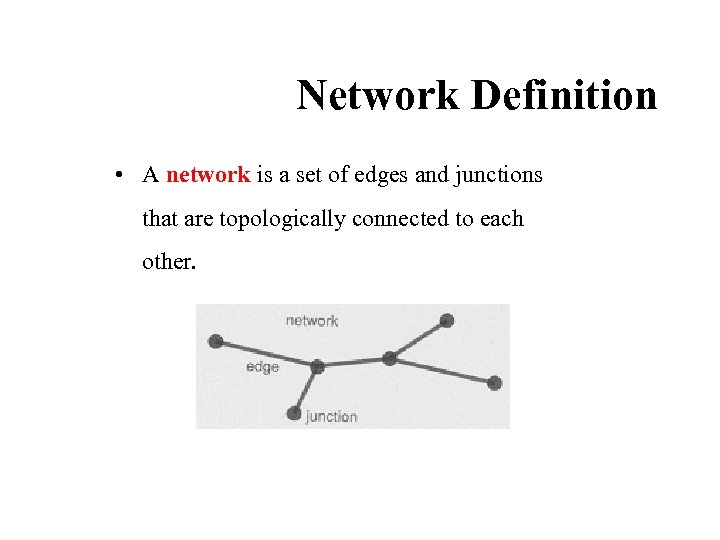 Network Definition • A network is a set of edges and junctions that are topologically connected to each other.
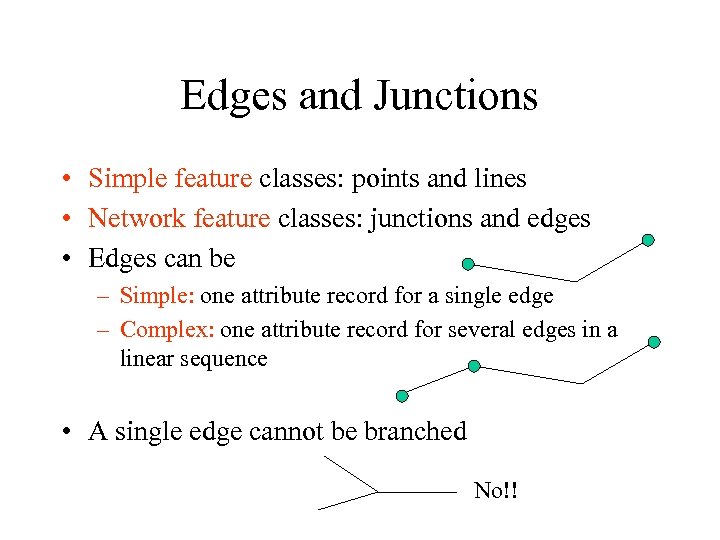 Edges and Junctions • Simple feature classes: points and lines • Network feature classes: junctions and edges • Edges can be – Simple: one attribute record for a single edge – Complex: one attribute record for several edges in a linear sequence • A single edge cannot be branched No!!
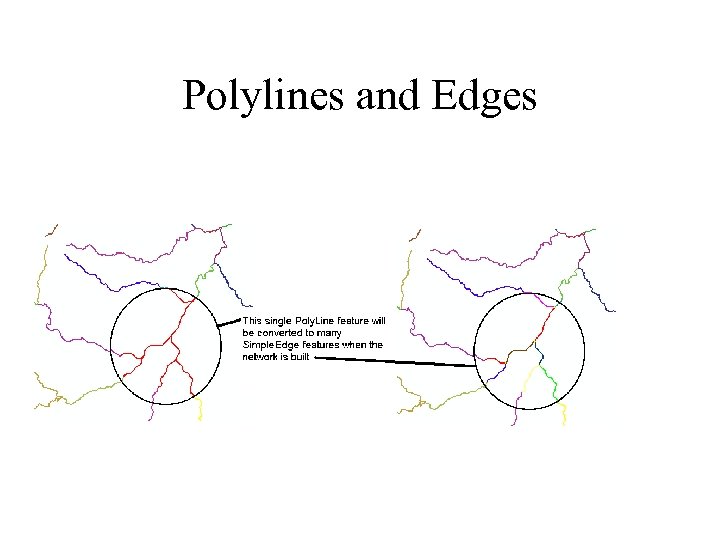 Polylines and Edges
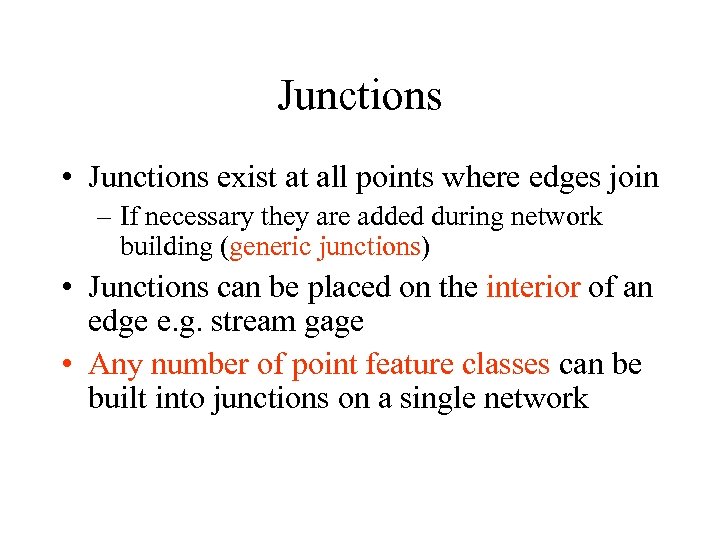 Junctions • Junctions exist at all points where edges join – If necessary they are added during network building (generic junctions) • Junctions can be placed on the interior of an edge e. g. stream gage • Any number of point feature classes can be built into junctions on a single network
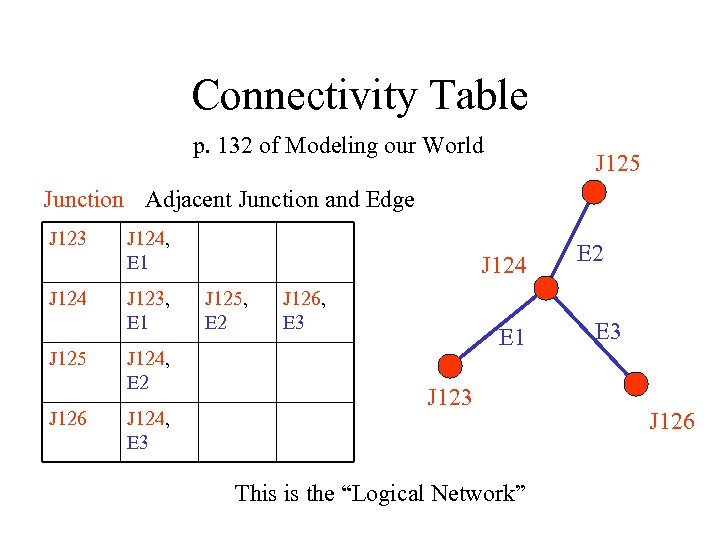 Connectivity Table p. 132 of Modeling our World J 125 Junction Adjacent Junction and Edge J 123 J 124 J 125 J 126 J 124, E 1 J 123, E 1 J 124, E 2 J 124, E 3 J 124 J 125, E 2 J 126, E 3 E 1 J 123 This is the “Logical Network” E 2 E 3 J 126
 Flow to a sink
 Network Tracing on the Guadalupe Basin
 Linear Referencing Where are we on a line?
 Addressing
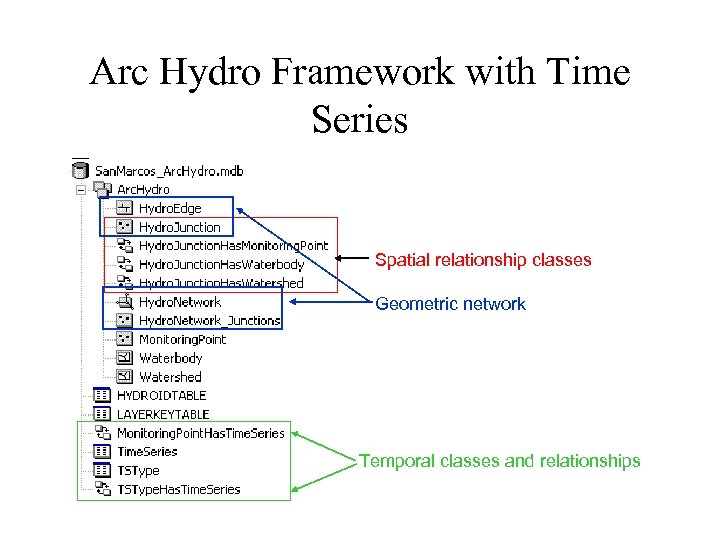 Arc Hydro Framework with Time Series Spatial relationship classes Geometric network Temporal classes and relationships
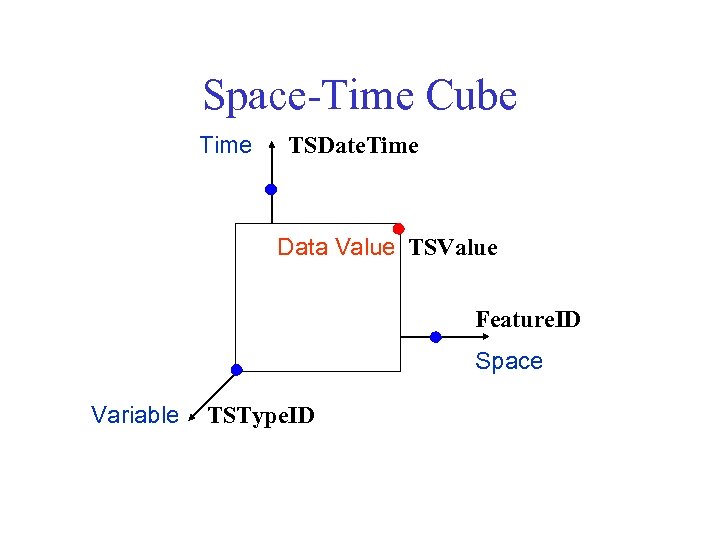 Space-Time Cube Time TSDate. Time Data Value TSValue Feature. ID Space Variable TSType. ID
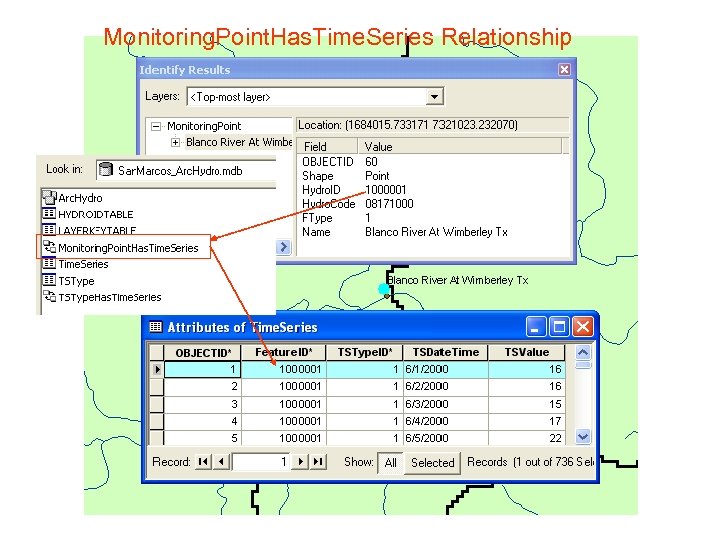 Monitoring. Point. Has. Time. Series Relationship
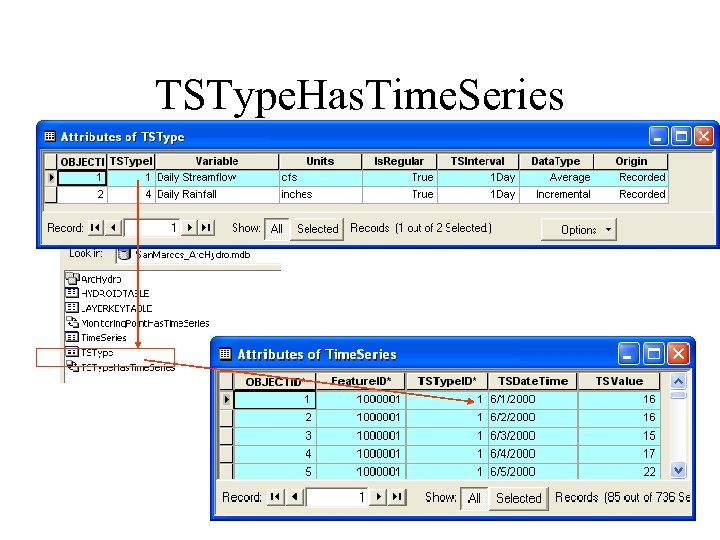 TSType. Has. Time. Series
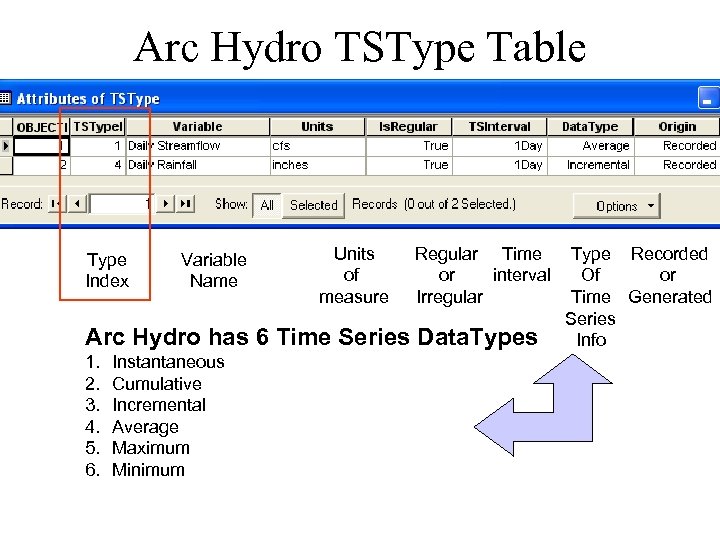 Arc Hydro TSType Table Type Index Variable Name Units of measure Regular Time or interval Irregular Arc Hydro has 6 Time Series Data. Types 1. 2. 3. 4. 5. 6. Instantaneous Cumulative Incremental Average Maximum Minimum Type Recorded Of or Time Generated Series Info
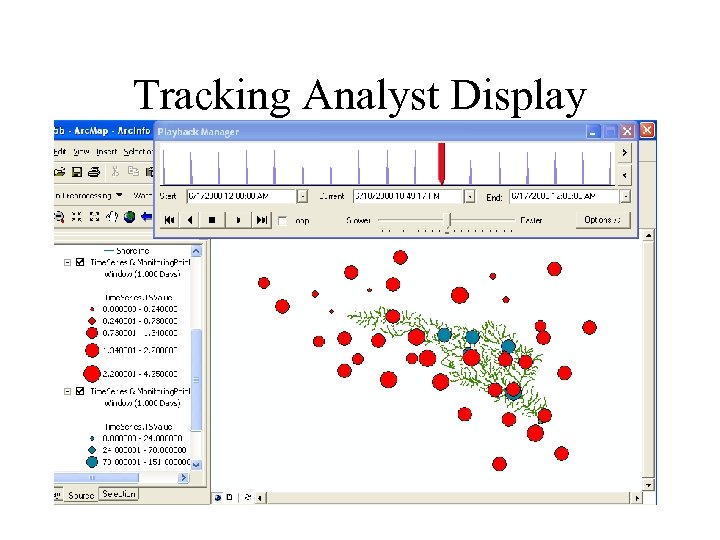 Tracking Analyst Display
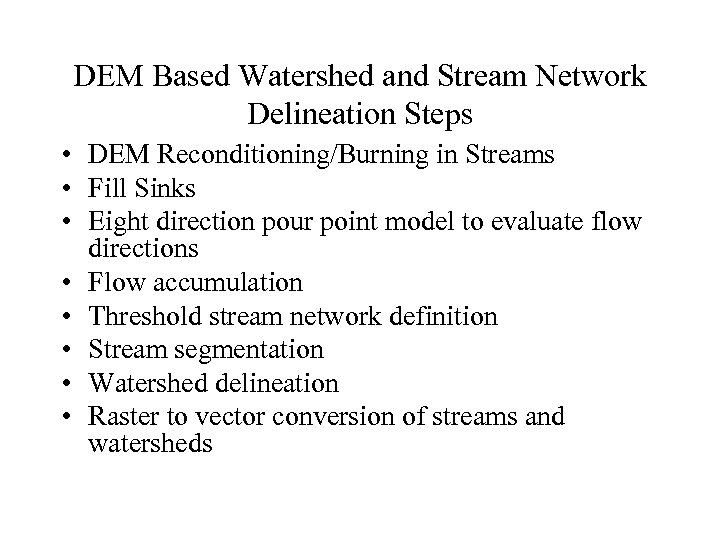 DEM Based Watershed and Stream Network Delineation Steps • DEM Reconditioning/Burning in Streams • Fill Sinks • Eight direction pour point model to evaluate flow directions • Flow accumulation • Threshold stream network definition • Stream segmentation • Watershed delineation • Raster to vector conversion of streams and watersheds
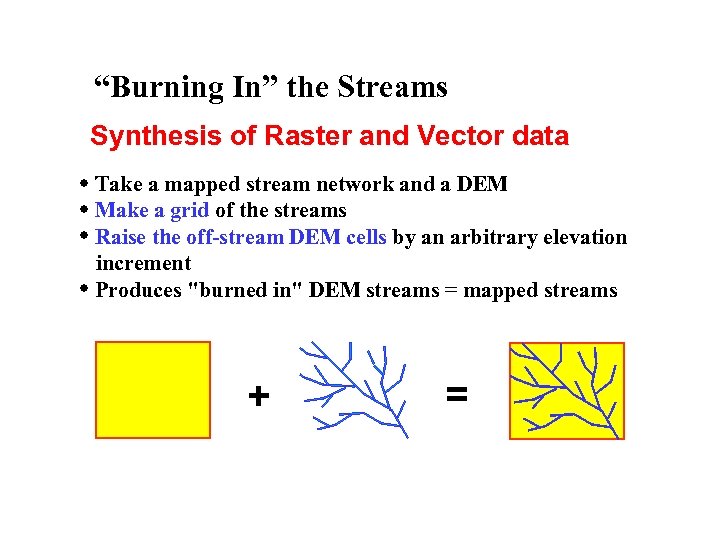 “Burning In” the Streams Synthesis of Raster and Vector data Take a mapped stream network and a DEM Make a grid of the streams Raise the off-stream DEM cells by an arbitrary elevation increment Produces "burned in" DEM streams = mapped streams + =
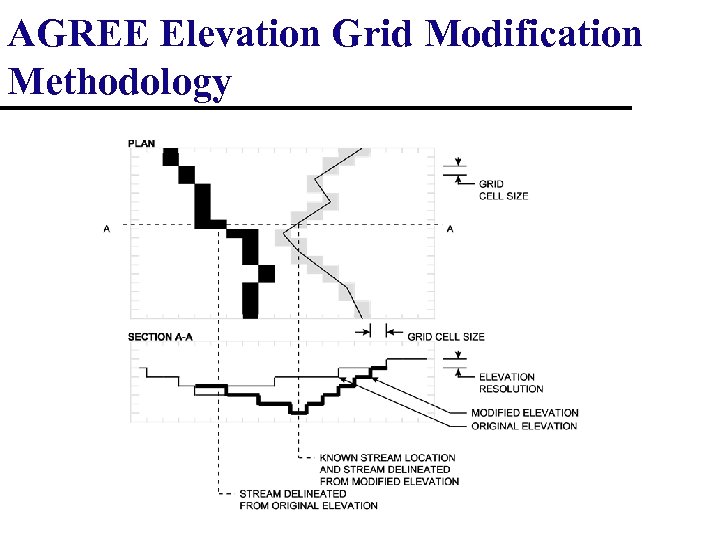 AGREE Elevation Grid Modification Methodology
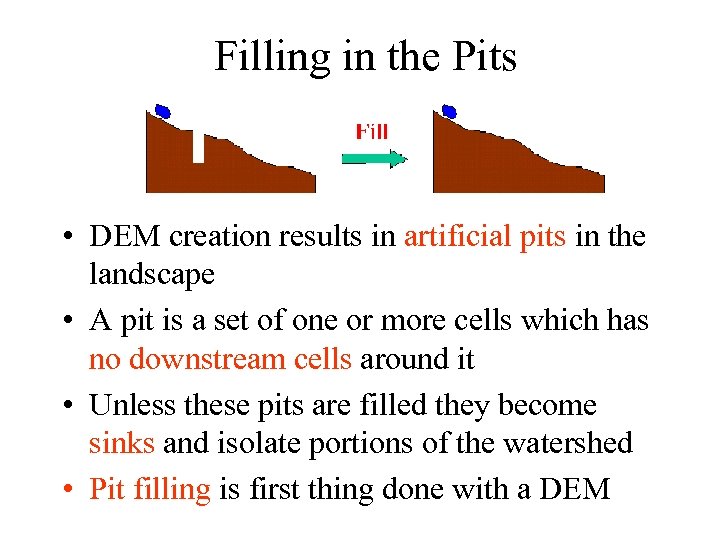 Filling in the Pits • DEM creation results in artificial pits in the landscape • A pit is a set of one or more cells which has no downstream cells around it • Unless these pits are filled they become sinks and isolate portions of the watershed • Pit filling is first thing done with a DEM
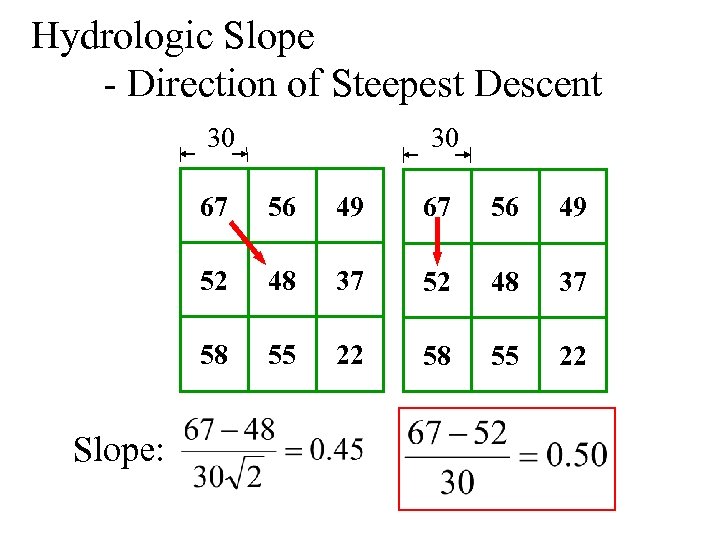 Hydrologic Slope - Direction of Steepest Descent 30 30 67 49 67 56 49 52 48 37 58 Slope: 56 55 22 58 55 22
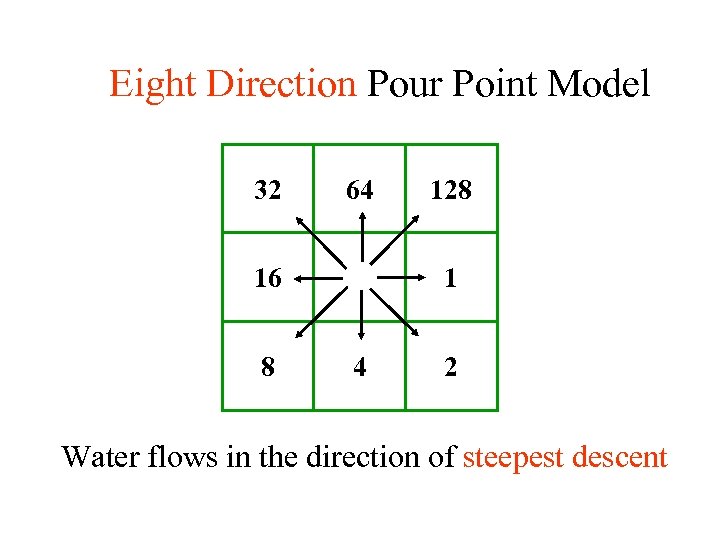 Eight Direction Pour Point Model 32 64 1 16 8 128 4 2 Water flows in the direction of steepest descent
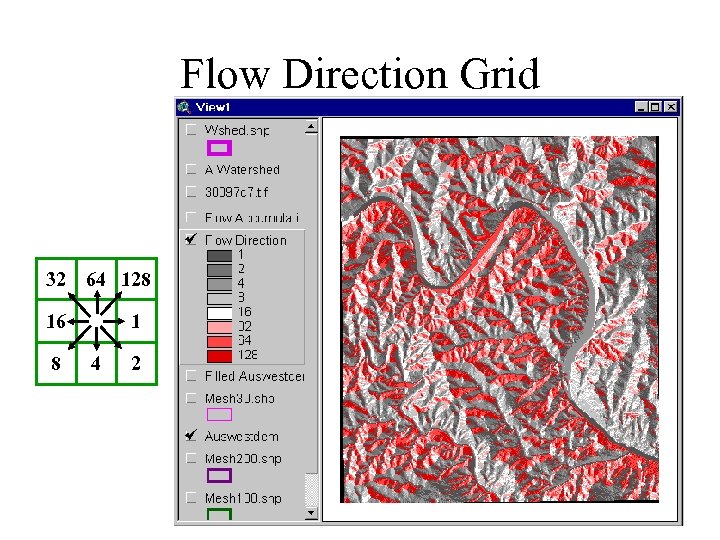 Flow Direction Grid 32 64 128 16 8 1 4 2
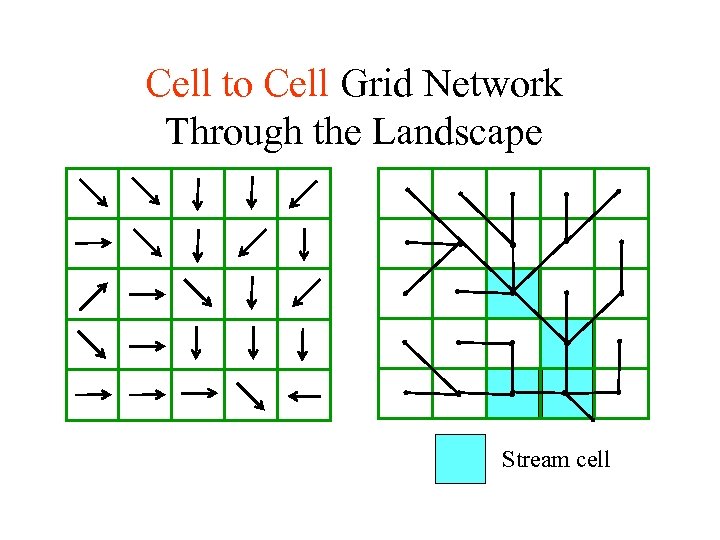 Cell to Cell Grid Network Through the Landscape Stream cell
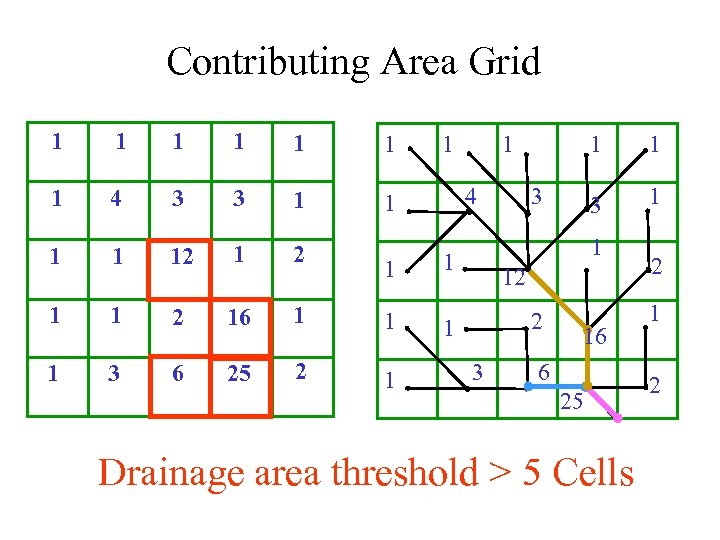 Contributing Area Grid 1 1 1 1 4 3 3 1 1 12 1 1 2 16 1 1 1 3 6 25 2 1 1 4 1 3 3 1 1 12 2 1 3 16 6 25 Drainage area threshold > 5 Cells 2 1 2
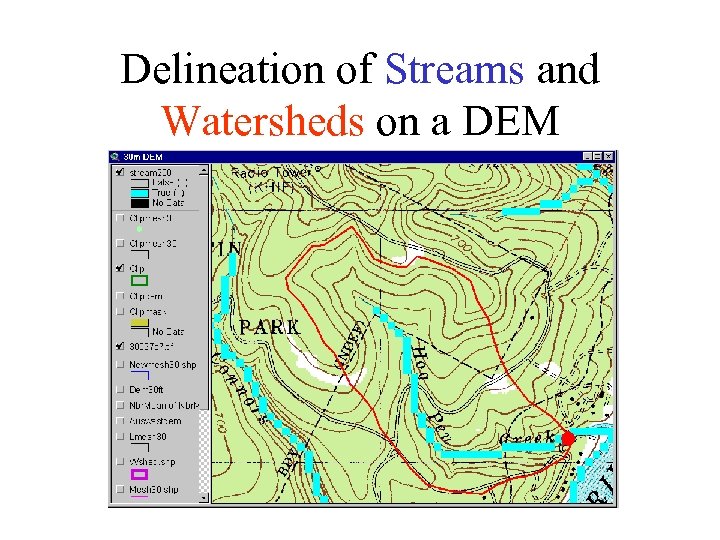 Delineation of Streams and Watersheds on a DEM
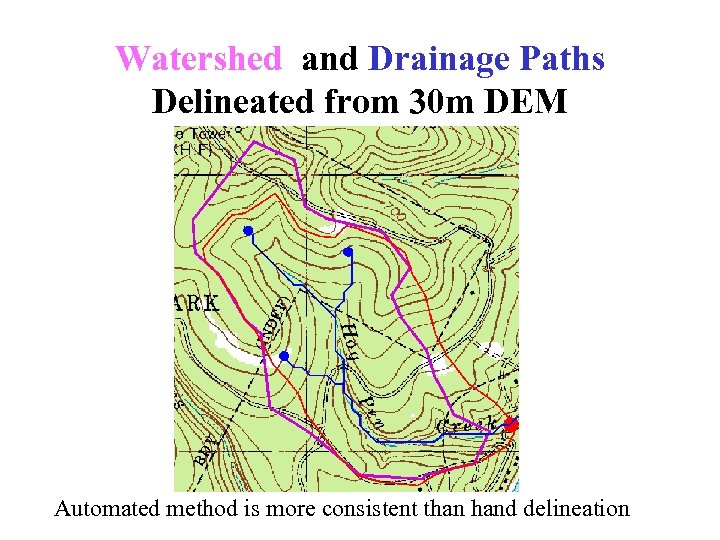 Watershed and Drainage Paths Delineated from 30 m DEM Automated method is more consistent than hand delineation
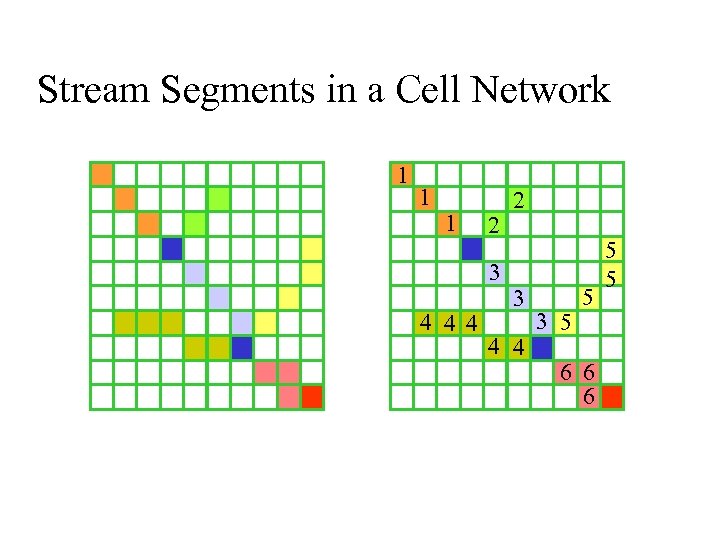 Stream Segments in a Cell Network 1 1 1 2 3 4 4 4 2 3 4 4 3 5 5 6 6 6 5 5
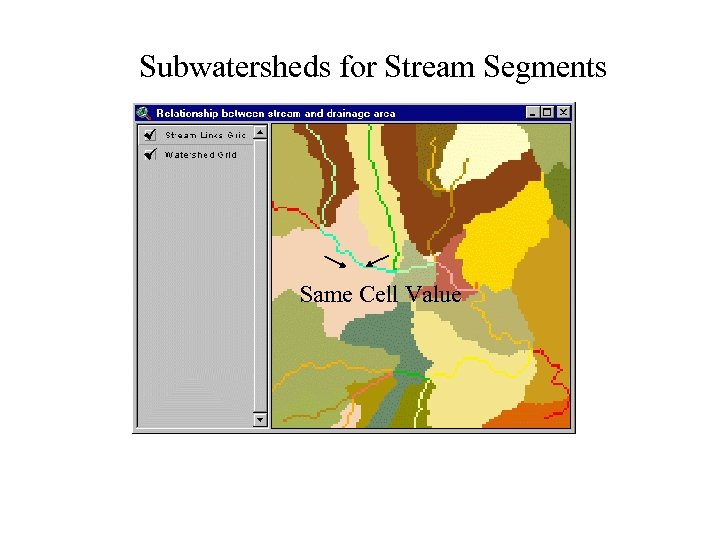 Subwatersheds for Stream Segments Same Cell Value
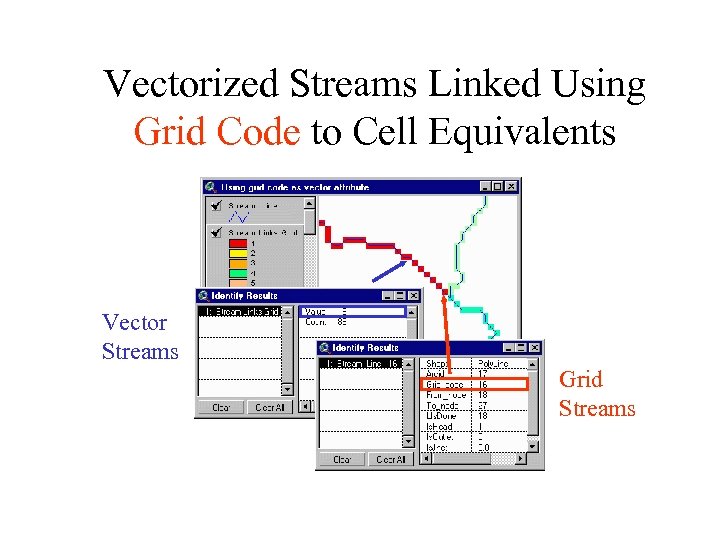 Vectorized Streams Linked Using Grid Code to Cell Equivalents Vector Streams Grid Streams
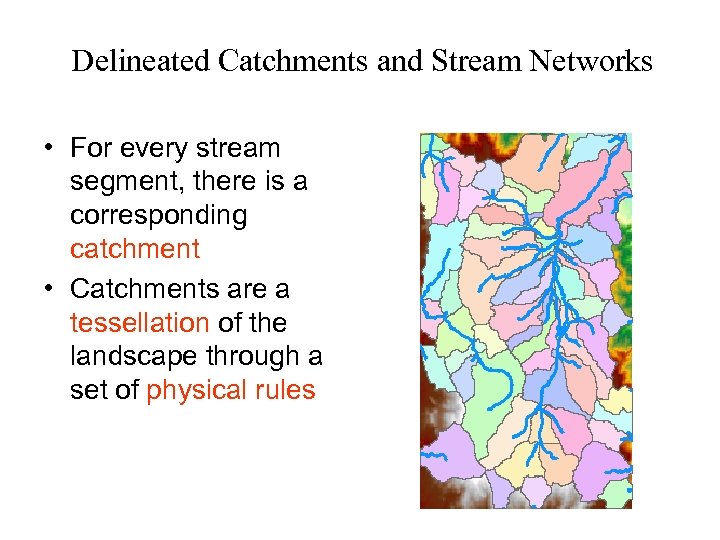 Delineated Catchments and Stream Networks • For every stream segment, there is a corresponding catchment • Catchments are a tessellation of the landscape through a set of physical rules
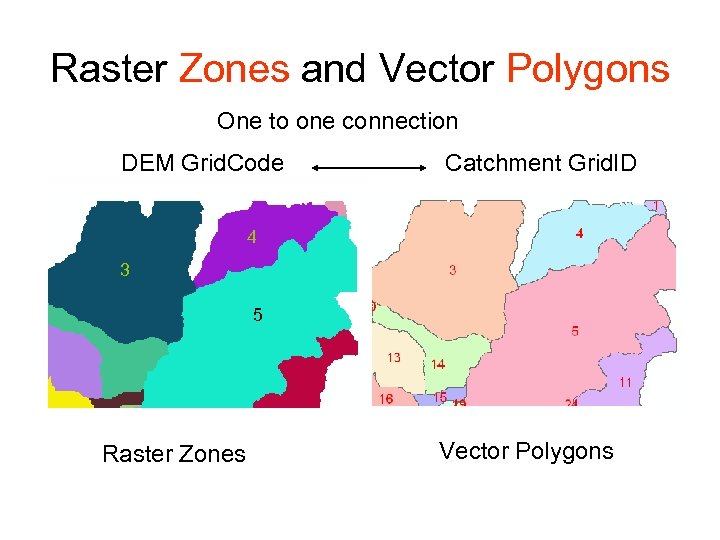 Raster Zones and Vector Polygons One to one connection DEM Grid. Code Catchment Grid. ID 4 3 5 Raster Zones Vector Polygons
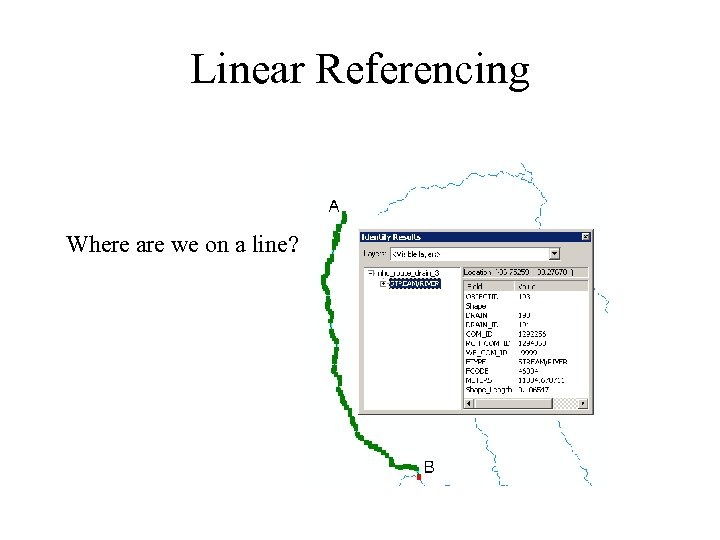
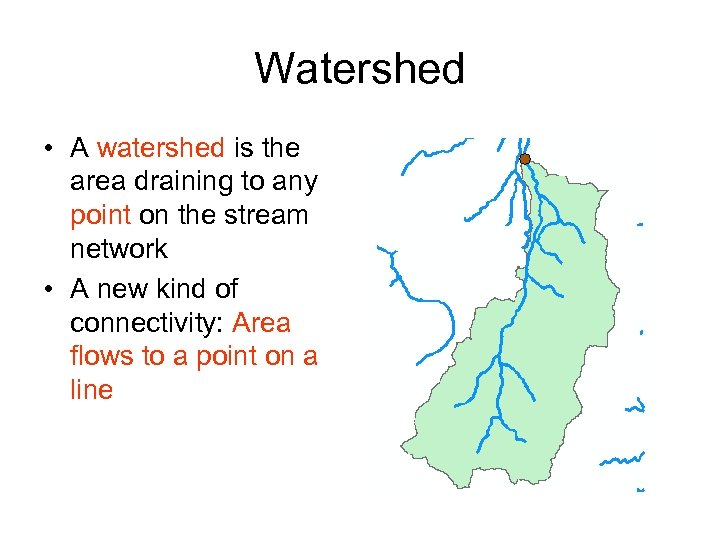 Watershed • A watershed is the area draining to any point on the stream network • A new kind of connectivity: Area flows to a point on a line
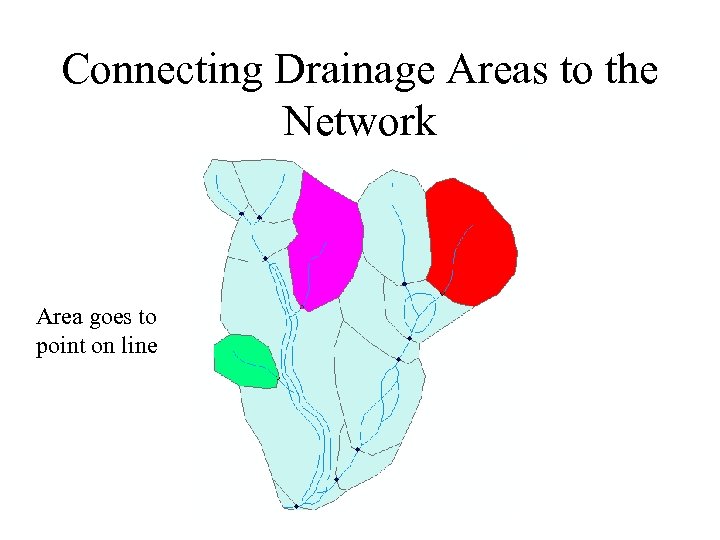 Connecting Drainage Areas to the Network Area goes to point on line
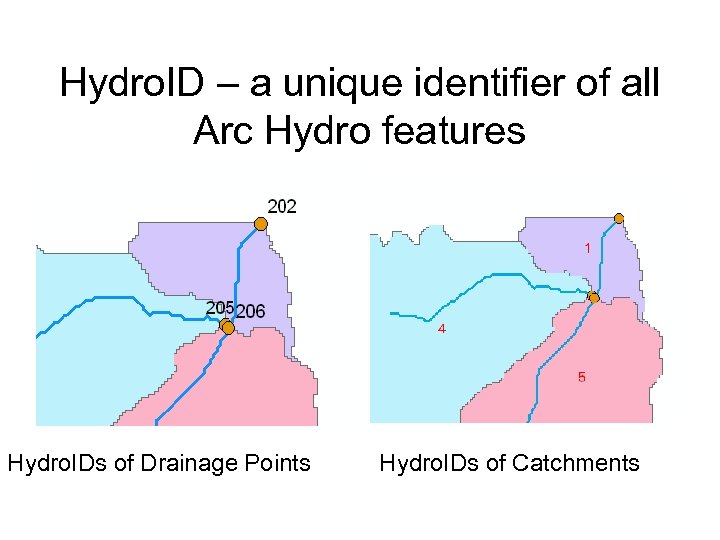 Hydro. ID – a unique identifier of all Arc Hydro features Hydro. IDs of Drainage Points Hydro. IDs of Catchments