


 Скачать презентацию GIOVE-A Radiation Environment Study Regime and Instrument Description
853ce2150dab97cb7480803014f7aea0.ppt
- Количество слайдов: 20
 GIOVE-A Radiation Environment Study Regime and Instrument Description B Taylor, C Underwood (University of Surrey) S Jason, S Fellows, E Rooney (SSTL) K Ryden, D Rodgers, P Morris (Qineti. Q) G Gatti, G Mandorlo, H Evans, E Daly (ESA) GIOVE-A ©SSTL/University of Surrey 3 rd Euro Space Weather Meeting, 13 -17 Nov 2006
 Outline • • • The MEO Radiation Environment Galileo & the GIOVE-A Spacecraft GIOVE MEO Environment Goals Radiation Monitors onboard GIOVE Timeline 2 ©SSTL/University of Surrey 3 rd Euro Space Weather Meeting, 13 -17 Nov 2006
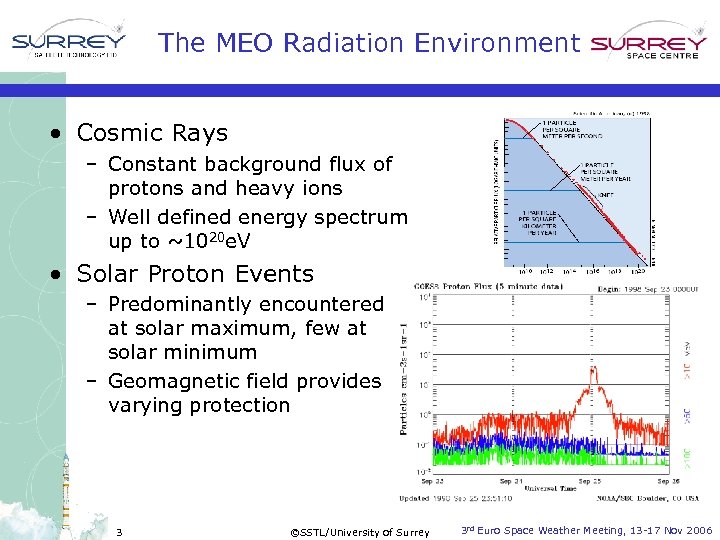 The MEO Radiation Environment • Cosmic Rays – Constant background flux of protons and heavy ions – Well defined energy spectrum up to ~1020 e. V • Solar Proton Events – Predominantly encountered at solar maximum, few at solar minimum – Geomagnetic field provides varying protection 3 ©SSTL/University of Surrey 3 rd Euro Space Weather Meeting, 13 -17 Nov 2006
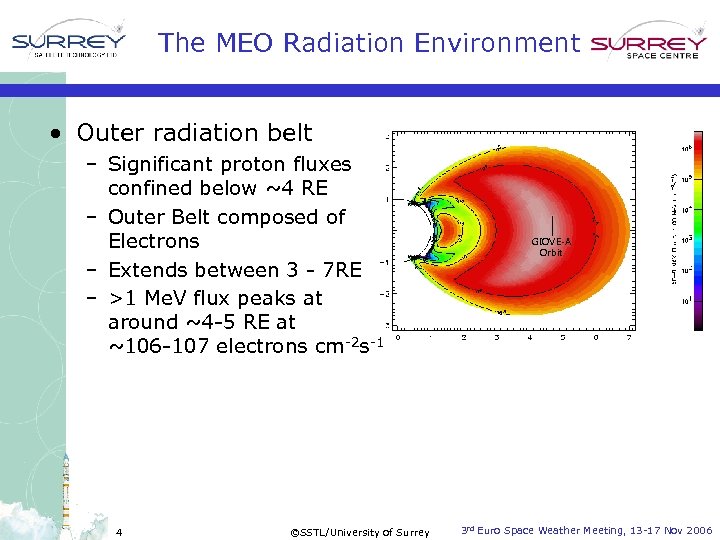 The MEO Radiation Environment • Outer radiation belt – Significant proton fluxes confined below ~4 RE – Outer Belt composed of Electrons – Extends between 3 - 7 RE – >1 Me. V flux peaks at around ~4 -5 RE at ~106 -107 electrons cm-2 s-1 4 ©SSTL/University of Surrey GIOVE-A Orbit 3 rd Euro Space Weather Meeting, 13 -17 Nov 2006
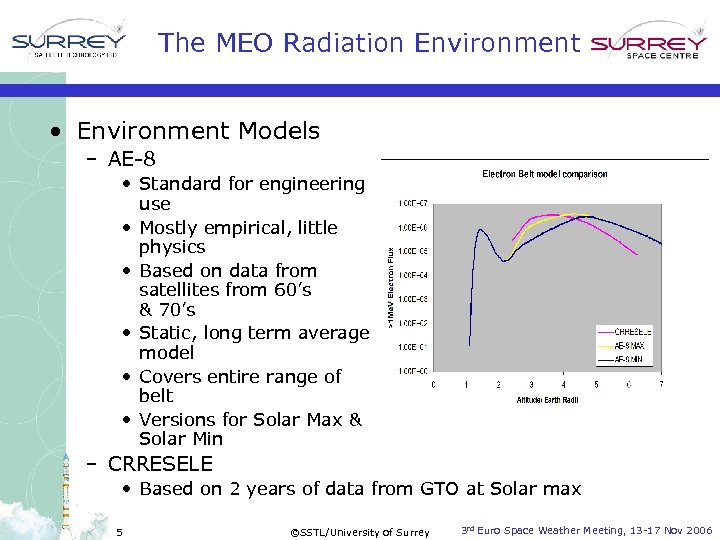 The MEO Radiation Environment • Environment Models – AE-8 • Standard for engineering use • Mostly empirical, little physics • Based on data from satellites from 60’s & 70’s • Static, long term average model • Covers entire range of belt • Versions for Solar Max & Solar Min – CRRESELE • Based on 2 years of data from GTO at Solar max 5 ©SSTL/University of Surrey 3 rd Euro Space Weather Meeting, 13 -17 Nov 2006
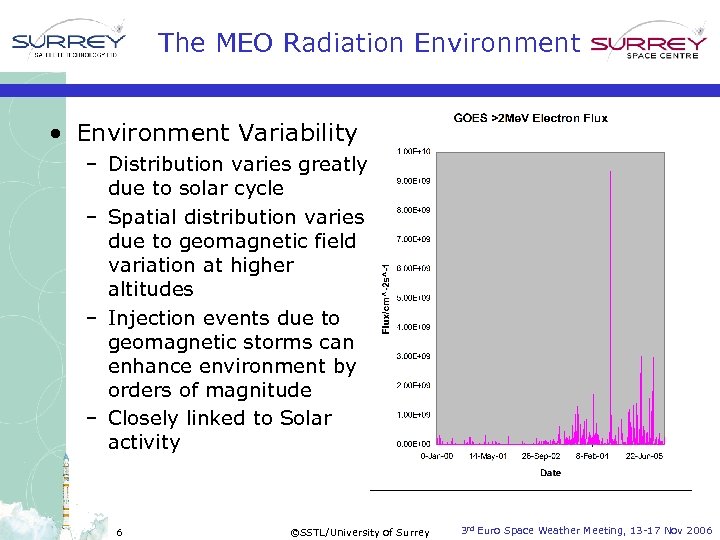 The MEO Radiation Environment • Environment Variability – Distribution varies greatly due to solar cycle – Spatial distribution varies due to geomagnetic field variation at higher altitudes – Injection events due to geomagnetic storms can enhance environment by orders of magnitude – Closely linked to Solar activity 6 ©SSTL/University of Surrey 3 rd Euro Space Weather Meeting, 13 -17 Nov 2006
 The MEO Radiation Environment • Environment dangers and effects – Total Ionising Dose (TID) caused by energetic particles (electrons, protons and heavy ions) – Single Event Effects (SEE) caused by energetic heavy ions and protons – Electrostatic Discharge (ESD) – caused by penetrating electrons 7 ©SSTL/University of Surrey 3 rd Euro Space Weather Meeting, 13 -17 Nov 2006
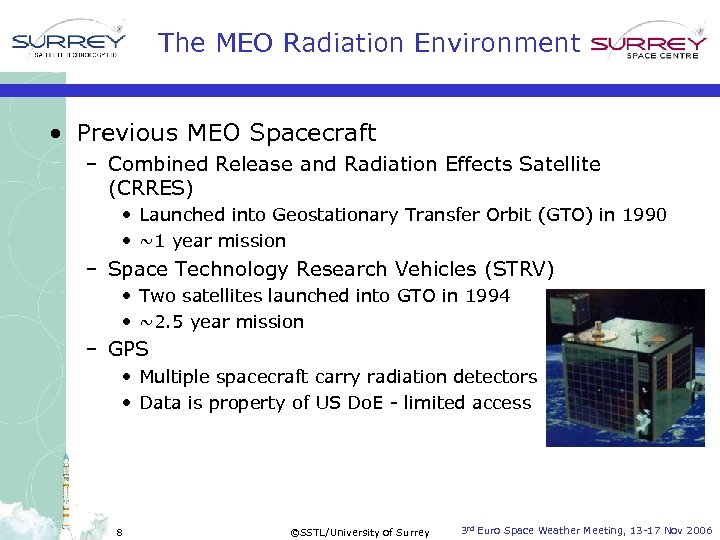 The MEO Radiation Environment • Previous MEO Spacecraft – Combined Release and Radiation Effects Satellite (CRRES) • Launched into Geostationary Transfer Orbit (GTO) in 1990 • ~1 year mission – Space Technology Research Vehicles (STRV) • Two satellites launched into GTO in 1994 • ~2. 5 year mission – GPS • Multiple spacecraft carry radiation detectors • Data is property of US Do. E - limited access 8 ©SSTL/University of Surrey 3 rd Euro Space Weather Meeting, 13 -17 Nov 2006
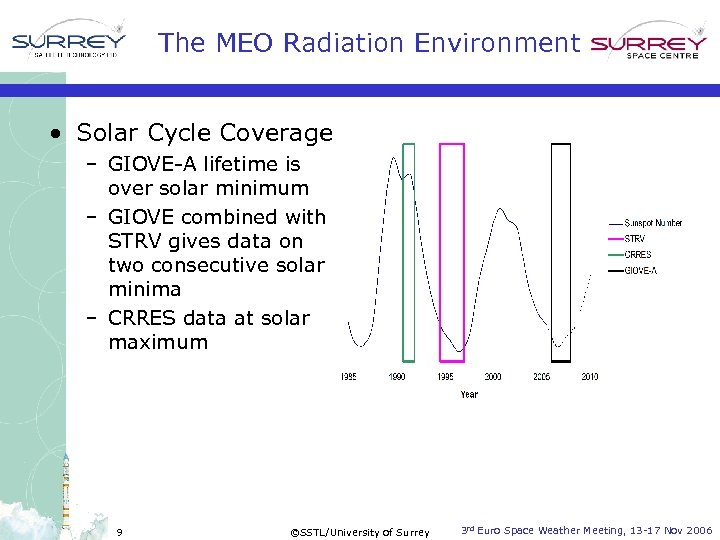 The MEO Radiation Environment • Solar Cycle Coverage – GIOVE-A lifetime is over solar minimum – GIOVE combined with STRV gives data on two consecutive solar minima – CRRES data at solar maximum 9 ©SSTL/University of Surrey 3 rd Euro Space Weather Meeting, 13 -17 Nov 2006
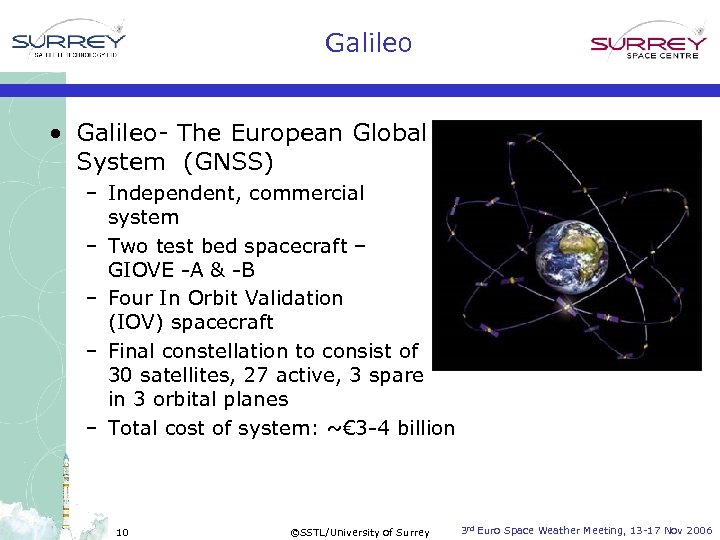 Galileo • Galileo- The European Global Navigation Satellite System (GNSS) – Independent, commercial system – Two test bed spacecraft – GIOVE -A & -B – Four In Orbit Validation (IOV) spacecraft – Final constellation to consist of 30 satellites, 27 active, 3 spare in 3 orbital planes – Total cost of system: ~€ 3 -4 billion 10 ©SSTL/University of Surrey 3 rd Euro Space Weather Meeting, 13 -17 Nov 2006
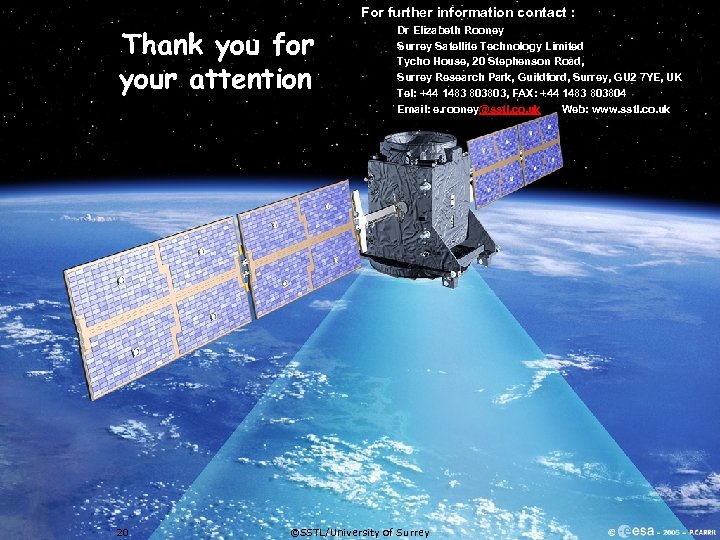
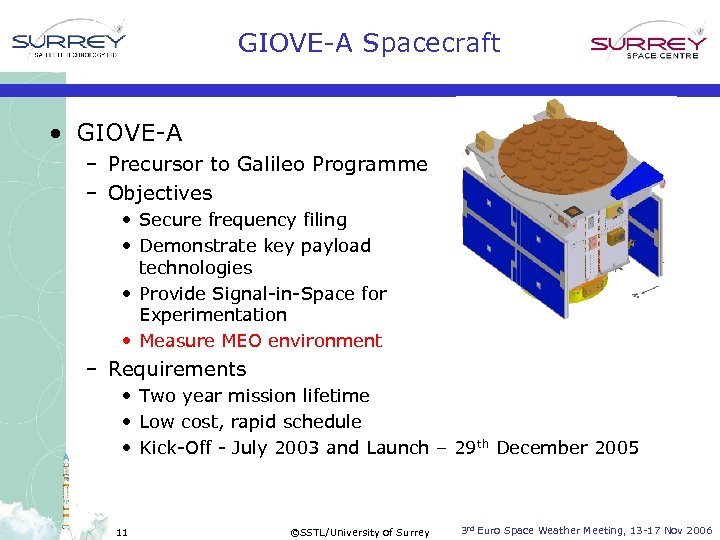 GIOVE-A Spacecraft • GIOVE-A – Precursor to Galileo Programme – Objectives • Secure frequency filing • Demonstrate key payload technologies • Provide Signal-in-Space for Experimentation • Measure MEO environment – Requirements • Two year mission lifetime • Low cost, rapid schedule • Kick-Off - July 2003 and Launch – 29 th December 2005 11 ©SSTL/University of Surrey 3 rd Euro Space Weather Meeting, 13 -17 Nov 2006
 MEO Environment Goals • Optimise the design of the Galileo satellites – Confirm requirements are correct, modify if necessary • Are existing models a good enough description of the environment? – – LET spectrum Electron Fluxes Total Ionising Dose rates 12 ©SSTL/University of Surrey 3 rd Euro Space Weather Meeting, 13 -17 Nov 2006
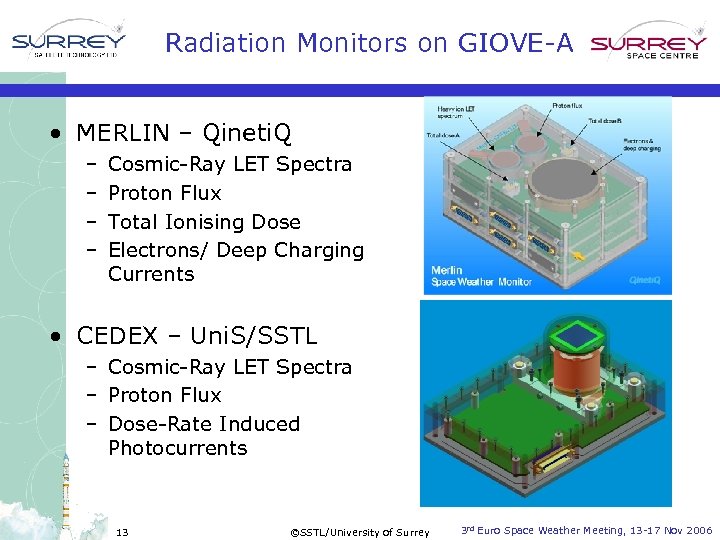 Radiation Monitors on GIOVE-A • MERLIN – Qineti. Q – – Cosmic-Ray LET Spectra Proton Flux Total Ionising Dose Electrons/ Deep Charging Currents • CEDEX – Uni. S/SSTL – Cosmic-Ray LET Spectra – Proton Flux – Dose-Rate Induced Photocurrents 13 ©SSTL/University of Surrey 3 rd Euro Space Weather Meeting, 13 -17 Nov 2006
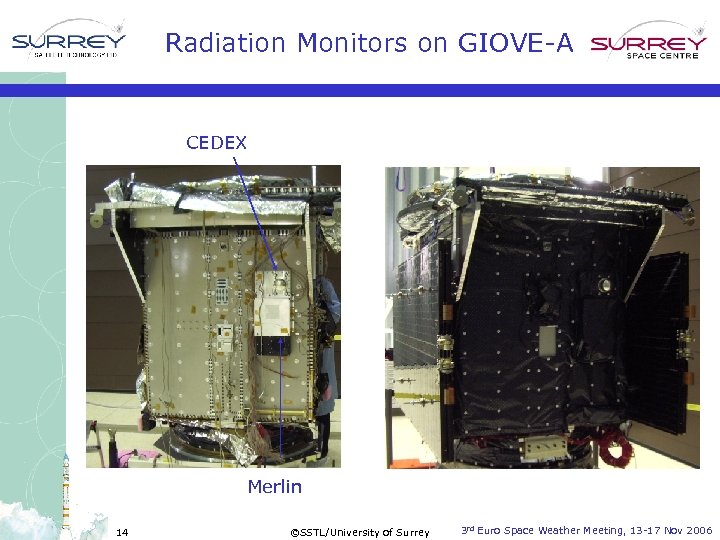 Radiation Monitors on GIOVE-A CEDEX Merlin 14 ©SSTL/University of Surrey 3 rd Euro Space Weather Meeting, 13 -17 Nov 2006
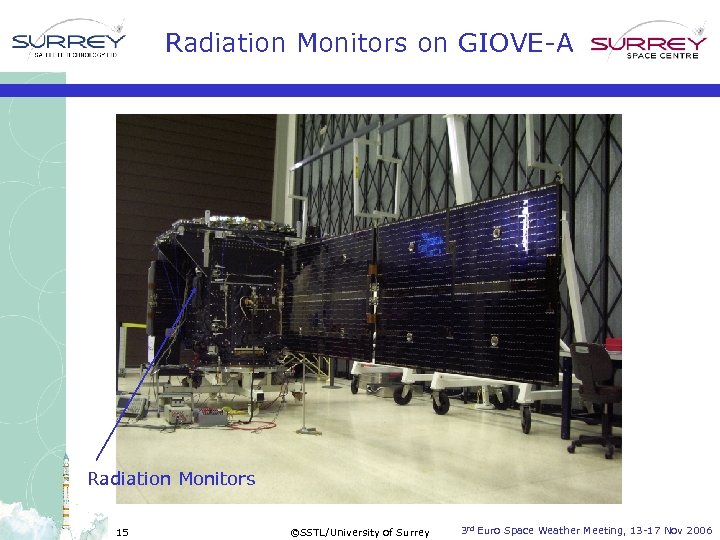 Radiation Monitors on GIOVE-A Radiation Monitors 15 ©SSTL/University of Surrey 3 rd Euro Space Weather Meeting, 13 -17 Nov 2006
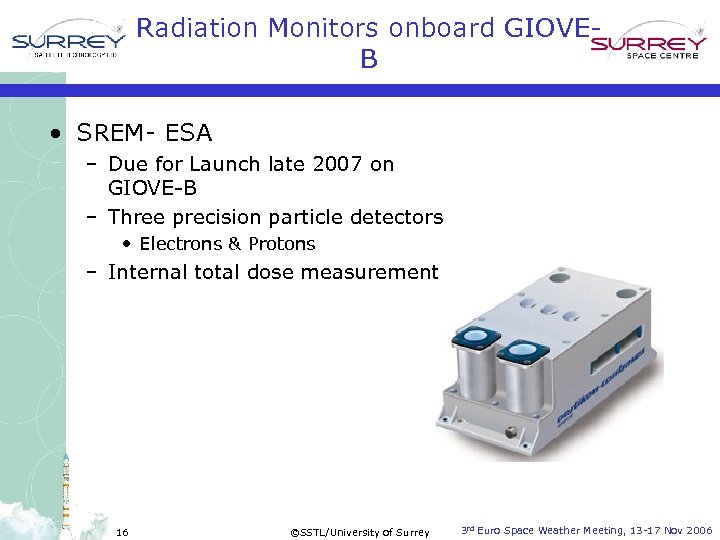 Radiation Monitors onboard GIOVEB • SREM- ESA – Due for Launch late 2007 on GIOVE-B – Three precision particle detectors • Electrons & Protons – Internal total dose measurement 16 ©SSTL/University of Surrey 3 rd Euro Space Weather Meeting, 13 -17 Nov 2006
 Timeline – Initial Operations • CEDEX & Merlin turned on - 29 th December 2005 – Second contact after launch – Operated near continuously since first switch-on • Environmental Readiness Review (ERR) 06/04/2006 • Environmental Payloads Commissioning Phase – Setup of download and processing chain • Initial Operations Phase – Initial analysis of data with simplified shielding models 17 ©SSTL/University of Surrey 3 rd Euro Space Weather Meeting, 13 -17 Nov 2006
 Timeline – Main Operations • Main Operations Phase – Part 1 – Simplified 1 D Mulassis, and 3 D GEANT-4 model of the payloads/ spacecraft. – Results compared to AE 8/CRRESELE • Main Operations Phase – Part 2 – Electron response of Merlin using Geant 4, SREM data expected (but now delayed) – Data compared with static and quasi-static models (AE 8, FLUMIC, CRRESELE, ESAMEA, etc). – Results used to validate modelling performed in MOP-1 – Pile-up induced responses to electrons in Proton Flux measurements from Merlin investigated to derive further data on electron environment 18 ©SSTL/University of Surrey 3 rd Euro Space Weather Meeting, 13 -17 Nov 2006
 Conclusions • Merlin and CEDEX have been operating since December 2005 • Initial commissioning activities are complete • Data analyses continue to be refined • The following two papers will describe the units in more detail and present the in-orbit results 19 ©SSTL/University of Surrey 3 rd Euro Space Weather Meeting, 13 -17 Nov 2006
 For further information contact : Thank you for your attention 20 Dr Elizabeth Rooney Surrey Satellite Technology Limited Tycho House, 20 Stephenson Road, Surrey Research Park, Guildford, Surrey, GU 2 7 YE, UK Tel: +44 1483 803803, FAX: +44 1483 803804 Email: e. rooney@sstl. co. uk Web: www. sstl. co. uk ©SSTL/University of Surrey 3 rd Euro Space Weather Meeting, 13 -17 Nov 2006