 Скачать презентацию Giorgi Japaridze Theory of Computability The class NP
97d33f2a1a60fd94f9d768767584647f.ppt
- Количество слайдов: 11



Giorgi Japaridze Theory of Computability The class NP Section 7. 3
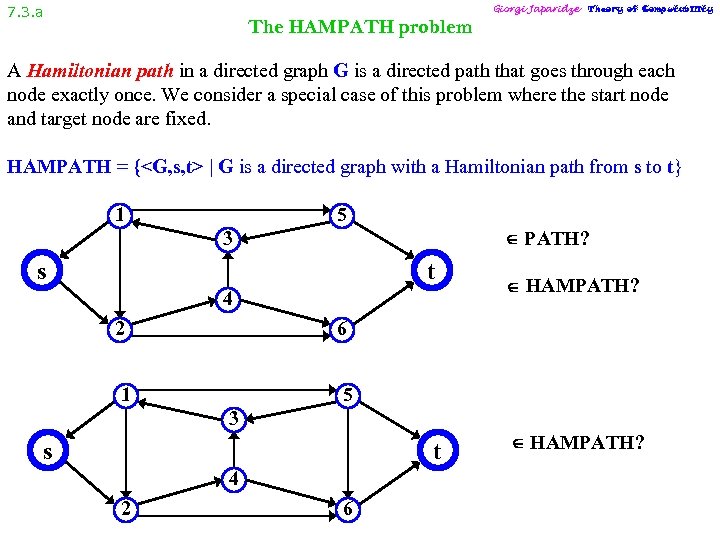
Giorgi Japaridze 7. 3. a Theory of Computability The HAMPATH problem A Hamiltonian path in a directed graph G is a directed path that goes through each node exactly once. We consider a special case of this problem where the start node and target node are fixed. HAMPATH = {<G, s, t> | G is a directed graph with a Hamiltonian path from s to t} 1 5 PATH? 3 s t 4 2 6 1 HAMPATH? 5 3 s t 4 2 6 HAMPATH?
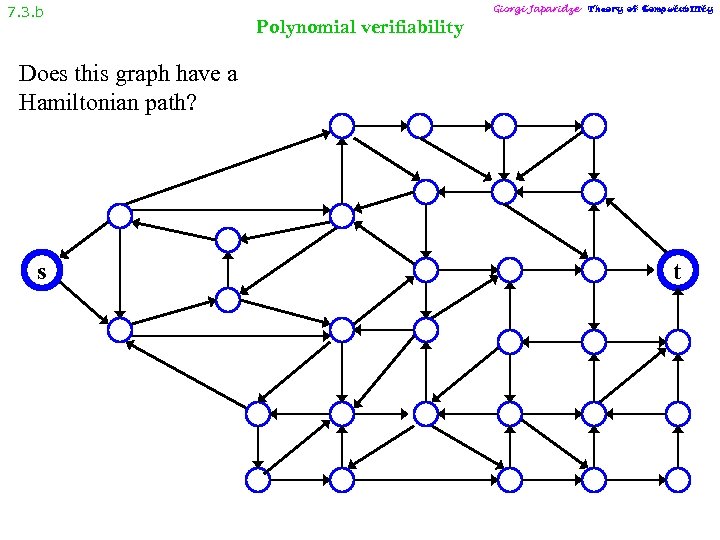
7. 3. b Giorgi Japaridze Theory of Computability Polynomial verifiability Does this graph have a Hamiltonian path? s t
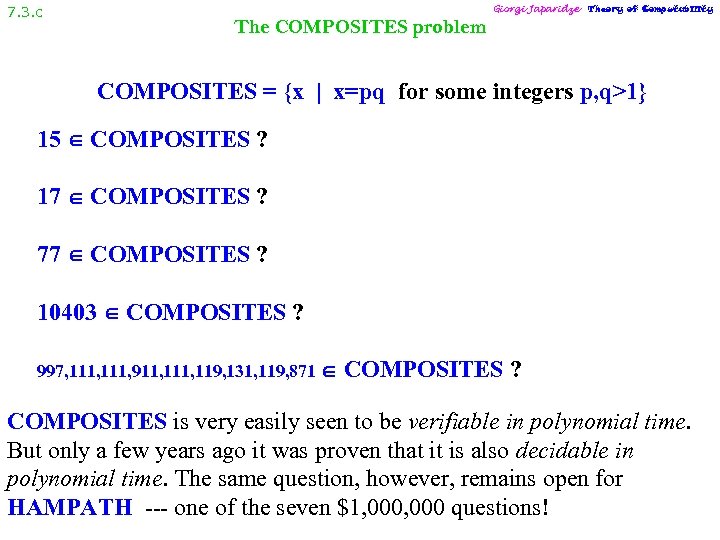
7. 3. c Giorgi Japaridze Theory of Computability The COMPOSITES problem COMPOSITES = {x | x=pq for some integers p, q>1} 15 COMPOSITES ? 17 COMPOSITES ? 77 COMPOSITES ? 10403 COMPOSITES ? 997, 111, 911, 119, 131, 119, 871 COMPOSITES ? COMPOSITES is very easily seen to be verifiable in polynomial time. But only a few years ago it was proven that it is also decidable in polynomial time. The same question, however, remains open for HAMPATH --- one of the seven $1, 000 questions!
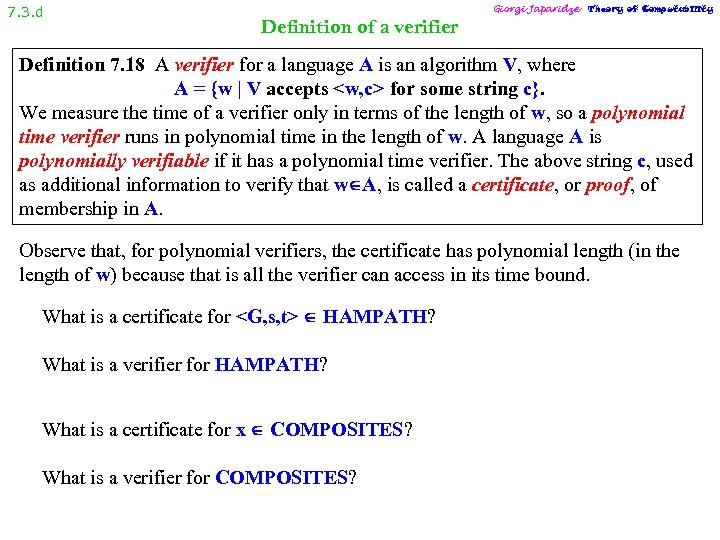
7. 3. d Giorgi Japaridze Theory of Computability Definition of a verifier Definition 7. 18 A verifier for a language A is an algorithm V, where A = {w | V accepts <w, c> for some string c}. We measure the time of a verifier only in terms of the length of w, so a polynomial time verifier runs in polynomial time in the length of w. A language A is polynomially verifiable if it has a polynomial time verifier. The above string c, used as additional information to verify that w A, is called a certificate, or proof, of membership in A. Observe that, for polynomial verifiers, the certificate has polynomial length (in the length of w) because that is all the verifier can access in its time bound. What is a certificate for <G, s, t> HAMPATH? What is a verifier for HAMPATH? What is a certificate for x COMPOSITES? What is a verifier for COMPOSITES?
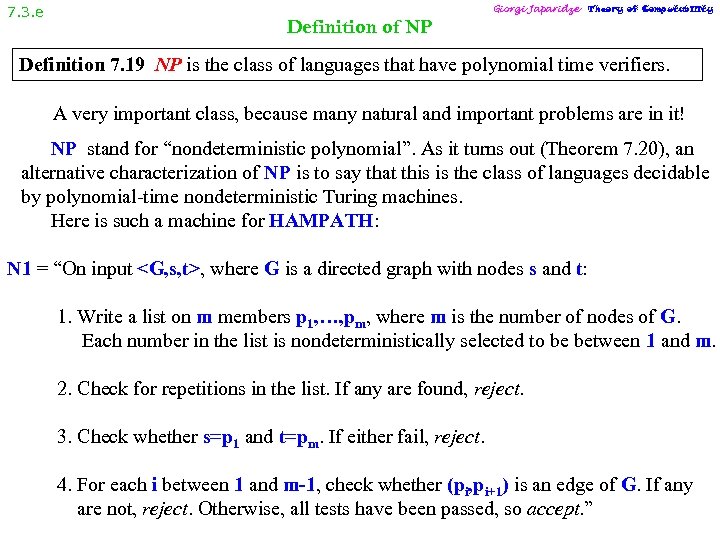
7. 3. e Giorgi Japaridze Theory of Computability Definition of NP Definition 7. 19 NP is the class of languages that have polynomial time verifiers. A very important class, because many natural and important problems are in it! NP stand for “nondeterministic polynomial”. As it turns out (Theorem 7. 20), an alternative characterization of NP is to say that this is the class of languages decidable by polynomial-time nondeterministic Turing machines. Here is such a machine for HAMPATH: N 1 = “On input <G, s, t>, where G is a directed graph with nodes s and t: 1. Write a list on m members p 1, …, pm, where m is the number of nodes of G. Each number in the list is nondeterministically selected to be between 1 and m. 2. Check for repetitions in the list. If any are found, reject. 3. Check whether s=p 1 and t=pm. If either fail, reject. 4. For each i between 1 and m-1, check whether (pi, pi+1) is an edge of G. If any are not, reject. Otherwise, all tests have been passed, so accept. ”
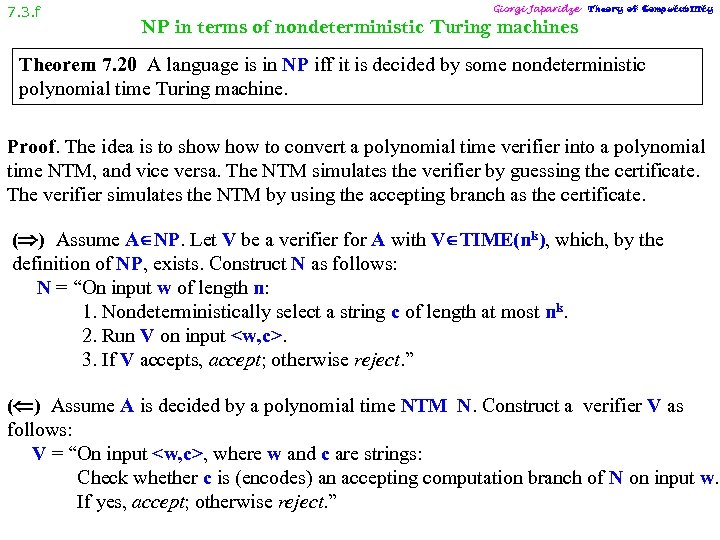
7. 3. f Giorgi Japaridze Theory of Computability NP in terms of nondeterministic Turing machines Theorem 7. 20 A language is in NP iff it is decided by some nondeterministic polynomial time Turing machine. Proof. The idea is to show to convert a polynomial time verifier into a polynomial time NTM, and vice versa. The NTM simulates the verifier by guessing the certificate. The verifier simulates the NTM by using the accepting branch as the certificate. ( ) Assume A NP. Let V be a verifier for A with V TIME(nk), which, by the definition of NP, exists. Construct N as follows: N = “On input w of length n: 1. Nondeterministically select a string c of length at most nk. 2. Run V on input <w, c>. 3. If V accepts, accept; otherwise reject. ” ( ) Assume A is decided by a polynomial time NTM N. Construct a verifier V as follows: V = “On input <w, c>, where w and c are strings: Check whether c is (encodes) an accepting computation branch of N on input w. If yes, accept; otherwise reject. ”
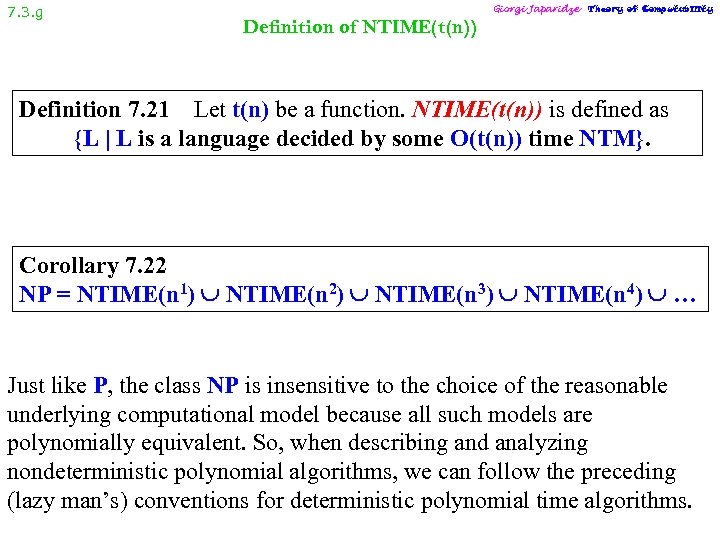
7. 3. g Giorgi Japaridze Theory of Computability Definition of NTIME(t(n)) Definition 7. 21 Let t(n) be a function. NTIME(t(n)) is defined as {L | L is a language decided by some O(t(n)) time NTM}. Corollary 7. 22 NP = NTIME(n 1) NTIME(n 2) NTIME(n 3) NTIME(n 4) … Just like P, the class NP is insensitive to the choice of the reasonable underlying computational model because all such models are polynomially equivalent. So, when describing and analyzing nondeterministic polynomial algorithms, we can follow the preceding (lazy man’s) conventions for deterministic polynomial time algorithms.
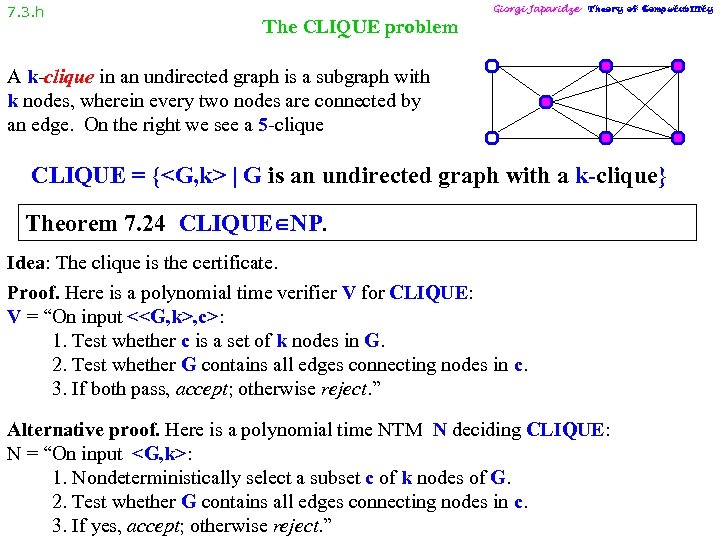
7. 3. h Giorgi Japaridze Theory of Computability The CLIQUE problem A k-clique in an undirected graph is a subgraph with k nodes, wherein every two nodes are connected by an edge. On the right we see a 5 -clique CLIQUE = {<G, k> | G is an undirected graph with a k-clique} Theorem 7. 24 CLIQUE NP. Idea: The clique is the certificate. Proof. Here is a polynomial time verifier V for CLIQUE: V = “On input <<G, k>, c>: 1. Test whether c is a set of k nodes in G. 2. Test whether G contains all edges connecting nodes in c. 3. If both pass, accept; otherwise reject. ” Alternative proof. Here is a polynomial time NTM N deciding CLIQUE: N = “On input <G, k>: 1. Nondeterministically select a subset c of k nodes of G. 2. Test whether G contains all edges connecting nodes in c. 3. If yes, accept; otherwise reject. ”
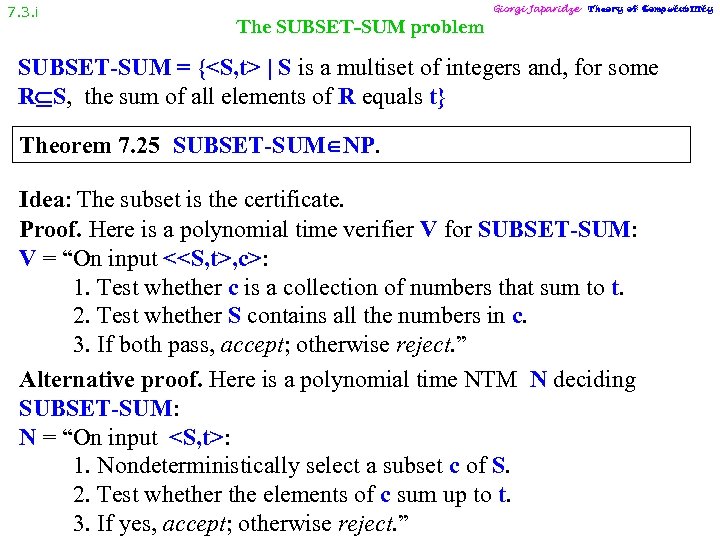
7. 3. i Giorgi Japaridze Theory of Computability The SUBSET-SUM problem SUBSET-SUM = {<S, t> | S is a multiset of integers and, for some R S, the sum of all elements of R equals t} Theorem 7. 25 SUBSET-SUM NP. Idea: The subset is the certificate. Proof. Here is a polynomial time verifier V for SUBSET-SUM: V = “On input <<S, t>, c>: 1. Test whether c is a collection of numbers that sum to t. 2. Test whether S contains all the numbers in c. 3. If both pass, accept; otherwise reject. ” Alternative proof. Here is a polynomial time NTM N deciding SUBSET-SUM: N = “On input <S, t>: 1. Nondeterministically select a subset c of S. 2. Test whether the elements of c sum up to t. 3. If yes, accept; otherwise reject. ”
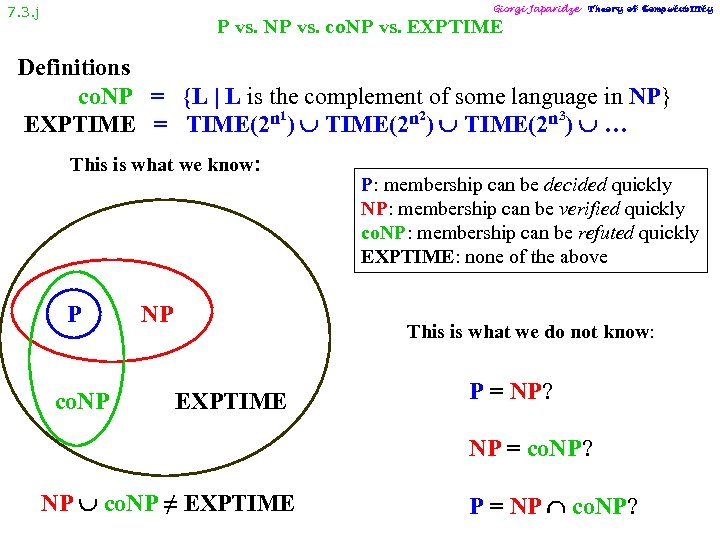
Giorgi Japaridze 7. 3. j Theory of Computability P vs. NP vs. co. NP vs. EXPTIME Definitions co. NP = {L | L is the complement of some language in NP} 1 2 3 EXPTIME = TIME(2 n ) … This is what we know: P co. NP NP P: membership can be decided quickly NP: membership can be verified quickly co. NP: membership can be refuted quickly EXPTIME: none of the above This is what we do not know: EXPTIME P = NP? NP = co. NP? NP co. NP ≠ EXPTIME P = NP co. NP?
Скачать презентацию Giorgi Japaridze Theory of Computability The class NP
97d33f2a1a60fd94f9d768767584647f.ppt