 Скачать презентацию Gini Index IBM Intelligent Miner n Gini index
a033b3e8c46053ce7a7b7bf546ea58c4.ppt
- Количество слайдов: 32



Gini Index (IBM Intelligent. Miner) n Gini index n n All attributes are assumed continuous-valued Assume there exist several possible split values for each attribute May need other tools, such as clustering, to get the possible split values Can be modified for categorical attributes 1
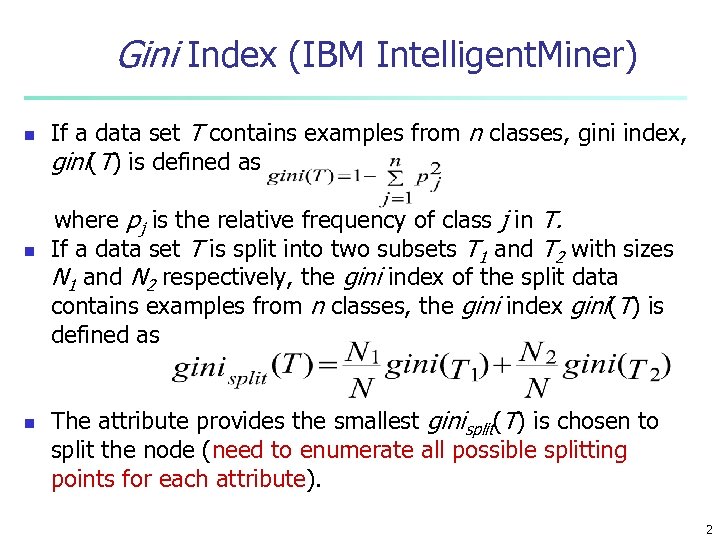
Gini Index (IBM Intelligent. Miner) n n n If a data set T contains examples from n classes, gini index, gini(T) is defined as where pj is the relative frequency of class j in T. If a data set T is split into two subsets T 1 and T 2 with sizes N 1 and N 2 respectively, the gini index of the split data contains examples from n classes, the gini index gini(T) is defined as The attribute provides the smallest ginisplit(T) is chosen to split the node (need to enumerate all possible splitting points for each attribute). 2

Example for gini Index n n Suppose there two attributes: age and income, and the class label is buy and not buy. There are three possible split values for age: 30, 40, 50. There are two possible split values for income: 30 K, 40 K We need to calculate the following gini Index n n n giniage=30(T), giniage=40(T), giniage=50(T), giniincome=30 k(T), giniincome=40 k(T) choose the minimal one as the split attribute 3
Inference Power of an Attribute n n A feature that is useful in inferring the group identity of a data tuple is said to have a good inference power to that group identity. In the following table, given attributes (features) “Gender”, “Beverage”, “State”, try to find their inference power to “Group id” 4
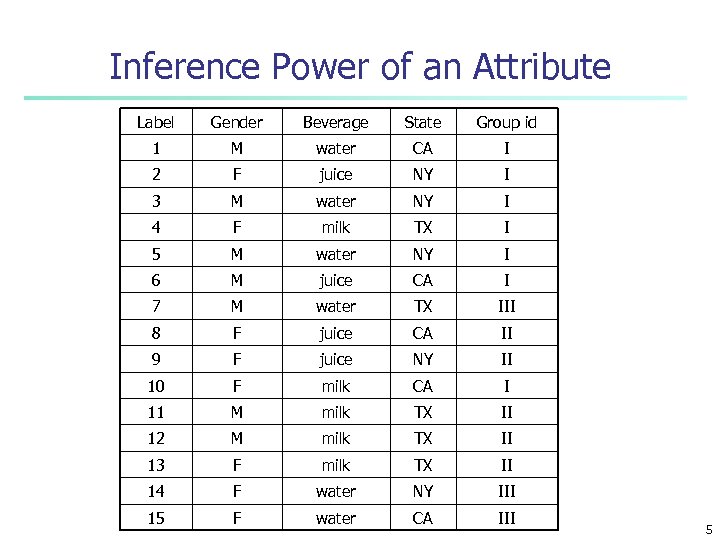
Inference Power of an Attribute Label Gender Beverage State Group id 1 M water CA I 2 F juice NY I 3 M water NY I 4 F milk TX I 5 M water NY I 6 M juice CA I 7 M water TX III 8 F juice CA II 9 F juice NY II 10 F milk CA I 11 M milk TX II 12 M milk TX II 13 F milk TX II 14 F water NY III 15 F water CA III 5
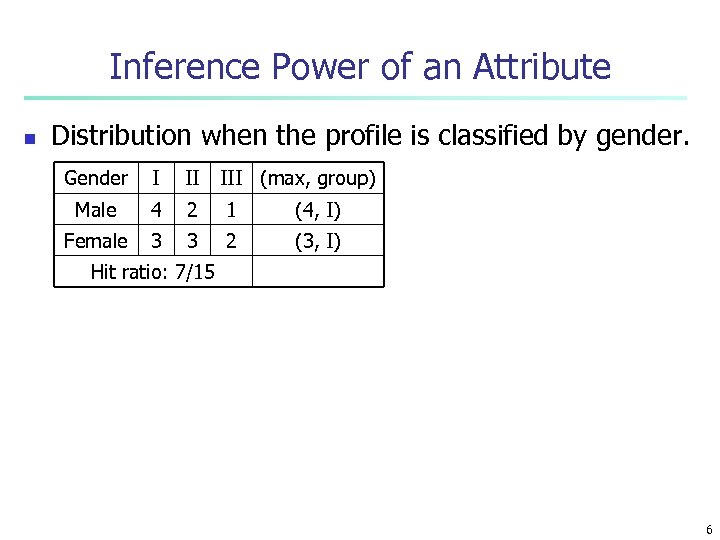
Inference Power of an Attribute n Distribution when the profile is classified by gender. Gender I II III (max, group) Male 4 2 1 (4, I) Female 3 3 2 (3, I) Hit ratio: 7/15 6

Inference Power of an Attribute n Distribution when the profile is classified by state. State I II III (max, group) CA 3 1 1 (3, I) NY 3 1 1 (3, I) TX 1 3 2 (3, II) Hit ratio: 9/15 7
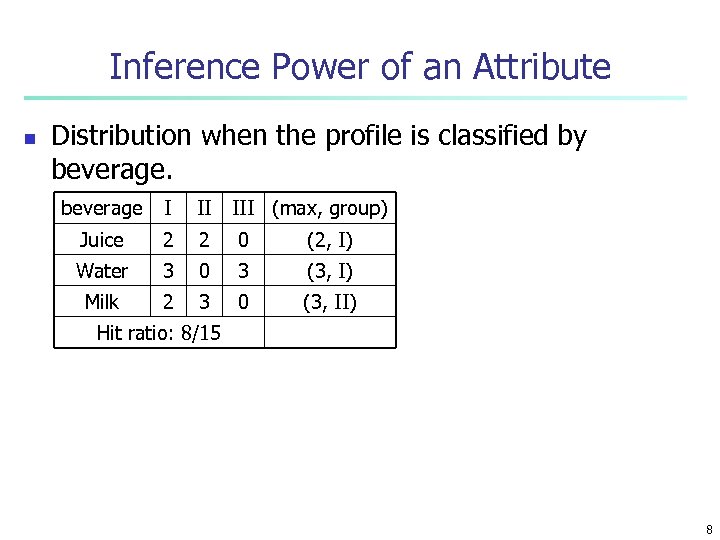
Inference Power of an Attribute n Distribution when the profile is classified by beverage I II III (max, group) Juice 2 2 0 (2, I) Water 3 0 3 (3, I) Milk 2 3 0 (3, II) Hit ratio: 8/15 8
Inference Power of an Attribute n n The “state” attribute is found to have the largest inference power The procedure continues similarly after the first level tree expanding 9
Inference Power of Multiple Attributes n It is noted that in some cases, n n the group identity is not so dependent on the value of a single attribute but instead, it is dependent upon the combined values of a set of attributes 10
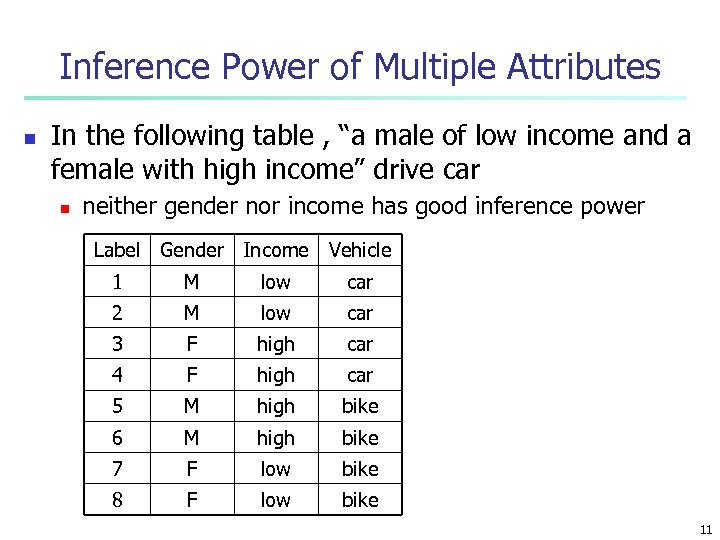
Inference Power of Multiple Attributes n In the following table , “a male of low income and a female with high income” drive car n neither gender nor income has good inference power Label Gender Income Vehicle 1 M low car 2 M low car 3 F high car 4 F high car 5 M high bike 6 M high bike 7 F low bike 8 F low bike 11
Algorithm for Inference Power Mining n Feature extraction phase: n n To learn useful features, which have good inference powers to group identities, from a subset of the training database. Feature combination phase: n To evaluate extracted features based on the entire training database and form multi-attribute predicates with good inference powers. 12
Remarks n Note that for the example profile n n n “state” is the attribute with the largest inference power “beverage” is the attribute with the highest information gain Information gain considers the cost of the whole process; hit ratio corresponds to a one-step optimization 13
Extracting Classification Rules from Trees n n n Represent the knowledge in the form of IF-THEN rules One rule is created for each path from the root to a leaf Each attribute-value pair along a path forms a conjunction The leaf node holds the class prediction Rules are easier for humans to understand 14
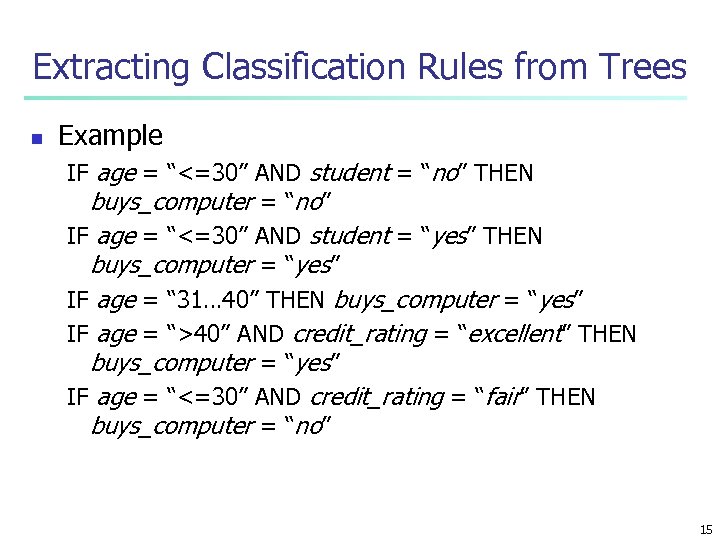
Extracting Classification Rules from Trees n Example IF age = “<=30” AND student = “no” THEN buys_computer = “no” IF age = “<=30” AND student = “yes” THEN buys_computer = “yes” IF age = “ 31… 40” THEN buys_computer = “yes” IF age = “>40” AND credit_rating = “excellent” THEN buys_computer = “yes” IF age = “<=30” AND credit_rating = “fair” THEN buys_computer = “no” 15
Classification in Large Databases n n Scalability: Classifying data sets with millions of examples and hundreds of attributes with reasonable speed Why decision tree induction in data mining? n n n relatively faster learning speed (than other classification methods) convertible to simple and easy to understand classification rules comparable classification accuracy with other methods 16
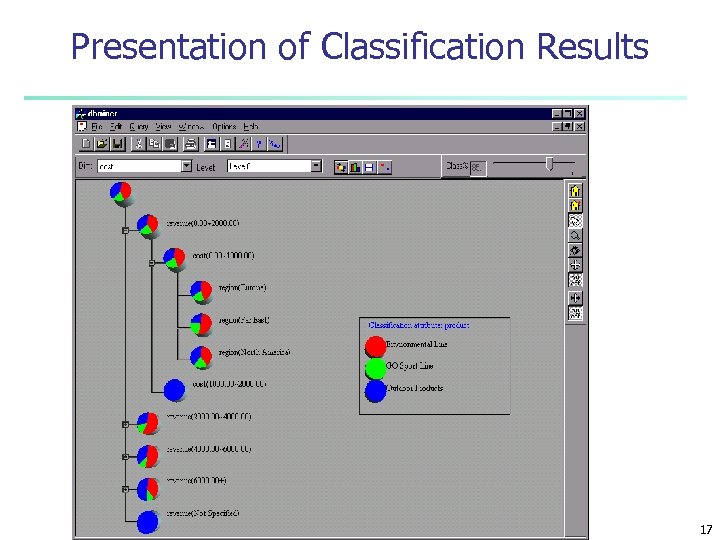
Presentation of Classification Results 17
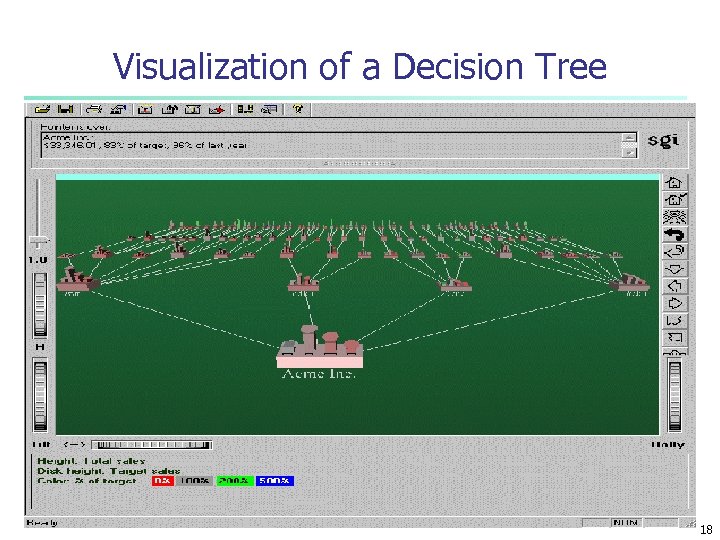
Visualization of a Decision Tree 18
Neural Networks n Analogy to Biological Systems n Massive Parallelism allowing for computational efficiency n The first learning algorithm came in 1959 (Rosenblatt) who suggested that if a target output value is provided for a single neuron with fixed inputs, one can incrementally change weights to learn to produce these outputs 19
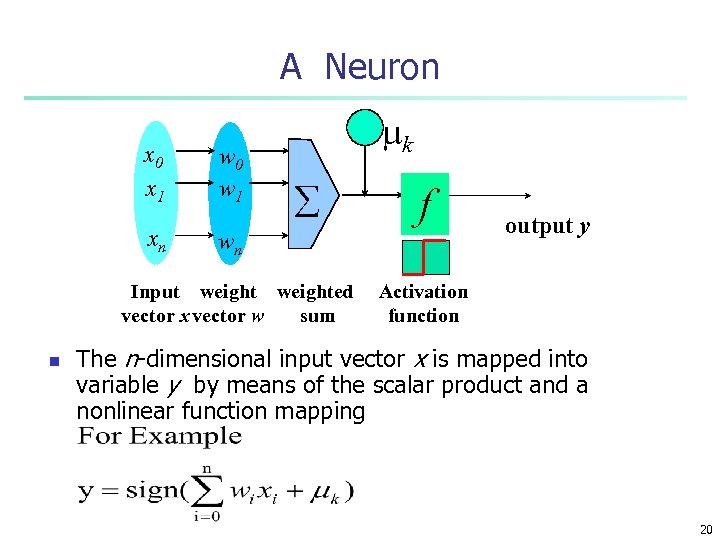
A Neuron x 0 x 1 xn w 0 w 1 - mk å wn Input weighted vector x vector w sum n f output y Activation function The n-dimensional input vector x is mapped into variable y by means of the scalar product and a nonlinear function mapping 20
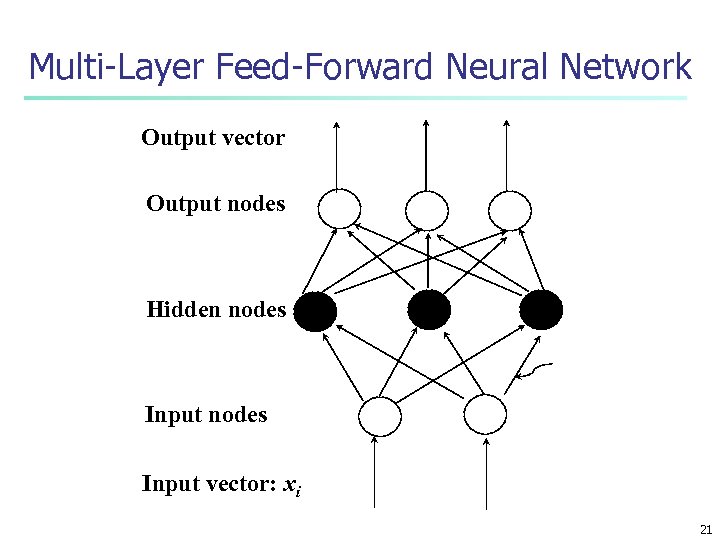
Multi-Layer Feed-Forward Neural Network Output vector Output nodes Hidden nodes Input vector: xi 21
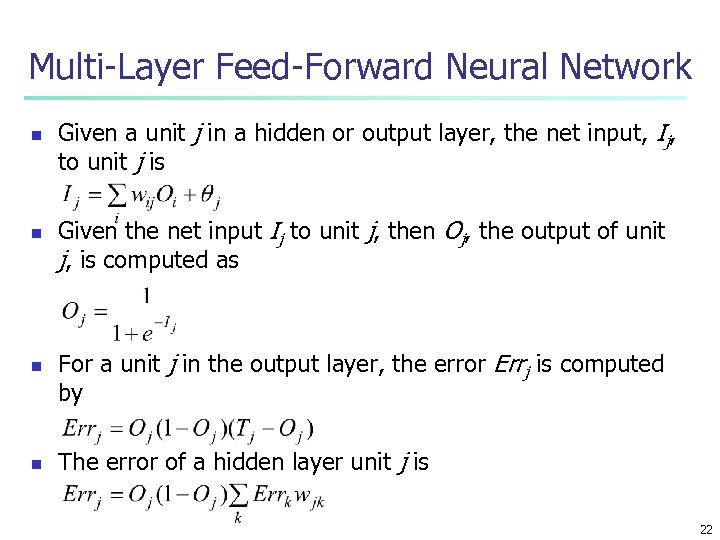
Multi-Layer Feed-Forward Neural Network n n Given a unit j in a hidden or output layer, the net input, Ij, to unit j is Given the net input Ij to unit j, then Oj, the output of unit j, is computed as For a unit j in the output layer, the error Errj is computed by The error of a hidden layer unit j is 22
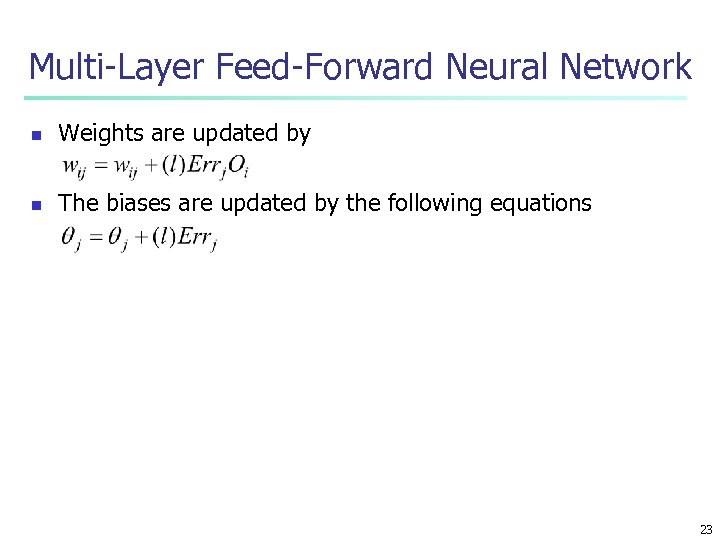
Multi-Layer Feed-Forward Neural Network n Weights are updated by n The biases are updated by the following equations 23
Network Training n The ultimate objective of training n n obtain a set of weights that makes almost all the tuples in the training data classified correctly Steps n n n Initialize weights with random values Feed the input tuples into the network one by one For each unit n n Compute the net input to the unit as a linear combination of all the inputs to the unit Compute the output value using the activation function Compute the error Update the weights and the bias 24
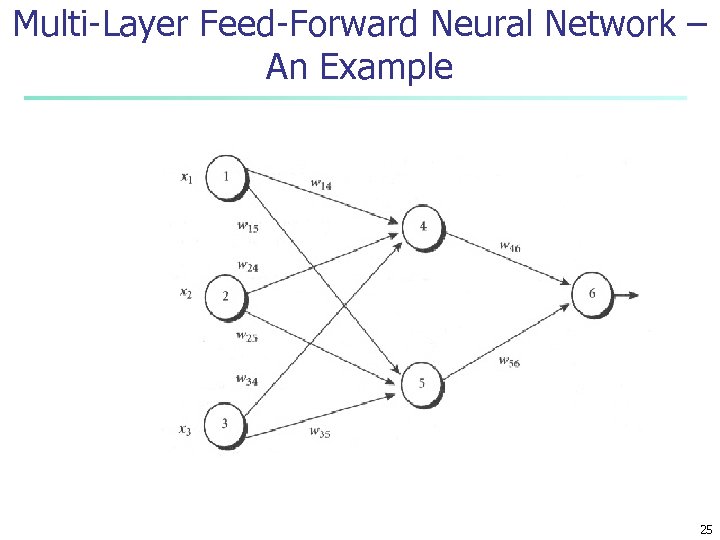
Multi-Layer Feed-Forward Neural Network – An Example 25
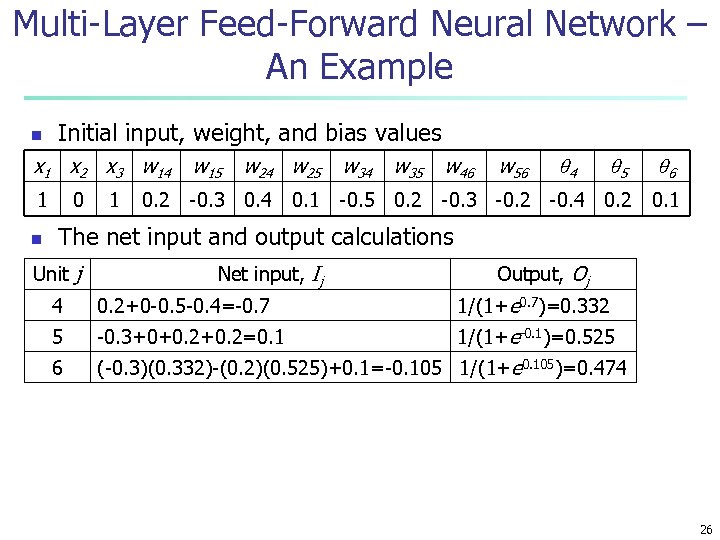
Multi-Layer Feed-Forward Neural Network – An Example n Initial input, weight, and bias values x 1 x 2 x 3 w 14 1 n 0 1 w 15 5 6 0. 1 -0. 5 0. 2 -0. 3 -0. 2 -0. 4 0. 2 0. 1 w 24 w 25 0. 2 -0. 3 0. 4 w 35 w 46 w 56 4 The net input and output calculations Unit j Net input, Ij Output, Oj 4 0. 2+0 -0. 5 -0. 4=-0. 7 1/(1+e 0. 7)=0. 332 5 -0. 3+0+0. 2=0. 1 1/(1+e-0. 1)=0. 525 6 (-0. 3)(0. 332)-(0. 2)(0. 525)+0. 1=-0. 105 1/(1+e 0. 105)=0. 474 26
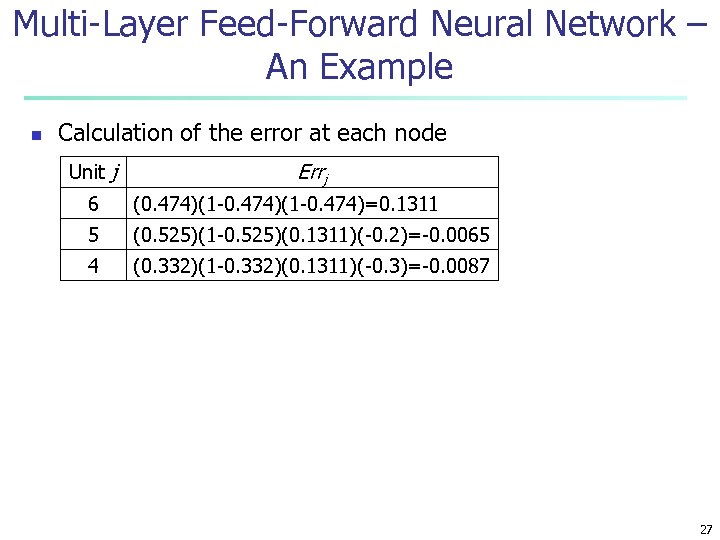
Multi-Layer Feed-Forward Neural Network – An Example n Calculation of the error at each node Unit j Errj 6 (0. 474)(1 -0. 474)=0. 1311 5 (0. 525)(1 -0. 525)(0. 1311)(-0. 2)=-0. 0065 4 (0. 332)(1 -0. 332)(0. 1311)(-0. 3)=-0. 0087 27
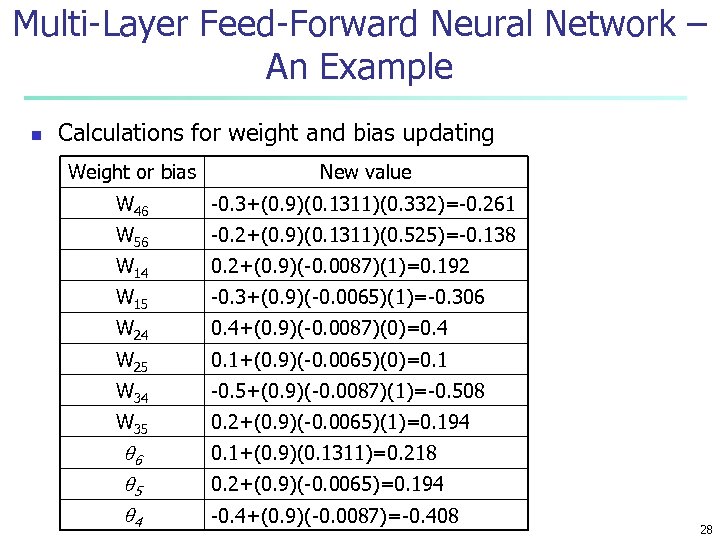
Multi-Layer Feed-Forward Neural Network – An Example n Calculations for weight and bias updating Weight or bias New value W 46 -0. 3+(0. 9)(0. 1311)(0. 332)=-0. 261 W 56 -0. 2+(0. 9)(0. 1311)(0. 525)=-0. 138 W 14 0. 2+(0. 9)(-0. 0087)(1)=0. 192 W 15 -0. 3+(0. 9)(-0. 0065)(1)=-0. 306 W 24 0. 4+(0. 9)(-0. 0087)(0)=0. 4 W 25 0. 1+(0. 9)(-0. 0065)(0)=0. 1 W 34 -0. 5+(0. 9)(-0. 0087)(1)=-0. 508 W 35 0. 2+(0. 9)(-0. 0065)(1)=0. 194 6 5 4 0. 1+(0. 9)(0. 1311)=0. 218 0. 2+(0. 9)(-0. 0065)=0. 194 -0. 4+(0. 9)(-0. 0087)=-0. 408 28
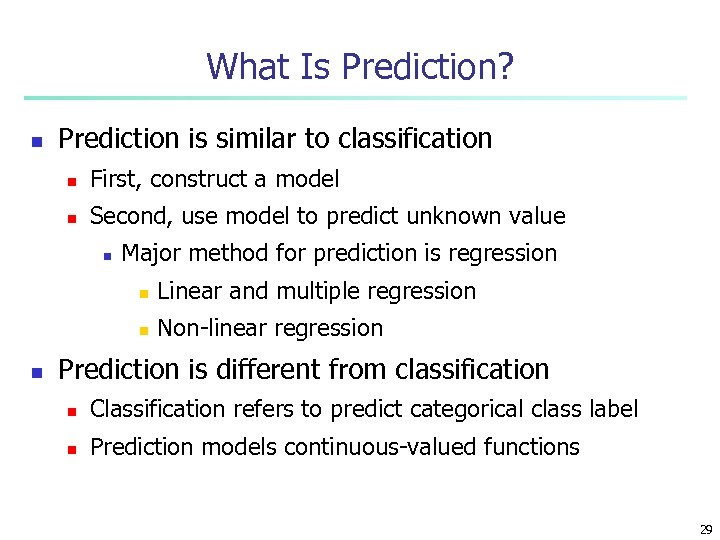
What Is Prediction? n Prediction is similar to classification n First, construct a model n Second, use model to predict unknown value n Major method for prediction is regression n Linear and multiple regression Non-linear regression Prediction is different from classification n Classification refers to predict categorical class label n Prediction models continuous-valued functions 29
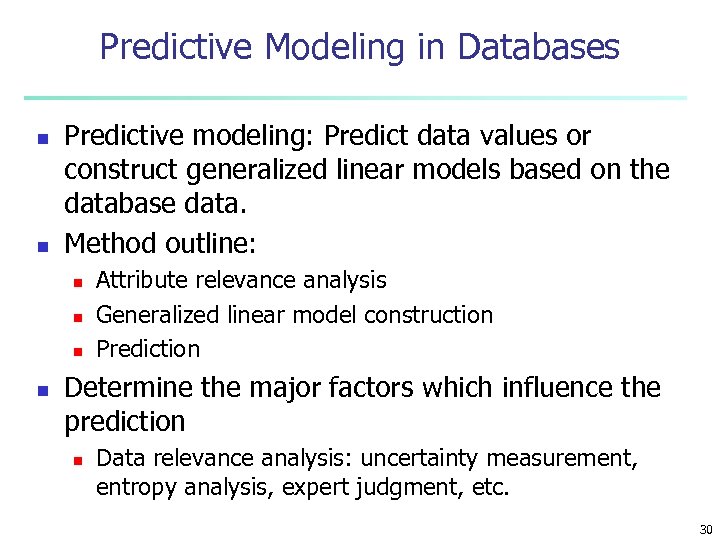
Predictive Modeling in Databases n n Predictive modeling: Predict data values or construct generalized linear models based on the database data. Method outline: n n Attribute relevance analysis Generalized linear model construction Prediction Determine the major factors which influence the prediction n Data relevance analysis: uncertainty measurement, entropy analysis, expert judgment, etc. 30
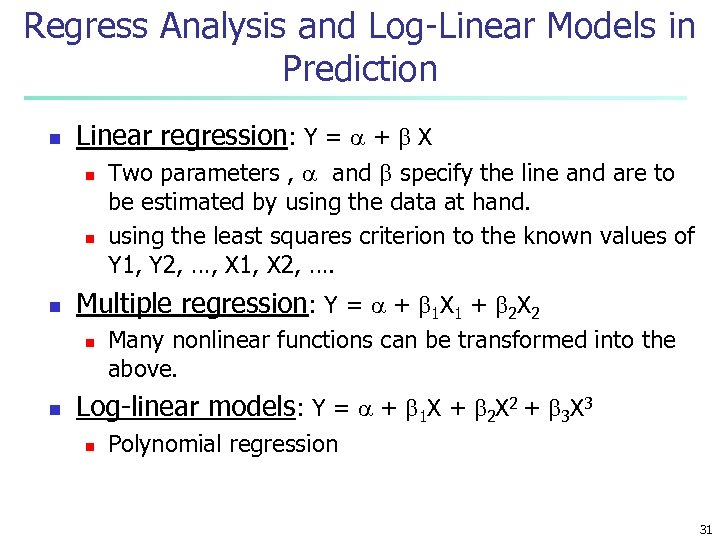
Regress Analysis and Log-Linear Models in Prediction n Linear regression: Y = + X n n n Multiple regression: Y = + 1 X 1 + 2 X 2 n n Two parameters , and specify the line and are to be estimated by using the data at hand. using the least squares criterion to the known values of Y 1, Y 2, …, X 1, X 2, …. Many nonlinear functions can be transformed into the above. Log-linear models: Y = + 1 X + 2 X 2 + 3 X 3 n Polynomial regression 31
Summary n Classification is an extensively studied problem (mainly in statistics, machine learning & neural networks) n Classification is probably one of the most widely used data mining techniques with a lot of extensions n Scalability is still an important issue for database applications: thus combining classification with database techniques should be a promising topic n Research directions: classification of non-relational data, e. g. , text, spatial, multimedia, etc. . 32
Скачать презентацию Gini Index IBM Intelligent Miner n Gini index
a033b3e8c46053ce7a7b7bf546ea58c4.ppt