


 Скачать презентацию GINCO GRUNDTVIG INTERNATIONAL NETWORK of COURSE ORGANISERS 503706
fe114775603feb0c484e9bd2ff1a67df.ppt
- Количество слайдов: 37
 GINCO GRUNDTVIG INTERNATIONAL NETWORK of COURSE ORGANISERS 503706 LLP 1 2009 1 BE GRUNDTVIG GNW
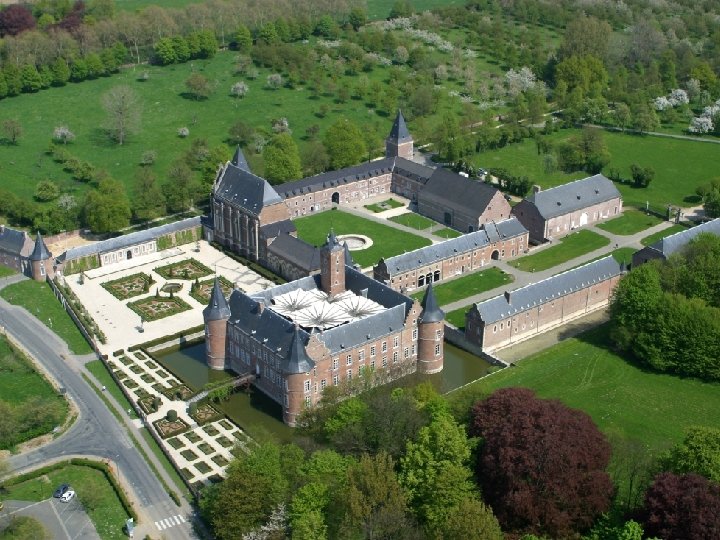
 Landcommanderij Alden Biesen • Historic place, built by the Teutonic knights • ‘State’ cultural centre, Flemish government • Touristic place • Heritage & culture • Seminar & conference centre • Training centre • European centre • Outdoor events • Historic exhibitions • Contemporary art exhibitions • Conferences & meetings • Opera & ancient music • Story telling castle • Promotion and support for decentralised LLP actions • Centralised LLP projects
 Projects coordinated by AB Sheherazade 1001 stories for adult learning MICE
 Projects with AB as a partner The Art of Networking ESCO-ORT
 GINCO background • GRU IST: the European grant system for adult educators willing to attend GRU courses, run by the National Agencies. • Courses by an international partnership in a Grundtvig project context or by individual adult education organisations. • GRU MP or NW: funds for projects or networks possibly for the development of international training courses • In support to improving access to a rich and varied provision for the professional development of adult educators. • GINCO wants to network actual and potential GRU course organisers, not only offering a forum for cooperation and exchange of expertise but also offering support for development, promotion of access, delivery, accreditation and sustainability of their courses.
 GINCO objectives • • • To contribute to improve the quality of GRU European training provision and its validation systems. To install effective mechanisms for networking and cooperation between (potential) GRU course organisers. To strengthen the cooperation between the relevant stakeholders of GRU courses. To contribute to the professionalization of AE staff concerning GRU course provision and delivery To expand the GRU course provision in LLP countries To support dissemination and sustainability of the GRU course provision
 GINCO partners 1. 2. 3. 4. 5. 6. 7. 8. 9. 10. 11. 12. 13. 14. 15. 16. 17. 18. 19. 20. 21. Landcommanderij Alden Biesen (BE) Platform Opleiding, Onderwijs en Organisatie (NL) EPOS vzw (BE) Die Berater (AT) BUPNET - Bildung und Projekt Netzwerk (DE) DEMA - Associacio Dep d'Estudis dels Medis Actuals (ES) Training 2000 (IT) Universität Bielefeld (DE) Bauer-Messner Evaluierungs KEG (AT) Klaipeda University Continuing Studies Institute (LT) Foundation Institute of Technology and Development, Sofia Univ. (BG) European Association for the Education of Adults (BE) University of Glasgow (GB) Agentia Nationala pentru Programe Comunitare in Domeniul Educatiei (RO) Kansanvalistusseura - Llin. E (FI) Lithuanian Association of Adult Education (LT) Aristotle University of Thessaloniki (HE) The Social and Healthcare College (DK) EGECED - Eğitim ve Gençlik Çalişmari Enstitüsü Derneği (TR) INstitut SUPérieur de formation permanente (FR) ECORYS (GB)
 Quality of delivery • Create and provide an evaluation frame for GRU courses, based on the SEALLL approach (www. sealll. eu) • Help course organisers apply appropriate, innovative adult LLL methodologies for their courses. • Adequate didactic use of ICT in preliminary, face to face and follow up phases.
 Validation • Improve the expertise of course organisers concerning certification and validation • Tools to manage learners’ statistics for a better management of the participants, evaluation of progress and impact and validation of learning outcomes.
 Course provision • Analysis of the present GRU course offer in the database • Analysis of national course provision, and identification of factors that lead to a European offer (6 countries). Identification of gaps between national and GRU provision. • Development of strategies to turn national provision into an international quality GRU course offer. • Products: - Guidelines - System for quality assessment of courses & course quality label: GINCO award.
 Dissemination • To disseminate the network, its activities and products and to improve dissemination of GRU course opportunities. • 3 conferences (1 each year) for stakeholders: – 2010: Course quality care & didactics: 27 -30 October, IZMIR (TR) – 2011: Learning outcome validation & impact: Thessaloniki (HE): 7 – 11 December – 2012: Course provision: Hasselt (BE): 26 – 29 September • Training days, lectures at conferences, newsletters. . . • Ginco will link up and feed into existing networks (EAEA, LLINE, ESREA. . . ) into AE associations and the GRU European INFONET AE II.
 Advocacy • spokesman on behalf of the course organisers in relation to NAs, Commission and educational policy makers at relevant levels. • help shape policy on the one hand help implement it among course organisers on the other hand. • recommendations for improvement: policy paper directed towards EC, NAs, national and European umbrellas and decision-makers. • www. ginconet. eu
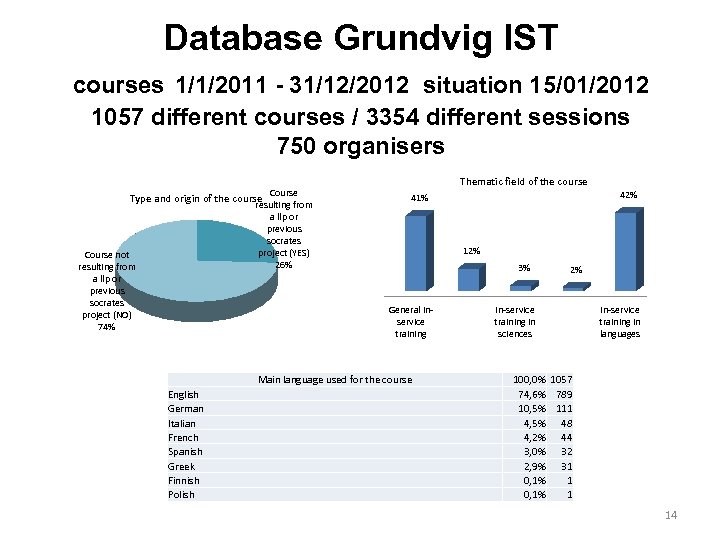 Database Grundvig IST courses 1/1/2011 - 31/12/2012 situation 15/01/2012 1057 different courses / 3354 different sessions 750 organisers Course Type and origin of the course resulting from a llp or previous socrates project (YES) Course not 26% resulting from a llp or previous socrates project (NO) 74% Thematic field of the course 12% 3% General inservice training Main language used for the course English German Italian French Spanish Greek Finnish Polish 42% 41% 2% In-service training in sciences In-service training in languages 100, 0% 1057 74, 6% 789 10, 5% 111 4, 5% 48 4, 2% 44 3, 0% 32 2, 9% 31 0, 1% 1 14
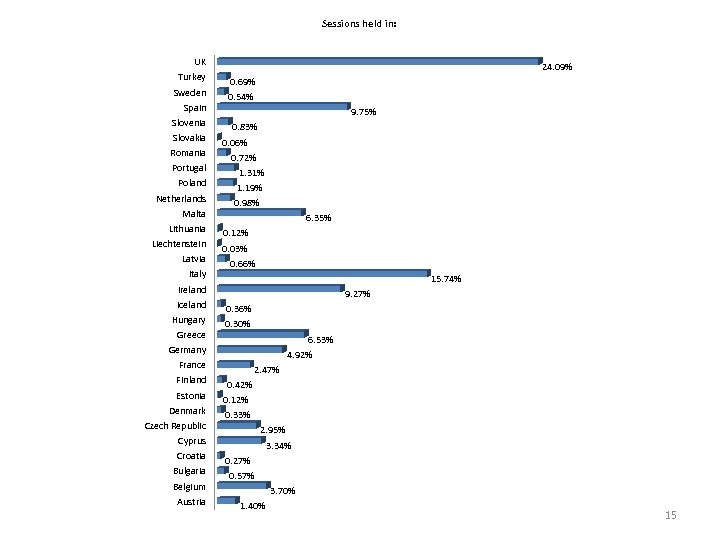 Sessions held in: UK Turkey Sweden Spain Slovenia Slovakia Romania Portugal Poland Netherlands Malta Lithuania Liechtenstein Latvia Italy Ireland Iceland Hungary Greece Germany France Finland Estonia Denmark Czech Republic Cyprus Croatia Bulgaria Belgium Austria 24. 09% 0. 69% 0. 54% 9. 75% 0. 83% 0. 06% 0. 72% 1. 31% 1. 19% 0. 98% 6. 35% 0. 12% 0. 03% 0. 66% 15. 74% 9. 27% 0. 36% 0. 30% 6. 53% 4. 92% 2. 47% 0. 42% 0. 12% 0. 33% 2. 95% 3. 34% 0. 27% 0. 57% 3. 70% 1. 40% 15
 Validation of professional development in AE GRUNDVIG IST GINCO & LEVEL 5 Guy Tilkin, Alden Biesen
 Definition: Validation is the process of identifying, assessing and recognising knowledge, skills and competences acquired in formal, non formal and informal settings. “The confirmation by a competent body that learning outcomes (knowledge, skills and/or competences) acquired by an individual in a formal, non formal or informal setting have been assessed against predefined criteria and are compliant with the requirements of a validation standard. Validation typically leads to certification. ” (2009 CEDEFOP)
 Update Oslo conference 04/03/12 • • • RPL: recognition of prior learning For certificate or shortcut in training Raising certification level, less cost than full training Employability oriented Only validation of VET competences Only (non formally) workplace developed competences No validation of personal and social competences No validation of general AE topics No volunteer, citizenship, cultural sector • What about the Grundtvig world in this respect? ? 18
 Where do we stand? • Value of having been to a Grundtvig course? • Certificate of attendance • Certificate of input • Certificate of achievement • Validation of learning outcomes • Validation of competence development • Certified by related higher ed. organisation
 Grundtvig courses: a spearhead for innovation and European priorities • • Competence driven Grundtvig courses, in which adult educators as participants experience the approach are the best way to introduce competence based education and learning. Validation of professional development in Grundtvig courses is an efficient way to spread the principle and culture of validation of learning outcomes.
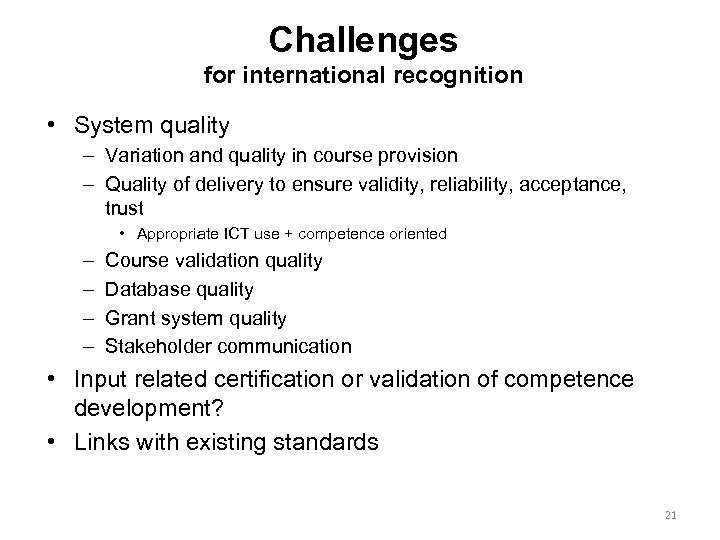 Challenges for international recognition • System quality – Variation and quality in course provision – Quality of delivery to ensure validity, reliability, acceptance, trust • Appropriate ICT use + competence oriented – – Course validation quality Database quality Grant system quality Stakeholder communication • Input related certification or validation of competence development? • Links with existing standards 21
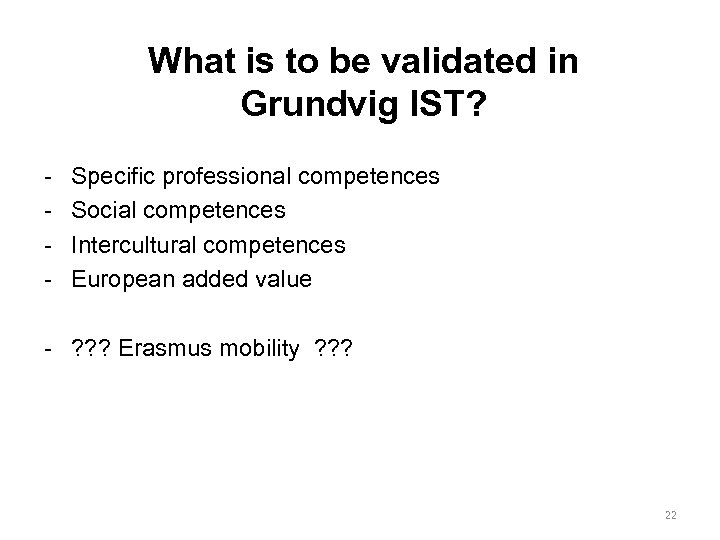 What is to be validated in Grundvig IST? Specific professional competences Social competences Intercultural competences European added value ? ? ? Erasmus mobility ? ? ? 22
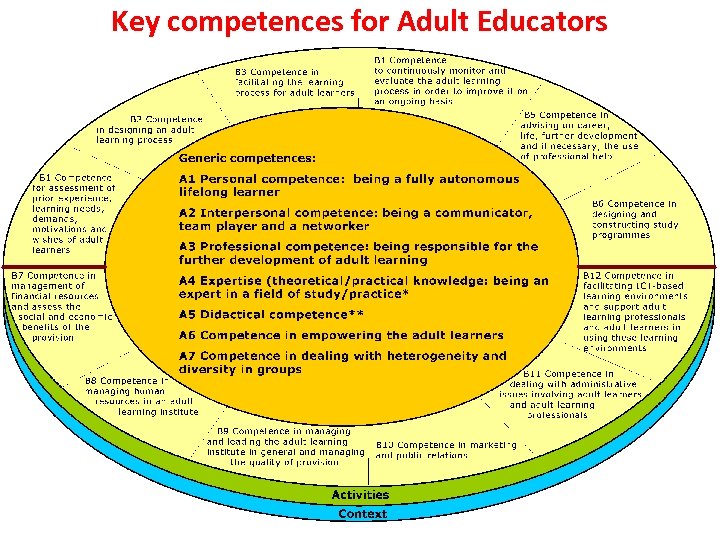 Key competences for Adult Educators
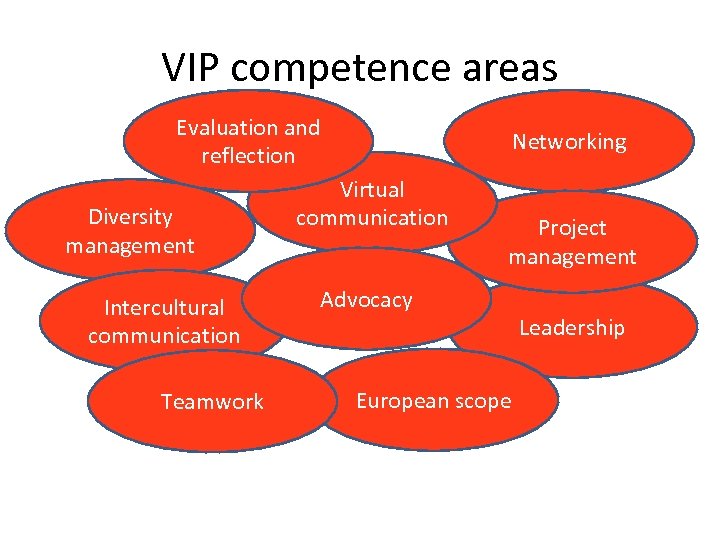 VIP competence areas Evaluation and reflection Diversity management Intercultural communication Teamwork Networking Virtual communication Project management Advocacy European scope Leadership
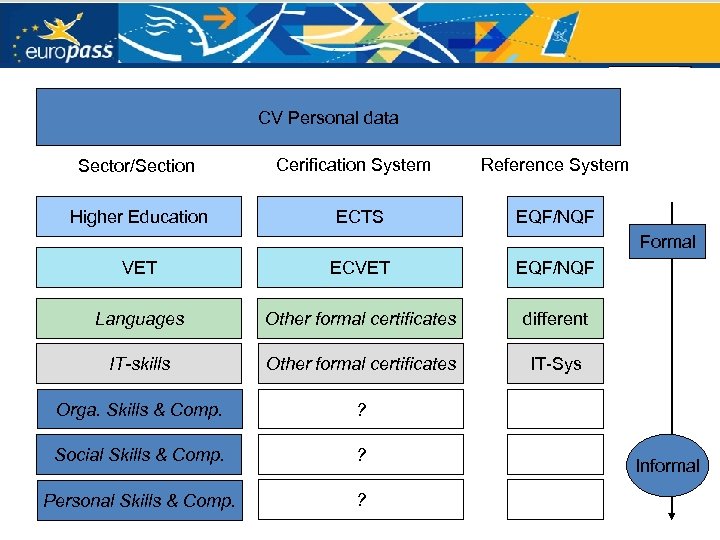 EUROPASS CV Personal data Sector/Section Higher Education Cerification System ECTS Reference System EQF/NQF Formal VET ECVET EQF/NQF Languages Other formal certificates different IT-skills Other formal certificates IT Sys Orga. Skills & Comp. ? Social Skills & Comp. ? Personal Skills & Comp. ? Informal
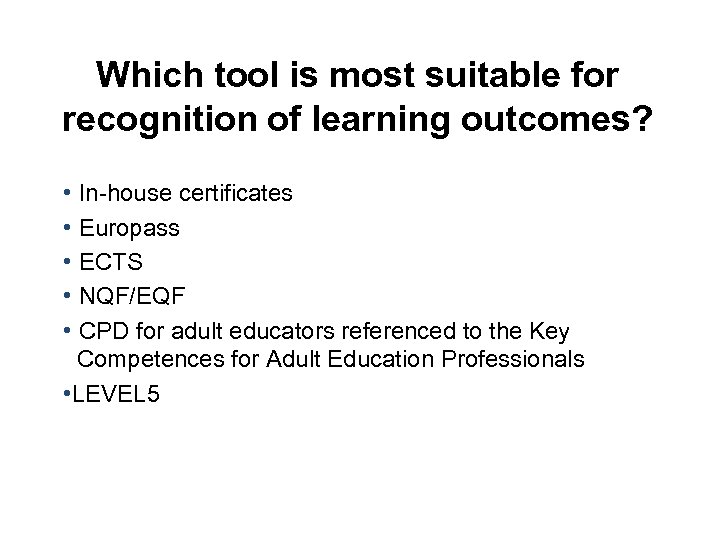 Which tool is most suitable for recognition of learning outcomes? • In house certificates • Europass • ECTS • NQF/EQF • CPD for adult educators referenced to the Key Competences for Adult Education Professionals • LEVEL 5
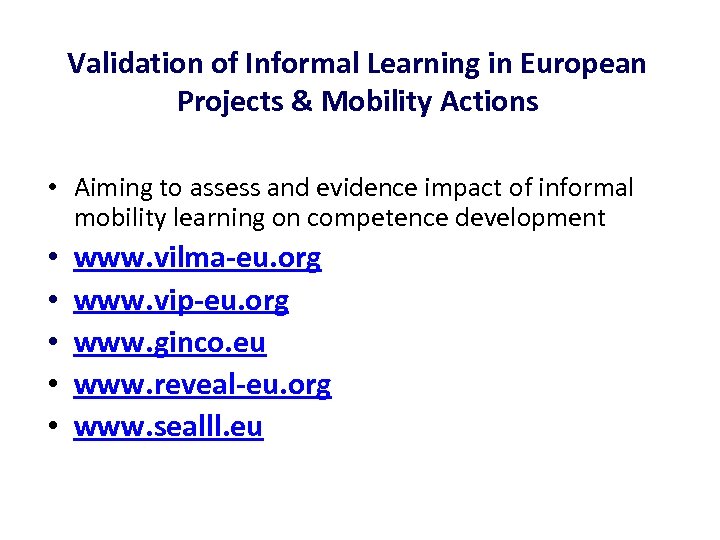 Validation of Informal Learning in European Projects & Mobility Actions • Aiming to assess and evidence impact of informal mobility learning on competence development • • • www. vilma-eu. org www. vip-eu. org www. ginco. eu www. reveal-eu. org www. sealll. eu
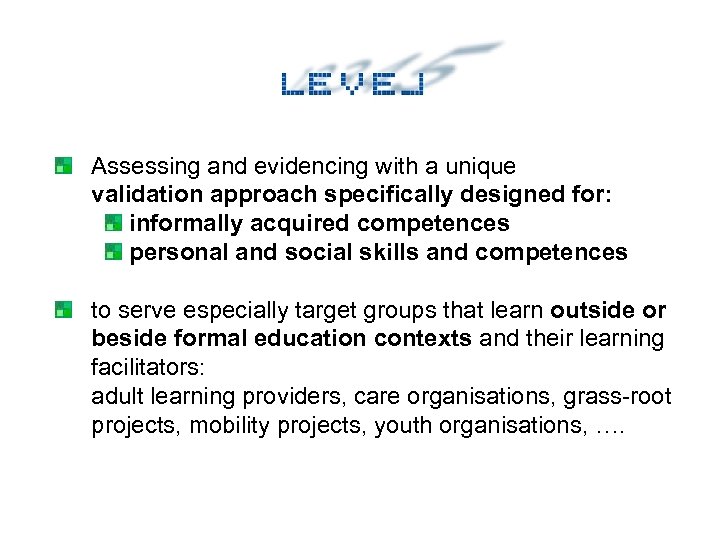 Assessing and evidencing with a unique validation approach specifically designed for: informally acquired competences personal and social skills and competences to serve especially target groups that learn outside or beside formal education contexts and their learning facilitators: adult learning providers, care organisations, grass root projects, mobility projects, youth organisations, ….
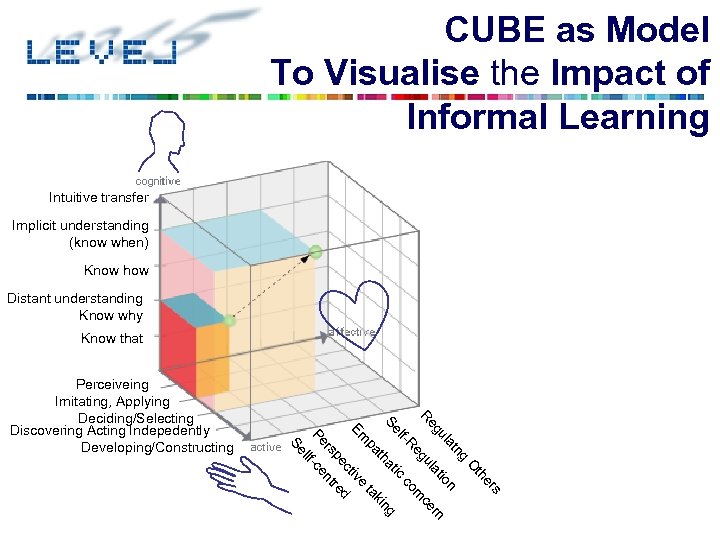 CUBE as Model To Visualise the Impact of Informal Learning Intuitive transfer Implicit understanding (know when) Know how Distant understanding Know why Know that s er th O ng n at io ul rn at eg ul ce R eg om R c lf ic Se at ng th ki pa ta e Em iv ct d pe tre rs n Pe f ce l l Se Perceiveing Imitating, Applying Deciding/Selecting Discovering Acting Indepedently Developing/Constructing
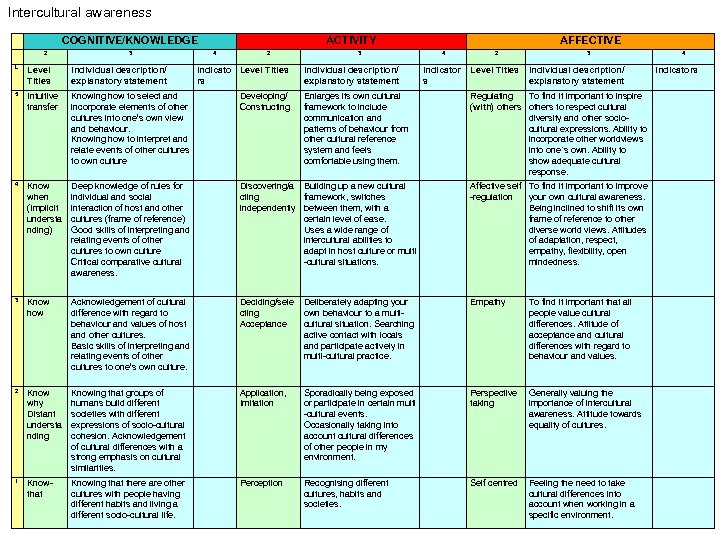 Intercultural awareness COGNITIVE/KNOWLEDGE 2 3 ACTIVITY 4 2 3 AFFECTIVE 4 2 Indicator s Level Titles 3 L Level Titles Individual description/ explanatory statement 5 Intuitive transfer Knowing how to select and incorporate elements of other cultures into one’s own view and behaviour. Knowing how to interpret and relate events of other cultures to own culture Developing/ Constructing 4 Know when (Implicit understa nding) Deep knowledge of rules for individual and social interaction of host and other cultures (frame of reference) Good skills of interpreting and relating events of other cultures to own culture Critical comparative cultural awareness. Discovering/a Building up a new cultural cting framework, switches independently between them, with a certain level of ease. Uses a wide range of intercultural abilities to adapt in host culture or multi cultural situations. Affective self To find it important to improve regulation your own cultural awareness. Being inclined to shift its own frame of reference to other diverse world views. Attitudes of adaptation, respect, empathy, flexibility, open mindedness. 3 Know how Acknowledgement of cultural difference with regard to behaviour and values of host and other cultures. Basic skills of interpreting and relating events of other cultures to one’s own culture. Deciding/sele cting Acceptance Deliberately adapting your own behaviour to a multi cultural situation. Searching active contact with locals and participate actively in multi cultural practice. Empathy To find it important that all people value cultural differences. Attitude of acceptance and cultural differences with regard to behaviour and values. 2 Know why Distant understa nding Knowing that groups of humans build different societies with different expressions of socio cultural cohesion. Acknowledgement of cultural differences with a strong emphasis on cultural similarities. Application, Imitation Sporadically being exposed or participate in certain multi cultural events. Occasionally taking into account cultural differences of other people in my environment. Perspective taking Generally valuing the importance of intercultural awareness. Attitude towards equality of cultures. 1 Know that Knowing that there are other cultures with people having different habits and living a different socio cultural life. Perception Recognising different cultures, habits and societies. Self centred Feeling the need to take cultural differences into account when working in a specific environment. Indicato Level Titles rs Individual description/ explanatory statement Enlarges its own cultural framework to include communication and patterns of behaviour from other cultural reference system and feels comfortable using them. Individual description/ explanatory statement Regulating To find it important to inspire (with) others to respect cultural diversity and other socio cultural expressions. Ability to incorporate other worldviews into one´s own. Ability to show adequate cultural response. 4 Indicators
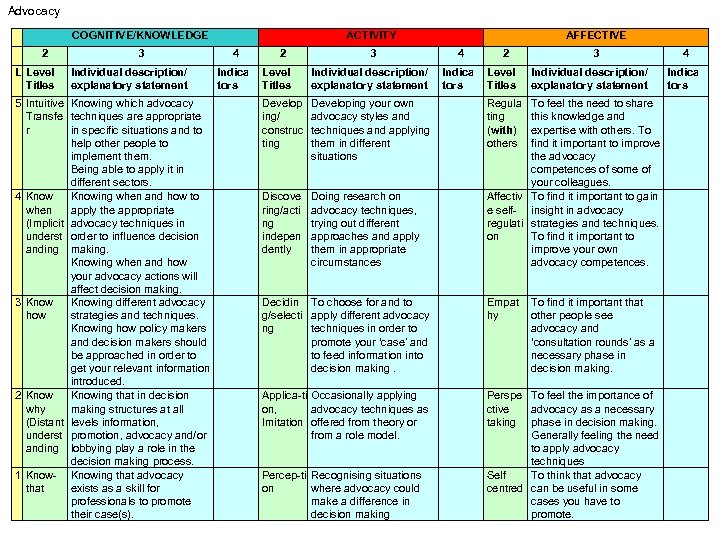 Advocacy COGNITIVE/KNOWLEDGE 2 L Level Titles 3 Individual description/ explanatory statement 5 Intuitive Knowing which advocacy Transfe techniques are appropriate r in specific situations and to help other people to implement them. Being able to apply it in different sectors. 4 Knowing when and how to when apply the appropriate (Implicit advocacy techniques in underst order to influence decision anding making. Knowing when and how your advocacy actions will affect decision making. 3 Knowing different advocacy how strategies and techniques. Knowing how policy makers and decision makers should be approached in order to get your relevant information introduced. 2 Knowing that in decision why making structures at all (Distant levels information, underst promotion, advocacy and/or anding lobbying play a role in the decision making process. 1 Knowing that advocacy that exists as a skill for professionals to promote their case(s). ACTIVITY 4 Indica tors 2 3 Level Titles Individual description/ explanatory statement Develop ing/ construc ting Developing your own advocacy styles and techniques and applying them in different situations Discove ring/acti ng indepen dently Doing research on advocacy techniques, trying out different approaches and apply them in appropriate circumstances AFFECTIVE 4 Indica tors 2 Level Titles 3 Individual description/ explanatory statement Regula ting (with) others To feel the need to share this knowledge and expertise with others. To find it important to improve the advocacy competences of some of your colleagues. Affectiv To find it important to gain e self insight in advocacy regulati strategies and techniques. on To find it important to improve your own advocacy competences. Decidin To choose for and to g/selecti apply different advocacy ng techniques in order to promote your ‘case’ and to feed information into decision making. Empat hy Applica ti Occasionally applying on, advocacy techniques as Imitation offered from theory or from a role model. Perspe To feel the importance of ctive advocacy as a necessary taking phase in decision making. Generally feeling the need to apply advocacy techniques Self To think that advocacy centred can be useful in some cases you have to promote. Percep ti Recognising situations on where advocacy could make a difference in decision making To find it important that other people see advocacy and ‘consultation rounds’ as a necessary phase in decision making. 4 Indica tors
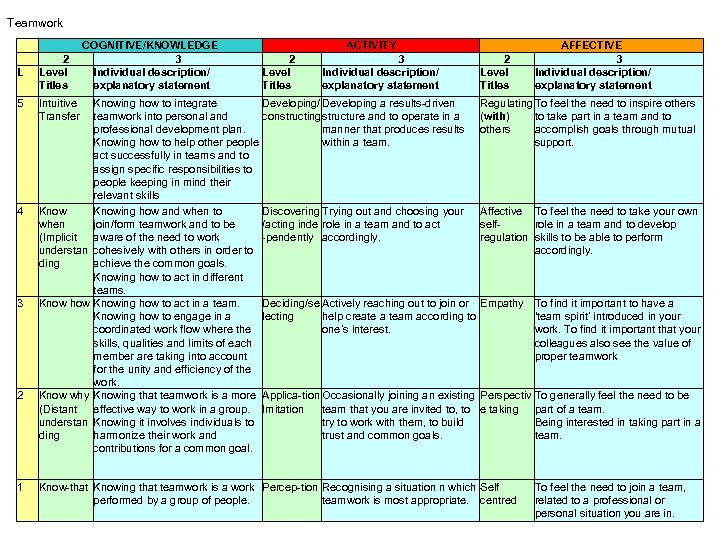 Teamwork L 2 Level Titles COGNITIVE/KNOWLEDGE 3 Individual description/ explanatory statement ACTIVITY 2 Level Titles 3 Individual description/ explanatory statement 2 Level Titles 5 Intuitive Transfer 4 Know when (Implicit understan ding 3 Know how 2 Know why (Distant understan ding 1 Know that Knowing that teamwork is a work Percep tion Recognising a situation n which Self performed by a group of people. teamwork is most appropriate. centred AFFECTIVE 3 Individual description/ explanatory statement Knowing how to integrate Developing/ Developing a results driven Regulating To feel the need to inspire others teamwork into personal and constructing structure and to operate in a (with) to take part in a team and to professional development plan. manner that produces results others accomplish goals through mutual Knowing how to help other people within a team. support. act successfully in teams and to assign specific responsibilities to people keeping in mind their relevant skills Knowing how and when to Discovering Trying out and choosing your Affective To feel the need to take your own join/form teamwork and to be /acting inde role in a team and to act self role in a team and to develop aware of the need to work pendently accordingly. regulation skills to be able to perform cohesively with others in order to accordingly. achieve the common goals. Knowing how to act in different teams. Knowing how to act in a team. Deciding/se Actively reaching out to join or Empathy To find it important to have a Knowing how to engage in a lecting help create a team according to ‘team spirit’ introduced in your coordinated work flow where the one’s interest. work. To find it important that your skills, qualities and limits of each colleagues also see the value of member are taking into account proper teamwork for the unity and efficiency of the work. Knowing that teamwork is a more Applica tion, Occasionally joining an existing Perspectiv To generally feel the need to be effective way to work in a group. Imitation team that you are invited to, to e taking part of a team. Knowing it involves individuals to try to work with them, to build Being interested in taking part in a harmonize their work and trust and common goals. team. contributions for a common goal. To feel the need to join a team, related to a professional or personal situation you are in.
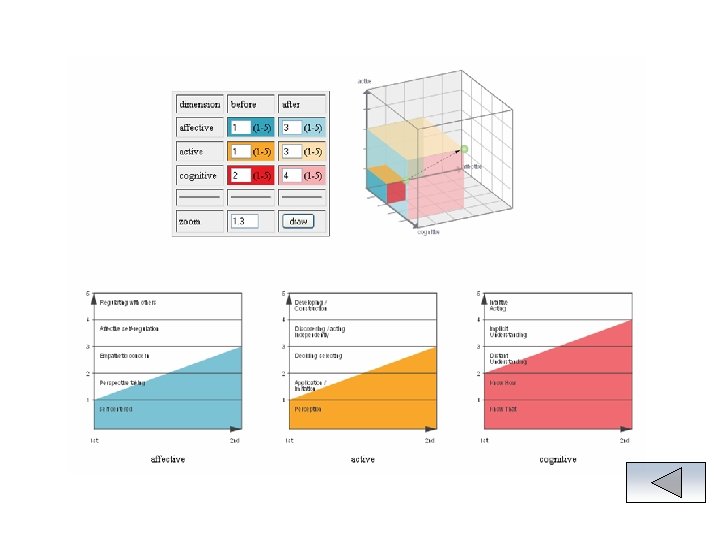 33/27
33/27
 Tools for assessment
 Instruments for assessment • Overview of possible methods or instruments for assessment. • In this context instruments or tools are for collecting or gathering the necessary information. • To assess the quality of a performance in a certain context. This performance is the result of a certain level of knowledge, attitude, activity. • No matter which tool one wishes to choose, the underlying thought should be a series of things one wishes to know. This implies that there always will be a list of questions behind any evaluation activity.
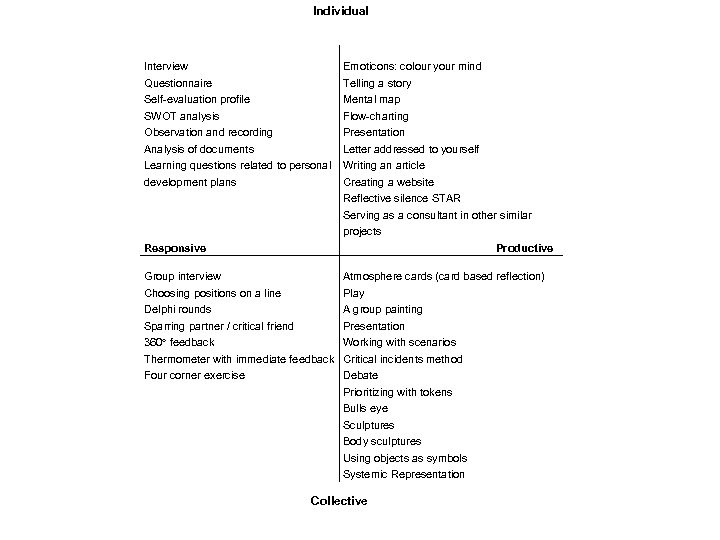 Individual Interview Questionnaire Self evaluation profile Emoticons: colour your mind Telling a story Mental map SWOT analysis Observation and recording Analysis of documents Learning questions related to personal development plans Flow charting Presentation Letter addressed to yourself Writing an article Creating a website Reflective silence STAR Serving as a consultant in other similar projects Productive Responsive Group interview Choosing positions on a line Delphi rounds Sparring partner / critical friend 360 feedback Thermometer with immediate feedback Four corner exercise Atmosphere cards (card based reflection) Play A group painting Presentation Working with scenarios Critical incidents method Debate Prioritizing with tokens Bulls eye Sculptures Body sculptures Using objects as symbols Systemic Representation Collective
 • GINCO conference: Hasselt, 26 – 29 Sept. 2012 • SEALLL/VIP course: Ancona, 08 – 13 Oct. 2012 Guy Tilkin GINCO coordinator guy. tilkin@alden biesen. be