 Скачать презентацию GIFTED IDENTIFICATION AS A SYSTEM 2011 by
level 3 theme 3 Gifted Identification as a System.pptx
- Количество слайдов: 46



GIFTED IDENTIFICATION AS A SYSTEM © 2011 by The Johns Hopkins University. All rights reserved.
2 Outcomes Participants will be able to: v Articulate the purposes of identification of the gifted v Develop a working knowledge of different forms of data collection for gifted identification v Apply one or more identification strategies to a real or hypothetical student
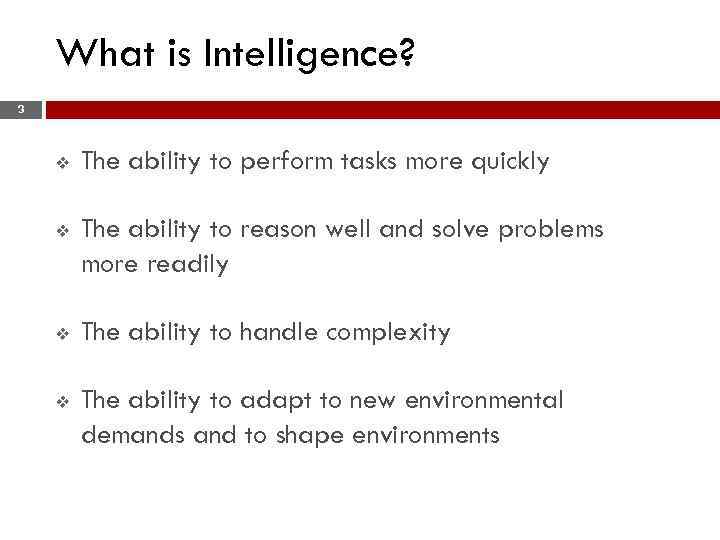
What is Intelligence? 3 v The ability to perform tasks more quickly v The ability to reason well and solve problems more readily v The ability to handle complexity v The ability to adapt to new environmental demands and to shape environments
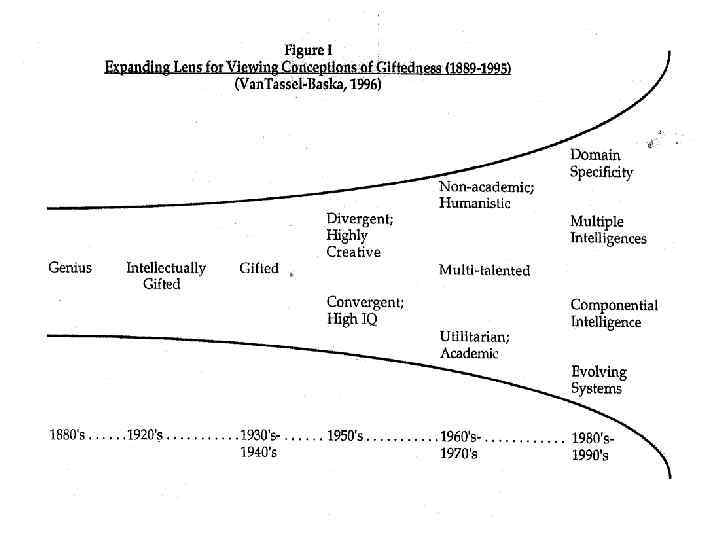
4
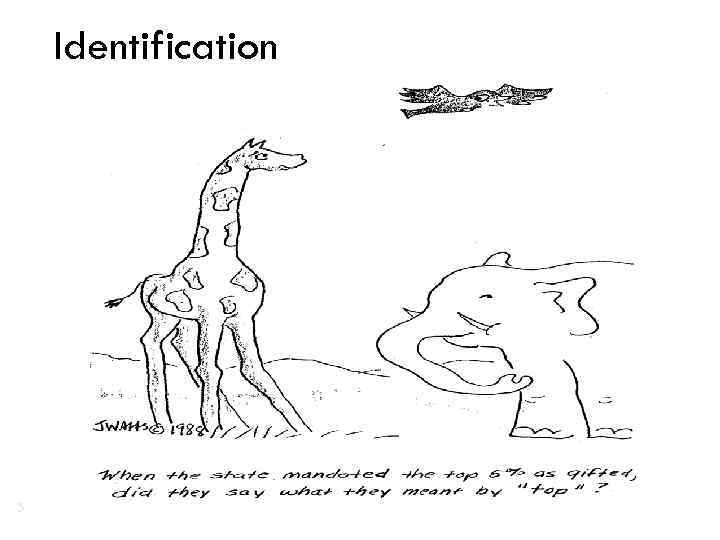
Identification 5
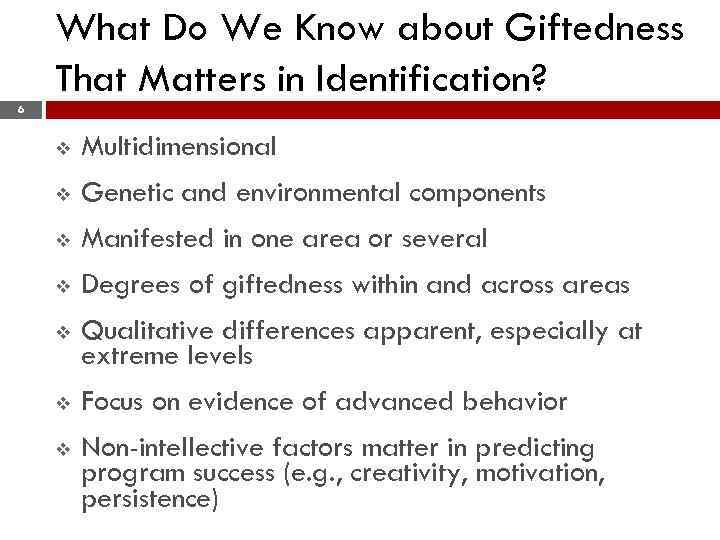
What Do We Know about Giftedness That Matters in Identification? 6 v Multidimensional v Genetic and environmental components v Manifested in one area or several v Degrees of giftedness within and across areas v Qualitative differences apparent, especially at extreme levels v Focus on evidence of advanced behavior v Non-intellective factors matter in predicting program success (e. g. , creativity, motivation, persistence)
Purpose of Identification 7 Identification should provide some direction for educational programming as well as determine which students will benefit most from such programs.
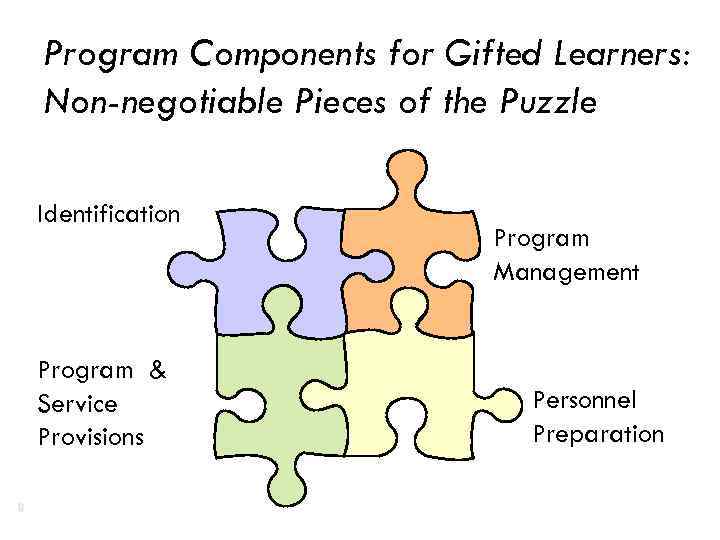
Program Components for Gifted Learners: Non-negotiable Pieces of the Puzzle Identification Program & Service Provisions 8 Program Management Personnel Preparation
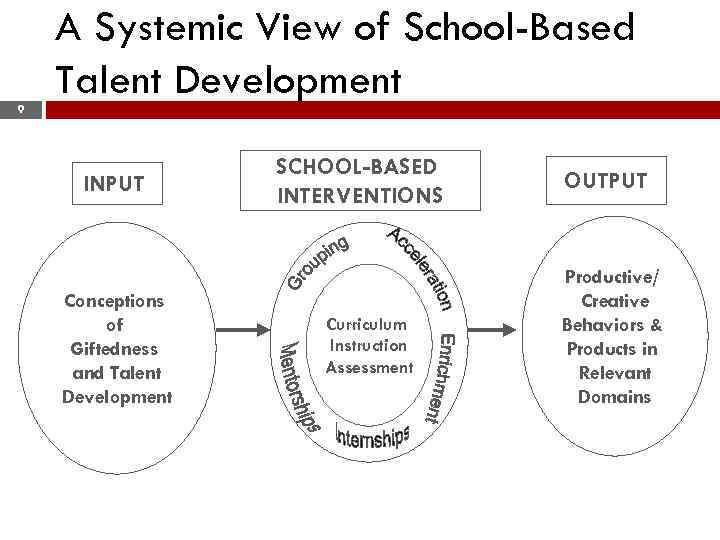
A Systemic View of School-Based Talent Development 9 INPUT Conceptions of Giftedness and Talent Development SCHOOL-BASED INTERVENTIONS Curriculum Instruction Assessment OUTPUT Productive/ Creative Behaviors & Products in Relevant Domains
General vs. Specific Characteristics of Gifted Children 10 v General characteristics speak to learning behaviors that could relate to all subject areas v Specific characteristics relate to subject-based behaviors v A combination of both yields the strongest information on who may be the best candidates for gifted programs
Student #1 11 Ruslan became interested in black holes, worm holes, and white holes when he was in the second grade. He formed his own definitions about these astronomical constructs and had a theory about the shape of the universe’s fabric. He is learning algebra in the fifth grade. Why might you infer that Ruslan is a gifted student?
Student #2 12 His middle school teacher describes Aidos as an average student. He makes C’s at school—just enough to pass from one grade level to the next. His peers have a different perspective of his ability. They have seen the working rockets that he builds from scraps he finds in neighborhood trash cans. Why might you infer that Aidos is a gifted student?
Student #3 13 Dinara, a ninth grader, has been writing stories at home since she was able to hold a pencil. At first, they were pictures she described to her mother; later, they were narrative short stories about dogs. Now, she is engrossed in writing a novel that she plans to submit to a publisher within the next few years. She has never shared her writing with her teachers at school. While she completes the required schoolwork and makes A’s on her report cards, she prefers to pursue her passion at home. Why might you infer that Dinara is a gifted student?
Best Practices in Identification 14 v Multiple criteria (3 or more) v A two-stage process of screening and identification v Measures that are relevant to program emphasis v Equitable processes for selection, validation, and placement v Placement of students based on individual profile data considerations
Best Practices in Identification (cont. ) 15 v Consideration of instruments and other approaches sensitive to the inclusion of minority, low socio-economic status, and disabled students v Different identification procedures for secondary level v Development of early and continuous procedures to evaluate the identification process v Strong links between identification and instruction (internal consistency)
Best Practices in Identification (cont. ) 16 v A clearly-defined, broadened conception of giftedness v Avoidance of cut-off scores v Recognition of intelligence as multi-faceted and identification of students in multiple talent areas v Different instruments used for different areas of giftedness; instruments are reliable and valid
Why Multiple Criteria? 17 v A single test cannot sample all of the behaviors v Scores vary across assessments v A variety of sources provide a broader picture of the student
Why Multiple Stages of the Process? 18 v Different measures are more or less precise in identifying gifted learners v Group tests are less effective than individual ones v Screening yields a pool for further consideration v Identification should include either individual or group above-level instrumentation
Standards on Assessment 19 All students in grades PK– 12 should have equal access to a comprehensive assessment system that allows them to demonstrate diverse characteristics and behaviors that are associated with giftedness.
Standards on Assessment (cont. ) 20 v Educators develop environments and instructional activities that allow students to show their gifts and talents v Educators provide parents/guardians with information regarding diverse characteristics
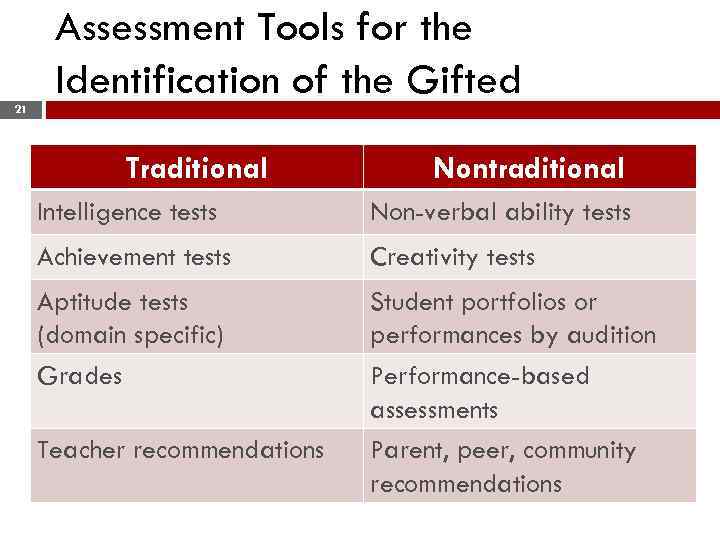
Assessment Tools for the Identification of the Gifted 21 Traditional Nontraditional Intelligence tests Non-verbal ability tests Achievement tests Creativity tests Aptitude tests (domain specific) Grades Student portfolios or performances by audition Performance-based assessments Parent, peer, community recommendations Teacher recommendations
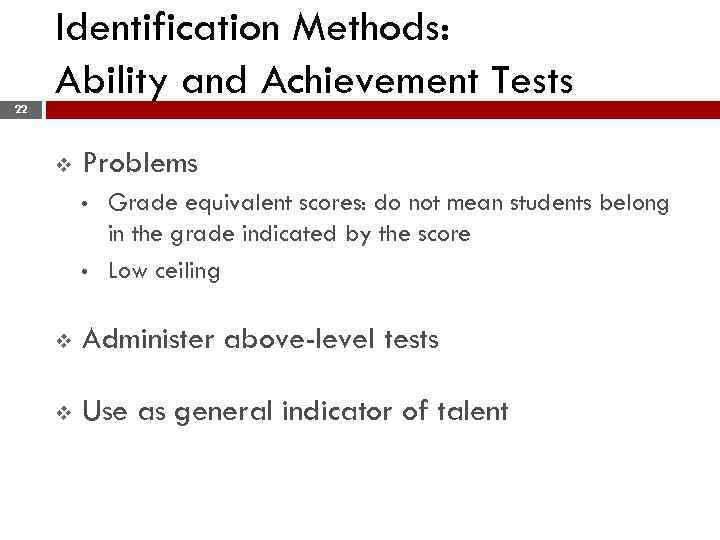
Identification Methods: Ability and Achievement Tests 22 v Problems • • Grade equivalent scores: do not mean students belong in the grade indicated by the score Low ceiling v Administer above-level tests v Use as general indicator of talent
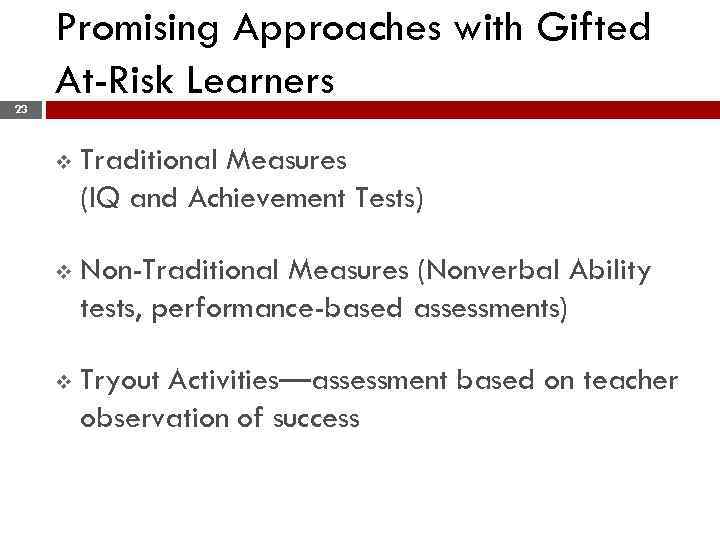
Promising Approaches with Gifted At-Risk Learners 23 v Traditional Measures (IQ and Achievement Tests) v Non-Traditional Measures (Nonverbal Ability tests, performance-based assessments) v Tryout Activities—assessment based on teacher observation of success
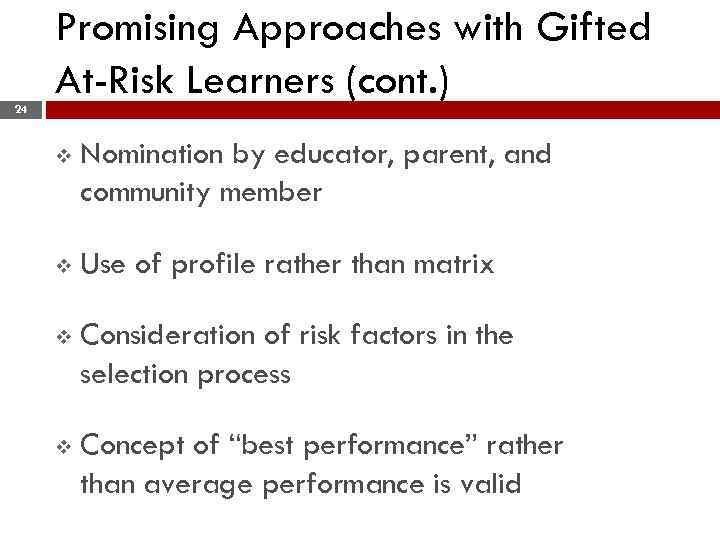
Promising Approaches with Gifted At-Risk Learners (cont. ) 24 v Nomination by educator, parent, and community member v Use of profile rather than matrix v Consideration of risk factors in the selection process v Concept of “best performance” rather than average performance is valid
25
Features of Performance-Based Assessment 26 v Emphasis on thinking and problem solving, not prior learning v Above-level/advanced v Open-ended v Use of manipulatives v Emphasis on articulation of thinking processes
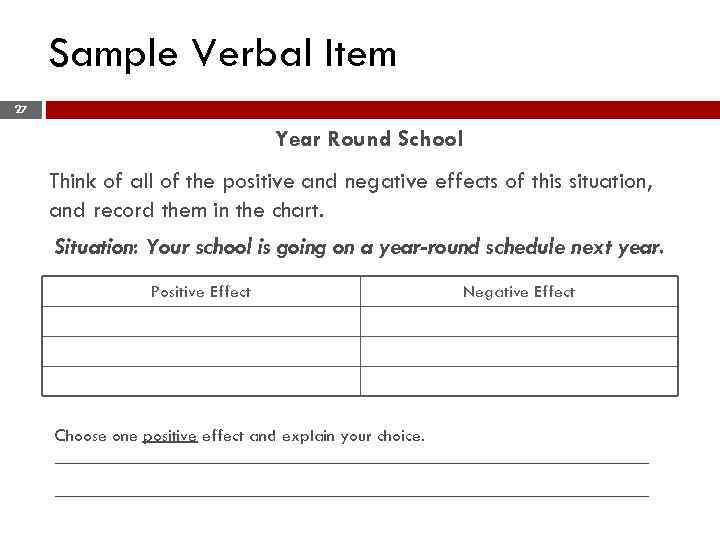
Sample Verbal Item 27 Year Round School Think of all of the positive and negative effects of this situation, and record them in the chart. Situation: Your school is going on a year-round schedule next year. Positive Effect Negative Effect Choose one positive effect and explain your choice. __________________________________________________________________
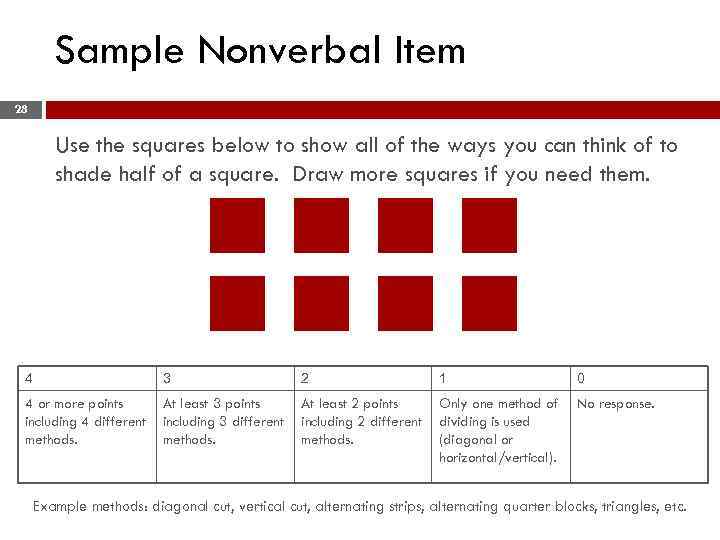
Sample Nonverbal Item 28 Use the squares below to show all of the ways you can think of to shade half of a square. Draw more squares if you need them. 4 3 2 1 0 4 or more points including 4 different methods. At least 3 points including 3 different methods. At least 2 points including 2 different methods. Only one method of dividing is used (diagonal or horizontal/vertical). No response. Example methods: diagonal cut, vertical cut, alternating strips, alternating quarter blocks, triangles, etc.
29 What Does it Mean to be Gifted in Your School? v Philosophy—Inclusive, exclusive, or a continuum of services? v Definition—What does it mean to be gifted in your school? Does this allow for equal access for all learners? v Goals for your program—What are you seeking to accomplish in your program?
Multiple Criteria 30 A combination of at least 3 criteria is recommended: v Appropriate rating scales, checklists, questionnaires from parents and teachers v Individual or group ability measures v Individual or group-specific aptitude tests v Individual or group achievement tests v Record of previous accomplishments (grades) v Appropriate student products, performance, and/or portfolio
Screening… 31 …the process of creating the pool of potential candidates using multiple criteria through the referral process, review of test data, or from other sources. Screening is the active search for students who should be evaluated for identification.
Issues in the Identification of Gifted and Talented Students 32 v Rationale for identification v Cut-off scores v Disadvantaged, disabled, and female students v Biases in ratings and nominations v Test reliability and validity
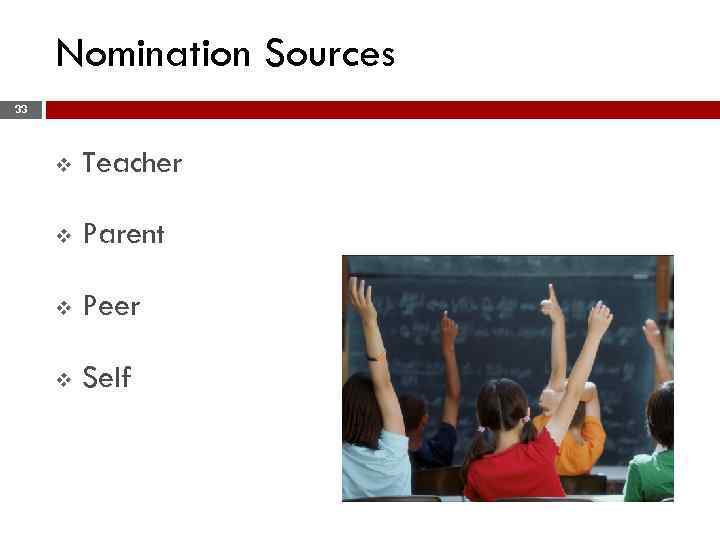
Nomination Sources 33 v Teacher v Parent v Peer v Self
Teacher Nominations 34 v May be informal or formal v May be ineffective • • • v Favor “teacher-pleasers” Over- and under-identifiers Susceptible to class and culture bias Reliability and validity issues Local norms Are more effective when teachers understand characteristics of gifted students
Parent Nominations 35 v Provide valuable background knowledge—prior to school v May exaggerate or underestimate child’s abilities
Parent Nominations— Sample Questions 36 v Special interests and hobbies? v Recent books enjoyed or read? v Unusual accomplishments, past or present? v Special talents? v Special opportunities your child has had? v Preferred activities when alone? v Relationships with others? v Special problems or needs?
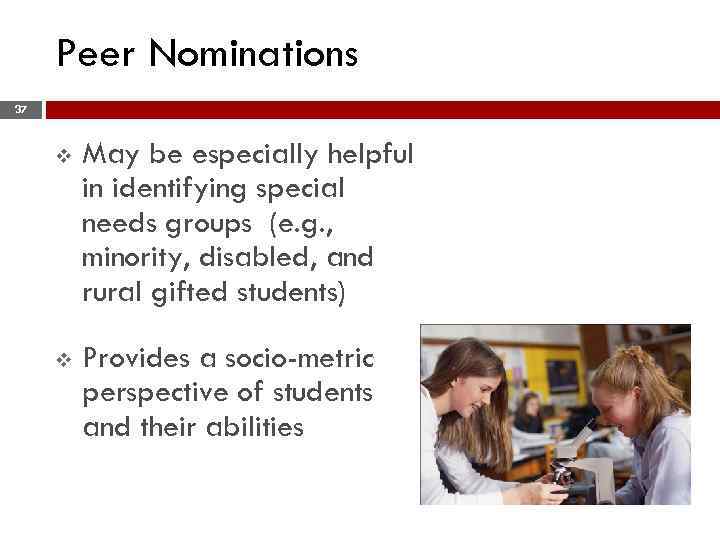
Peer Nominations 37 v May be especially helpful in identifying special needs groups (e. g. , minority, disabled, and rural gifted students) v Provides a socio-metric perspective of students and their abilities
Peer Nominations—Sample Questions 38 v Smartest kid in class? v Best at math? v Best reader? v Best memory? v Finishes work first? v Most unusual ideas? v Great storyteller? v Asks interesting questions?
Self-Nomination 39 v Recommended especially for middle and high school levels v May assess motivation and drive to excel
Self-Nomination 40 Check the area(s) in which you think you have special abilities or talents and tell why. q General Intellectual q Science q Math q Social Studies q Language Arts q Reading q Art q Music q Drama q Dance q Creativity q Leadership
Checks and Balances for Identification 41 v Advocacy: The identification procedures should be for the benefit of all students. v Defensible: The most recent and best research should be used. v Equity: The rights of all students should be safeguarded. v Comprehensiveness: Students gifted in various domains should be identified and served. v Pragmatic: The schools should be permitted to make local modifications based upon resources, context, and personnel.
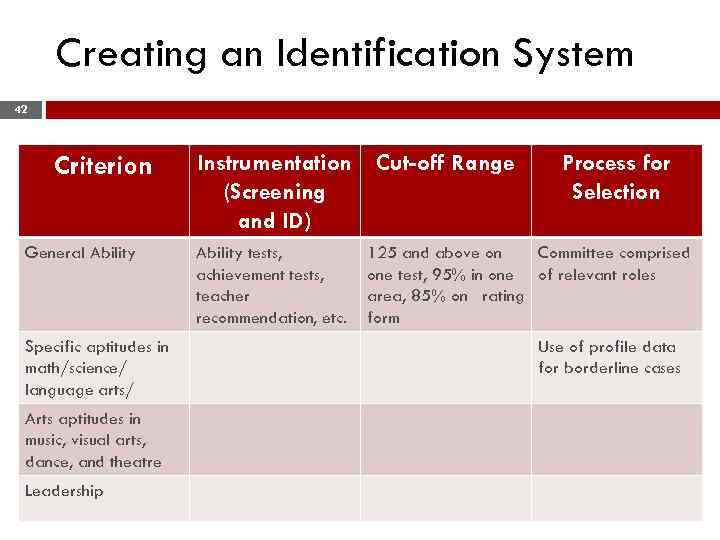
Creating an Identification System 42 Criterion General Ability Specific aptitudes in math/science/ language arts/ Arts aptitudes in music, visual arts, dance, and theatre Leadership Instrumentation (Screening and ID) Ability tests, achievement tests, teacher recommendation, etc. Cut-off Range Process for Selection 125 and above on Committee comprised one test, 95% in one of relevant roles area, 85% on rating form Use of profile data for borderline cases
Your turn… 43 Create an identification system that: 1. Attends to best practices and national standards 2. Considers current approaches employed 3. Uses the template provided
Other Identification Considerations 44 v Additional data related to special needs learners (twice exceptional, culturally diverse, poverty) v Weighting of instrumentation v Use of committees to review data and make ID recommendations v Construction of waiting lists v Placement procedures/policies v Exit procedures/policies
45 Discussion Question What are some of the issues related to formal identification procedures in your context?
46 Session Reflection How can educators use multiple measures to better identify students who are advanced in one or more areas?
Скачать презентацию GIFTED IDENTIFICATION AS A SYSTEM 2011 by
level 3 theme 3 Gifted Identification as a System.pptx