 Скачать презентацию Gibran 1926 The Prophet Your children are not
be60e6c24b32badceb42cabdacf411cc.ppt
- Количество слайдов: 21



Gibran (1926) The Prophet Your children are not your children. They are the sons and daughters of Life’s longing for itself. They come through you but not from you, And though they are with you yet they belong not to you. You may give them your love but not your thoughts, For they have their own thoughts. You may house their bodies but not their souls, For their souls dwell in the house of tomorrow, Which you cannot visit even in your dreams. You may strive to be like them, but seek not to make them like you. For life goes not backward nor tarries with yesterday. . . http: //www. youtube. com/watch? v=HCVvo. L_F 5 g. A&feature=r elated http: //www. youtube. com/watch? v=rh 4 fg. YGEKL 8
Rights Responsibilities and Advocacy Module 6 cf 005 Session Four “We should have the right to take responsibility”
Learning outcomes ¢ ¢ Critically examine the concept of ‘competency’ within the children’s/ young people’s rights agenda Use the work of Foucault to analyse how issues of power may be operating Share ideas around a Native American model of childhood and youth Evaluate the Investing in Children initiative in Durham (Cairns, 2001) in terms of what lessons might be learned for children and young people’s participation (guided activity)
Summative assessment ¢ ¢ You are to attend a conference on children’s and young people’s rights in the global context. As an advocate for children/ young people within your chosen area of interest, you will offer a written paper to critically examine the complexities surrounding the implementation of a rights-based agenda to improve issues of equity and inclusion for these children/ young people; you will offer a particular focus on Article 12 of the UNCRC. http: //www 2. ohchr. org/english/bodies/crc/docs/Advance. Versions/CRC. C. GBR. CO. 4. pdf
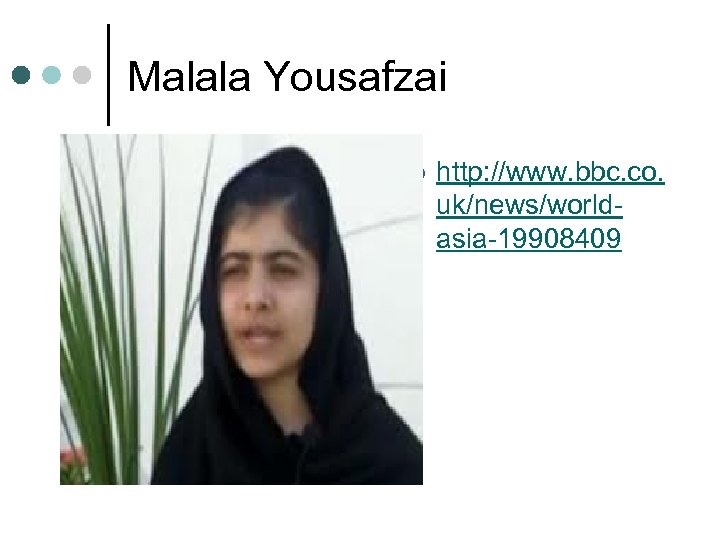
Malala Yousafzai ¢ http: //www. bbc. co. uk/news/worldasia-19908409
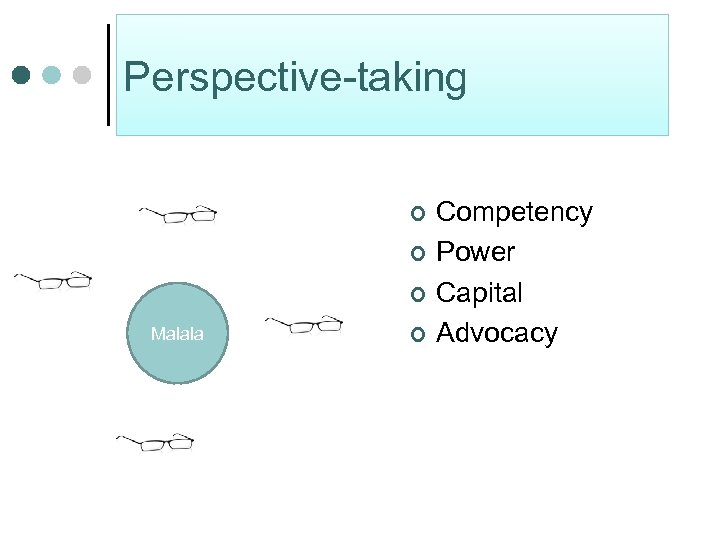
Perspective-taking ¢ ¢ ¢ Malala ¢ Competency Power Capital Advocacy
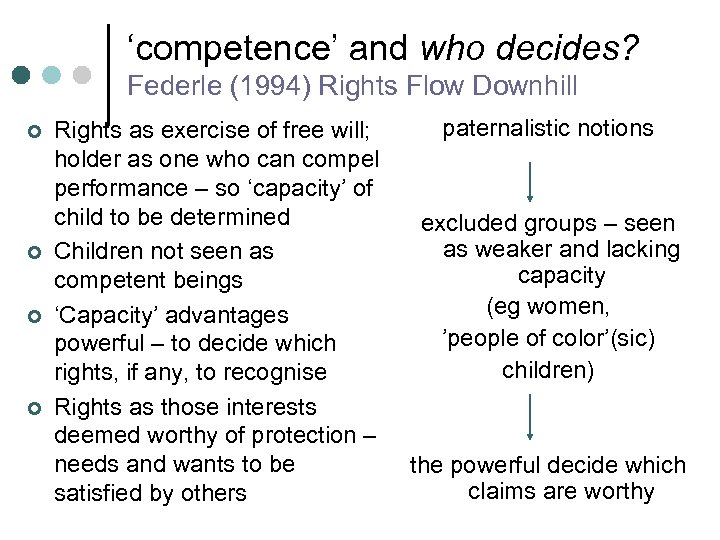
‘competence’ and who decides? Federle (1994) Rights Flow Downhill ¢ ¢ Rights as exercise of free will; holder as one who can compel performance – so ‘capacity’ of child to be determined Children not seen as competent beings ‘Capacity’ advantages powerful – to decide which rights, if any, to recognise Rights as those interests deemed worthy of protection – needs and wants to be satisfied by others paternalistic notions excluded groups – seen as weaker and lacking capacity (eg women, ’people of color’(sic) children) the powerful decide which claims are worthy
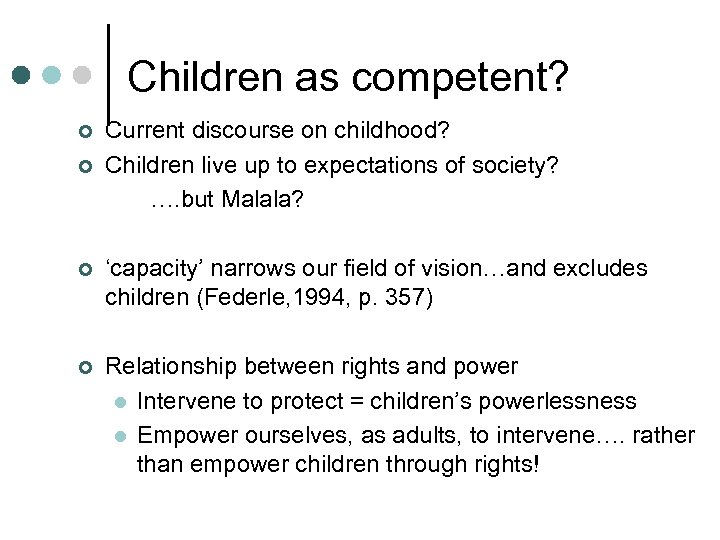
Children as competent? ¢ ¢ Current discourse on childhood? Children live up to expectations of society? …. but Malala? ¢ ‘capacity’ narrows our field of vision…and excludes children (Federle, 1994, p. 357) ¢ Relationship between rights and power l Intervene to protect = children’s powerlessness l Empower ourselves, as adults, to intervene…. rather than empower children through rights!
A key point of Kathleen Hunt Federle (1994, p. 366) “To have rights, then, is not dependent upon the capacity to exercise or assert them; rather, these rights prohibit those who already have power from exerting it” ¢ Mutual respect owing to power ¢ Reduce victimization of children/ young people; no longer see them as powerless………Malala currently? ? ¢
Dependence independence and interdependence ¢ ¢ ¢ Need to re-think discourse on childhood and children’s claims on citizenship Narrow conceptions of citizenship that exclude children and young people (Hallett and Prout, 2003) Outdated notions of citizenship Hidden contributions (as with women!) Children and adults bound by mutual interdependence
An alternative world view? Native American philosophy of child-rearing: the circle of courage Spirit of belonging Child nurtured by wider community …. . all claimed relationship. All belong to one another and should be treated accordingly. ¢ Spirit of mastery All need to feel competent and all encouraged in their competency. If opportunities denied, then troubled behaviour. ¢ Spirit of independence Increasing opportunities to make own decisions Guidance without interference Blend of autonomy with belonging ¢ Spirit of generosity Core values of sharing and community responsibility Opportunities to give to others to develop as caring persons ¢ (Brendtro, Brokenleg and Van Bockern, 2002)
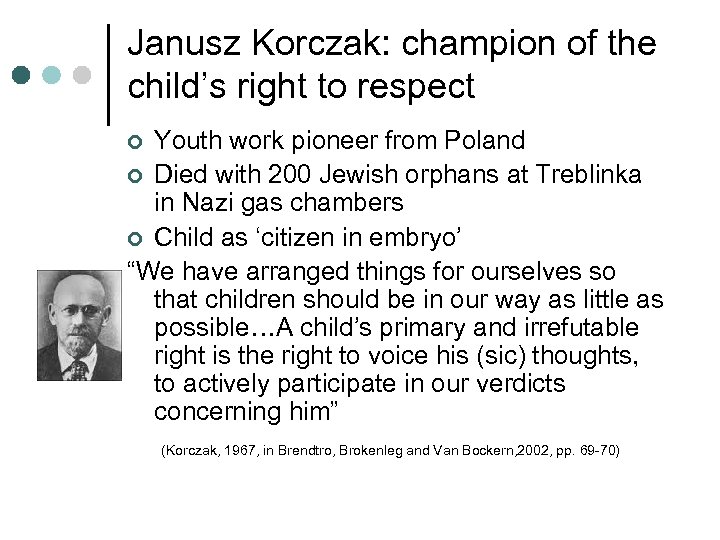
Janusz Korczak: champion of the child’s right to respect Youth work pioneer from Poland ¢ Died with 200 Jewish orphans at Treblinka in Nazi gas chambers ¢ Child as ‘citizen in embryo’ “We have arranged things for ourselves so that children should be in our way as little as possible…A child’s primary and irrefutable right is the right to voice his (sic) thoughts, to actively participate in our verdicts concerning him” ¢ (Korczak, 1967, in Brendtro, Brokenleg and Van Bockern, 2002, pp. 69 -70)
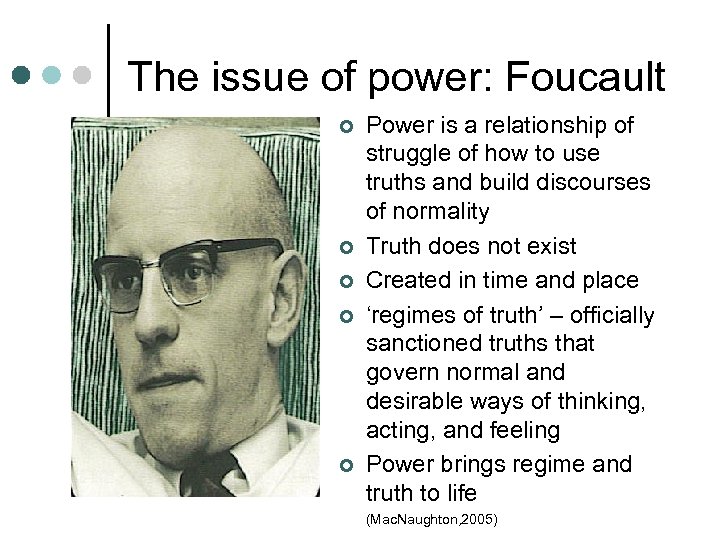
The issue of power: Foucault ¢ ¢ ¢ Power is a relationship of struggle of how to use truths and build discourses of normality Truth does not exist Created in time and place ‘regimes of truth’ – officially sanctioned truths that govern normal and desirable ways of thinking, acting, and feeling Power brings regime and truth to life (Mac. Naughton, 2005)
An example of adult power? (Foucault’s ‘panoptican’? ) ¢ Mosquito alarm ¢ http: //www. guardian. co. uk/society/2010/jun/24/mosquito-youth-dispersal -alarms-face-ban? & http: //news. bbc. co. uk/1/hi/uk/7241527. stm ¢ Campaigns to ban Mosquito alarm http: //www. civilrightsmovement. co. uk/mosquito-alarm-infringementhuman-rights. html • The campaign has won the support of human rights groups including Liberty, whose director, Shami Chakrabarti, described it as a "sonic weapon directed against children and young people".
So, who decides? ¢ ¢ Power relations between children, young people and adults Dominant discourse – ‘regime of truth’ in relation to place of children and young people within society eg. ‘adultism’? ? “My idea of what is normal has changed so drastically. When you are with someone abusive it is like they rewrite normality. “ http: //www. guardian. co. uk/society/2011/sep/15/teenage-relationship-abuse-prevalent-nspcc? &CMP=EMCSOCEML 657 ¢ ¢ As one ‘truth’ dominates, so others are necessarily silenced/ marginalised Federle (1994) advocates reconceiving rights by recognising power and powerlessness and throwing out ‘capacity’
Rights flow downhill “Although to have a right is to have power, to obtain a right is to be powerless. In this sense, rights flow downhill towards the powerless; they shift power away from those who have it to those who do not, and equalize relationships” (Federle, 1994, pp. 365 -366) Thinks!! Which is the stronger, and for whom? Protecting children because they are dependent OR Respecting children because they are powerful
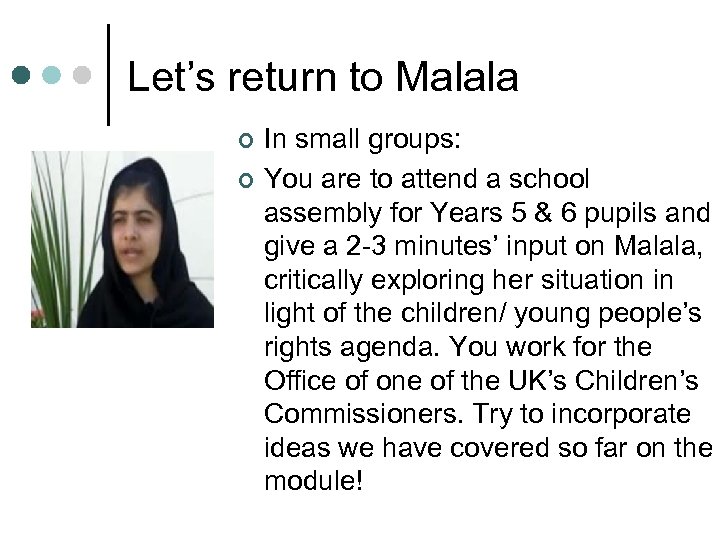
Let’s return to Malala ¢ ¢ In small groups: You are to attend a school assembly for Years 5 & 6 pupils and give a 2 -3 minutes’ input on Malala, critically exploring her situation in light of the children/ young people’s rights agenda. You work for the Office of one of the UK’s Children’s Commissioners. Try to incorporate ideas we have covered so far on the module!
Oppression within participation? What types of person might be encouraged/ feel able to actively participate? ¢ What types of person might be left out? ¢ What might the reasons be? ¢ How might we overcome this? (consider the journal article offered as OOCA in week 3: Wyness, M. (2009) Children ¢ ¢ Representing Children: Participation and the problem of diversity in UK youth councils. Childhood, 16 (4), pp. 535 -552. ) Student voice here at Uo. W – call for reps!
Guided activity to contribute towards your preparation for the poster session next week ¢ ¢ Read the journal article by Cairns (2001) ¢ ¢ Continue to create your poster for session 5 How might you analyse the young people’s final success using the ideas of Foucault? What have you learned from the Cairns article about participation?
Next week: session 5 ¢ ¢ Do come prepared to offer your individual poster presentation to a few of your peers in a conference-style format Get feedback and ideas from your peers Build your confidence and ‘talk’ your summative ideas to prepare for the written assignment (formative and summative) See summative assignment brief for ideas for poster – embedded in webfolio, session 3
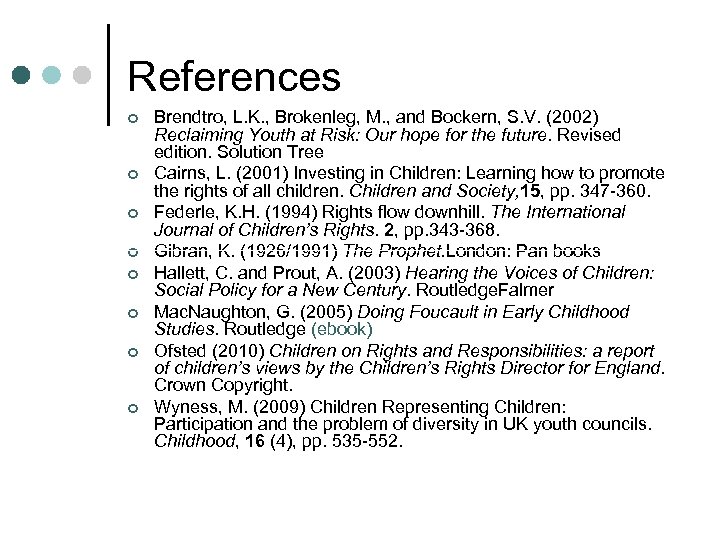
References ¢ ¢ ¢ ¢ Brendtro, L. K. , Brokenleg, M. , and Bockern, S. V. (2002) Reclaiming Youth at Risk: Our hope for the future. Revised edition. Solution Tree Cairns, L. (2001) Investing in Children: Learning how to promote the rights of all children. Children and Society, 15, pp. 347 -360. Federle, K. H. (1994) Rights flow downhill. The International Journal of Children’s Rights. 2, pp. 343 -368. Gibran, K. (1926/1991) The Prophet. London: Pan books Hallett, C. and Prout, A. (2003) Hearing the Voices of Children: Social Policy for a New Century. Routledge. Falmer Mac. Naughton, G. (2005) Doing Foucault in Early Childhood Studies. Routledge (ebook) Ofsted (2010) Children on Rights and Responsibilities: a report of children’s views by the Children’s Rights Director for England. Crown Copyright. Wyness, M. (2009) Children Representing Children: Participation and the problem of diversity in UK youth councils. Childhood, 16 (4), pp. 535 -552.
Скачать презентацию Gibran 1926 The Prophet Your children are not
be60e6c24b32badceb42cabdacf411cc.ppt