


 Скачать презентацию GGR 357 H 1 F Geography of Housing
598e94040fb184ba520a5db73e544059.ppt
- Количество слайдов: 44
 GGR 357 H 1 F Geography of Housing and Housing Policy May 14, 2008 SESSION 2 TENURE CHOICE AND SOCIO-ECONOMIC INEQUALITIES DR. AMANDA HELDERMAN
 Course web page http: //individual. utoronto. ca/helderman/
 Announcements l Text book sale $15. 00 Exact change only l Room 50. 57 l l – Additional opportunities?
 Assignment • • • Individually written, unique research paper Demographics and housing issues in Torontonian neighbourhoods Immediately relevant topic to this course: Homelessness extremely wealthy neighbourhood: Not appropriate choice of topic for obvious reasons • Do not exceed 1, 500 words! Hard copy and digital copy (word only) • ALL RELEVANT LIT SHOULD BE USED! • DUE DATE PAPER: Friday, June 20, 2008 • Drop box Office of Geography/ Program in Planning • Name student, student number, my name, course •
 Assignment • The paper should at least describe the demographic, socio-economic and physical characteristics of the area Demographic and socio-economic characteristics of the neighbourhood: http: //www. toronto. ca/demographics/ Physical characteristics of the area: map • Writing courses • • Be aware of waiting times! Contact the writing centre ASAP Assistance from instructor (at least two weeks in advance): • • • By providing 1 -page draft outline well in advance of appointment after class By email: Helderman@geog. utoronto. ca
 Assignment l Paper preparations: very wise of you to start exploring paper themes! l Assignment description available online l Please embed all maps/ tables into the paper l Appropriate attention in the text l Use of appendices (if useful background information) l Illustrations for required elements such as physical structure (maps) and demographic characteristics (tables)
 Timelines l MIDTERM EXAM: Monday June 2, 2008, this room l DUE DATE PAPER: Friday, June 20, 2008 – – l Drop box Office of Geography/ Program in Planning Name student, student number, my name, course June 23 -27, 2008: FINAL EXAMINATIONS: – Exact date to be announced
 Highlights from first session l l Several slides are worth revisiting Summary first session: – – – Definition of housing, complexity concept Importance of housing Modelling housing market behaviour
 Defining Housing l Complexity of housing: all alternative definitions are applicable at the same time, some meanings are separated and confused l Broad definition: BUNDLE OF SERVICES (for builders, owners and renters) – Physical facility – Shelter – Consumption of services: public, schools, environment, etc. – Location/ accessibility
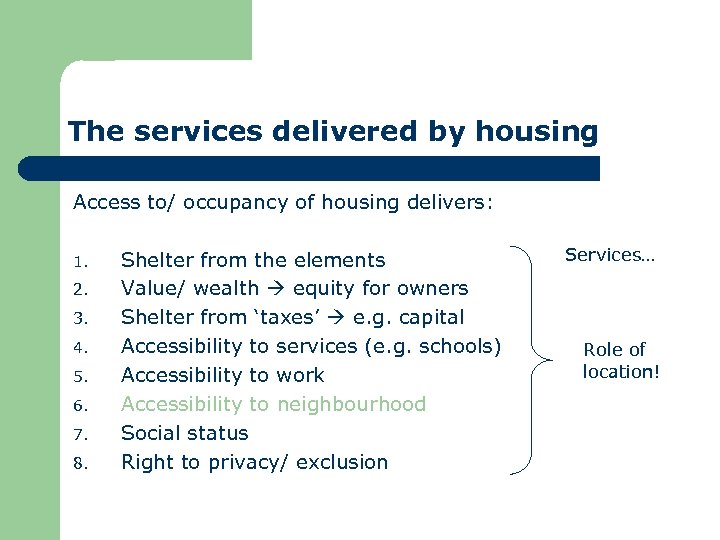 The services delivered by housing Access to/ occupancy of housing delivers: 1. 2. 3. 4. 5. 6. 7. 8. Shelter from the elements Value/ wealth equity for owners Shelter from ‘taxes’ e. g. capital Accessibility to services (e. g. schools) Accessibility to work Accessibility to neighbourhood Social status Right to privacy/ exclusion Services… Role of location!
 The importance of housing l l l Housing is the built environment for intraurban migration and mobility Housing competes with other uses in the urban land market for accessibility and space Housing is the principal mechanism through which urban neighbourhoods change, and one of the stimulants of change (session on neighbourhood transitions) – – Moves of households/ activities, demographic change New (demographic/ economic/ social/ cultural) developments Aging of real estate Fluctuations in house prices
 Models for housing market behaviour Traditionally in terms of streams of relocations, and origins and destinations (aggregate patterns): l Gravity models – based on the characteristics of places – Size and distance between places l Push/pull models – based on flows of individuals, decisions l (Recurrent) Markov Chains – based on matching process between households and housing Two more recent approaches: l Micro-economic approaches (Sjaastad) – based on the costs and returns of human migration (monetary and non-monetary costs) l Life cycle/ Life course perspective – based on life events that trigger a change in one of the parallel careers, individual and microeconomic
 Life course, parallel careers Cohabitation Child birth Divorce/ separation Remarriage Child birth Widowhood HH Job change LB Enrolling into higher education ED HS
 Life course: paradigm shift in the social sciences l l l Convergence of theory and empirical work Devoted attention to the individual household Brought the topic of residential relocations into the centre of housing studies Linking individual action with social change and social structure Demographic events introduced as milestones and critical transitions in people’s lives UNIVERSAL: these events apply for almost everyone, and occur everywhere and throughout history
 Introduction housing tenure (new topic) l Housing tenure choice l Individual advantages/ disadvantages to homeownership l Socio-economic inequalities l Separate markets l Mechanisms of widening socio-economic gaps
 Introduction l Advantages of homeownership for governments l Policy instruments l Literature discussion
 Housing tenure choice l l l l 2 nd step in the relocation decision (see Brown & Moore, 1970) Destination choice models Life course stage Household composition and socio-economic characteristics Housing type Level of housing consumption Opportunity structure: – – Local housing stock Local housing market conditions
 The values of housing l Consumption value l Investment value l Policy importance
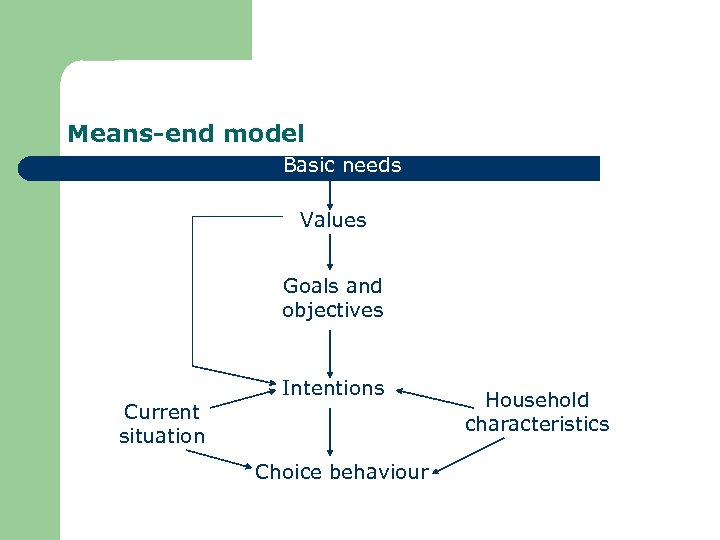 Means-end model Basic needs Values Goals and objectives Current situation Intentions Choice behaviour Household characteristics
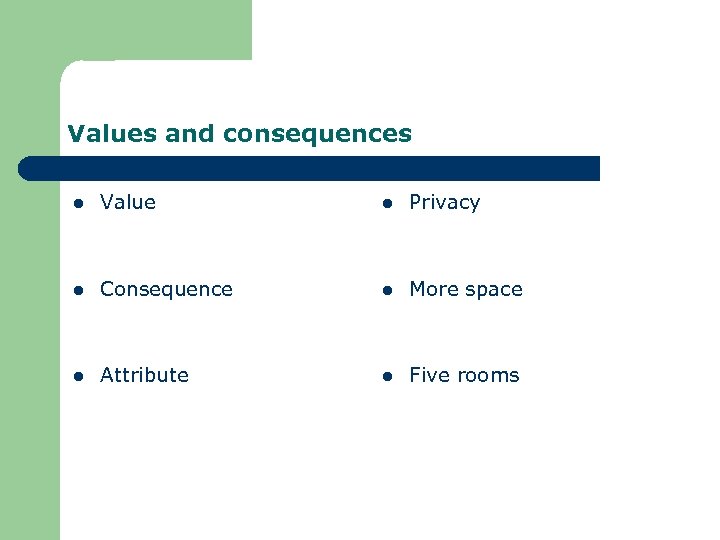 Values and consequences l Value l Privacy l Consequence l More space l Attribute l Five rooms
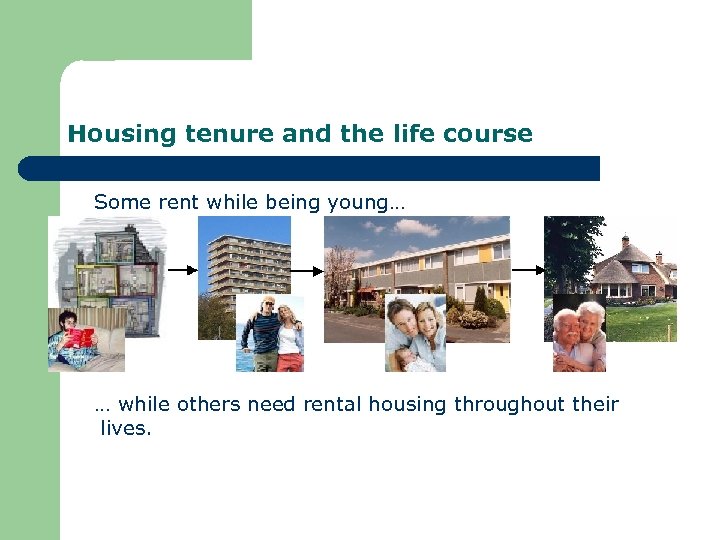 Housing tenure and the life course Some rent while being young… … while others need rental housing throughout their lives.
 Individual advantages to homeownership l l l l Building up equity from a home Housing quality Customized aspects/ alterations Control of individual housing situation/ independence Continuity/ stability Status Emotional value
 Individual disadvantages to homeownership l l Financial risk: housing market Financial risk: labour market position Responsibility for maintenance Impedes residential relocations: – Financial commitment – Transaction costs – Sense of security, personal environment – Emotional attachment – Stable households
 Socio-economic inequalities l l l Building up equity Spatial concentration of opportunities Quality of housing and neighbourhoods Social mobility Separate markets
 Separate markets l l l Few moves between the rented and owner-occupied segments Interruption in building up equity Maintaining housing quality Rising incomes and housing consumption needs during a large period of an individual’s life course Equity facilitating new purchase Based on: Helderman, 2007
 Moving from rent to own l l l Increase in housing budget Increase in housing consumption needs Higher quality home Higher quality neighbourhood Personal space, free to adjust to personal preferences Preference to own
 Moving from own to rent l l l Decrease in housing budget Decrease in housing consumption needs Urgent need to relocate Desire to consume equity Preference for renting Motives related to disruptions and changes in the family life cycle or life course patterns (divorce, separation, aging, health issues, change of jobs)
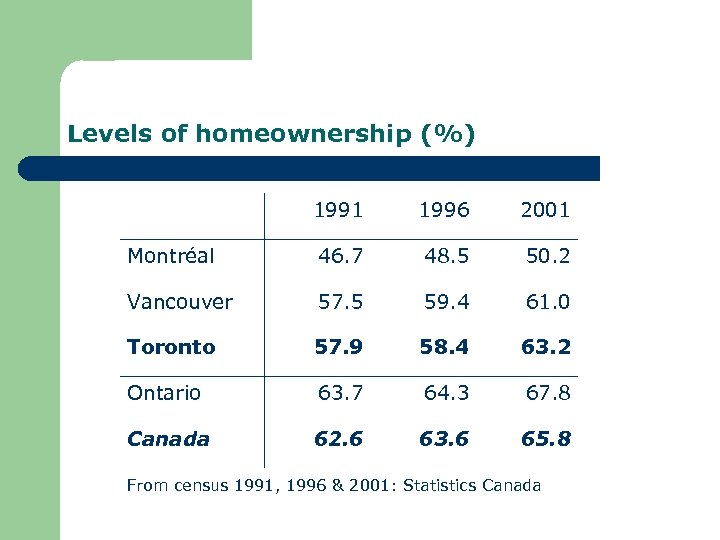 Levels of homeownership (%) 1991 1996 2001 Montréal 46. 7 48. 5 50. 2 Vancouver 57. 5 59. 4 61. 0 Toronto 57. 9 58. 4 63. 2 Ontario 63. 7 64. 3 67. 8 Canada 62. 6 63. 6 65. 8 From census 1991, 1996 & 2001: Statistics Canada
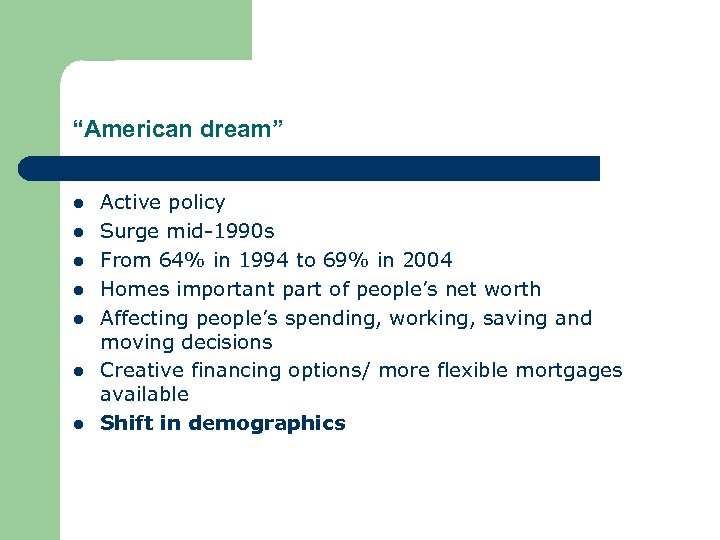 “American dream” l l l l Active policy Surge mid-1990 s From 64% in 1994 to 69% in 2004 Homes important part of people’s net worth Affecting people’s spending, working, saving and moving decisions Creative financing options/ more flexible mortgages available Shift in demographics
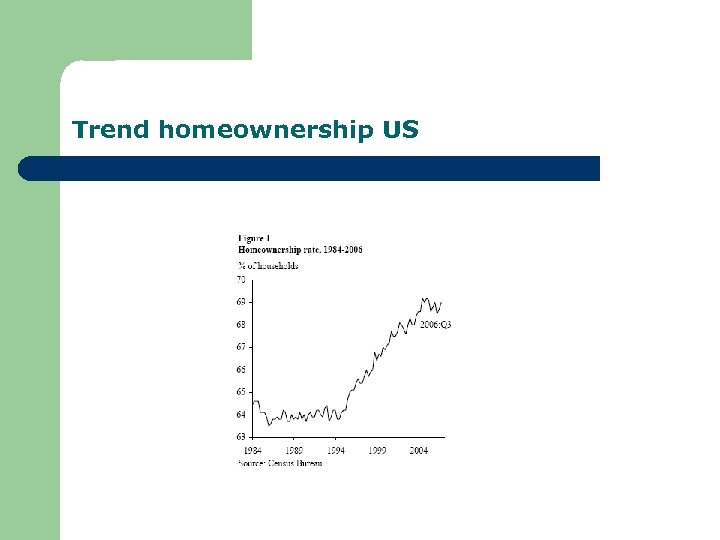 Trend homeownership US
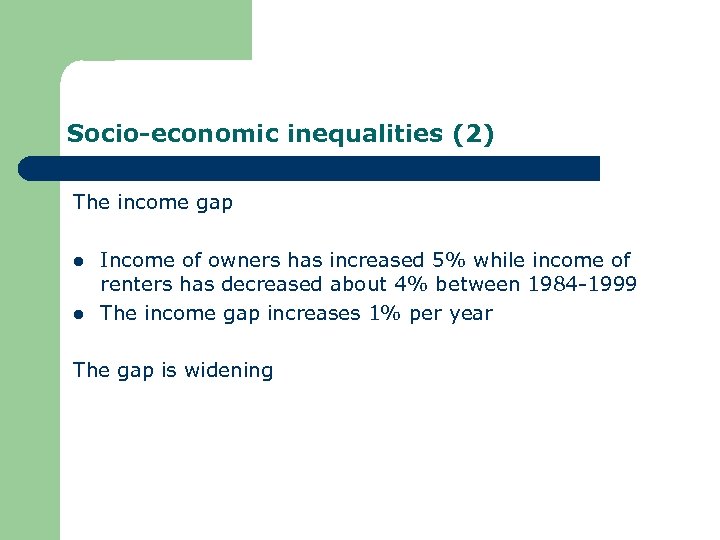 Socio-economic inequalities (2) The income gap l l Income of owners has increased 5% while income of renters has decreased about 4% between 1984 -1999 The income gap increases 1% per year The gap is widening
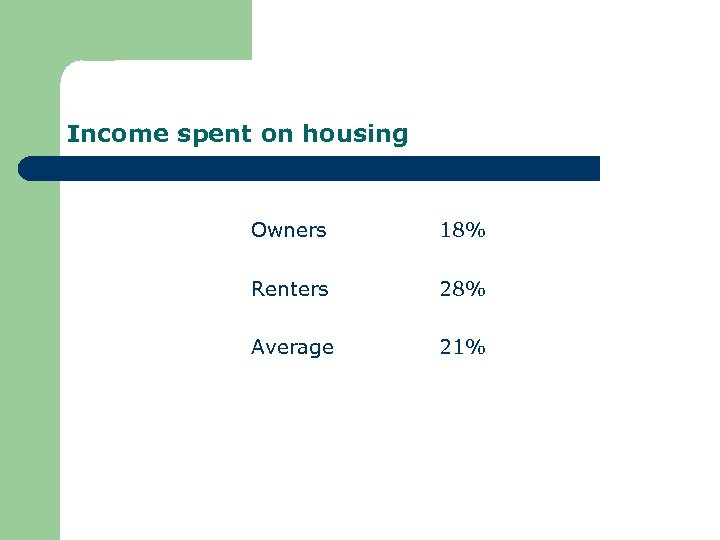 Income spent on housing Owners 18% Renters 28% Average 21%
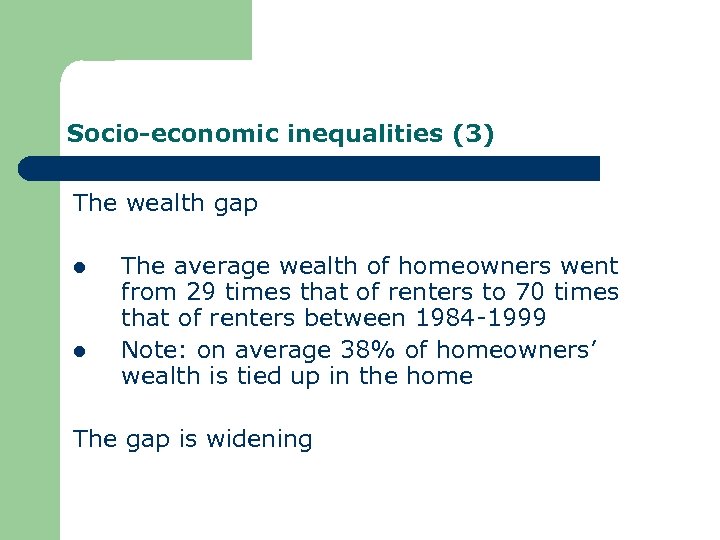 Socio-economic inequalities (3) The wealth gap l l The average wealth of homeowners went from 29 times that of renters to 70 times that of renters between 1984 -1999 Note: on average 38% of homeowners’ wealth is tied up in the home The gap is widening
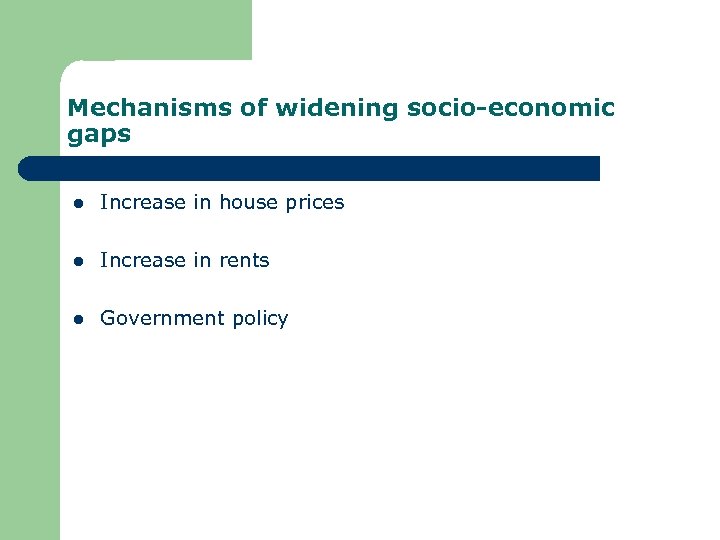 Mechanisms of widening socio-economic gaps l Increase in house prices l Increase in rents l Government policy
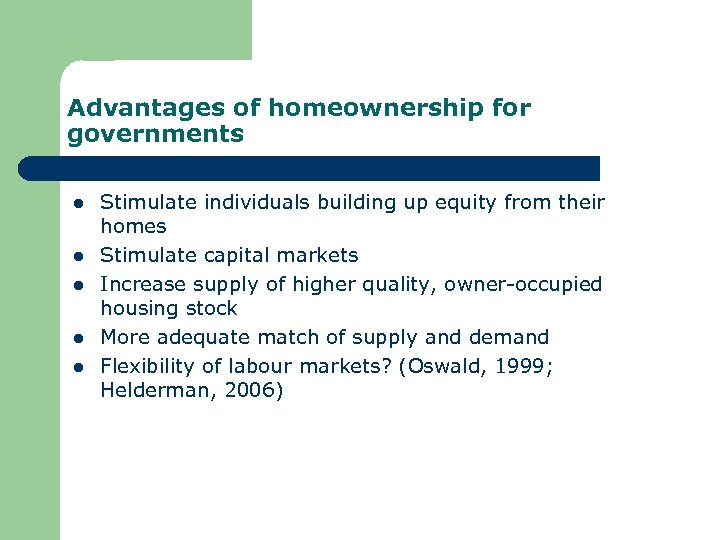 Advantages of homeownership for governments l l l Stimulate individuals building up equity from their homes Stimulate capital markets Increase supply of higher quality, owner-occupied housing stock More adequate match of supply and demand Flexibility of labour markets? (Oswald, 1999; Helderman, 2006)
 Policy instruments 1) Tax incentives: l l l No tax on capital gains from house sales RRSP Home Buyers’ Plan (HBP) Flexible Down Payment Plan Lower Monthly Payments Purchase Plus Improvements Land Transfer Tax (LTT) Rebate No housing related tax concessions for renters! l Ontario waives land transfer taxes, may in theory be beneficial to both owner-occ. and rent.
 Policy instruments (2) 2) Subsidies 3) Rent control 4) Municipal regulations Key: The ability to pay rents. The question remains… What would make rental investments sufficiently profitable for developers?
 Literature session 3 - Hulchanski, J. D. (2005), A tale of two Canadas: homeowners getting richer, renters getting poorer. In: J. D. Hulchanski & M. Shapcott (eds. 2005), Finding room. Policy options for a Canadian rental housing strategy. Chapter 4. p. 81 -88. - Oswald, A. J. (1999), The housing market and Europe’s unemployment: a non-technical paper, mimeo University of Warwick. - Coulson, N. E. & Fisher, L. M. (2002), Tenure choice and labour market outcomes. Housing Studies, 17(1), pp. 35 -49. - Helderman, A. C. (2007), Once a homeowner, always a homeowner? An analysis of moves out of owner-occupation. Journal of Housing and the Built Environment (22), pp. 239 -261.
 Literature discussion Hulchanski & Shapcott, chapter 4: Housing tenure represents the divide between the two very different types of households in terms of income and wealth (Hulchanski, 2004, p. 85)
 Literature discussion (2) Oswald: We can put Europe back to work by reducing homeownership (Oswald, 1999, p. 2) Migration (long distance moves) is necessary for individual flexibility on the labour market so that advantage may be taken from economic opportunities (Helderman, 1 st class)
 Literature discussion (3) Why do the papers of Oswald and Coulson & Fisher have totally separate outcomes?
 Same hypothesis, different outcomes l Methodology: bivariate/ multivariate – – Household situation/ life course stage Dynamic/ static modelling l Assumptions: general/ partial models l Self-selection bias
 Literature next session: Intergenerational transmission of homeownership - Henretta, J. C. (1984), Parental status and child’s home ownership. American Sociological Review 49, pp. 131140. - Jenkins, S. P. & A. K. Maynard (1983), Intergenerational continuities in housing. Urban Studies 20, pp. 431438. Classics!
 Literature next session: Intergenerational transmission of homeownership l Helderman, A. C. & C. H. Mulder (2007), Intergenerational transmission of homeownership: the roles of gifts and continuities in housing market characteristics. Urban Studies 44 (2), pp. 231 -247.