 Скачать презентацию GFS-2001 Session Learning Objective Session 9 10
25c78739b85a3f685c3e60c7bf3d9193.ppt
- Количество слайдов: 47



GFS-2001 Session Learning Objective Session 9 & 10 v At the end of the session, the participants will be familiarized with key points of Components of Revenue, Expenses and Balance Sheet, Difference between transactions in non financial assets and financial assets, and concepts thereon will be more clear to them. R. T. I. Allahabad 1
GFS-2001 Session Overview Session 9 & 10 In this session, we will discuss: • The key points of Components of Revenue, Expenses and Balance Sheet, Difference between transactions in non financial assets and the concepts embodied therein. R. T. I. Allahabad 2
GFS-2001 I- Revenue and its components Session 9 & 10 Definition of Revenue: Revenue is an increase in net worth resulting from a transaction. Four main sources of revenue: For general government units, the four main source of revenue are: a) Taxes and other compulsory transfers imposed by government units, b) Property income derived from the ownership of assets, c) Sales of goods and services, d) Voluntary transfers received from other units. Ref. 5. 1 of GFS 2001 Manual R. T. I. Allahabad 3 .
GFS-2001 I- Revenue and its components Session 9 & 10 Types of Revenue: (a) Tax Revenue: It forms the dominant share of revenue for many government units. It composed of following: (i) Compulsory transfer of revenue to general government sector Exclusion from tax revenue: Fines, penalties, and most social security contributions are excluded from tax revenue. Negative revenue or adjustable revenue: they are adjustments that allow the excessive increase in net worth previously recorded to be corrected. Ref. 5. 2 of GFS 2001 Manual R. T. I. Allahabad 4
GFS-2001 I- Revenue and its components Session 9 & 10 (b) Non Tax Revenue: All other types of revenue are frequently combined into a heterogeneous category of non tax revenue. Some categorization are as follows: (i) Social Contributions (ii) Grants (iii) Property income (iv) Sales of goods and services (v) Miscellaneous other revenues viz. fines, penalties, forfeits, settlements arising from judicial processes, voluntary transfers other than grants, Sales of existing goods including used military items. R. T. I. Allahabad 5 Ref. 5. 3 & 5. 9 of GFS 2001 Manual
![I- Revenue and its components GFS-2001 (iii) Property Income (GFS): Property income [GFS] is](https://present5.com/presentation/25c78739b85a3f685c3e60c7bf3d9193/image-6.jpg "I- Revenue and its components GFS-2001 (iii) Property Income (GFS): Property income [GFS] is")
I- Revenue and its components GFS-2001 (iii) Property Income (GFS): Property income [GFS] is received when gener algovernment units place financial assets and/or non produced assets at the disposal of other units. Interest, dividends, and rent are the major compo nents of this category. Ref. 5. 6 of GFS 2001 Manual (iv) Sales of Goods and Services: Sales of goods and services include sales by market establishments, administrative fees, inciden tal sales by non market establishments, and imputed sales of goods and services. Some administrative fees are so high that they are clearly out of propor tion to the cost of the services provided. Such fees are classified as taxes. These are recorded as revenue without deduction of expenses incurred in generating Session that revenue. 9 & 10 Ref. 5. 7 of GFS 2001 Manual R. T. I. Allahabad 6
GFS-2001 I- Revenue and its components B. Classification and recording of revenue § Revenue is composed of heterogeneous ele ments. Accordingly, the elements are classified according to different characteristics depending on the type of revenue. § For taxes the classification scheme is determined mainly by the base on which the tax is levied. § Grants are classified by the source from which the revenue is derived, § property income is classified by type of income. Session 9 & 10 R. T. I. Allahabad 7
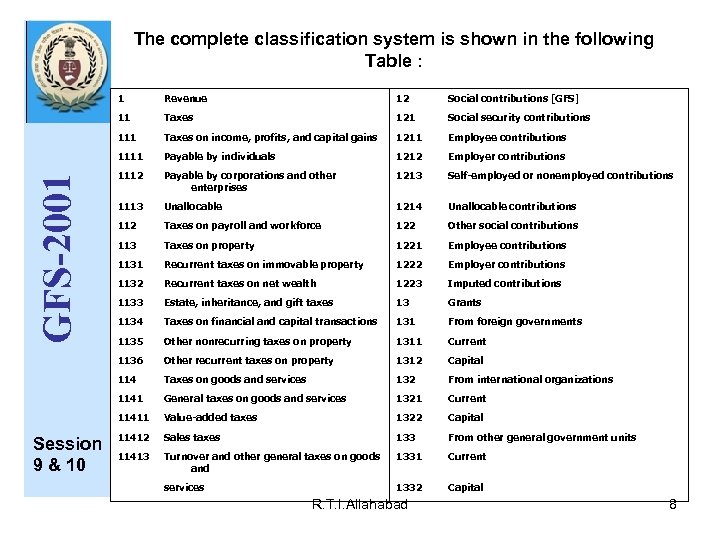
The complete classification system is shown in the following Table : 12 Social contributions [GFS] Taxes 121 Social security contributions 111 Taxes on income, profits, and capital gains 1211 Employee contributions 1111 Payable by individuals 1212 Employer contributions 1112 Payable by corporations and other enterprises 1213 Self-employed or nonemployed contributions 1113 Unallocable 1214 Unallocable contributions 112 Taxes on payroll and workforce 122 Other social contributions 113 Taxes on property 1221 Employee contributions 1131 Recurrent taxes on immovable property 1222 Employer contributions 1132 Recurrent taxes on net wealth 1223 Imputed contributions 1133 Estate, inheritance, and gift taxes 13 Grants 1134 Taxes on financial and capital transactions 131 From foreign governments 1135 Other nonrecurring taxes on property 1311 Current 1136 Other recurrent taxes on property 1312 Capital 114 Taxes on goods and services 132 From international organizations 1141 General taxes on goods and services 1321 Current 11411 Session 9 & 10 Revenue 11 GFS-2001 1 Value-added taxes 1322 Capital 11412 Sales taxes 133 From other general government units 11413 Turnover and other general taxes on goods and 1331 Current services 1332 Capital R. T. I. Allahabad 8
![1142 Excises 14 Other revenue 1143 Profits of fiscal monopolies 141 Property income [GFS]](https://present5.com/presentation/25c78739b85a3f685c3e60c7bf3d9193/image-9.jpg "1142 Excises 14 Other revenue 1143 Profits of fiscal monopolies 141 Property income [GFS]")
1142 Excises 14 Other revenue 1143 Profits of fiscal monopolies 141 Property income [GFS] 1144 Taxes on specific services 1411 Interest [GFS] 1145 Taxes on use of goods and on permission to use 1412 Dividends goods or perform activities 1413 Withdrawals from income of quasi-corporations 11451 Motor vehicle taxes 1414 Property income attributed to insurance 11452 Other taxes on use of goods and on permission policyholders to use goods or perform activities 1415 Rent 1146 Other taxes on goods and services 142 Sales of goods and services 115 Taxes on international trade and transactions 1421 Sales by market establishments 1151 Customs and other import duties 1422 Administrative fees 1152 Taxes on exports 1423 Incidental sales by nonmarket establishments 1153 Profits of export or import monopolies 1424 Imputed sales of goods and services 1154 Exchange profits 143 Fines, penalties, and forfeits 1155 Exchange taxes 144 Voluntary transfers other than grants 1156 Other taxes on international trade and transactions 1441 Current 116 Other taxes 1442 Capital 1161 Payable solely by business 145 Miscellaneous and unidentified revenue 1162 Payable by other than business or unidentifiable R. T. I. Allahabad 9
GFS-2001 I- Revenue and its components Session 9 & 10 (b) Basis of recording of Revenue: (i) Revenue should be recorded according to the accrual basis, (ii) With the exception of taxes and social contri butions, the amount of revenue to be recorded is the entire amount to which the general government unit has an unconditional claim. (iii) only those taxes and social insurance contributions that are evidenced by tax assessments and declarations, customs decla rations, and similar documents are considered to cre ate revenue for government units. (iv) The dif ferencebetween assessments and expected collections represents a claim that has no real value and should not be recorded as revenue. (v) Social security contributions include all compulsory payments made by insured persons, or their employers, to government units providing social security benefits in order to secure entitlement to those bene fits, provided the contributions are levied as a func tion of earnings, payroll, or the number of employees. (vi) Compulsory transfers levied on other bases and earmarked for social security expenditures are taxes and are classified according to their respective tax base. In particular, receipts based on net income per sonalized by adjustments for personal deductions and exemptions are classified as income taxes, even if earmarked for the payment of social security ben efits. Compulsory payments levied as a function of earnings, payroll, or the number of employees that do not secure entitlement to social security benefits are classified as taxes on payroll or workforce. Ref. 5. 13 to 5. 17 of GFS 2001 Manual R. T. I. Allahabad 10
I- Revenue and its components GFS-2001 Detailed description of Classification of Revenue: 1. Taxes (11): (i) Approach adopted in GFS System: The approach adopted in the GFS system is to classify taxes mainly by the base on which the tax is levied. Taxes are grouped into six major categories: § taxes on income, profits, and capital gains; § taxes on pay roll and workforce; § taxes on property; § taxes on goods and services; § taxes on international trade and transactions; and § other taxes. The bor derlines between these categories are not always clear, and the text provides additional commentary in questionable cases. (ii) If the revenue is designated for use in a social security scheme, then it is a social security contribution. Otherwise, it is a Session tax on payroll and workforce. 9 & 10 R. T. I. Allahabad 11
I- Revenue and its components GFS-2001 (iii) Taxes and other compulsory transfers should be recorded when the activities, transactions, or other events occur that create government claims to the taxes or other payments. (iv) Tax refunds generally are treated as negative taxes. Refunds are adjustments for overpayments. They are attributed to the period in which the event occurred that generated the overpayment. In the case of a value added type tax, taxpayers other than final consumers normally are allowed a refund of taxes paid on purchases. If this refund exceeds the taxes paid by that taxpayer, the net refund is treated as a negative tax. (v) Tax credits are amounts deductible from the tax that otherwise would be payable. Some types of credits can result in a government unit making a net payment to the taxpayer. Such net payments are treated as an expense rather than a negative tax. (vi) In some cases, one government unit collects taxes and then Session transfers some or all of them to another government unit. 9 & 10 R. T. I. Allahabad 12
I- Revenue and its components GFS-2001 (vi) Where an amount is collected by one govern ment for and on behalf of another government, and the latter government has the authority to impose the tax, set and vary its rate, and determine the use of the proceeds, then the former is acting as an agent for the latter and the tax is reassigned. Any amount retained by the collecting government as a collection charge should be treated as a payment for a service. (viii) Where different governments jointly and equally set the rate of a tax and jointly and equally decide on the distribution of the proceeds (ix) There may also be the circumstance where a tax is imposed under the constitutional or other authority of one government, but other governments individually set the tax rate in their jurisdictions and individually decide on the use of the proceeds of the tax generated in their jurisdictions. The proceeds of the tax Session generated in each respective government's jurisdiction are attributed 9 & 10 as tax revenues of that government. Ref. 5. 18 to 5. 28 of GFS 2001 Manual R. T. I. Allahabad 13
GFS-2001 I- Revenue and its components (a) Taxes on Income, profits, and capital gains (111): (i) Taxes on income, profits, and capital gains generally are levied on: § wages, salaries, tips, fees, commissions, fringe benefits, and other compensa tion for labor services; § interest, dividends, rent, and royalty incomes; § capital gains and losses, including capital gain distributions of investment funds; § profits of corporations, partnerships, sole proprietorships, estates, and trusts; § taxable por tions of social security, pension, annuity, life insur ance, and other retirement account distributions; and § miscellaneous other income items Session 9 & 10 R. T. I. Allahabad 14
GFS-2001 I- Revenue and its components Session 9 & 10 (ii) Taxes on income, profits, and capital gains are attributed either to individuals (1111) or to corpora tionsand other enterprises (1112). When the infor mation needed to determine whether taxes should be attributed to either of these categories is not available, the taxes are treated as unallocable (1113). (iii) These taxes may be levied on actual or esti matedincome and profits and on realized or unreal ized capital gains. (iv) In principle, income taxes and social contribu tions based on income should be attributed to the period in which the income is earned, even though there may be a significant delay between the end of the accounting period and the time at which it is fea sible to determine the actual liability of the taxpayer (v) Income taxes are normally imposed on the income earned during an entire year. (vi) Under imputation systems of corporate income tax, shareholders are wholly or partly relieved on their liability for an income tax on dividends paid by the corporation out of income or profits liable to cor porate income tax. The relief is usually called a tax credit although it actually is a means of allocating a tax among taxpayers. Ref. 5. 29 to 5. 34 of GFS 2001 Manual R. T. I. Allahabad 15
I- Revenue and its components (b) Taxes on Payroll and Workforce (112) : GFS-2001 (i) This category consists of taxes that are collected from employers or the self employed either as a pro portionof payroll size or as a fixed amount person and that are not earmarked for social security schemes. Payments earmarked for social security schemes are classified as social security contributions (121). Ref. 5. 35 of GFS 2001 Manual (c) Taxes on Property (113): (i) This item includes taxes on the use, ownership, or transfer of wealth. The taxes may be levied at regular intervals, one time only, or on a change in ownership. (ii) Taxes on the ownership or use of specific types of property often are based on the value of the prop ertyat a particular time but are deemed to accrue continuously over the entire year or the portion of the year that the property was owned, if less than the entire year. Taxes on the transfer of wealth are recorded at the time of the transfer, and some Session taxes on the ownership or use of property are recorded at a specific 9 & 10 time, such as a one time tax on net wealth. R. T. I. Allahabad 16
I- Revenue and its components GFS-2001 (iii) Taxes on immovable property that are levied on the basis of a presumed net income are recorded as taxes on income, profits, and capital gains (111). § Taxes on the use of property for residence, where the tax is payable by either proprietor or tenant and the amount payable is a function of the user's per sonal circumstances, such as pay or the number of dependents, are treated as taxes on income, profits, and capital gains (111). § Taxes on construction, enlargement, or alteration of all buildings, or those whose value or use den sity exceeds a certain threshold, are included in taxes on use of goods and on permission to use goods or perform activities (1145). § Taxes on use of one's own property for special trading purposes, such as selling alcohol, tobacco, or meat, are recorded under taxes on use of goods and on permission to use goods or perform activ ities(1145) § Taxes on exploitation of land subsoil assets not owned by government units, including taxes on extraction and exploitation of minerals and other resources, are recorded in other taxes on goods and services (1146). Payments to a government unit as the owner of land subsoil assets are recorded in rent (1415). Payments for licenses for the permis sionto exploit land subsoil assets are classified in taxes on use of goods and on Session permission to use goods or perform activities (1145) 9 & 10 § Taxes on capital gains resulting from the sale of property are included in taxes on income, profits, and capital gains (111) R. T. I. Allahabad 17
I- Revenue and its components GFS-2001 (iv) Taxes on property are divided into six cate gories: § recurrent taxes on immovable property; § recurrent taxes on net wealth; § estate, § inheritance, and § gift taxes; taxes on financial and capital transactions; § other non recurrent taxes on property; and other recurrent taxes on property (v) Recurrent taxes on immovable property (1131). This item covers taxes levied regularly on the use or ownership of immovable property, which includes land, buildings, and other structures. The taxes can be levied on proprietors, tenants, or both. The amount of the taxes is usually a percentage of an assessed proper tyvalue that is based on a notional rental income, sales price, capitalized yield, or other characteristics such as size or location. Unlike recurrent taxes on net wealth (1132), liabilities incurred on the property are usually not taken into account in assessment of these taxes. Session (vi) Recurrent taxes on net wealth (1132). This item covers taxes levied regularly on net wealth, which is usually defined as the value of a wide 9 & 10 range of movable and immovable property less liabilities incurred on that property. R. T. I. Allahabad 18
I- Revenue and its components GFS-2001 (vii) Estate, inheritance, and gift taxes (1133) This item covers taxes on transfers of property at death and on gifts. Taxes on the transfer of property at death include estate taxes, which are usually based on the size of the total estate, and inheritance taxes, which may be determined by the amount received by bene ficiaries and/or their relationship to the deceased. (viii) Taxes on financial and capital transactions (1134). This item includes taxes on change of own ership of property, except those classified as gifts, inheritance, or estate transactions. Included are taxes on the issue, purchase, and sale of securities, taxes on checks and other forms of payment, and taxes levied on specific legal transactions, such as the val idation of contracts and the sale of immovable prop erty. This category does not include taxes on the use of goods (part of 1145); taxes on capital gains (part of 111); recurrent taxes on net wealth (1132); other nonrecurrent taxes on property (1135); fees paid to cover court charges or for birth, marriage, or death certificates (part of 1422); sales taxes (11412); Session or general stamp taxes (part of 116). 9 & 10 R. T. I. Allahabad 19
I- Revenue and its components GFS-2001 (ix) Other non recurrent taxes on property (1135). This item covers taxes on net wealth and property that are levied on a one time basis or at irregular intervals. It includes taxes on net wealth levied to meet emer gency expenditures or to effect a redistribution of wealth; taxes on property, such as betterment levies, that take account of increases in land values due to government permission to develop the land or the provision by government of additional local facilities; taxes on the revaluation of capital; and any other exceptional taxes on particular items of property. (x) Other recurrent taxes on property (1136). This item includes any recurrent taxes on property not included in categories 1131, 1132, or 1134, such as recurrent gross taxes on personal property, jewelry, cattle, other livestock, other particular items of prop erty, and external signs of wealth. Taxes on the use of particular types of movable property, such as motor vehicles and guns, are classified in taxes on use of goods and on permission to use goods or perform activities (1145) Session Ref. 5. 36 to 5. 45 of GFS 2001 Manual 9 & 10 R. T. I. Allahabad 20
I- Revenue and its components GFS-2001 (d) Taxes on goods and services (114): (i) Included in this item are all taxes levied on the production, extraction, sale, transfer, leasing, or deliv ery of goods and rendering of services. Also included are taxes on the use of goods and on permission to use goods or perform activities. Taxes on goods and ser vices include: § Value added taxes. § General sales taxes, whether levied at manufac turer/production, wholesale, or retail level § Single stage taxes and cumulative multistage taxes, where "stage" refers to stage of production or distribution. § Excises. § Taxes levied on the use of motor vehicles or other goods. § Taxes levied on permission to use goods or perform certain activities. Session § Taxes on the extraction, processing, or production of minerals and other products. 9 & 10 Ref. 5. 46 of GFS 2001 Manual R. T. I. Allahabad 21
GFS-2001 I- Revenue and its components Session 9 & 10 (ii) This category does not include taxes levied on international trade and transactions (115) but does include taxes levied upon importation or at the bor derif the liability does not result solely from the fact that the goods have crossed the border and is applic able to domestic goods or transactions as well. Ref. 5. 47 of GFS 2001 Manual (iii) General taxes on goods and services (1141). This item includes all taxes, other than customs and other import duties (1151) and taxes on exports (1152), levied on the production, leasing, delivery, sale, purchase, or other change of ownership of a wide range of goods and the rendering of a wide range of services. When taxes are levied on a limited range of goods rather than a wide range, they are included in excises (1142). This item is subdivided into the following categories: § Value added taxes (11411). A value added tax (VAT) is a tax on goods or services collected in stages by enterprises but which is ultimately charged in full to the final purchasers. VAT is usually calculated on the price of the good or service, including any other tax on the product. VAT may also be payable on imports of goods or services in addition to any import duties or other taxes on the imports. § Sales taxes (11412). This category includes all general taxes levied at one stage only, whether at manufacturing or production stages or on whole sale or retail trade § Turnover and other general taxes on goods and services (11413). This category includes multi stagecumulative taxes, which include a tax each time a transaction takes place without deduction for taxes paid on inputs and all general consump tion taxes where elements of value added, sales, or multistage taxes are combined. Ref. 5. 48 of GFS 2001 Manual R. T. I. Allahabad 22
GFS-2001 I- Revenue and its components Session 9 & 10 ((iv) Excises (1142). Excises are taxes levied on par ticular products, or on a limited range of products, that are not classifiable under general taxes on goods and services (1141); profits of fiscal monopolies (1143); customs and other import duties (1151); or taxes on exports (1152). Taxes on electricity, gas, and energy are regarded as taxes on goods and are included under excises rather than taxes on specific services (1144). Ref. 5. 49 of GFS 2001 Manual (v) Profits of fiscal monopolies (1143). § This item covers that part of the profits of fiscal monopolies that is transferred to the government. § Fiscal monopolies are public corporations or public quasi corporations that exercise the taxing power of government by the use of monopoly powers over the production or distribution of a particular kind of good or service. § The monopolies are created to raise government revenues that could other wisebe gathered through taxes on private sector pro duction or distribution of the commodities concerned. § Typical commodities subject to fiscal monopolies are tobacco products, alcoholic beverages, salt, matches, petroleum products, and agricultural products. § Fiscal monopolies are distinguished from public enterprises such as rail transport, electricity, post offices, and other communications services. § Transfers to government from such public enterprises are treated as dividends (1412) or withdrawals of income from quasi corpora tions (1413). § The concept of fiscal monopoly does not extend to state lotteries, the profits of which are also regarded as dividends (1412) or withdrawals ofincome from quasi corporations (1413). § Export and import monopoly profits transferred from marketing boards or other enterprises dealing with international trade are similar to fiscal monopoly profits, but are classified as profits of export or import monopolies (1153). § Any reserves retained by fiscal monopolies are exclud ed. § The taxes are recorded when the transfer takes place rather than when the profits were R. T. I. Allahabad 23 earned. Ref. 5. 50 to 5. 52 of GFS 2001 Manual
I- Revenue and its components GFS-2001 (vi) Taxes on specific services (1144). § All taxes levied on payments for specific services, such as taxes on transport charges, insurance premiums, banking services, entertainment, restaurants, and advertising charges, are included here. § Also included in this item are taxes levied on gambling and betting stakes for horse races, football pools, lotteries, and so forth. § Taxes on entry to casinos, races, etc. are also classified as selective taxes on services. If, however, the taxes form part of a general tax on goods and ser vices, the revenue is recorded under category 1141. § Taxes on individual gains from football pools or other gambling proceeds are classified in taxes on income, profits, and capital gains (111). § Profits transferred to government from state lotteries are regarded as divi dends (1412) or withdrawals of income from quasi corporations (1413). § Taxes on checks and on the issue, transfer, or redemption of securities are classi fied astaxes on financial and capital transactions (1134). Stamp tax revenues that cannot be assigned to taxes on services or Session § other transactions are classified as other taxes (116). 9 & 10 § Taxes on electricity, gas, and energy are included under excises (1142) Ref. 5. 53 of GFS 2001 Manual R. T. I. Allahabad 24
I- Revenue and its components GFS-2001 (vii) Taxes on use of goods and on permission to use goods or perform activities (1145). One of the regula tory functions of government is to forbid the ownership or use of certain goods or the pursuit of certain activi tiesunless specific permission is granted by issuing a license or other certificate for which a fee is demanded. Ref. 5. 54 of GFS 2001 Manual (viii) More specifically, the following types of fees are considered taxes: § fees where the payer of the levy is not the receiver of the benefit, such as a fee collect ed from slaughterhouses to finance a service provided to farmers; § fees where government is not providing a specific service in return for the levy even though a license may be issued to the payer, such as a hunting, fishing, or shooting license that is not accompanied by the right to use a specific area of government land; and § fees where benefits are received only by those pay ing the fee but the benefits received by each individual are not necessarily in proportion to the payments, such as a milk marketing levy paid by Session dairy farmers and used to promote the consumption of milk. 9 & 10 Ref. 5. 55 of GFS 2001 Manual R. T. I. Allahabad 25
I- Revenue and its components GFS-2001 (ix) Although taxes in this category are levied on the use of goods rather than on the ownership or transfer of goods, registration of the ownership of goods may generate the tax claim. For example, reg istration of the ownership of animals or motor vehi cles may be the event that causes a tax on the use of these items to be assessed. Taxes on the use of goods may apply even to functionally unusable goods, such as antique motor vehicles or guns. Ref. 5. 56 of GFS 2001 Manual (x) Borderline cases § It arise with taxes on the permis sion to perform business activities, which are levied on a combined income, payroll, or turnover base. § Borderline cases also arise with taxes on the ownership or use of property that could be classi fied asrecurrent taxes on immovable property (1131), recurrent taxes on net wealth (1132), or other recur rent taxes on property (1136). § Unlike the taxes under this item, category 1131 is confined to taxes on the ownership or tenancy of immovable property and such taxes normally are related to the value of the property. § The taxes included in 1132 and 1136 are confined to ownership rather than use of assets, apply to groups of assets rather than particular goods, and Session are based on the value of assets. 9 & 10 Ref. 5. 57 of GFS 2001 Manual R. T. I. Allahabad 26
I- Revenue and its components GFS-2001 (xi) This category is subdivided into motor vehicle taxes and other taxes on the use of goods and on the permission to use goods or perform services: § Motor vehicle taxes (11451). This category includes taxes on the use of motor vehicles or per mission to use motor vehicles. § Other taxes on use of goods and on permission to use goods or perform services (11452). Business and professional licenses are included in this cate gory. It would not cover business taxes levied on gross sales, which would be classi fiedunder general taxes on goods and services (1141). Also included in this category are pollution taxes levied on the emission or discharge into the environment of noxious gases, liquids, or other harmful substances. Ref. 5. 58 of GFS 2001 Manual (xii) Other taxes on goods and services (1146). This item includes taxes on the extraction of miner als, fossil fuels, and other exhaustible resources from deposits owned privately or by another government and any other taxes on goods or services not included in categories 1141 through 1145. The taxes are recorded when the resources are extracted. Payments for the extraction of exhaustible resources from deposits Session owned by the government unit receiving the pay mentare classified as 9 & 10 rent (1415). Ref. 5. 59 of GFS 2001 Manual R. T. I. Allahabad 27
I- Revenue and its components GFS-2001 (e) Taxes on international trade and transaction: (i) Customs and other import duties (1151). This item covers revenue from all levies collected on goods because they are entering the country or services because they are delivered by nonresidents to resi dents. The levies may be imposed for revenue or pro tection purposes and may be determined on a specific or ad valorem basis, but they must be restricted by law to imported products. Included are duties levied under the customs tariff schedule and its annexes, including surtaxes that are based on the tariff schedule, consular fees, tonnage charges, statistical taxes, fiscal duties, and surtaxes not based on the customs tarif schedule. Taxes that fall on imports only because the imports fall into a wider category of goods that are subject to the tax are recorded under general taxes on goods and services (1141) or excises (1142) Ref. 5. 60 of GFS 2001 Manual (ii) Taxes on exports (1152). This category includes all levies based on the fact that goods are being transported out of the country Session or services are being delivered to nonresidents by residents. 9 & 10 Ref. 5. 61 of GFS 2001 Manual R. T. I. Allahabad 28
I- Revenue and its components GFS-2001 (iii) Profits of export or import monopolies (1153). § Governments may establish enterprises with the monopoly right to export or import particular goods and/or control services provided to or received from nonresidents to raise revenue that could be gathered through taxes on exports, imports, or dealings in for eign exchange. § When such monopolies exist, the profits remitted to government by the monopolistic enterprises or marketing boards are considered to be taxes. § Such profits are recorded as tax revenue when transferred to the government and do not include the retained reserves of the enterprises or marketing boards. § Profits received from export or import enterprises or marketing boards that do not represent monopoly profits are recorded as property income (141). Profits transferred to the government from public enterprises or marketing boards dealing in commodities domestically, outside of international trade, are recorded under Session property income (141) or profits of fiscal monopolies (1143) 9 & 10 Ref. 5. 62 of GFS 2001 Manual R. T. I. Allahabad 29
GFS-2001 I- Revenue and its components Session 9 & 10 (iv) Exchange profits (1154). When the monopoly powers of government or monetary authorities are exercised to extract a margin between the purchase and sale prices of foreign exchange, other than to cover administrative costs, the revenue derived constitutes a compulsory levy exacted from both pur chaser and seller of foreign exchange. It is the com mon equivalent of an import duty and export duty levied in a single exchange rate system or of a tax on the sale or purchase of foreign exchange. Like the profits of export or import monopolies, the revenue represents the exercise of monopoly powers for tax purposes and is included in tax revenues when received by government. . Ref. 5. 63 of GFS 2001 Manual (v) Exchange taxes (1155). This item covers taxes that are levied upon the sale or purchase of foreign exchange, whether at a unified exchange rate or at dif ferentexchange rates. Included are taxes on remit tances abroad if the taxes are levied on the purchase of foreign exchange that is to be remitted. Remittance taxes that are not levied on the purchase of foreign exchange are recorded under other taxes on international trade and transactions (1156) Ref. 5. 64 of GFS 2001 Manual (vi) Other taxes on international trade and trans actions(1156). This item includes other taxes levied on various aspects of international trade and transac tions, such as taxes levied exclusively or predomi nantlyon travel abroad, taxes on insurance or invest mentabroad, and taxes on remittances abroad, excluding taxes levied on the purchase of foreign exchange to be remitted abroad, which are included in exchangee taxes (1155). Ref. 5. 65 of GFS 2001 Manual R. T. I. Allahabad 30
GFS-2001 I- Revenue and its components Session 9 & 10 (f) Other Taxes (116) § This item covers revenue from taxes levied pre dominantly on a base or bases other than those described under the preceding tax headings. Also included is revenue from unidentified taxes and inter est and penalties collected for late payment or non payment of taxesbut not identifiable by tax category. § The item is subdivided into other taxes paid solely by business (1161) and other taxes paid by other than business or unidentifiable (1162). § The item includes taxes on persons that are not based on income or pre sumptive income, sometimes referred to as poll taxes, head taxes, or capitation taxes. § Personal taxes based on actual or presumptive income are recorded as taxes on income, profits, and capital gains (111). § Also included are stamp taxes that do not fall exclusively or predominantly on a single class of transactions or activities covered by other taxes. Examples would be revenues from the sale of stamps required to be affixed to contracts and checks. § Revenues from the sale of stamps assignable to a single category, such as liquor and cigarettes, would be shown as taxes on those products, either excises (1142) or taxes on spe cific services(1144). § Also included would be an expenditure tax that is levied on purchases but is per sonalized by the application of personal deductions and exemptions and revenue from taxes levied on a combination of several tax bases, where the revenue cannot be readily allocated to each tax base or to one predominant tax base Ref. 5. 66 of GFS 2001 Manual R. T. I. Allahabad 31
![I- Revenue and its components GFS-2001 2. Social Contributions [GFS] (12) (i) Social contributions](https://present5.com/presentation/25c78739b85a3f685c3e60c7bf3d9193/image-32.jpg "I- Revenue and its components GFS-2001 2. Social Contributions [GFS] (12) (i) Social contributions")
I- Revenue and its components GFS-2001 2. Social Contributions [GFS] (12) (i) Social contributions are actual or imputed receipts either from employers on behalf of their employees or from employees, self employed or non employed persons on their own behalf that secure entitlement to social benefits for the contributors, their dependents, or their survivors. The contributions may be compulsory or voluntary. Social contributions are classified as social security contribu tions (121) or other social contributions (122) depend ing on the type of scheme receiving them. (ii) Social contributions are levied as a function of earnings, payroll, or the number of employees. When income is used as a proxy for gross wages, however, as for the self employed, the receipts are included here. Compulsory payments assessed on a different base but earmarked for social insurance schemes are treated as taxes. (iii) the amount of social contributions recorded as revenue should only be the amount that is realistically expected to be collected. The actual collection, how ever, may be in a later period, perhaps much Session later. 9 & 10 Ref. 5. 67 to 5. 70 of GFS 2001 Manual R. T. I. Allahabad 32
I- Revenue and its components GFS-2001 (a) Social Security Contributions (121): (i) Contributions to social security schemes are clas sified by the source of the contribution. Employee con tributions (1211) are either paid directly by employees or are deducted from employees' wages and salaries and transferred on their behalf by the employer. Employer contributions (1212) are paid directly by employers on behalf of their employees. Amounts paid by general government employers are not eliminated by consolidation when the paying and receiving units are in the same sector or sub sector because the contri butions are considered to be rerouted as described in paragraph 3. 20 of Chapter 3 and then paid by the employees. Self employed or non employed contribu tions (1213) are paid by contributors who are not employees. Un allocable contributions (1214) are those contributions whose source cannot be deter mined. If any contributions were voluntary, a memo randumitem of their total amount would be useful for computing the fiscal burden and Session other uses. 9 & 10 Ref. 5. 71 of GFS 2001 Manual R. T. I. Allahabad 33
I- Revenue and its components GFS-2001 (b) Other Social Contributions (122) : (i) Other social contributions include actual and imputed contributions to social insurance schemes operated by governments as employers on behalf of their employees that do not provide retirement benefits. Unlike social security schemes, social insurance schemes for government employees generally tie the level of benefits directly to the level of contributions. Such schemes usually are operated by a government only for its own employees, but they can be operat edby one government on behalf of the employees of many governments. Ref. 5. 72 of GFS 2001 Manual (ii) Employee contributions (1221) include amounts paid directly by employees or transferred from wages and salaries and other compensation by employers on behalf of employees. Employer contributions (1222) include amounts paid by employers on behalf of their employees. As with employer contributions to social security schemes, these contributions are not eliminat edby consolidation when the paying and receiving governments are in the same sector or sub sector. (iii) Imputed contributions (1223) arise when gov ernment employers provide social benefits directly to their employees, former employees, or dependents Session out of their own resources without involving an insurance enterprise or an 9 & 10 autonomous or non autonomous pension fund. Ref. 5. 73 of GFS 2001 Manual R. T. I. Allahabad 34
I- Revenue and its components GFS-2001 3. Grants (13): (i) Grants are noncompulsory current or capital transfers received by a government unit from either another government unit or an international organi zation. Grants are classified first by the type of unit paying the grant and then by whether the grant is cur rent or capital. (ii) Three sources of grants are recognized in the GFS system: grants from foreign governments (131), grants from international organizations (132), and grants from other general government units (133). (iii) Current grants are those made for purposes of current expenditure and are not linked to or condi tionalon the acquisition of an asset by the recipient. Capital grants involve the acquisition of assets by the recipient and may consist of a transfer of cash that the recipient is expected or required to use for the acquisition of an asset or assets (other than invento ries), the transfer of an asset (other than inventories and cash), or the cancellation of a liability by mutu al agreement between the creditor and debtor. If doubt Session exists regarding the character of a grant, it should be classified as 9 & 10 current. Ref. 5. 73 of GFS 2001 Manual R. T. I. Allahabad 35
I- Revenue and its components GFS-2001 (iv) Grants in kind should be valued at current mar ket prices. If market prices are not available then the value should be the explicit costs incurred in provid ing the resources or the amounts that would be received if the resources were sold. In some cases, the donor and the recipient may view the value quite differently. In this case, the valuation from the view point of the donor should be used. (v) Grants are recorded when all requirements and conditions for receiving them are satisfied and the receiving unit has an unconditional claim. Determining this time can be complex because there is a wide variety of eligibility conditions that have varying legal powers. In some cases, a potential grant recipient has a legal claim when it has satisfied certain conditions, such as the prior incurrence of expenses for a specific purpose or the passage of leg islation. In many cases, the grant recipient never has a claim on the donor and it should be attributed to the time at which the cash payment is Session made. 9 & 10 Ref. 5. 75 to 5. 79 of GFS 2001 Manual R. T. I. Allahabad 36
![I- Revenue and its components GFS-2001 4. Other revenue (14): (a) Property Income [GFS]](https://present5.com/presentation/25c78739b85a3f685c3e60c7bf3d9193/image-37.jpg "I- Revenue and its components GFS-2001 4. Other revenue (14): (a) Property Income [GFS]")
I- Revenue and its components GFS-2001 4. Other revenue (14): (a) Property Income [GFS] (141): (i) Property income includes a variety of forms of revenue earned by a general government unit when it places financial and/or non produced assets that it owns at the disposal of other units. Revenue in this category may take the form of interest, dividends, withdrawals from income of quasi corporations, property income attributed to insurance policyholders, or rent. Ref. 5. 81 of GFS 2001 Manual (ii) Interest [GFS] (1411) § Interest is receivable by general government units that own certain kinds of financial assets, namely deposits, securities other than shares, loans, and accounts receivable. § The contract between creditor and debtor may call for periodic payments equal to the amount of inter estthat has accrued but not yet been paid, but in other cases there may be no such requirement so that the interest accrued is not due to be paid Session until the end of the contract. 9 & 10 Ref. 5. 82 & 5. 83 of GFS 2001 Manual R. T. I. Allahabad 37
I- Revenue and its components (iii) Dividends (1412): GFS-2001 § Session 9 & 10 § § § General government units, in their capacity as shareholders and owners of a corporation, become entitled to receive dividends as a result of placing equity funds at the disposal of that corporation. General government units may receive dividends from private or public corporations. Distributions of profits by public corporations may take place irregularly and may not be explicitly labeled as dividends. Dividends include all distributions of profits by corpo rations to their shareholders or owners, including profits of central banks transferred to government units, profits derived from the operation of monetary authority functions outside the central bank, and profits trans ferredby state lotteries. When payments are received from public corporations, it can be difficult to decide whether they are dividends or withdrawals of equity. Dividends are payments a corporation makes out of its current income, which is derived from its ongoing productive activities. A corporation may, however, smooth the divi dends its pays from one period to the next so that in some periods it pays more in dividends than it earns from its productive activities. Such payments are still dividends. Ref. 5. 85 to 5. 87 of GFS 2001 Manual R. T. I. Allahabad 38
I- Revenue and its components GFS-2001 (iv) Withdrawals from income of quasi corpora tions (1413). § By definition, quasi corporations cannot distribute income in the form of dividends, but the owner may choose to withdraw some or all of the income. Conceptually, the withdrawal of such income is equivalent to the distribution of corporate income through dividends and is treated the same way. The amount of income that the owner of a quasi corporation chooses to withdraw will depend largely on the size of its net income. All such withdrawals are record ed on the date the payment actually occurs. § As with dividends, withdrawals from income of quasi corporations do not include withdrawals of funds realized from the sale or other disposal of the quasi corporation's assets. The transfer of funds resulting from such disposals is recorded as a reduc tion of the equity of quasi corporations owned by government. Similarly, funds withdrawn by liquidating large amounts of accumulated retained earnings or other reserves of Session the quasi corporation are treated as withdrawals from equity. 9 & 10 Ref. 5. 88 to 5. 89 of GFS 2001 Manual R. T. I. Allahabad 39
I- Revenue and its components GFS-2001 (v) Property income attributed to insurance policyholders (1414). § Insurance enterprises hold techni cal reserves in the form of prepayments of premiums, reserves against outstanding claims, and actuarial reserves against outstanding risks in respect of life insurance policies. § These reserves are considered to be assets of the policyholders or beneficiaries, including any general government units that are policyholders, and liabilities of the insurance enterprises. § Any income received from the investment of insurance technical reserves is also considered to be the property of the policyholders or beneficiaries and is described as property income attributed to insurance policyholders. Ref. 5. 90 of GFS 2001 Manual Session 9 & 10 R. T. I. Allahabad 40
GFS-2001 I- Revenue and its components Session 9 & 10 (vi) Rent (1415): § Rent is the property income received from certain leases of land, subsoil assets, and other naturally occurring assets. Other leases of these types of assets, especially leases of the electromagnetic spectrum, may be considered the sale of an intangi ble non produced asset. § As with interest, rent accrues continuously to the asset's owner throughout the period of the contract. The rent recorded for a particular accounting period is, therefore, equal to the value of the accumulated rent that becomes payable over the accounting period and may differ from the amount of rent that becomes due for payment or is actually paid during the period. § General government units may own subsoil assets in the form of deposits of minerals or fossil fuels and may grant leases that permit other units to extract these deposits over a specified period of time in return for a payment or series of payments. These payments are often described as "royalties, " but they are rents that accrue to owners of assets in return for putting the assets at the disposal of other units for specified periods of time. The rents may take the form of periodic payments of fixed amounts, irrespective of the rate of extraction, or, more usually, will be derived according to the quantity, volume, or value of the asset extracted. Enterprises engaged in exploration on government land may make payments to general government units in exchange for the right to undertake test drilling or otherwise investigate the existence and location of R. T. I. Allahabad 41 sub soil assets. Such payments are also treated as rents even though no extraction may take place.
I- Revenue and its components GFS-2001 § § § Session 9 & 10 Other types of rent include payments for the right to cut timber on non cultivated government land, to exploit bodies of unmanaged water for recreational or commercial purposes, including fishing, to use water for irrigation, and to graze animals on gov ernment land. Rent should not be confused with severance taxes, business licenses, or other taxes. Severance taxes are imposed on the extraction of minerals and fossil fuels from land owned privately or by another government. If the payment counts toward the taxes on profits, then it should be classified as taxes on income, profits, and capital gains (111). Payments counted toward a tax on the gross value of produc tion should be classified as other taxes on goods and services (1146). Payments for a license or permit to conduct extraction operations should be classified as taxes on use of goods and on permission to use goods or perform activities (1145). Rent should also not be confused with the rental of produced assets, which is treated as sales of goods and services (142). A single transaction may comprise both rent and sales of goods and services. Ref. 5. 91 to 5. 97 of GFS 2001 Manual R. T. I. Allahabad 42
I- Revenue and its components GFS-2001 (b) Sales of goods and Services (142): (i) Sales by market establishments (1421): § An establishment is a part of an enterprise situated in a single location and at which only a single productive activity is carried out or the principal productive activity accounts for most of the value added. § A market establishment within a government unit is an establishment that sells or otherwise disposes of all or most of its output at prices that are economically significant. § This category consists of the sales of all market establish mentsthat are part of the units for which statistics are being compiled. § Because all establishments of public corporations are market establishments, all sales of public corporations are included here. § Rentals of produced assets are treated as sales of services and are included in this category. Session § Sales of non financial assets are disposals of non financial 9 & 10 assets as described in this session in subsequent discussion. Ref. 5. 98 of GFS 2001 Manual R. T. I. Allahabad 43
I- Revenue and its components GFS-2001 (ii) Administrative fees (1422): § This item includes fees for compulsory licenses and other administrative fees that are sales of services. Examples are drivers' licenses, passports, court fees, and radio and television licenses when public authorities provide general broadcasting services. For these fees to be considered a sale of a service, the general govern mentunit must exercise some regulatory function — for example, checking the competence or qualifica tions of the person concerned, checking the efficient and safe functioning of the equipment in question, or carrying out some other form of control that it would otherwise not be obliged to do. § If a payment is clearly out of all proportion to the cost of providing the service, then the fee is classified as taxes Session on use of goods and on permission to use goods or 9 & 10 perform activities (1145). R. T. I. Allahabad Ref. 5. 99 of GFS 2001 Manual 44
GFS-2001 I- Revenue and its components Session 9 & 10 (iii) Incidental Sales by non market establishment (1423): § This item covers sales of goods and services by non market establishments of general government units other than administrative fees. § Included are sales incidental to the usual social or community activities of government departments and agencies, such as sales of products made at voca tional schools, seeds from experimental farms, post cards and art reproductions by museums, fees at gov ernment hospitals and clinics, tuition fees at government schools, and admission fees to government museums, parks, and cultural and recreational facilities that are not organized as public corporations. Ref. 5. 100 of GFS 2001 Manual (iv) Imputed sales of goods and services (1424): § When a unit produces goods and services for the purpose of using them as compensation of employees in kind, the unit is acting in two capacities: as an employer and as a general producer of goods and services. In order to indicate the total amount paid as compensation of employees, it is necessary to treat the amount paid in kind as if it had been paid in cash as wages and salaries and then the employees had used the cash to purchase the goods and services. This category includes the total value of these imputed sales. § Sales of goods are recorded when legal ownership changes. Ref. 5. 101 & 5. 102 of GFS 2001 Manual R. T. I. Allahabad 45
I- Revenue and its components GFS-2001 (c) Fines, penalties and forfeits (143): § Fines and penalties are compulsory current transfers imposed on units by courts of law or quasi judicial bodies for violations of laws or administrative rules. Out of court agreements are also included. § Forfeits are amounts that were deposited with a general government unit pending a legal or administrative proceeding and that have been transferred to the general government unit as part of the resolution of that proceeding. § Fines and penalties assessed for infringement of regulations identified as relating to a particular tax are recorded together with that tax. Other fines and penalties identifiable as relating to tax offenses are classified as other taxes (116). § Most fines, penalties, and forfeits are deter minedat a specific time. These transfers are recorded when the general government unit has a legal claim to the funds, which may be when a court ren ders judgment or an administrative ruling is published, or it may be when a late payment or other infringement automatically causes a Session fine or penalty. 9 & 10 Ref. 5. 103 & 5. 105 of GFS 2001 Manual R. T. I. Allahabad 46
GFS-2001 I- Revenue and its components Session 9 & 10 (d) Voluentary transfers other than grants (144): § This category includes gifts and voluntary donations from individuals, private nonprofit institutions, nongovernmental foundations, corporations, and any other source other than governments and international organizations. Current voluntary transfers other than grants (1441) include, for example, contributions to government of food, blan kets, and medical supplies for relief purposes. § Capital voluntary transfers other than grants (1442) include transfers for the construction or purchase of hospitals, schools, museums, theaters, and cultural centers and gifts of land, buildings, or intangible assets such as patents and copyrights. If it is not clear whether the transfer is current or capital, it is classified as current. Ref. 5. 106 of GFS 2001 Manual (e) Miscellaneous and unidentified revenue (145): § Included in this category are all revenues that do not fit into any other category. § Items that might appear here are sales of used military and other goods that were not classified as assets, sales of scrap, non life insurance claims against insurance corporations, non life insurance premiums of government operated insurance schemes, payments received for damage to government property other than payments from a judicial process, and any revenues for which adequate information is not available to permit their classification elsewhere. R. T. I. Allahabad 47 Ref. 5. 107 of GFS 2001 Manual
Скачать презентацию GFS-2001 Session Learning Objective Session 9 10
25c78739b85a3f685c3e60c7bf3d9193.ppt