


 Скачать презентацию Getting work 2013 Andrew Ross and Peter
c24f0efac74a7c4a692ff0e456d7c057.ppt
- Количество слайдов: 17
 Getting work © 2013 Andrew Ross and Peter Williams. Published 2013 by John Wiley & Sons, Ltd. 1
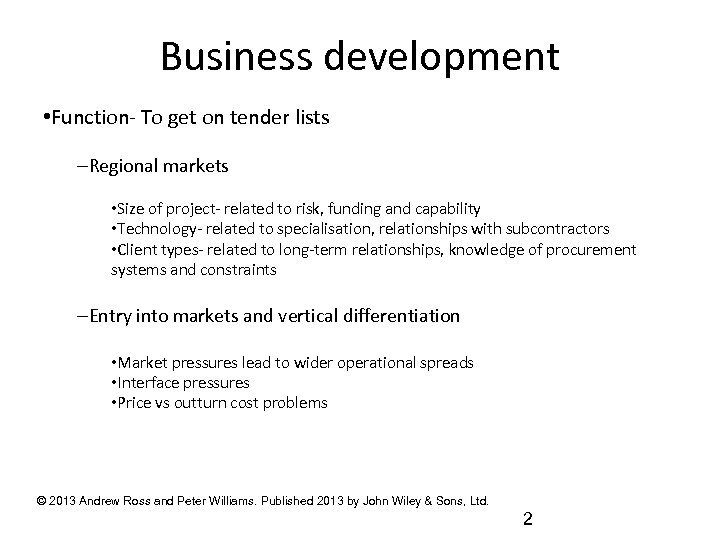 Business development • Function- To get on tender lists –Regional markets • Size of project- related to risk, funding and capability • Technology- related to specialisation, relationships with subcontractors • Client types- related to long-term relationships, knowledge of procurement systems and constraints –Entry into markets and vertical differentiation • Market pressures lead to wider operational spreads • Interface pressures • Price vs outturn cost problems © 2013 Andrew Ross and Peter Williams. Published 2013 by John Wiley & Sons, Ltd. 2
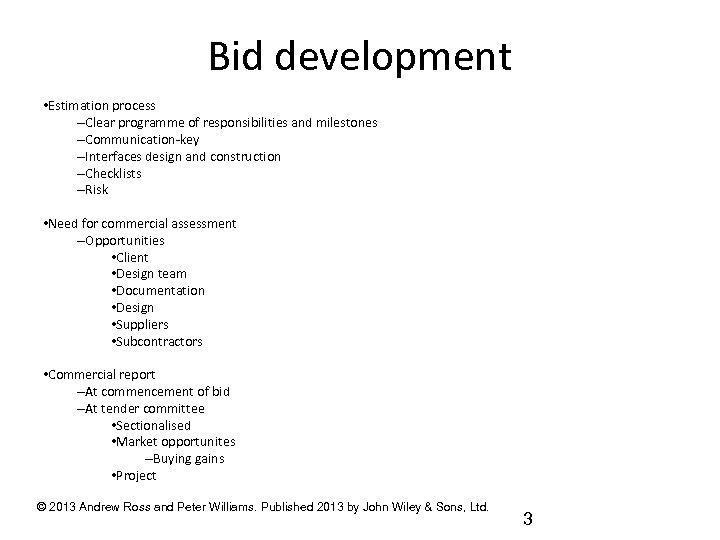 Bid development • Estimation process –Clear programme of responsibilities and milestones –Communication-key –Interfaces design and construction –Checklists –Risk • Need for commercial assessment –Opportunities • Client • Design team • Documentation • Design • Suppliers • Subcontractors • Commercial report –At commencement of bid –At tender committee • Sectionalised • Market opportunites –Buying gains • Project © 2013 Andrew Ross and Peter Williams. Published 2013 by John Wiley & Sons, Ltd. 3
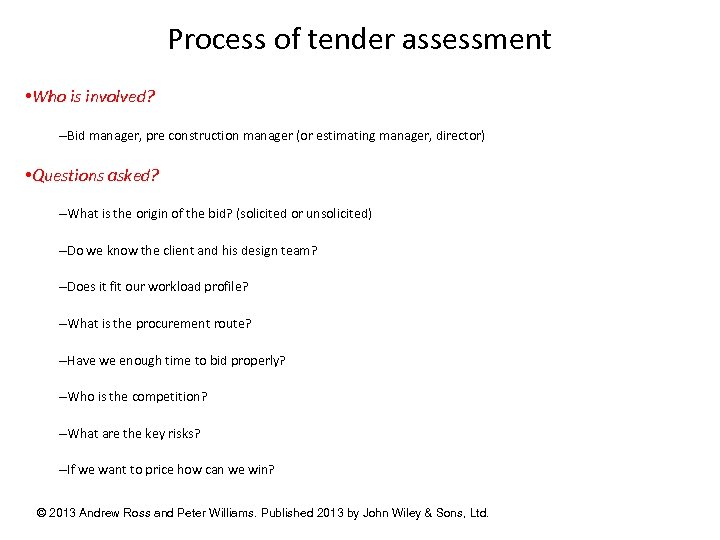 Process of tender assessment • Who is involved? –Bid manager, pre construction manager (or estimating manager, director) • Questions asked? –What is the origin of the bid? (solicited or unsolicited) –Do we know the client and his design team? –Does it fit our workload profile? –What is the procurement route? –Have we enough time to bid properly? –Who is the competition? –What are the key risks? –If we want to price how can we win? © 2013 Andrew Ross and Peter Williams. Published 2013 by John Wiley & Sons, Ltd.
 What are the key risks? –Client • Have we worked together before? • Is there a chance of repeat business? • Is the budget realistic? • How is the client funding the project? • Payment record (public or private client) –Form of contract • Standard form or significant alterations • Any deal breakers e. g. on demand bonds or “fit for purpose” © 2013 Andrew Ross and Peter Williams. Published 2013 by John Wiley & Sons, Ltd.
 Contractual risk assessment –Payment processes • Payment period following issue of Architects Certificate • Valuation method (cost plus, schedule of rates, stage payments and timing etc) • Variation and claim evaluation- standards of “proof” –Supply chain risk • Are there any nominated, specified or named contractors? • Have we experience of them and can they perform © 2013 Andrew Ross and Peter Williams. Published 2013 by John Wiley & Sons, Ltd.
 Contractual Risk assessment Design Risks • What is the extent of design responsibility? –D&B, contractor design portion supplement, no design • Who’s involved? –Consultants, specialist contractors, planners, community groups. • How robust is the design? –Concept vs. detail –Can we identify the extent of the design development necessary? • Reliability of designers –Can they supply design information in accordance with the programme, big enough to carry PI if they fail – Robustness of their contract e. g. novation terms and the stage that the designers are integrated with construction team © 2013 Andrew Ross and Peter Williams. Published 2013 by John Wiley & Sons, Ltd.
 Production risk- commercial implications • Programme risks –Is the contract period realistic? –Critical path and information/procurement of resources to hit key commencement dates –Early activities, design information availability • Supply chain risks –How are subcontractors selected- price only? ? –Do we need to align with key subcontractors i. e. M&E –Time available to resend out for commercial opportunity? © 2013 Andrew Ross and Peter Williams. Published 2013 by John Wiley & Sons, Ltd.
 How is the commercial risk analysis undertaken? – Risk schedule prepared –Overall aim to arrive at a financial estimate of risk, threat and opportunity. –A range of market assessments made, subcontract/supplier comparisons, the competition, strength of contractor’s offer. –Commercial opportunity identified • The extent of additional profit that can be gained via “commercial management” of supply chain and client(? ) • Sometimes tied into qualifications and/or the programme © 2013 Andrew Ross and Peter Williams. Published 2013 by John Wiley & Sons, Ltd.
 Shifting the risk? The use of qualification Qualifications to Bid (sometimes called Clarifications) • Design team’s view on qualifications –Risk transfer back to client/clients design team –Not complying with specification/Employers requirements –Risk of disqualification (LA’s) • Single stage selective tendering requirement –Expressly excluded but sometimes considered if problems with documentation/construction process come to light during the tendering period. –Might decide to submit an alternative lower cost bid © 2013 Andrew Ross and Peter Williams. Published 2013 by John Wiley & Sons, Ltd.
 Responses- Commercial • Front loading tender- cash flow enhancement –Money moved to early activities from later activities resulting in enhanced cash flow – stage payments –Movement of method related costs from measured work rates into prelims e. g. scaffolding or enabling works=early payment • Variation assessment- profit enhancement –Loading of areas that are likely to change in future e. g. Substructure, soft spots, obstructions, incorrect quant's –Errors in BQ descriptions, quantities, drawings- check contract for variation definition. –Programme phasing not workable © 2013 Andrew Ross and Peter Williams. Published 2013 by John Wiley & Sons, Ltd.
 Responses- commercial II • Subcontractor/Supplier assessment –View taken over post contract additional discount available (better buying!) • Dependent on time available for negotiation • Subcontract status- preferred • Scope of subcontract e. g. design difficult to replace • Extent of competition and the ability to replace tendering subcontractor with another. • Type of subcontractor © 2013 Andrew Ross and Peter Williams. Published 2013 by John Wiley & Sons, Ltd.
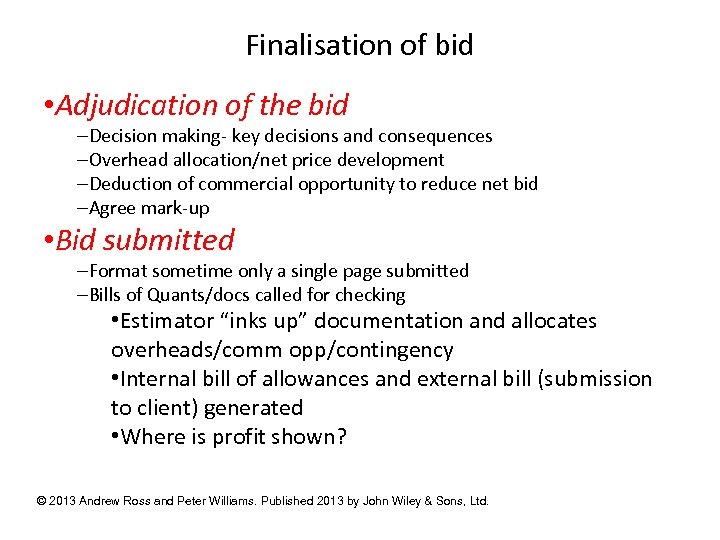 Finalisation of bid • Adjudication of the bid –Decision making- key decisions and consequences –Overhead allocation/net price development –Deduction of commercial opportunity to reduce net bid –Agree mark-up • Bid submitted –Format sometime only a single page submitted –Bills of Quants/docs called for checking • Estimator “inks up” documentation and allocates overheads/comm opp/contingency • Internal bill of allowances and external bill (submission to client) generated • Where is profit shown? © 2013 Andrew Ross and Peter Williams. Published 2013 by John Wiley & Sons, Ltd.
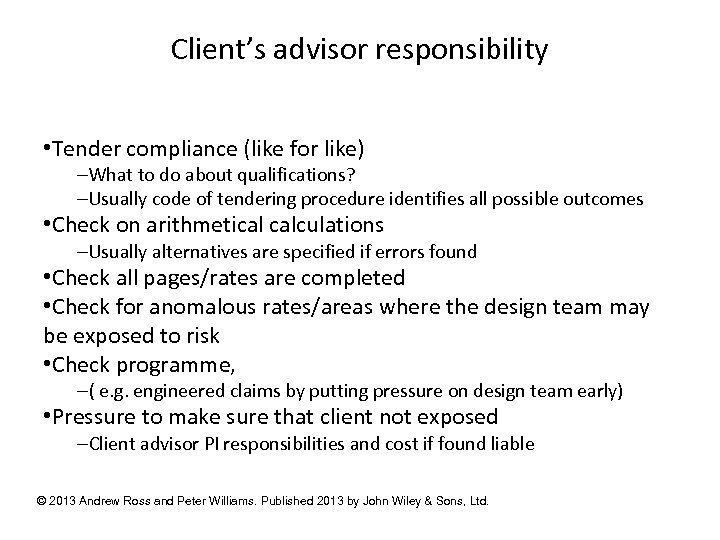 Client’s advisor responsibility • Tender compliance (like for like) –What to do about qualifications? –Usually code of tendering procedure identifies all possible outcomes • Check on arithmetical calculations –Usually alternatives are specified if errors found • Check all pages/rates are completed • Check for anomalous rates/areas where the design team may be exposed to risk • Check programme, –( e. g. engineered claims by putting pressure on design team early) • Pressure to make sure that client not exposed –Client advisor PI responsibilities and cost if found liable © 2013 Andrew Ross and Peter Williams. Published 2013 by John Wiley & Sons, Ltd.
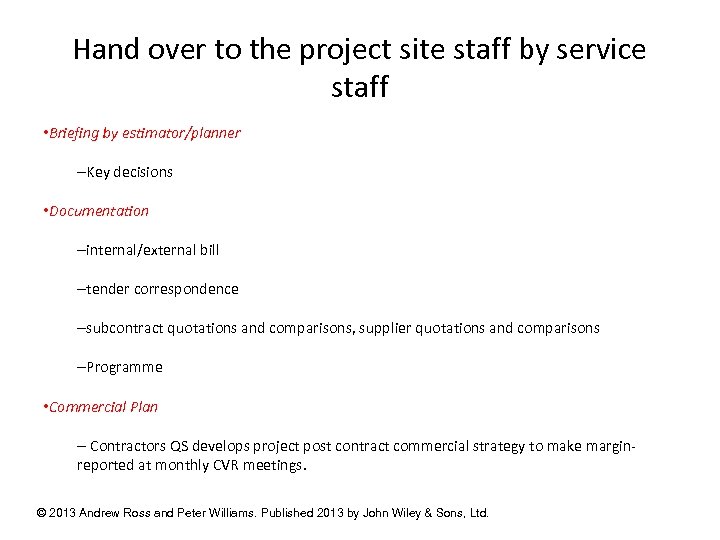 Hand over to the project site staff by service staff • Briefing by estimator/planner –Key decisions • Documentation –internal/external bill –tender correspondence –subcontract quotations and comparisons, supplier quotations and comparisons –Programme • Commercial Plan – Contractors QS develops project post contract commercial strategy to make marginreported at monthly CVR meetings. © 2013 Andrew Ross and Peter Williams. Published 2013 by John Wiley & Sons, Ltd.
 Tender lists • Open competition • Frameworks and approved lists • Ad hoc lists © 2013 Andrew Ross and Peter Williams. Published 2013 by John Wiley & Sons, Ltd. 16
 Newer approaches • Auctions • E-bidding • Reverse auctions © 2013 Andrew Ross and Peter Williams. Published 2013 by John Wiley & Sons, Ltd. 17