


 Скачать презентацию Getting the FACTS in Florida Linda Thanasides Florida
5f42a11394a2787807b2a8bc9ada85ae.ppt
- Количество слайдов: 26
 Getting the FACTS in Florida Linda Thanasides Florida Center for Advising and Academic Support October 13, 2000 Copyright - FCAAS 2000
 How Did It All Start? l State of Florida was mandated to establish a statewide advising system in 1997 to link 38 public post-secondary institutions for information transfer l FACTS (Florida Academic Counseling and Tracking for Students) was created l Short-time frame for prototype implementation – 9 months Copyright - FCAAS 2000
 What is FACTS? l Distributed, platform independent, web-based delivery system l Links institutions together with realtime communication l Interfaces with each institution’s host applications to maintain data integrity Copyright - FCAAS 2000
 Technically Speaking… l Central Web Site – IBM Mainframe (CICS/VSAM/DB 2) – Central server is an RS/6000, SP 2 – Locally written code eliminates need for middle ware communication software l Institutional Systems: – MVS, OS/400, Unix, NT, Etc. l Network Interfaces: – TCP/IP socket connections, CICS Sockets Copyright - FCAAS 2000
 FACTS Provides Services l Students can – Retrieve transcripts – Receive academic advising – See what is needed to complete a degree at any other institution in the system – Construct “what if” scenarios – Make coursework assumptions for educational planning – Link to other sites for college planning Copyright - FCAAS 2000
 FACTS Provides Information l Institutional Info in following areas – Admissions – Student records – Registration – Financial Aid – Fee Payments – Student Services – Library Services – Career Counseling – Distance Learning Copyright - FCAAS 2000
 How do you Organize 38+ Different Institutions? l Large project tackled issues one by one but set in motion concurrently l Various management structures create project management challenge – 10 Public Universities – 28 Public Community Colleges – 27 Private Institutions – Open architecture so more can join Copyright - FCAAS 2000
 Get the Right People Involved l Cooperative effort: – State Board of Regents – State Board of Community Colleges – Universities l Governing Board created from cooperating entities Copyright - FCAAS 2000
 Organize Team/Resources l Core team needed to establish initial communication system l FACTS needed a skilled, productive team to meet short deadline – Looked at contractors/consultants – Prototype institutions volunteered technical resources for design and programming Copyright - FCAAS 2000
 Organize Initial Resource Team l Technical Project Design Team was appointed – Define system scope – Create an initial timeline – Propose a governance structure shared by Community Colleges and Universities l This team is now our Technical Oversight Committee Copyright - FCAAS 2000
 Organize Administration/Management l Management of system design is by consensus (not necessarily total agreement) l System design is a group effort – Guiding principles preserve institutional autonomy Copyright - FCAAS 2000
 Permanent Central Staff Needed l Important that a trusted central staff be organized for system support – To administer funding – Implement and maintain system support – To eventually do all development so no outsourcing is needed l Permanent staff is continually growing Copyright - FCAAS 2000
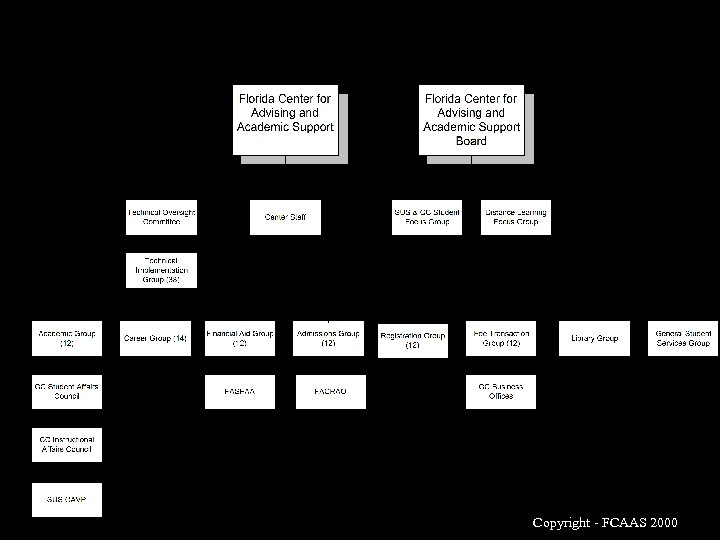
 “Expert Teams” Used for Input l Need user expertise and “buy-in” l Organized teams in functional areas – Comprised from departmental staff from all institutions – Make recommendations on policy and functionality – Suggest target dates and budget needs for additional functionality Copyright - FCAAS 2000
 Copyright - FCAAS 2000
 Helpful Hints l Initial start up organization is different from long term organization – Focus is different – Resources may be different l Important to reassess project – Goals – Resources – Processes Copyright - FCAAS 2000
 Helpful Hints l Be aware of time commitments for “volunteers” l Prepare for growth l Communicate!! Copyright - FCAAS 2000
 Institutional Benefits l Benefit of increasing knowledge and expertise of Center staff for services l Software packages provided by Center for institutional development l Sharing of data previously unavailable l All institutions can have a web presence l Greater exposure to potential students Copyright - FCAAS 2000
 Student Benefits l One web address to gather information l Gather information without having to go to several campus offices l Provide off-campus services to distance learners l Allow almost 24 -hour-a-day access to student information Copyright - FCAAS 2000
 Student Benefits l Transfer between institutions is easier l Interagency agreements make student access to information easier – Common course numbering – Articulation agreements – Common prerequisites Copyright - FCAAS 2000
 Impact on Administrators/Staff l Time to spend with greater number of students l Use FACTS as an informational tool l Force the accuracy of data presented to students Copyright - FCAAS 2000
 Impact on Institutions l Forcing policy changes – Hours of business – Distribution of information – Internal policy changes • • Processing electronic signatures Residency affidavits Fee payments Other online forms Copyright - FCAAS 2000
 Impact on Institutions l Pressure to offer quality services – From students – From state legislature – From institution—to stay in competition with local and national offerings Copyright - FCAAS 2000
 Impact on Institutions l Cost efficiencies are occurring – Institutions are not buying software on their own that FACTS will provide – Changes in processes are resulting in savings • Not mailing grades, transcripts • Staff can handle other tasks due to less student traffic Copyright - FCAAS 2000
 Current Status of FACTS l Thirty-one of thirty-eight public postsecondary institutions are displaying transcripts and degree audits l Implementing web-based admissions applications l Implementing a degree program search Copyright - FCAAS 2000
 Current Status of FACTS l Enhancing current functions l Adding informational functions l Working toward implementation of private institutions Copyright - FCAAS 2000
 VISIT THE SITE! FACTS. ORG Copyright - FCAAS 2000