 Скачать презентацию Getting Serious about Injury Management Rehabilitation Kirsty Mc Innes
41d2b0b3588c0fa93ded8f56af605ebe.ppt
- Количество слайдов: 38



Getting Serious about Injury Management/Rehabilitation Kirsty Mc. Innes, Nancy Barlow, ACC, May 2016
Key Legislation Injury Prevention Rehabilitation and Compensation Act 2001 S. 71 Employer’s obligations in relation to rehabilitation (1) This section applies to an employer if — a. the Corporation decides, under section 86(2)(a), that it is reasonably practicable to return the claimant to the same employment in which the claimant was engaged, and with the employer who was employing the claimant, when the claimant’s incapacity commenced; and b. the Corporation gives the employer notice, in writing, of the decision. (2) The employer must take all practicable steps to assist the claimant with the claimant’s vocational rehabilitation under his or her individual rehabilitation plan.
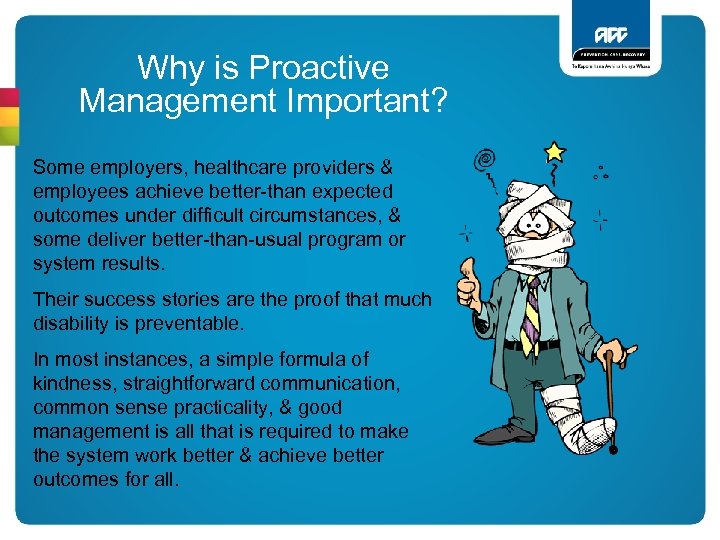
Why is Proactive Management Important? Some employers, healthcare providers & employees achieve better-than expected outcomes under difficult circumstances, & some deliver better-than-usual program or system results. Their success stories are the proof that much disability is preventable. In most instances, a simple formula of kindness, straightforward communication, common sense practicality, & good management is all that is required to make the system work better & achieve better outcomes for all.

What does this mean? Successful Stay At Work/Return To Work requires team work. Expecting & allowing people to contribute what they can at work Sense of urgency to normalise daily routine; prolonged time away from work is often harmful. In only a few weeks, most people make adjustments, adopt a new view of themselves & their situation. Some begin to think they are permanently disabled regardless of medical facts. Once that idea is implanted, it’s hard to shake.
What does this mean? Devote more attention & resources by focusing on the “front end” while the window of opportunity to make the most difference is still open. In practice; ensuring that the right things happen during the first few days & weeks of work absence. Employees routinely receive support & services they need to get their daily lives back to normal as soon as possible
Things to consider Employers are sometimes unwilling to admit they are unsure of what to do. A manager may feel it’s easier to refuse to provide temporary transitional work than to ask for help because he/she doesn’t know • how to interpret the medical certificate, • how to figure out appropriate tasks, • how to manage the employee.
Optimal vs. Sub Optimal Outcomes Mr A & Mr B • Two fictitious men with • Identical medical conditions & • Treatment. Mr. A. & Mr. B. both had back problems severe enough to require surgery, but Mr. B. returns to work in 6 weeks while Mr. A. ends up on with a long term disability. WHY?
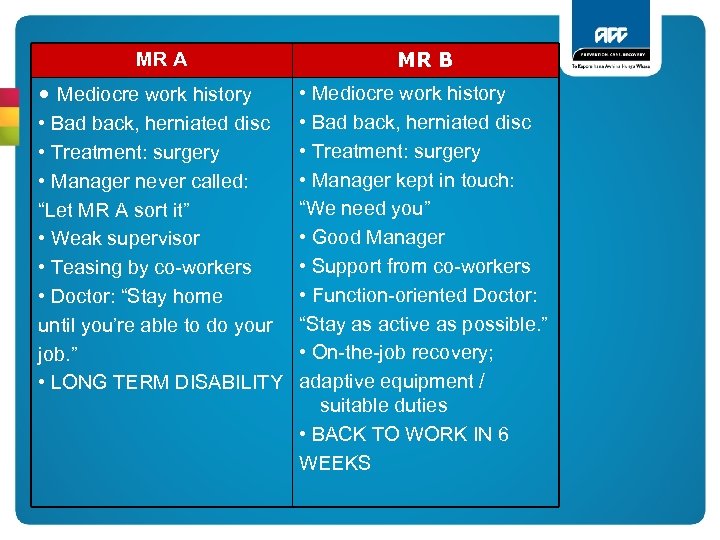
MR A MR B • Mediocre work history • Bad back, herniated disc • Treatment: surgery • Manager never called: “Let MR A sort it” • Weak supervisor • Teasing by co-workers • Doctor: “Stay home until you’re able to do your job. ” • LONG TERM DISABILITY • Mediocre work history • Bad back, herniated disc • Treatment: surgery • Manager kept in touch: “We need you” • Good Manager • Support from co-workers • Function-oriented Doctor: “Stay as active as possible. ” • On-the-job recovery; adaptive equipment / suitable duties • BACK TO WORK IN 6 WEEKS
At its heart, the stay-at-work / return-towork process is a very common, everyday process. Let’s walk through the usual steps in the process by considering Tom; Tom woke up to find his cut foot was badly infected. Tom’s current ability to work is assessed on three important dimensions, either formally or informally: 1/ Functional capacity – what can he do today? Has Tom’s infection made him so sick he simply can’t function at all & has to be in bed? If not, what can he do in his current condition? 2/ Functional impairments or limitations – what can’t Tom do now that he normally can? In Tom’s case, the acute pain he is experiencing means he is too uncomfortable to do any activities that require him to be on his feet for prolonged periods e. g. prolonged standing, walking, etc.
Stay-at-work / return-to-work process 3/ Medically-based restrictions – what Tom should not do? In Tom’s case, would walking, standing, & being on his feet all day actually worsen the infection or delay healing? Are the temporarily-altered capacities, limitations, & restrictions sufficient to perform the tasks required by the job? To answer this question, the functional demands of the job must be known. These include the knowledge, skills, & abilities - physical, cognitive & social required to perform a job. In our case example, Tom already knows what it takes to do his usual job. The last question is what must occur in order for the situation to be resolved & allow Tom to go to work? If it is clear that the worker can be safe & comfortable doing his usual job, or if any necessary modifications can be made easily himself, he simply goes to work.
Stay-at-work / Return-to-work process Legal requirements, company policies, or concerns about the safety of co-workers, the public, or the organisation will affect what happens.
Work Related Injuries • Via ACC system • Ensure immediate controls in place • Investigation & further control process • Manage the RTW process
Work Injuries • Manager responsibilities: – The manager is responsible for: – encouraging the employee to return to work. – assisting with the injured employee’s rehabilitation. • Employee’s responsibilities – The injured employee must report a work accident immediately to their manager. – be an active participant in the rehabilitation process. • First week of incapacity – For the first week of incapacity, the employer is required to pay.
Non Work Injuries • Via ACC system • Manage the RTW process • Same principles as for Work Injury Same I. Suitable/Alternative Duties II. Monitoring III. Communication
Non-work Injuries • Manager responsibilities: – The manager is responsible for: – encouraging the employee to return to work – assisting with the injured employee’s rehabilitation • Employee’s responsibilities – The injured employee must report a non-work accident to their manager within 24 hours, if practicable. – be an active participant in the rehabilitation process. • First week of incapacity – For the first week of incapacity, the employee must use their sick leave entitlement. – Where the employee has no sick leave entitlement then they must take leave without pay.
Paperwork – what is the process? • • • Incident form Consent form Staff member provides timely Medical Certificates Line Manager Communication Employee /Employer RTW Plan conversation initiated ACC involved? - Bank Account Details, Client ID (Drivers License, Wage Information, Consent Form, Payroll information request)
“It looks like this employee will be off work for a while!” • Rehabilitating injured employees: • Managers should encourage an injured employee’s earliest return to work. For employees incapacitated for more than one week a Manager should: – contact the employee’s ACC Case Manager ASAP to initiate the development of a rehabilitation programme; – ensure the availability of alternative duties the employee can perform while they recover from the injury; – ensure that the return-to-work component of the rehabilitation programme is implemented; – ensure that the employee receives the proper income entitlements. This includes returning to work on a full-time or a part-time basis, or if undertaking alternative duties.
“Staff on light duties can be hard to manage!” • Successful SAW/RTW requires team work. • Expecting & allowing people to contribute what they can at work • Sense of urgency to normalise daily routine; prolonged time away from work is often harmful. It is worse to leave the employee at home, than help return them back to work! • In only a few weeks, most people make adjustments, adopt a new view of themselves & their situation. Some begin to think they are permanently disabled regardless of medical facts. • Once that idea is implanted, it’s hard to shake.
When to involve HR: • If the employee refuses to agree or engage in a rehabilitation plan – The Company may review its continued support for the injured employee if they refuse to agree to a rehabilitation programme or fail to comply with its requirements. ACC may also cancel or suspend compensation and rehabilitation benefits. • If you are having difficulty getting hold of the employee (within reason) • Non-compliance with an agreed rehabilitation plan (this can then become a performance issue) • If the case looks like it is dragging on, no progress is being made, and you are unsure of the next steps, it may be appropriate for HR to support the Manager and the Case Manager in dealing with the employee
Managers and Employees: • Communicate (early, regularly, internal, external) • Understand their role • Share Information (early) • Plan, Monitor and Follow-up • Be consistent • Use support options if unsure
Certification Medically-Required, Medically-Discretionary & Medically-Unnecessary? Suitable Duties
Medically-Required Typically, absence is medically required when: Attendance is required at a place of care (hospital, doctor’s office, physical therapy). Recovery (or quarantine) requires confinement to bed or home. Being in the workplace or travelling to work is medically contraindicated (poses a specific hazard to the public, co-workers, or to the worker personally, i. e. , risks damage to tissues or delays healing). (Source: ACOEM Practice Guidelines, 2 nd edition, Chapter 5, Cornerstones of Disability Prevention and Management, pp 80 -82)
Medically-Discretionary Time away from work at the discretion of a patient or employer that is: • Associated with a diagnosable medical condition that may have created some functional impairment but left other functional abilities still intact. • Most commonly due to a patient’s or employer’s decision not to make the extra effort required to find a way for the patient to stay at work during illness or recovery. (Source: ACOEM Practice Guidelines, 2 nd edition, Chapter 5, Cornerstones of Disability Prevention and Management, pp 80 -82)
Medically-Unnecessary? Occurs whenever a person stays away from work because of non medical issues such as: • The perception that a diagnosis alone (without demonstrable functional impairment) justifies work absence. • Other problems that masquerade as medical issues, e. g. , anger, fear, job dissatisfaction, or other psychosocial factors. • Poor information flow or inadequate communications. • Administrative or procedural delay. (Source: ACOEM Practice Guidelines, 2 nd edition, Chapter 5, Cornerstones of Disability Prevention and Management, pp 80 -82)
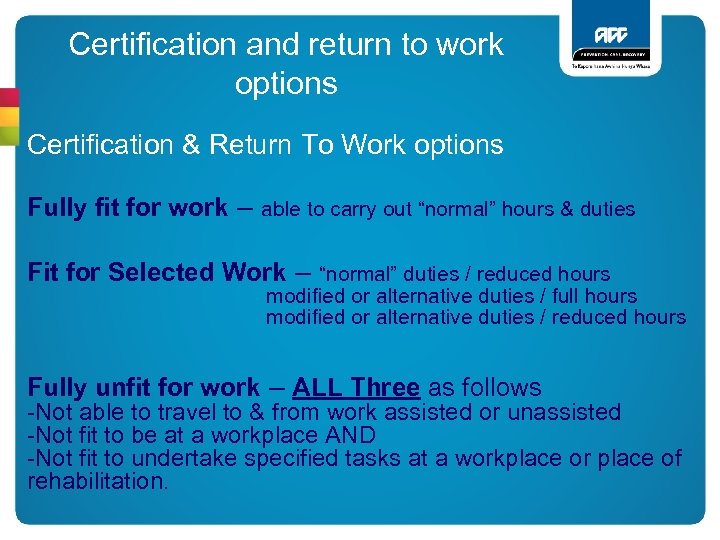
Certification and return to work options Certification & Return To Work options Fully fit for work – able to carry out “normal” hours & duties Fit for Selected Work – “normal” duties / reduced hours modified or alternative duties / full hours modified or alternative duties / reduced hours Fully unfit for work – ALL Three as follows -Not able to travel to & from work assisted or unassisted -Not fit to be at a workplace AND -Not fit to undertake specified tasks at a workplace or place of rehabilitation.
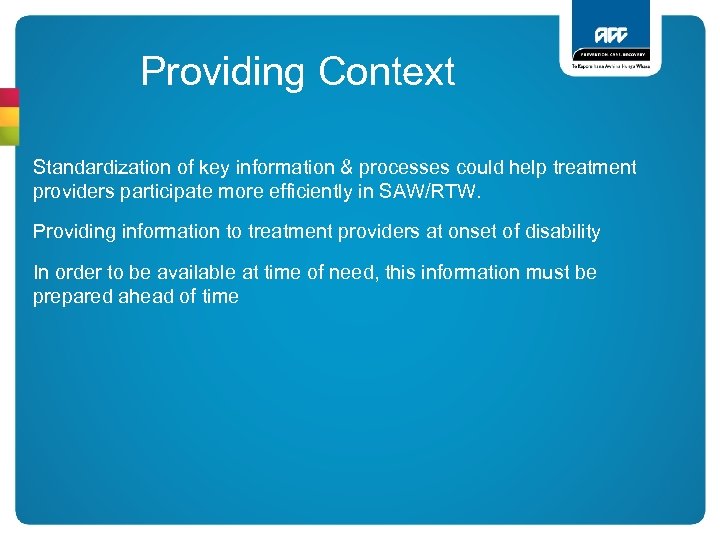
Providing Context Standardization of key information & processes could help treatment providers participate more efficiently in SAW/RTW. Providing information to treatment providers at onset of disability In order to be available at time of need, this information must be prepared ahead of time
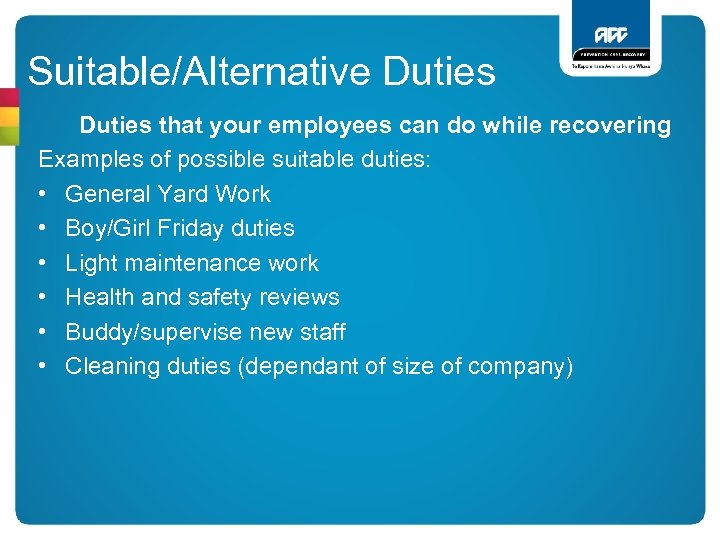
Suitable/Alternative Duties that your employees can do while recovering Examples of possible suitable duties: • General Yard Work • Boy/Girl Friday duties • Light maintenance work • Health and safety reviews • Buddy/supervise new staff • Cleaning duties (dependant of size of company)
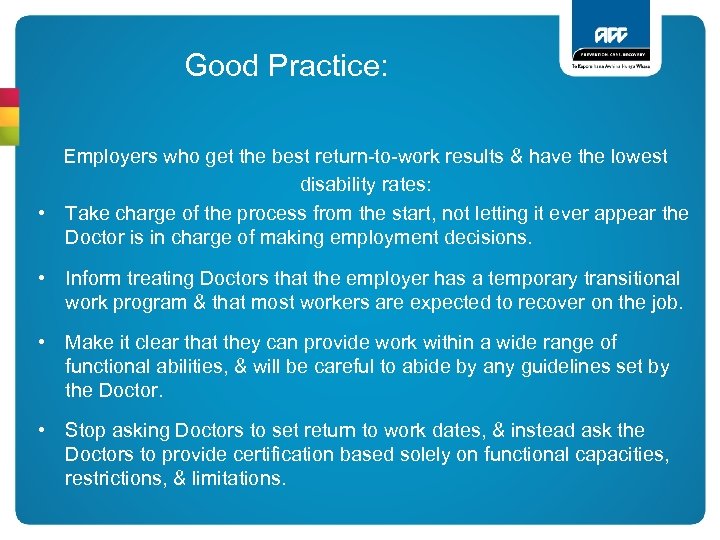
Good Practice: Employers who get the best return-to-work results & have the lowest disability rates: • Take charge of the process from the start, not letting it ever appear the Doctor is in charge of making employment decisions. • Inform treating Doctors that the employer has a temporary transitional work program & that most workers are expected to recover on the job. • Make it clear that they can provide work within a wide range of functional abilities, & will be careful to abide by any guidelines set by the Doctor. • Stop asking Doctors to set return to work dates, & instead ask the Doctors to provide certification based solely on functional capacities, restrictions, & limitations.
Things you can do in Injury Management / Return to Work
Things you can do…. • Manage the situation early and upfront, why wait? • Discuss Workplace Assessment • Communication; Injured worker, ACC & Doctors • Doctors & ACC staff do not always understand the job; tell them what it is all about • Clarify with treatment providers where unsure • Ensure consistent use of gaining consent at time of incident being reported • Request attendance at case conferences • Focus on what can be done - not on what can’t
Things you can do…. • Return to Work planning - do it together • Implement consistent Return to Work processes; people, work / non work • Ensure everyone understands these processes • Provide suitable work • Monitor the Return to Work – look out for problems • Learn from experience • Share the knowledge with others
Managers and Employees: • Communicate (early, regularly, internal, external) • Understand their role • Share Information (early) • Plan, Monitor and Follow-up • Be consistent • Use support options if unsure
It is good Business to RTW • We do not make people better in order to get them back to work • We get people back to work in order to make them better
Questions?
Why do we have return to work programs? • ACC / HS Acts. • It works. • Staff engagement. • Morally • Social, and financial benefits.
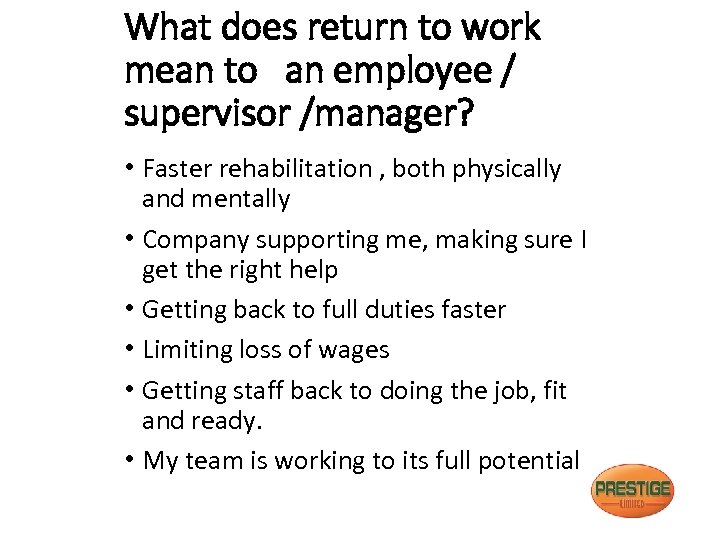
What does return to work mean to an employee / supervisor /manager? • Faster rehabilitation , both physically and mentally • Company supporting me, making sure I get the right help • Getting back to full duties faster • Limiting loss of wages • Getting staff back to doing the job, fit and ready. • My team is working to its full potential
Скачать презентацию Getting Serious about Injury Management Rehabilitation Kirsty Mc Innes
41d2b0b3588c0fa93ded8f56af605ebe.ppt