


 Скачать презентацию Getting Prepared for a Radiological Terrorist Event David
1a9e93a9f1939470e2e7f073652ec83d.ppt
- Количество слайдов: 76
 Getting Prepared for a Radiological Terrorist Event David J. Brenner, Ph. D. , D. Sc. , Center for Radiological Research Columbia University Medical Center djb 3@columbia. edu You can view / download this lecture at www. columbia. edu/~djb 3
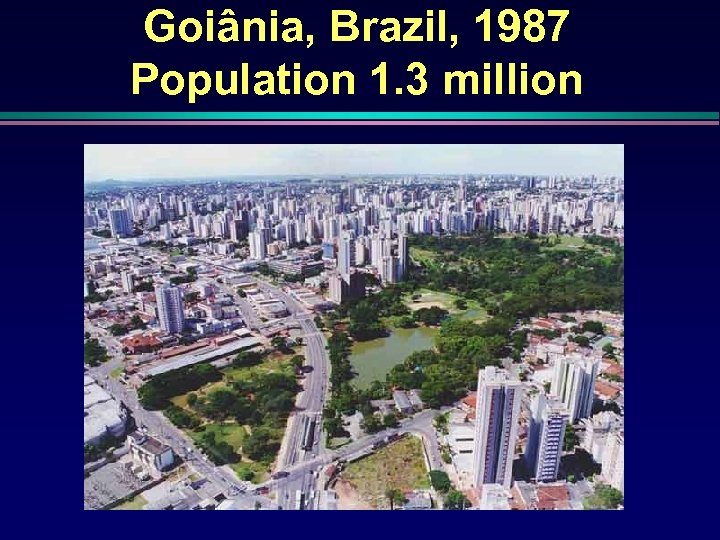 Goiânia, Brazil, 1987 Population 1. 3 million
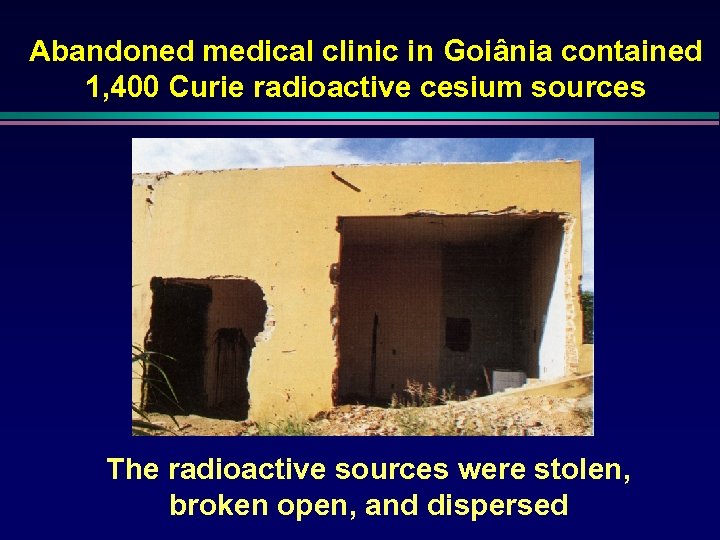 Abandoned medical clinic in Goiânia contained 1, 400 Curie radioactive cesium sources The radioactive sources were stolen, broken open, and dispersed
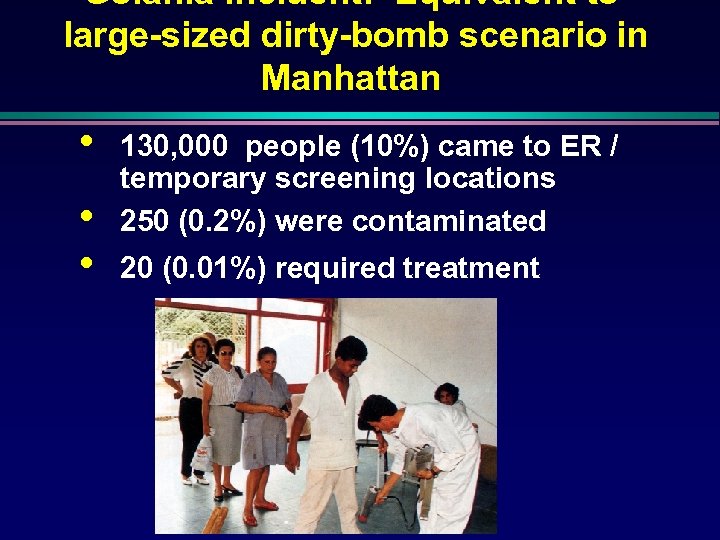 Goiânia incident: Equivalent to large-sized dirty-bomb scenario in Manhattan • • • 130, 000 people (10%) came to ER / temporary screening locations 250 (0. 2%) were contaminated 20 (0. 01%) required treatment
 Topics that we will cover ü What is ionizing radiation? How is it harmful? ü Radiation threat scenarios ü Appropriate medical responses ü Psychological aspects ü Resources
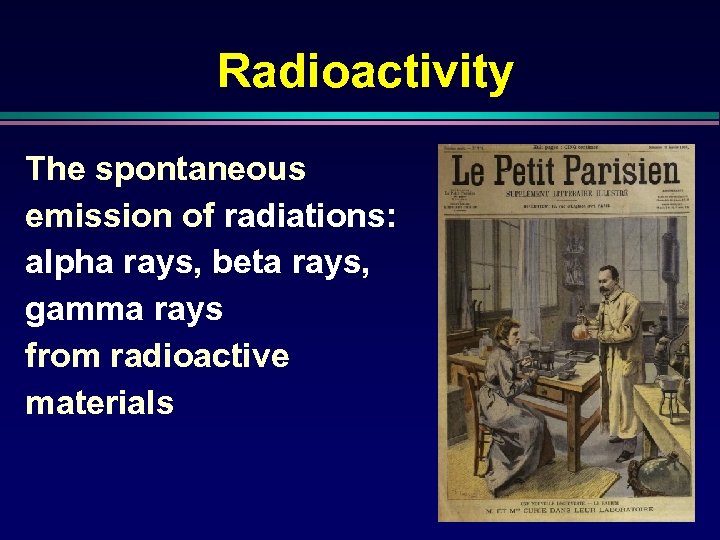 Radioactivity The spontaneous emission of radiations: alpha rays, beta rays, gamma rays from radioactive materials
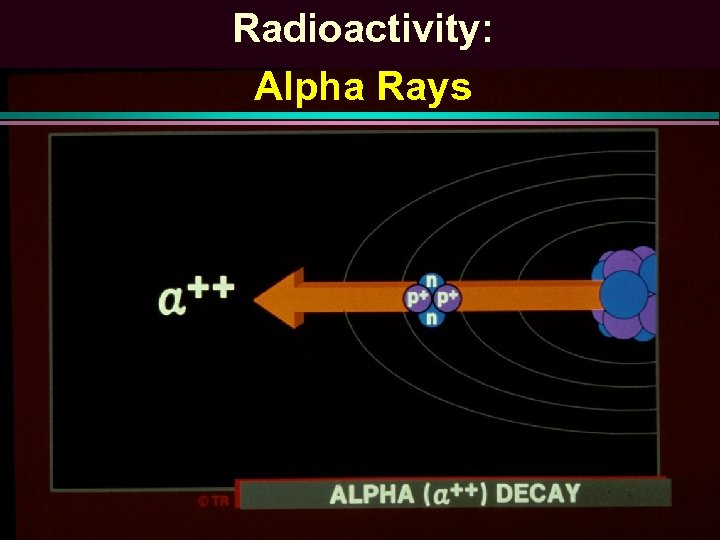 Radioactivity: Alpha Rays
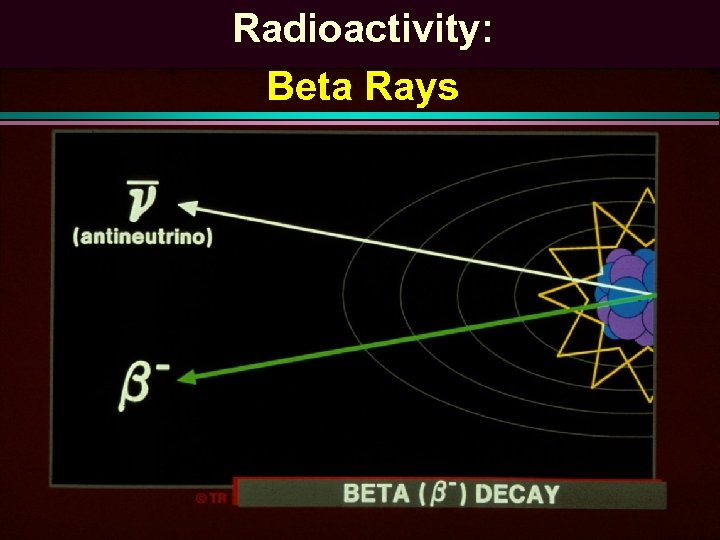 Radioactivity: Beta Rays
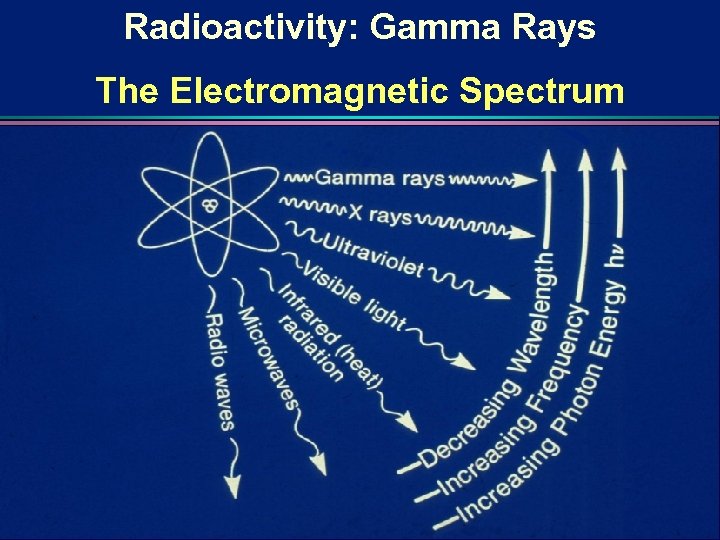 Radioactivity: Gamma Rays The Electromagnetic Spectrum
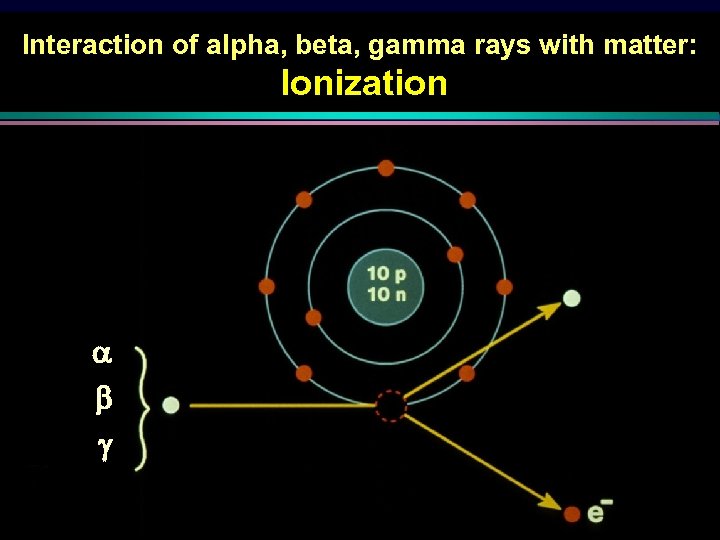 Interaction of alpha, beta, gamma rays with matter: Ionization a b
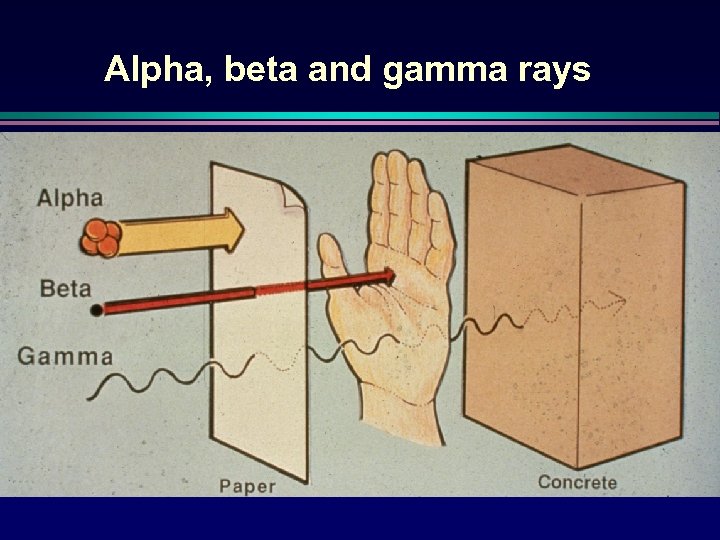 Alpha, beta and gamma rays
 Radiation vs. Radioactive Material • Radiation: energy transported in the form of particles or waves (alpha, beta, gamma, neutrons) • Radioactive Material: material that contains atoms that emit radiation spontaneously
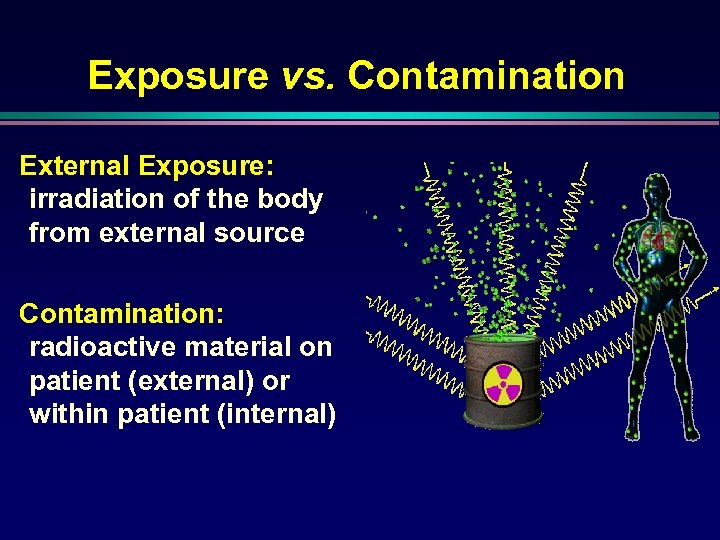 Exposure vs. Contamination External Exposure: irradiation of the body from external source Contamination: radioactive material on patient (external) or within patient (internal)
 Radiation Dose • • • Measured in milli. Gray (m. Gy) (1/1000 joule / kg) Equivalent dose is measured in milli. Sievert (m. Sv) For our purposes, 1 m. Gy = 1 m. Sv • • Old units are the rad and the rem 10 m. Gy = 1 rad; 10 m. Sv = 1 rem • Average background radiation dose is 3 m. Sv / year A mammogram produces about 0. 01 m. Sv. A CT scan produces about 10 m. Sv.
 Radioactivity • The activity (strength) of a radioactive source is measured in Curies (Ci) or Becquerels (Bq) • • 1 Bq = 1 radioactive disintegrations / sec 1 Ci = 37 GBq = 37 thousand million disintegrations / sec
 The Principal Hazards of Ionizing Radiation E E E Cancer risks Hereditary risks Effects on the developing embryo/fetus
 Radiation Risks Teratogenic risks Order of magnitude larger than Carcinogenic risks Order of magnitude larger than Hereditary risks
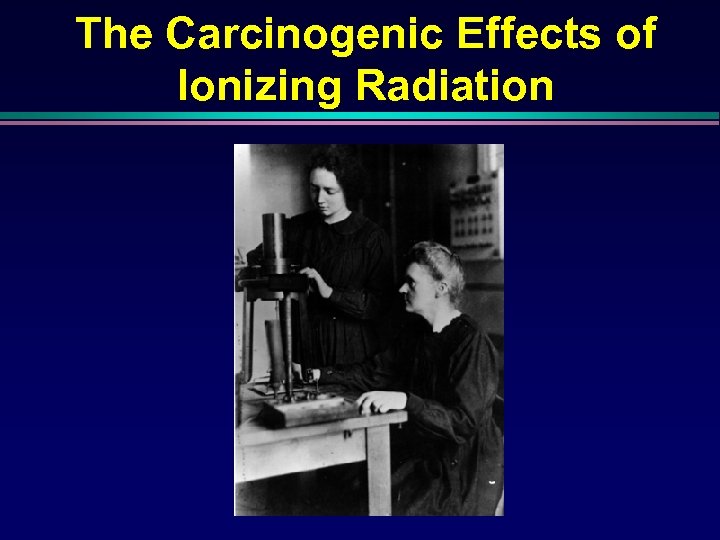 The Carcinogenic Effects of Ionizing Radiation
 Ionizing Radiation and Cancer Most of our information comes from studies of A-bomb survivors
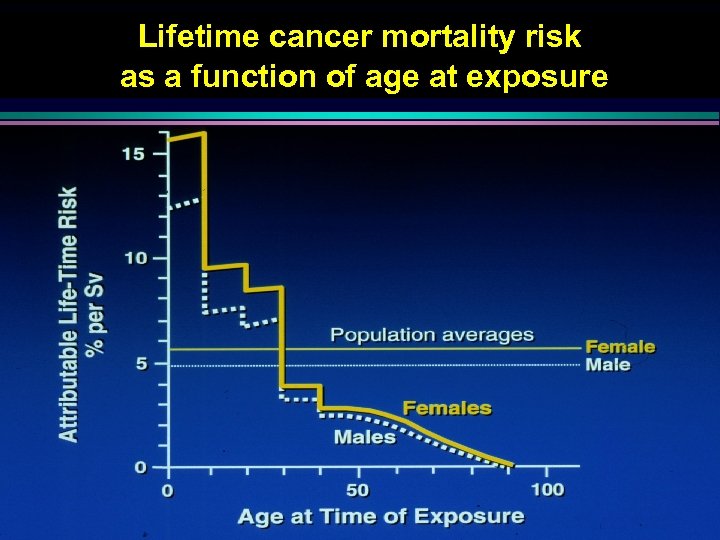 Lifetime cancer mortality risk as a function of age at exposure
 Individual Susceptibility to Radiation Carcinogenesis There are likely to be subpopulations of individuals who are significantly more sensitive to ionizing radiation than the average: • Children • ATM heterozygotes • • (Ataxia Telangiectasia, 1 -2% of the population) BRCA 1 BRCA 2
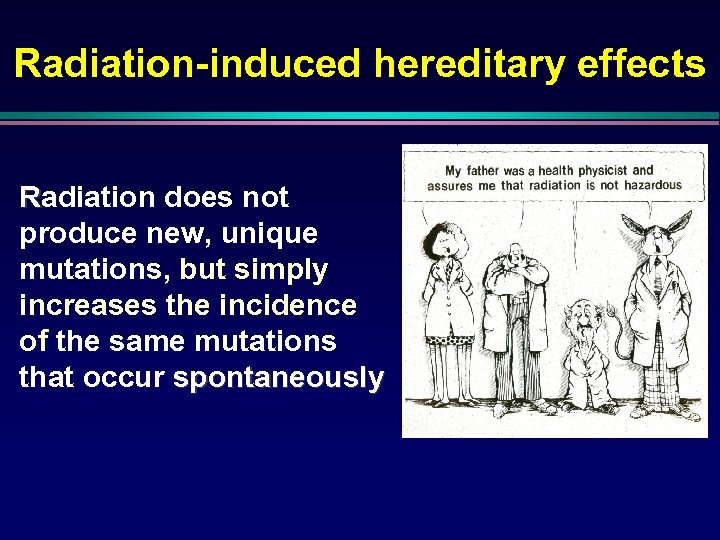 Radiation-induced hereditary effects Radiation does not produce new, unique mutations, but simply increases the incidence of the same mutations that occur spontaneously
 Teratogenic Risks (i. e. , to the embryo/fetus, if relevant) Moderate doses of radiation can produce catastrophic effects on the developing embryo and fetus.
 The principle effects of radiation on the developing embryo and fetus are: E Growth retardation E Embryonic, neonatal, or fetal death E Congenital malformations and functional impairment, such as mental retardation.
 Radiation Risks Teratogenic risks order of magnitude larger than Carcinogenic risks order of magnitude larger than Hereditary risks
 Radiation Threat Scenarios E Nuclear device E Damage to nuclear power plant E Dirty bombs
 Nuclear Device Risk • • Exposure to rays and neutrons Fallout of fission products (including short-lived iodine isotopes) Outcome • • Large number of acute deaths Long-term carcinogenesis Likelihood • Remote
 Attack on a nuclear power plant Risk • • Attack on the reactor itself: Attack on stored used fuel elements Release of fission products: I-131, Cs-137, etc Outcome • • Unlikely to involve acute deaths Long-term carcinogenesis Likelihood • Extremely unlikely
 Dirty Bombs (Radioactive dispersal devices, RDD) Risk • Release of radioactive cesium, cobalt or americium • Small number of contaminated people • Large number of very slightly contaminated people • Psychological chaos (many frightened people) Outcome • • Unlikely to result in acute deaths Risk of long-term carcinogenesis Likelihood • Likely
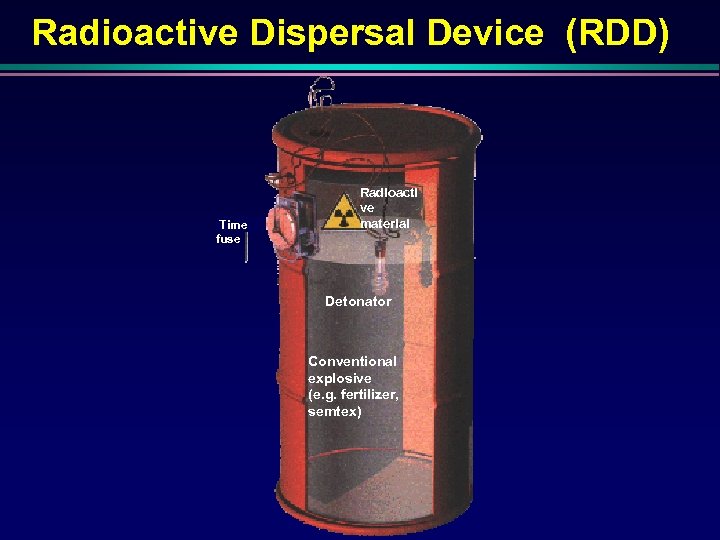 Radioactive Dispersal Device (RDD) Time fuse Radioacti ve material Detonator Conventional explosive (e. g. fertilizer, semtex)
 Dirty Bombs How available are the radioactive materials?
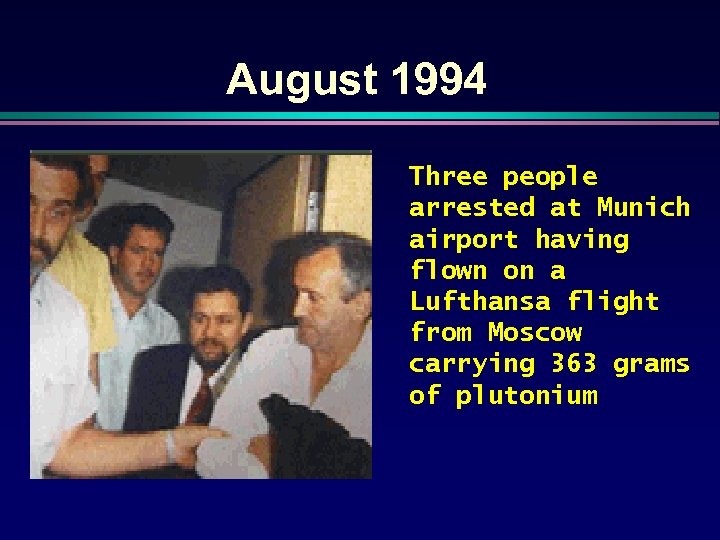 August 1994 Three people arrested at Munich airport having flown on a Lufthansa flight from Moscow carrying 363 grams of plutonium
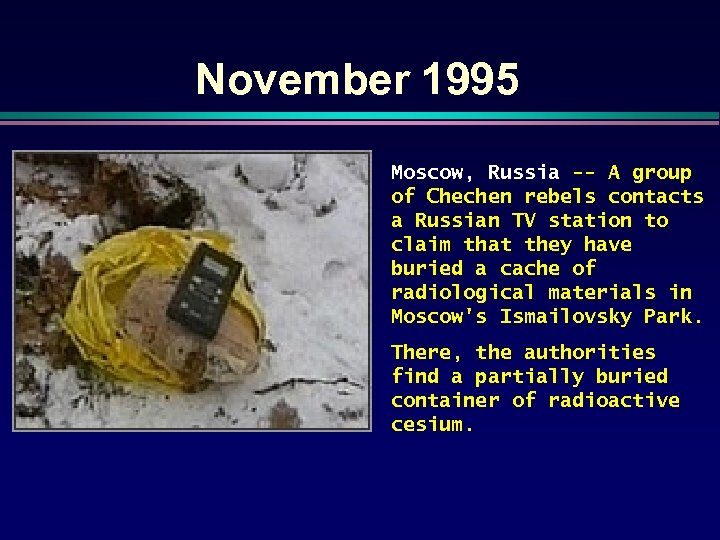 November 1995 Moscow, Russia -- A group of Chechen rebels contacts a Russian TV station to claim that they have buried a cache of radiological materials in Moscow's Ismailovsky Park. There, the authorities find a partially buried container of radioactive cesium.
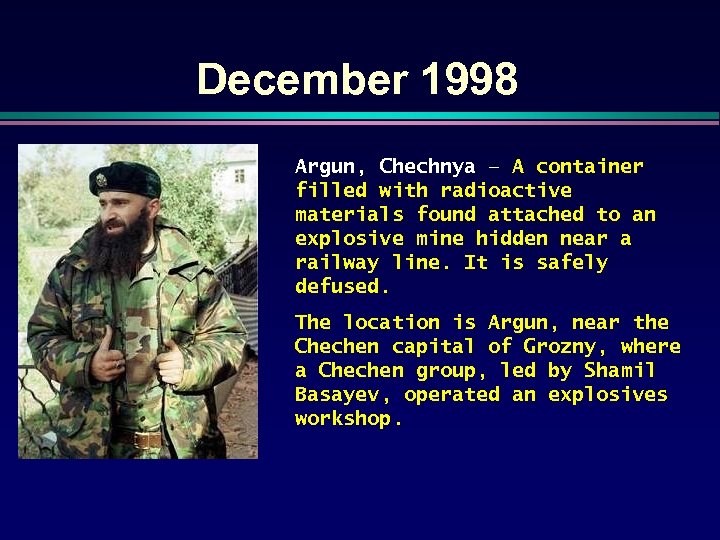 December 1998 Argun, Chechnya – A container filled with radioactive materials found attached to an explosive mine hidden near a railway line. It is safely defused. The location is Argun, near the Chechen capital of Grozny, where a Chechen group, led by Shamil Basayev, operated an explosives workshop.
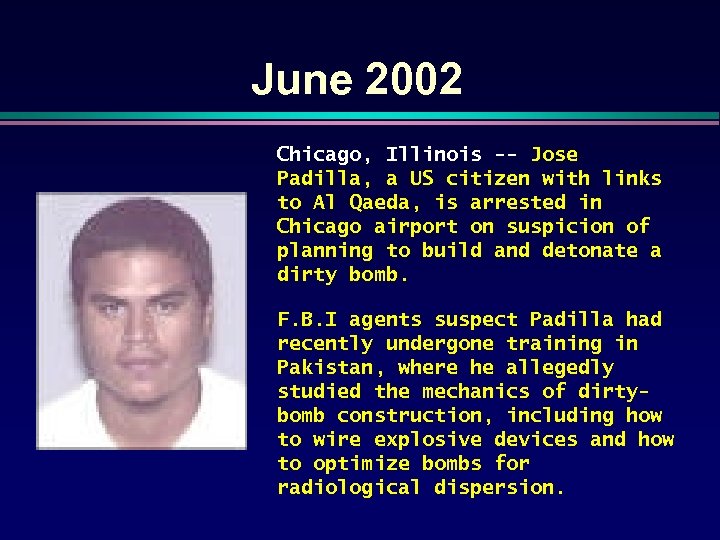 June 2002 Chicago, Illinois -- Jose Padilla, a US citizen with links to Al Qaeda, is arrested in Chicago airport on suspicion of planning to build and detonate a dirty bomb. F. B. I agents suspect Padilla had recently undergone training in Pakistan, where he allegedly studied the mechanics of dirtybomb construction, including how to wire explosive devices and how to optimize bombs for radiological dispersion.
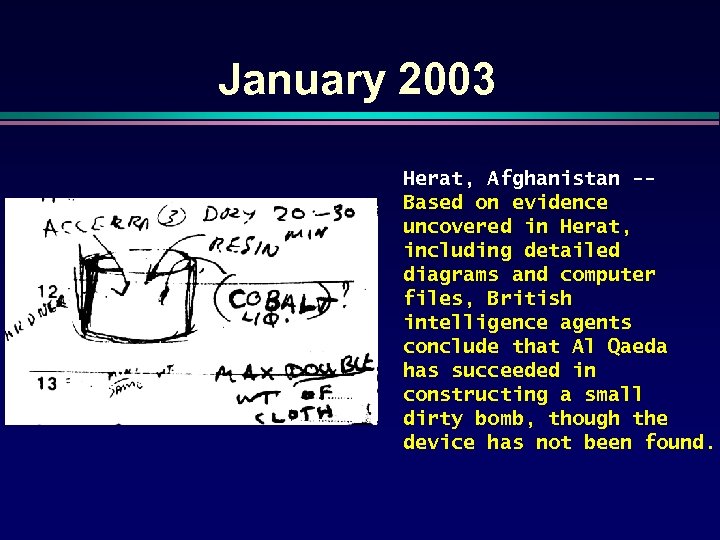 January 2003 A collage of dirty bomb plans journalists recently discovered in Afghanistan Herat, Afghanistan -Based on evidence uncovered in Herat, including detailed diagrams and computer files, British intelligence agents conclude that Al Qaeda has succeeded in constructing a small dirty bomb, though the device has not been found.
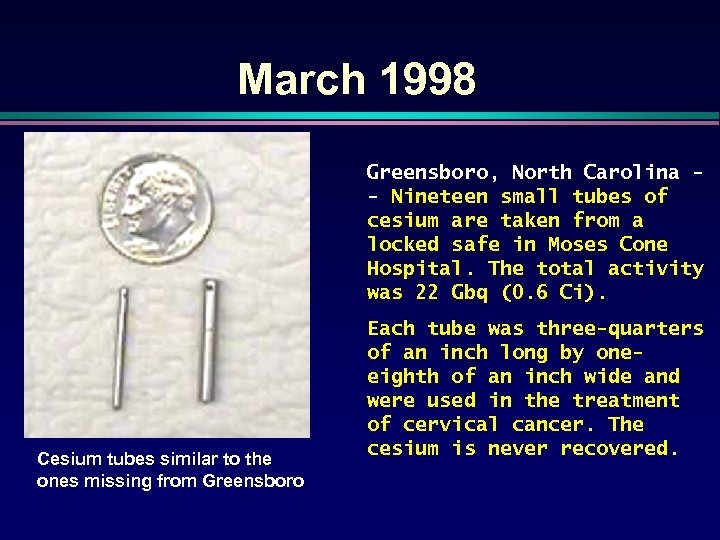 March 1998 Greensboro, North Carolina - Nineteen small tubes of cesium are taken from a locked safe in Moses Cone Hospital. The total activity was 22 Gbq (0. 6 Ci). Cesium tubes similar to the ones missing from Greensboro Each tube was three-quarters of an inch long by oneeighth of an inch wide and were used in the treatment of cervical cancer. The cesium is never recovered.
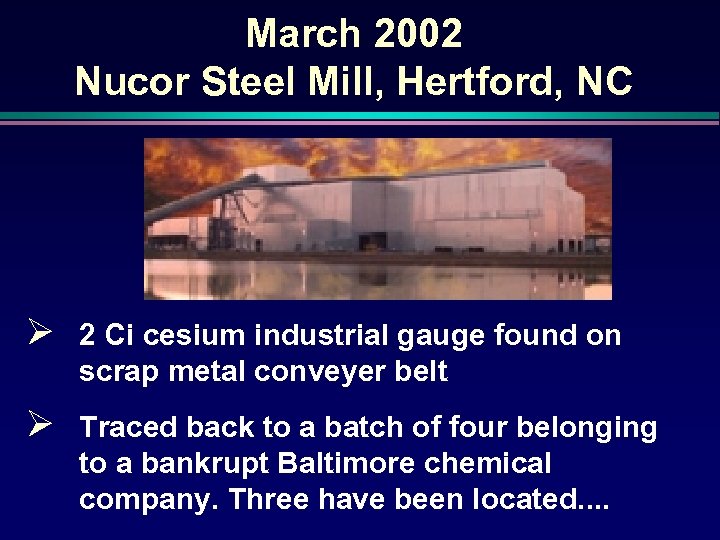 March 2002 Nucor Steel Mill, Hertford, NC Ø 2 Ci cesium industrial gauge found on scrap metal conveyer belt Ø Traced back to a batch of four belonging to a bankrupt Baltimore chemical company. Three have been located. .
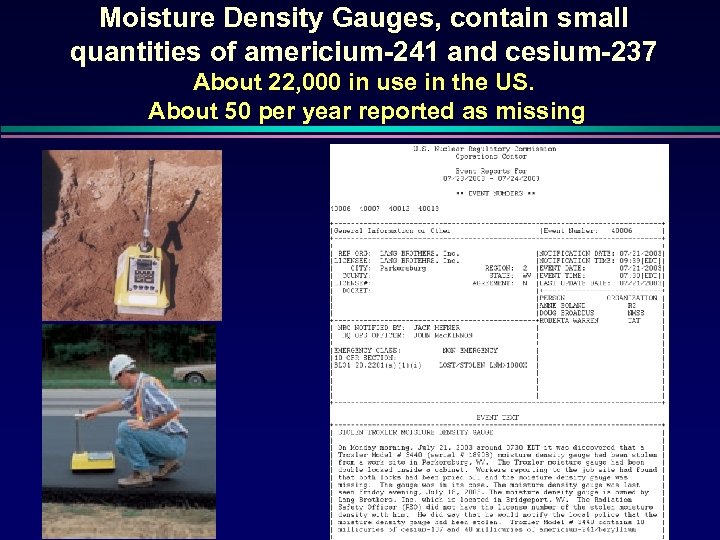 Moisture Density Gauges, contain small quantities of americium-241 and cesium-237 About 22, 000 in use in the US. About 50 per year reported as missing
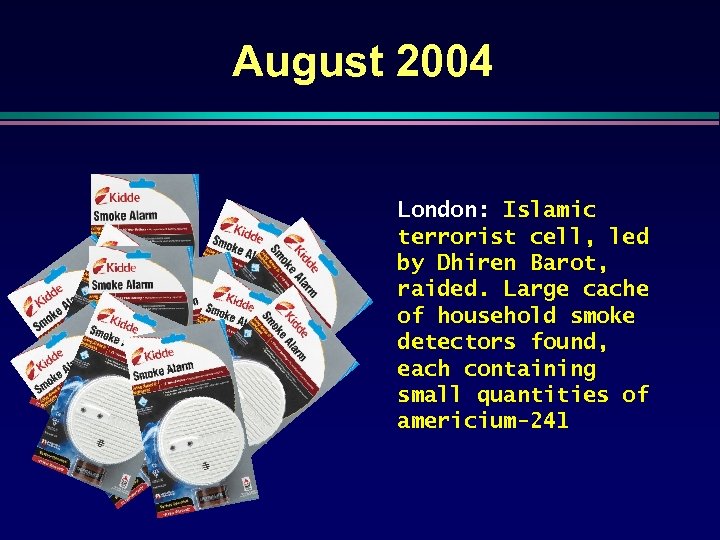 August 2004 London: Islamic terrorist cell, led by Dhiren Barot, raided. Large cache of household smoke detectors found, each containing small quantities of americium-241
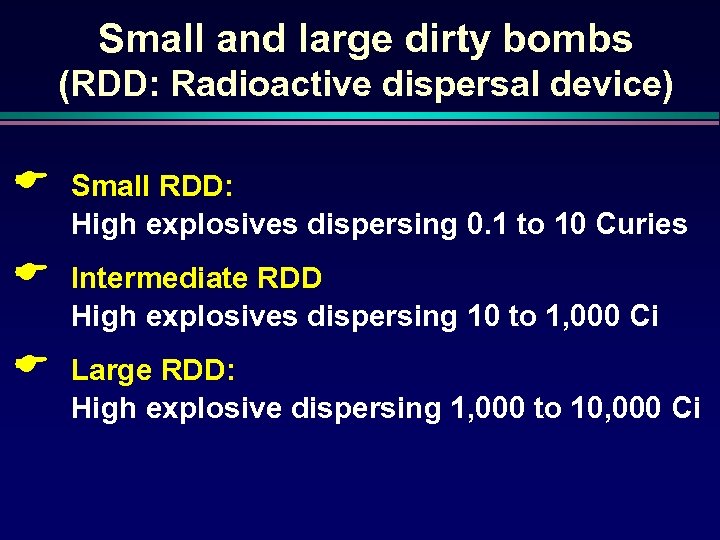 Small and large dirty bombs (RDD: Radioactive dispersal device) E Small RDD: High explosives dispersing 0. 1 to 10 Curies E Intermediate RDD High explosives dispersing 10 to 1, 000 Ci E Large RDD: High explosive dispersing 1, 000 to 10, 000 Ci
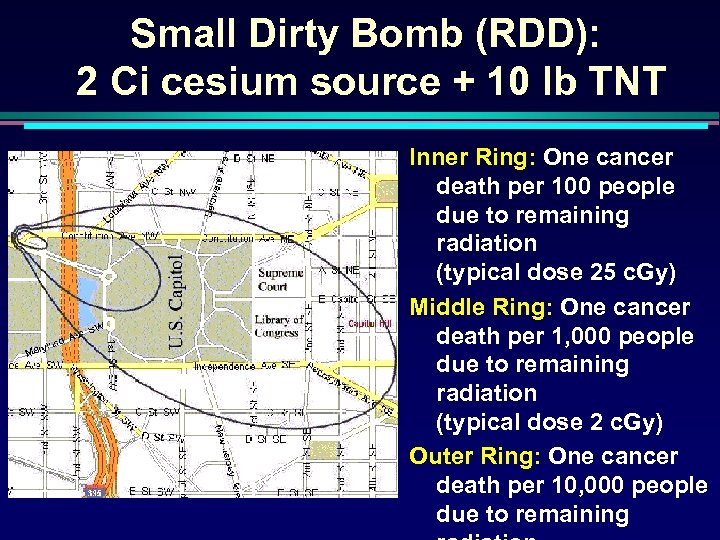 Small Dirty Bomb (RDD): 2 Ci cesium source + 10 lb TNT Inner Ring: One cancer death per 100 people due to remaining radiation (typical dose 25 c. Gy) Middle Ring: One cancer death per 1, 000 people due to remaining radiation (typical dose 2 c. Gy) Outer Ring: One cancer death per 10, 000 people due to remaining
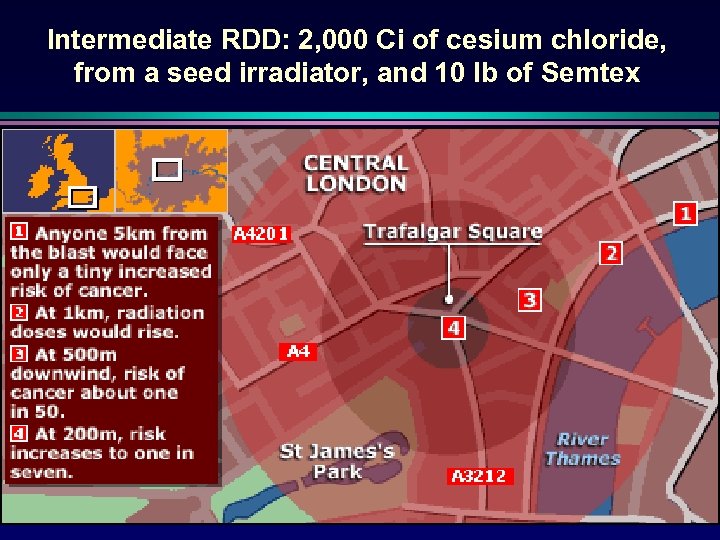 Intermediate RDD: 2, 000 Ci of cesium chloride, from a seed irradiator, and 10 lb of Semtex
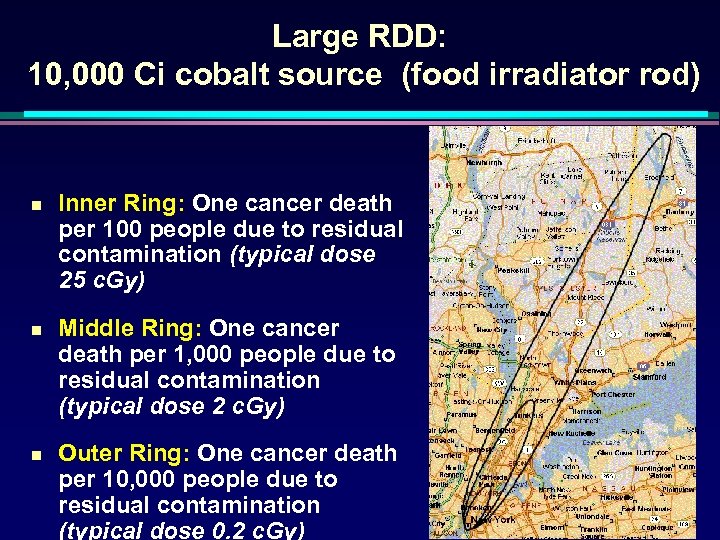 Large RDD: 10, 000 Ci cobalt source (food irradiator rod) n n n Inner Ring: One cancer death per 100 people due to residual contamination (typical dose 25 c. Gy) Middle Ring: One cancer death per 1, 000 people due to residual contamination (typical dose 2 c. Gy) Outer Ring: One cancer death per 10, 000 people due to residual contamination (typical dose 0. 2 c. Gy)
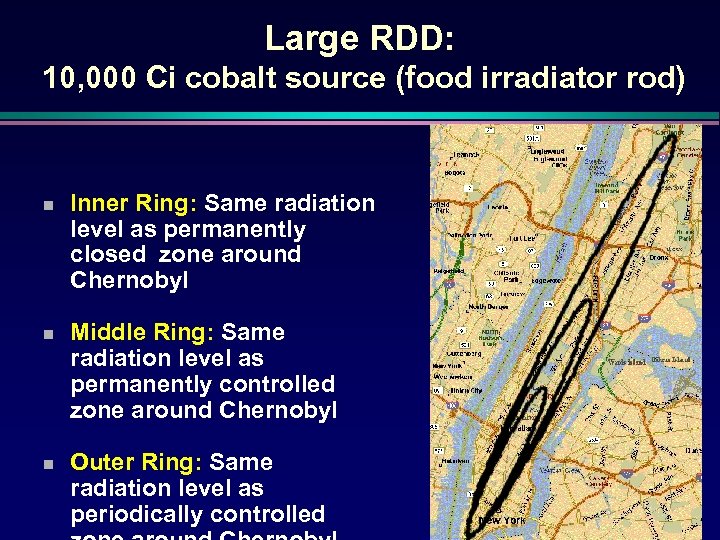 Large RDD: 10, 000 Ci cobalt source (food irradiator rod) n n n Inner Ring: Same radiation level as permanently closed zone around Chernobyl Middle Ring: Same radiation level as permanently controlled zone around Chernobyl Outer Ring: Same radiation level as periodically controlled
 Immediate Medical Management Issues You need to be part of a radiation casualty team • Health providers • Physicists • Social workers / administrators
 Immediate Medical Management Issues • Triage • Decontamination • Initial stabilization and treatment of life-threatening injury • Health care provider health and safety • Surge capacity: availability of staff (quantity and specialists), supplies, space
 Almost all the individual presenting at ER / clinic will not have a measurable radiation exposure • Goiânia – 99. 8% of individuals at ER/clinic not contaminated – 8% had “psychosomatic reactions which mimicked radiation exposure” • Israel, attacked by Scud missiles during 1991 Gulf war – 51% of individuals at ER were “stress casualties”
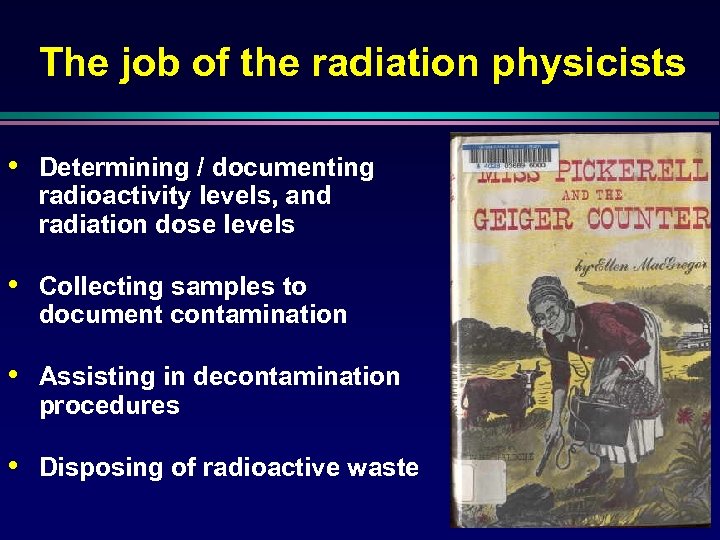 The job of the radiation physicists • Determining / documenting radioactivity levels, and radiation dose levels • Collecting samples to document contamination • Assisting in decontamination procedures • Disposing of radioactive waste
 Staff radiation protection • Fundamental Principles - Time - Distance - Shielding • Personnel Protective Equipment • Contamination Control
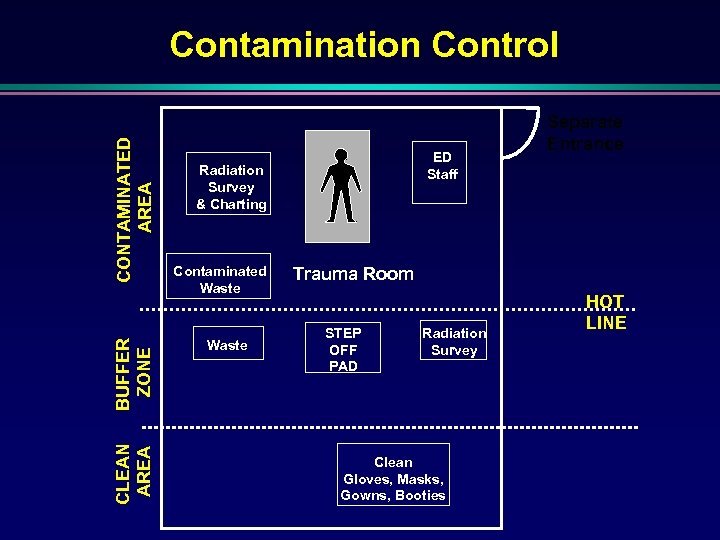 CLEAN AREA BUFFER ZONE CONTAMINATED AREA Contamination Control ED Staff Radiation Survey & Charting Contaminated Waste Separate Entrance Trauma Room STEP OFF PAD Radiation Survey Clean Gloves, Masks, Gowns, Booties HOT LINE
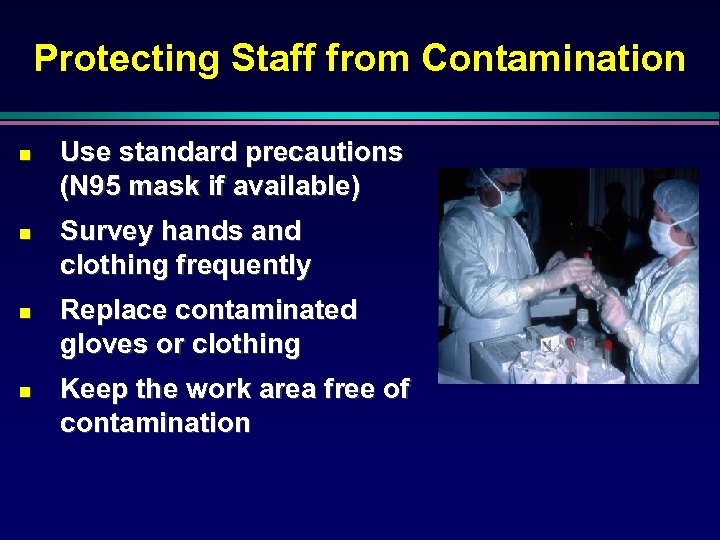 Protecting Staff from Contamination n n Use standard precautions (N 95 mask if available) Survey hands and clothing frequently Replace contaminated gloves or clothing Keep the work area free of contamination
 Pregnant Staff • Pregnant staff should be reassigned
 We need to be prepared for a radiological incident • Facilities should plan in advance and include procedures in their Disaster Plan Everyone needs training!
 If there is a plan in place and staff are well trained, radiation exposure to staff should be very low “When workers at Chernobyl who were in the reactor area at the time of the nuclear accident were decontaminated, the medical personal at the site received less than 10 m. Gy of radiation. ” Mettler & Voelz, New England Journal of Medicine, 346: 1554 (2002)
 Patient Management - Priorities • Standard medical triage is the highest priority – don’t delay giving critical care because a patient is contaminated • Radiation exposure and contamination are secondary considerations
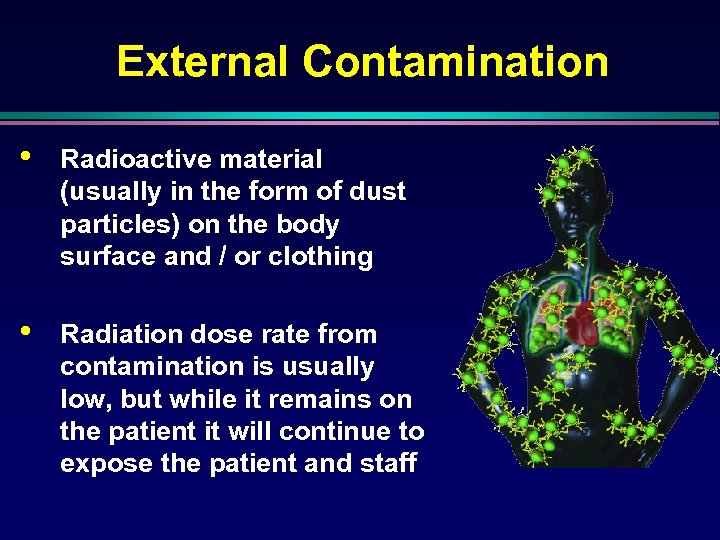 External Contamination • Radioactive material (usually in the form of dust particles) on the body surface and / or clothing • Radiation dose rate from contamination is usually low, but while it remains on the patient it will continue to expose the patient and staff
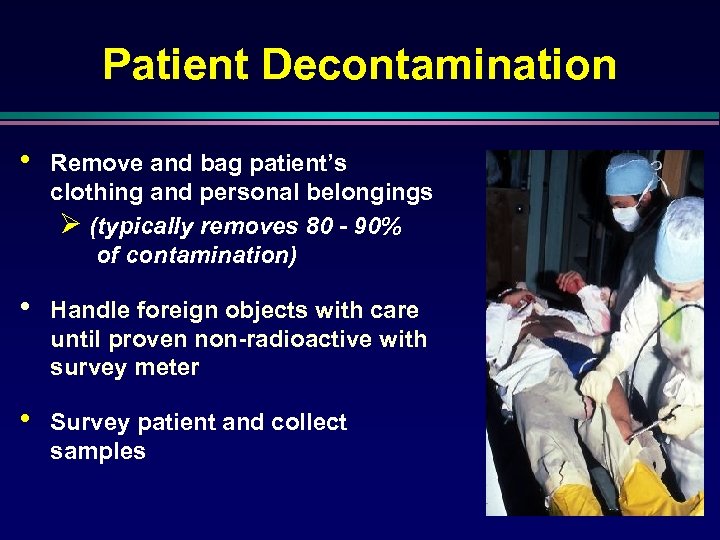 Patient Decontamination • Remove and bag patient’s clothing and personal belongings Ø (typically removes 80 - 90% of contamination) • Handle foreign objects with care until proven non-radioactive with survey meter • Survey patient and collect samples
 Decontamination Priorities • Wounds • Intact skin • Change outer gloves frequently to minimize spread of contamination
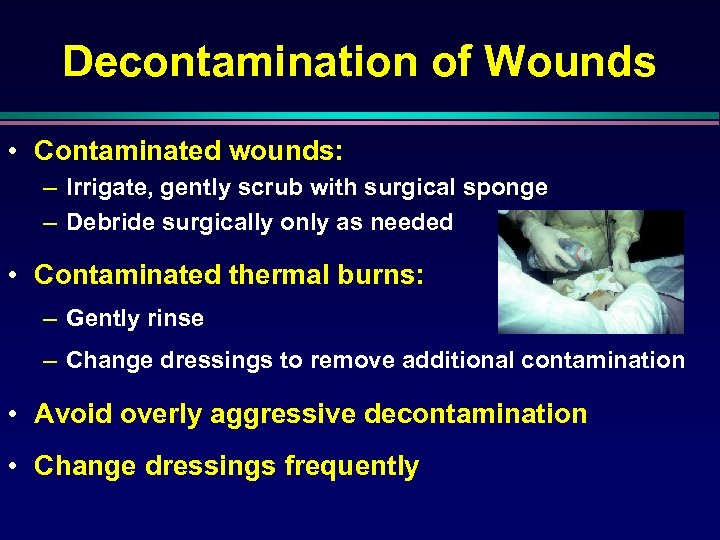 Decontamination of Wounds • Contaminated wounds: – Irrigate, gently scrub with surgical sponge – Debride surgically only as needed • Contaminated thermal burns: – Gently rinse – Change dressings to remove additional contamination • Avoid overly aggressive decontamination • Change dressings frequently
 Decontamination of Skin • Use multiple gentle efforts • Use soap & water • Cut hair if necessary (do not shave) • Use survey meter
 Cease Patient Decontamination • When decontamination efforts produce no significant reduction in contamination • When the level of radiation of the contaminated area is less than about twice background
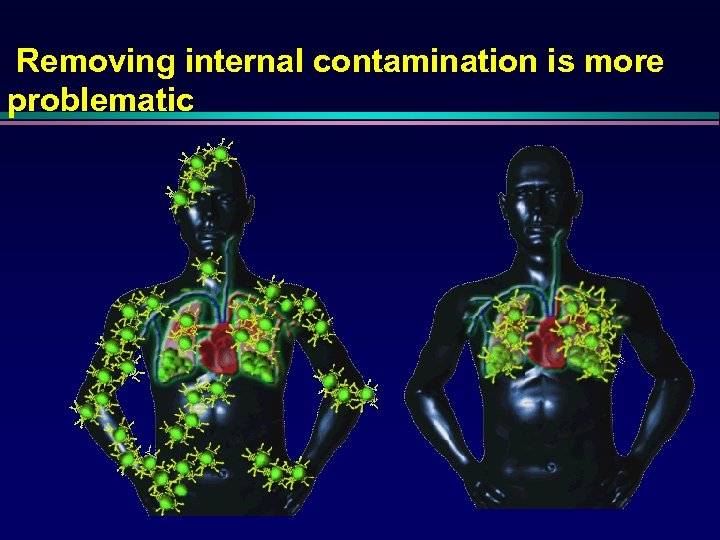 Removing internal contamination is more problematic
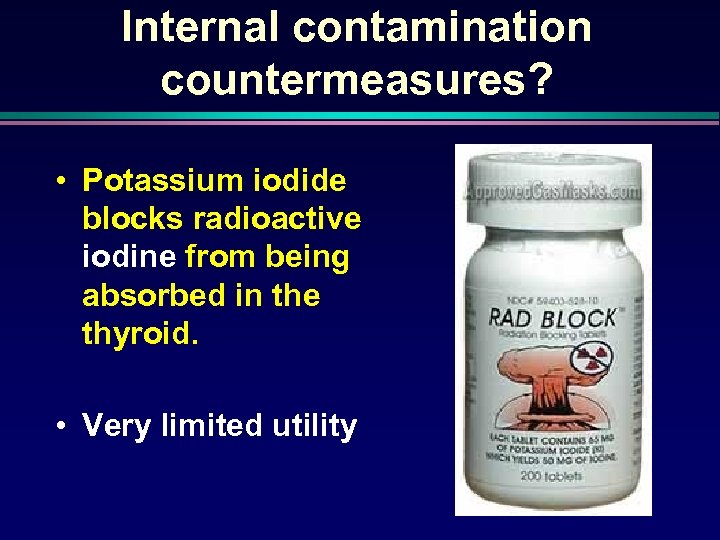 Internal contamination countermeasures? • Potassium iodide blocks radioactive iodine from being absorbed in the thyroid. • Very limited utility
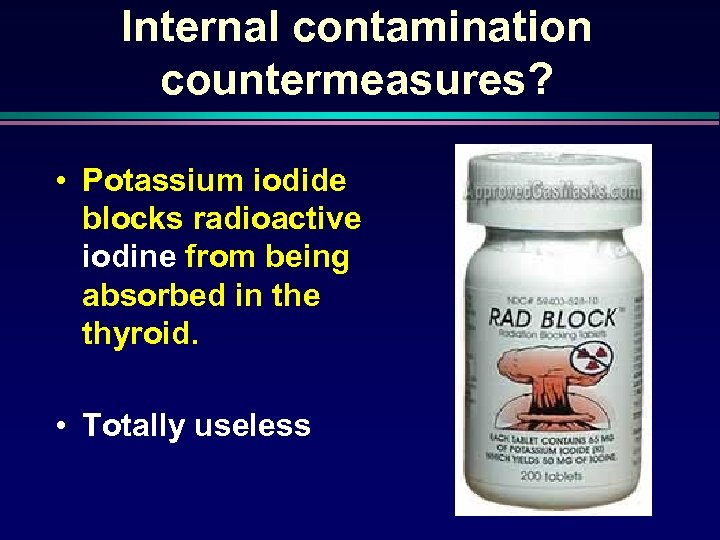 Internal contamination countermeasures? • Potassium iodide blocks radioactive iodine from being absorbed in the thyroid. • Totally useless
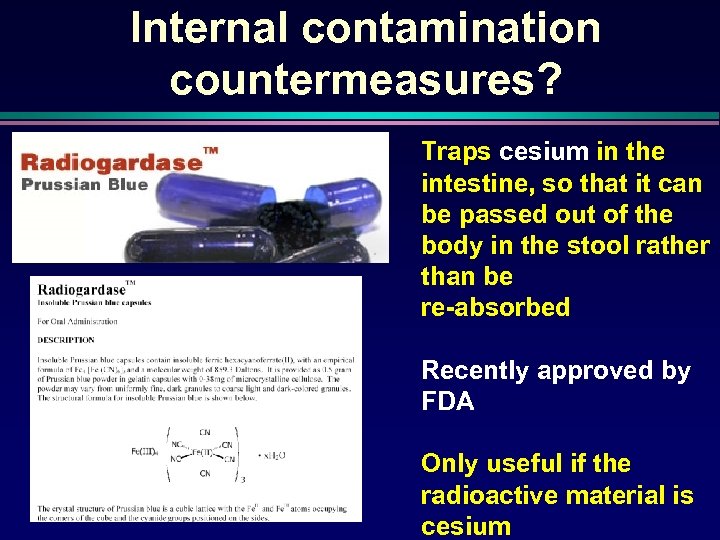 Internal contamination countermeasures? Traps cesium in the intestine, so that it can be passed out of the body in the stool rather than be re-absorbed Recently approved by FDA Only useful if the radioactive material is cesium
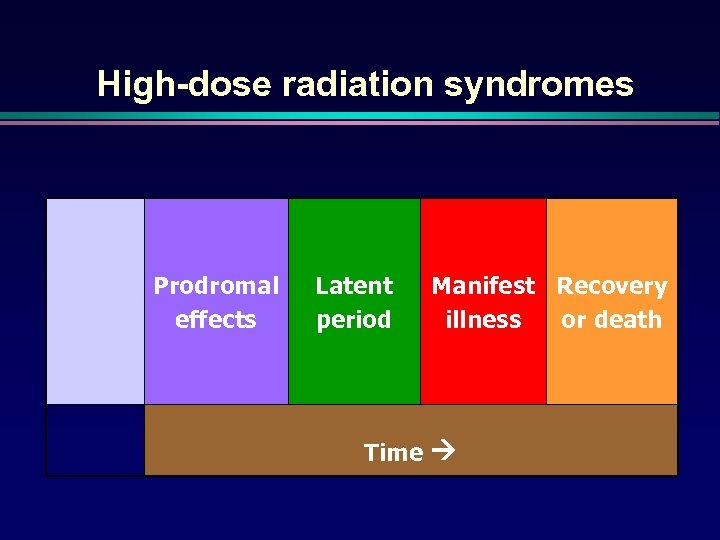 High-dose radiation syndromes Prodromal effects Latent period Manifest Recovery illness or death Time
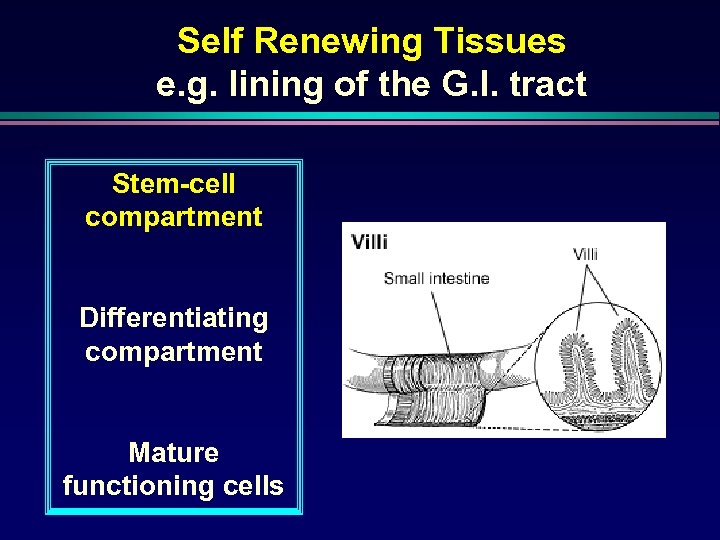 Self Renewing Tissues e. g. lining of the G. I. tract Stem-cell compartment Differentiating compartment Mature functioning cells
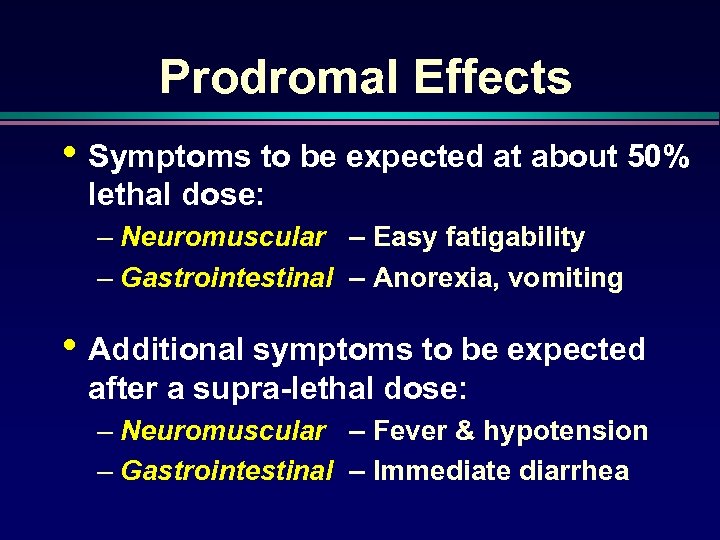 Prodromal Effects • Symptoms to be expected at about 50% lethal dose: – Neuromuscular – Easy fatigability – Gastrointestinal – Anorexia, vomiting • Additional symptoms to be expected after a supra-lethal dose: – Neuromuscular – Fever & hypotension – Gastrointestinal – Immediate diarrhea
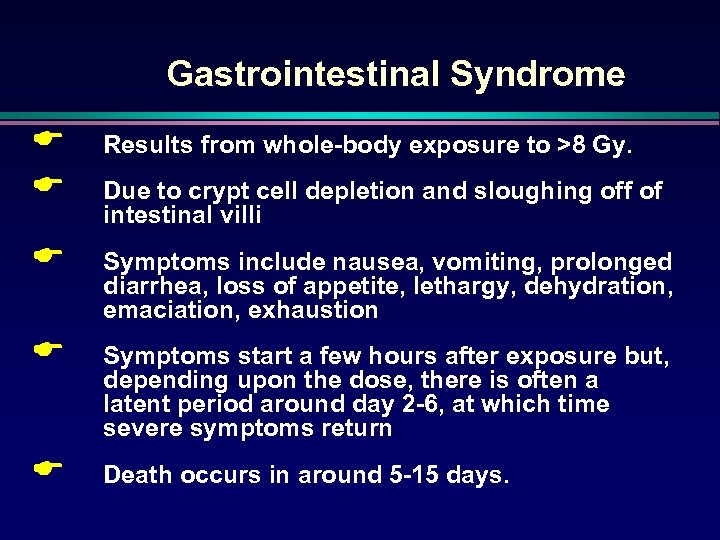 Gastrointestinal Syndrome E E Results from whole-body exposure to >8 Gy. E Symptoms include nausea, vomiting, prolonged diarrhea, loss of appetite, lethargy, dehydration, emaciation, exhaustion E Symptoms start a few hours after exposure but, depending upon the dose, there is often a latent period around day 2 -6, at which time severe symptoms return E Death occurs in around 5 -15 days. Due to crypt cell depletion and sloughing off of intestinal villi
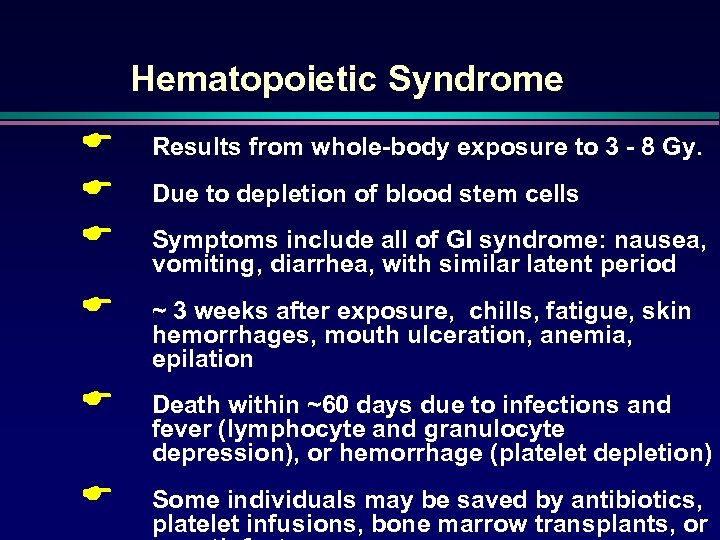 Hematopoietic Syndrome E E E Results from whole-body exposure to 3 - 8 Gy. E ~ 3 weeks after exposure, chills, fatigue, skin hemorrhages, mouth ulceration, anemia, epilation E Death within ~60 days due to infections and fever (lymphocyte and granulocyte depression), or hemorrhage (platelet depletion) E Some individuals may be saved by antibiotics, platelet infusions, bone marrow transplants, or Due to depletion of blood stem cells Symptoms include all of GI syndrome: nausea, vomiting, diarrhea, with similar latent period
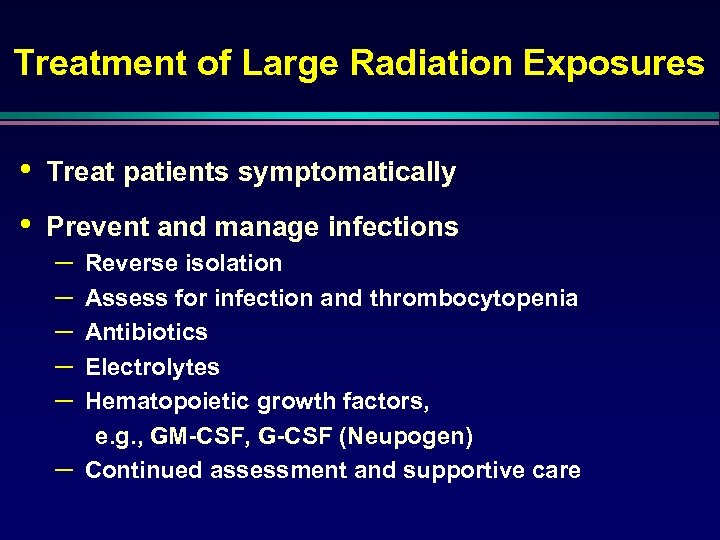 Treatment of Large Radiation Exposures • • Treat patients symptomatically Prevent and manage infections – – – Reverse isolation Assess for infection and thrombocytopenia Antibiotics Electrolytes Hematopoietic growth factors, e. g. , GM-CSF, G-CSF (Neupogen) Continued assessment and supportive care
 Bottom Line Medical centers in major cities need to be able to quickly assemble a competent team to cope with a radiation incident: ü ü Physicists Emergency room specialists Radiation oncologist / radiologist Psychologists
 Selected Further Information CDC and OSHA have good starting websites: www. bt. cdc. gov/radiation/index. asp www. osha. gov/SLTC/emergencypreparedness/rdd_tech. html Documents American College of Radiology: “Disaster Preparedness for Radiology Professionals” Download at www. acr. org/departments/educ/disaster_prep/dp_primer. ht ml National Council on Radiation Protection and Measurement Report No. 138, 2001 “Management of Terrorist Events Involving Radioactive Material”
 The real bottom line ü The threat of radiological terror is real ü Most scenarios will present primarily organizational challenges
 The real bottom line ü The threat of radiological terror is real ü Most scenarios will present primarily organizational challenges ü The answer: