


 Скачать презентацию Getting Medicines to People who Need Them Donor
0f4a68a158f0680aa9effb1894a955b0.ppt
- Количество слайдов: 94
 Getting Medicines to People who Need Them: Donor Programs & Coordination University of Iowa April 11, 2007
 Agenda • Overview of the Issues • Some of the Donors – Multi-lateral – Bi-lateral – Foundations & FBOs • How to Get Drugs to People • Donor Collaboration
 Issues
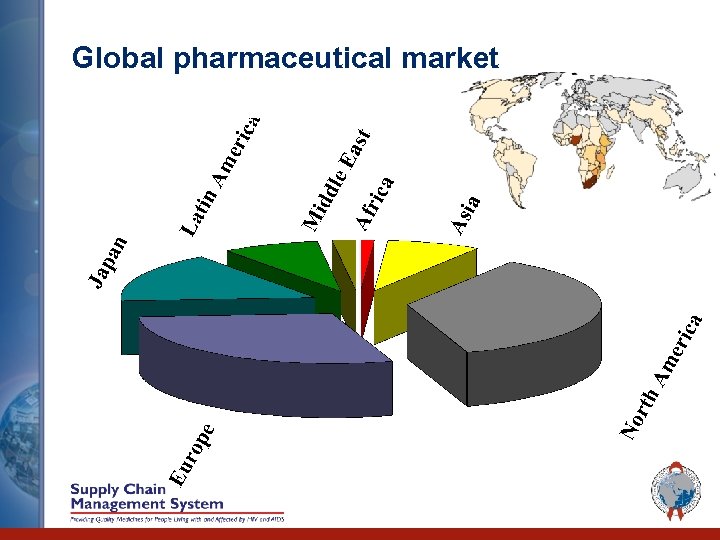 Global pharmaceutical market
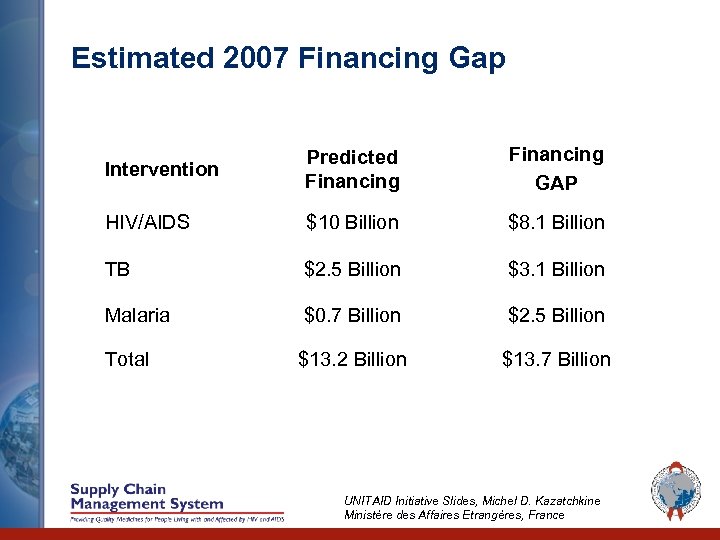 Estimated 2007 Financing Gap Intervention Predicted Financing GAP HIV/AIDS $10 Billion $8. 1 Billion TB $2. 5 Billion $3. 1 Billion Malaria $0. 7 Billion $2. 5 Billion Total $13. 2 Billion $13. 7 Billion UNITAID Initiative Slides, Michel D. Kazatchkine Ministère des Affaires Etrangères, France
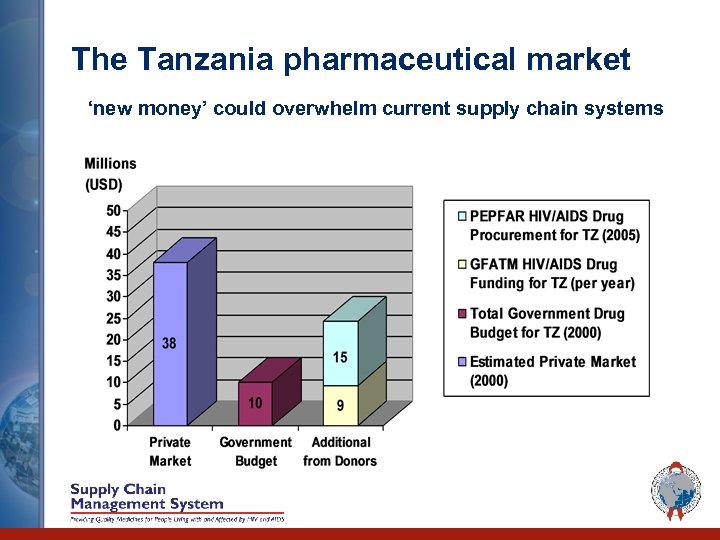 The Tanzania pharmaceutical market ‘new money’ could overwhelm current supply chain systems
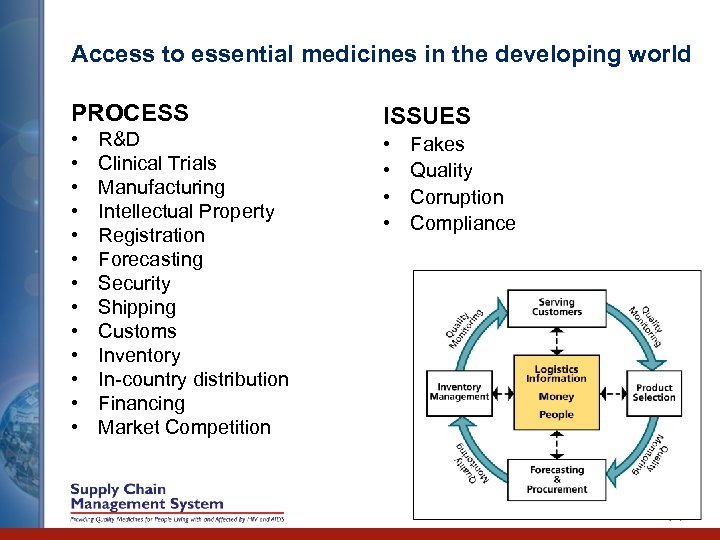 Access to essential medicines in the developing world PROCESS • • • • R&D Clinical Trials Manufacturing Intellectual Property Registration Forecasting Security Shipping Customs Inventory In-country distribution Financing Market Competition ISSUES • • Fakes Quality Corruption Compliance
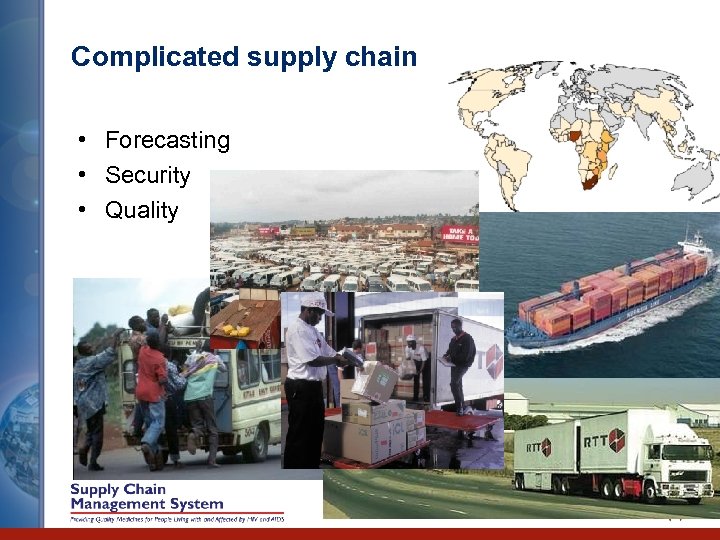 Complicated supply chain • Forecasting • Security • Quality
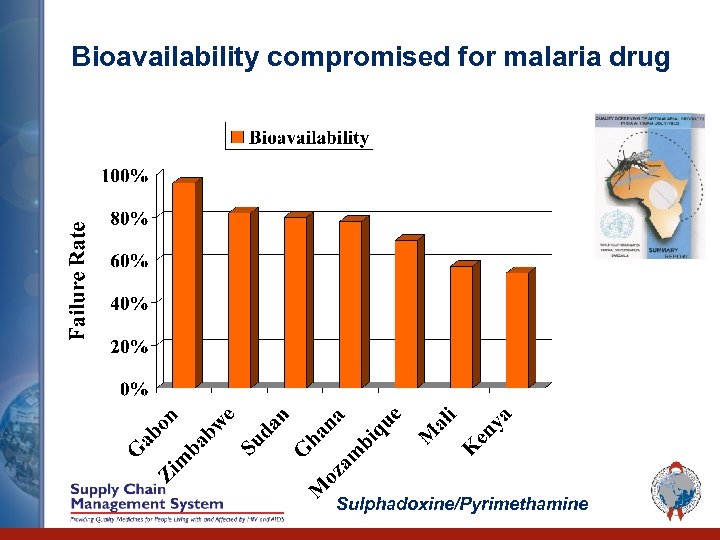 Bioavailability compromised for malaria drug Sulphadoxine/Pyrimethamine
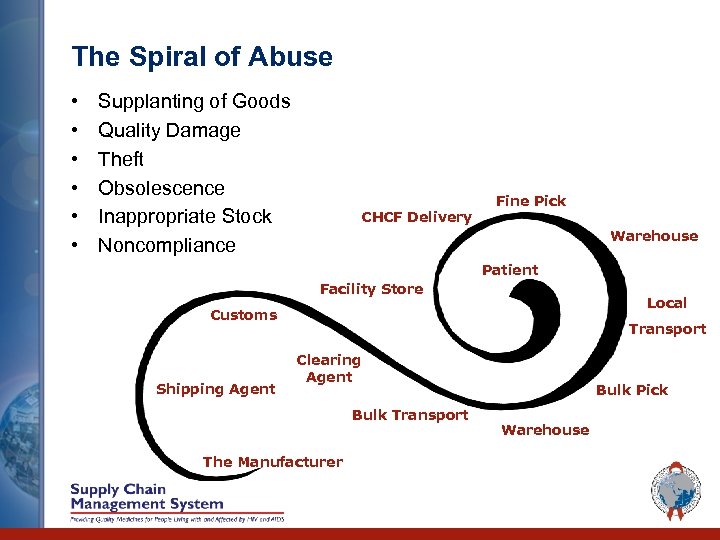 The Spiral of Abuse • • • Supplanting of Goods Quality Damage Theft Obsolescence Inappropriate Stock Noncompliance CHCF Delivery Fine Pick Warehouse Patient Facility Store Local Customs Shipping Agent Transport Clearing Agent Bulk Transport The Manufacturer Bulk Pick Warehouse
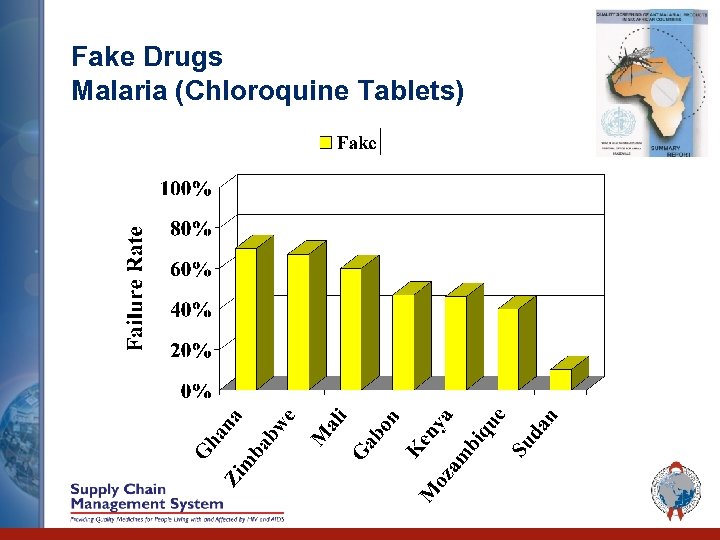 Fake Drugs Malaria (Chloroquine Tablets)
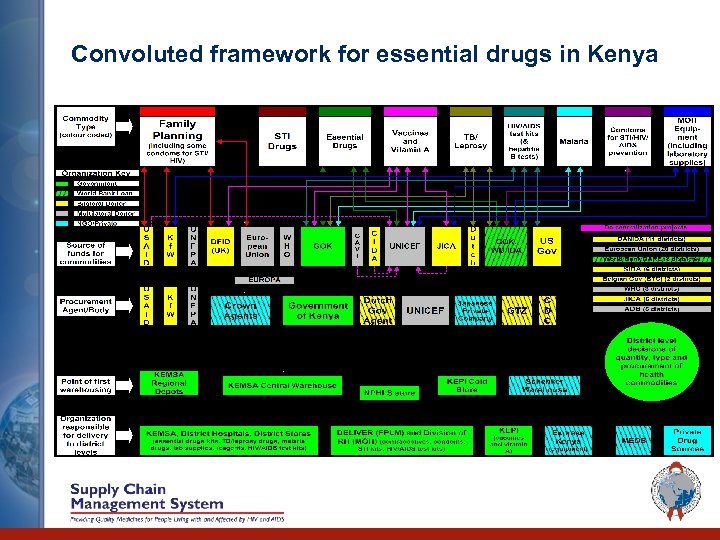 Convoluted framework for essential drugs in Kenya
 Donors
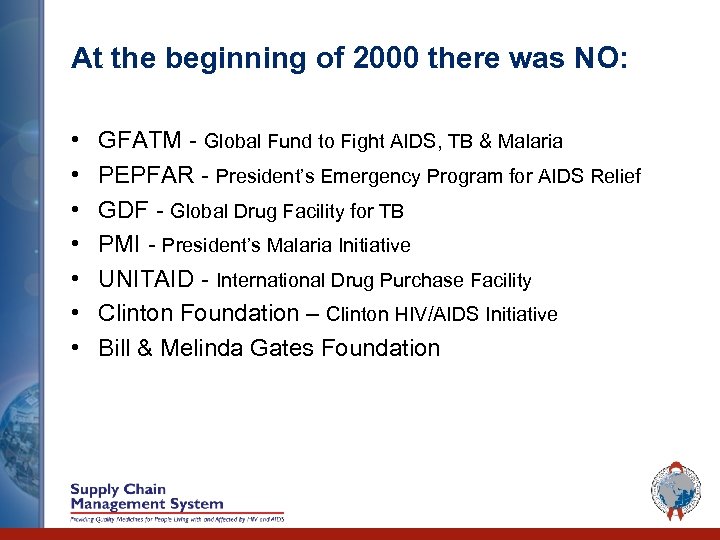 At the beginning of 2000 there was NO: • • GFATM - Global Fund to Fight AIDS, TB & Malaria PEPFAR - President’s Emergency Program for AIDS Relief GDF - Global Drug Facility for TB PMI - President’s Malaria Initiative UNITAID - International Drug Purchase Facility Clinton Foundation – Clinton HIV/AIDS Initiative Bill & Melinda Gates Foundation
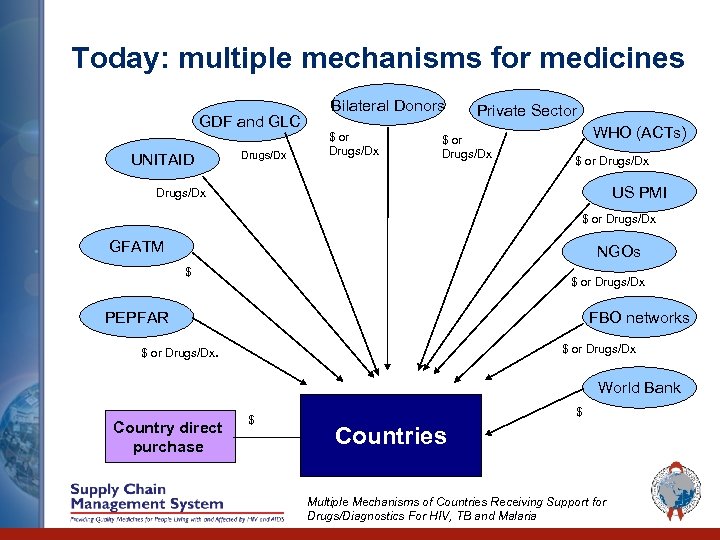 Today: multiple mechanisms for medicines GDF and GLC UNITAID Drugs/Dx Bilateral Donors $ or Drugs/Dx Private Sector $ or Drugs/Dx WHO (ACTs) $ or Drugs/Dx US PMI Drugs/Dx $ or Drugs/Dx GFATM NGOs $ $ or Drugs/Dx PEPFAR FBO networks $ or Drugs/Dx. World Bank Country direct purchase $ $ Countries Multiple Mechanisms of Countries Receiving Support for Drugs/Diagnostics For HIV, TB and Malaria
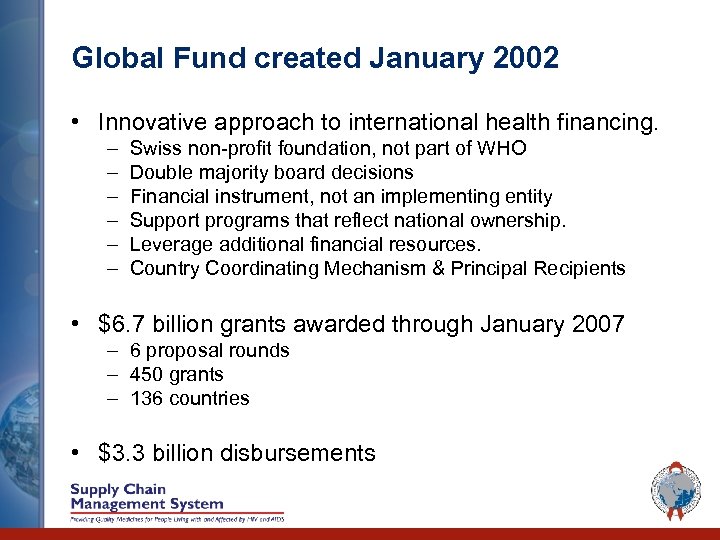 Global Fund created January 2002 • Innovative approach to international health financing. – – – Swiss non-profit foundation, not part of WHO Double majority board decisions Financial instrument, not an implementing entity Support programs that reflect national ownership. Leverage additional financial resources. Country Coordinating Mechanism & Principal Recipients • $6. 7 billion grants awarded through January 2007 – 6 proposal rounds – 450 grants – 136 countries • $3. 3 billion disbursements
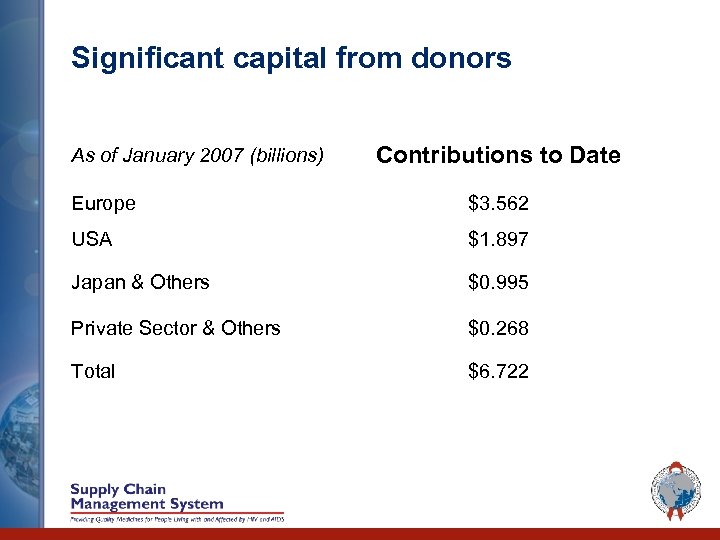 Significant capital from donors As of January 2007 (billions) Contributions to Date Europe $3. 562 USA $1. 897 Japan & Others $0. 995 Private Sector & Others $0. 268 Total $6. 722
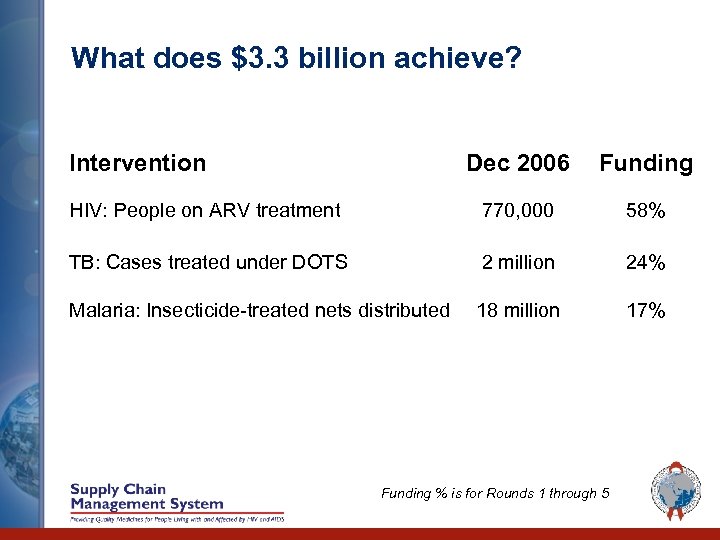 What does $3. 3 billion achieve? Intervention Dec 2006 Funding HIV: People on ARV treatment 770, 000 58% TB: Cases treated under DOTS 2 million 24% Malaria: Insecticide-treated nets distributed 18 million 17% Funding % is for Rounds 1 through 5
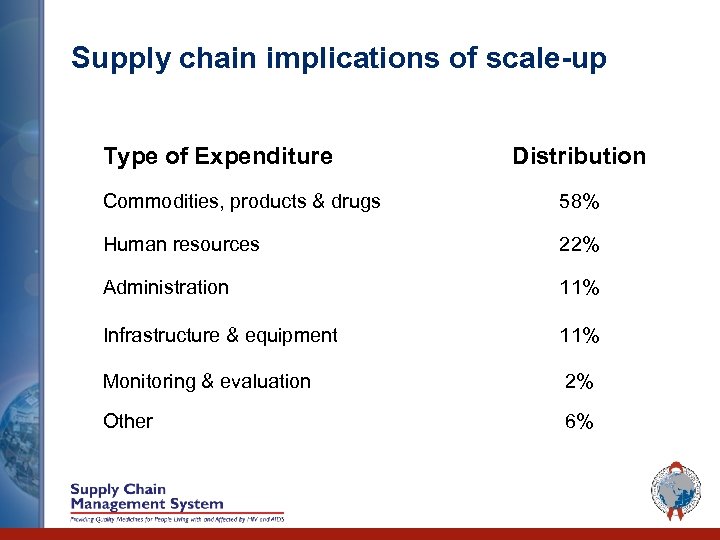 Supply chain implications of scale-up Type of Expenditure Distribution Commodities, products & drugs 58% Human resources 22% Administration 11% Infrastructure & equipment 11% Monitoring & evaluation 2% Other 6%
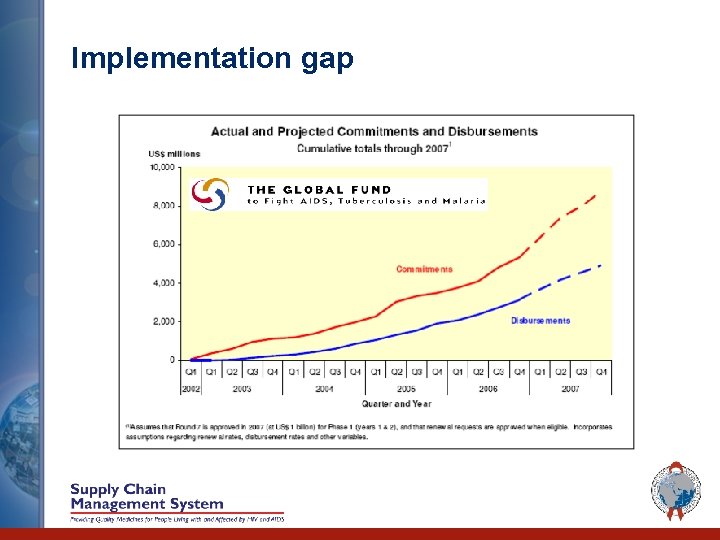 Implementation gap
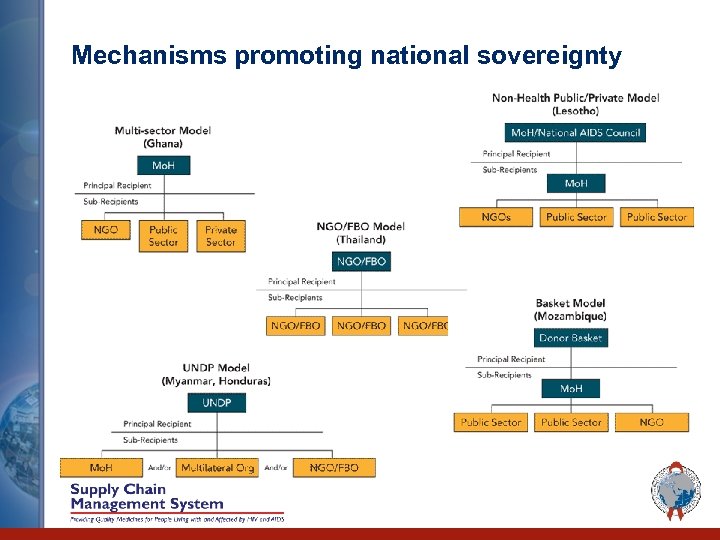 Mechanisms promoting national sovereignty
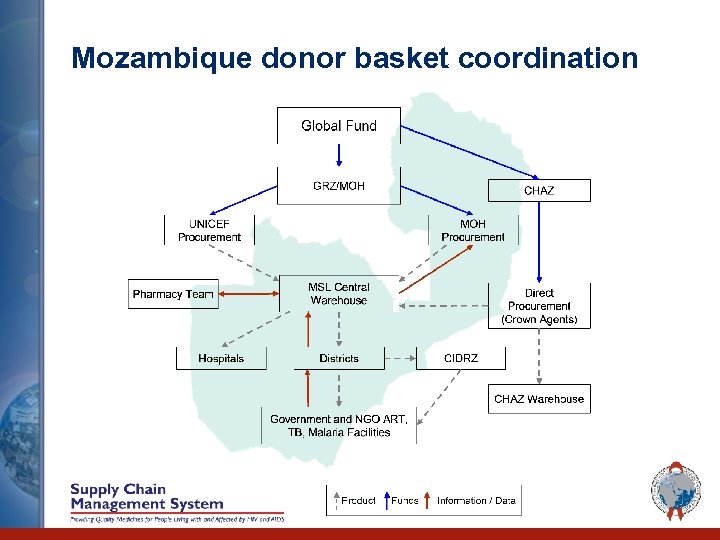 Mozambique donor basket coordination
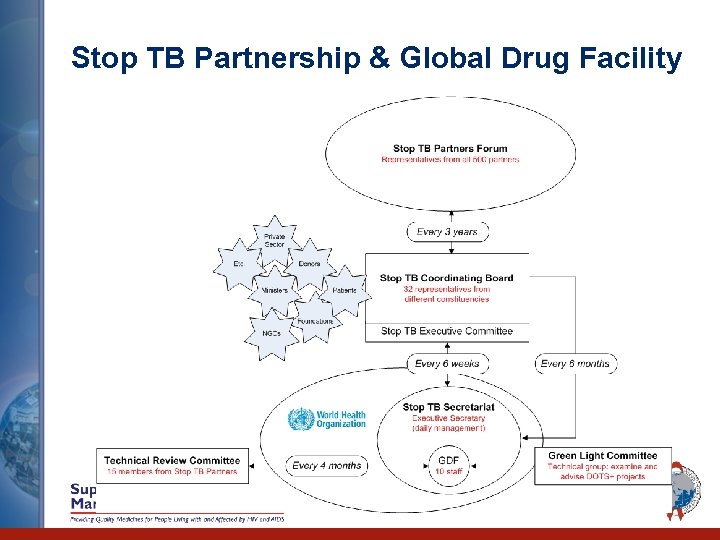 Stop TB Partnership & Global Drug Facility
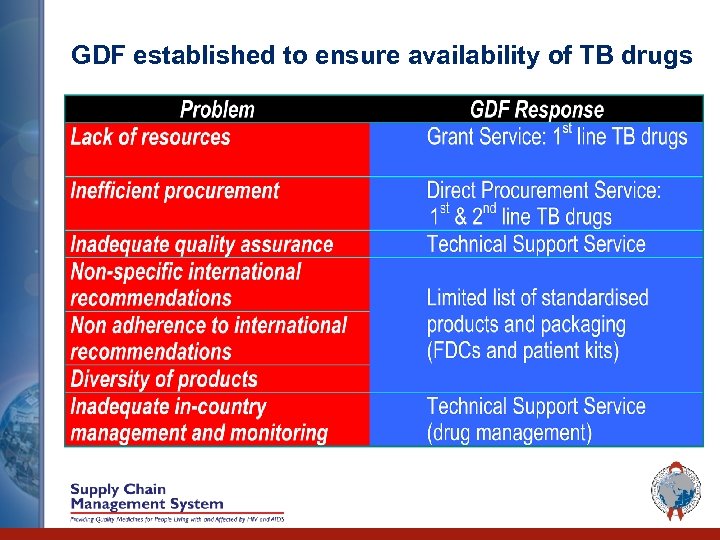 GDF established to ensure availability of TB drugs
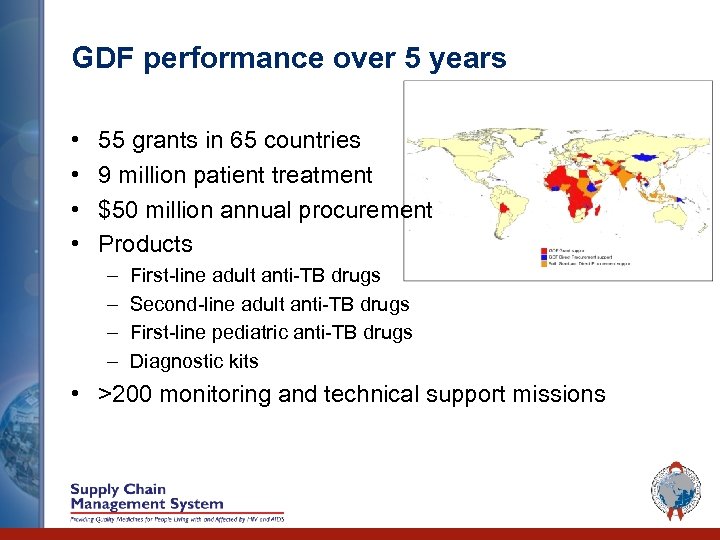 GDF performance over 5 years • • 55 grants in 65 countries 9 million patient treatment $50 million annual procurement Products – – First-line adult anti-TB drugs Second-line adult anti-TB drugs First-line pediatric anti-TB drugs Diagnostic kits • >200 monitoring and technical support missions
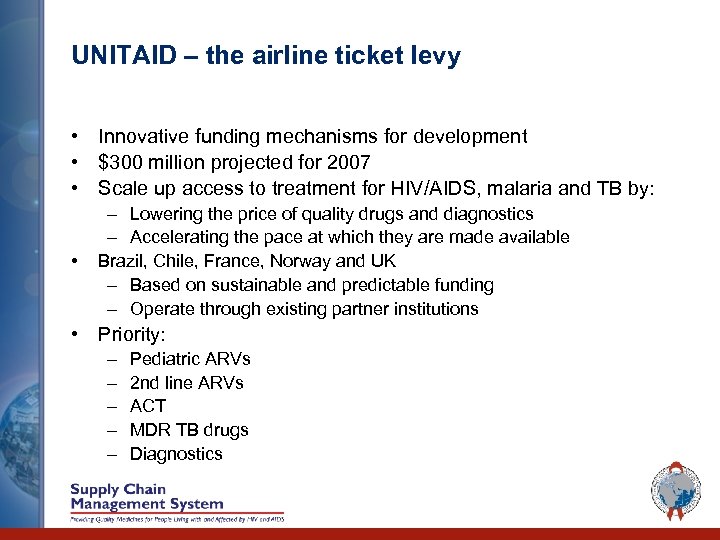 UNITAID – the airline ticket levy • Innovative funding mechanisms for development • $300 million projected for 2007 • Scale up access to treatment for HIV/AIDS, malaria and TB by: • – Lowering the price of quality drugs and diagnostics – Accelerating the pace at which they are made available Brazil, Chile, France, Norway and UK – Based on sustainable and predictable funding – Operate through existing partner institutions • Priority: – – – Pediatric ARVs 2 nd line ARVs ACT MDR TB drugs Diagnostics
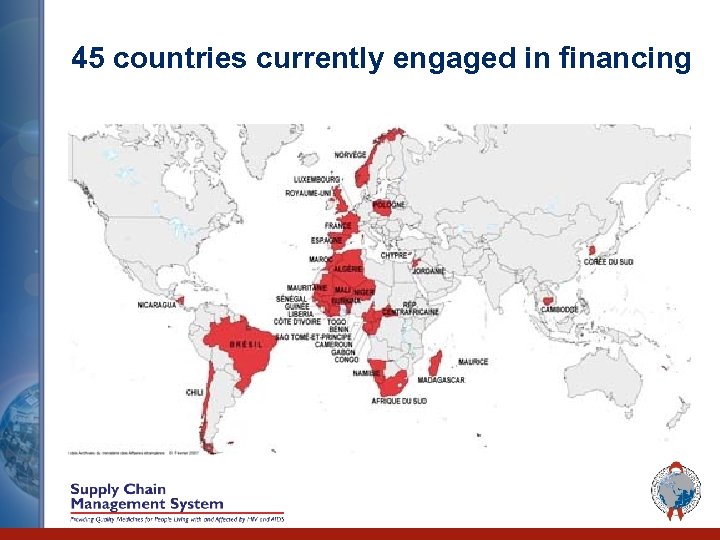 45 countries currently engaged in financing
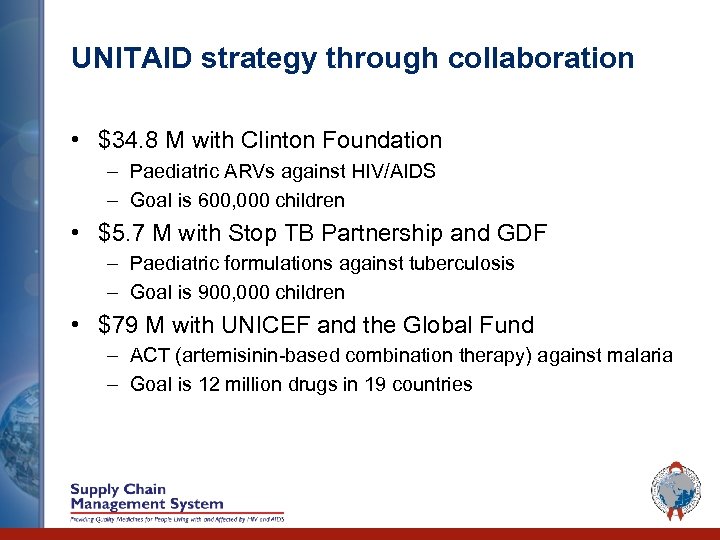 UNITAID strategy through collaboration • $34. 8 M with Clinton Foundation – Paediatric ARVs against HIV/AIDS – Goal is 600, 000 children • $5. 7 M with Stop TB Partnership and GDF – Paediatric formulations against tuberculosis – Goal is 900, 000 children • $79 M with UNICEF and the Global Fund – ACT (artemisinin-based combination therapy) against malaria – Goal is 12 million drugs in 19 countries
 Faith-based Organizations
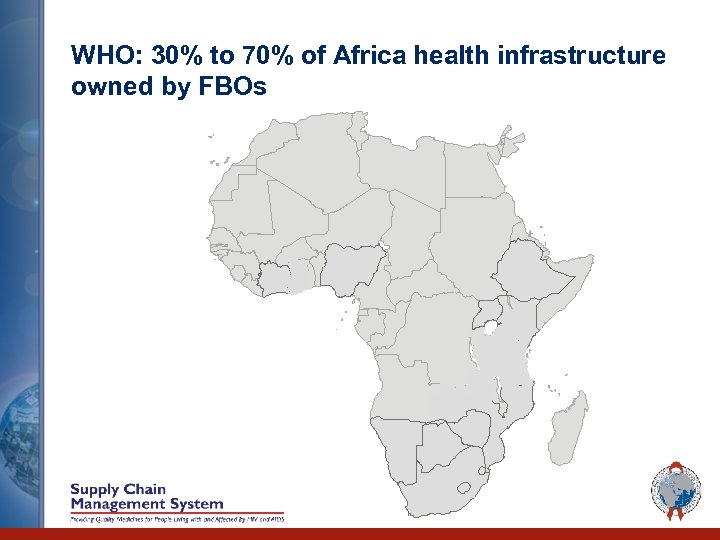 WHO: 30% to 70% of Africa health infrastructure owned by FBOs
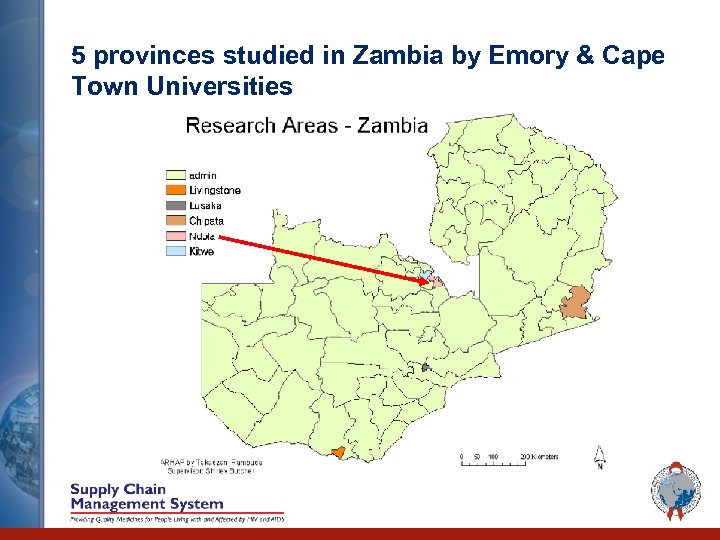 5 provinces studied in Zambia by Emory & Cape Town Universities
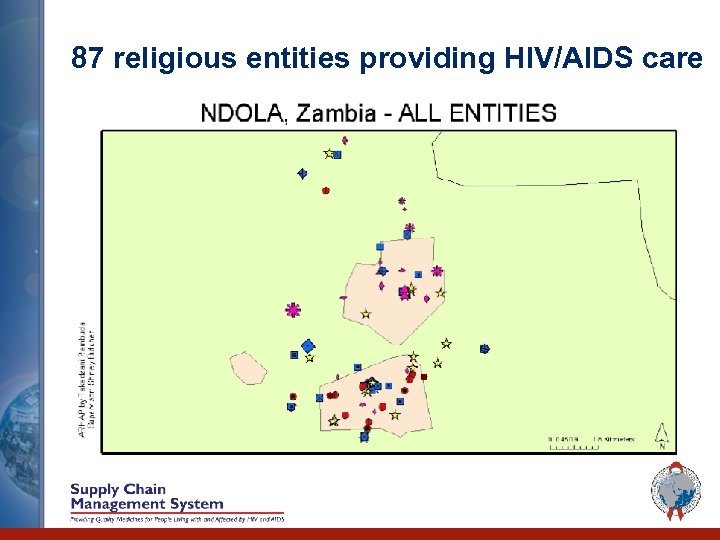 87 religious entities providing HIV/AIDS care
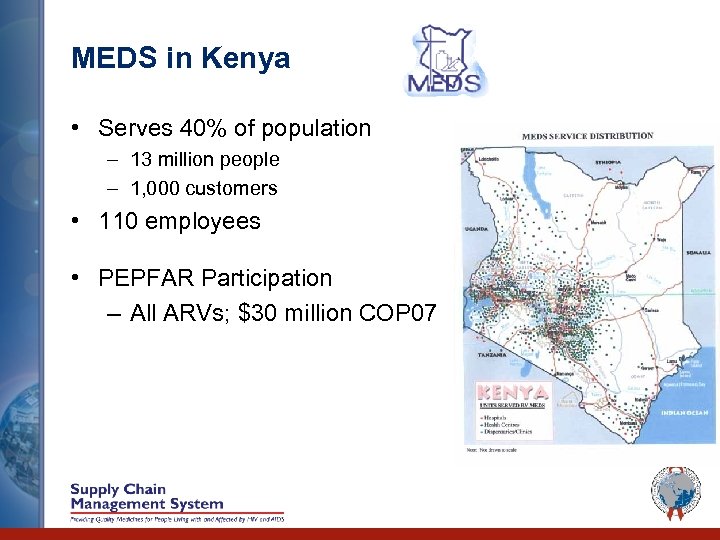 MEDS in Kenya • Serves 40% of population – 13 million people – 1, 000 customers • 110 employees • PEPFAR Participation – All ARVs; $30 million COP 07
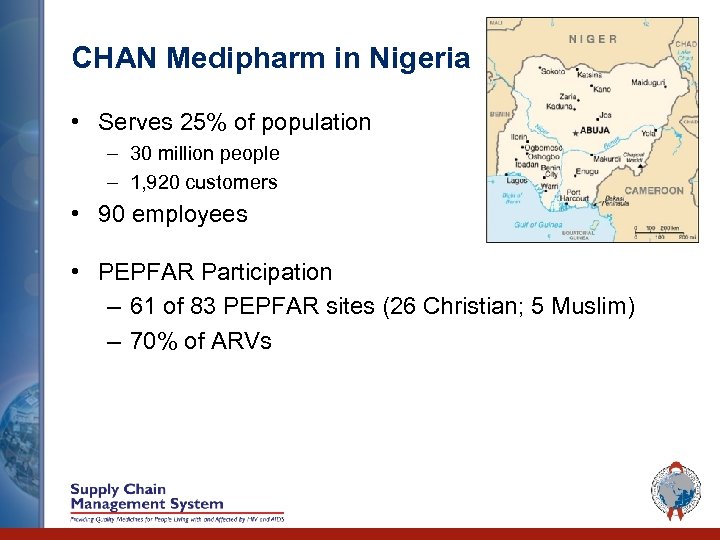 CHAN Medipharm in Nigeria • Serves 25% of population – 30 million people – 1, 920 customers • 90 employees • PEPFAR Participation – 61 of 83 PEPFAR sites (26 Christian; 5 Muslim) – 70% of ARVs
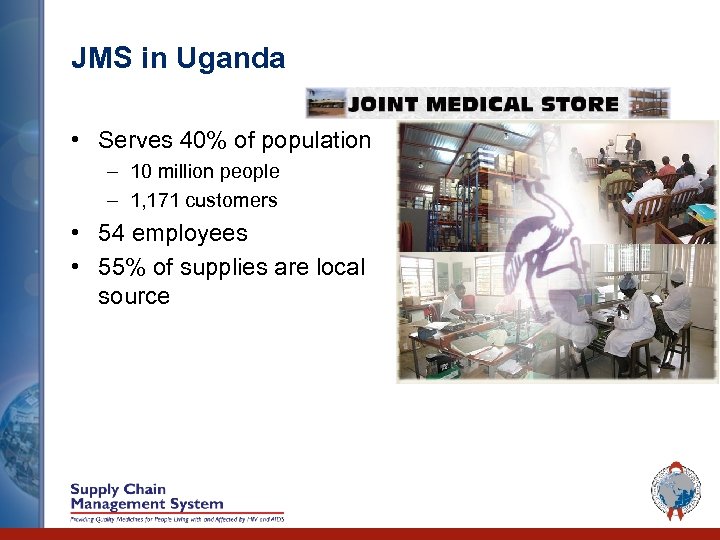 JMS in Uganda • Serves 40% of population – 10 million people – 1, 171 customers • 54 employees • 55% of supplies are local source
 FBOs and the global programs • FBOs provide much of the healthcare • FBOs often are not at the table • FBOs must be engaged to meet scale up requirements • FBOs are a key to sustainability • Faith-based Drug Supply Organizations are scared
 EPN • Ecumenical Pharmaceutical Network is a thought leader and advocate in pharmaceutical distribution to developing world • 76 member organizations in 31 countries – Christian Health Associations (CHAs) – Drug Supply Organizations (DSOs) • WHO/EPN 2003 Survey of Sub-Saharan Africa – – 16 Faith-based DSOs in 11 countries serving … 8, 269 hospitals and clinics 112 million population 43% of population on average in country
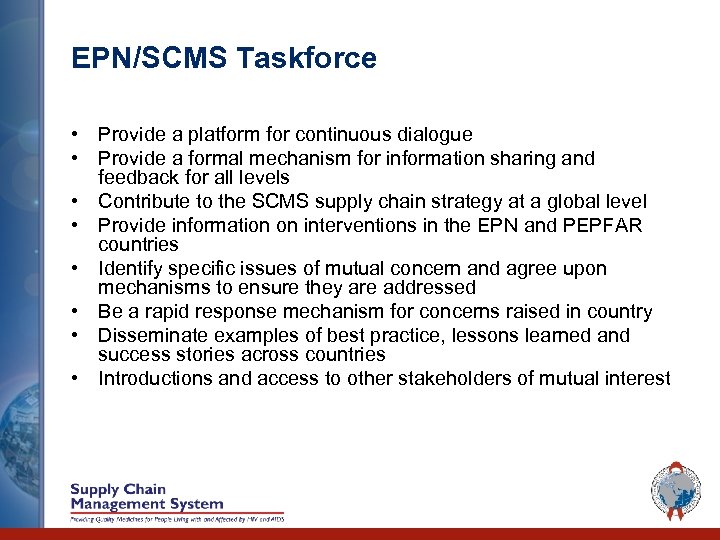 EPN/SCMS Taskforce • Provide a platform for continuous dialogue • Provide a formal mechanism for information sharing and feedback for all levels • Contribute to the SCMS supply chain strategy at a global level • Provide information on interventions in the EPN and PEPFAR countries • Identify specific issues of mutual concern and agree upon mechanisms to ensure they are addressed • Be a rapid response mechanism for concerns raised in country • Disseminate examples of best practice, lessons learned and success stories across countries • Introductions and access to other stakeholders of mutual interest
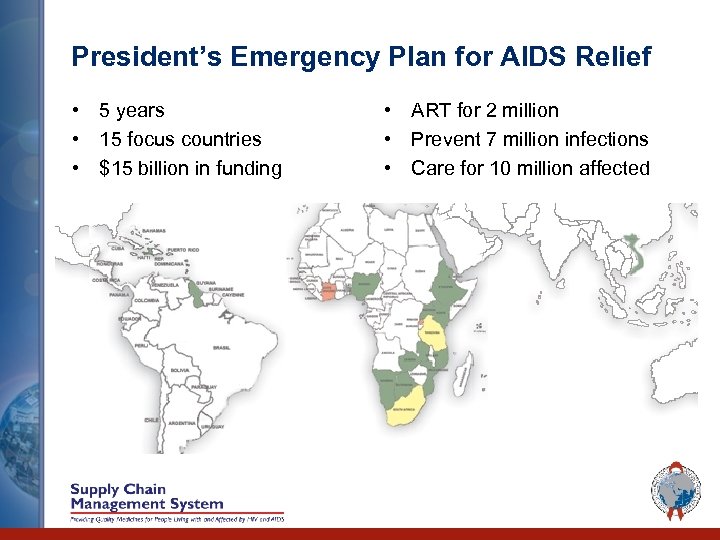 President’s Emergency Plan for AIDS Relief • 5 years • 15 focus countries • $15 billion in funding • ART for 2 million • Prevent 7 million infections • Care for 10 million affected
 PEPFAR a new way of doing business • • Department of State U. S. Agency for International Development Department of Defense Department of Commerce Department of Labor Department of Health and Human Services (HHS) Peace Corps
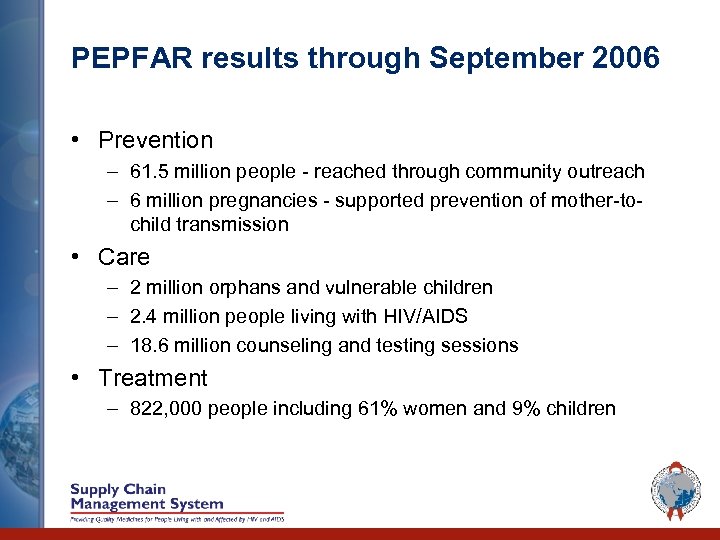 PEPFAR results through September 2006 • Prevention – 61. 5 million people - reached through community outreach – 6 million pregnancies - supported prevention of mother-tochild transmission • Care – 2 million orphans and vulnerable children – 2. 4 million people living with HIV/AIDS – 18. 6 million counseling and testing sessions • Treatment – 822, 000 people including 61% women and 9% children
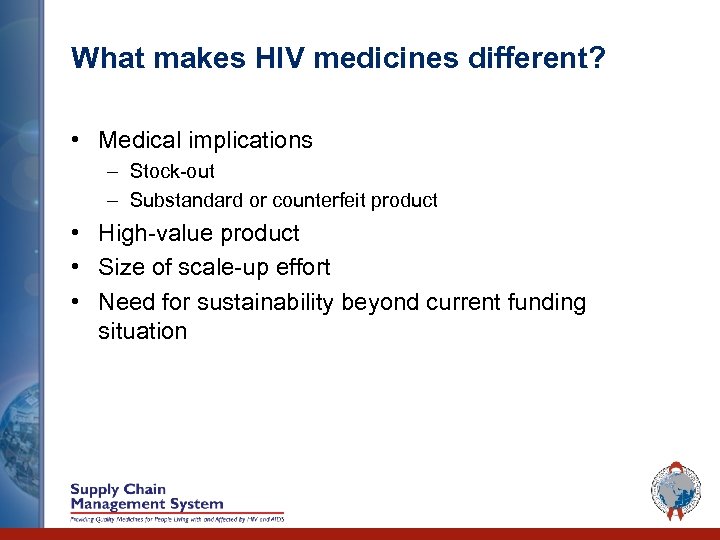 What makes HIV medicines different? • Medical implications – Stock-out – Substandard or counterfeit product • High-value product • Size of scale-up effort • Need for sustainability beyond current funding situation
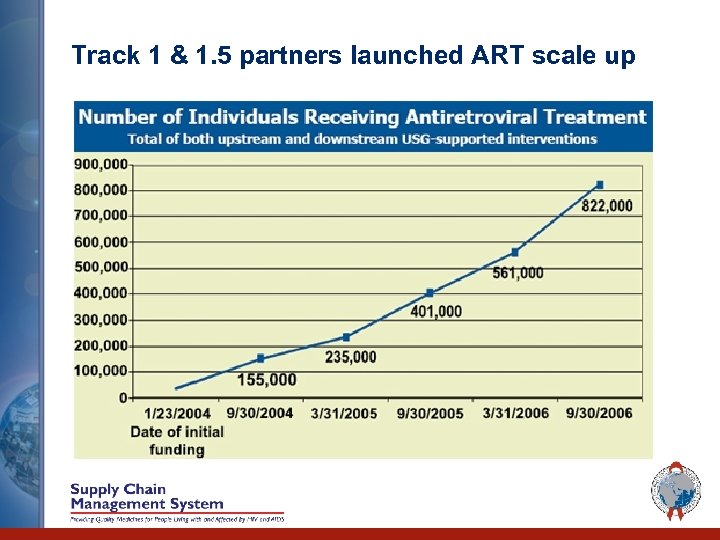 Track 1 & 1. 5 partners launched ART scale up
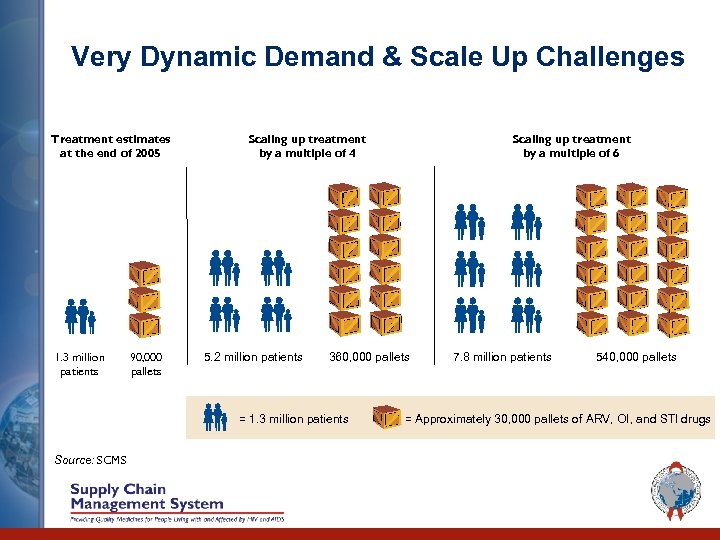 Very Dynamic Demand & Scale Up Challenges Treatment estimates at the end of 2005 1. 3 million patients 90, 000 pallets Scaling up treatment by a multiple of 4 5. 2 million patients 360, 000 pallets = 1. 3 million patients Source: SCMS Scaling up treatment by a multiple of 6 7. 8 million patients 540, 000 pallets = Approximately 30, 000 pallets of ARV, OI, and STI drugs
 Current supply chain challenges can impede program performance • Inadequate data for quantification/forecasting of needed commodities • Large, infrequent orders place burdens on local infrastructure leading to stockouts or product expiration • Overstretched country storage and delivery routes increase risk of theft, counterfeiting and spoilage resulting in health risks and product loss • Supply of HIV/AIDS commodities is determined by forecasts rather than demand
 How to Get Drugs to People
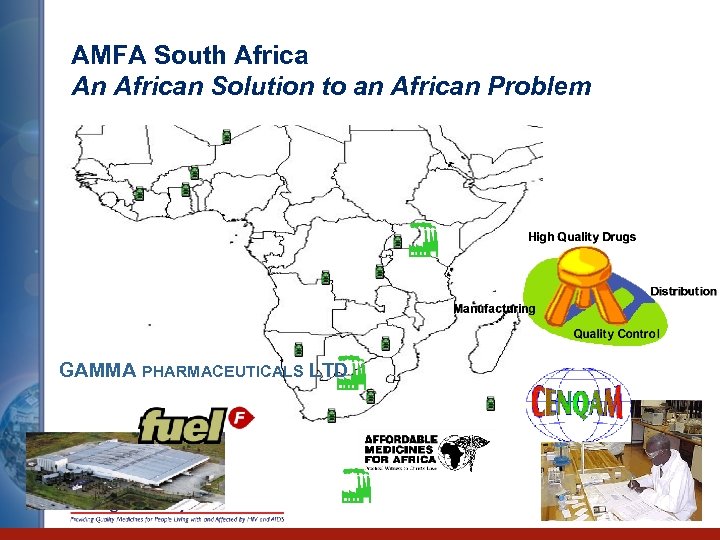 AMFA South Africa An African Solution to an African Problem GAMMA PHARMACEUTICALS LTD
 SCMS team operates seamlessly • • Affordable Medicines for Africa Johannesburg, South Africa AMFA Foundation St. Charles, Illinois, USA Booz Allen Hamilton Mc. Lean, Virginia USA Crown Agents Consultancy, Inc. Washington, DC, USA The Fuel Logistics Group (Pty) Ltd. Sandton, South Africa IDA Solutions Amsterdam, Netherlands JSI Research & Training Institute, Inc. Boston, Massachusetts, USA Management Sciences for Health, Inc. Boston, Massachusetts, USA • • The Manoff Group, Inc. Washington, DC, USA MAP International Brunswick, Georgia, USA The North-West University Potchefstroom, South Africa Northrop Grumman Mc. Lean, Virginia, USA Program for Appropriate Technology in Health Seattle, Washington, USA UPS Supply Chain Solutions. SM Atlanta, Georgia, USA Voxiva, Inc. Washington, DC, USA 3 i Infotech, Inc. Edison, New Jersey, USA
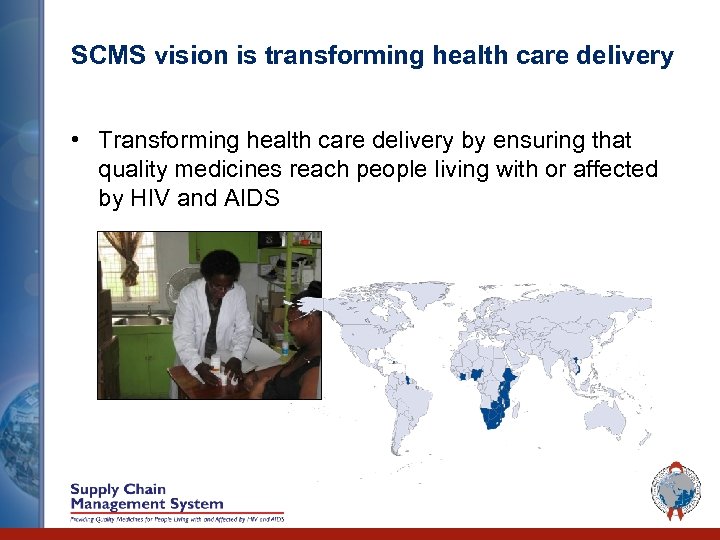 SCMS vision is transforming health care delivery • Transforming health care delivery by ensuring that quality medicines reach people living with or affected by HIV and AIDS
 Key SCMS strategies support efforts to serve more people • Strengthen existing systems • Aggregate procurement across many clients; longer-term supplier contracts • Use world-class freight forwarding and inventory management; regional distribution centers • Improve decision making through availability and use of logistics and supply chain data • Coordinate efforts and global quantification with multiple partners • Ensure sustainable solutions that will last beyond SCMS
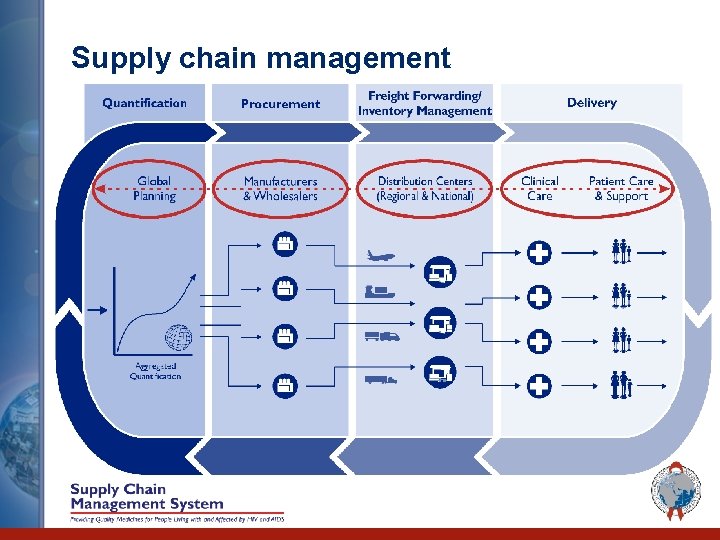 Supply chain management
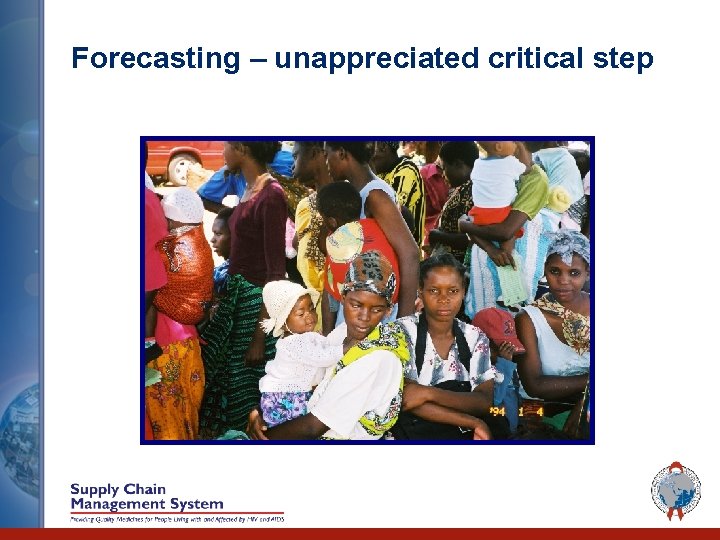 Forecasting – unappreciated critical step
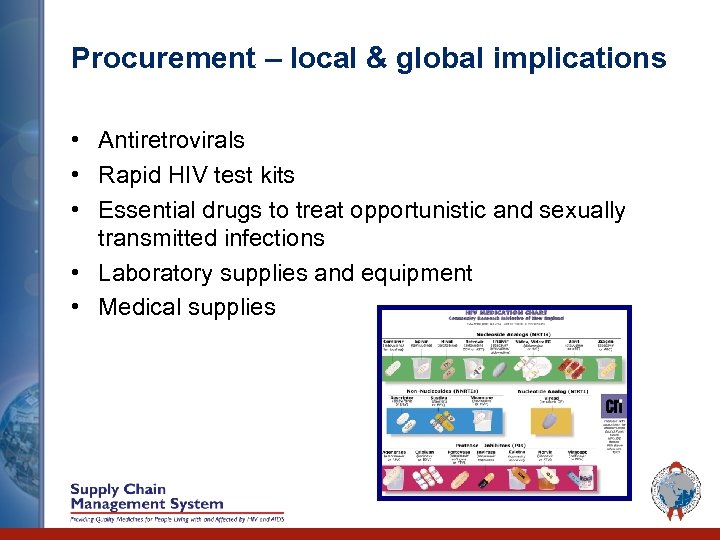 Procurement – local & global implications • Antiretrovirals • Rapid HIV test kits • Essential drugs to treat opportunistic and sexually transmitted infections • Laboratory supplies and equipment • Medical supplies
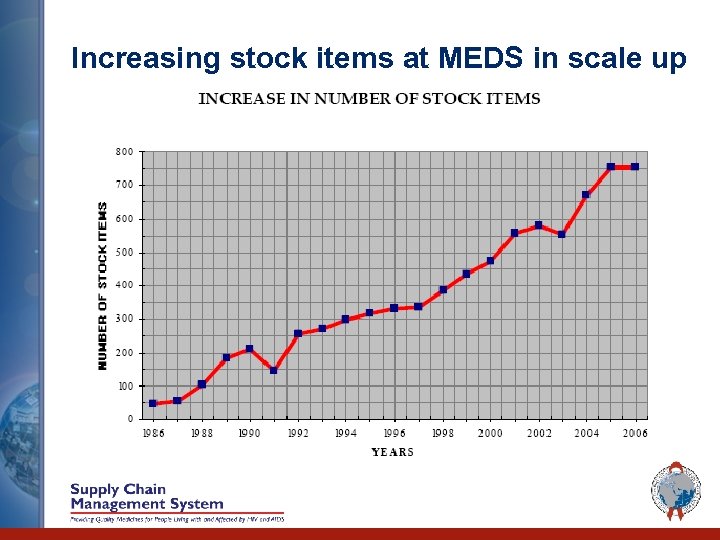 Increasing stock items at MEDS in scale up
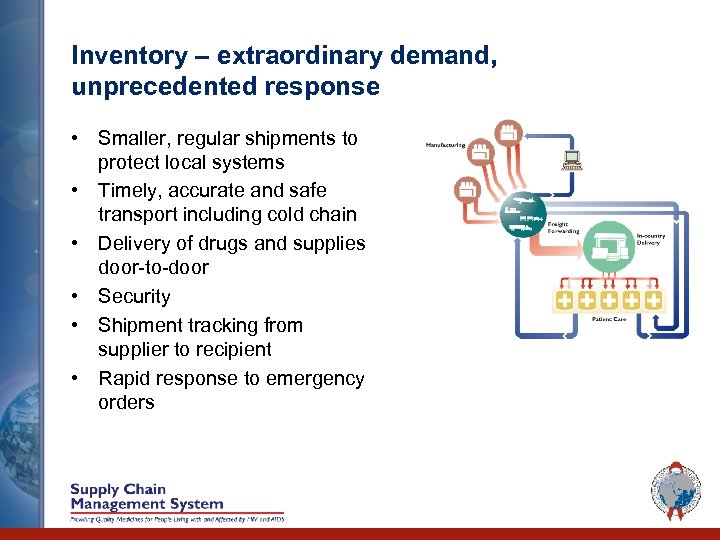 Inventory – extraordinary demand, unprecedented response • Smaller, regular shipments to protect local systems • Timely, accurate and safe transport including cold chain • Delivery of drugs and supplies door-to-door • Security • Shipment tracking from supplier to recipient • Rapid response to emergency orders
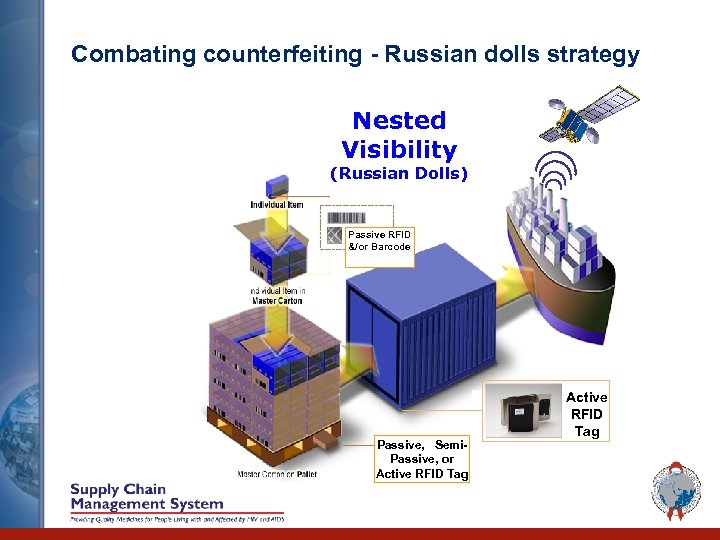 Combating counterfeiting - Russian dolls strategy Nested Visibility (Russian Dolls) Passive RFID &/or Barcode Passive, Semi. Passive, or Active RFID Tag
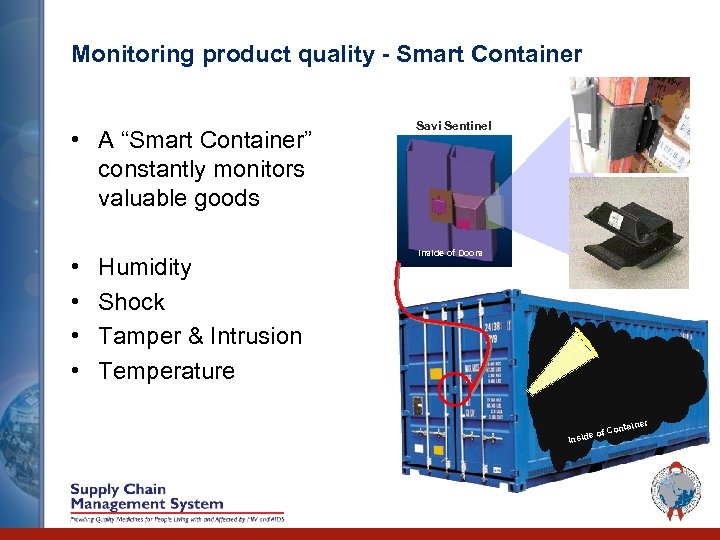 Monitoring product quality - Smart Container • A “Smart Container” constantly monitors valuable goods • • Humidity Shock Tamper & Intrusion Temperature Savi Sentinel Inside of Doors e of Insid ainer Cont
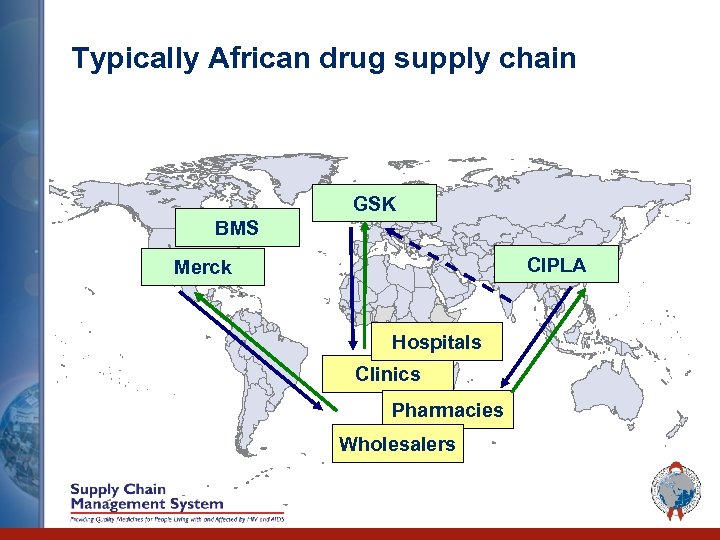 Typically African drug supply chain GSK BMS CIPLA Merck Hospitals Clinics Pharmacies Wholesalers
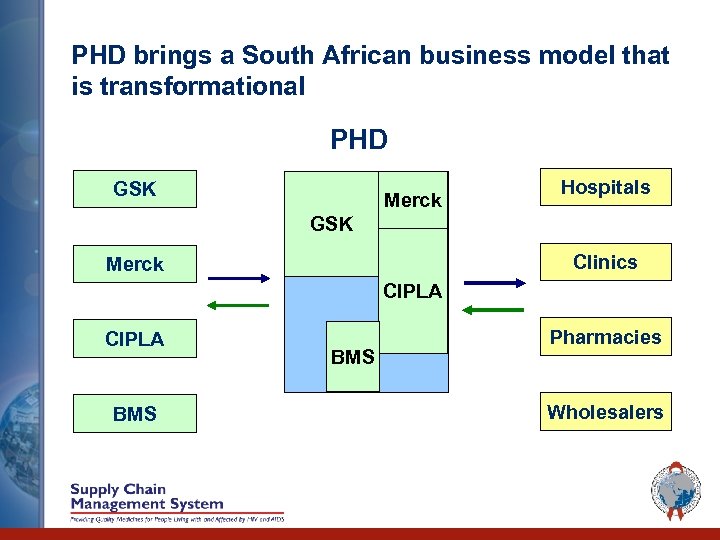 PHD brings a South African business model that is transformational PHD GSK Merck Hospitals GSK Clinics Merck CIPLA BMS Pharmacies Wholesalers
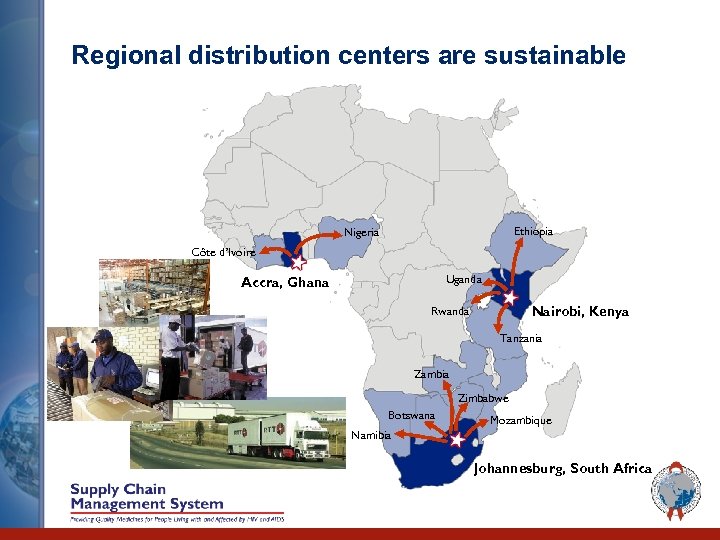 Regional distribution centers are sustainable Ethiopia Nigeria Côte d’Ivoire Uganda Accra, Ghana Nairobi, Kenya Rwanda Tanzania Zambia Zimbabwe Botswana Mozambique Namibia Johannesburg, South Africa
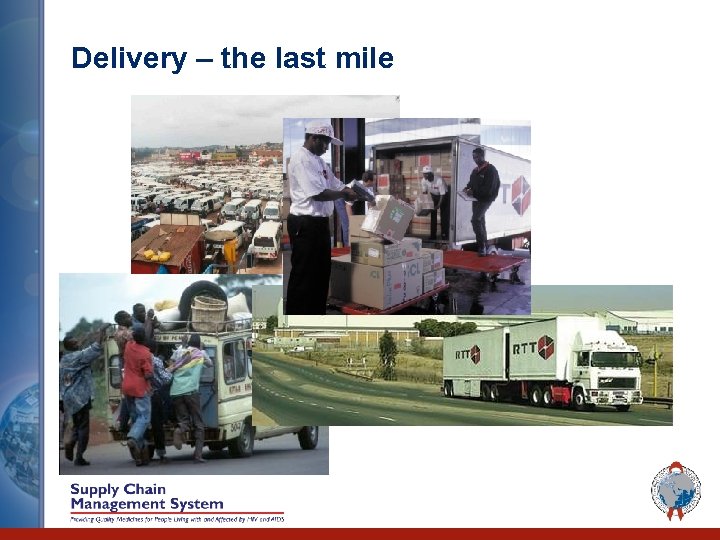 Delivery – the last mile
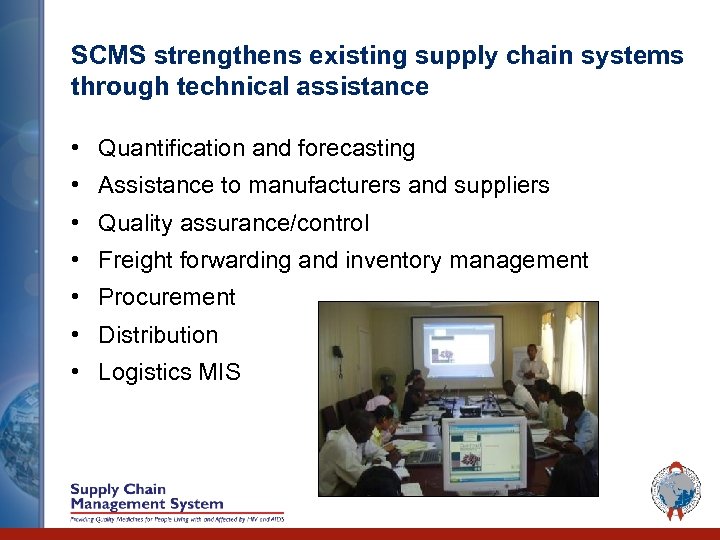 SCMS strengthens existing supply chain systems through technical assistance • Quantification and forecasting • Assistance to manufacturers and suppliers • Quality assurance/control • Freight forwarding and inventory management • Procurement • Distribution • Logistics MIS
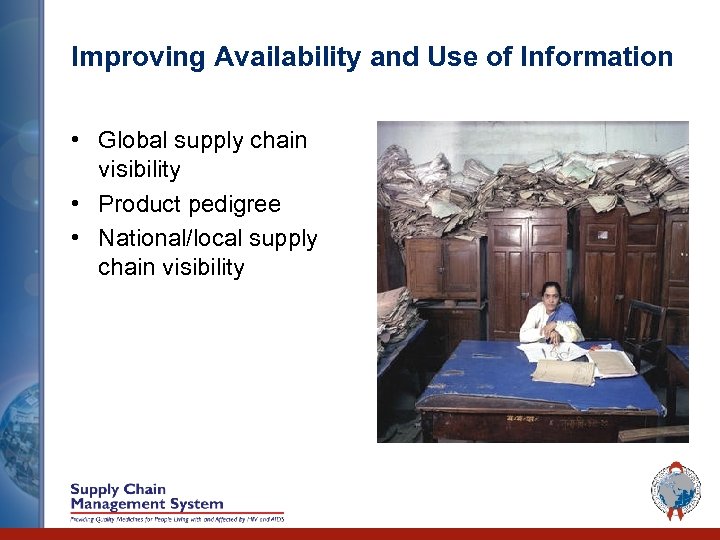 Improving Availability and Use of Information • Global supply chain visibility • Product pedigree • National/local supply chain visibility
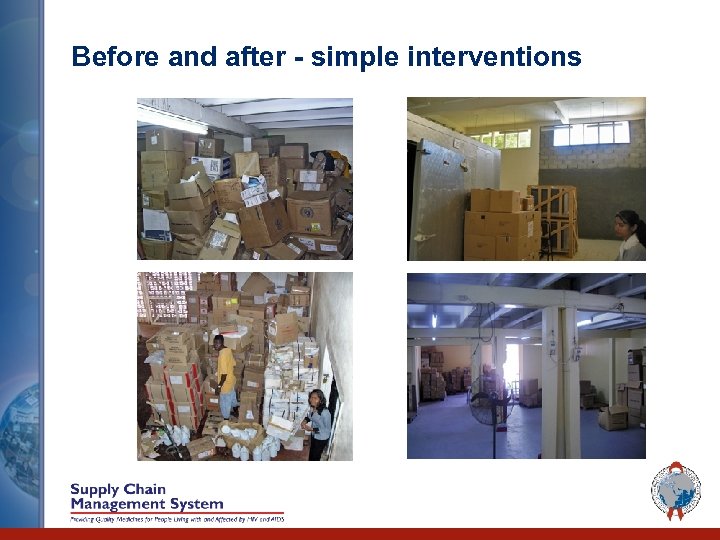 Before and after - simple interventions
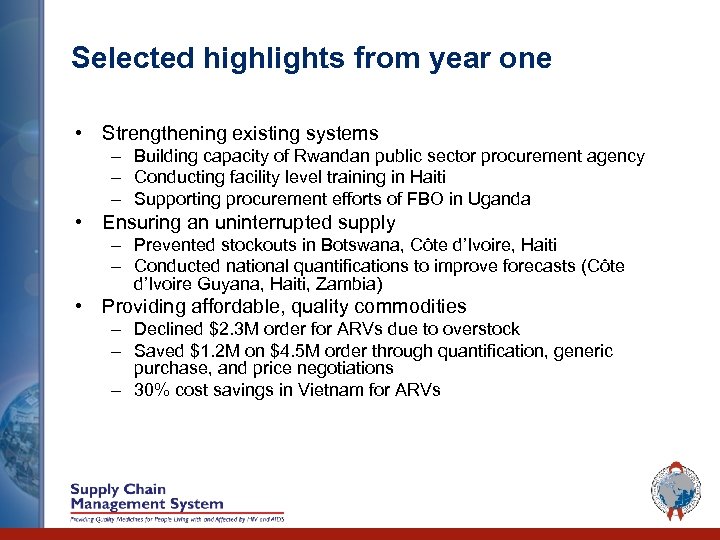 Selected highlights from year one • Strengthening existing systems – Building capacity of Rwandan public sector procurement agency – Conducting facility level training in Haiti – Supporting procurement efforts of FBO in Uganda • Ensuring an uninterrupted supply – Prevented stockouts in Botswana, Côte d’Ivoire, Haiti – Conducted national quantifications to improve forecasts (Côte d’Ivoire Guyana, Haiti, Zambia) • Providing affordable, quality commodities – Declined $2. 3 M order for ARVs due to overstock – Saved $1. 2 M on $4. 5 M order through quantification, generic purchase, and price negotiations – 30% cost savings in Vietnam for ARVs
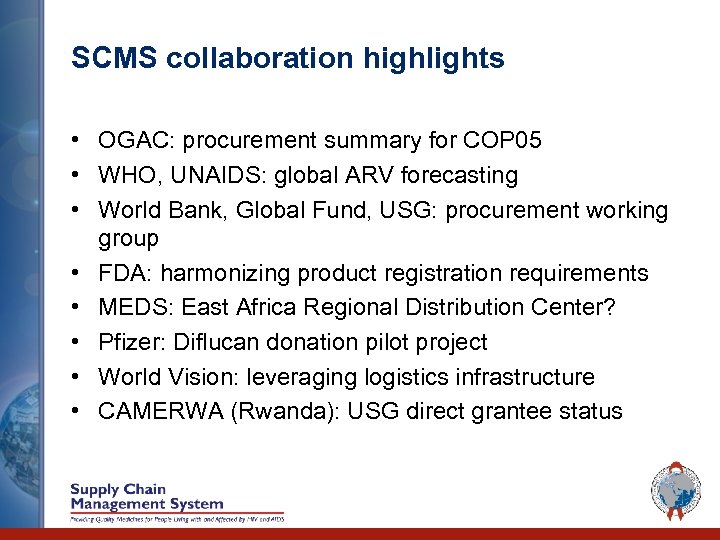 SCMS collaboration highlights • OGAC: procurement summary for COP 05 • WHO, UNAIDS: global ARV forecasting • World Bank, Global Fund, USG: procurement working group • FDA: harmonizing product registration requirements • MEDS: East Africa Regional Distribution Center? • Pfizer: Diflucan donation pilot project • World Vision: leveraging logistics infrastructure • CAMERWA (Rwanda): USG direct grantee status
 Global Collaboration for Local Results Pooled Procurement
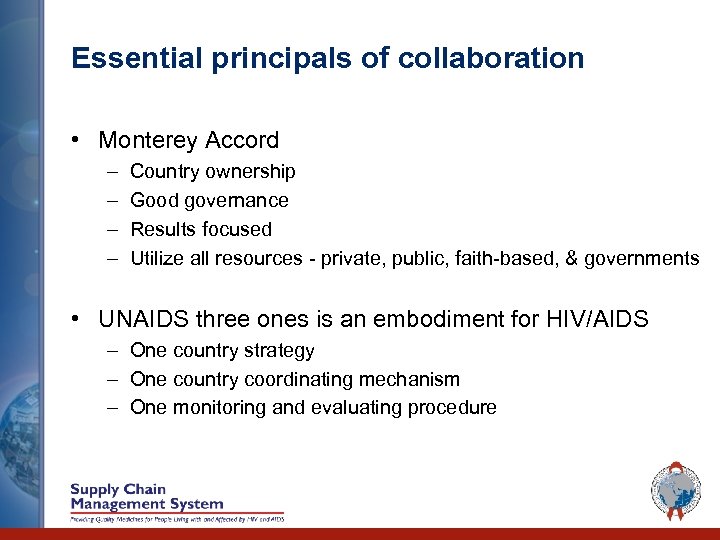 Essential principals of collaboration • Monterey Accord – – Country ownership Good governance Results focused Utilize all resources - private, public, faith-based, & governments • UNAIDS three ones is an embodiment for HIV/AIDS – One country strategy – One country coordinating mechanism – One monitoring and evaluating procedure
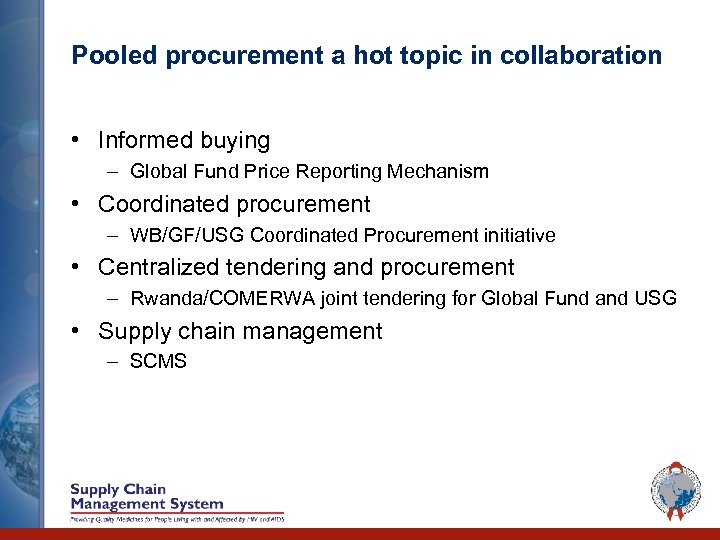 Pooled procurement a hot topic in collaboration • Informed buying – Global Fund Price Reporting Mechanism • Coordinated procurement – WB/GF/USG Coordinated Procurement initiative • Centralized tendering and procurement – Rwanda/COMERWA joint tendering for Global Fund and USG • Supply chain management – SCMS
 Global Price Reporting Mechanism
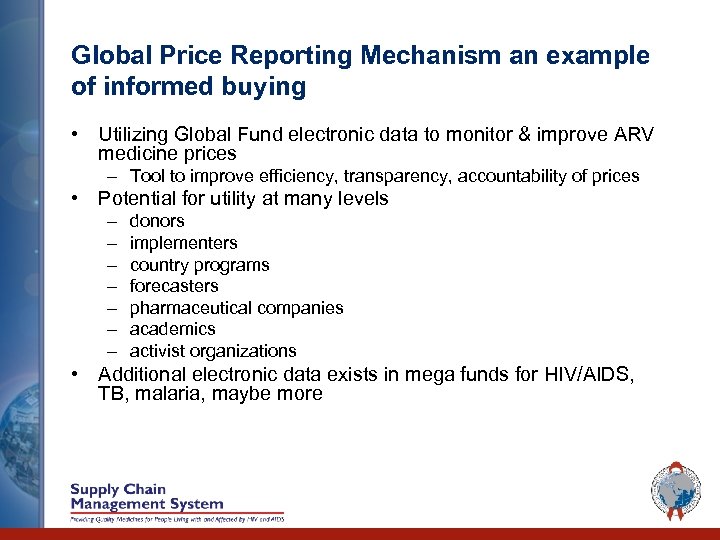 Global Price Reporting Mechanism an example of informed buying • Utilizing Global Fund electronic data to monitor & improve ARV medicine prices – Tool to improve efficiency, transparency, accountability of prices • Potential for utility at many levels – – – – donors implementers country programs forecasters pharmaceutical companies academics activist organizations • Additional electronic data exists in mega funds for HIV/AIDS, TB, malaria, maybe more
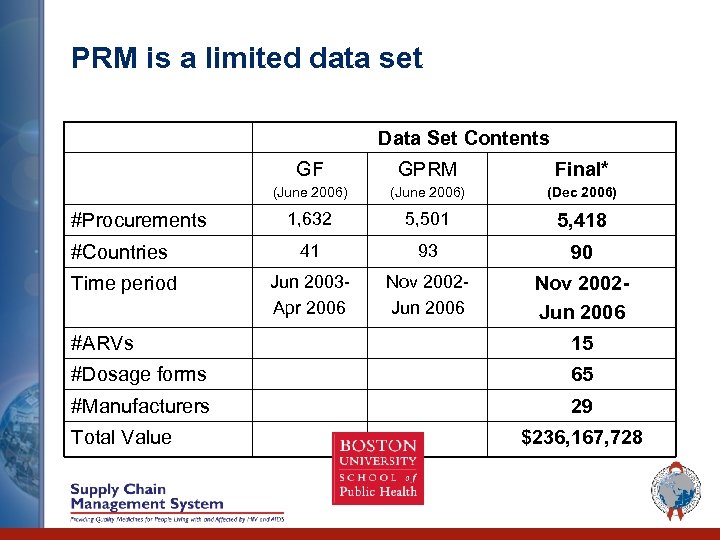 PRM is a limited data set Data Set Contents GF GPRM Final* (June 2006) (Dec 2006) 1, 632 5, 501 5, 418 #Countries 41 93 90 Time period Jun 2003 Apr 2006 Nov 2002 Jun 2006 #Procurements #ARVs 15 #Dosage forms 65 #Manufacturers 29 Total Value $236, 167, 728
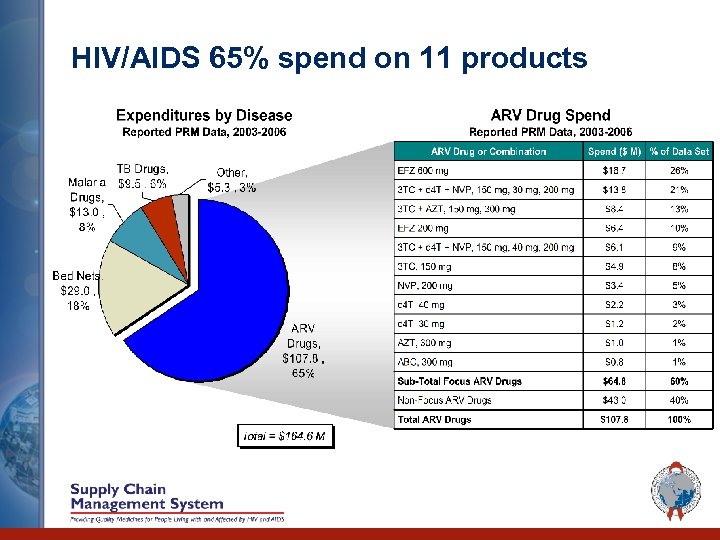 HIV/AIDS 65% spend on 11 products
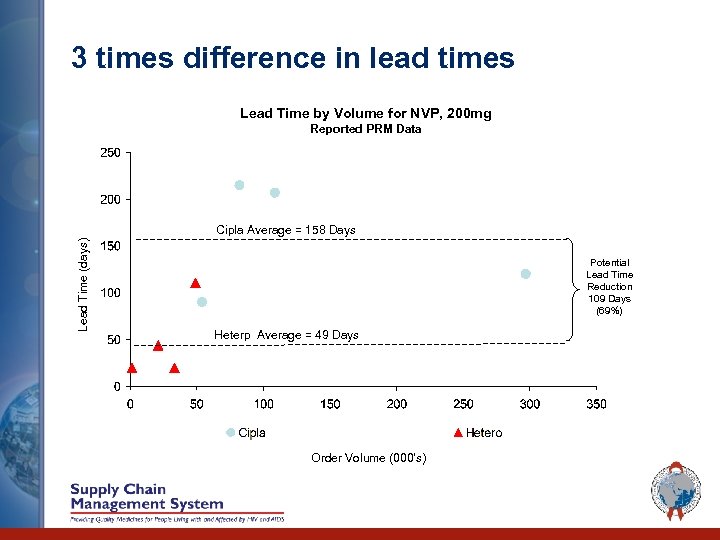 3 times difference in lead times Lead Time by Volume for NVP, 200 mg Reported PRM Data Lead Time (days) Cipla Average = 158 Days Potential Lead Time Reduction 109 Days (69%) Heterp Average = 49 Days Order Volume (000’s)
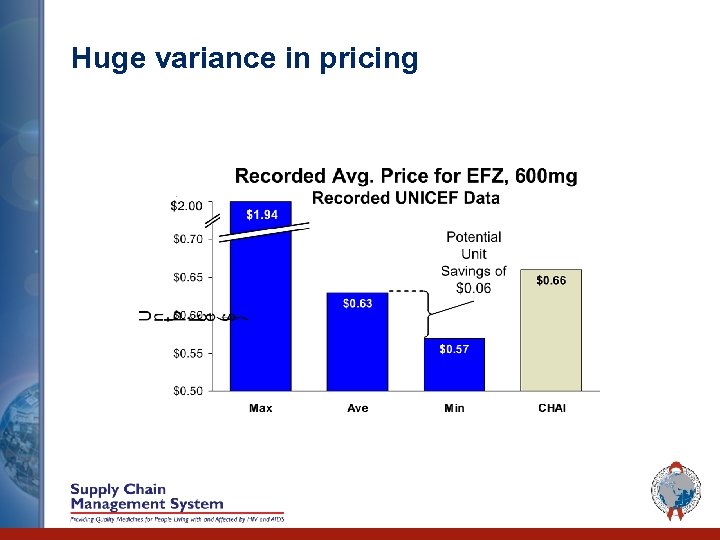 Huge variance in pricing
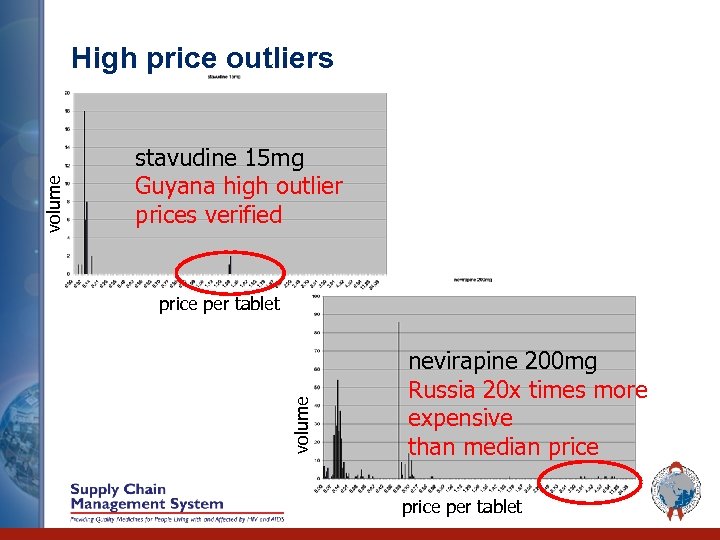 stavudine 15 mg Guyana high outlier prices verified price per tablet volume High price outliers nevirapine 200 mg Russia 20 x times more expensive than median price per tablet
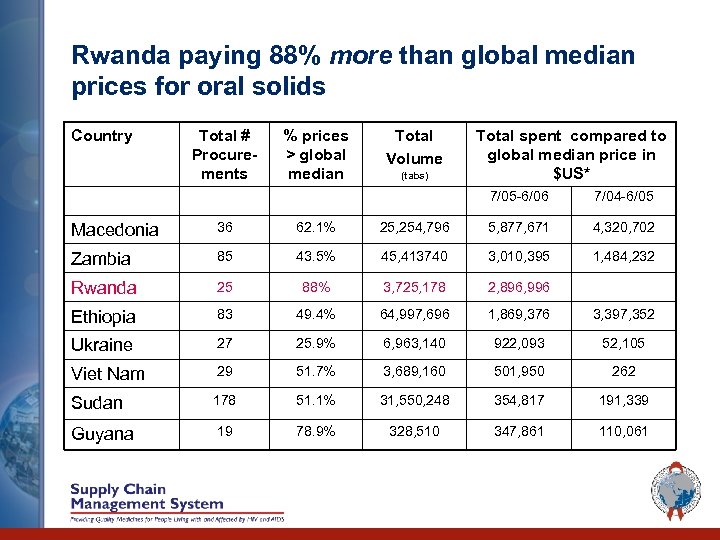 Rwanda paying 88% more than global median prices for oral solids Country Total # Procurements % prices > global median Total Volume (tabs) Total spent compared to global median price in $US* 7/05 -6/06 7/04 -6/05 Macedonia 36 62. 1% 25, 254, 796 5, 877, 671 4, 320, 702 Zambia 85 43. 5% 45, 413740 3, 010, 395 1, 484, 232 Rwanda 25 88% 3, 725, 178 2, 896, 996 Ethiopia 83 49. 4% 64, 997, 696 1, 869, 376 3, 397, 352 Ukraine 27 25. 9% 6, 963, 140 922, 093 52, 105 Viet Nam 29 51. 7% 3, 689, 160 501, 950 262 Sudan 178 51. 1% 31, 550, 248 354, 817 191, 339 Guyana 19 78. 9% 328, 510 347, 861 110, 061
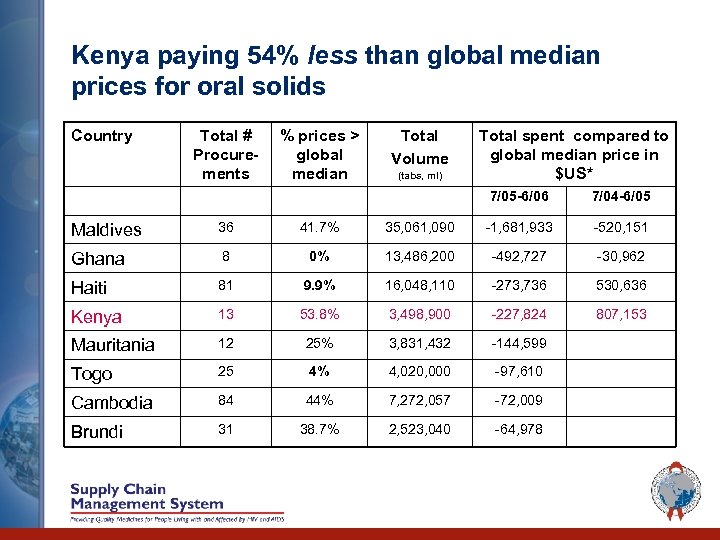 Kenya paying 54% less than global median prices for oral solids Country Total # Procurements % prices > global median Total Volume (tabs, ml) Total spent compared to global median price in $US* 7/05 -6/06 7/04 -6/05 Maldives 36 41. 7% 35, 061, 090 -1, 681, 933 -520, 151 Ghana 8 0% 13, 486, 200 -492, 727 -30, 962 Haiti 81 9. 9% 16, 048, 110 -273, 736 530, 636 Kenya 13 53. 8% 3, 498, 900 -227, 824 807, 153 Mauritania 12 25% 3, 831, 432 -144, 599 Togo 25 4% 4, 020, 000 -97, 610 Cambodia 84 44% 7, 272, 057 -72, 009 Brundi 31 38. 7% 2, 523, 040 -64, 978
 WB/GF/USG Coordinated Procurement
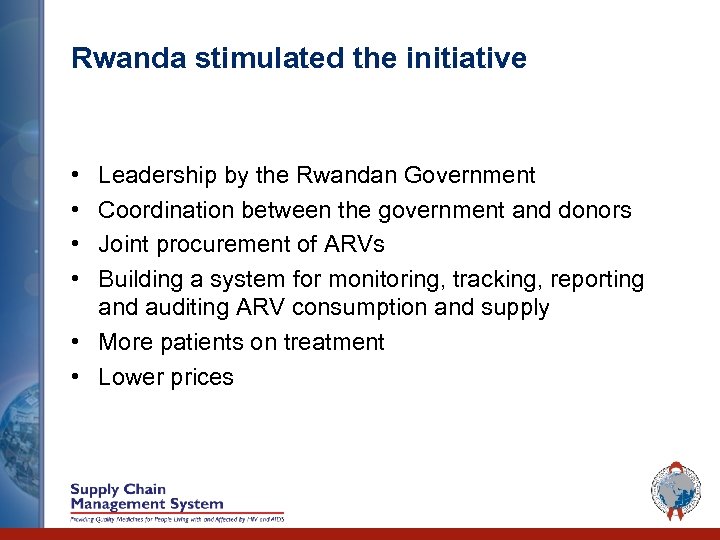 Rwanda stimulated the initiative • • Leadership by the Rwandan Government Coordination between the government and donors Joint procurement of ARVs Building a system for monitoring, tracking, reporting and auditing ARV consumption and supply • More patients on treatment • Lower prices
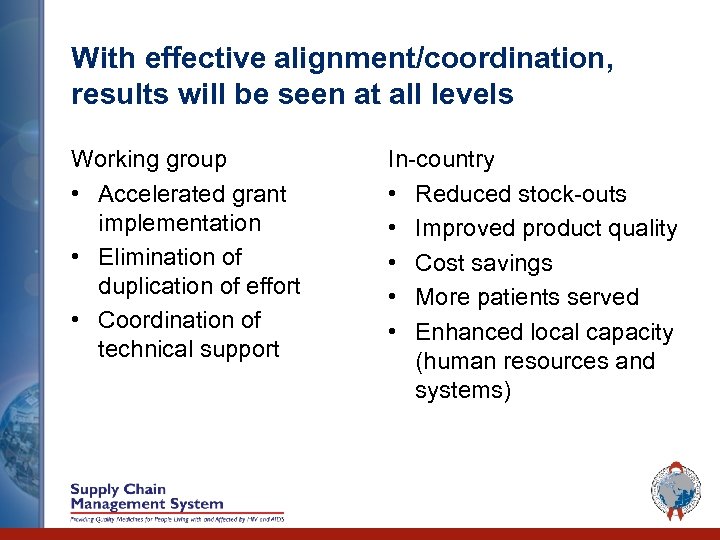 With effective alignment/coordination, results will be seen at all levels Working group • Accelerated grant implementation • Elimination of duplication of effort • Coordination of technical support In-country • Reduced stock-outs • Improved product quality • Cost savings • More patients served • Enhanced local capacity (human resources and systems)
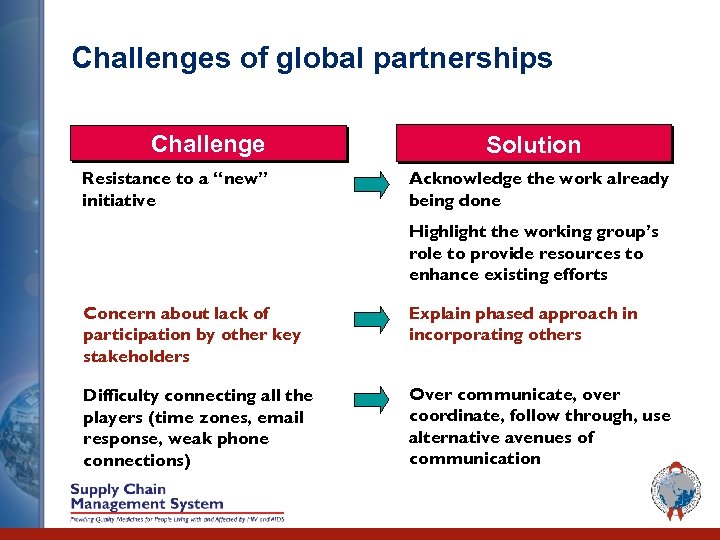 Challenges of global partnerships Challenge Resistance to a “new” initiative Solution Acknowledge the work already being done Highlight the working group’s role to provide resources to enhance existing efforts Concern about lack of participation by other key stakeholders Explain phased approach in incorporating others Difficulty connecting all the players (time zones, email response, weak phone connections) Over communicate, over coordinate, follow through, use alternative avenues of communication
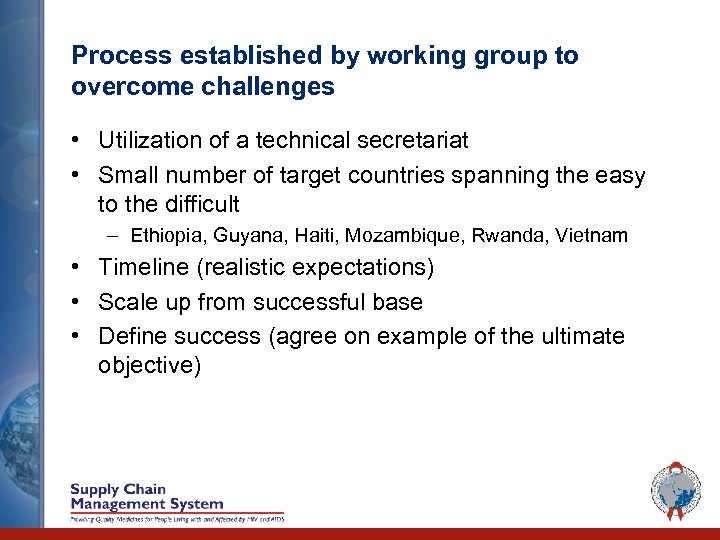 Process established by working group to overcome challenges • Utilization of a technical secretariat • Small number of target countries spanning the easy to the difficult – Ethiopia, Guyana, Haiti, Mozambique, Rwanda, Vietnam • Timeline (realistic expectations) • Scale up from successful base • Define success (agree on example of the ultimate objective)
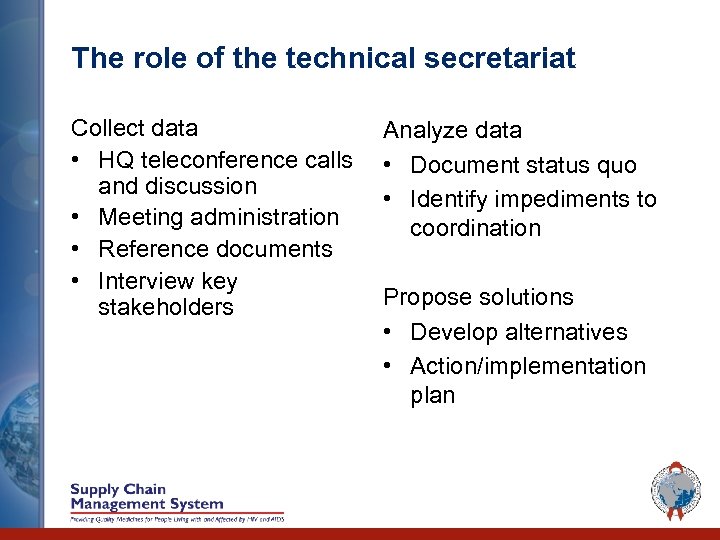 The role of the technical secretariat Collect data • HQ teleconference calls and discussion • Meeting administration • Reference documents • Interview key stakeholders Analyze data • Document status quo • Identify impediments to coordination Propose solutions • Develop alternatives • Action/implementation plan
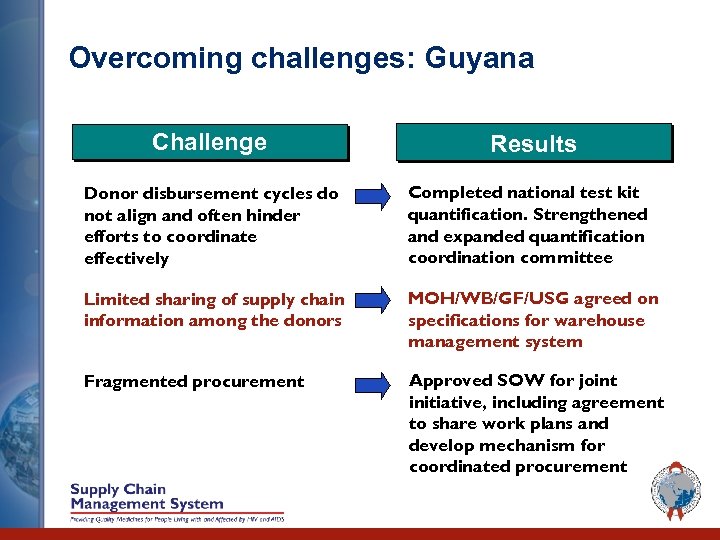 Overcoming challenges: Guyana Challenge Results Donor disbursement cycles do not align and often hinder efforts to coordinate effectively Completed national test kit quantification. Strengthened and expanded quantification coordination committee Limited sharing of supply chain information among the donors MOH/WB/GF/USG agreed on specifications for warehouse management system Fragmented procurement Approved SOW for joint initiative, including agreement to share work plans and develop mechanism for coordinated procurement
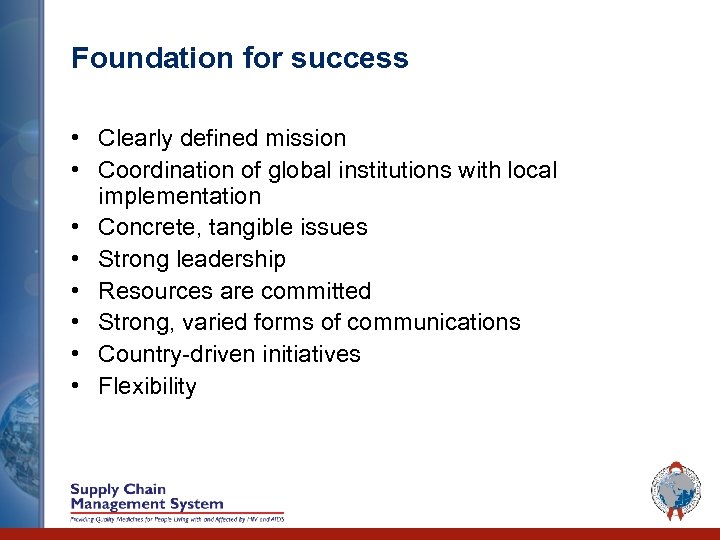 Foundation for success • Clearly defined mission • Coordination of global institutions with local implementation • Concrete, tangible issues • Strong leadership • Resources are committed • Strong, varied forms of communications • Country-driven initiatives • Flexibility
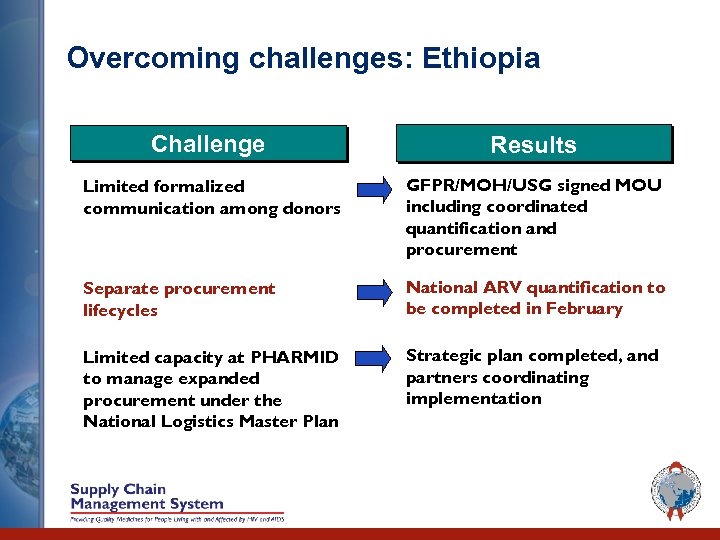 Overcoming challenges: Ethiopia Challenge Results Limited formalized communication among donors GFPR/MOH/USG signed MOU including coordinated quantification and procurement Separate procurement lifecycles National ARV quantification to be completed in February Limited capacity at PHARMID to manage expanded procurement under the National Logistics Master Plan Strategic plan completed, and partners coordinating implementation
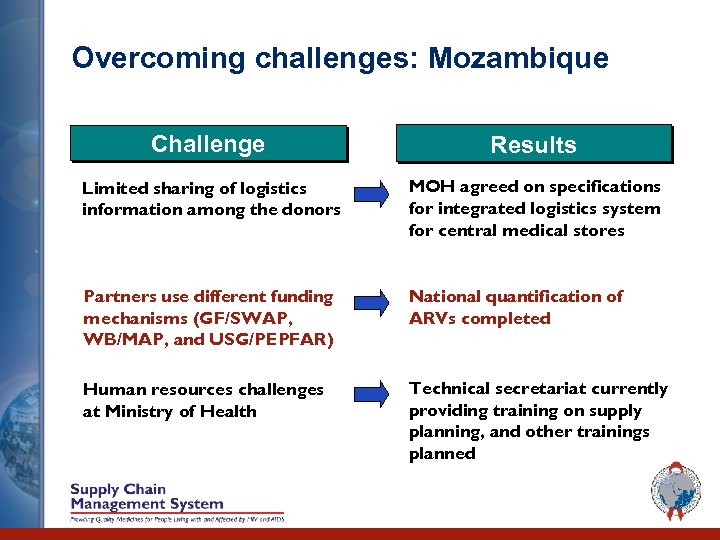 Overcoming challenges: Mozambique Challenge Results Limited sharing of logistics information among the donors MOH agreed on specifications for integrated logistics system for central medical stores Partners use different funding mechanisms (GF/SWAP, WB/MAP, and USG/PEPFAR) National quantification of ARVs completed Human resources challenges at Ministry of Health Technical secretariat currently providing training on supply planning, and other trainings planned
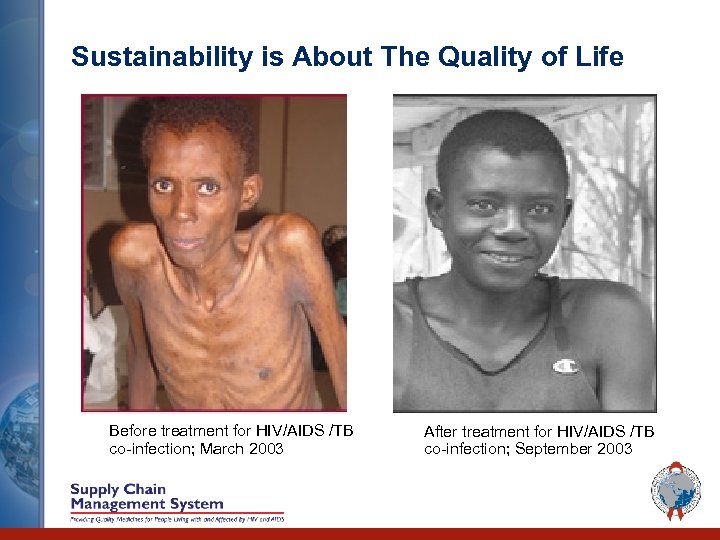 Sustainability is About The Quality of Life Before treatment for HIV/AIDS /TB co-infection; March 2003 After treatment for HIV/AIDS /TB co-infection; September 2003
 Questions Thanks! For more information: Website: scms. pfscm. org E-mail: scmsinfo@pfscm. org Main phone: +1. 571. 227. 8600 Main fax: +1. 703. 310. 5270