 Скачать презентацию Get smart about your money Financial Education for
d6724f1044a878c764d4b6f5e38f5b49.ppt
- Количество слайдов: 51




Get smart about your money Financial Education for College Students Leslie Lum llum@bcc. ctc. edu www. bellevuecollege. edu/financialeducation 1
Activity Financial dreams/Financial nightmares • List all your financial dreams • List all your financial nightmares 2
Your (financial) Life 3
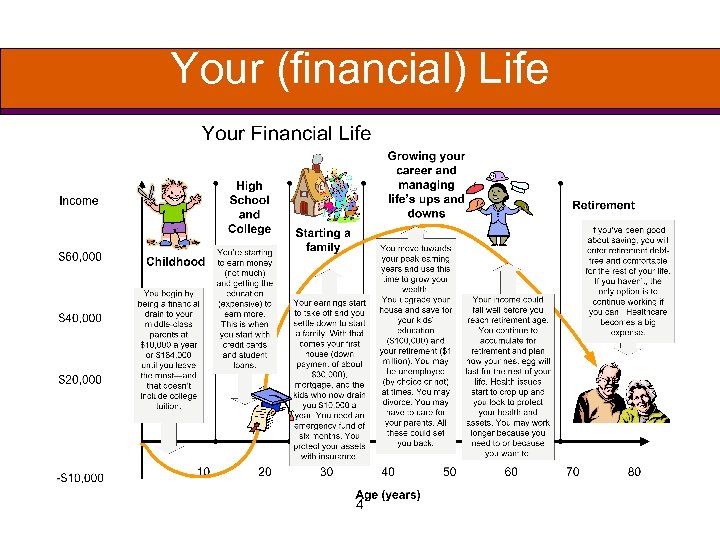
Your (financial) Life 4
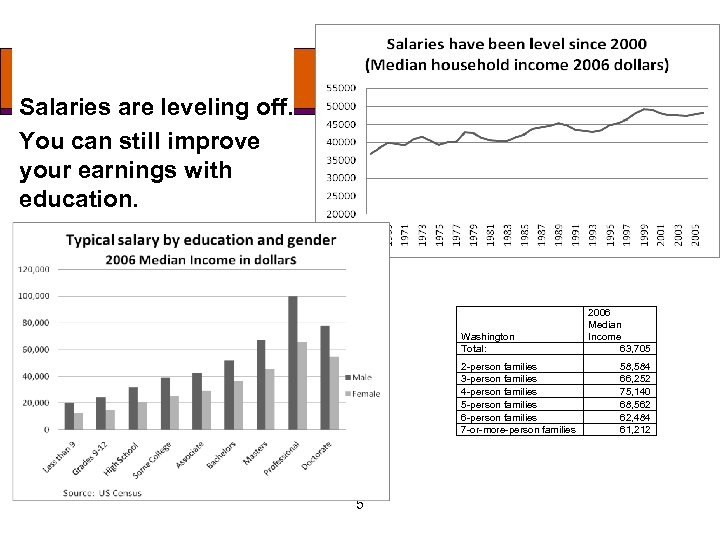
Salaries are leveling off. You can still improve your earnings with education. Washington Total: 2 -person families 3 -person families 4 -person families 5 -person families 6 -person families 7 -or-more-person families 5 2006 Median Income 63, 705 58, 584 66, 252 75, 140 68, 562 62, 484 61, 212
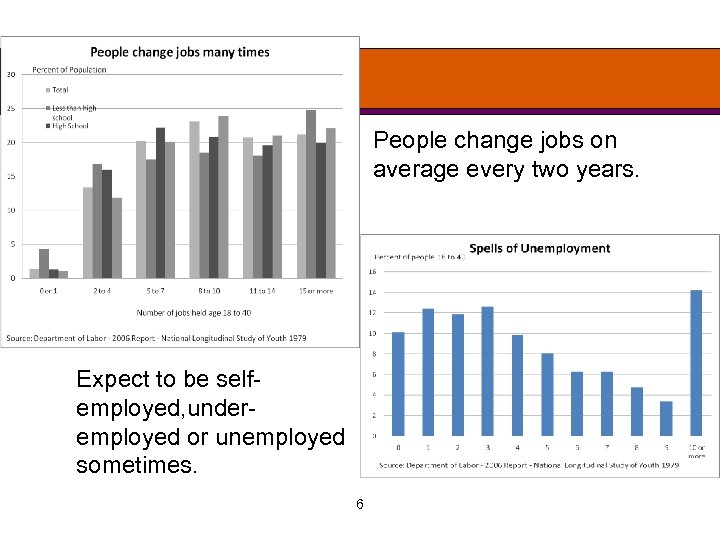
People change jobs on average every two years. Expect to be selfemployed, underemployed or unemployed sometimes. 6
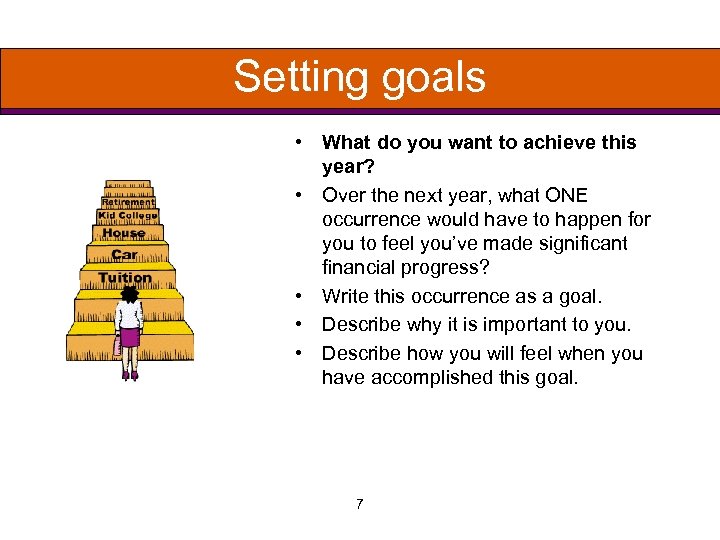
Setting goals • What do you want to achieve this year? • Over the next year, what ONE occurrence would have to happen for you to feel you’ve made significant financial progress? • Write this occurrence as a goal. • Describe why it is important to you. • Describe how you will feel when you have accomplished this goal. 7
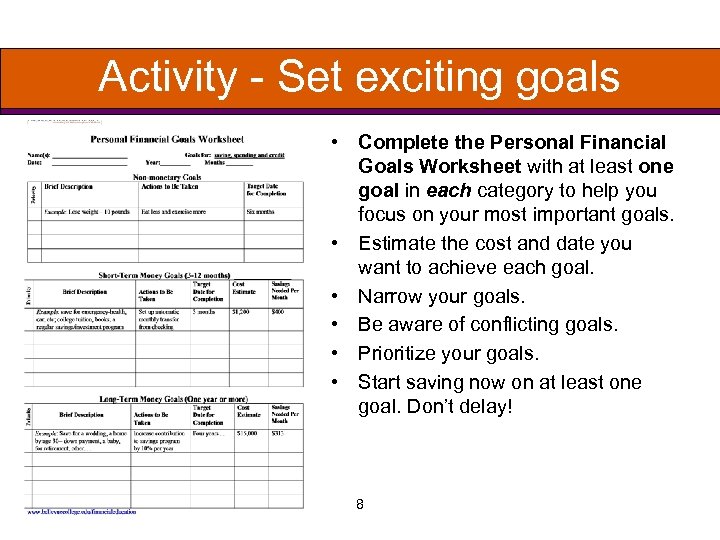
Activity - Set exciting goals • Complete the Personal Financial Goals Worksheet with at least one goal in each category to help you focus on your most important goals. • Estimate the cost and date you want to achieve each goal. • Narrow your goals. • Be aware of conflicting goals. • Prioritize your goals. • Start saving now on at least one goal. Don’t delay! 8
It’s a marathon not a sprint – plan your saving. 9
Saving Plan • Helps you achieve all your financial goals • It can help you get control of your life • It can relieve stress and stop conflict in a family • Start as a student even if you don’t have much money • It should be a lifetime habit 10
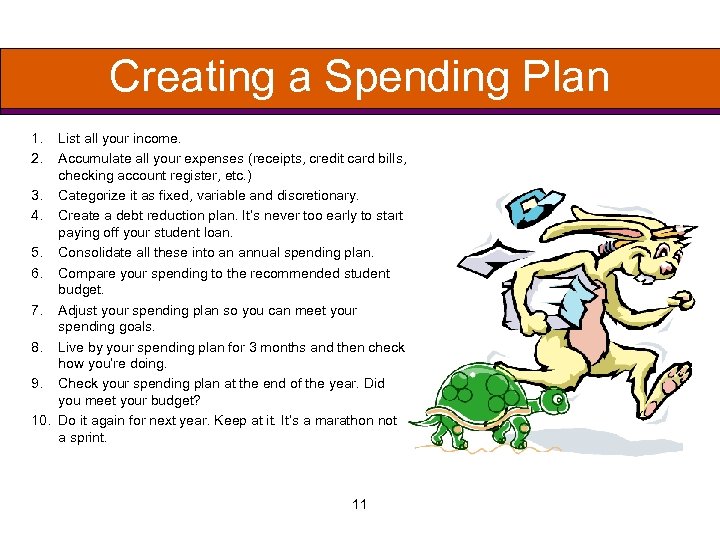
Creating a Spending Plan 1. 2. List all your income. Accumulate all your expenses (receipts, credit card bills, checking account register, etc. ) 3. Categorize it as fixed, variable and discretionary. 4. Create a debt reduction plan. It’s never too early to start paying off your student loan. 5. Consolidate all these into an annual spending plan. 6. Compare your spending to the recommended student budget. 7. Adjust your spending plan so you can meet your spending goals. 8. Live by your spending plan for 3 months and then check how you’re doing. 9. Check your spending plan at the end of the year. Did you meet your budget? 10. Do it again for next year. Keep at it. It’s a marathon not a sprint. 11
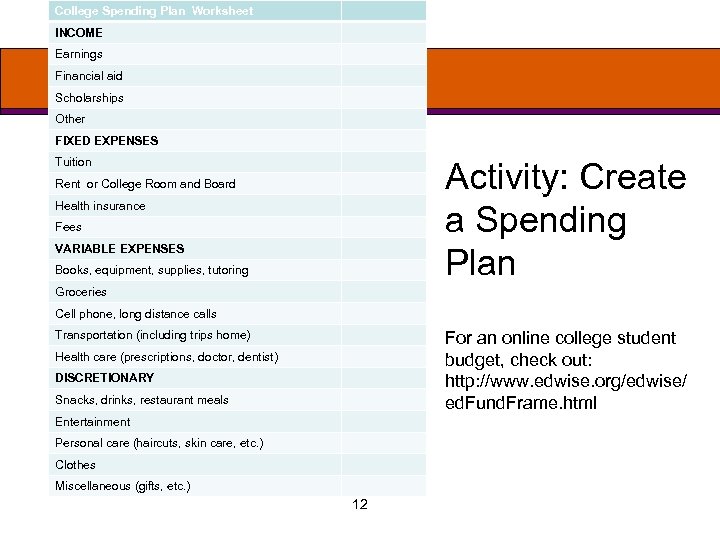
College Spending Plan Worksheet INCOME Earnings Financial aid Scholarships Other FIXED EXPENSES Tuition Activity: Create a Spending Plan Rent or College Room and Board Health insurance Fees VARIABLE EXPENSES Books, equipment, supplies, tutoring Groceries Cell phone, long distance calls For an online college student budget, check out: http: //www. edwise. org/edwise/ ed. Fund. Frame. html Transportation (including trips home) Health care (prescriptions, doctor, dentist) DISCRETIONARY Snacks, drinks, restaurant meals Entertainment Personal care (haircuts, skin care, etc. ) Clothes Miscellaneous (gifts, etc. ) 12
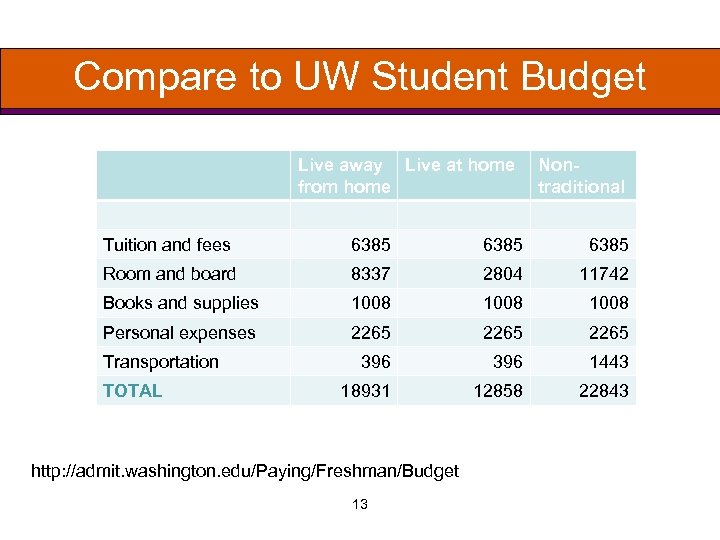
Compare to UW Student Budget Live away Live at home from home Nontraditional Tuition and fees 6385 Room and board 8337 2804 11742 Books and supplies 1008 Personal expenses 2265 396 1443 18931 12858 22843 Transportation TOTAL http: //admit. washington. edu/Paying/Freshman/Budget 13
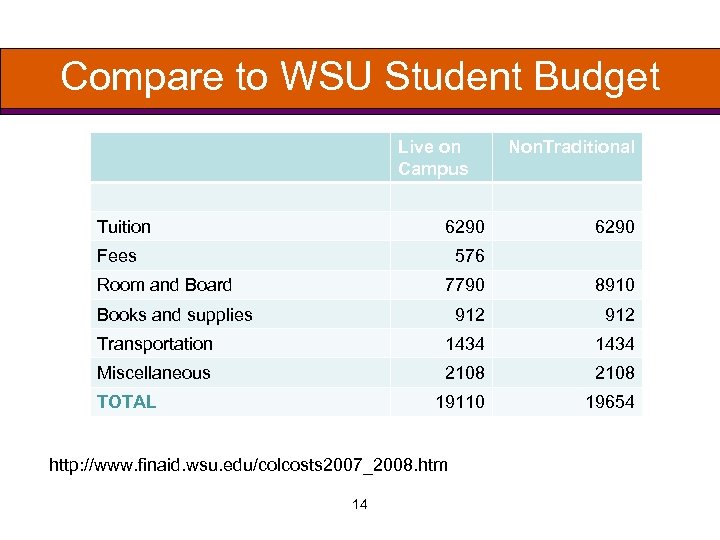
Compare to WSU Student Budget Live on Campus Tuition 6290 Fees Non. Traditional 6290 576 Room and Board 7790 8910 912 Transportation 1434 Miscellaneous 2108 19110 19654 Books and supplies TOTAL http: //www. finaid. wsu. edu/colcosts 2007_2008. htm 14
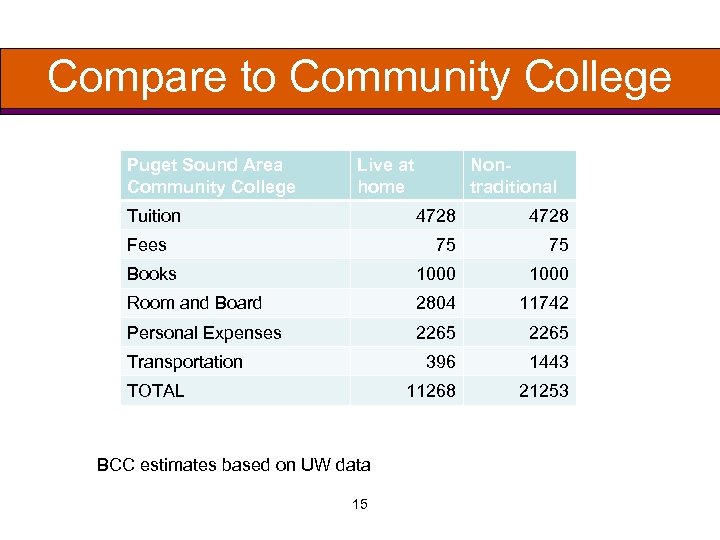
Compare to Community College Puget Sound Area Community College Live at home Tuition Nontraditional 4728 75 75 Books 1000 Room and Board 2804 11742 Personal Expenses 2265 396 1443 11268 21253 Fees Transportation TOTAL BCC estimates based on UW data 15
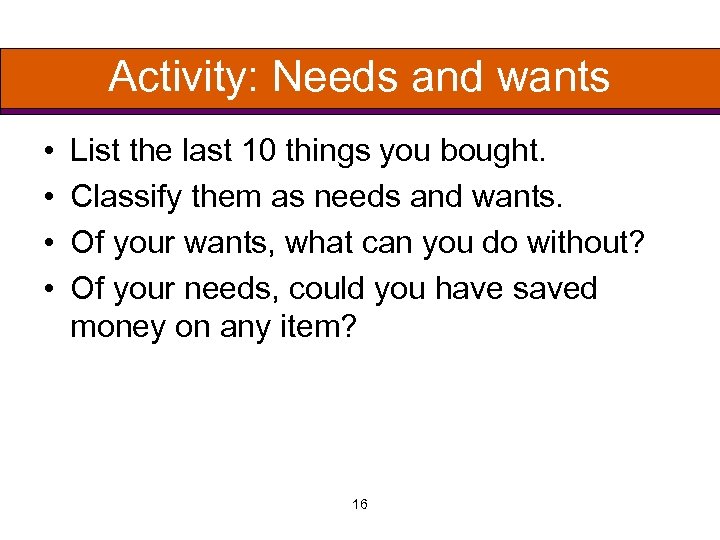
Activity: Needs and wants • • List the last 10 things you bought. Classify them as needs and wants. Of your wants, what can you do without? Of your needs, could you have saved money on any item? 16
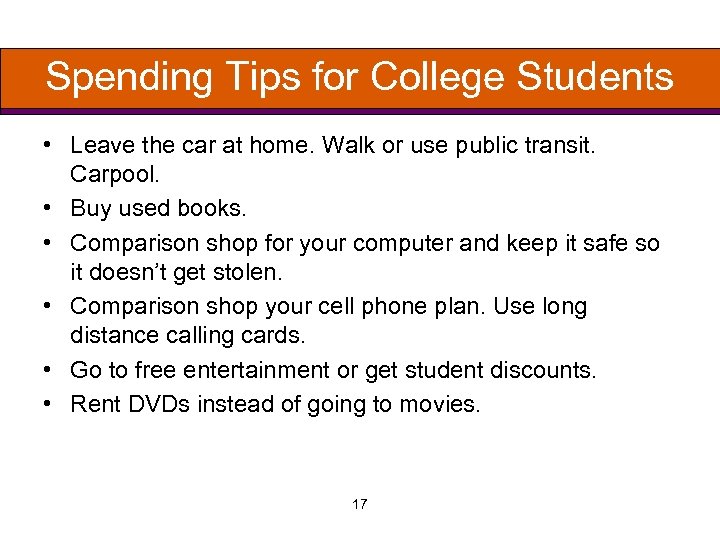
Spending Tips for College Students • Leave the car at home. Walk or use public transit. Carpool. • Buy used books. • Comparison shop for your computer and keep it safe so it doesn’t get stolen. • Comparison shop your cell phone plan. Use long distance calling cards. • Go to free entertainment or get student discounts. • Rent DVDs instead of going to movies. 17
Bucking the debt generation – good credit habits 18
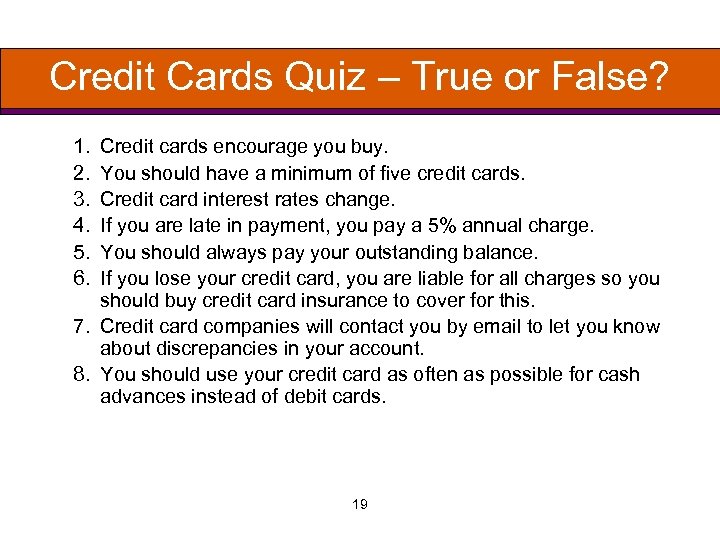
Credit Cards Quiz – True or False? 1. 2. 3. 4. 5. 6. Credit cards encourage you buy. You should have a minimum of five credit cards. Credit card interest rates change. If you are late in payment, you pay a 5% annual charge. You should always pay your outstanding balance. If you lose your credit card, you are liable for all charges so you should buy credit card insurance to cover for this. 7. Credit card companies will contact you by email to let you know about discrepancies in your account. 8. You should use your credit card as often as possible for cash advances instead of debit cards. 19
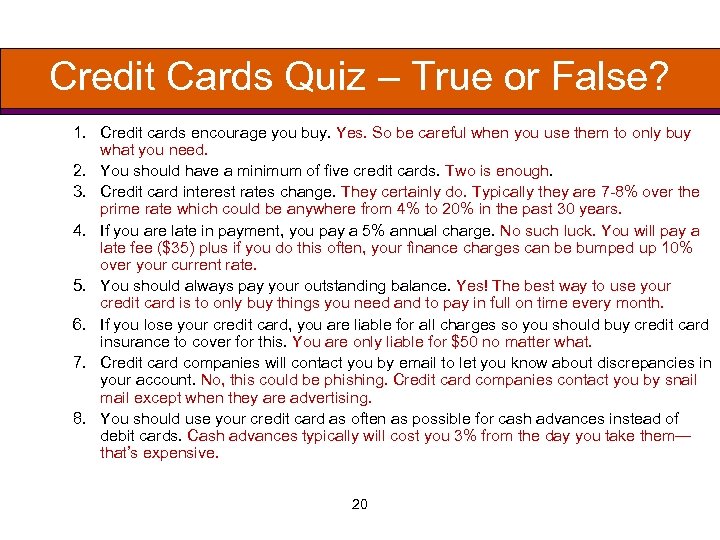
Credit Cards Quiz – True or False? 1. Credit cards encourage you buy. Yes. So be careful when you use them to only buy what you need. 2. You should have a minimum of five credit cards. Two is enough. 3. Credit card interest rates change. They certainly do. Typically they are 7 -8% over the prime rate which could be anywhere from 4% to 20% in the past 30 years. 4. If you are late in payment, you pay a 5% annual charge. No such luck. You will pay a late fee ($35) plus if you do this often, your finance charges can be bumped up 10% over your current rate. 5. You should always pay your outstanding balance. Yes! The best way to use your credit card is to only buy things you need and to pay in full on time every month. 6. If you lose your credit card, you are liable for all charges so you should buy credit card insurance to cover for this. You are only liable for $50 no matter what. 7. Credit card companies will contact you by email to let you know about discrepancies in your account. No, this could be phishing. Credit card companies contact you by snail mail except when they are advertising. 8. You should use your credit card as often as possible for cash advances instead of debit cards. Cash advances typically will cost you 3% from the day you take them— that’s expensive. 20
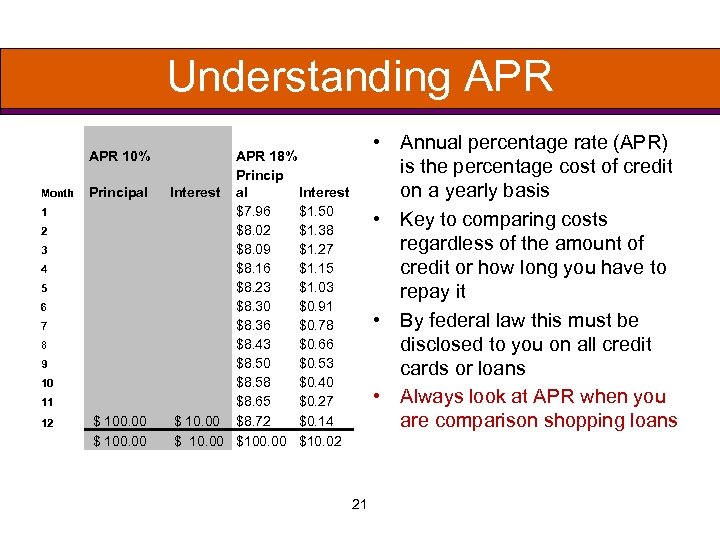
Understanding APR 10% Month 1 2 3 4 5 6 7 8 9 10 11 12 Principal $ 100. 00 • Annual percentage rate (APR) is the percentage cost of credit on a yearly basis • Key to comparing costs regardless of the amount of credit or how long you have to repay it • By federal law this must be disclosed to you on all credit cards or loans • Always look at APR when you are comparison shopping loans APR 18% Princip Interest al Interest $7. 96 $1. 50 $8. 02 $1. 38 $8. 09 $1. 27 $8. 16 $1. 15 $8. 23 $1. 03 $8. 30 $0. 91 $8. 36 $0. 78 $8. 43 $0. 66 $8. 50 $0. 53 $8. 58 $0. 40 $8. 65 $0. 27 $ 10. 00 $8. 72 $0. 14 $ 10. 00 $10. 02 21
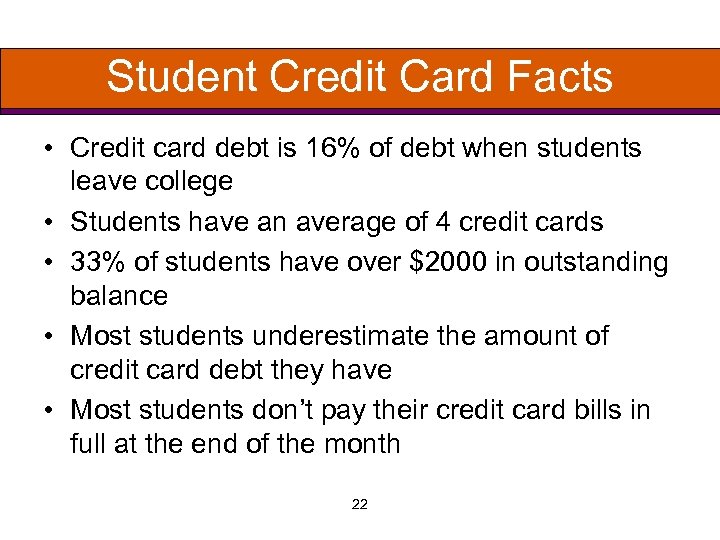
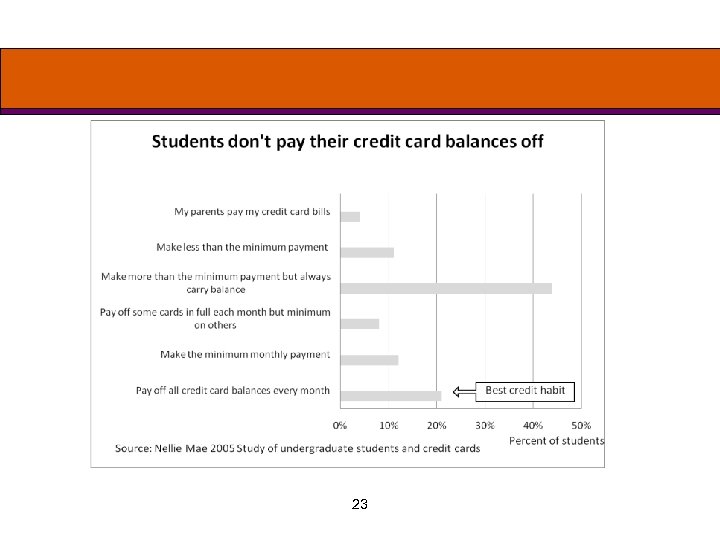
Student Credit Card Facts • Credit card debt is 16% of debt when students leave college • Students have an average of 4 credit cards • 33% of students have over $2000 in outstanding balance • Most students underestimate the amount of credit card debt they have • Most students don’t pay their credit card bills in full at the end of the month 22
23
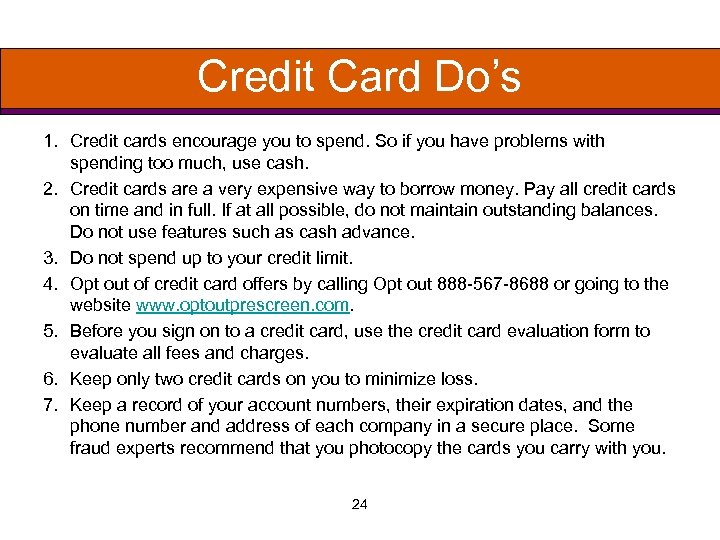
Credit Card Do’s 1. Credit cards encourage you to spend. So if you have problems with spending too much, use cash. 2. Credit cards are a very expensive way to borrow money. Pay all credit cards on time and in full. If at all possible, do not maintain outstanding balances. Do not use features such as cash advance. 3. Do not spend up to your credit limit. 4. Opt out of credit card offers by calling Opt out 888 -567 -8688 or going to the website www. optoutprescreen. com. 5. Before you sign on to a credit card, use the credit card evaluation form to evaluate all fees and charges. 6. Keep only two credit cards on you to minimize loss. 7. Keep a record of your account numbers, their expiration dates, and the phone number and address of each company in a secure place. Some fraud experts recommend that you photocopy the cards you carry with you. 24
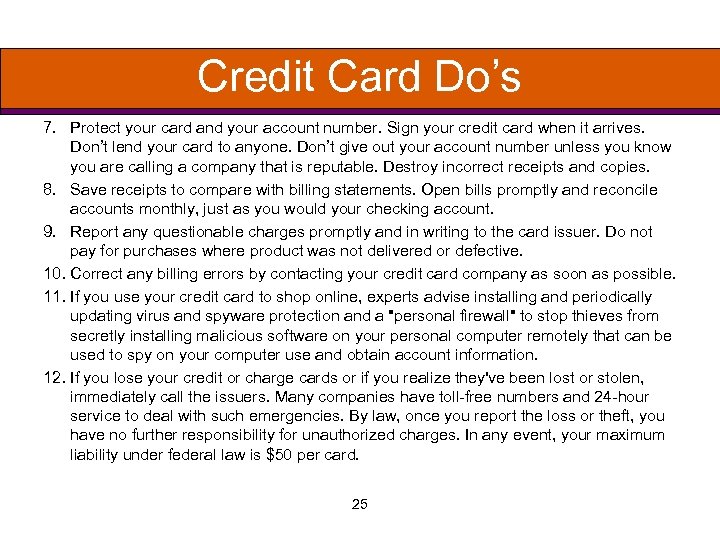
Credit Card Do’s 7. Protect your card and your account number. Sign your credit card when it arrives. Don’t lend your card to anyone. Don’t give out your account number unless you know you are calling a company that is reputable. Destroy incorrect receipts and copies. 8. Save receipts to compare with billing statements. Open bills promptly and reconcile accounts monthly, just as you would your checking account. 9. Report any questionable charges promptly and in writing to the card issuer. Do not pay for purchases where product was not delivered or defective. 10. Correct any billing errors by contacting your credit card company as soon as possible. 11. If you use your credit card to shop online, experts advise installing and periodically updating virus and spyware protection and a "personal firewall" to stop thieves from secretly installing malicious software on your personal computer remotely that can be used to spy on your computer use and obtain account information. 12. If you lose your credit or charge cards or if you realize they've been lost or stolen, immediately call the issuers. Many companies have toll-free numbers and 24 -hour service to deal with such emergencies. By law, once you report the loss or theft, you have no further responsibility for unauthorized charges. In any event, your maximum liability under federal law is $50 per card. 25
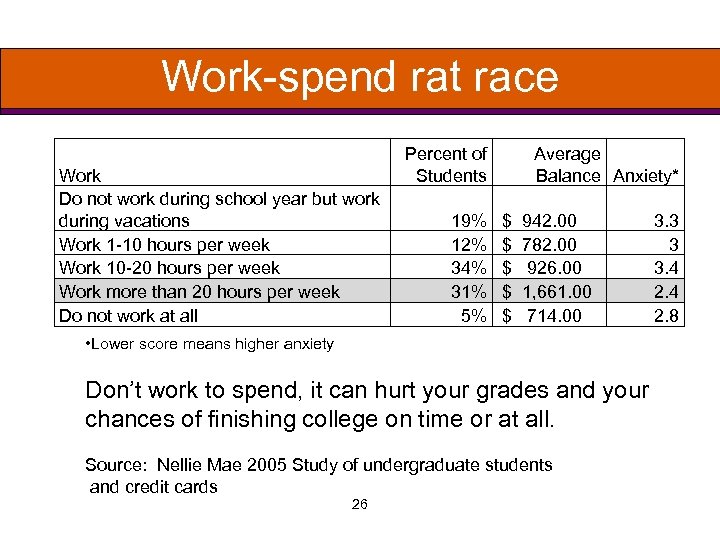
Work-spend rat race Work Do not work during school year but work during vacations Work 1 -10 hours per week Work 10 -20 hours per week Work more than 20 hours per week Do not work at all Percent of Students 19% 12% 34% 31% 5% Average Balance Anxiety* $ 942. 00 $ 782. 00 $ 926. 00 $ 1, 661. 00 $ 714. 00 3. 3 3 3. 4 2. 8 • Lower score means higher anxiety Don’t work to spend, it can hurt your grades and your chances of finishing college on time or at all. Source: Nellie Mae 2005 Study of undergraduate students and credit cards 26
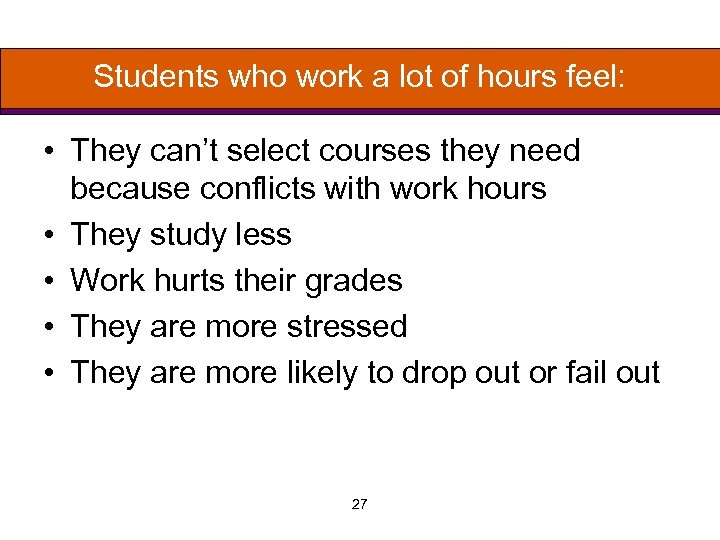
Students who work a lot of hours feel: • They can’t select courses they need because conflicts with work hours • They study less • Work hurts their grades • They are more stressed • They are more likely to drop out or fail out 27
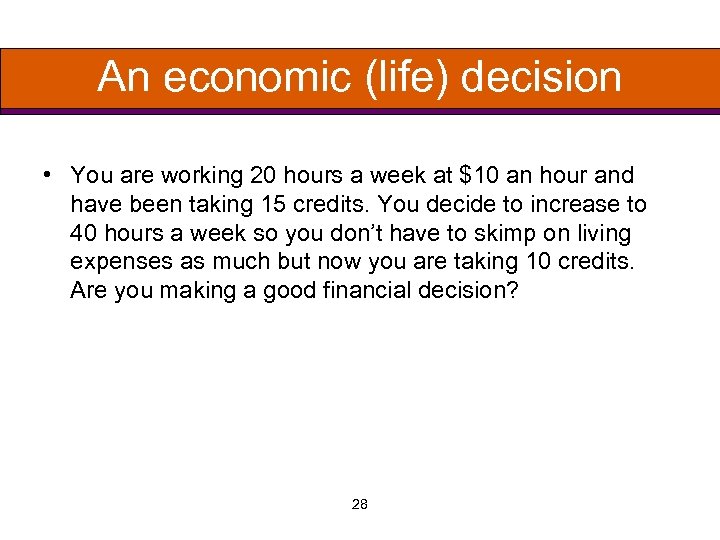
An economic (life) decision • You are working 20 hours a week at $10 an hour and have been taking 15 credits. You decide to increase to 40 hours a week so you don’t have to skimp on living expenses as much but now you are taking 10 credits. Are you making a good financial decision? 28
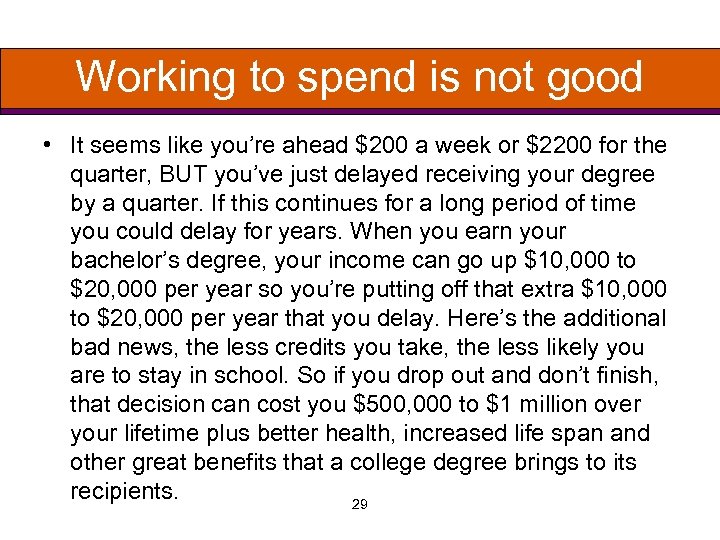
Working to spend is not good • It seems like you’re ahead $200 a week or $2200 for the quarter, BUT you’ve just delayed receiving your degree by a quarter. If this continues for a long period of time you could delay for years. When you earn your bachelor’s degree, your income can go up $10, 000 to $20, 000 per year so you’re putting off that extra $10, 000 to $20, 000 per year that you delay. Here’s the additional bad news, the less credits you take, the less likely you are to stay in school. So if you drop out and don’t finish, that decision can cost you $500, 000 to $1 million over your lifetime plus better health, increased life span and other great benefits that a college degree brings to its recipients. 29
Managing student loans 30
Higher inflation on college tuition 31
Is causing more families to borrow for college 32
Ways to pay for school for low-income families Husky Promise: guarantees that full tuition at the University of Washington will be covered by grant or scholarship support if you are a low- or lower middle-income student and a Washington resident. These grants and scholarships do not have to be repaid. They cover students whose families earn less than 65% of the state median (about $42, 000 in 2007) Cougar Commitment Program: Washington State University commits to covering the cost of tuition and mandatory fees for students who otherwise could not afford to attend. 33
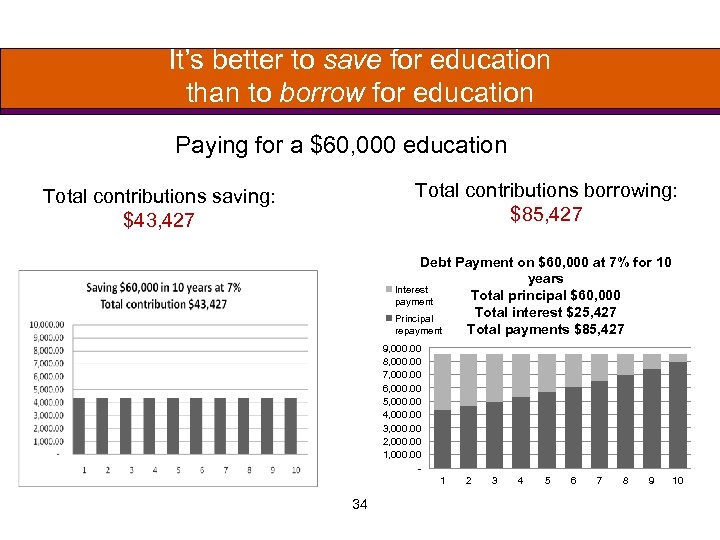
It’s better to save for education than to borrow for education Paying for a $60, 000 education Total contributions borrowing: $85, 427 Total contributions saving: $43, 427 Debt Payment on $60, 000 at 7% for 10 years Interest Total principal $60, 000 payment Total interest $25, 427 Principal repayment Total payments $85, 427 9, 000. 00 8, 000. 00 7, 000. 00 6, 000. 00 5, 000. 00 4, 000. 00 3, 000. 00 2, 000. 00 1 34 2 3 4 5 6 7 8 9 10
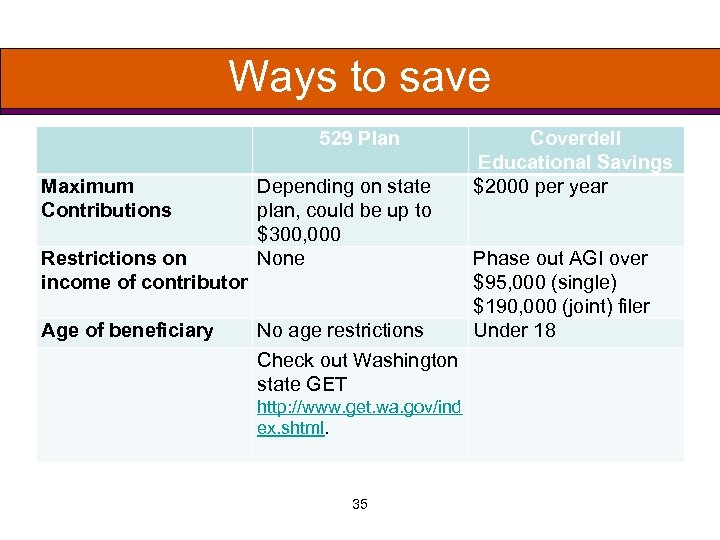
Ways to save 529 Plan Maximum Contributions Restrictions on income of contributor Age of beneficiary Depending on state plan, could be up to $300, 000 None No age restrictions Check out Washington state GET http: //www. get. wa. gov/ind ex. shtml. 35 Coverdell Educational Savings $2000 per year Phase out AGI over $95, 000 (single) $190, 000 (joint) filer Under 18
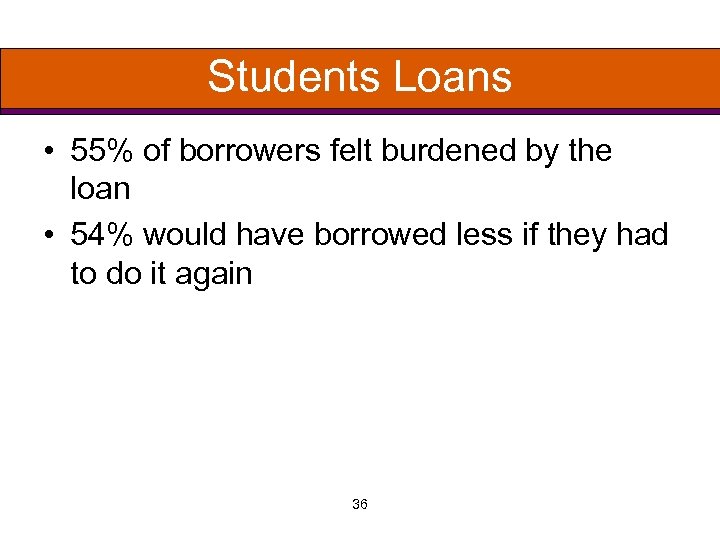
Students Loans • 55% of borrowers felt burdened by the loan • 54% would have borrowed less if they had to do it again 36
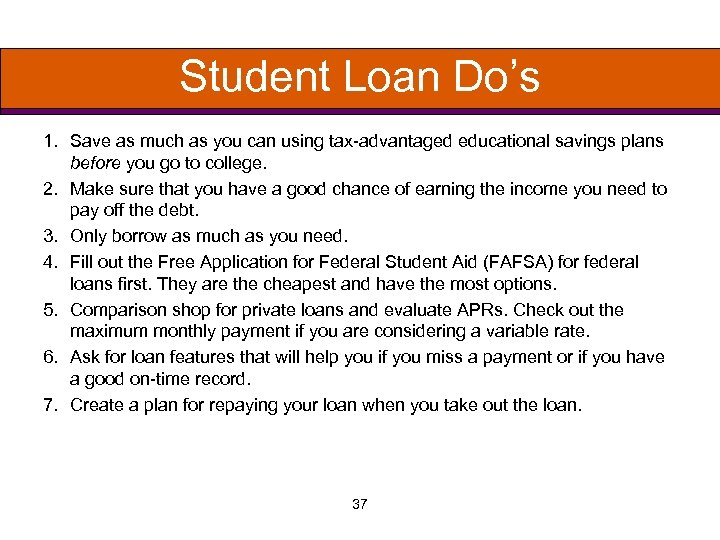
Student Loan Do’s 1. Save as much as you can using tax-advantaged educational savings plans before you go to college. 2. Make sure that you have a good chance of earning the income you need to pay off the debt. 3. Only borrow as much as you need. 4. Fill out the Free Application for Federal Student Aid (FAFSA) for federal loans first. They are the cheapest and have the most options. 5. Comparison shop for private loans and evaluate APRs. Check out the maximum monthly payment if you are considering a variable rate. 6. Ask for loan features that will help you if you miss a payment or if you have a good on-time record. 7. Create a plan for repaying your loan when you take out the loan. 37
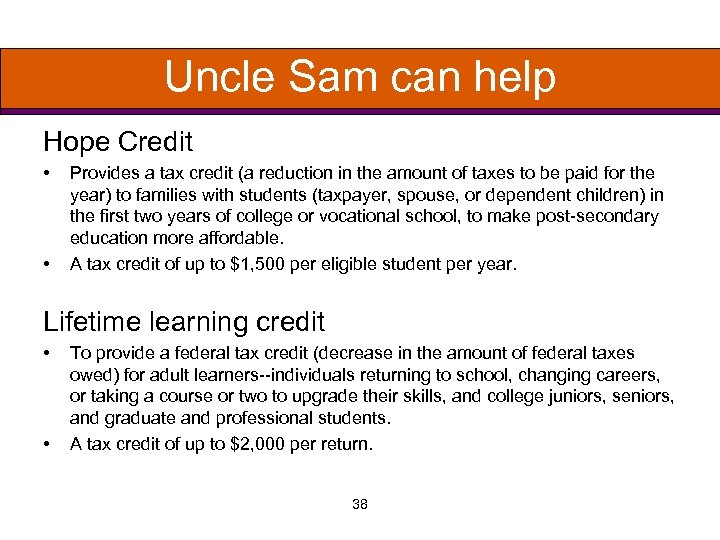
Uncle Sam can help Hope Credit • • Provides a tax credit (a reduction in the amount of taxes to be paid for the year) to families with students (taxpayer, spouse, or dependent children) in the first two years of college or vocational school, to make post-secondary education more affordable. A tax credit of up to $1, 500 per eligible student per year. Lifetime learning credit • • To provide a federal tax credit (decrease in the amount of federal taxes owed) for adult learners--individuals returning to school, changing careers, or taking a course or two to upgrade their skills, and college juniors, seniors, and graduate and professional students. A tax credit of up to $2, 000 per return. 38
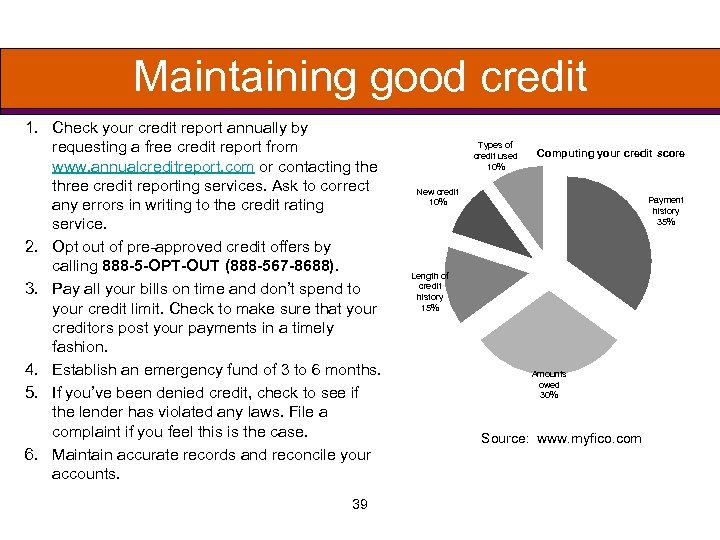
Maintaining good credit 1. Check your credit report annually by requesting a free credit report from www. annualcreditreport. com or contacting the three credit reporting services. Ask to correct any errors in writing to the credit rating service. 2. Opt out of pre-approved credit offers by calling 888 -5 -OPT-OUT (888 -567 -8688). 3. Pay all your bills on time and don’t spend to your credit limit. Check to make sure that your creditors post your payments in a timely fashion. 4. Establish an emergency fund of 3 to 6 months. 5. If you’ve been denied credit, check to see if the lender has violated any laws. File a complaint if you feel this is the case. 6. Maintain accurate records and reconcile your accounts. 39 Types of credit used 10% Computing your credit score New credit 10% Payment history 35% Length of credit history 15% Amounts owed 30% Source: www. myfico. com
Coping with credit problems 1. Stay calm and work your way slowly and surely through the problem. Don’t delay. Take action now and make it a priority. 2. If you feel that an error caused your credit problem, tell the credit rating service. Be diligent about monitoring your credit report. 3. Seek financial counseling right away. Use free counseling services that are listed in www. usdoj. gov/ust. Be aware of credit counseling services (even though they claim to be nonprofit) that charge you fees. 4. Make a list of all the debts you owe with the creditor names and addresses. Call your lenders and creditors. Let them know you're having financial difficulties. 5. Prepare a realistic spending plan to pay down your debt. 6. If you have savings, consider using it to pay as many bills as you can. Consider selling some assets. Consider getting a second job to pay off your debt. 7. It might take longer than you thought for your financial crisis to go away. Be persistent with your creditors and payment plan. 8. As you start to pull yourself out of the financial crisis, remember to set aside money for savings. 40

Growing your wealth with smart investing. 41

Tax-advantaged investing • The earlier you learn about investing, the more wealth you will accumulate. Learn about stocks, bonds, international, real estate and others. • Maximize your employer’s match in a 401 K • Contribute your earnings to a Roth IRA 42
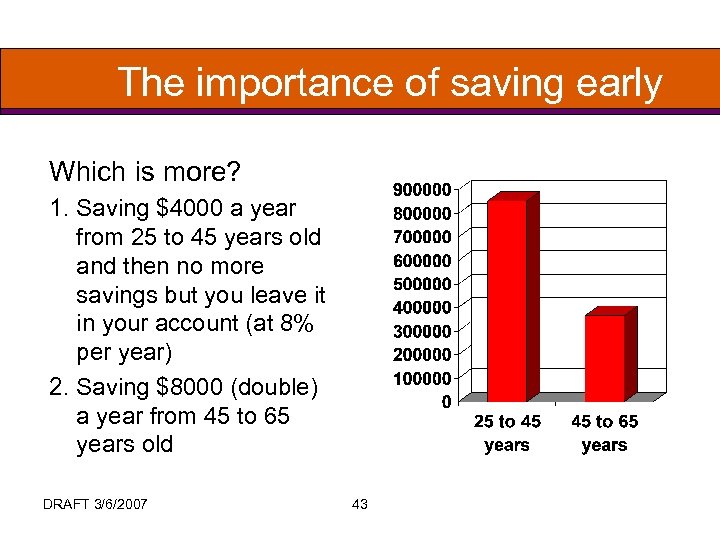
The importance of saving early Which is more? 1. Saving $4000 a year from 25 to 45 years old and then no more savings but you leave it in your account (at 8% per year) 2. Saving $8000 (double) a year from 45 to 65 years old DRAFT 3/6/2007 43
The effect of saving every year • You cut out candy and soda for savings of $25 every week. • What will you have in 40 years? DRAFT 3/6/2007 44
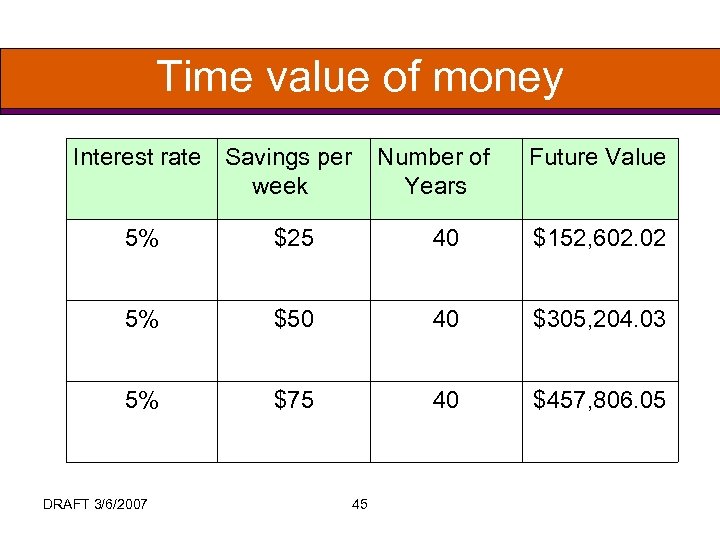
Time value of money Interest rate Savings per Number of week Years Future Value 5% $25 40 $152, 602. 02 5% $50 40 $305, 204. 03 5% $75 40 $457, 806. 05 DRAFT 3/6/2007 45
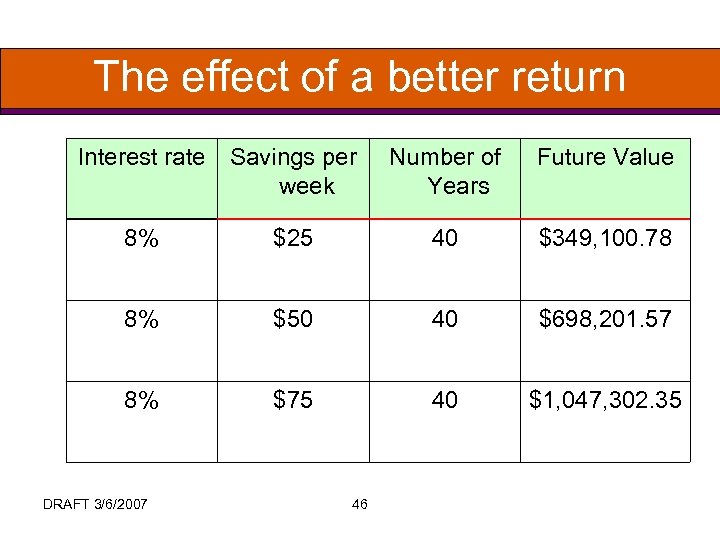
The effect of a better return Interest rate Savings per week Number of Years Future Value 8% $25 40 $349, 100. 78 8% $50 40 $698, 201. 57 8% $75 40 $1, 047, 302. 35 DRAFT 3/6/2007 46
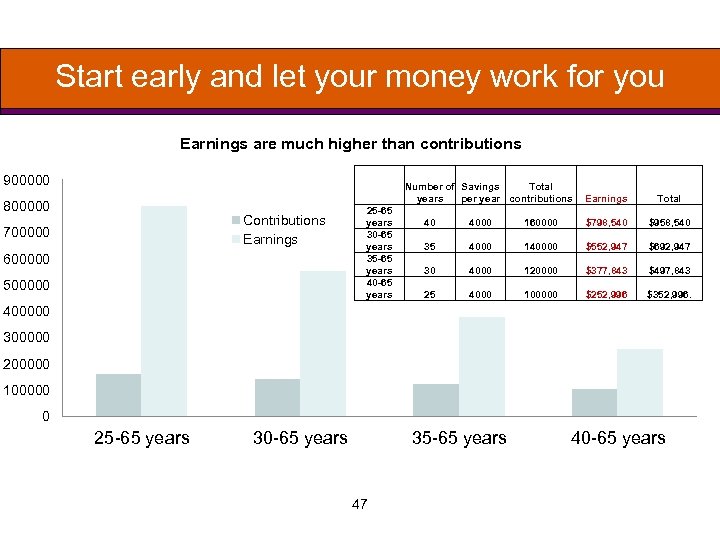
Start early and let your money work for you Earnings are much higher than contributions 900000 800000 Contributions Earnings 700000 600000 500000 25 -65 years 30 -65 years 35 -65 years 40 -65 years Number of Savings Total years per year contributions Earnings Total 40 4000 160000 $798, 540 $958, 540 35 4000 140000 $552, 947 $692, 947 30 4000 120000 $377, 843 $497, 843 25 4000 100000 $252, 996 $352, 996. 400000 300000 200000 100000 0 25 -65 years 30 -65 years 35 -65 years 47 40 -65 years
Cost of cashing out • About 57% of people who leave companies cash out their retirement benefits of $8445. If you left this money in a retirement plan for 40 years at a return of 8%, calculate what it contributes to your retirement. 48
Cost of cashing out • You lose about $183, 500 for your retirement fund. If you cash out, you pay taxes on your withdrawal plus a 10% penalty on top of that. That would leave you with $6000 now versus $183, 500 when you retire. 49
Protect your money. 50
Protect your money Do’s • Protect all your financial information. Don’t give out your social security number unless absolutely necessary. Most places will give you another identity number if you ask for it. • Keep track of your credit card spending and check your statements very carefully. If you find a charge for something you did not buy, contact your credit card company immediately. • Balance your checkbook every month. In general keep good records. • Burn your mail, or use a shredder to cut up the receipts and other papers you throw into the garbage. Don’t leave outgoing mail in unlocked mailboxes. • Avoid filling out forms for contests and clubs. The “contest” may simply be a way for someone to collect your private information. • Protect your computer with anti-virus software and firewalls especially if you use it for online banking or purchasing. • Check your credit report every year. (More tips in appendix. ) 51
Скачать презентацию Get smart about your money Financial Education for
d6724f1044a878c764d4b6f5e38f5b49.ppt