 Скачать презентацию GET READY FOR THE MOST SPECTACULAR MOST ACCESSIBLE
0852d82fa3e447f53c8d79025fa480b1.ppt
- Количество слайдов: 17



GET READY FOR THE MOST SPECTACULAR MOST ACCESSIBLE VISION-RELATED PUBLIC HEALTH EVENT IN HISTORY! Source: www. ta 3. sk/news/archive_sk-q 3_2009. php
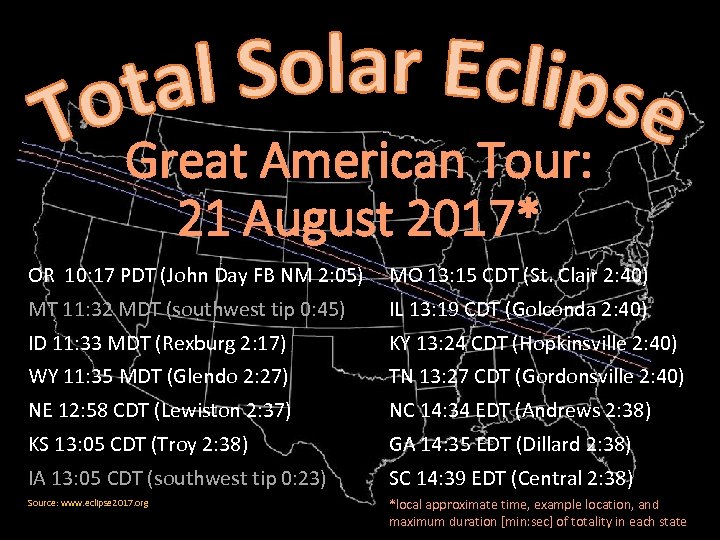
Great American Tour: 21 August 2017* OR 10: 17 PDT (John Day FB NM 2: 05) MO 13: 15 CDT (St. Clair 2: 40) MT 11: 32 MDT (southwest tip 0: 45) IL 13: 19 CDT (Golconda 2: 40) ID 11: 33 MDT (Rexburg 2: 17) KY 13: 24 CDT (Hopkinsville 2: 40) WY 11: 35 MDT (Glendo 2: 27) TN 13: 27 CDT (Gordonsville 2: 40) NE 12: 58 CDT (Lewiston 2: 37) NC 14: 34 EDT (Andrews 2: 38) KS 13: 05 CDT (Troy 2: 38) GA 14: 35 EDT (Dillard 2: 38) IA 13: 05 CDT (southwest tip 0: 23) SC 14: 39 EDT (Central 2: 38) Source: www. eclipse 2017. org *local approximate time, example location, and maximum duration [min: sec] of totality in each state
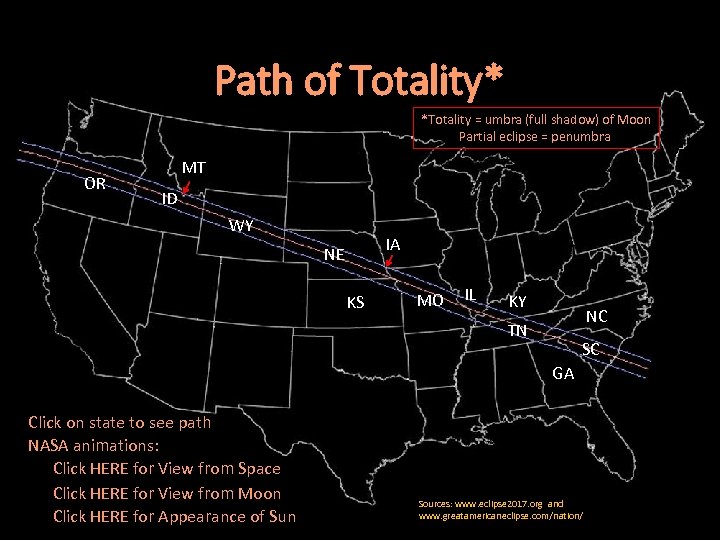
Path of Totality* *Totality = umbra (full shadow) of Moon Partial eclipse = penumbra OR MT ID WY IA NE KS MO IL KY NC TN SC GA Click on state to see path NASA animations: Click HERE for View from Space Click HERE for View from Moon Click HERE for Appearance of Sun Sources: www. eclipse 2017. org and www. greatamericaneclipse. com/nation/
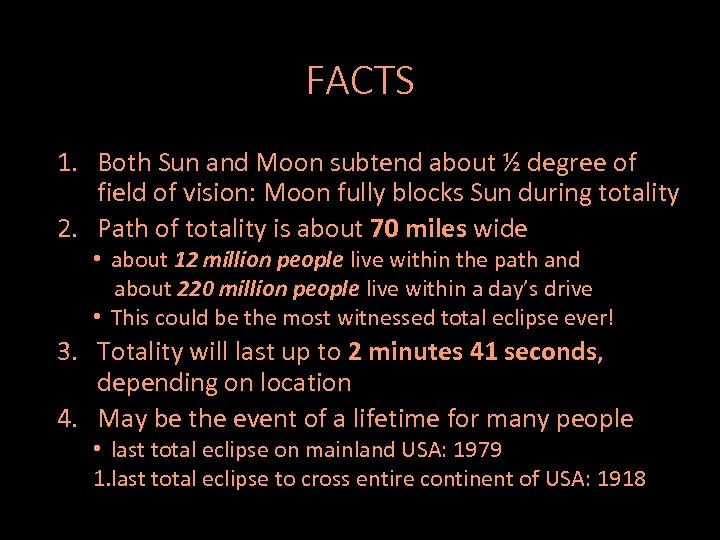
FACTS 1. Both Sun and Moon subtend about ½ degree of field of vision: Moon fully blocks Sun during totality 2. Path of totality is about 70 miles wide • about 12 million people live within the path and about 220 million people live within a day’s drive • This could be the most witnessed total eclipse ever! 3. Totality will last up to 2 minutes 41 seconds, depending on location 4. May be the event of a lifetime for many people • last total eclipse on mainland USA: 1979 1. last total eclipse to cross entire continent of USA: 1918
FACTS 5. Most hotels, parks, and campsites within path of totality in each state have been fully booked since last year 6. Partial eclipse will be visible to everyone in USA, Canada, Mexico, and Caribbean • over 500 million people 7. Partial eclipse will last up to over 2 hours, depending on location 8. Many planetariums, natural history museums, and local astronomical societies across the continent will host viewing parties
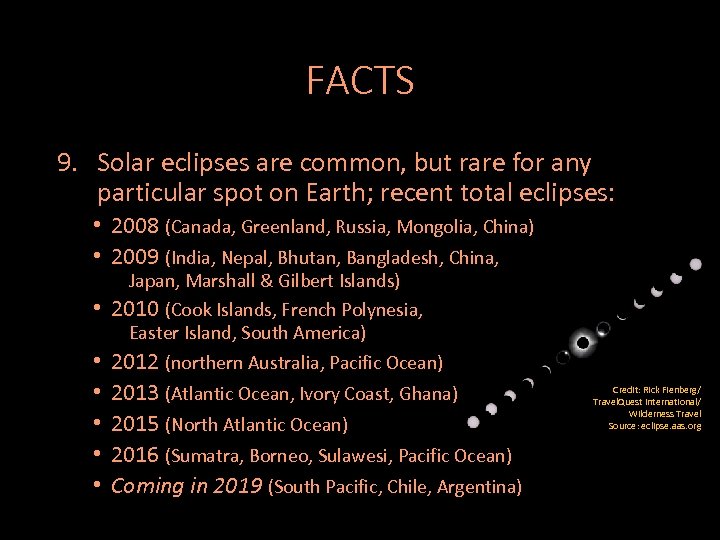
FACTS 9. Solar eclipses are common, but rare for any particular spot on Earth; recent total eclipses: • 2008 (Canada, Greenland, Russia, Mongolia, China) • 2009 (India, Nepal, Bhutan, Bangladesh, China, • • • Japan, Marshall & Gilbert Islands) 2010 (Cook Islands, French Polynesia, Easter Island, South America) 2012 (northern Australia, Pacific Ocean) 2013 (Atlantic Ocean, Ivory Coast, Ghana) 2015 (North Atlantic Ocean) 2016 (Sumatra, Borneo, Sulawesi, Pacific Ocean) Coming in 2019 (South Pacific, Chile, Argentina) Credit: Rick Fienberg/ Travel. Quest International/ Wilderness Travel Source: eclipse. aas. org
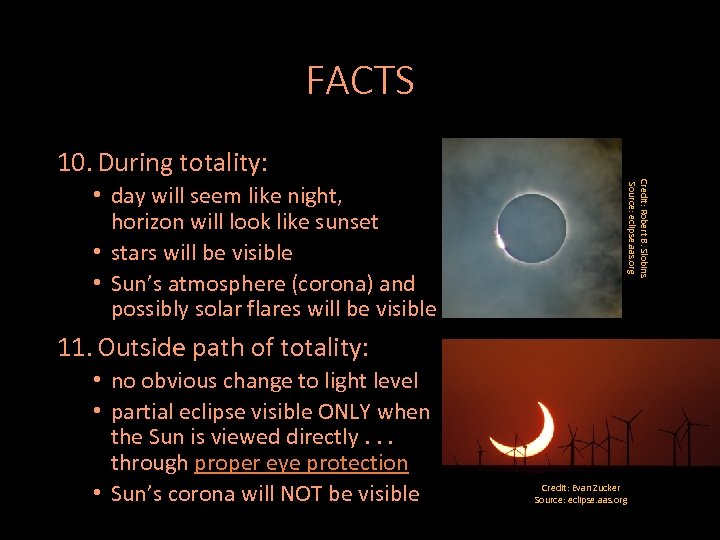
FACTS 10. During totality: Credit: Robert B. Slobins Source: eclipse. aas. org • day will seem like night, horizon will look like sunset • stars will be visible • Sun’s atmosphere (corona) and possibly solar flares will be visible 11. Outside path of totality: • no obvious change to light level • partial eclipse visible ONLY when the Sun is viewed directly. . . through proper eye protection • Sun’s corona will NOT be visible Credit: Evan Zucker Source: eclipse. aas. org
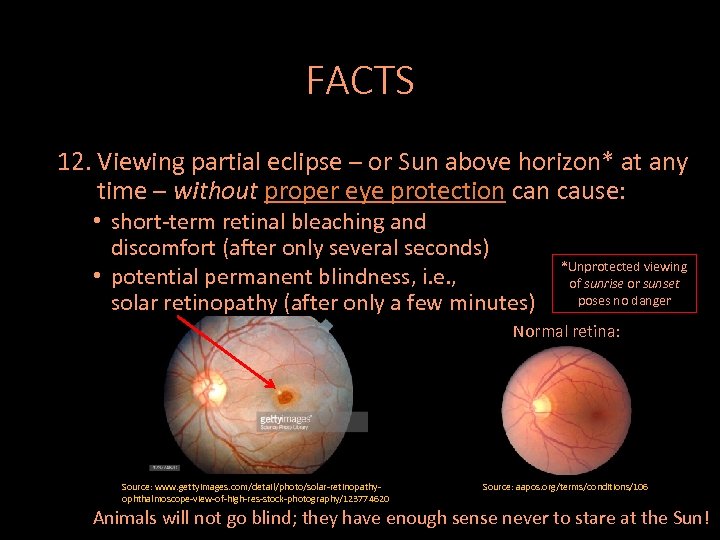
FACTS 12. Viewing partial eclipse – or Sun above horizon* at any time – without proper eye protection cause: • short-term retinal bleaching and discomfort (after only several seconds) • potential permanent blindness, i. e. , solar retinopathy (after only a few minutes) *Unprotected viewing of sunrise or sunset poses no danger Normal retina: Source: www. gettyimages. com/detail/photo/solar-retinopathyophthalmoscope-view-of-high-res-stock-photography/123774620 Source: aapos. org/terms/conditions/106 Animals will not go blind; they have enough sense never to stare at the Sun!
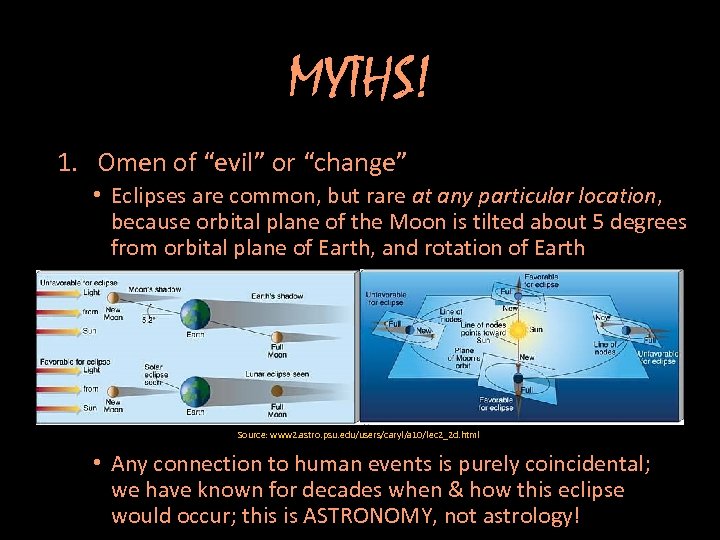
MYTHS! 1. Omen of “evil” or “change” • Eclipses are common, but rare at any particular location, because orbital plane of the Moon is tilted about 5 degrees from orbital plane of Earth, and rotation of Earth Source: www 2. astro. psu. edu/users/caryl/a 10/lec 2_2 d. html • Any connection to human events is purely coincidental; we have known for decades when & how this eclipse would occur; this is ASTRONOMY, not astrology!
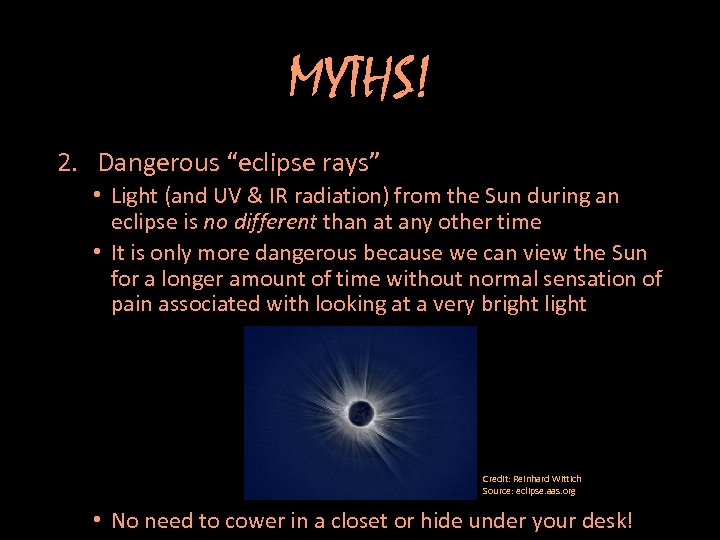
MYTHS! 2. Dangerous “eclipse rays” • Light (and UV & IR radiation) from the Sun during an eclipse is no different than at any other time • It is only more dangerous because we can view the Sun for a longer amount of time without normal sensation of pain associated with looking at a very bright light Credit: Reinhard Wittich Source: eclipse. aas. org • No need to cower in a closet or hide under your desk!
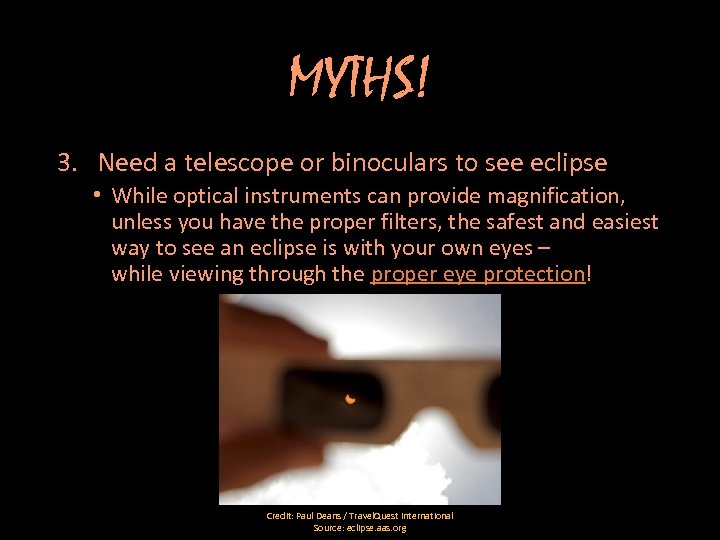
MYTHS! 3. Need a telescope or binoculars to see eclipse • While optical instruments can provide magnification, unless you have the proper filters, the safest and easiest way to see an eclipse is with your own eyes – while viewing through the proper eye protection! Credit: Paul Deans / Travel. Quest International Source: eclipse. aas. org
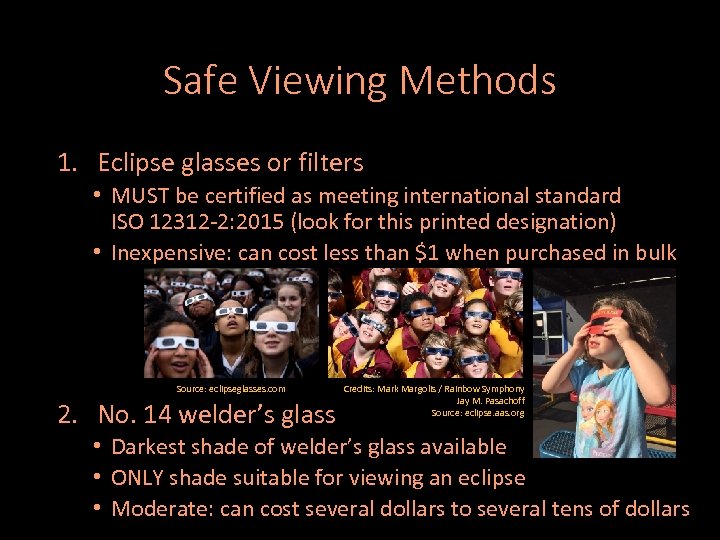
Safe Viewing Methods 1. Eclipse glasses or filters • MUST be certified as meeting international standard ISO 12312 -2: 2015 (look for this printed designation) • Inexpensive: can cost less than $1 when purchased in bulk Source: eclipseglasses. com 2. No. 14 welder’s glass Credits: Mark Margolis / Rainbow Symphony Jay M. Pasachoff Source: eclipse. aas. org • Darkest shade of welder’s glass available • ONLY shade suitable for viewing an eclipse • Moderate: can cost several dollars to several tens of dollars
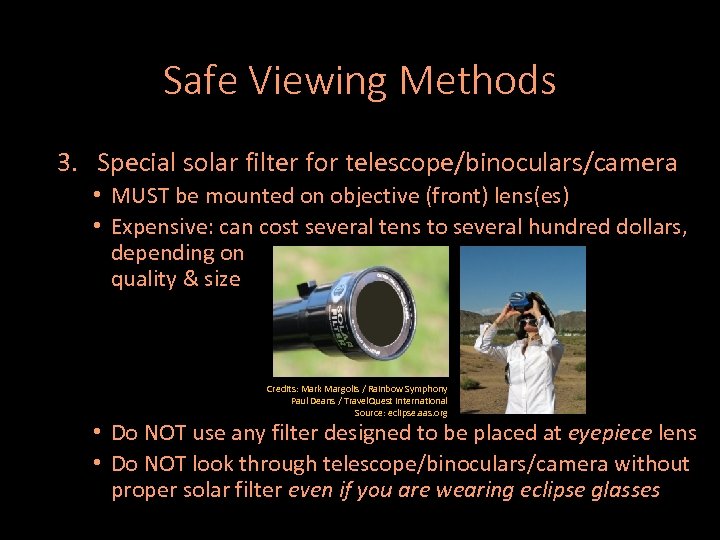
Safe Viewing Methods 3. Special solar filter for telescope/binoculars/camera • MUST be mounted on objective (front) lens(es) • Expensive: can cost several tens to several hundred dollars, depending on quality & size Credits: Mark Margolis / Rainbow Symphony Paul Deans / Travel. Quest International Source: eclipse. aas. org • Do NOT use any filter designed to be placed at eyepiece lens • Do NOT look through telescope/binoculars/camera without proper solar filter even if you are wearing eclipse glasses
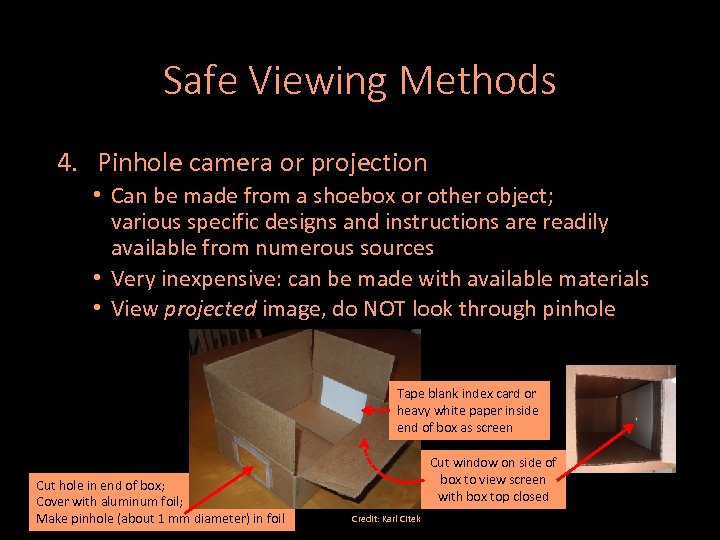
Safe Viewing Methods 4. Pinhole camera or projection • Can be made from a shoebox or other object; various specific designs and instructions are readily available from numerous sources • Very inexpensive: can be made with available materials • View projected image, do NOT look through pinhole Tape blank index card or heavy white paper inside end of box as screen Cut hole in end of box; Cover with aluminum foil; Make pinhole (about 1 mm diameter) in foil Cut window on side of box to view screen with box top closed Credit: Karl Citek
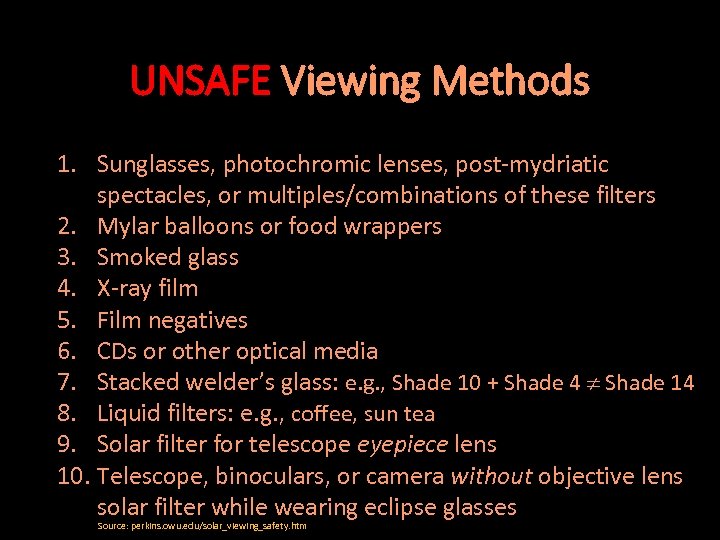
UNSAFE Viewing Methods 1. Sunglasses, photochromic lenses, post-mydriatic spectacles, or multiples/combinations of these filters 2. Mylar balloons or food wrappers 3. Smoked glass 4. X-ray film 5. Film negatives 6. CDs or other optical media 7. Stacked welder’s glass: e. g. , Shade 10 + Shade 4 Shade 14 8. Liquid filters: e. g. , coffee, sun tea 9. Solar filter for telescope eyepiece lens 10. Telescope, binoculars, or camera without objective lens solar filter while wearing eclipse glasses Source: perkins. owu. edu/solar_viewing_safety. htm
Resources • Where to buy eclipse glasses Rainbow Symphony American Paper Optics Thousand Oaks Optical Amazon • Useful websites (most include additional good links) American Astronomical Society: general, viewing safety NASA Perkins Observatory (viewing safety) Eclipse 2017 Great American Eclipse Space. com
Notice • Compiled by: Karl Citek, OD, Ph. D, FAAO Diplomate, AAO PHEV Section Professor of Optometry Pacific University College of Optometry Forest Grove, Oregon citekk 1@pacificu. edu • Disclaimer This presentation is provided at no cost and may be distributed without notification, provided that no changes are made. The mention of any product or website does not constitute endorsement. No payment, reimbursement, or incentive – monetary or otherwise – was received for this presentation.
Скачать презентацию GET READY FOR THE MOST SPECTACULAR MOST ACCESSIBLE
0852d82fa3e447f53c8d79025fa480b1.ppt