


 Скачать презентацию Gesture Recognition in Complex Scenes Vassilis Athitsos Computer
5616e78bf05f0c3a785ee23ea9183498.ppt
- Количество слайдов: 60
 Gesture Recognition in Complex Scenes Vassilis Athitsos Computer Science and Engineering Department University of Texas at Arlington 1
 Collaborators n n n n Jonathan Alon (ex-BU, now Negevtech, Israel). Jingbin Wang (ex-BU, now Google). Quan Yuan (Boston University). Alexandra Stefan (Boston University). Stan Sclaroff (Boston University). George Kollios (Boston University). Margrit Betke (Boston University). 2
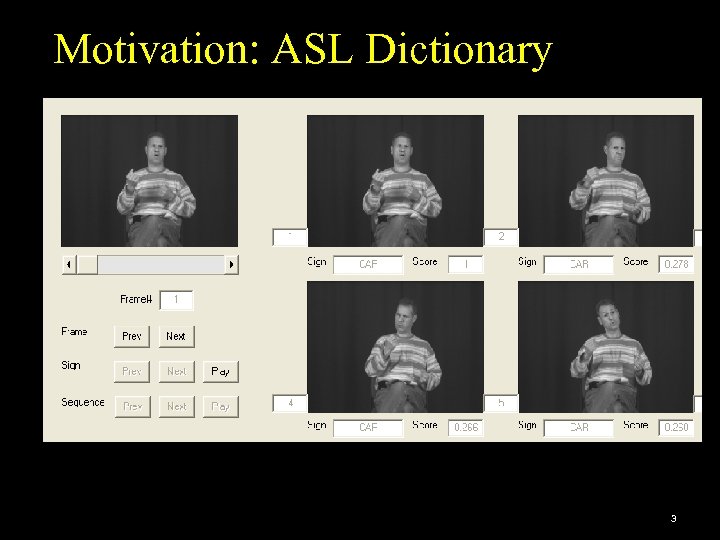 Motivation: ASL Dictionary 3
 Motivation: ASL Dictionary n Addresses needs of a large community: n 500, 000 to 2 million ASL users in the US. n n Direct impact in education of Deaf children. n n ? ? ? in the European Union. Most born to hearing parents, learn ASL at school. Challenging problems in vision, learning, database indexing. n n n Large-scale motion-based video retrieval. Efficient large-scale multiclass recognition. Learning complex patterns from few examples. 4
 Sources of Information Hand motion. n Hand pose. n n n Shape. Orientation. Facial expressions. n Body pose. n 5
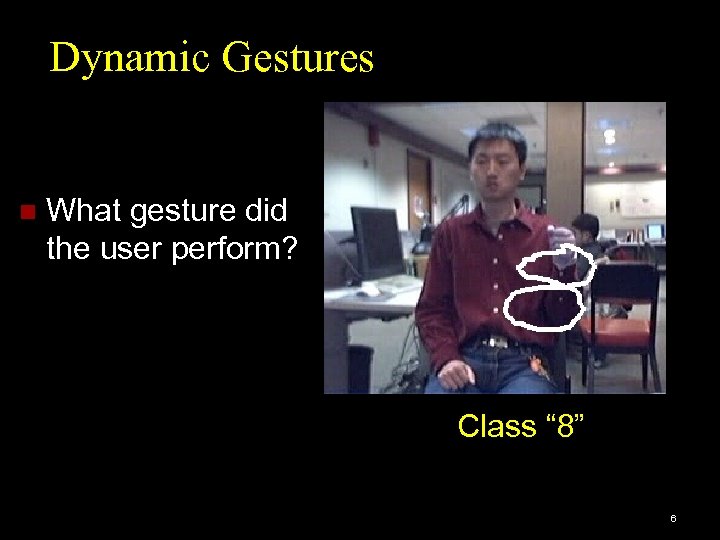 Dynamic Gestures n What gesture did the user perform? Class “ 8” 6
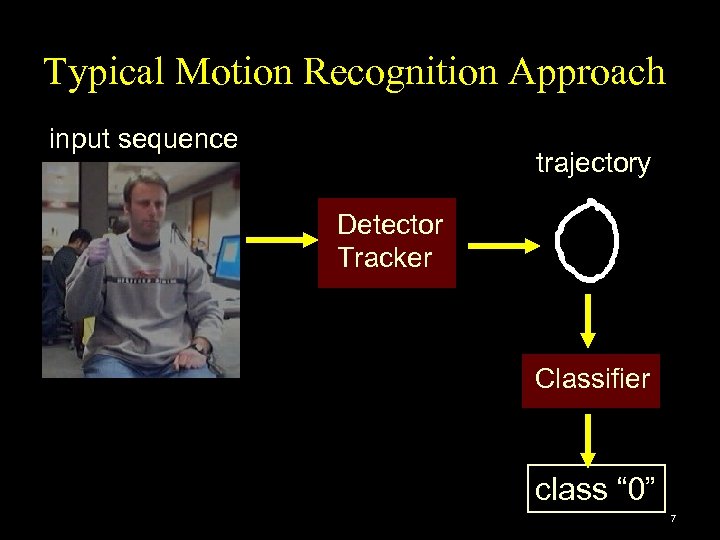 Typical Motion Recognition Approach input sequence trajectory Detector Tracker Classifier class “ 0” 7
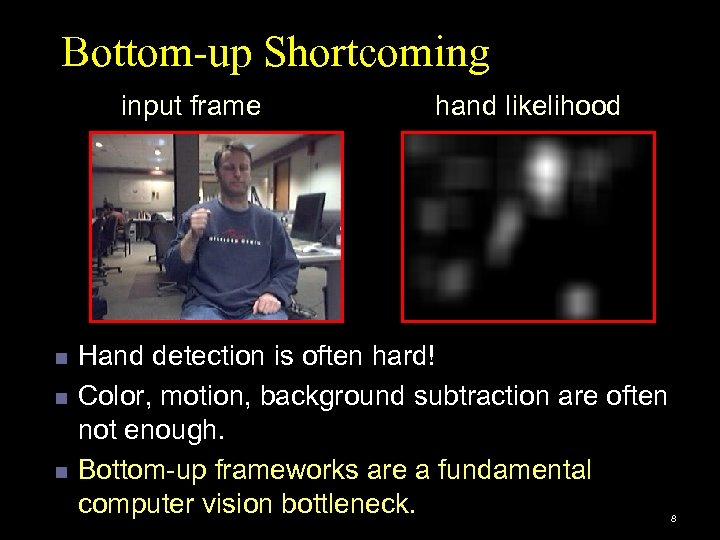 Bottom-up Shortcoming input frame n n n hand likelihood Hand detection is often hard! Color, motion, background subtraction are often not enough. Bottom-up frameworks are a fundamental computer vision bottleneck. 8
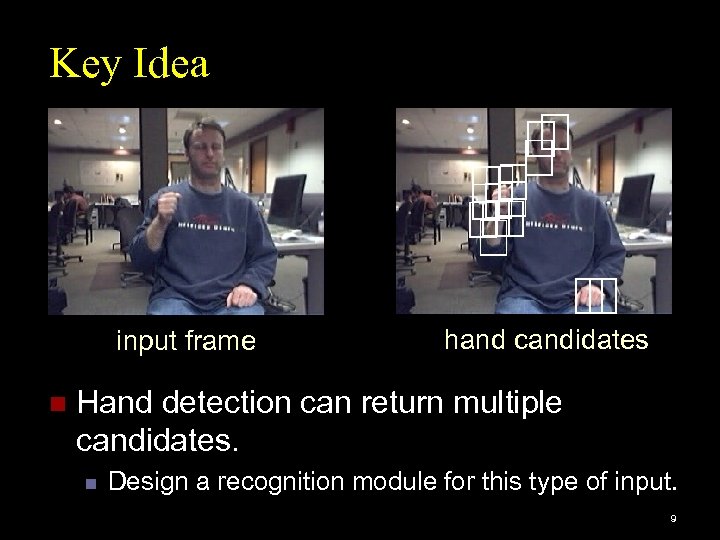 Key Idea input frame n hand candidates Hand detection can return multiple candidates. n Design a recognition module for this type of input. 9
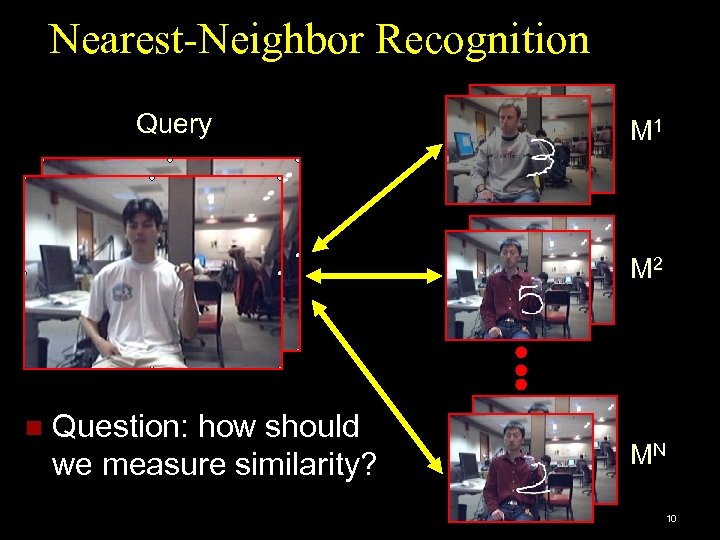 Nearest-Neighbor Recognition Query M 1 M 2 n Question: how should we measure similarity? MN 10
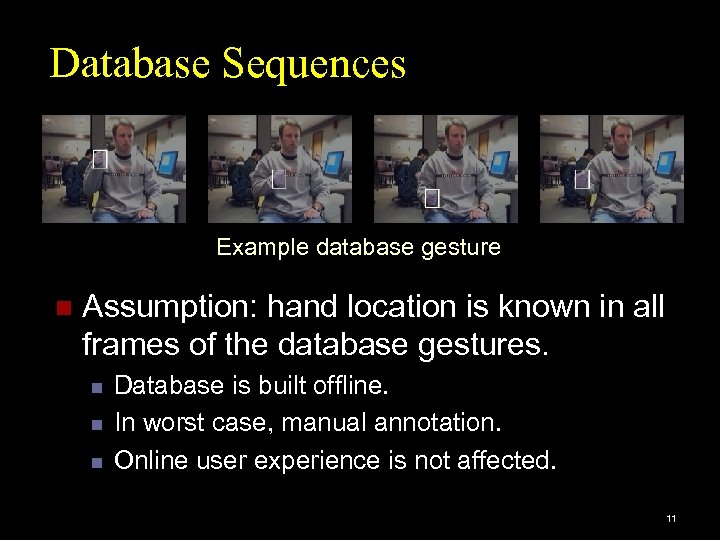 Database Sequences Example database gesture n Assumption: hand location is known in all frames of the database gestures. n n n Database is built offline. In worst case, manual annotation. Online user experience is not affected. 11
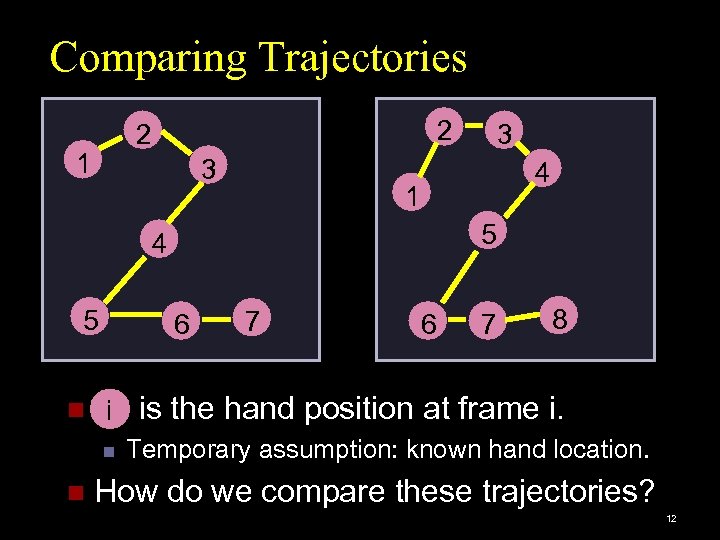 Comparing Trajectories 2 2 1 3 4 1 5 4 5 6 n i n n 3 7 6 7 8 is the hand position at frame i. Temporary assumption: known hand location. How do we compare these trajectories? 12
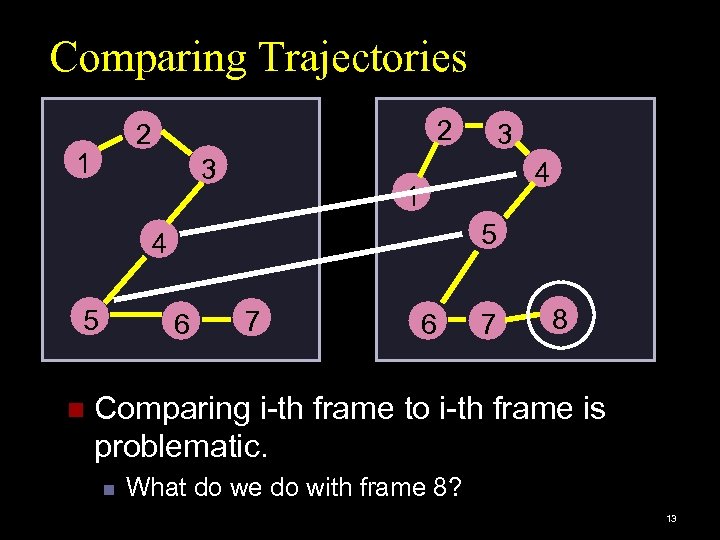 Comparing Trajectories 2 2 1 3 4 1 5 4 5 n 3 6 7 8 Comparing i-th frame to i-th frame is problematic. n What do we do with frame 8? 13
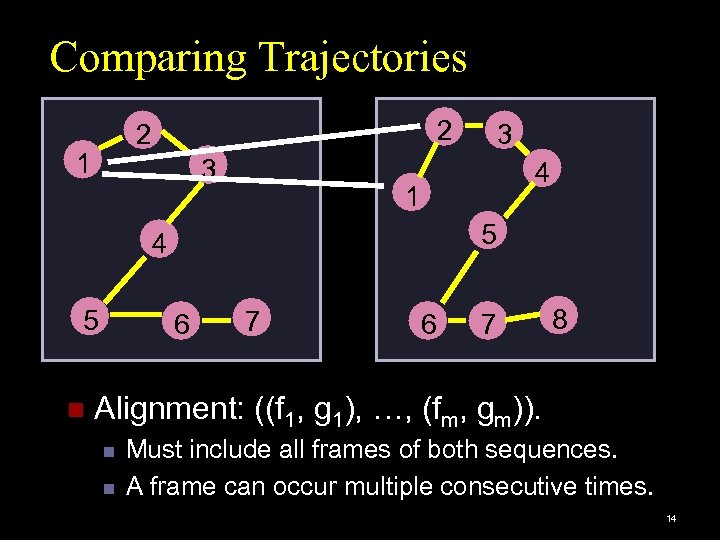 Comparing Trajectories 2 2 1 3 4 1 5 4 5 n 3 6 7 8 Alignment: ((f 1, g 1), …, (fm, gm)). n n Must include all frames of both sequences. A frame can occur multiple consecutive times. 14
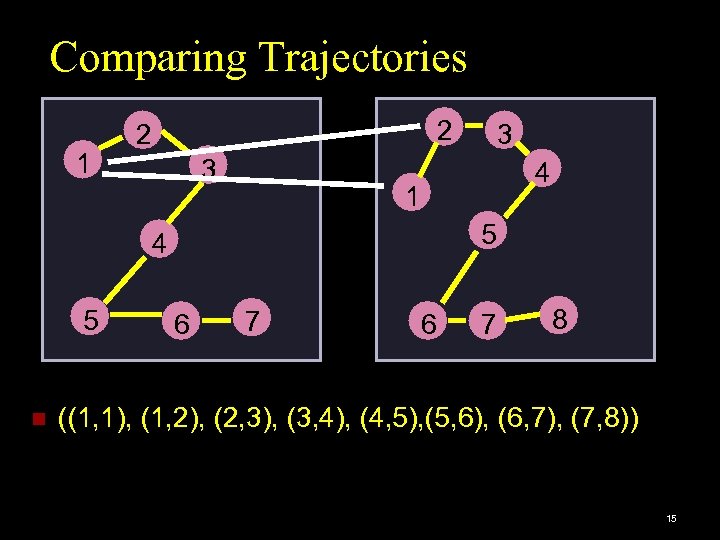 Comparing Trajectories 1 2 2 3 4 1 5 4 5 n 3 6 7 8 ((1, 1), (1, 2), (2, 3), (3, 4), (4, 5), (5, 6), (6, 7), (7, 8)) 15
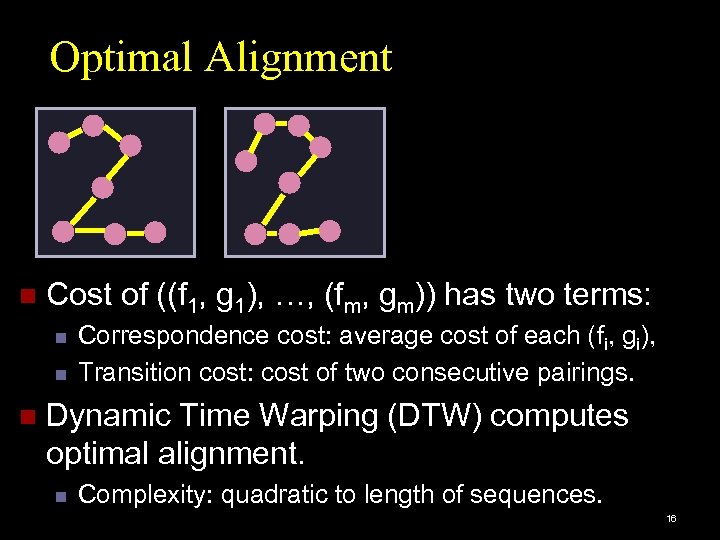 Optimal Alignment n Cost of ((f 1, g 1), …, (fm, gm)) has two terms: n n n Correspondence cost: average cost of each (fi, gi), Transition cost: cost of two consecutive pairings. Dynamic Time Warping (DTW) computes optimal alignment. n Complexity: quadratic to length of sequences. 16
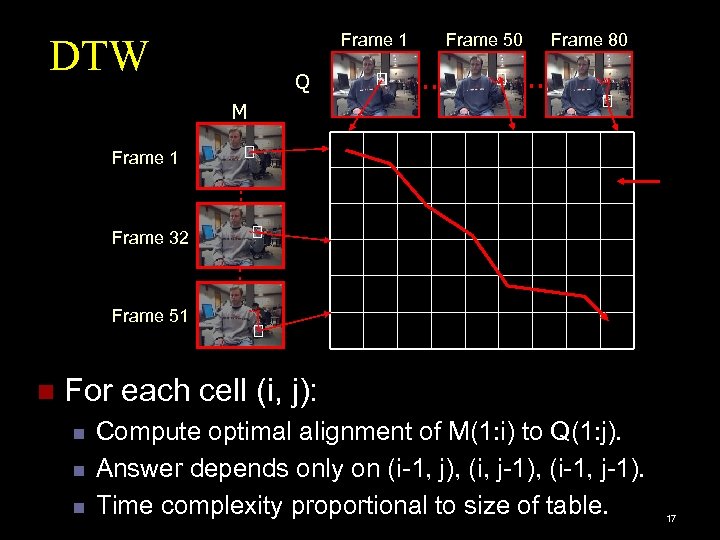 Frame 1 DTW Q Frame 50 . . Frame 80 . . M Frame 1 . . Frame 32 . . Frame 51 n For each cell (i, j): n n n Compute optimal alignment of M(1: i) to Q(1: j). Answer depends only on (i-1, j), (i, j-1), (i-1, j-1). Time complexity proportional to size of table. 17
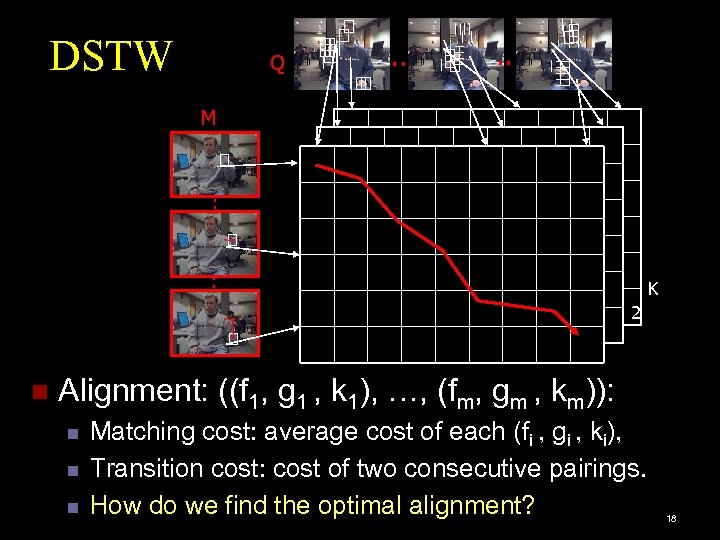 DSTW Q . . M . . W W . . K 2 1 n Alignment: ((f 1, g 1 , k 1), …, (fm, gm , km)): n n n Matching cost: average cost of each (fi , gi , ki), Transition cost: cost of two consecutive pairings. How do we find the optimal alignment? 18
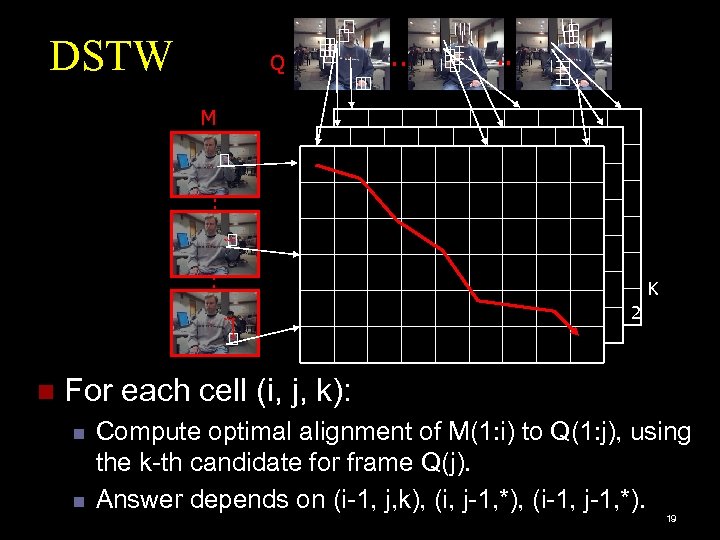 DSTW Q . . M . . W W . . K 2 1 n For each cell (i, j, k): n n Compute optimal alignment of M(1: i) to Q(1: j), using the k-th candidate for frame Q(j). Answer depends on (i-1, j, k), (i, j-1, *), (i-1, j-1, *). 19
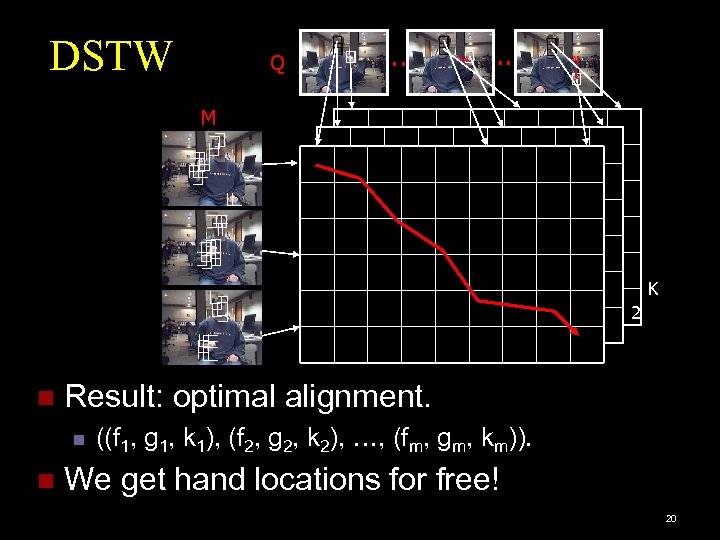 DSTW Q . . M W W K 2 1 n Result: optimal alignment. n n ((f 1, g 1, k 1), (f 2, g 2, k 2), …, (fm, gm, km)). We get hand locations for free! 20
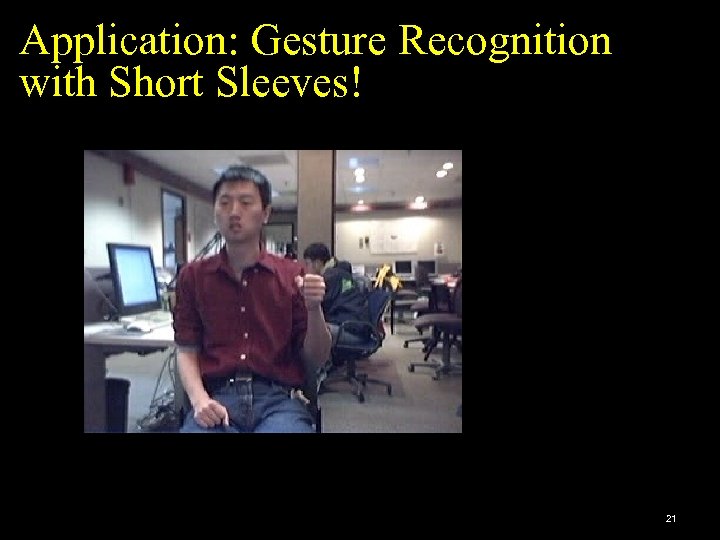 Application: Gesture Recognition with Short Sleeves! 21
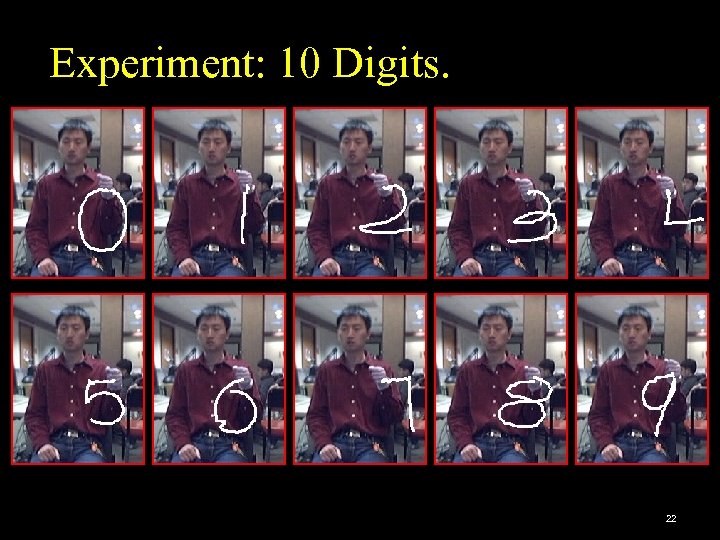 Experiment: 10 Digits. 22
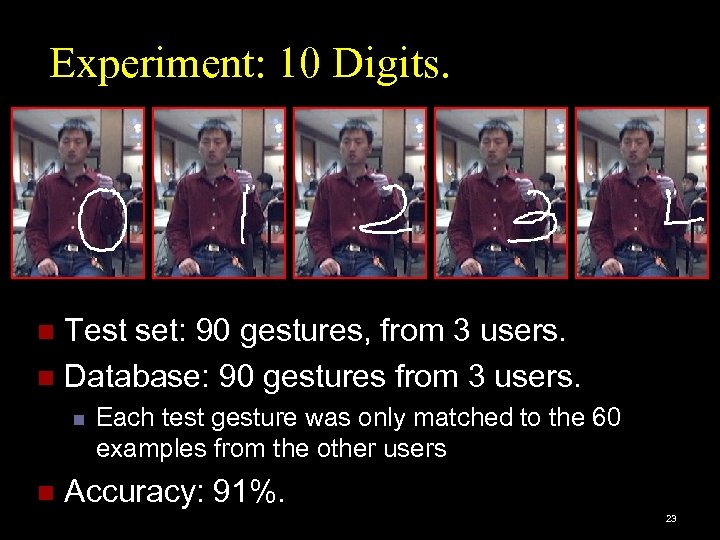 Experiment: 10 Digits. Test set: 90 gestures, from 3 users. n Database: 90 gestures from 3 users. n n n Each test gesture was only matched to the 60 examples from the other users Accuracy: 91%. 23
 Discussion n Higher level module (recognition) tolerant to lower-level (detection) ambiguities. n Recognition disambiguates detection. This is important for designing plug-andplay modules. n Use in ASL dictionary. n n n User signs unknown word in front of computer. Video sequences of signs are ranked in order of DSTW score. 24
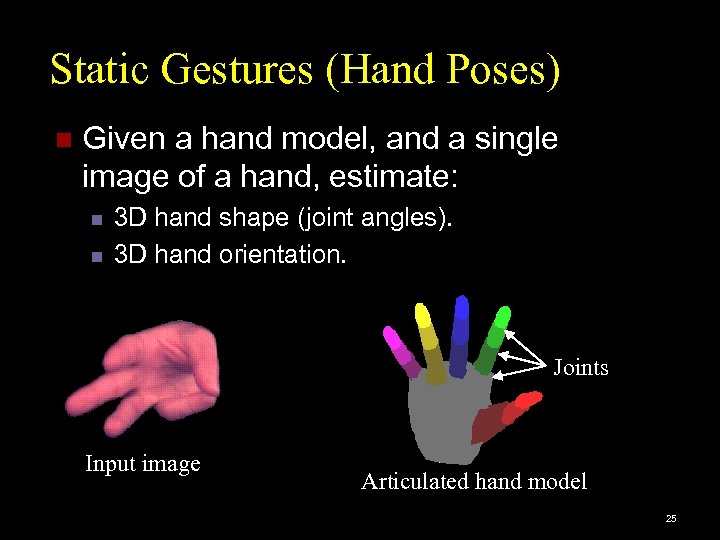 Static Gestures (Hand Poses) n Given a hand model, and a single image of a hand, estimate: n n 3 D hand shape (joint angles). 3 D hand orientation. Joints Input image Articulated hand model 25
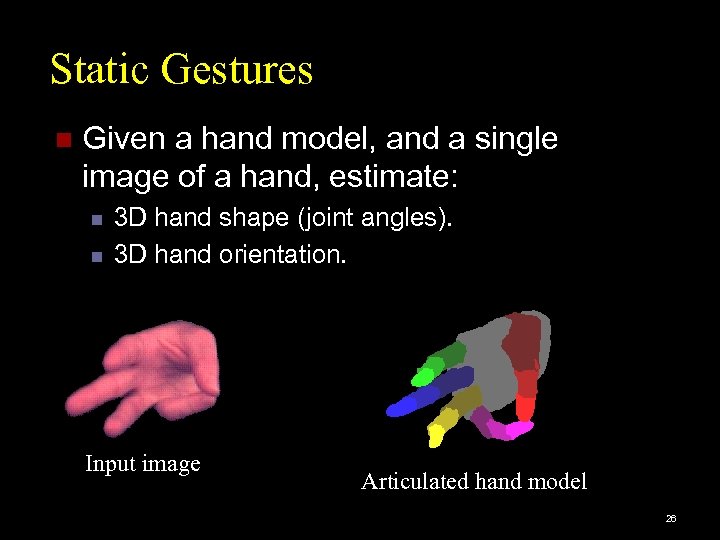 Static Gestures n Given a hand model, and a single image of a hand, estimate: n n 3 D hand shape (joint angles). 3 D hand orientation. Input image Articulated hand model 26
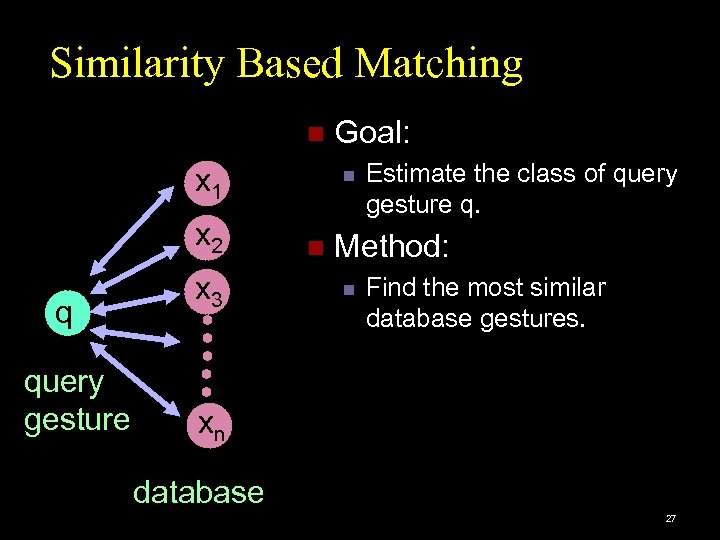 Similarity Based Matching n x 1 x 2 q query gesture x 3 Goal: n n Estimate the class of query gesture q. Method: n Find the most similar database gestures. xn database 27
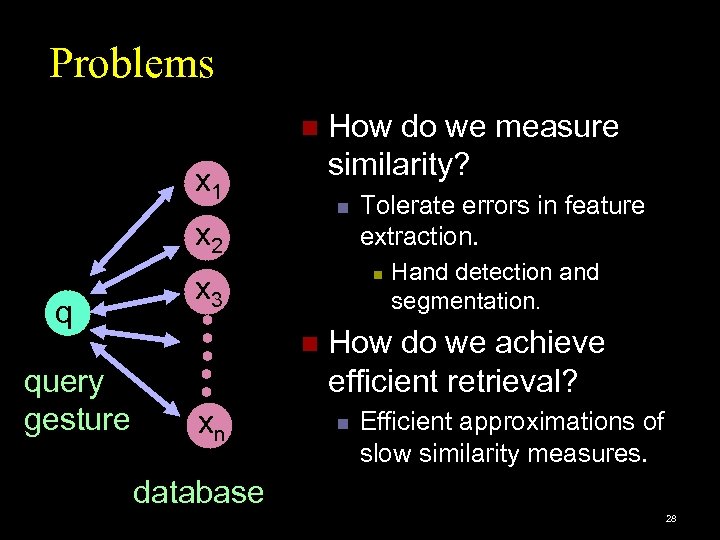 Problems n x 1 n x 2 q x 3 xn Tolerate errors in feature extraction. n n query gesture How do we measure similarity? Hand detection and segmentation. How do we achieve efficient retrieval? n Efficient approximations of slow similarity measures. database 28
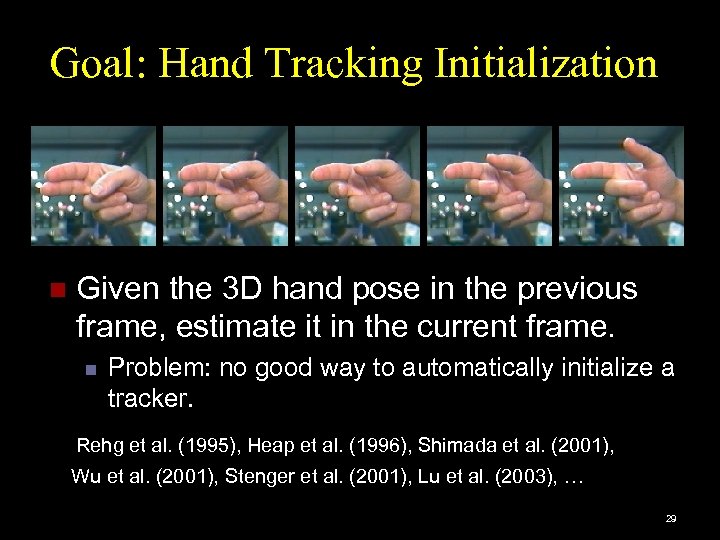 Goal: Hand Tracking Initialization n Given the 3 D hand pose in the previous frame, estimate it in the current frame. n Problem: no good way to automatically initialize a tracker. Rehg et al. (1995), Heap et al. (1996), Shimada et al. (2001), Wu et al. (2001), Stenger et al. (2001), Lu et al. (2003), … 29
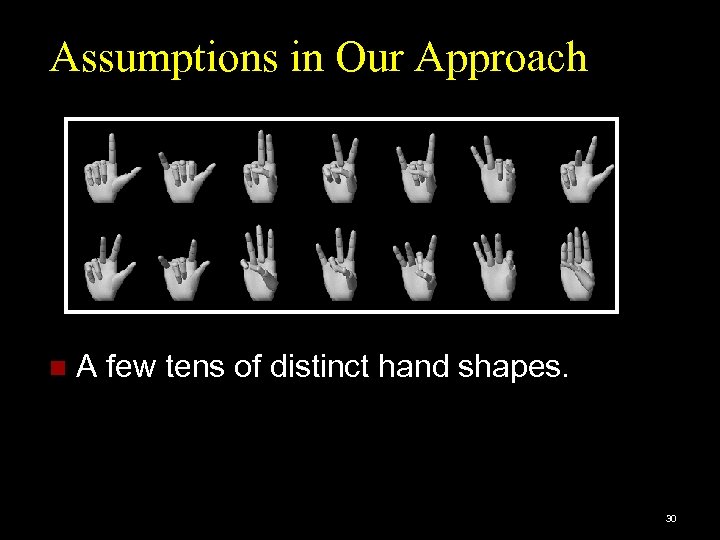 Assumptions in Our Approach n A few tens of distinct hand shapes. 30
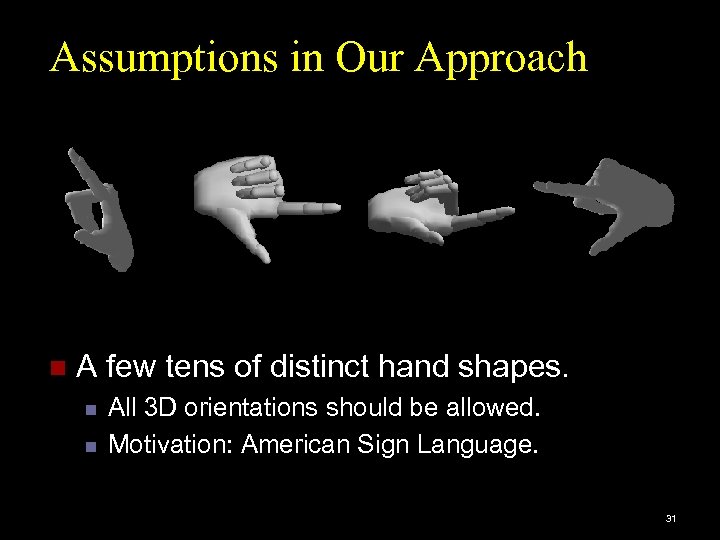 Assumptions in Our Approach n A few tens of distinct hand shapes. n n All 3 D orientations should be allowed. Motivation: American Sign Language. 31
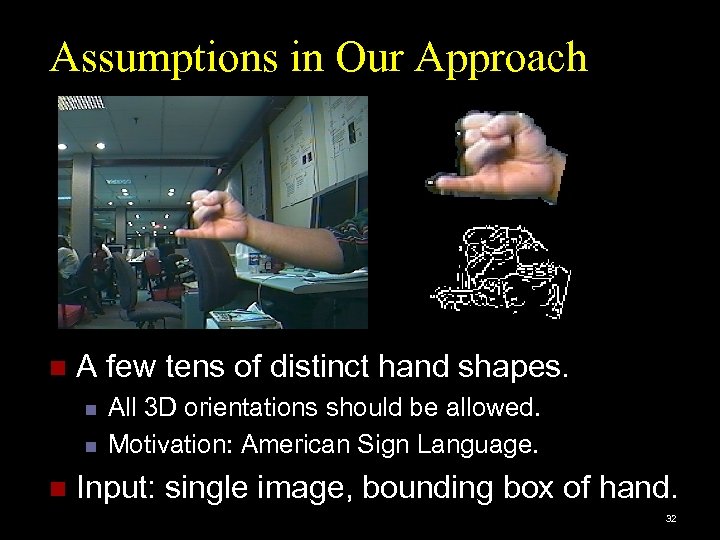 Assumptions in Our Approach n A few tens of distinct hand shapes. n n n All 3 D orientations should be allowed. Motivation: American Sign Language. Input: single image, bounding box of hand. 32
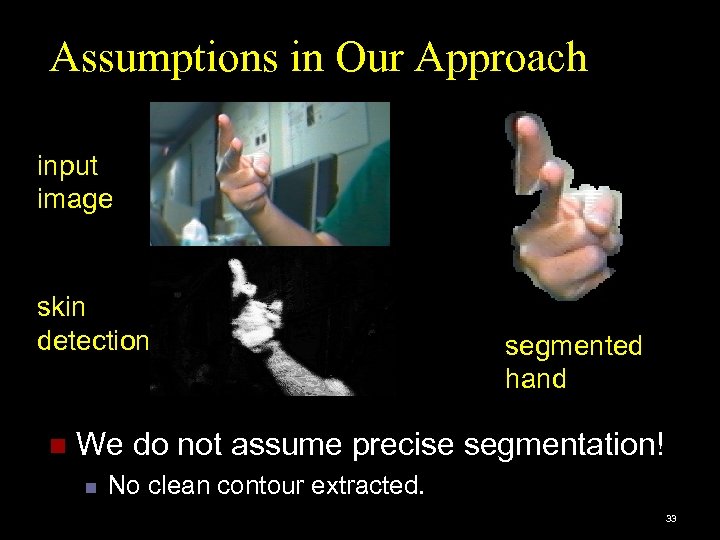 Assumptions in Our Approach input image skin detection n segmented hand We do not assume precise segmentation! n No clean contour extracted. 33
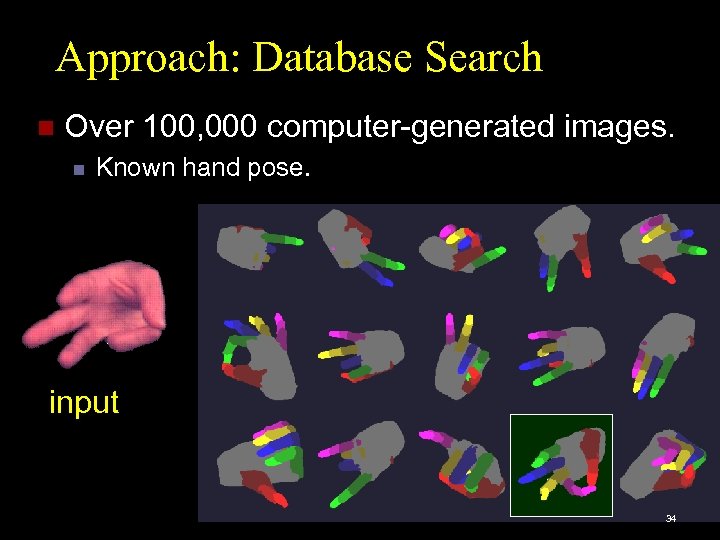 Approach: Database Search n Over 100, 000 computer-generated images. n Known hand pose. input 34
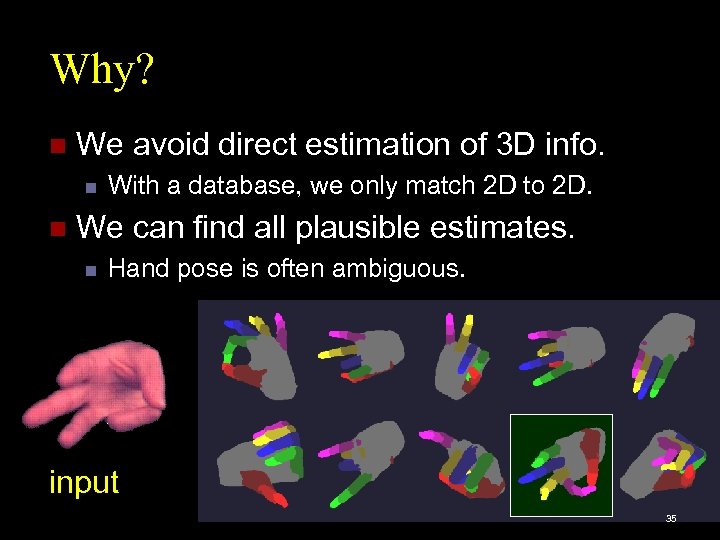 Why? n We avoid direct estimation of 3 D info. n n With a database, we only match 2 D to 2 D. We can find all plausible estimates. n Hand pose is often ambiguous. input 35
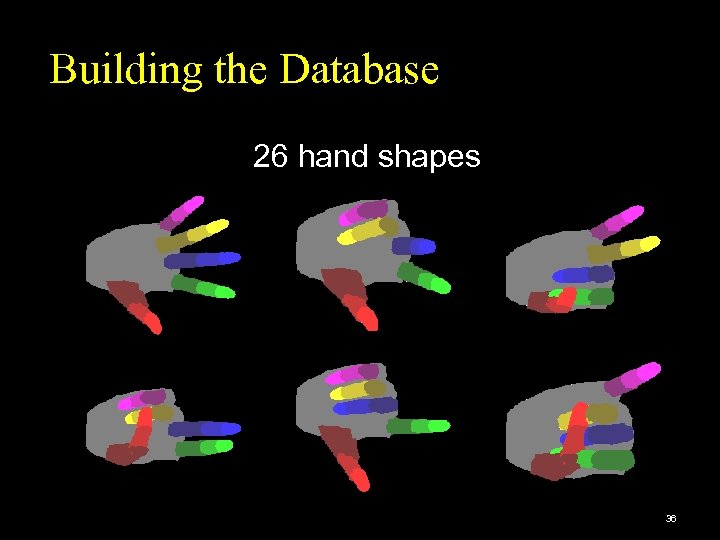 Building the Database 26 hand shapes 36
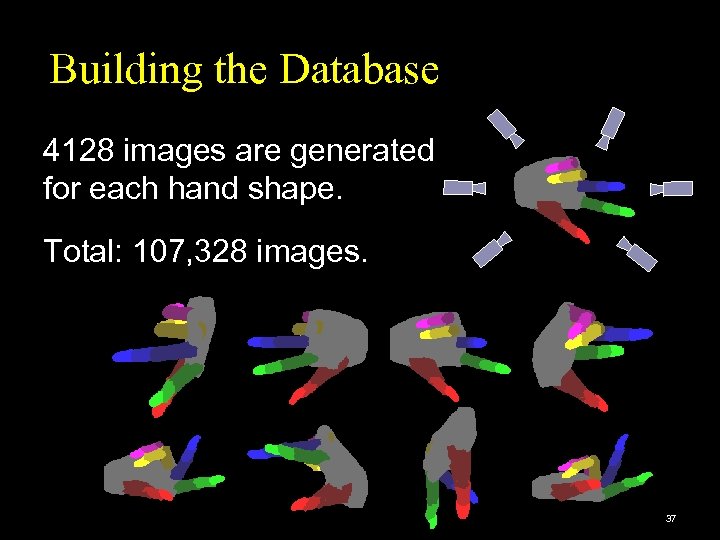 Building the Database 4128 images are generated for each hand shape. Total: 107, 328 images. 37
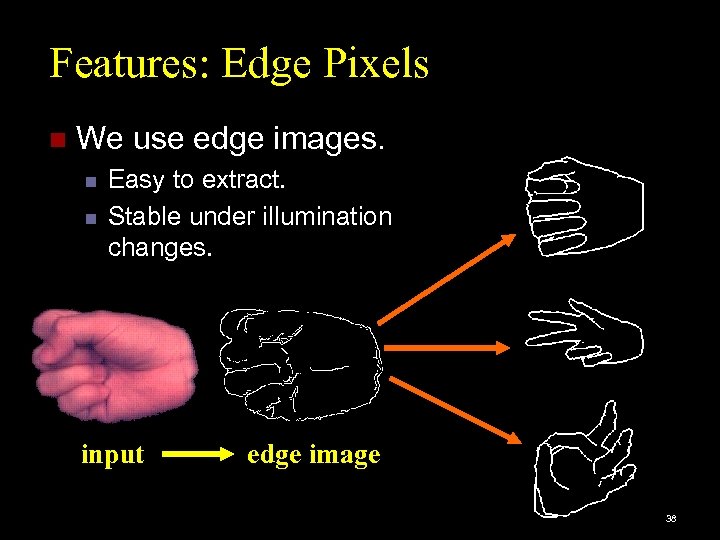 Features: Edge Pixels n We use edge images. n n Easy to extract. Stable under illumination changes. input edge image 38
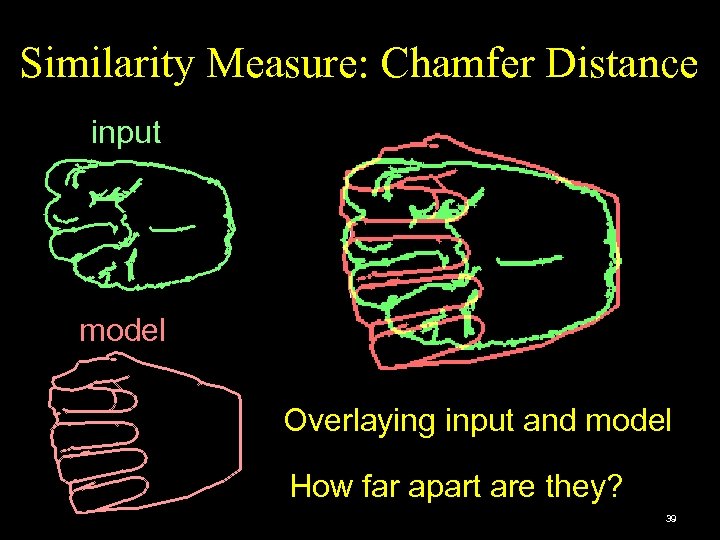 Similarity Measure: Chamfer Distance input model Overlaying input and model How far apart are they? 39
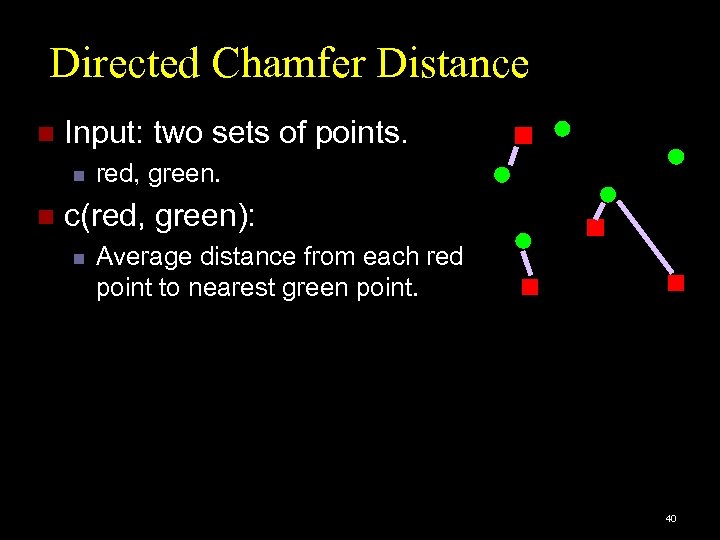 Directed Chamfer Distance n Input: two sets of points. n n red, green. c(red, green): n Average distance from each red point to nearest green point. 40
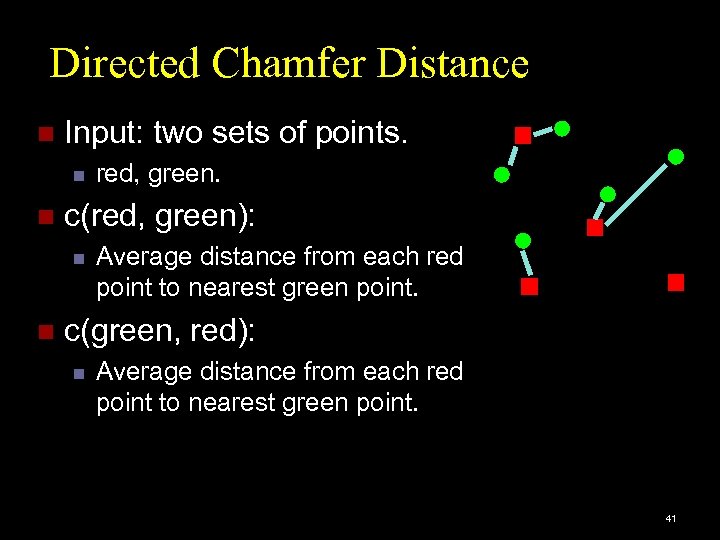 Directed Chamfer Distance n Input: two sets of points. n n c(red, green): n n red, green. Average distance from each red point to nearest green point. c(green, red): n Average distance from each red point to nearest green point. 41
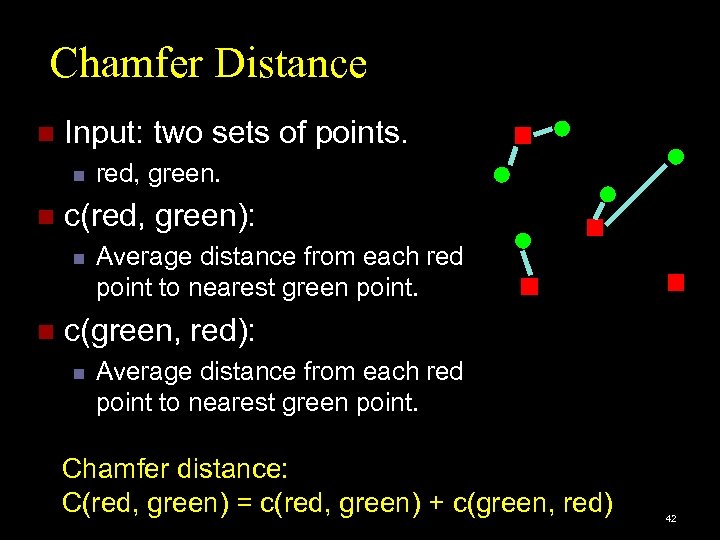 Chamfer Distance n Input: two sets of points. n n c(red, green): n n red, green. Average distance from each red point to nearest green point. c(green, red): n Average distance from each red point to nearest green point. Chamfer distance: C(red, green) = c(red, green) + c(green, red) 42
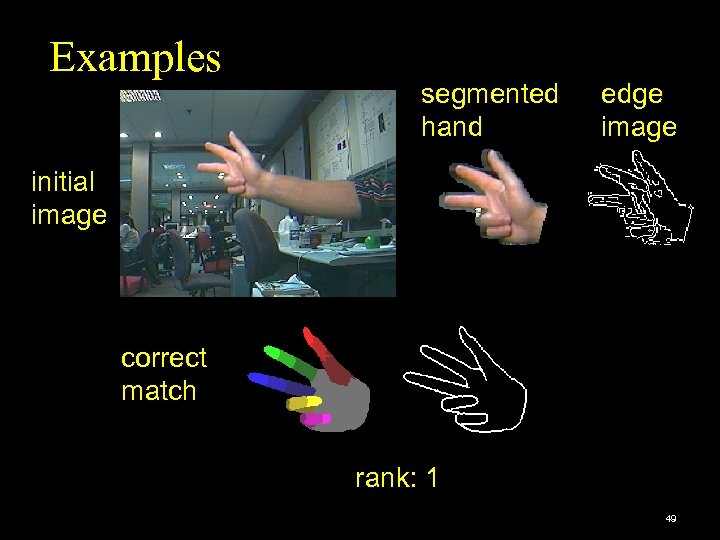
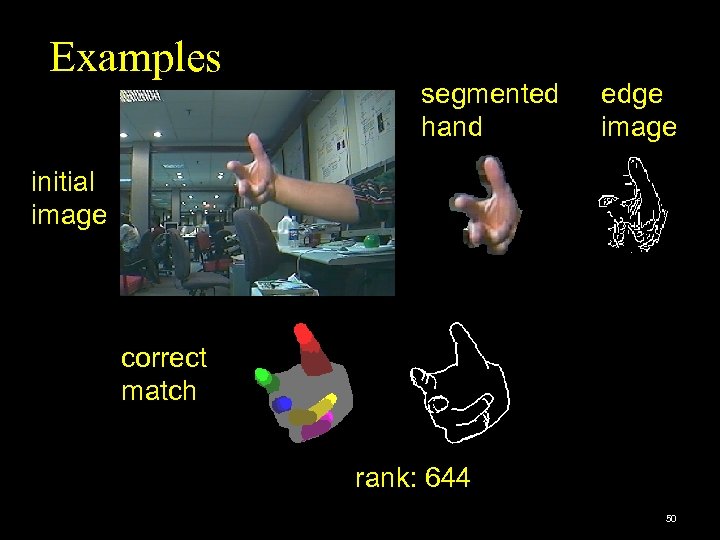
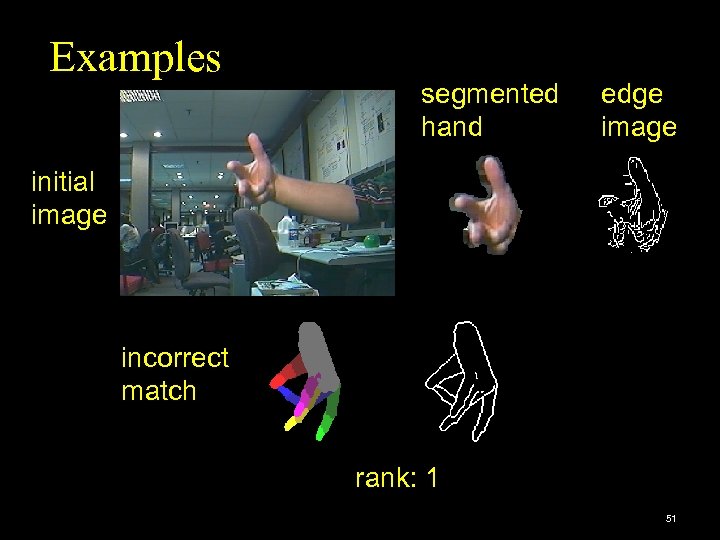
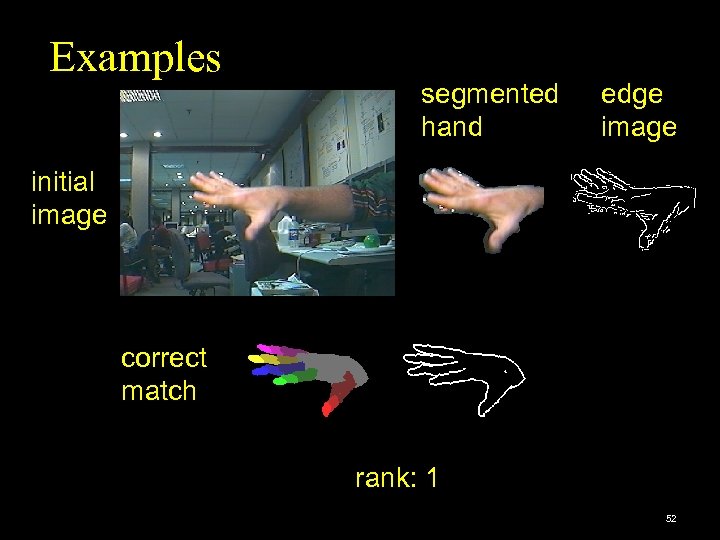
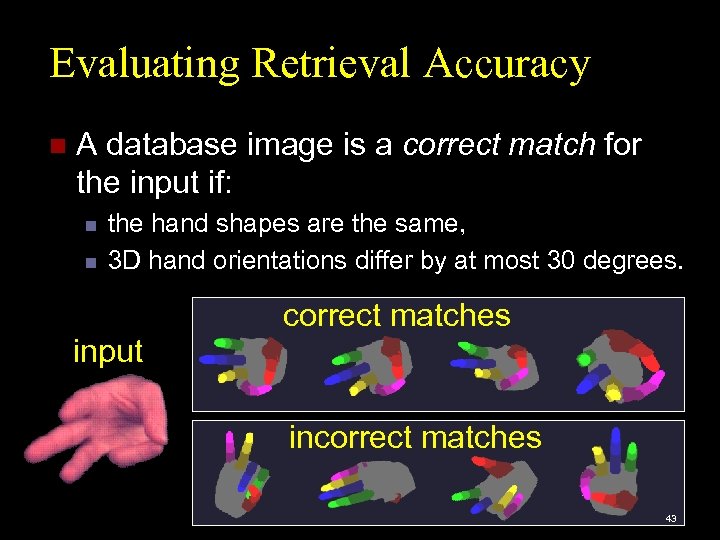 Evaluating Retrieval Accuracy n A database image is a correct match for the input if: n n the hand shapes are the same, 3 D hand orientations differ by at most 30 degrees. correct matches input incorrect matches 43
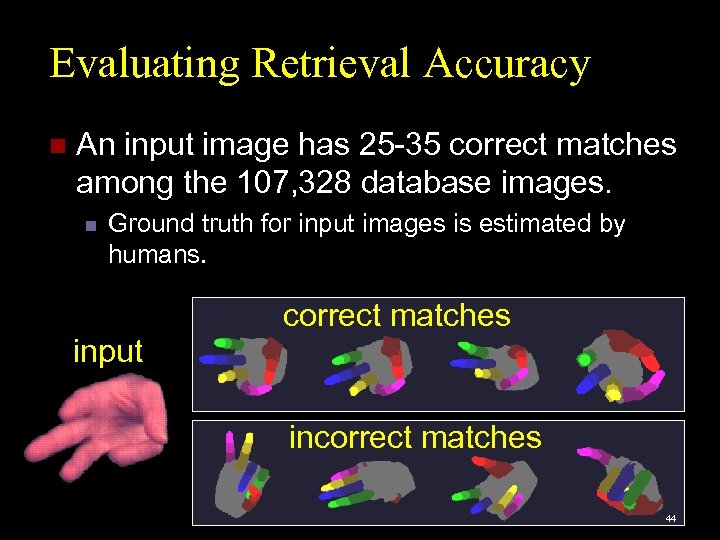 Evaluating Retrieval Accuracy n An input image has 25 -35 correct matches among the 107, 328 database images. n Ground truth for input images is estimated by humans. correct matches input incorrect matches 44
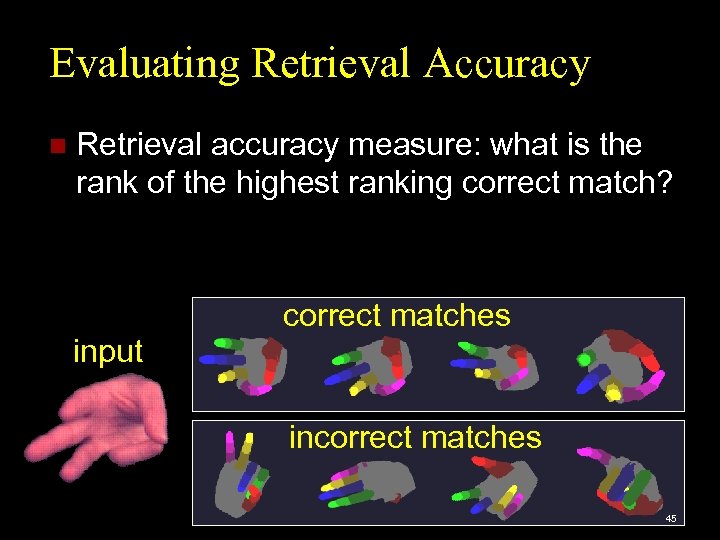 Evaluating Retrieval Accuracy n Retrieval accuracy measure: what is the rank of the highest ranking correct match? correct matches input incorrect matches 45
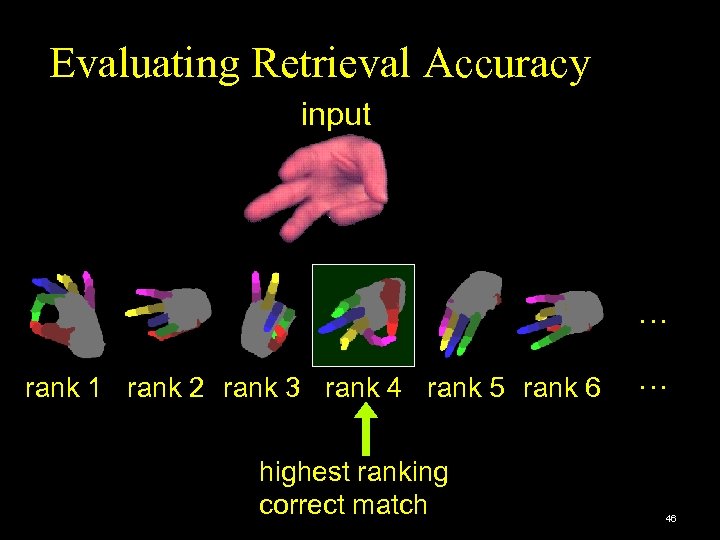 Evaluating Retrieval Accuracy input … rank 1 rank 2 rank 3 rank 4 rank 5 rank 6 highest ranking correct match … 46
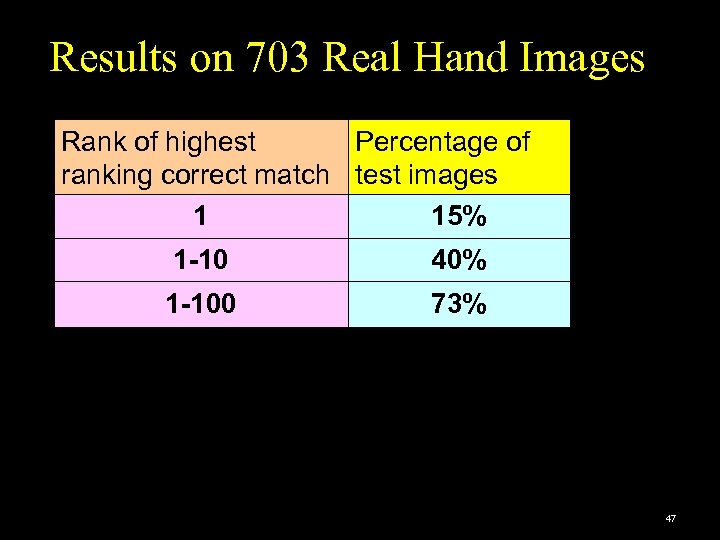 Results on 703 Real Hand Images Rank of highest Percentage of ranking correct match test images 1 15% 1 -10 40% 1 -100 73% 47
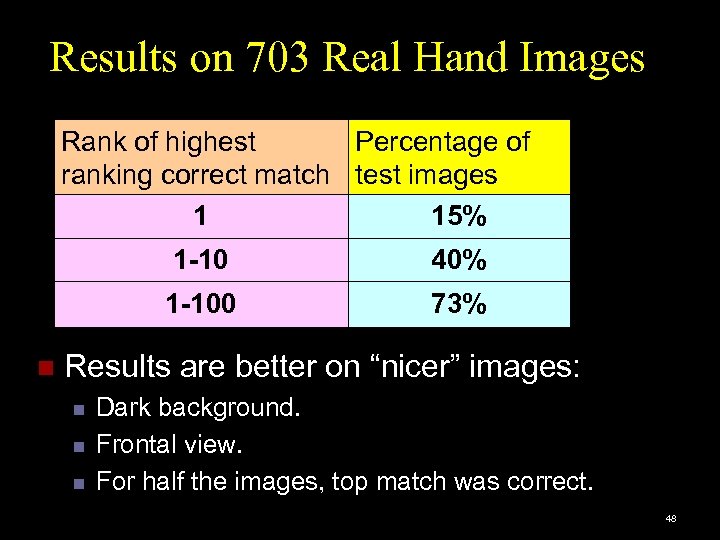 Results on 703 Real Hand Images Rank of highest Percentage of ranking correct match test images 1 15% 1 -100 n 40% 73% Results are better on “nicer” images: n n n Dark background. Frontal view. For half the images, top match was correct. 48
 Examples segmented hand edge image initial image correct match rank: 1 49
 Examples segmented hand edge image initial image correct match rank: 644 50
 Examples segmented hand edge image initial image incorrect match rank: 1 51
 Examples segmented hand edge image initial image correct match rank: 1 52
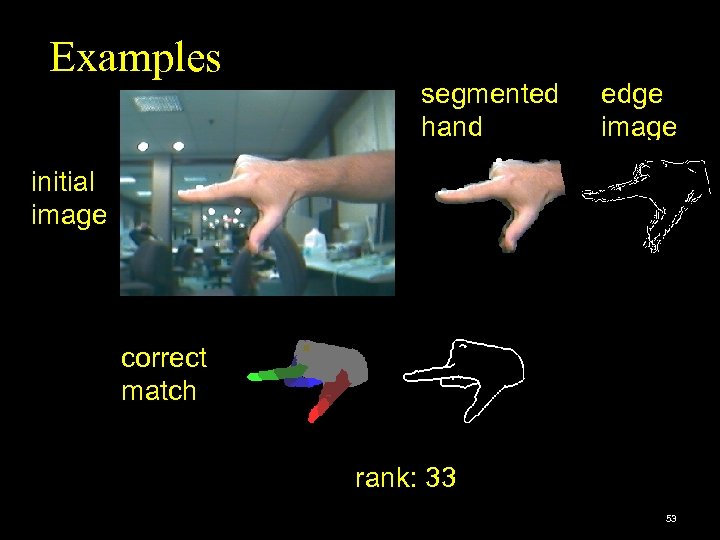 Examples segmented hand edge image initial image correct match rank: 33 53
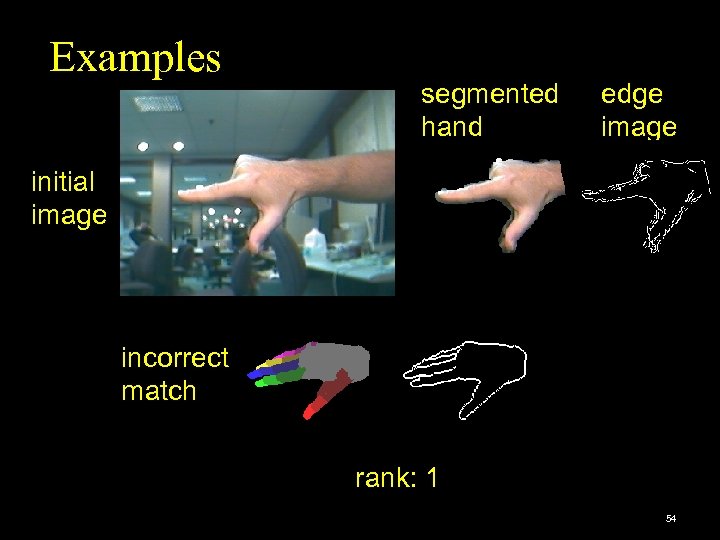 Examples segmented hand edge image initial image incorrect match rank: 1 54
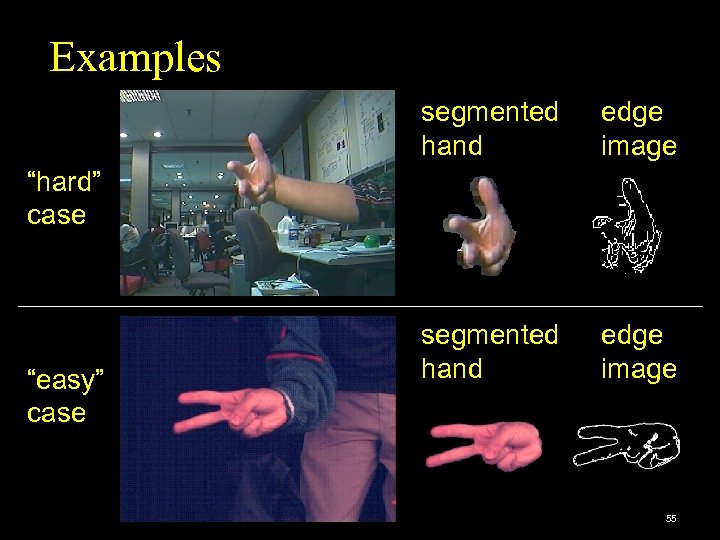 Examples segmented hand edge image “hard” case “easy” case 55
 Discussion 3 D pose estimation from a single image is hard! n What is our system good for? n n Cleanly segmented frontal views. Generating hypotheses that domain knowledge/constraints can disambiguate. Tracker initialization and error recovery. n How would our system be integrated with a tracker? 56
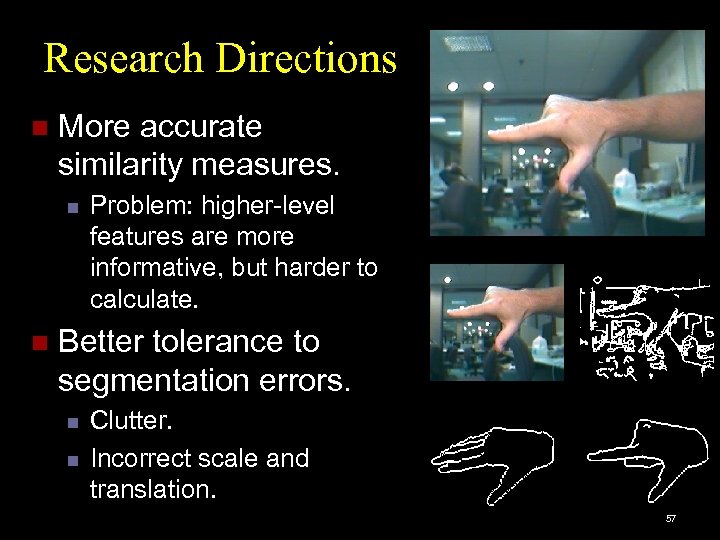 Research Directions n More accurate similarity measures. n n Problem: higher-level features are more informative, but harder to calculate. Better tolerance to segmentation errors. n n Clutter. Incorrect scale and translation. 57
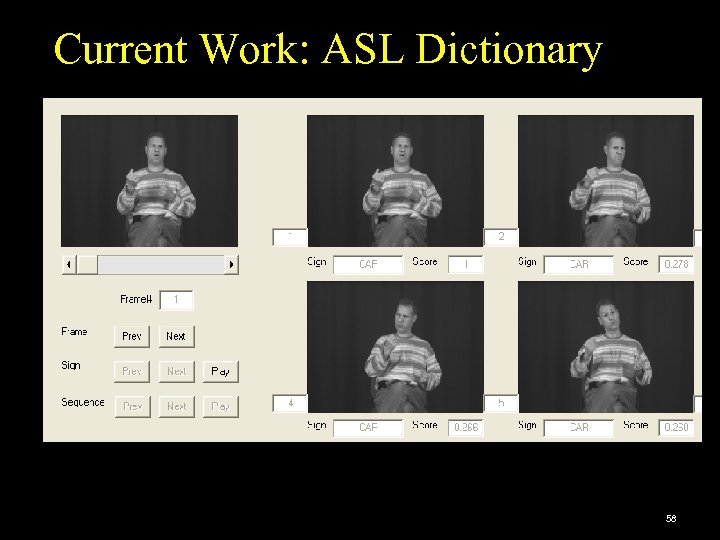 Current Work: ASL Dictionary 58
 Current Work: ASL Dictionary n Computer vision challenge: n n n Estimate hand pose and motion accurately and fast. Our existing hand pose method leaves many questions unanswered. Machine learning challenge: n n Currently, in DSTW, there is no learning. learn models of signs. n n 4000 classes, 1 -5 examples per sign. Data mining challenge: n indexing methods for large numbers of classes. 59
 n Comments, n E-mail: n Web: questions, complaints… athitsos@uta. edu http: //crystal. uta. edu/~athitsos/ END 60