 Скачать презентацию Gerhard Eschelbeck CTO and VP Engineering Qualys Black
775f641a41dcdaac0e4d6c452fdf4ece.ppt
- Количество слайдов: 40




Gerhard Eschelbeck CTO and VP Engineering Qualys Black. Hat Conference Japan October 2004
Agenda § Evolution of Threats § Research Methodology § One Year After: Update on the External Data § The Internal Data § The Laws of Vulnerabilities § Summary and Action 2
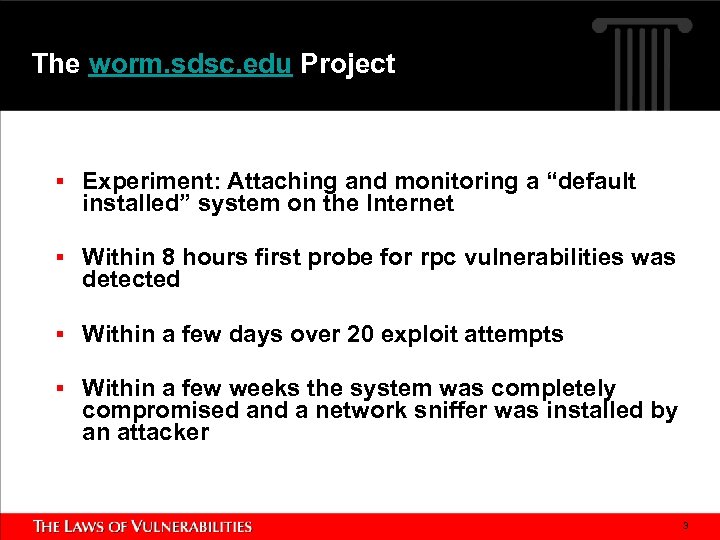
The worm. sdsc. edu Project § Experiment: Attaching and monitoring a “default installed” system on the Internet § Within 8 hours first probe for rpc vulnerabilities was detected § Within a few days over 20 exploit attempts § Within a few weeks the system was completely compromised and a network sniffer was installed by an attacker 3
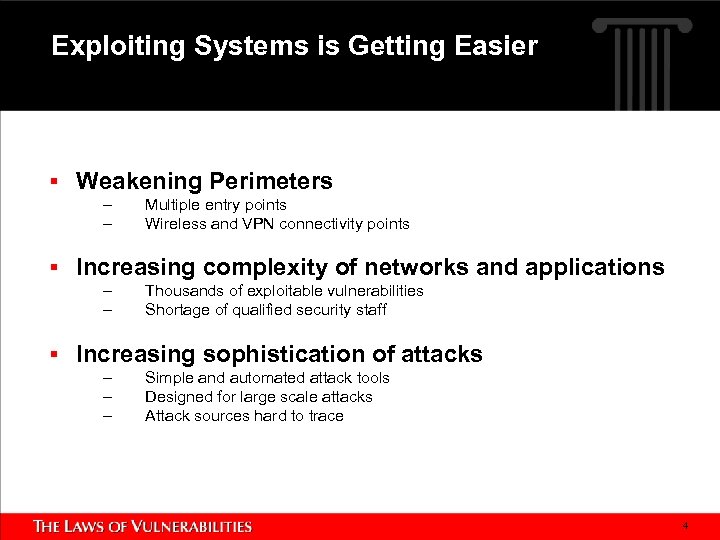
Exploiting Systems is Getting Easier § Weakening Perimeters – – Multiple entry points Wireless and VPN connectivity points § Increasing complexity of networks and applications – – Thousands of exploitable vulnerabilities Shortage of qualified security staff § Increasing sophistication of attacks – – – Simple and automated attack tools Designed for large scale attacks Attack sources hard to trace 4
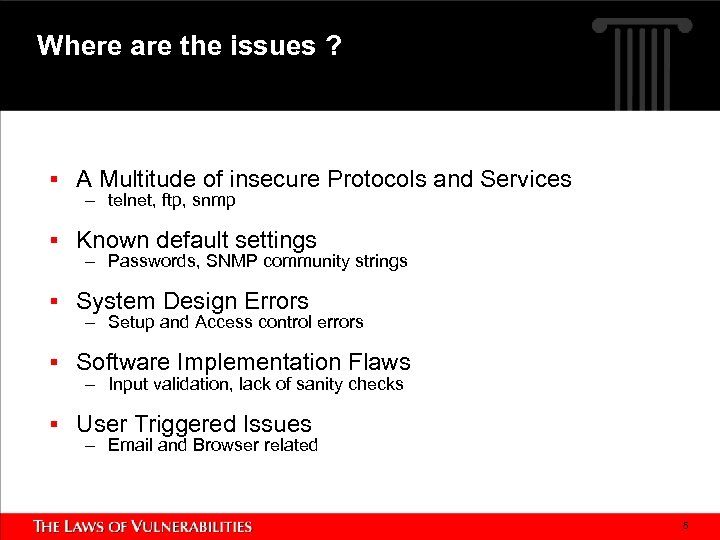
Where are the issues ? § A Multitude of insecure Protocols and Services – telnet, ftp, snmp § Known default settings – Passwords, SNMP community strings § System Design Errors – Setup and Access control errors § Software Implementation Flaws – Input validation, lack of sanity checks § User Triggered Issues – Email and Browser related 5
First Generation Threats § Spreading mostly via email, file-sharing § Human Action Required § Virus-type spreading / No vulnerabilities § Examples: Melissa Macro Virus, Love. Letter VBScript Worm § Replicates to other recipients § Discovery/Removal: Antivirus 6
What happened since then ? § Security flaws in all relevant software packages § 40 new vulnerabilities per week § Internet Explorer: 100+ vulnerabilities § 802. 11 wireless security broken § Successful attacks against the Internet root DNS servers § Popularity of the “Port 80 Loophole” § Major worm outbreaks 7
Second Generation Threats § Active worms § Leveraging known vulnerabilities § Low level of sophistication in spreading strategy (i. e. § § randomly) Non Destructive Payloads Blended threats (consists of virus, trojan, exploits vulnerabilities, automation) System and Application level attacks Remedy: Identify and Fix Vulnerabilities 8
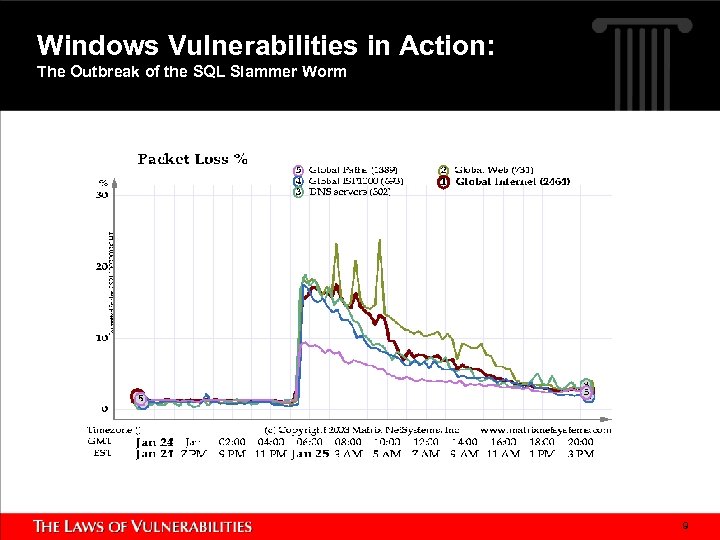
Windows Vulnerabilities in Action: The Outbreak of the SQL Slammer Worm 9
What’s Next ? § Improved speed and strategy to identify new vulnerable targets § Popularity of the exploited system/application/platform § Affecting New Technologies/Applications § Shortening Vulnerability/Exploit Life-Cycle 10
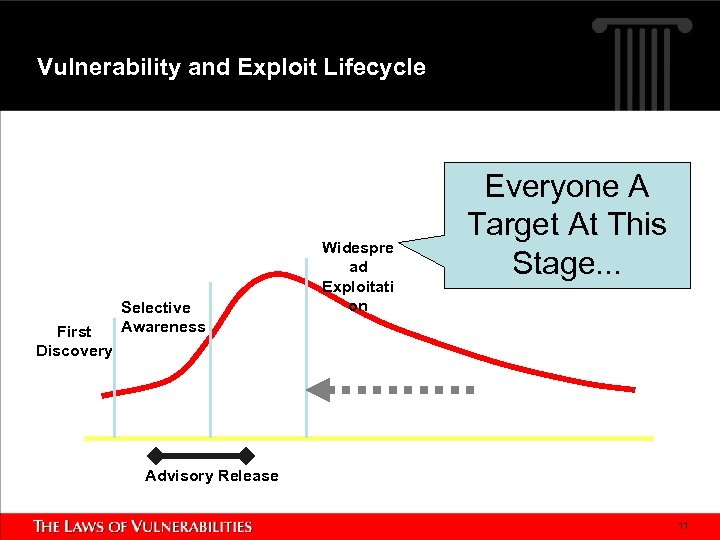
Vulnerability and Exploit Lifecycle First Discovery Selective Awareness Widespre ad Exploitati on Everyone A Target At This Stage. . . Advisory Release 11
Third Generation (Future) Threats § Leveraging known and unknown vulnerabilities § Precompiled list of initial victims to provide aggressive § § growth Active Payloads Leveraging polymorphic techniques and encryption to prevent discovery Multiple attack vectors Impact on new Technologies (Instant Messaging, Wireless Networks, Voice over IP, . . . ) 12
Firewalls and IDS are not protecting § Enforcement (Firewalls) • Structuring at the network level – building security zones • limited visibility at application level • Mostly static in decision making § Secure Transport (VPN) • Expanding corporate networks into the Internet § Monitoring (IDS) • Limited scope of data for decision making • Massive amounts of log/report information • Mostly reactive 13
Research § Objective: Understanding prevalence of critical vulnerabilities over time in real world § Timeframe: January 2002 - Ongoing § Data Source: – 70% Global Enterprise networks – 30 % Random trials § Methodology: Automatic Data collection with statistical data only – no possible correlation to individual user or systems 14
External and Internal Data Sources Sasser Worm Blaster Worm 15
Raw Results § Largest collection of global real-world vulnerability data: – 6, 627, 000 IP-Scans since begin 2002 – 2, 275 out of 3, 374 unique vulnerabilities detected in the real world – 3, 834, 000 total critical* vulnerabilities found – 1, 031 out of 1, 504 unique critical vulnerabilities detected in the real world * Providing an attacker the ability to gain full control of the system, and/or leakage of highly sensitive information. For example, vulnerabilities may enable full read and/or write access to files, remote execution of commands, and the presence of backdoors. 16
Analysis Performed § § § Identifying Window of Exposure Lifespan of Critical Vulnerabilities Resolution Response Trend over Time Vulnerability Prevalence 17
Microsoft Web. DAV Vulnerability Microsoft Windows 2000 IIS Web. DAV Buffer Overflow Vulnerability CAN-2003 -0109 Qualys ID 86479 Released: March 2003 18
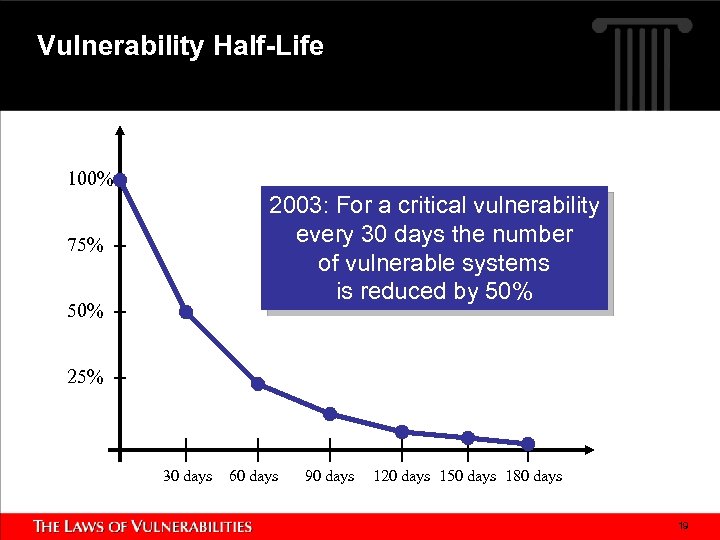
Vulnerability Half-Life 100% 2003: For a critical vulnerability every 30 days the number of vulnerable systems is reduced by 50% 75% 50% 25% 30 days 60 days 90 days 120 days 150 days 180 days 19
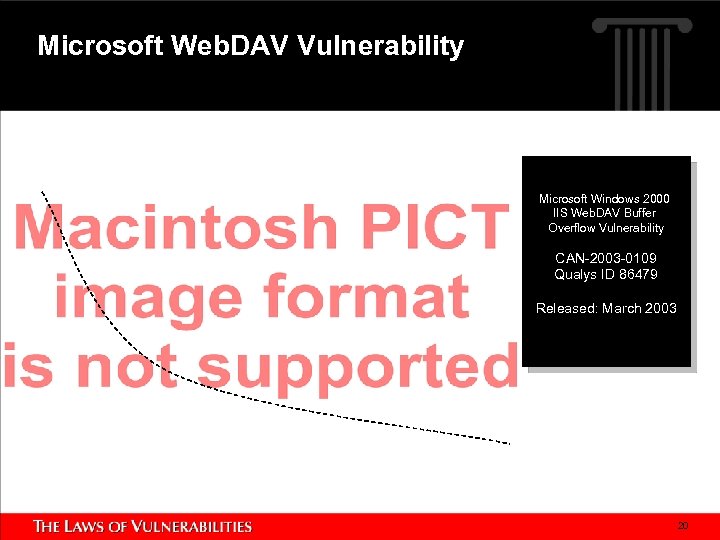
Microsoft Web. DAV Vulnerability Microsoft Windows 2000 IIS Web. DAV Buffer Overflow Vulnerability CAN-2003 -0109 Qualys ID 86479 Released: March 2003 20
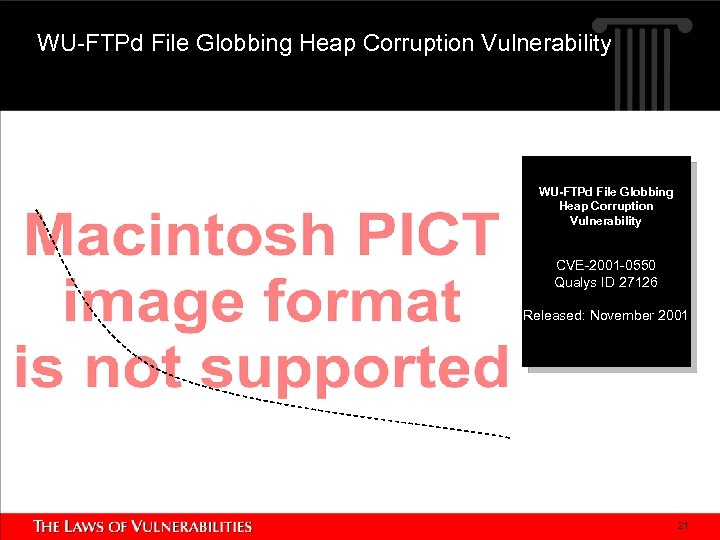
WU-FTPd File Globbing Heap Corruption Vulnerability CVE-2001 -0550 Qualys ID 27126 Released: November 2001 21
Microsoft Windows ASN. 1 Library Integer Handling Vulnerability CAN-2003 -0818 Qualys ID 90103 Released: February 2004 22
Buffer overflow in Microsoft Local Security Authority Subsystem Service (LSASS) CAN-2003 -0533 Qualys ID 90108 Released: April 2004 23
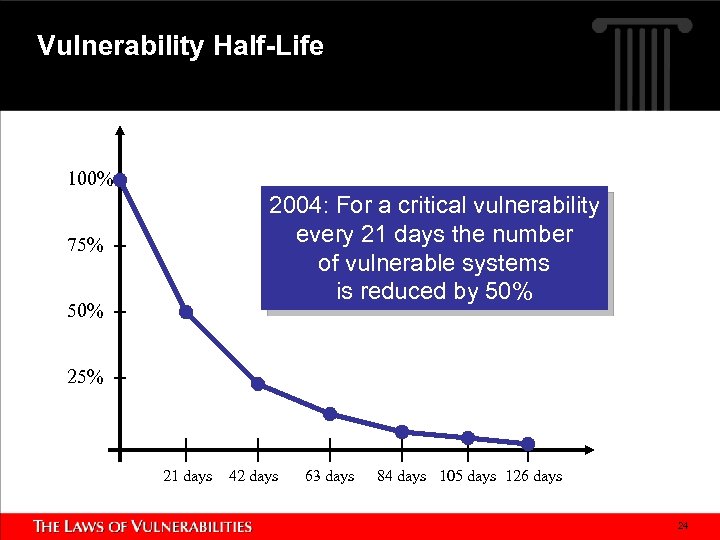
Vulnerability Half-Life 100% 2004: For a critical vulnerability every 21 days the number of vulnerable systems is reduced by 50% 75% 50% 25% 21 days 42 days 63 days 84 days 105 days 126 days 24
Microsoft Exchange Server Buffer Overflow Vulnerability CAN-2003 -0714 Qualys ID 74143 Released: October 2003 25
Microsoft Messenger Service Buffer Overflow Vulnerability CAN-2003 -0717 Qualys ID 70032 Released: October 2003 26
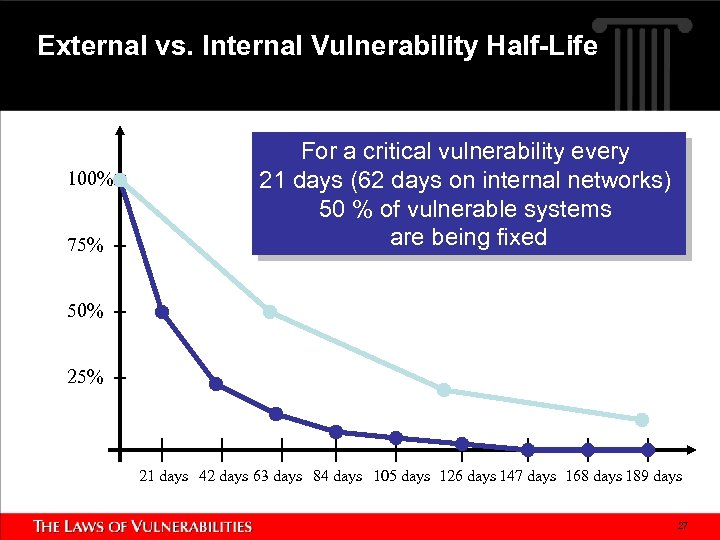
External vs. Internal Vulnerability Half-Life 100% 75% For a critical vulnerability every 21 days (62 days on internal networks) 50 % of vulnerable systems are being fixed 50% 25% 21 days 42 days 63 days 84 days 105 days 126 days 147 days 168 days 189 days 27

SSL Server Allows Cleartext Communication Qualys ID 38143 28
SQL Slammer Vulnerability MS-SQL 8. 0 UDP Slammer Worm Buffer Overflow Vulnerability CAN-2002 -0649 Qualys ID 19070 Released: July 2002 29
A Continuous Cycle of Infection 30
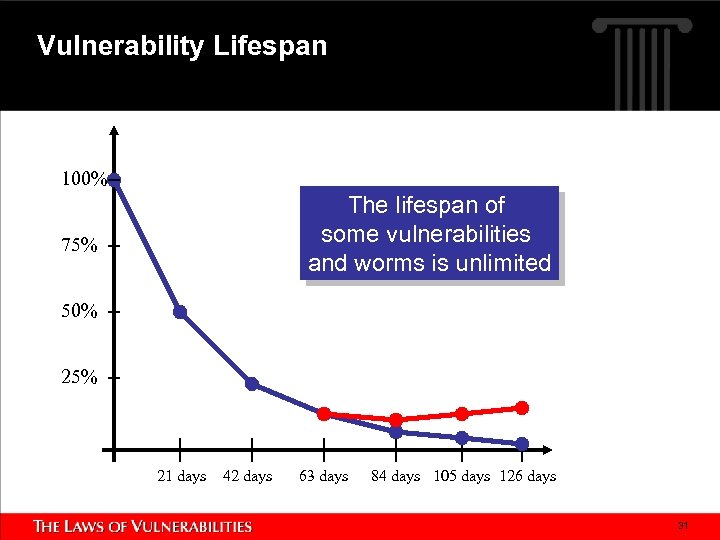
Vulnerability Lifespan 100% The lifespan of some vulnerabilities and worms is unlimited 75% 50% 25% 21 days 42 days 63 days 84 days 105 days 126 days 31
The Sasser Worm and its Victims Buffer overflow in Microsoft Local Security Authority Subsystem Service (LSASS) CAN-2003 -0533 Qualys ID 90108 Released: April 2004 32
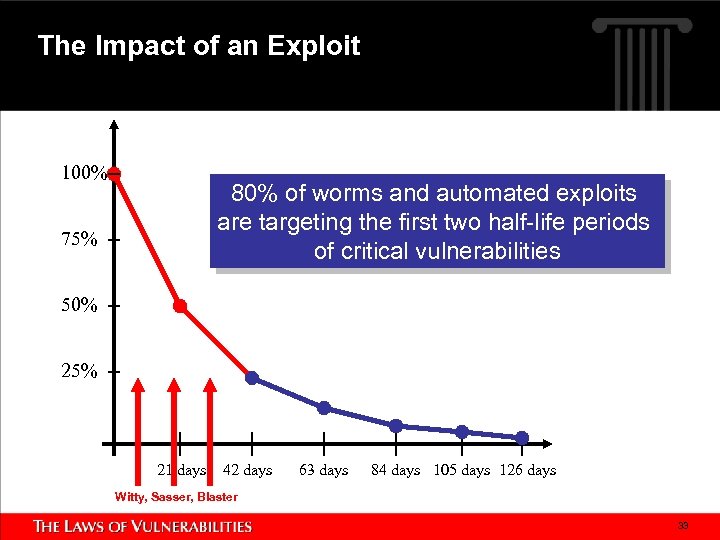
The Impact of an Exploit 100% 80% of worms and automated exploits are targeting the first two half-life periods of critical vulnerabilities 75% 50% 25% 21 days 42 days 63 days 84 days 105 days 126 days Witty, Sasser, Blaster 33
Vulnerability Prevalence Mapping Vulnerability Prevalence Individual Vulnerabilities 34
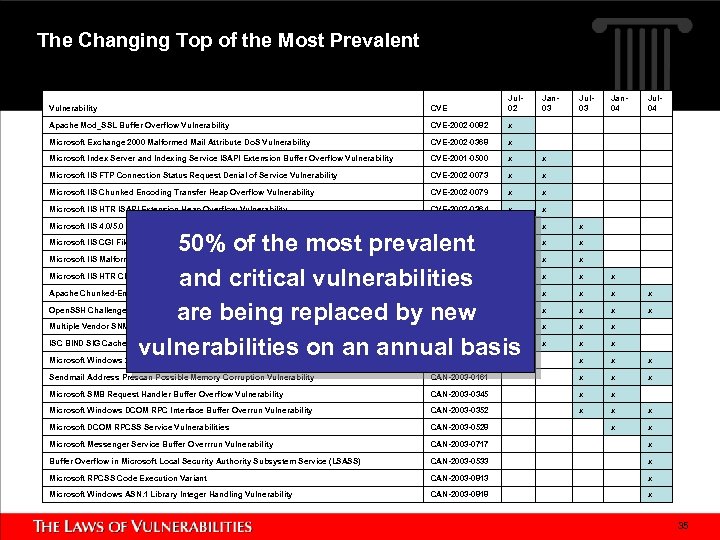
The Changing Top of the Most Prevalent Vulnerability CVE Jul 02 Jan 03 Jul 03 Apache Mod_SSL Buffer Overflow Vulnerability CVE-2002 -0082 x Microsoft Exchange 2000 Malformed Mail Attribute Do. S Vulnerability CVE-2002 -0368 x Microsoft Index Server and Indexing Service ISAPI Extension Buffer Overflow Vulnerability CVE-2001 -0500 x x Microsoft IIS FTP Connection Status Request Denial of Service Vulnerability CVE-2002 -0073 x x Microsoft IIS Chunked Encoding Transfer Heap Overflow Vulnerability CVE-2002 -0079 x x Microsoft IIS HTR ISAPI Extension Heap Overflow Vulnerability CVE-2002 -0364 x x Microsoft IIS 4. 0/5. 0 Extended UNICODE Remote Execution Vulnerability CVE-2000 -0884 x x x Microsoft IIS CGI Filename Decode Error Vulnerability CVE-2001 -0333 x x x Microsoft IIS Malformed HTR Request Buffer Overflow Vulnerability CVE-2002 -0071 x x x Microsoft IIS HTR Chunked Encoding Transfer Heap Overflow Vulnerability CVE-2002 -0364 x x Apache Chunked-Encoding Memory Corruption Vulnerability CVE-2002 -0392 x x x Open. SSH Challenge-Response Authentication Integer Overflow Vulnerability CVE-2002 -0639 x x x Multiple Vendor SNMP Request And Trap Handling Vulnerabilities CAN-2002 -0012 x x x ISC BIND SIG Cached Resource Record Buffer Overflow ( sigrec bug) Vulnerability CAN-2002 -1219 x x x Microsoft Windows 2000 IIS Web. DAV Buffer Overflow Vulnerability CAN-2003 -0109 x x x Sendmail Address Prescan Possible Memory Corruption Vulnerability CAN-2003 -0161 x x x Microsoft SMB Request Handler Buffer Overflow Vulnerability CAN-2003 -0345 x x Microsoft Windows DCOM RPC Interface Buffer Overrun Vulnerability CAN-2003 -0352 x x x Microsoft DCOM RPCSS Service Vulnerabilities CAN-2003 -0528 x x Microsoft Messenger Service Buffer Overrrun Vulnerability CAN-2003 -0717 x Buffer Overflow in Microsoft Local Security Authority Subsystem Service (LSASS) CAN-2003 -0533 x Microsoft RPCSS Code Execution Variant CAN-2003 -0813 x Microsoft Windows ASN. 1 Library Integer Handling Vulnerability CAN-2003 -0818 x 50% of the most prevalent and critical vulnerabilities are being replaced by new vulnerabilities on an annual basis Jan 04 Jul 04 35
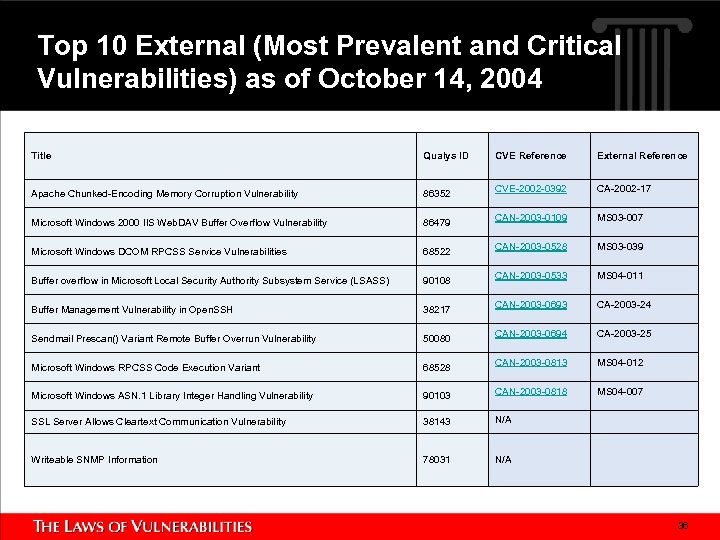
Top 10 External (Most Prevalent and Critical Vulnerabilities) as of October 14, 2004 Title Qualys ID CVE Reference External Reference Apache Chunked-Encoding Memory Corruption Vulnerability 86352 CVE-2002 -0392 CA-2002 -17 Microsoft Windows 2000 IIS Web. DAV Buffer Overflow Vulnerability 86479 CAN-2003 -0109 MS 03 -007 Microsoft Windows DCOM RPCSS Service Vulnerabilities 68522 CAN-2003 -0528 MS 03 -039 Buffer overflow in Microsoft Local Security Authority Subsystem Service (LSASS) 90108 CAN-2003 -0533 MS 04 -011 Buffer Management Vulnerability in Open. SSH 38217 CAN-2003 -0693 CA-2003 -24 Sendmail Prescan() Variant Remote Buffer Overrun Vulnerability 50080 CAN-2003 -0694 CA-2003 -25 Microsoft Windows RPCSS Code Execution Variant 68528 CAN-2003 -0813 MS 04 -012 Microsoft Windows ASN. 1 Library Integer Handling Vulnerability 90103 CAN-2003 -0818 MS 04 -007 SSL Server Allows Cleartext Communication Vulnerability 38143 N/A Writeable SNMP Information 78031 N/A 36
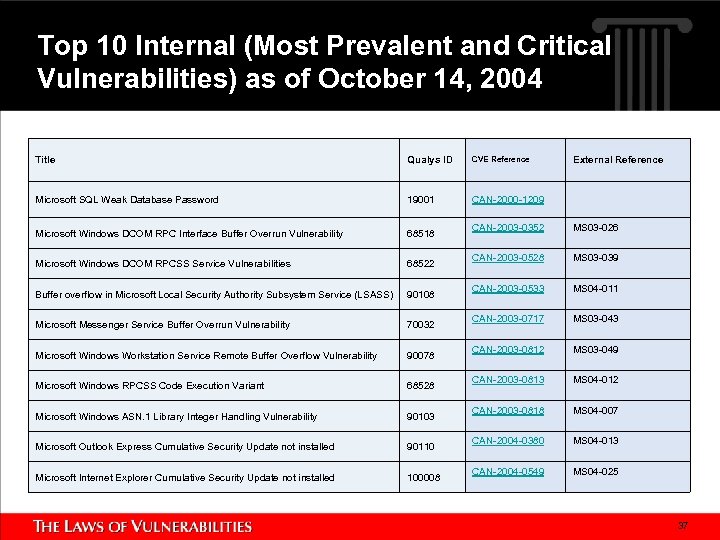
Top 10 Internal (Most Prevalent and Critical Vulnerabilities) as of October 14, 2004 Title Qualys ID CVE Reference Microsoft SQL Weak Database Password 19001 CAN-2000 -1209 Microsoft Windows DCOM RPC Interface Buffer Overrun Vulnerability 68518 Microsoft Windows DCOM RPCSS Service Vulnerabilities 68522 Buffer overflow in Microsoft Local Security Authority Subsystem Service (LSASS) 90108 Microsoft Messenger Service Buffer Overrun Vulnerability 70032 Microsoft Windows Workstation Service Remote Buffer Overflow Vulnerability 90078 Microsoft Windows RPCSS Code Execution Variant 68528 Microsoft Windows ASN. 1 Library Integer Handling Vulnerability 90103 Microsoft Outlook Express Cumulative Security Update not installed 90110 Microsoft Internet Explorer Cumulative Security Update not installed 100008 External Reference CAN-2003 -0352 MS 03 -026 CAN-2003 -0528 MS 03 -039 CAN-2003 -0533 MS 04 -011 CAN-2003 -0717 MS 03 -043 CAN-2003 -0812 MS 03 -049 CAN-2003 -0813 MS 04 -012 CAN-2003 -0818 MS 04 -007 CAN-2004 -0380 MS 04 -013 CAN-2004 -0549 MS 04 -025 37
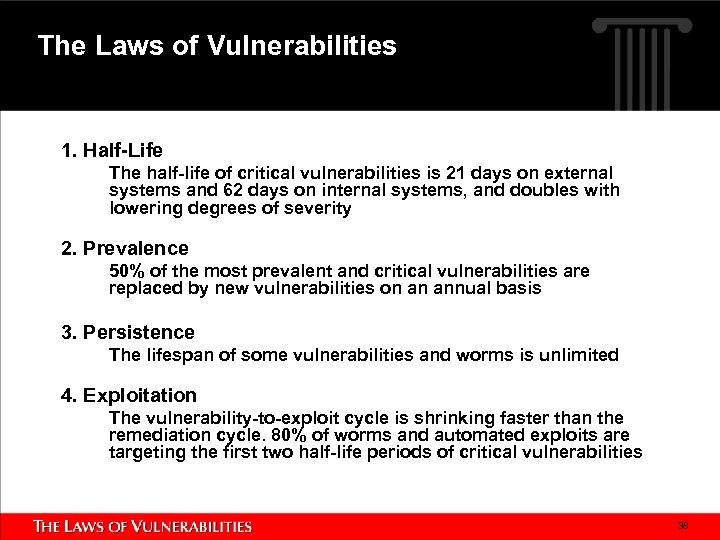
The Laws of Vulnerabilities 1. Half-Life The half-life of critical vulnerabilities is 21 days on external systems and 62 days on internal systems, and doubles with lowering degrees of severity 2. Prevalence 50% of the most prevalent and critical vulnerabilities are replaced by new vulnerabilities on an annual basis 3. Persistence The lifespan of some vulnerabilities and worms is unlimited 4. Exploitation The vulnerability-to-exploit cycle is shrinking faster than the remediation cycle. 80% of worms and automated exploits are targeting the first two half-life periods of critical vulnerabilities 38
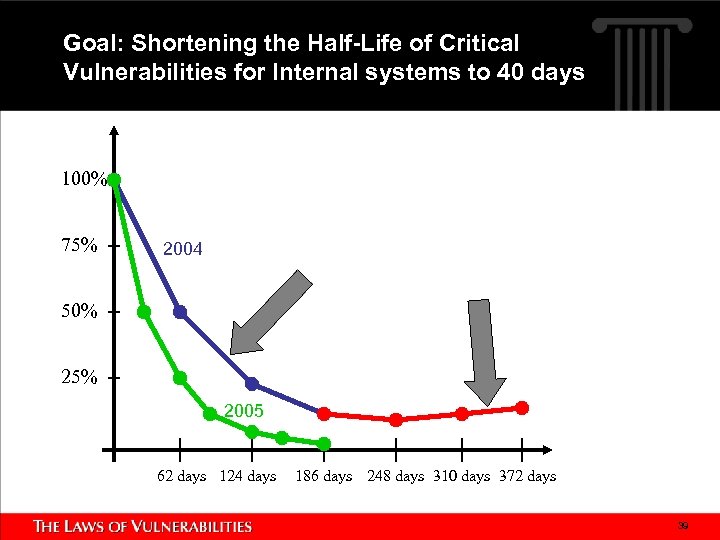
Goal: Shortening the Half-Life of Critical Vulnerabilities for Internal systems to 40 days 100% 75% 2004 50% 25% 2005 62 days 124 days 186 days 248 days 310 days 372 days 39
Summary and Actions we can take: § Significant progress on the Remediation Cycle (30 to 21 days) for external Vulnerabilities § Goal: Shortening the Half-Life of internal vulnerabilities from 62 days to 40 days within one year § Required: Your support to reach this goal § References: – http: //www. qualys. com/laws This presentation and any future updates – http: //www. qualys. com/top 10 Continuously updated Top Ten Index of most prevalent and critical external and internal vulnerabilities – http: //www. qualys. com/top 10 scan Free Top Ten Assessment Tool § Comments and Suggestions: geschelbeck@qualys. com 40
Скачать презентацию Gerhard Eschelbeck CTO and VP Engineering Qualys Black
775f641a41dcdaac0e4d6c452fdf4ece.ppt