 Скачать презентацию Геохимия тантала и ниобия Aleksandr Stepanov CODES UTAS
Stepanov_Nb-Ta.NSU.ppt
- Количество слайдов: 28



Геохимия тантала и ниобия Aleksandr Stepanov CODES, UTAS March, 2013
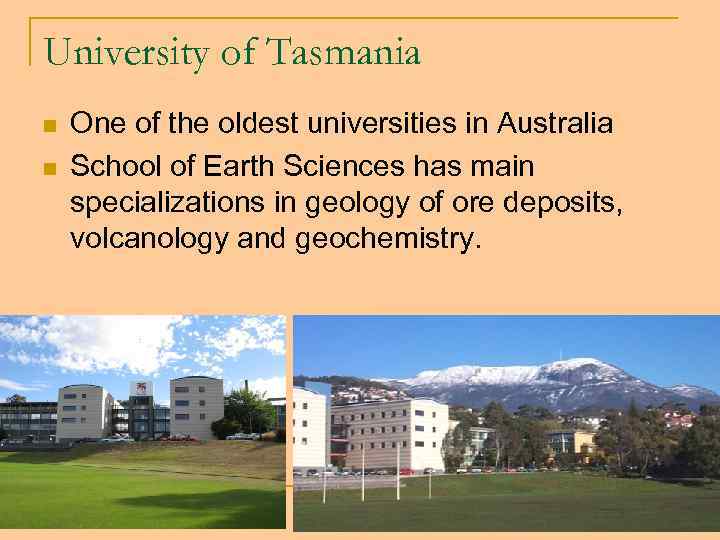
University of Tasmania n n One of the oldest universities in Australia School of Earth Sciences has main specializations in geology of ore deposits, volcanology and geochemistry.
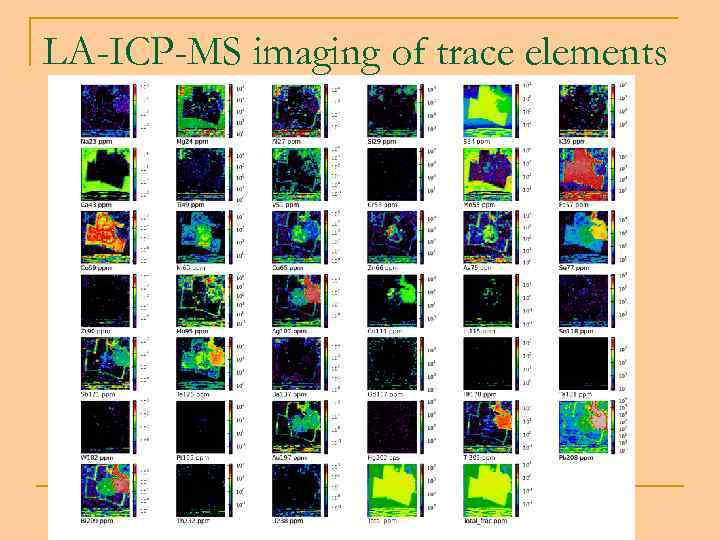
LA-ICP-MS imaging of trace elements
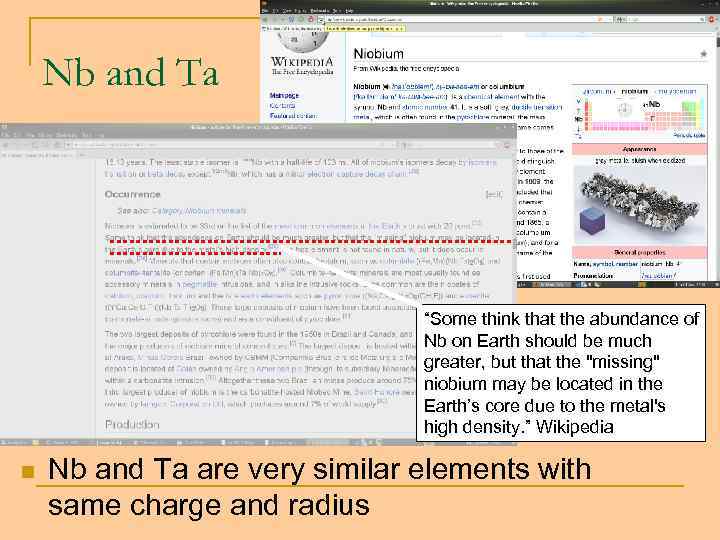
Nb and Ta “Some think that the abundance of Nb on Earth should be much greater, but that the "missing" niobium may be located in the Earth’s core due to the metal's high density. ” Wikipedia n Nb and Ta are very similar elements with same charge and radius
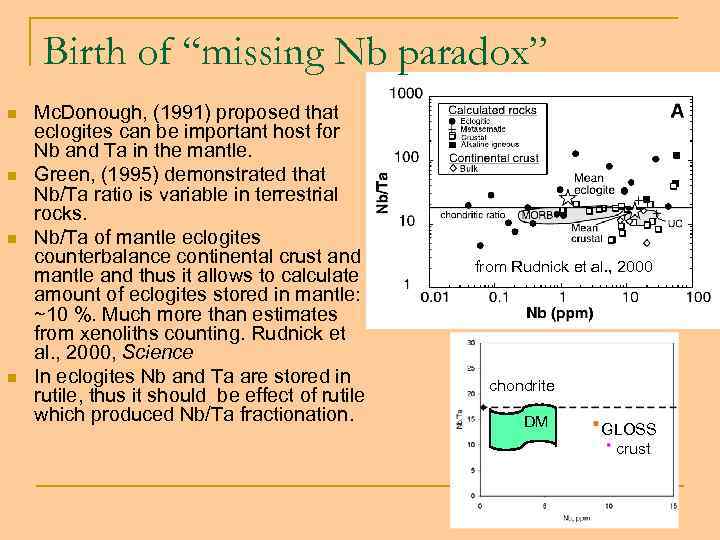
Birth of “missing Nb paradox” n n Mc. Donough, (1991) proposed that eclogites can be important host for Nb and Ta in the mantle. Green, (1995) demonstrated that Nb/Ta ratio is variable in terrestrial rocks. Nb/Ta of mantle eclogites counterbalance continental crust and mantle and thus it allows to calculate amount of eclogites stored in mantle: ~10 %. Much more than estimates from xenoliths counting. Rudnick et al. , 2000, Science In eclogites Nb and Ta are stored in rutile, thus it should be effect of rutile which produced Nb/Ta fractionation. from Rudnick et al. , 2000 chondrite DM GLOSS crust
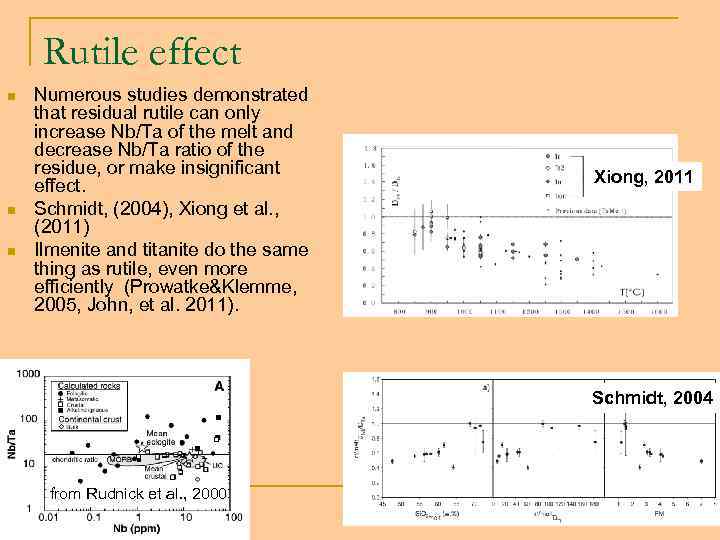
Rutile effect n n n Numerous studies demonstrated that residual rutile can only increase Nb/Ta of the melt and decrease Nb/Ta ratio of the residue, or make insignificant effect. Schmidt, (2004), Xiong et al. , (2011) Ilmenite and titanite do the same thing as rutile, even more efficiently (Prowatke&Klemme, 2005, John, et al. 2011). Xiong, 2011 Schmidt, 2004 from Rudnick et al. , 2000
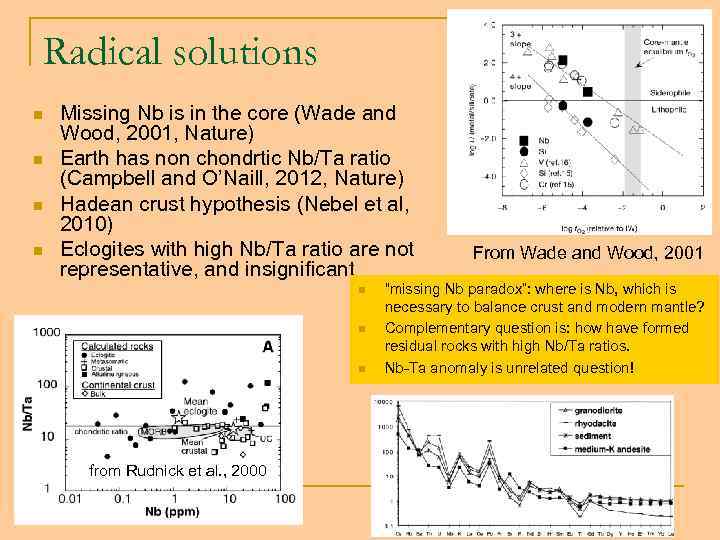
Radical solutions n n Missing Nb is in the core (Wade and Wood, 2001, Nature) Earth has non chondrtic Nb/Ta ratio (Campbell and O’Naill, 2012, Nature) Hadean crust hypothesis (Nebel et al, 2010) Eclogites with high Nb/Ta ratio are not representative, and insignificant n n n from Rudnick et al. , 2000 From Wade and Wood, 2001 “missing Nb paradox”: where is Nb, which is necessary to balance crust and modern mantle? Complementary question is: how have formed residual rocks with high Nb/Ta ratios. Nb-Ta anomaly is unrelated question!
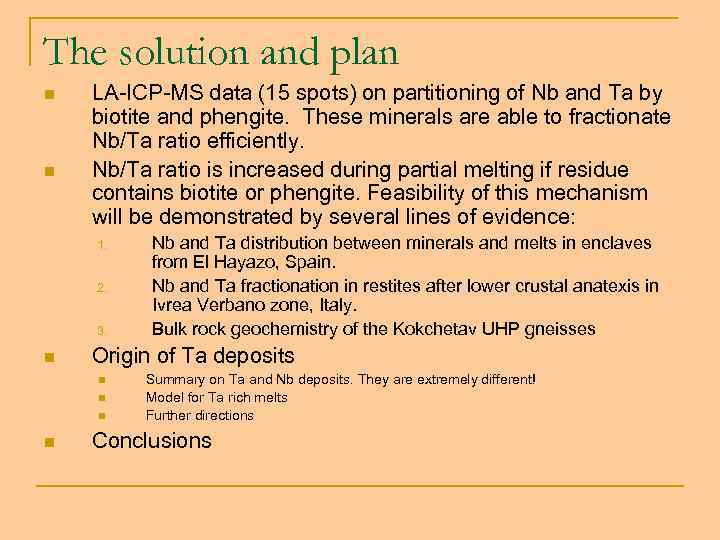
The solution and plan n n LA-ICP-MS data (15 spots) on partitioning of Nb and Ta by biotite and phengite. These minerals are able to fractionate Nb/Ta ratio efficiently. Nb/Ta ratio is increased during partial melting if residue contains biotite or phengite. Feasibility of this mechanism will be demonstrated by several lines of evidence: 1. 2. 3. n Origin of Ta deposits n n Nb and Ta distribution between minerals and melts in enclaves from El Hayazo, Spain. Nb and Ta fractionation in restites after lower crustal anatexis in Ivrea Verbano zone, Italy. Bulk rock geochemistry of the Kokchetav UHP gneisses Summary on Ta and Nb deposits. They are extremely different! Model for Ta rich melts Further directions Conclusions
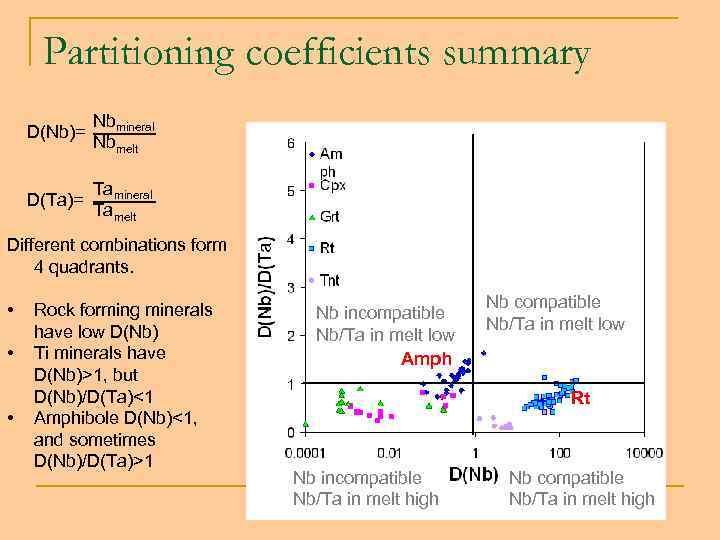
Partitioning coefficients summary D(Nb)= Nbmineral Nbmelt D(Ta)= Tamineral Tamelt Different combinations form 4 quadrants. • • • Rock forming minerals have low D(Nb) Ti minerals have D(Nb)>1, but D(Nb)/D(Ta)<1 Amphibole D(Nb)<1, and sometimes D(Nb)/D(Ta)>1 Nb incompatible Nb/Ta in melt low Amph Nb compatible Nb/Ta in melt low Rt Nb incompatible Nb/Ta in melt high Nb compatible Nb/Ta in melt high
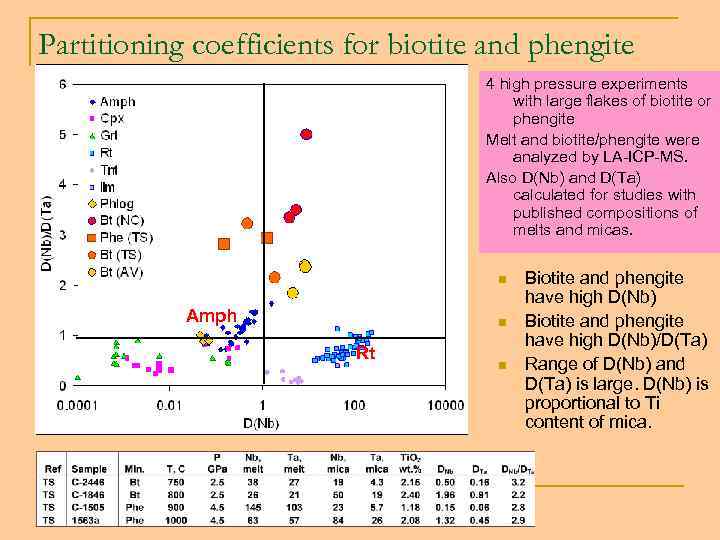
Partitioning coefficients for biotite and phengite 4 high pressure experiments with large flakes of biotite or phengite Melt and biotite/phengite were analyzed by LA-ICP-MS. Also D(Nb) and D(Ta) calculated for studies with published compositions of melts and micas. n Amph n Rt n Biotite and phengite have high D(Nb)/D(Ta) Range of D(Nb) and D(Ta) is large. D(Nb) is proportional to Ti content of mica.
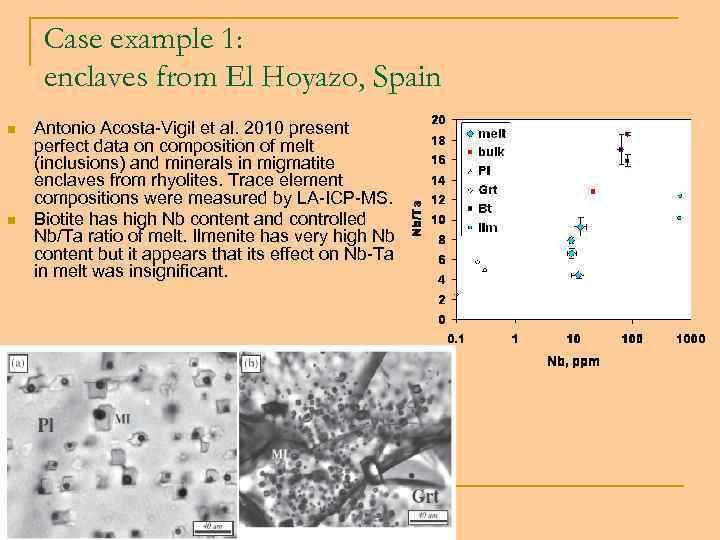
Case example 1: enclaves from El Hoyazo, Spain n n Antonio Acosta-Vigil et al. 2010 present perfect data on composition of melt (inclusions) and minerals in migmatite enclaves from rhyolites. Trace element compositions were measured by LA-ICP-MS. Biotite has high Nb content and controlled Nb/Ta ratio of melt. Ilmenite has very high Nb content but it appears that its effect on Nb-Ta in melt was insignificant.
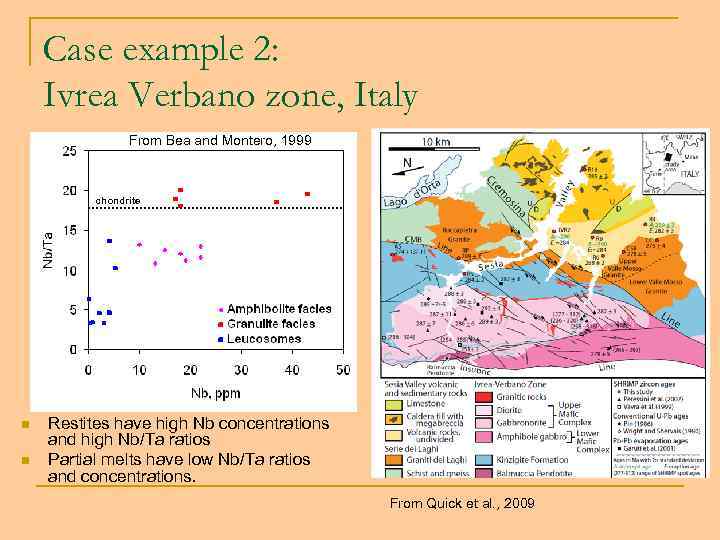
Case example 2: Ivrea Verbano zone, Italy From Bea and Montero, 1999 chondrite n n Restites have high Nb concentrations and high Nb/Ta ratios Partial melts have low Nb/Ta ratios and concentrations. From Quick et al. , 2009
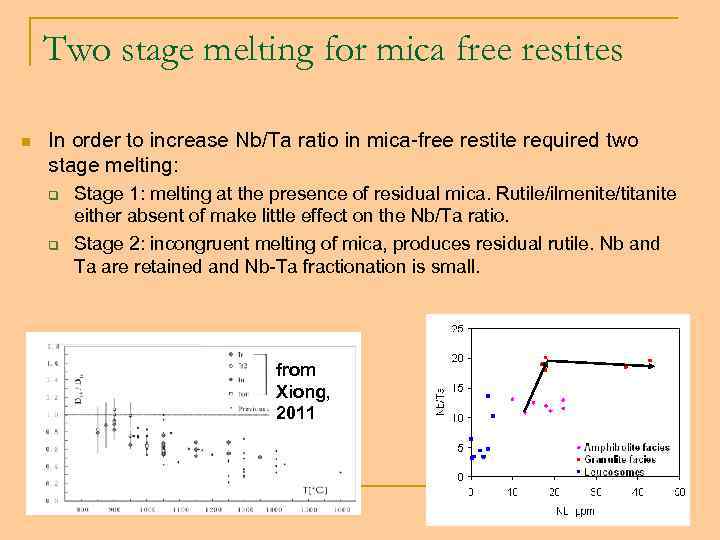
Two stage melting for mica free restites n In order to increase Nb/Ta ratio in mica-free restite required two stage melting: q q Stage 1: melting at the presence of residual mica. Rutile/ilmenite/titanite either absent of make little effect on the Nb/Ta ratio. Stage 2: incongruent melting of mica, produces residual rutile. Nb and Ta are retained and Nb-Ta fractionation is small. from Xiong, 2011
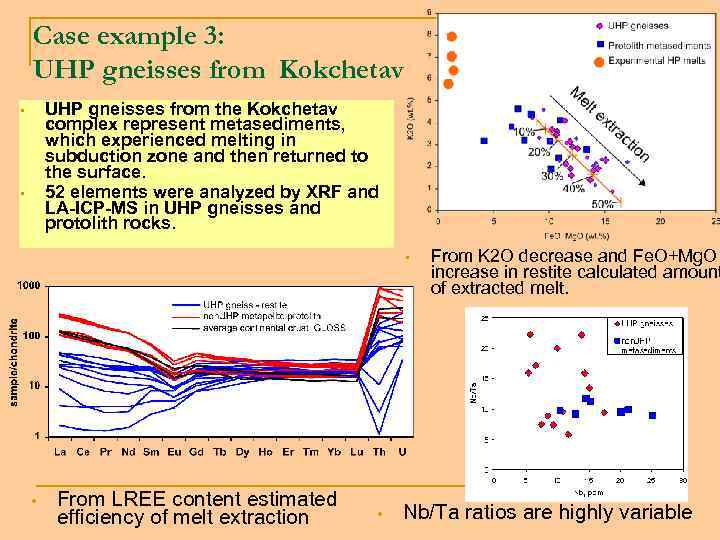
Case example 3: UHP gneisses from Kokchetav UHP gneisses from the Kokchetav complex represent metasediments, which experienced melting in subduction zone and then returned to the surface. 52 elements were analyzed by XRF and LA-ICP-MS in UHP gneisses and protolith rocks. • • From LREE content estimated efficiency of melt extraction • From K 2 O decrease and Fe. O+Mg. O increase in restite calculated amount of extracted melt. Nb/Ta ratios are highly variable
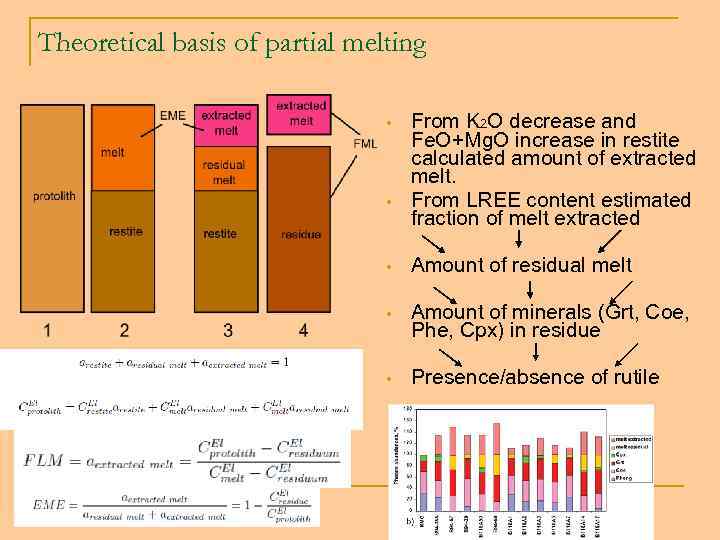
Theoretical basis of partial melting • • From K 2 O decrease and Fe. O+Mg. O increase in restite calculated amount of extracted melt. From LREE content estimated fraction of melt extracted • Amount of residual melt • Amount of minerals (Grt, Coe, Phe, Cpx) in residue • Presence/absence of rutile
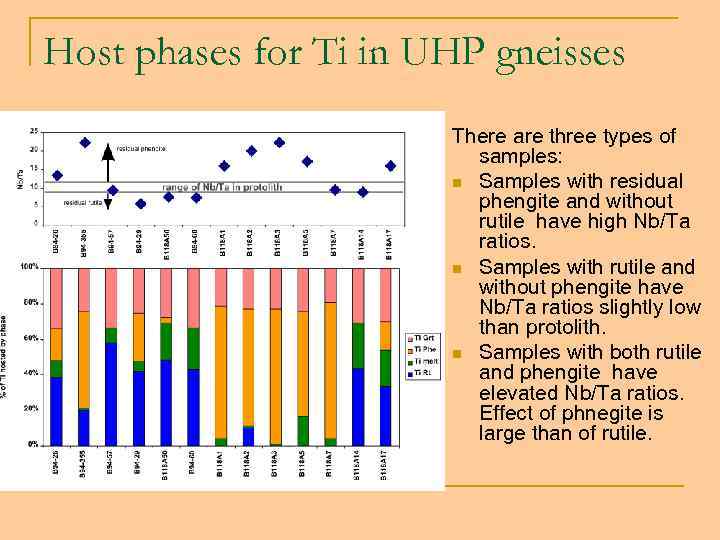
Host phases for Ti in UHP gneisses There are three types of samples: n Samples with residual phengite and without rutile have high Nb/Ta ratios. n Samples with rutile and without phengite have Nb/Ta ratios slightly low than protolith. n Samples with both rutile and phengite have elevated Nb/Ta ratios. Effect of phnegite is large than of rutile.
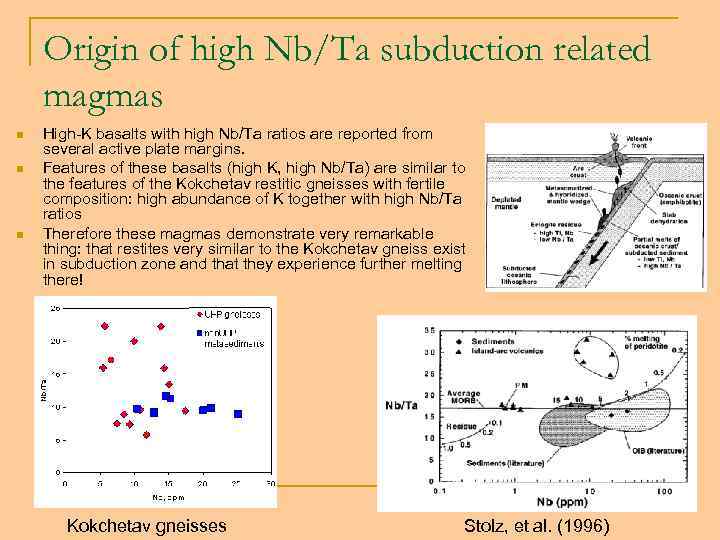
Origin of high Nb/Ta subduction related magmas n n n High-K basalts with high Nb/Ta ratios are reported from several active plate margins. Features of these basalts (high K, high Nb/Ta) are similar to the features of the Kokchetav restitic gneisses with fertile composition: high abundance of K together with high Nb/Ta ratios Therefore these magmas demonstrate very remarkable thing: that restites very similar to the Kokchetav gneiss exist in subduction zone and that they experience further melting there! Kokchetav gneisses Stolz, et al. (1996)
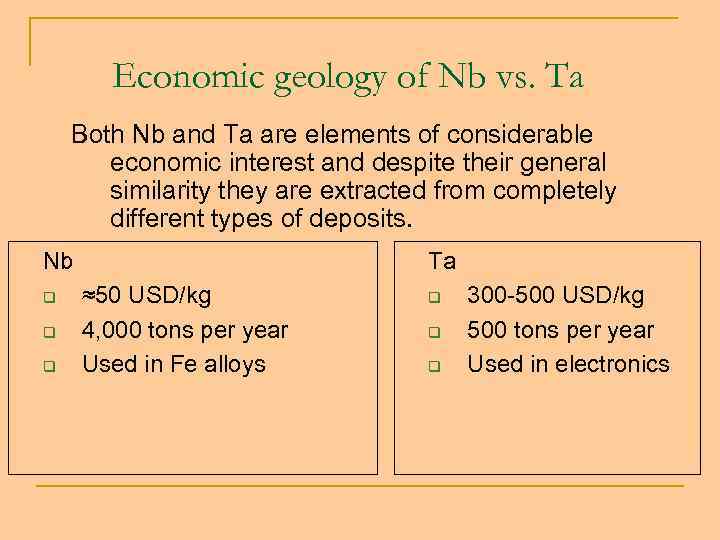
Economic geology of Nb vs. Ta Both Nb and Ta are elements of considerable economic interest and despite their general similarity they are extracted from completely different types of deposits. Nb q q q Ta ≈50 USD/kg 4, 000 tons per year Used in Fe alloys q q q 300 -500 USD/kg 500 tons per year Used in electronics
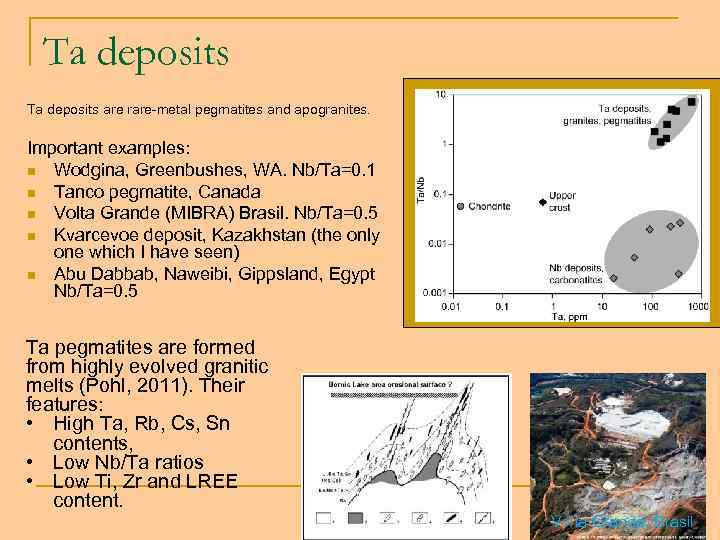
Ta deposits are rare-metal pegmatites and apogranites. Important examples: n Wodgina, Greenbushes, WA. Nb/Ta=0. 1 n Tanco pegmatite, Canada n Volta Grande (MIBRA) Brasil. Nb/Ta=0. 5 n Kvarcevoe deposit, Kazakhstan (the only one which I have seen) n Abu Dabbab, Naweibi, Gippsland, Egypt Nb/Ta=0. 5 Ta pegmatites are formed from highly evolved granitic melts (Pohl, 2011). Their features: • High Ta, Rb, Cs, Sn contents, • Low Nb/Ta ratios • Low Ti, Zr and LREE content. Volta Grande, Brasil
![Ta minerals n n [(Mn 2+, Fe 2+) (Ta, Nb)2 O 6] columbite–tantalite series](https://present5.com/presentation/-58474412_301707636/image-21.jpg "Ta minerals n n [(Mn 2+, Fe 2+) (Ta, Nb)2 O 6] columbite–tantalite series")
Ta minerals n n [(Mn 2+, Fe 2+) (Ta, Nb)2 O 6] columbite–tantalite series with intermediate solid solutions commonly referred as coltan, wodginite Mn 2+(Sn, Ta)Ta 2 O 8, microlite (Na, Ca)2 Ta 2 O 6(O, OH, F). Ta present in cassiterite Important source of Ta Columbite
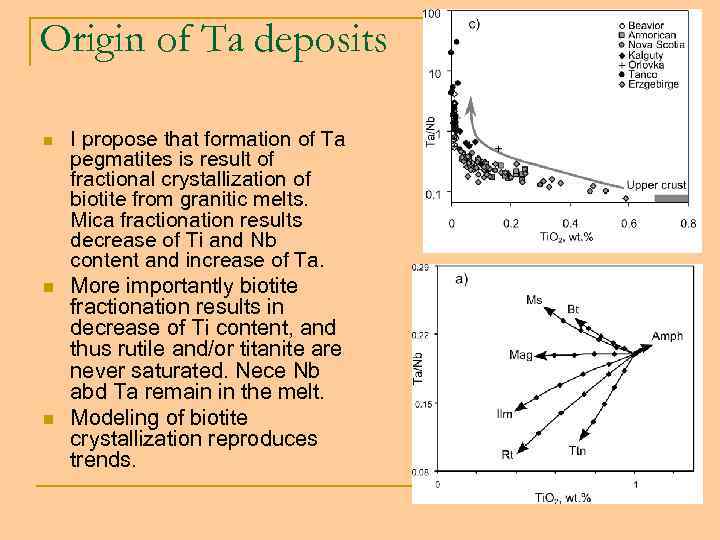
Origin of Ta deposits n n n I propose that formation of Ta pegmatites is result of fractional crystallization of biotite from granitic melts. Mica fractionation results decrease of Ti and Nb content and increase of Ta. More importantly biotite fractionation results in decrease of Ti content, and thus rutile and/or titanite are never saturated. Nece Nb abd Ta remain in the melt. Modeling of biotite crystallization reproduces trends.
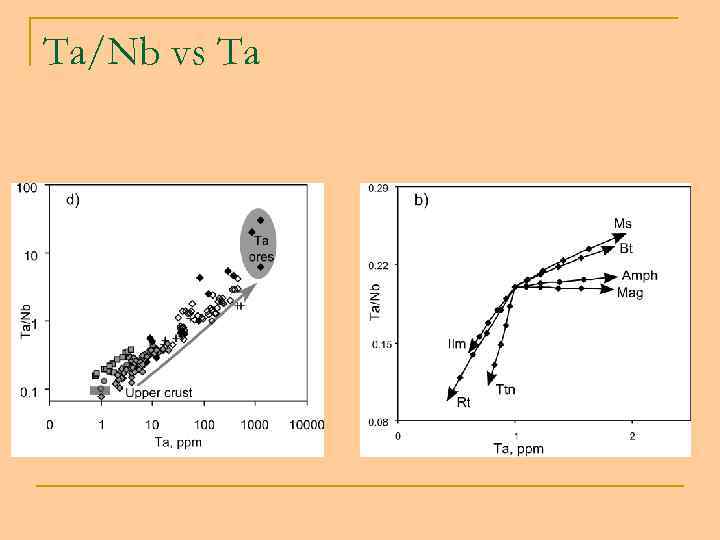
Ta/Nb vs Ta
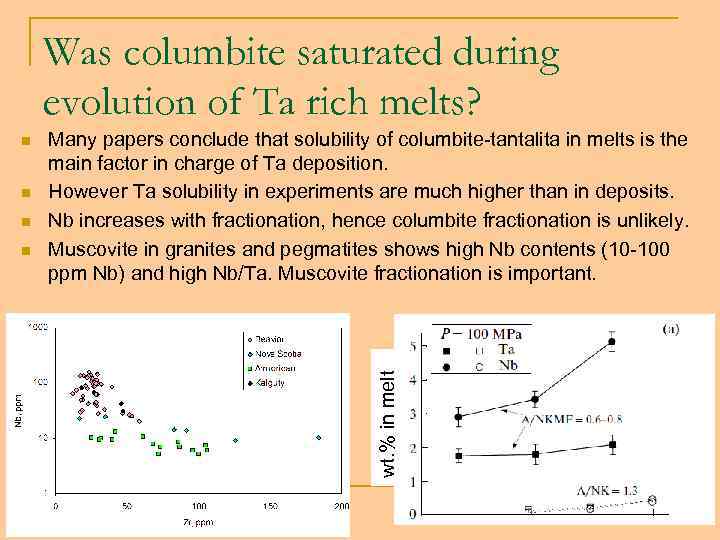
Was columbite saturated during evolution of Ta rich melts? n n n Many papers conclude that solubility of columbite-tantalita in melts is the main factor in charge of Ta deposition. However Ta solubility in experiments are much higher than in deposits. Nb increases with fractionation, hence columbite fractionation is unlikely. Muscovite in granites and pegmatites shows high Nb contents (10 -100 ppm Nb) and high Nb/Ta. Muscovite fractionation is important. wt. % in melt n
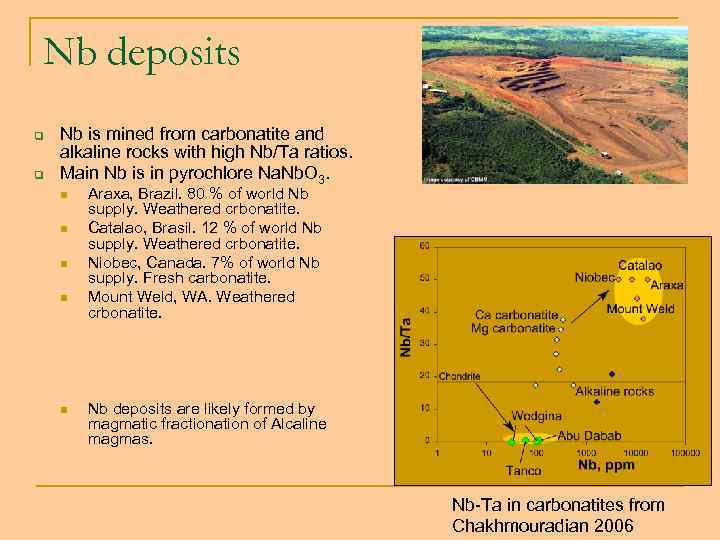
Nb deposits q q Nb is mined from carbonatite and alkaline rocks with high Nb/Ta ratios. Main Nb is in pyrochlore Na. Nb. O 3. n n n carbonatites Araxa, Brazil. 80 % of world Nb supply. Weathered crbonatite. Catalao, Brasil. 12 % of world Nb supply. Weathered crbonatite. Niobec, Canada. 7% of world Nb supply. Fresh carbonatite. Mount Weld, WA. Weathered crbonatite. Nb deposits are likely formed by magmatic fractionation of Alcaline magmas. Nb-Ta in carbonatites from Chakhmouradian 2006
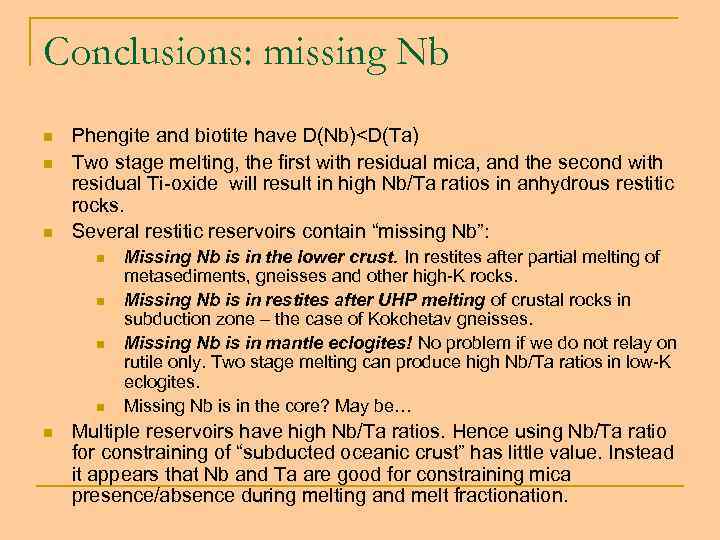
Conclusions: missing Nb n n n Phengite and biotite have D(Nb)<D(Ta) Two stage melting, the first with residual mica, and the second with residual Ti-oxide will result in high Nb/Ta ratios in anhydrous restitic rocks. Several restitic reservoirs contain “missing Nb”: n n n Missing Nb is in the lower crust. In restites after partial melting of metasediments, gneisses and other high-K rocks. Missing Nb is in restites after UHP melting of crustal rocks in subduction zone – the case of Kokchetav gneisses. Missing Nb is in mantle eclogites! No problem if we do not relay on rutile only. Two stage melting can produce high Nb/Ta ratios in low-K eclogites. Missing Nb is in the core? May be… Multiple reservoirs have high Nb/Ta ratios. Hence using Nb/Ta ratio for constraining of “subducted oceanic crust” has little value. Instead it appears that Nb and Ta are good for constraining mica presence/absence during melting and melt fractionation.
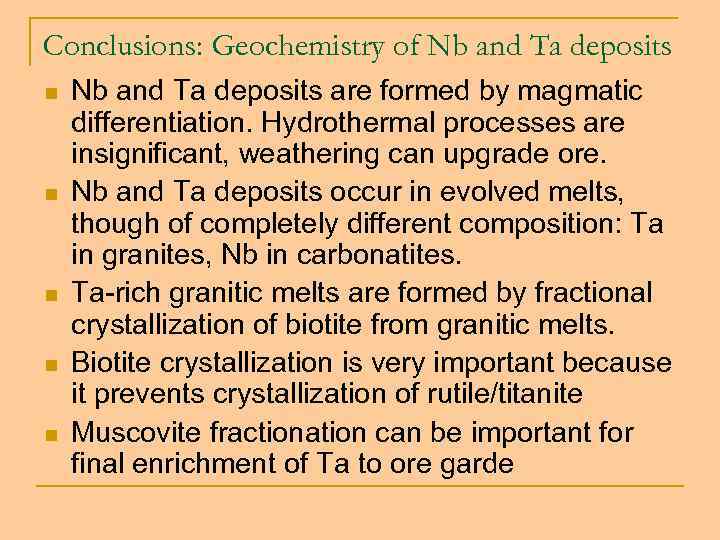
Conclusions: Geochemistry of Nb and Ta deposits n n n Nb and Ta deposits are formed by magmatic differentiation. Hydrothermal processes are insignificant, weathering can upgrade ore. Nb and Ta deposits occur in evolved melts, though of completely different composition: Ta in granites, Nb in carbonatites. Ta-rich granitic melts are formed by fractional crystallization of biotite from granitic melts. Biotite crystallization is very important because it prevents crystallization of rutile/titanite Muscovite fractionation can be important for final enrichment of Ta to ore garde

Thank you for attention
Скачать презентацию Геохимия тантала и ниобия Aleksandr Stepanov CODES UTAS
Stepanov_Nb-Ta.NSU.ppt